Category: Features

  • Microsoft bridges the gap between Azure and DevOps

    Microsoft bridges the gap between Azure and DevOps

    DevOps can be easy for a startup. Many of the concepts and principles of DevOps come quite naturally to a fresh company just getting started. It’s a different story, however, for large, established enterprises trying to wrap their arms around this DevOps thing. For IT admins working in Microsoft’s Azure cloud platform, though, things just got a lot easier thanks to the integration of Chef and Puppet Labs.

    Many organizations are heavily invested in the Microsoft ecosystem. IT teams and administrators are familiar with Windows domains, Active Directory, Hyper-V, and Azure. They know how to write scripts and leverage PowerShell to get things done, but they’re much less familiar with the core principles of DevOps, or common DevOps automation tools like Chef and Puppet Labs.

    One of the driving forces of DevOps is the ability—or perhaps necessity—to automate those tasks that can be automated so IT resources are freed up to focus on more important tasks. Deploying and configuring virtual servers and applications is necessary, but it can also be tedious, and it is a task that can be easily automated using DevOps tools.

    The arrangement also works the other way. Smaller companies that are already familiar with, and invested in DevOps may need to scale to a platform like Azure. They should be able to build on what they’ve started, and continue to use the tools they’re familiar with as the company migrates to Microsoft’s Azure.

    One of the main attractions of Microsoft Azure is the degree of flexibility, choice and control it gives customers. Microsoft Azure’s partnership with Puppet and Chef allows customers to choose from an array of existing technologies and communities to easily deploy, configure, automate and manage their VMs.

    According to a Microsoft spokesperson Puppet Labs and Chef complement and extend Microsoft technologies such as Resource Groups and PowerShell Desired State Configuration (DSC) to offer more options for customers to migrate existing or deploy new applications to the cloud. The partnership offers Microsoft the ability to support Linux and UNIX environments, and also alleviates the concerns that organizations already using Puppet or Chef will have about abandoning their investment. Now, they can continue to use their Puppet modules or Chef recipes in Azure.

    Luke Kanies, CEO of Puppet Labs believes the integration of Puppet Labs and Azure will help Microsoft IT admins by making it easier to deploy applications across any platform or cloud environment. Kanies explained in a press release, “Our goal is to help you automate the configuration and ongoing management of your machines and the software running on them, so you spend less of your time firefighting and running simple scripts across a thousand machines, and more time getting great software in front of your users.”

    I spoke with Kanies about the difference in dynamics between a small company and a large enterprise. He told me that in a small company it’s much easier to communicate and coordinate resources, and the cost of failure of any particular project is much lower. For a large, established enterprise, however, there is assumedly a large base of existing customers, and there is more fear and worry about possibly disrupting normal operations.

    I also had a chat with Ken Cheney, VP of business development for Chef. His philosophy mirrors a lot of what Kanies described. Cheney told me that emerging companies have the luxury of starting from ground zero with a clean slate. There aren’t yet any established processes to navigate. The challenge is trying to transform an organization with established processes, and a team of existing developers over to a DevOps mentality. Integrating DevOps into Azure helps organizations to meet that challenge.

    DevOps adds an element of speed and simplicity that makes it easier for larger enterprises to be more agile. Using tools like Puppet Labs and Chef enables IT admins to add speed as a core requirement for infrastructure projects without disrupting or conflicting with other requirements—like security and stability.

    Ultimately, the new alliance illustrates Microsoft’s commitment to empower Azure customers with the best-in-class configuration and automation tools by embracing the technologies, communities and ecosystems that developers know and love. Combining Azure with powerful and popular platforms like Chef and Puppet Labs bridges the gap between traditional IT and DevOps—enabling old school IT admins to embrace DevOps, and DevOps startups to mature and evolve into larger enterprises.

  • Expanding DevOps requires a supportive IT community

    Expanding DevOps requires a supportive IT community

    How do we bring newbies into the DevOps community? Until they know the melody, they can’t appreciate the song.

    echo-chamberWhile leading a DevOps event, the speaker polled the audience about their knowledge of DevOps.  All of the attendees were well acquainted and actively engaged.  It was obvious there were no newbies in the room.  It made me wonder if we were yelling into an echo chamber filled with people who were already on board.  Where were the newbies?

    My concerns that day reminded me of a 1990 Stanford University study led by graduate student Elizabeth Newton.  She assigned groups of two people to play a communications game. The first person picked a simple song that everyone would know (like Happy Birthday), and tapped the rhythm of the song on the table. The second person was the listener and tried to guess the song.  On average, the tappers anticipated a 50 percent success rate. In reality, the listeners only guessed the song correctly 3 out of 120 attempts (2.5%). [Source: Health & Health, 2007 pp. 19-20]

    That happened because the tappers already had the multidimensional melody playing in their heads.  Conversely the listener was unaware of the melody in the tappers’ head and was limited to the one-dimensional tapping patterns.  When tapping was the only means of communicating the song, the listeners almost always failed to guess the song title.

    What’s the Point?

    As DevOps enthusiasts we have experience and expertise — we know the melody.  We have pre-existing knowledge and confidence that this new model works.  Many of us have years of experience, experimentation and a network of insightful supporters to advance our learning. We know the DevOps founding stories and have read a myriad of blogs, articles and books.  We have listened to the webinars and podcast cafes.

    ideasAs the DevOps message tappers, we hear the melody of innovation and progress. And, in our minds, we assume we are communicating our DevOps stories with clarity. We point to effective projects, tools and teams, and create new models and terminology, expecting everyone in the IT community, or those still working in more traditional silo-ed organizations, to comprehend our activities. The listeners, however, may not have the same experience, confidence or base of knowledge. This is especially true of IT teams in enterprise organizations. Many of them have never read the books or heard the compelling stories. They have achieved success and grown their careers with Waterfall, in silos, with hand-off challenges and with technologies from past generations. Maybe they have never even played with Open Source technologies, worked with an open community, or explored the benefits of Agile methodologies. Thus, when many DevOps enthusiasts speak, their message is not understood by traditional IT professionals or those still working in silo-ed organizations.

    Break through the IT barriers and silo-ed structures!

    Breaking through to traditional IT professionals and silo-ed enterprise contributors begins with making the assumption that some may not have sufficient knowledge or experience in this area. This does not mean enthusiasm in DevOps presentations and conversations have to be toned down. Rather, it means they need to begin at the shallow end with stories and then move listeners to the deep end with more technical and detailed information (e.g.,  new ways to systematically reintroduce lean, agile, continuous integration, continuous delivery, continuous improvement models, etc.). The best way to accomplish this goal is to think specifically about traditional IT professionals and their specialty niches. When making presentations or engaging with them, consider their view, context, roles, work silos, and lack of opportunity to see their contributions make a difference. Then endeavor to inspire them to increase their knowledge base and expand their network by exploring collaboration opportunities internally with co-workers and externally with other groups.

    PolarizedSome presenters and team leaders find it effective to begin their group sessions and new conversations with stories from their initial exploration or foray into DevOps. Others employ familiar IT language, ideals, expectations and activities before transitioning into a DevOps melody. This will serve to expand the community to those who are well entrenched in older models (e.g., traditional Waterfall-based organizations, etc.).

    Through greater understanding and deliberate behavior, much can be accomplished when legacy and DevOps groups collaborate: common goals are often more rapidly reached; polarization between old and new models avoided; and DevOps practices expanded across a wider IT community. Externally, this would ensure a wider community of support for DevOps and an ongoing flow of cross discipline collaboration and insights: and internally this can lead to faster innovations, improved corporate unity and accelerated success in the marketplace.  Leaving new invitees outside of the DevOps conversation (intentionally or unintentionally) could hurt our DevOps efforts more than we might ever know. Without building in correlation or transition concepts between old and new, in everything we do,  speakers and leaders could spend endless amounts of time and effort tapping “Happy Birthday,” but very few “newbies” would ever have a chance to recognize, support or see the value in our DevOps melody.

  • Camp DevOps @ GlueCon 2014

    Camp DevOps @ GlueCon 2014

    campdetailsstaging-devopsy.kinsta.cloud is very pleased to announce that in conjunction with Eric Norlin and Glue Conference 2014,  we will be presenting our inaugural Camp DevOps @ Gluecon on May 20th, one day before Gluecon 2014. Camp DevOps will take place from 8:30 am until 4:30 pm. The event will be held at the Atlas Institute Building at the scenic University of Colorado/Boulder campus. Here is a link to a flyer with more information here.  You can go also get more information by going to Campstaging-devopsy.kinsta.cloud (site is still going up, so be patient if there is a problem) or our Eventbrite page.


    Moving staging-devopsy.kinsta.cloud beyond the 4 walls of the website has always been part of our business plan. Camp DevOps is our own conference brand. Martin Logan, staging-devopsy.kinsta.cloud co-founder has held Camp DevOps before, but this will be the first event since our commercial launch.  Over time what Camp DevOps is and what to expect we hope will be better understood. But since this is the first, let me quickly give some background.

    We recognize there are no shortages of conferences around DevOps. Camp DevOps is not meant to compete with DevOps Days and similar conferences. We think DevOps Days are great events and we will be working with local Meetup groups to help them with DevOps Days in the future.  Camp DevOps are also not meant to compete with Velocity or other enterprise events.  Instead Camp DevOps like staging-devopsy.kinsta.cloud itself is meant to pitch a big tent. We will have content and activities for the different constituents of the growing DevOps community.

    CampDevOps @ Gluecon 2014 will feature keynote presentations (Sanjeev Sharma of IBM and author of “DevOps for Dummies”, Rajat Bhargava, CEO JumpCloud and Howard Diamond, CEO of MobileDay already confirmed), multi-track presentations with one geared for technical audiences and another aimed at business and cultural topics, panel discussions and what we are calling “Hello World”. Hello World will feature hands on learning with DevOps tools. Attendees will need their own computing device to follow along.

    There will also be table top displays, Continental breakfast and lunch served. We are hoping to have a sponsor for dinner as well. The cost to attend Camp DevOps is just $49.99. If you are already registered for Gluecon, you can attend for free. If you are not registered for Gluecon and register for Camp DevOps you will receive a $100 dollar credit towards Gluecon registration. There will also be complimentary shuttle service from the Gluecon hotel, The Omni to the Atlas building at CU/Boulder.

    Attendance is limited so please don’t wait to register!

    Besides the keynote speakers, we also will have presentations from AppDynamics, MongoDB, VictorOps and others. We will be updating the agenda and presenters daily.  We still have room for more track speakers, keynotes, panel and Hello World presenters. If you are interested contact us at CampDevOps@DevOps.com.

    Sponsorship packages are also still available. There are sponsorship opportunities in conjunction with Gluecon and CampDevOps or just Camp DevOps. Contact us at CampDevOps@DevOps.com for details.

  • The Importance of the Bus Driver

    The Importance of the Bus Driver

    The topic of DevOps has been a topic for many a debate over recent months years. Without adding fuel to the fire I’d like to present a slightly different take on the DevOps culture.

    The phrase ‘what if I was hit by a bus?’ can often be heard within the vicinity of software development teams. It relates to a measurement known as the ‘bus factor‘. Individual talent should not be discouraged, however when it becomes silo’d that talent translates to risk for a business. Try to think back over your career – do the following sound familiar?

    “I don’t know how to do that, X usually does that”

    “X is away at the moment so we’ll need to put that on hold”

    “X left yesterday and didn’t cover this in their handover”

    If you have read ‘Phoenix Project‘ – think of Brent…

    Using the fated bus driver I’d like to take us on a journey (excuse the pun) through a DevOps culture.

    In-sourcing the bus driver

    You work for a small green minded startup. Being green minded and wanting to help your staff, you decide to buy a bus to get everyone to work in the morning. Realising that you don’t actually have a dedicated bus driver, you decide to take it in turns to drive the bus in the morning. Everyone gets involved, everyone knows how to drive the bus, everyone knows which route is best.

    Idea 1

    Don’t over engineer your processes. At this stage you’re already exhibiting DevOps characteristics!

    The talented bus driver

    Your small team has performed really well, people like what you do and now your team isn’t quite so small. There are now over 50 people on your bus in the morning. It wasn’t long until you realised that Sarah is the best bus driver you have. Inevitably, Sarah usually just takes up driving the bus each and every morning.

    If Sarah is off, Mike takes over but he often makes people late for work and tends to hit a lot of parked cars.

    Furthermore the bus recently broke down when Sarah was off, Mike and your bus passengers all took a look at the engine and tried to help but there seemed to be a ‘magic’ piece of string holding two parts together.

    When they consulted the bus manufacturer manual, this piece of string was no where to be seen. Mike had to call Sarah whilst on holiday!

    Mike calls the bus company to ask for a replacement bus, to be told it will be 2 hours until a second bus arrives. The team sit and wait patiently.

    Idea 2

    Try to identify your tipping point. Some key indicators are reliance on individuals, information silo’s, phrases such as ‘oh I didn’t know it functioned like that in production’, production environments start to diverge (without communication) from development environments.

    How many production environments have the web server, app server, database, load balancer et al all running on the same machine? Is this how your development teams work? Does this differ to the view of the operations team?

    Your bus stops

    We’ve identified a few problems but lets focus on the positives. Firstly, let’s celebrate actually spotting the problem, it is very easy to continue with the status quo. Our second success was the reaction of our bus passengers. When the bus broke down, instead of complaining, the bus passengers tried to help mend the bus.

    Idea 3

    When and where your bus stops is less important than who it stops for. It might be stating the obvious, however if you wish to move towards a DevOps culture you need talented team members. You need people that care for the organisation and their profession. A desire to share knowledge for a greater goal.

    If your team are not interested or do not care, then no matter how much you say DevOps you need to boost their interest first.

    Hopefully you’ll start to hear your teams utter phrases such as “What does production look like?”, “You could do this slightly differently you know”…

    What if your talented bus driver has an RTA?

    There are no doubting Sarah’s talents – I mean come on, she was able to fix a bus engine with a piece of string, knew the best bus routes and always got your team to work on time…

    What would we do if Sarah left or was, somewhat ironically, hit by a bus?

    Idea 4

    Could your organisation raise the value of sharing and encourage knowledge share?

    Assuming you’ve got the right people on the bus, you might also find that other staff members have ideas for improvement when you explain the current process. Your Sarah(s) should not fear sharing their knowledge and should be rewarded/encouraged for doing so.

    One of your passengers may even know a faster journey to work or a better way to fix the bus engine.

    The bus seating plan

    Although you didn’t enforce it, you start to find groups forming on your bus journey, all your teenagers are sat together at the back playing music on their phones…..

    Idea 5

    Don’t let job titles restrict conversations. Water cooler chats are incredibly productive and help teams share ideas.

    Replacement bus service

    When the bus broke down Mike was able to order a replacement but it had a 2 hour turnaround time.

    Would it be better if we always had 2 or 3 buses running? If each bus had enough capacity for all 50 passengers we’d probably always make sure people were on time for work.

    It would be even better if all bus drivers knew the routes that Sarah used, all buses had the same piece of magic string and all bus drivers knew what the magic string did.

    Idea 6

    Something my team often hear me say is ‘Design for failure, don’t just react to it‘. When designing your applications and services try to think how the system can accommodate failing services better rather than what actions you might take in the event of failure.

    The same might be said for your human resources. Have your teams got a shared knowledge? What would your bus factor score be?

    Journey times

    Try to keep your passengers informed of your progress – you could let them know their ETA for work. Informed passengers tend to be more engaged and understanding. For example when telephoning a business, do you prefer to know what position you are in ‘the queue’ or would you rather sit on the line waiting without knowledge of when you may be spoken to?

    Idea 7

    Monitoring might be considered a key technical section of DevOps adoption. There are many, many tools that can help with this such as StatsD, Graphite, Librato, New relic, AppDynamics etc but whichever medium you choose, try to make sure your ops stats are in full view of your various teams not simply your ops staff. Get them in front of your dev team, support team, sales team, HR team they impact every member of staff.

    Hopefully, you will be surprised at an increased level of employee engagement. When ops are in war rooms fire fighting problems, each team member will understand the pressures they are under, some team members will also express a desire to help.

    You have arrived at your destination

    At this stage I may have flogged the bus concept a little too far. Are the concepts here a guide for the adoption of a DevOps culture? Does the ‘D’ word have to be attached to the guidelines above? I’ll let the community decide.

  • Secrets to Collaboration in DevOps

    Secrets to Collaboration in DevOps

    In IT and engineering departments, the notion of teamwork hasn’t been a priority until recently. People were hired based on their in-depth knowledge of a particular technology category, such as networks or operating systems. There wasn’t much need for someone in networking to talk to his server colleagues, unless the whole team was going out for a beer. Those were the happy days of ITIL, in which processes and procedures for maintaining systems and solving problems were linear and preprogrammed. With a solid configuration management database on hand, the world of IT management was a well-oiled (although sometimes slow) machine.

    This approach was okay when companies were only relying upon a few large application suites. But now, of course, this arrangement has been turned upside down. With hundreds of applications running the business, and those applications dependent upon hundreds or thousands of services and components, ITIL falls short. People working in silos can no longer effectively manage performance and resolve issues with this level of infrastructure complexity. Companies nor their customers don’t have the patience to wait hours for a website to resume service or a critical application to function properly again. These disruptions cost too much money to fix and can darken revenues and customer relationships.

    Enter DevOps: the new way to deal with rapid change and complexity through ongoing releases and frequent adaptations to the environment. In a 2013 survey of IT decision-makers by research firm Vanson Bourne, the top reasons for adopting DevOps were the need for simultaneous deployment across different platforms, and business pressures to release apps more quickly to meet customer demand and to improve the customer experience. A majority of the 1300 survey participants, 66%, said they either have a DevOps strategy or are planning to implement one.

    At the core, DevOps success relies heavily on collaboration between developers and IT operations staff. Only through the daily, open sharing of knowledge and best practices can a company solve problems and optimize applications efficiently in the DevOps fashion. To complicate matters, employees are living and working all over the place today. Bringing their insights together when it matters requires not merely the right tools, but the right culture. Here are some ideas for fostering collaboration in DevOps environments.

    1. Get rid of departmental silos and rigid processes. With a culture focused on ITIL, problems eventually get resolved—but often after a few hours or even days of running a question through the ranks;  by then the damage is done. This is no longer acceptable when employees and customers expect always on, always speedy service. After all, that’s the standard they readily achieve from their personal applications and devices. If your organization relies upon modern, highly scalable and visible applications, you need to break down internal barriers without delay. Forget about DevOps for a moment, and determine how roles might need to shift or rigid processes (such as approval chains for changes) may need to dissolve for the sake of fixing a problem right now. Empowering individuals to make changes immediately when conditions justify it is how technology organizations must operate today.

    2. Encourage discussion: Do employees only talk in the break room? If so, start scheduling daily standup meetings for the purpose of sharing status, timelines and exploring ideas. Finding the right time to accommodate people in different time zones might be tricky; in large, dispersed organizations, holding two daily meetings may be required.

    3. Eliminate hierarchies: Even in the flattest of organizations, informal hierarchies persist. With DevOps, however, it matters little if you are “the smartest person in the room” or have been with the organization the longest. Maintaining organizational hierarchies too often works against the goal of sharing information across the organization to better IT operations and application performance. Managers should work hard to encourage open sharing and the notion of equality among team members. Reward employees for their teamwork efforts and for showing mutual respect. Instill the notion that everyone is responsible for delivering excellent service and for resolving problems, not guarding turf. While this is an idealistic philosophy that’s hard to carry through on a daily basis, working toward this goal will in time grow a collaborative culture.

    4. Develop a business orientation:  In a DevOps culture, understanding the needs of the business is the highest priority. In fact, respondents to the Vanson Bourne survey said that the top three skills needed for DevOps are knowledge of business, priorities, strategies, or metrics (47%); knowledge of current business processes (42%); and communication skills (32%). Keep these qualities in mind when hiring new employees and when promoting those from within to senior roles. Create opportunities in which technical staff can interface with business leads to gain that critical business perspective.

    5. Set the tone at the top: As in most companies, the people in charge maintain a heavy influence on corporate culture. So, what if your CEO places a higher value on individual contributions than teamwork? It may feel like fighting an uphill battle, yet the CTO of a CIO or other person in charge may need to spearhead an education initiative to help higher-ups strike a balance. That can result in small yet powerful changes, such as instituting new employee incentives and more frequent performance review programs that align with DevOps goals.

    6. Sometimes, outsiders are required: DevOps is still a fairly new practice, and companies may not have in-house expertise to develop a new culture around it. Fortunately, there are an increasing number of outside coaches that can help organizations jumpstart new ways to organize and work. These experts can also objectively assess progress and help team members navigate difficult transitions or high-stakes projects. If such a coach can help your team get up to speed 50% faster on new collaborative practices, it will be time and money well spent as the business will see results faster too.

    7. Attitude is everything: On the surface, it would seem that younger people, those highly coveted “Millenials”, will be the front runners in DevOps organizations. Yet don’t make assumptions. If an older employee with decades of experience in operations and across different industries is willing and open to change, he or she could be the most valuable person on your team.

    8. Get rid of the dinosaur tools. Traditional APM and IT monitoring tools from enterprise software vendors may not have the right interface nor feature set to help DevOps teams keep up with cloud and hybrid infrastructures. Whatever tools you select, make sure they incorporate the real-time, collaborative elements embedded in today’s top consumer apps and social media websites. Think open forums, comment streams, “more like this” intelligence, messaging and the ability to upload videos and images that enhance a conversation. If the tools are fun, simple and allow people to get the information they need in one place, they’ll use them. If manual correlation of data and events is required using a clunky interface, they won’t.

    What’s powerful about DevOps is that while it requires new attitudes, methods and skills, the end result is that people are working together toward a common goal. Better collaboration doesn’t just serve DevOps, but an organization at large. It could result in a new development approach that kills the competition, or an IT management best practice that saves the company hundreds of thousands of dollars a year. Collaboration is the quintessential soft business skill, yet with the right intent, it can bring hard results that move the business forward.

  • DevOps Is About Serving The Customer: Q&A with Shridhar Mittal

    DevOps Is About Serving The Customer: Q&A with Shridhar Mittal

    As a longtime proponent of continuous delivery and fast deployment schedules, Shridhar Mittal has advocated for DevOps operational patterns since before the DevOps moniker was even coined. It was a philosophy that stemmed from what he and his colleagues at what was then Interactive TKO saw happening in response to the service-oriented architecture movement: many organizations were slowing down their releases as opposed speeding them up, which was the whole “promise” of SOA, he says.

    “So we started a whole company around how do you change your development processes to get speed with quality in this new world of distributed architectures,” he explains.

    Since iTKO’s acquisition by CA Technologies in 2011, Mittal has used his current role as general manager of application delivery at the company to focus his efforts on evangelizing DevOps cultural shifts within the enterprise. He believes that DevOps is on the brink of revolutionizing the way IT departments function and in addition to his anecdotal evidence from frequent talks with IT leaders, he points to a recent survey CA conducted together with IDG for evidence. According to technology decision-makers, while only 7 percent of organizations have already adopted DevOps practices with enterprise-wide scope, it is gaining traction. Another 39 percent report that they’ve either implemented DevOps principles with limited scope or are in the process of adopting DevOps. And another 28 percent are either planning on implementing or are evaluating DevOps.

    staging-devopsy.kinsta.cloud recently spoke with Mittal to discuss the mainstream uptake of DevOps, the biggest transition challenges and the attitudes about IT job performance in a new era of cooperation.

    staging-devopsy.kinsta.cloud: Why do you believe that DevOps is gaining so much traction today?

    Mittal: I think the whole promise of DevOps is around better customer experience. Better quality for the customer, but in a much, much faster way than you could do it before. To me, that is ultimate goal.

    Ever since the whole consumerization of IT, everyone uses the web and everyone uses mobile devices, and there is no buffer in between the application and the end consumer now. Previously to that you used to have, in the call center, you had people who are using applications and the consumer never actually interacted with the application.

    So if it sucked, its internal people that had to deal with that–it wasn’t the consumer. Now, you cannot afford to have your customers have a bad experience because then you are going to lose business. One of our case studies is the .com part of a very large company–one of the Fortune 100. They had done a study that showed that for every one second delay in the response in the website dropped the conversion rate of sending someone to the next step of purchasing. It dropped significantly for every second.

    Think about it. If you’re doing a big marketing event, you’re sending hundreds of thousands of people to your website, and just because your website doesn’t respond properly, you lose that many more potential customers.

    That’s the kind of value that we’re talking about right now. Take a simple example, say there’s the launch of a phone and the telecomm company wants to release it at the same time the manufacturer is releasing it and the systems are not connected in time. They would end up losing hundreds of millions if not billions of dollars of business because they didn’t release it at the same time, and one of the competitors actually released on time.

    These are the kinds of the hundreds of millions worth of value we’re talking about. In the past, people thought about it as, maybe if I can get three percent or four percent more efficiency I can save x numbers of millions. But what I think they’ll really be looking for now is the ability to grow their business much faster.

    staging-devopsy.kinsta.cloud: How can organizations start meeting the challenge of transitioning to DevOps?

    Mittal: Start small and then build up to the big There are at least three different on-ramps we talk about to get to DevOps. One is, just start with the development side of the word and decouple the development teams from each other so that they can do their things faster and still be able to deliver things on a higher quality. That’s using things like server virtualization and API testing. The second on-ramp is just improving your environment management, the release management capability. People today are spending tens or hundreds of man-hours creating and maintaining these environments then tearing them down and then bringing them up again.

    So figure out how automate that process where you can take so many man-days of work and bring it down to something that can be handled by one person and can be done as a self-service in a matter of minutes as opposed to taking days weeks or months to happen.

    And then the third on-ramp is to put more automated testing processes in place, for instances doing performance testing. Trying to do it in-house today is becoming more and more difficult because there’s never enough infrastructure internally to be able to handle simulating these tens of thousands and hundreds of thousands of people coming to your web site. It’s just not possible. So figure out ways to leverage cloud-based automated testing capabilities to support that.

    There are many different on-ramps and people can start from one or another and then start building to much bigger things. Start small and eventually expand to put it across the enterprise.

    It is also important to get the trust built between developers and operations through better visibility. The classic scenario is, the developers just want to write code, release it, then they want to go back to writing code again. Operations want to slow things down because all they care about is a stable environment. If I could get devs to have visibility and ownership and be measured on how the products are actually behaving in production and, same thing with ops, if I could give them visibility to what’s in the pipeline, what’s coming out, why is this coming out, what is the business case and how this impacts your business, they’ll all start feeling an ownership for the whole process.

    staging-devopsy.kinsta.cloud: That brings up an important question: how critical is it to change job performance metrics in both development and operations in order to make DevOps work?

    Mittal: I think it’s very important. I think it’s not something that has to be done from the get-go but I think somewhere after you have done the first couple of projects and some of the people have started buying into DevOps, that’s when you have to fundamentally change the culture of the company. In my mind, that’s contracted behavior—and it’s not because people are coin-operated.

    I’m not saying this in a bad way. To me, people look at the way they’re comped as a way of understanding what their direction is. What are they being asked to do?

    So if they are not getting measured on quality, to them, that means “Just make sure that you just get things out as fast as possible and then if you have to roll back, then you have to roll back.” And if you’re not getting measured on constant speed, then that’s like being told by the executives that, “All I want you to do is have a stable environment; I don’t care as much about getting new stuff out there.”

    So there has to be changes in the comp structure, how people are rewarded, to really change the culture of a company.

    staging-devopsy.kinsta.cloud: What other things need to be done on the line-of-business executive leadership side of the house to make DevOps work?

    Mittal: I think that the business side needs to be the driver to a large extent, because the business needs to say why something is important. If supply of IT capabilities is much less than demand, that means there has to be some kind of prioritization of work. And who’s making that determination? Who is doing the prioritization? To me, without a business context, you can’t be doing direct prioritization.

    I think the business has to be very involved in helping IT understand a prioritized list of what needs to get done. They don’t say how it needs to get done, they just need to say, “This is more important than this, and this is the impact to our business of that.”

  • DevOps Can Be Your Fountain of Youth

    DevOps Can Be Your Fountain of Youth

    There is a different, almost magical dynamic, at a startup that seems to fade away over time as companies establish themselves. One of the benefits of DevOps, though, is that it creates an environment where that startup magic can continue to thrive. DevOps is like a fountain of youth that lets corporations continue to act like startups where it counts.

    Once upon a time Microsoft consisted of nothing more than Bill Gates and Paul Allen hacking away at a keyboard. Like any successful company, it grew….and grew, and grew, and grew. And, as it grew the culture changed, and departments were created, and bureaucratic policies were implemented. A task or feature that Bill or Paul would have just cranked out on the fly in an afternoon during the early days now must be vetted and approved, and go through a chain of command, and maybe a focus group before it can finally see the light of day.

    Startups are often formed by a few friends over pizza and beer while watching TV. In the beginning, things just get done. There is generally no real hierarchy of control, and everyone just owns what they’re working on and they get it done.

    Startups also remind me of watching Star Trek: The Next Generation. It always seemed like everyone new everyone else’s job—and anybody could fill in for anybody else. If Geordi La Forge—the chief engineer of the USS Enterprise—was captured or incapacitated, Worf—the Klingon chief of security could just step in and manage the warp core in his absence. Although everyone had a designated role, they all understood enough about the other roles to take over in a pinch. That’s how startups are before things grow so big that each person barely has enough time to keep up with their own department and duties, and barely knows what anyone else is doing.

    That brings me back to DevOps. The essence of DevOps requires that individuals take both initiative and responsibility for what they’re working on. The culture of DevOps is more fast-paced, and it doesn’t allow for protracted bureaucracy to drag things down. An organization that embraces the DevOps culture is forced to retain the innovation and agility that defined the startup stage.

    Granted, a large company like Netflix, or IBM still has a management hierarchy. There are policies in place, and different departments for IT, and human resources, and accounting. The IT guy can’t simply cut his own checks, and the accounting person can’t just go rogue and hire people without the knowledge and consent of HR. There are defined roles, and most of them serve a distinct and valuable purpose.

    That corporate structure still exists, but with DevOps you maintain that startup mentality where it counts—where new ideas are being developed and implemented. Of course, it’s also not without its challenges. Balancing the autonomy of DevOps with the policies and bureaucracy of a larger, established corporation can be confusing, and it’s important to have boundaries in place for just how long the DevOps leash is, and where the threshold is at which things need to be escalated up the chain.

    DevOps isn’t about a bunch of rogue employees running around autonomously wreaking havoc on the company, though. Much of DevOps seems to focus on tools and technology—and those are a crucial element of automating routine tasks and facilitating DevOps—but, the power of DevOps from a cultural point of view lies in collaboration. Done right, DevOps fosters an environment that frees employees to work together to find the most effective and efficient solutions.

    You probably won’t be able to recreate a situation like Star Trek: The Next Generation in a larger company. There will be departments, and there will be designated roles that need to be filled. With the right DevOps tools and technology, though, you can automate and speed up routine tasks, and free up time previously spent on those tedious jobs for employees to devote to solving bigger problems. With the right DevOps culture, you will unchain those employees and enable them to think and interact more creatively to come up with innovative ideas that may never have seen the light of day in a traditional corporate bureaucracy.

    DevOps can enable your company to function with the drive and agility of a startup, while still maintaining the wisdom and maturity of an established corporation.

  • Deployment and Monitoring Automation with glu

    Deployment and Monitoring Automation with glu

    glu is a free/open source deployment and monitoring automation platform. glu is a project that was started at LinkedIn mid-2009 to address the exponentially growing needs of deploying the set of applications and services that make up the LinkedIn experience. Although some projects like Chef and Puppet existed at the time, they were mostly good at configuring the infrastructure (creating users, installing java, etc…). glu lives in a higher space: provisioning dynamic applications on an ensemble of machines (change often, real-time failure detection, etc…).

    glu is in the application deployment space

    First, let’s start with some definition: when I say application, I mean a piece of code that usually needs to run, and usually offers some form of api to talk to (which, at a lower level, is a socket listening on a port). Equivalent terminology is service or server. For example, a webapp server is an application. Although glu can also deal with one-off programs (run, do some computation and then stop) or infrastructure (perl, java, etc…), it is not optimized to handle these use cases and other projects are better at this task (Chef/Puppet).

    What is particular about applications in general, is that they tend to change a lot more often than infrastructure. In the age of continuous deployment, it is not uncommon sometimes to have the same application updated and deployed several times a day!

    glu has been designed to handle this use case: deploy applications to an arbitrary large set of nodes:

    • efficiently
    • with minimum/no human interaction
    • securely
    • in a reproducible manner
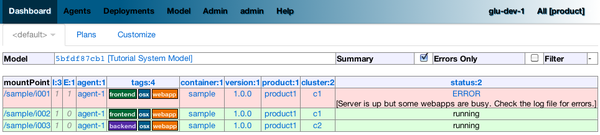
    glu executes a deployment
    simply click “OK”!

    glu is in the application monitoring space

    Once an application is up and running, many failures can happen from the low level hardware crashing to the application itself misbehaving. This is the nature of it, nothing is perfect, things will crash one way or another. So it is very important to monitor the state of the system in general in order to be able to react appropriately. glu has been designed to give a full view of the set of nodes on which you have deployed applications. When something goes wrong, you can know in a near real-time basis. You can then decide on the proper course of action like restarting the failed application on the node it crashed, or downgrading it to the previous version and redeploying the previous version to all the appropriate nodes. As a side note, you can also build a full monitoring solution on top of glu as explained in this blog post.

    glu detects failure

    glu is a platform

    It is very hard to build a one-size-fit-all solution. This is why glu has been designed to be a platform in order for you to build the solution that fits your environment and workflow on top of glu:

    • glu offers a REST api so that you can control glu yourself via a simple and documented api. For example, glu is not auto-reactive by design (which means that if something fails, glu will tell you about the failure, but it will not act on its own about it), but using the REST api, it is fairly easy to build a reactive solution on top of it.
    • the console (which is the main UI / REST api), is highly customizable (plugins to change the behavior of some features, css tweaks to let you change the look of it, etc…)
    • glu comes with its own package/distribution builder which lets you customize every component to suit your own needs (as simple as changing the port numbers or as complex as providing your own specializations).
    • glu does not dictate what a deployment mean to you, nor how to model your own system (clusters, groups, etc…), nor how to model your workflow (aka state machine in glu’s terminology). You are in control and you decide.

    glu in practice

    glu is not an academic exercise. glu has been built and successfully deployed at LinkedIn early 2010 prior to being released as open source. glu helps LinkedIn manage the complexity of releasing hundreds of applications/services on a 1000+ node environment (numbers from 2010). Other big names like Orbitz and Outbrain are using glu for their deployment needs.

    Over the years, glu has been refined and enhanced in order to support more use cases but the core and fundamental concepts on which glu was based originally and that I briefly introduced in this post are still what makes glu what it is!

    How to start with glu?

    If you want to take a look at glu, the best is to head to the main documentation page. I would also recommend to download glu and try the tutorial which gives you a feel of what glu is capable.

  • A Critical First Step in Bringing Dev and Ops Together

    A Critical First Step in Bringing Dev and Ops Together

    We all want to deliver excellent software to our customers. We now have a greater awareness than ever before of the interconnectedness of all the activities required to do so. The agile movement started this but it was not until the advent of DevOps that Ops was considered part of the full picture. In this article I will explain an effective first step that agile organizations can take to complete the picture and bring ops more completely into the product development process.

    Delivering excellent software starts with product definition and flows from those initial stories and designs, into dev, verification and testing, into production and then back again in the form of customer feedback and bugs. In reality the feedback paths represent a transitive closure of all activities just mentioned as you can see in the diagram below. Agile recognized the importance of feedback loops in good product development. Agile also realized that for the right information to flow, walls had to be broken down. The motto “Done means tested” arose and indicated that product owners were not done with a story, could not consider it closed, until it had been tested and they had verified it. This represented the integration of PM, development and QA functions. A huge step, but one step too short. Operations was still not viewed as a key part of building excellent software and there was not much insight into the fact that the feedback loop did not stop at testing. DevOps has recognized this shortfall and taken it to its logical conclusion – “Done means in production.”

    Operational Excellence Feedback Loop

    Product development is a cycle, a cycle that operations is a critical part of. In describing how all parts of the cycle can be integrated lets start at the most natural beginning; product definition. Product definition activities produce stories, designs, functional acceptance criteria (A.C.) and prioritization. In this phase we don’t produce all we need for the finished product but just enough to get us going. With popular agile methodologies like Scrum this is ideally not done solely by a product owner but instead in conjunction with dev and test at story grooming meetings, design reviews and sprint planning. In these meetings dev, QA and product communicate and negotiate stories, comment on designs, and flesh out acceptance criteria. In this way the stories, designs and acceptance criteria are improved and everyone gains an understanding of what is being built; they also become invested in it. A story may look something like this (abbreviated):

    Story: Blog administrator can change user roles SO THAT users can be managed effectively

    A.C: Given blog administrator is logged in
    And on a user profile
    When he selects a permission scheme from a permissions drop-down menu
    Then the users permissions are updated and stored in the DB

    This is a great start but it is not enough. If we are to be excellent we must modernize this just a bit and add in some DevOps spice.

    A first step towards bringing ops effectively into the cycle is to include someone responsible for actually operating the software in the story and acceptance criteria grooming sessions, design reviews, and sprint planning meetings. The critical aspect is that when the team negotiates the acceptance criteria associated with a story it will be ops responsibility to ensure we for each story or feature the team adds success and failure metrics, initial alarm values and any operational functionality such as a kill switch that will be needed in order to operate the functionality effectively. So a story will now contain things like the following in the A.C. (acceptance criteria).

    Given operation X fails
    Then the metric operation-x:failed will be sent through the metrics feed

    We will also alter our definition of done to make sure that a story will not be closed until we meet the ops driven acceptance criteria. For example: we can see the metrics we have defined in our A.C. show up on an ops dashboard. There are so many benefits to this such as folks that are unlucky enough to be on on-call will have participated in this story grooming and will know exactly what these metrics mean when they encounter an issue with them for the first time in production. Furthermore, they will know what operational levers they can pull or request to be pulled.

    This first step represents a connection from product definition to dev, to QA, to operations. This connection is perfectly natural and intuitive when you think about it. Being a true DevOps organization and developing operationally excellent products requires more but having connected product definition to operations as we have provides a nice toe hold from which to flesh things out further. Best of luck. If you have any questions leave them as comments and I will respond as best I can.

  • DevOps & UX: A Star-Crossed Love Story

    DevOps & UX: A Star-Crossed Love Story

    “Two households, both alike in dignity
    In fair Verona, where we lay our scene
    From ancient grudge break to new mutiny
    Where civil blood makes civil hands unclean.
    From forth the fatal loins of these two foes
    A pair of star-cross’d lovers take their life
    Whose misadventured piteous overthrows
    Do with their death bury their parents’ strife.” ~ Romeo and Juliet: Prologue, William Shakespeare

    For more than 15 years I have watched as they battle. The chasm between the two houses was so wide that I often wondered if it would ever be bridged. I never wavered from my view that we were all one house striving to find common ground for making working solutions for the world around us. Sometimes there were allies beside me. Sometimes I stood alone, For the first time in my professional history, it seems like the blood-feud could be put aside. Is it time for peace? Even more ambitious, is the day of an alliance at hand?

    The Feud

    For many years, corporate IT and finance were the only voices in the room. Ruled by an unquestioned and unmeasured desire for quantification and linear solutions, design considerations were usually an afterthought. All parties were subservient to the almighty ROI which ruled over all with an iron fist. Claims of possible productivity gains through better tooling were always met with doubt and even when taken seriously, you could not claim productivity gains unless you were willing to commit to lowering headcount. Tooling for technical employees to manage the environment and its operating data was so scarce, that there were more applications with no maintenance tooling than applications with operational plans. Operational changes were made by going into databases by hand and making changes in a “hit or miss until you hit” fashion.

    In the late 90’s UX showed up to the party and with a basis in humanism, the equation changed. This was the time that the “great misunderstanding” happened and 15 years were wasted building up a corporate landscape strewn with enmity and false narratives. The “great misunderstanding” goes something like this:

    • “Let’s make something that people can use” – UX practitioner espouses user-centric design and introduces new methods and artifacts into the SDLC processes which take interaction design specifications to a new level in corporate America
    • “That’s going to take more time and I don’t agree that it’s any better than what I could do myself” – IT staff view this incursion as a mechanism to take what little time they are given to complete projects while also limiting their creative outlet
    •  “I don’t care what you think and neither does anyone else” – UX practitioners view the response as a denial of their value proposition and a fundamental lack of care about the people who interact with technology

    Several of the basic assumptions in these archetypal interactions between disciplines were short-sighted. For example:

    • The “more time” fallacy – adding a design process may take more time if you only think about a single iteration in development and that’s only if you are lucky enough to have a complete interaction model worked out in your head that doesn’t have any design holes in it. Designing interactions on paper saves time in the same way that technical design saves time over “jumping straight to coding”
    • The “fighting on the wrong front” mistake – It was never the goal of UX to remove IT budget. The goal was to make things better for the humans that interacted with technology while creating business value. The two different disciplines never saw their goals as aligned. We will never know what the alternate history would have been like had UX and IT teamed up to get larger budgets in an effort to create better and more sustainable experiences for users, developers AND operators.
    • The “reductive labeling” error – Both IT and UX created a narrative where the interaction and visual design tasks were the “creative tasks” for “creative people”, while the development was the “technical tasks” for “technical people”. These labels have stuck around for the last 15 years and we are still paying the price for removing the idea that IT staff is fundamentally non-creative and devoid of craft.
    • The “self-reinforcing paradox” tragedy – It was never the goal of IT to demean the UX discipline. When one neglected child is joined by another neglected child, the two will almost unavoidably fight over the little attention afforded to either of them. The irony here is that UX’s basis in cognitive science could have possibly seen the hostile response from IT for what it was; a cry for help. Instead, UX took the bait offered by IT and thus we are here 15 years later with a wide chasm between two disciplines that should be united by common causes:
      • a desire to make awesome stuff
      • a desire to create sustainable solutions
      • a desire to express one’s self at work
      • a desire to improve the lives of their customers and employees at the same time

    Oh The Humanities

    When IT resources and UX practitioners first came together the familiar plot “boy meets girl, boy loses girl” emerged and we may now, thanks to DevOps finally have arrived at the time when “boy gets girl again”. Gene Kim and the folks at IT Revolution Press have hit the target dead center in their manifesto:

    “Working in most IT organizations is often thankless and frustrating. People feel as if they’re trapped in an ever-repeating horror movie, helpless to change the outcome The organization abdicates their responsibility to ensure that IT is managed well, plunging the department into relentless intertribal warfare between development, IT operations and information security. And of course, the auditors.

    What inevitably results is chronic under-achievement. The life of an IT professional is often demoralizing and frustrating, typically leading to feelings of powerlessness and rife with stress which seeps into every aspect of life. From stress-related health problems, to social issues, to tension at home, it has become clear that the current state of the IT professional is not only unhealthy, but unsustainable.

    As people, we’re wired to contribute and to feel like we’re actively making a difference. Yet, all too often when IT professionals ask their organization for support, they’re met with “you don’t understand,” or worse, a barely masked, “you don’t matter.”

    As a human being, this is the worst response we could receive. Because the opposite of love isn’t hate — it’s apathy.”

    Despite what some IT step-children will tell you, UX is not about making pretty pictures. UX as a discipline was formed to combat apathy and contempt by corporations through a mechanism of introducing empathy. Similarly, DevOps wasn’t formed to “make web pages faster”. DevOps clearly has a tactic of emphasizing performance (as well as other technical tactics), and performance improvements are clearly one of the benefits that come out of a DevOps organization. DevOps was formed to make IT a more sane and human space inside companies for IT employees, it just so happens that DevOps produces other impacts that are financially beneficial for enterprises.

    Avoiding The Fates of Romeo And Juliet

    Knowing that waters of DevOps and UX flow from the same wellspring allows the practitioners of DevOps several opportunities to repair the tragedies that have already befallen our enterprises before they escalate to the Shakespearian proportions. Three broad categories of opportunities would be:

    1. Enroll UX into the DevOps movement – Knowing that we are aligned creates multiple possibilities to bring many industry and enterprise change agents into our cause. How much would the DevOps adoption curve accelerate if people like Don Norman, Jesse James Garret, Alan Cooper or Steve Krug were visible advocates for DevOps? Support from UX at the leadership level in the industry and within your enterprise is an advantage you cannot afford to pass up. The number of consensus driven organizations are just too many to count and the more groups and individuals that believe in advancing our cause, the better.
    2. Learn from UX’s travails – Creating artificial barriers to discipline inclusion is ultimately an adoption limiting factor. When we make things pass-fail or turn collaborations into confrontations or competitions for who is DevOps and who is not, we all lose out on the what a wider community could offer. Hold yourself accountable to pivot confrontations into constructive opportunities where learning can happen for people of different disciplines.
    3. Take some pages from UX’s playbook –  UX’s biggest lever for creating believers is by involving non-UXers in the research methods and activities (think about the last time you went to a usability test behind the 2 way mirror and saw a person struggle to use a system you were part of implementing). One of the best things we the practitioner community can do is to demonstrate what life is like without DevOps in real-life scenarios. When someone really attaches to how ugly a manual process is, or how soul-crushing it is to not be able to self-actualize in their job, they can’t help but want to be a part of making it better. Problem solving is hard-wired into the human condition, let’s leverage it.