Category: Features

  • Digital.ai Deepens Value Stream Management Integration

    Digital.ai Deepens Value Stream Management Integration

    Digital.ai announced today it has expanded usage of machine learning algorithms within its namesake value stream management (VSM) platform to include modules to optimize flow and improve application quality in addition to enhancing its risk prediction and process optimization modules.

    In addition, Digital.ai has expanded the number of pre-built integrations it now provides for hundreds of DevOps tools and platforms.

    Derek Holt, general manager of agile and DevOps for Digital.ai, said the goal is to expand the bi-directional flow of data between the core Digital.ai platform and modules and tools provided by the company and its third-party DevOps partners.

    Digital.ai was formed from the merger of XebiaLabs and CollabNet VersionOne. The combined company has rolled up Numerify, a provider of analytics tools infused with artificial intelligence (AI), Experitest, a set of testing tools and Arxan, a provider of an application security platform. With the latest release, these capabilities have been integrated into the core Digital.ai platform in a way that goes well beyond merely providing access via a common user interface, said Holt.

    The goal is to provide organizations with a VSM platform through which better decisions can be made to optimize software development and delivery by first collecting data from all the DevOps tools employed and then using machine learning algorithms to surface optimization recommendations, noted Holt. As application development environments become more complex to manage, it’s already apparent that most IT teams will require AI capabilities embedded in a VSM platform to manage interdependent projects, noted Holt.

    Armed with those recommendations, it becomes simpler to reallocate resources in the event a critical project is going to be completed later than planned or shift resources to make sure that project is completed on time. A VSM platform also enables IT organizations to assess the impact those decisions will have on the rest of the business at a time when organizations have never been more financially dependent on the timely delivery of software. The late delivery of a single application module can wind up having a profound impact on revenue projections for organizations that increasingly rely on digital processes to engage customers.

    A recent survey conducted by Digital.ai found that many digital transformation initiatives are struggling, to some degree. Nearly half of respondents (49%) said they are not seeing the results they expected from their digital transformation efforts, and 54% admitted they were worried about their ability to compete. Over 90% need to see a better return on their digital transformation investments.

    Digital.ai claims it currently has more than 1,200 customers, including Allianz, Commerzbank, eBay, Janus Henderson and Levi’s that are using elements of the Digital.ai platform to better manage software development projects. Many of the users of those tools now include business executives and other application stakeholders that are employing a VSM platform to track the progress of application development projects. Digital.ai Analytics Lenses that are domain-specific make it simpler for different classes of end users to access pre-built dashboards and metrics, noted Holt.

    The market research firm Gartner has predicted that 70% of organizations will employ a value stream management platform by 2023 to improve flows across their DevOps pipelines. However, as DevOps platforms and project management applications continue to evolve, many are also adding many of the analytics capabilities found in a VSM platform. Each IT organization will need to decide which approach makes the most sense for them, but Digital.ai is clearly betting that as application development becomes more challenging, the need for an integrated VSM platform will become much more apparent.

  • JFrog Adds Private Distribution Network for App Binaries

    JFrog Adds Private Distribution Network for App Binaries

    At its online swampUP conference today, JFrog launched a Private Distribution Network (PDN) that makes it simpler and faster to distribute application binaries across an extended enterprise.

    Yoav Landman, JFrog CTO, said the PDN provides the equivalent of a content delivery network (CDN) designed specifically for distributing application binaries using a peer-to-peer network managed by JFrog. Each binary distributed is an immutable signed release that provides visibility and traceability to validate the source destination as well as the integrity of the binary, added Landman. That approach essentially applies concepts from a blockchain network to the distribution of application binaries, noted Landman.

    The PDN is based on patent-pending network optimization technology that employs caching, distribution nodes and lightweight accelerators that enable IT teams to distribute binaries through inbound-only firewalls or to environments that have limited connectivity, said Landman.

    Finally, the PDN also comes with tools to analyze binaries for open source security vulnerabilities and compliance with license policies in addition to role-based access controls (RBAC).

    Landman said the goal is to provide a way to distribute binaries via a single click all the way to edge computing platforms in a way that is tightly integrated with the continuous integration/continuous delivery (CI/CD) pipelines and software development life cycle (SDLC) processes a DevOps team already employs.

    Currently available via a private beta, PDN is scheduled to become available in the third quarter 2021 with pricing based on a per-use model that requires no upfront costs.

    JFrog

    For years now, JFrog has been making a case for applying DevOps best practices to the deployment of binaries rather than just managing source code. As enterprise IT environments become more distributed, the need to manage the deployment of binaries at scale becomes more acute. IT teams are not going to be able to dispatch software engineers to manually install binaries on every edge computing platform employed. The goal is to provide IT teams with complete transparency into software distribution in a way that makes it simple to address compliance requirements, said Landman.

    Most organizations already find deploying software to be a major challenge. CI processes are generally well understood as part of any application development process. CD has proven to be a more elusive goal, because each target platform on which software is destined to run tends to be unique, which makes automating the delivery process challenging. That issue is only going to be more difficult to address as organizations attempt to install software across hundreds, or even thousands, of edge computing platforms that might be based on a wide range of types of platforms. A PDN alleviates many of these issues by providing IT teams with a network to centrally manage the process, noted Landman.

    At this point it’s now only a matter of time before most organizations confront this next major DevOps challenge. As organizations look to process and analyze data at the edge to drive any number of digital processes in near real-time, the amount of software deployed outside of a cloud or traditional data center is about to explode. The challenge now, of course, is finding the most efficient way to secure delivery of all that code.

  • Oracle and Allies Launch ARM-Based Cloud Service

    Oracle and Allies Launch ARM-Based Cloud Service

    Oracle announced today it will make available for the first time ARM-based processors on the Oracle Cloud Infrastructure (OCI) that will also be supported as targets for deploying applications using GitHub, GitLab or Jenkins platforms. The latest Oracle service is based on processors from Ampere Computing.

    The company also revealed today it has joined the Continuous Delivery Foundation (CDF), an arm of the Linux Foundation that oversees the development of open source DevOps platforms and tools such as Jenkins and Spinnaker.

    Matt Leonard, vice president of compute for OCI, said the OCI Ampere A1 Compute provides an alternative to existing support for the x86-based processors that Oracle provides. That service will be offered at a cost of one cent per core hour with virtual machine sizes ranging from one to 80 OCPUs configured with one to 64 GB of memory per core or as a bare-metal service with 160 core and 1 TB of memory. Pricing per GB of RAM per hour is $0.0015. At that price point, Leonard said Oracle is now offering the lowest price per core of any cloud service provider.

    The growing availability of ARM-based processors is starting to have an impact on cloud economics at a time when organizations are significantly increasing the number of applications being built and deployed on public clouds. Many of those organizations, to reduce overall costs, are now actively evaluating ARM-based services, noted Leonard.

    To help jumpstart application development on the platform, Oracle is providing organizations with three classes of OCI Ampere A1 Compute services. An Oracle Cloud Free Tier gives developers $300 in free credits for 30 days. The Always Free ARM option gives developers four A1 cores and 24 GB memory, while an ARM Accelerator option provides open source developers, independent software vendors (ISV) partners, customers and universities with ARM-based development projects that need additional resources beyond what the Oracle Cloud Free Tier provides with credits for a 12-month period.

    Oracle Linux, Java, MySQL, GraalVM and the Oracle Container Engine for Kubernetes (OKE) service are also all available on the OCI Ampere A1 Compute along with integrations with DevOps platforms from GitHub, GitLab and/or Jenkins. Other vendors providing support for OCI Ampere A1 Compute include SUSE, Datadog, OnSpecta, NGINX and Genymobile.

    Oracle has also made available an Oracle Linux Cloud Developer image that enables DevOps teams to install, configure and launch a development environment via an OCI console that includes OCI client tools, utilities and common programming languages such as Java, GraalVM, Python, PHP, Node.js, Go and C/C++.

    Finally, each Ampere core is single threaded by design with its own 64 KB L1 I-cache, 64 KB L1 D-cache and a huge one MB L2 D-cache to eliminate any ‘noisy neighbor’ issues that IT organizations might otherwise encounter.

    Oracle is clearly betting that ARM-based processors will present the company with an opportunity to gain share at the expense of larger infrastructure-as-a-service (IaaS) rivals such as Amazon Web Services (AWS) and Microsoft Azure. It’s not clear to what degree IT teams might employ a different cloud service just to access ARM-based processors. However, in a world where IT teams now routinely employ multiple clouds, as far as Oracle is concerned, the playing field has never been more level.

  • API Security by Design

    API Security by Design

    “APIs are nothing new,” said Secure Code Warrior co-founder and CTO Matias Madou, but they have recently become more widely used.

    And where they were once a local mechanism, they are increasingly used in a distributed manner, partly because of changes to application architectures. Another reason is that users are increasingly likely to access systems from outside the organization, whether they are customers, suppliers or employees working at home.

    Potentially anyone and anything can access an API, so developers and architects should therefore assume that APIs are exposed, and treat requests accordingly.

    This means addressing issues such as authentication and authorization, and generally ensuring that the only data exposed by the API is the data that’s supposed to be exposed.

    So assume every API call is malicious, suggested Madou.

    Start at the Beginning

    Achieving API security starts with the design and architecture, so jumping in and writing code immediately is a mistake. Unfortunately, starting with a completely blank slate is unusual, and some code will likely already exist. In that case, it is especially important that the design makes provisions for possible weaknesses.

    If you want secure APIs, then ensure that everyone working on the project – architects, developers, testers and so on – are “very security savvy,” said Madou.

    The need to improve skills is often triggered when the company or one of its competitors experiences a problem.

    So teams should work to identify any existing problems, realize they need to proactively avoid the underlying issues, and undergo appropriate training, he says.

    The trouble is, “security and developers are not often the best of friends,” Madou said. So, developers tend to think that security is the responsibility of their security colleagues. But there should be a common goal: making reliable and secure software.

    “Security needs to help developers,” he said. One way of achieving this is to appoint a ‘security champion’ to act as a bridge between the security and development teams. An embedded security person can help developers realize that security is an enabler, not a blocker.

    Help When Help’s Needed

    Embedding communication from the security team into developers’ workflows is another part of the process. Slack is one possible conduit. Security people need to be wherever developers discuss issues. Then, they can take advantage of opportunities to say things like, “it looks like you’re having problems with SQL injection. Here’s some training material that might help.”

    Developers live in their IDE, so that’s where integration should occur. But design such systems to help developers, not to control them. “Developers are people, not robots controlled by machines,” Madou warned.

    Another consideration is that it’s important to avoid unnecessarily interrupting developers. Such systems should therefore predict what a developer is about to do and deliver appropriate guidance.

    For example, if someone codes a database connection, the system could offer the statements that securely retrieve information. Then, the developer can copy and paste them instead of starting from scratch each time. Using new code every time carries the risk of introducing vulnerabilities.

    “It’s tricky to make these systems,” Madou admited, but he predicted they will become increasingly common in the coming years.

  • Unqork Extends Automated No-Code SDLC Platform

    Unqork Extends Automated No-Code SDLC Platform

    Unqork today announced it has extended a no-code platform for managing the software development life cycle (SDLC) to include the ability to automatically document changes to application programming interfaces (APIs) and data models in addition to adding a point-in-time rollback capability.

    Ken Gavranovic, head of strategy and engineering for Unqork, said Unqork 2021.5 also adds a range of dashboards for monitoring application dependencies, service logs, revisions, logs and metrics.

    Finally, Unqork is adding tools to analyze, test and debug configurations along with enabling workflows to subscribe to events and adding a search capability for release candidates.

    Unqork is designed to present IT teams with a set of visual tools through which they can manage SDLC processes without having to build and maintain a platform made up of disparate offerings that they need to then integrate, said Gavranovic. The goal is to reduce the overall size of the team required to maintain an application development environment to enable organizations to allocate more time and resources to building applications, he added.

    The auto documentation for APIs is being added at a time when IT organizations are starting to employ a larger number of APIs as they transition toward building and deploying microservices-based applications. In addition to making it easier to reuse APIs, Unqork also now makes sure documentation for those APIs is always current, said Gavranovic.

    At the same time, Unqork is now providing a means to automatically document changes to data models based on a data store that is integrated in the platform, noted Gavranovic. That capability enables organizations to implicitly add governance capabilities to workflows with a minimal amount of friction.

    As organizations look to accelerate the rate at which applications are being developed to enable multiple digital business transformation initiatives, Gavranovic said more of them are starting to realize their existing processes are too complex and cumbersome to achieve that goal. Unqork is based on a data store that is shared by all the modules that make up the platform, which, in addition to enabling reusability, makes Unqork easier to deploy and manage, added Gavranovic.

    In addition, Gavranovic also noted that, over time, complex processes only increase the overall burnout rate of the development team. It’s hard enough to hire and retain developers today without requiring them to navigate a complex application development environment, he added. Eventually, the best talent will migrate to organizations that make it as easy for them to write code as possible, said Gavranovic.

    It’s not clear to what degree IT organizations will be revisiting the way they build software in the months ahead but as more of them realize how dependent the business now is on the timely delivery of software it’s only a matter of time before pressure to automate as much of the software development process as possible starts to mount. The cost of replacing an application development environment is, of course, not insubstantial. However, continuing to do the same thing with the expectation of producing a different result is, by definition, insanity.

  • Netlify Acquires FeaturePeek to Streamline App Feedback Process

    Netlify Acquires FeaturePeek to Streamline App Feedback Process

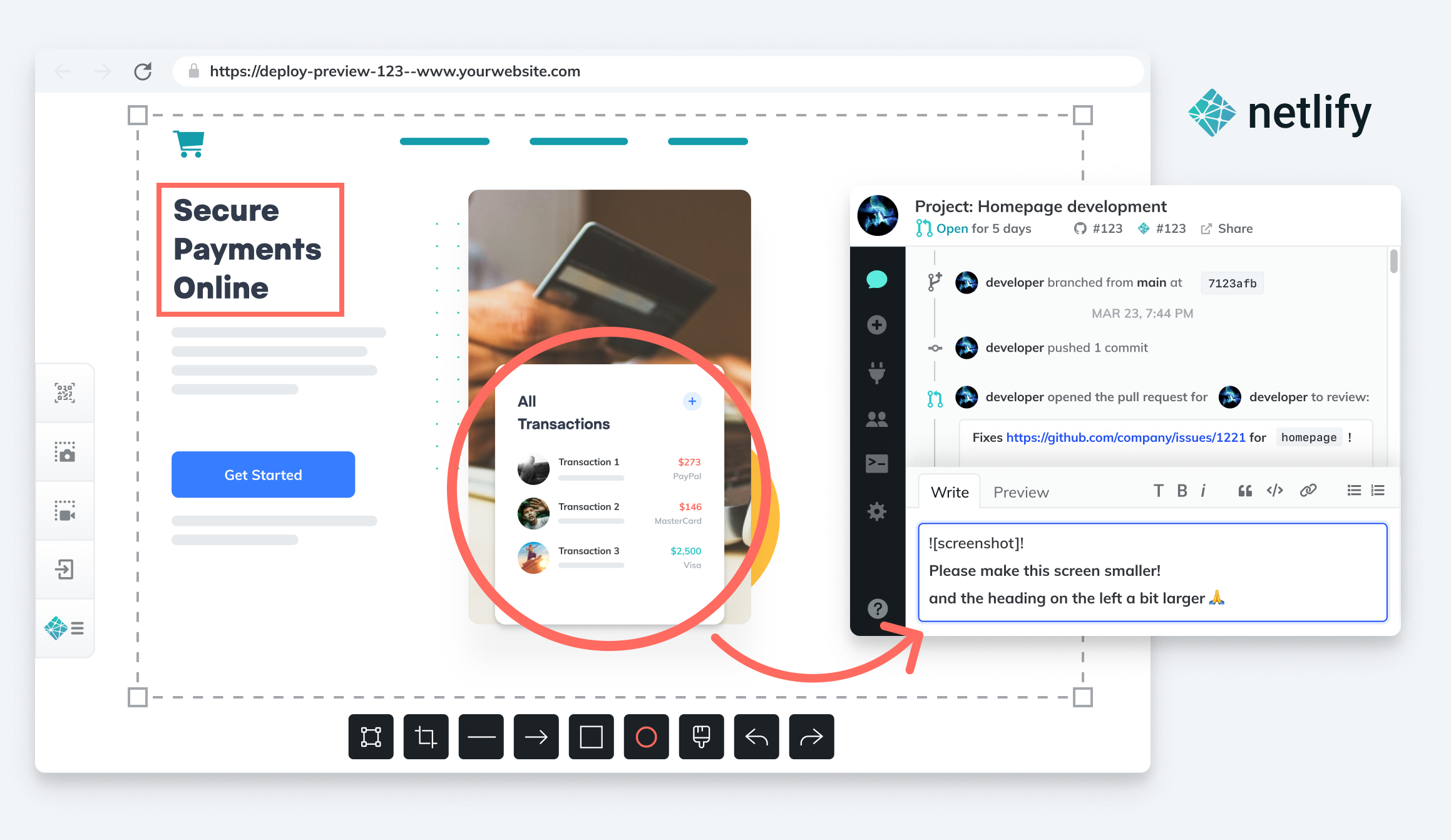
    Netlify announced today it has acquired FeaturePeek as part of an effort to make it simpler for DevOps teams to create a portal through which application stakeholders can both inspect a web application developed using JavaScript and leave comments for developers.

    Matt Biilmann, CEO of Netlify, said Netlify will embed that collaboration capability in the next iteration of its Netlify Deploy Previews. That tool makes it currently possible for a front end pull request from a Git repository to automatically generate a live preview of the site with a unique shareable URL.

    The current version simply shares URLs with application stakeholders, versus enabling DevOps teams to create a portal through which the review process can be centrally managed to make feedback more consistent, said Biilmann. Each piece of feedback from an application owner or stakeholder made via the portal will become a comment on the Git pull request, or can be shared via any collaboration tool a development team employs alongside a Netlify workflow, noted Biilmann.

    In the meantime, Netlify is also making available a free user role license for reviewers that want to make use of Netlify Deploy Previews to view recent updates to applications.

    Netlify has been driving adoption of a serverless computing framework based on a JAMstack architecture for building JavaScript applications faster. An application based on a JAMstack architecture isolates the front end and back end end of an application to make it possible to prebuild front ends that are highly optimized around static pages to make web applications faster. The name JAMstack is a mashup of JavaScript, application programming interface (API) and markup language.

    The need for more collaboration between developers and stakeholders has become more pronounced, in part, because organizations have significantly accelerated the rate at which they are investing in digital business transformation initiatives, noted Biilmann. With organization more dependent on software than ever, it’s critical for them to streamline the feedback cycle as the number of application stakeholders within organizations steadily increases, added Biilmann.

    As the relationship between DevOps teams and the rest of organization continues to evolve, the amount of feedback any team is likely to receive will continue to increase. Everyone from sales teams to the board of directors now realizes how dependent the business is on software. DevOps teams will need to way to organize and prioritize that feedback. They should also expect application owners and stakeholders to follow the progress of software development projects more closely than ever because, in many cases, financial projections are now based on assumptions being made about software delivery timetables.

    Many DevOps teams have been making the case to have a more central role in business planning for years. Now that many of them are getting a seat at the proverbial business planning table, however, they may soon realize they don’t really have the processes in place to absorb the overabundance of enthusiasm and anxiety that application stakeholders are likely to generate in equal measure.

  • ZenHub Brings More Science to Sprint Planning

    ZenHub Brings More Science to Sprint Planning

    ZenHub today revealed it has added a Planning Poker capability to its platform for managing software development projects that is designed to make it possible to prioritize sprints based on feedback collected from members of the application development team.

    That capability extends a sprint planning capability the company added this year to a project management application designed specifically for software development teams that employ the GitHub software repository. That sprint planning tool also automates routine tasks, such as automatically carrying over unfinished work to the next sprint.

    Aaron Upright, head of strategic accounts for ZenHub, said collectively, those capabilities will make it possible for development teams to prioritize their efforts in a way that is less biased using points that weight the opinions of team members based on how accurately they have made previous forecasts. For example, Planning Poker will assign a different weight to a developer that is consistently either overly optimistic or pessimistic about the length of time required to complete previous projects.

    Planning Poker is built right into GitHub, which Upright noted allows developers to make estimates without having to exit an environment where they already spend a good portion of their day.

    Thanks mainly to both an increase in and acceleration of the digital business transformation initiatives organizations have launched, DevOps teams are under increased time constraints.

    Many organizations’ entire business strategies now revolve around the rate at which software development projects can be completed. Many elements of those projects can’t go forward until a specific component upon which it depends is completed. Investors are holding business leaders more accountable for software delivery timetables that have direct implications on revenue generation.

    Not surprisingly, the type of end users that are now accessing project management applications to keep tabs on development progress has increased. Everyone from the sales team to the board of directors now wants more visibility into the rate at which software development projects are being completed. The challenge DevOps teams face is software development is an inexact science. Developers, based on individual personalities, exacting standards and willingness to work extra hours, are going to have widely divergent opinions on how long it may take to complete any given sprint.

    Nevertheless, Planning Poker presents organizations with an opportunity to rely on a more scientific approach than traditional guesswork, said Upright. The simple fact of the matter is that all estimates are wrong. The goal is to narrow the margin of error, he added.

    Regardless of how application development projects are managed, the relationship between DevOps teams and the rest of the organization has fundamentally changed. The entirety of some organizations is wholly dependent on the speed at which high-quality software is developed. In many cases, expectations are not realistically aligned with available development resources. A project management application that is widely employed across an organization should make that apparent to all interested stakeholders, which, in theory, at least, should result in either the hiring of additional developers or reassessment of the business strategy before the existing development team simply decides to abandon ship altogether.

  • Our API Mess is Coming

    Our API Mess is Coming

    APIs are the satisfaction of a long and deep need to be able to create consistent and reliable integrations between disparate systems, operating systems and datasets. As we started to use REST-based APIs, we also realized they fulfilled a previously little-addressed gap in automation. Frankly, they are a force multiplier in DevOps delivery.

    Early efforts at system-independent APIs were not great, but we learned lessons and are steadily getting better. While REST is the default solution for APIs, it probably isn’t the end of the road, as we continue to learn and improve. That’s what we in tech do – get excited about an idea, drive it to broad use and then iteratively improve it.

    And that’s the root of the problem. We have been, and are, saturating our applications with APIs. Internal, external, external-that-rely-on-another-external. The thing that comes to mind every single time I look at an API dependency map for even a medium-sized application is “spaghetti code.” Those lines are going all over, quite frequently returning to themselves.

    And we’re going to have to maintain this creation. Maybe not us, individually, but us as in IT and DevOps teams. The only constant is change, and far too many of us are not only failing to plan for API changes, but failing to even think about them. Because things are generally going swimmingly and most IT managers and DevOps teams have more urgent things to think about.

    But risk management – particularly broad risk – is an essential part of future planning. If you lose access to external API X, what will you do to keep your application running? If you lose an entire internal system that hosts API Y, how can you recover in a timely manner? While most organizations will identify and repair single points of failure, the solution is a pool, and the impact of losing Z servers in the pool needs to be understood, if nothing else – questions like, “At what point would user experience be impacted?” need to be asked, and a plan formulated to keep that from happening.

    We are already seeing issues created by using external APIs. All of them are predictable – an API going offline, or even disappearing completely; an API interface or attendant data format change; a change to the algorithms underlying the API, causing a change in data results, etc.

    API usage is far easier than it has historically been – and companies are working hard to make it easier to access APIs, both yours and others’. This is a good thing, as it means less time spent figuring out and tweaking API calls and request data. But it means our API dependence will only grow, and the number of lines in our dependency graphs – each representing some amount of risk – will only grow.

    “But we’re doing things in the cloud, so we can auto-scale, and failures are no longer and issue for us!” some shout. While that can help some scenarios, it doesn’t help others – if a vendor goes under and takes an API you use with it, or a preferred vendor (or inside component) becomes a security risk, you’ll still need to take steps. Knowing what and where your weaknesses are before they become issues is important, and worth your time.

    Most of you are killing it, cranking out solutions faster, iterating to make them better, using APIs to extend functionality and reduce delivery times. I’m just saying, stay aware of the technical debt you’re creating, because debts always come due, and risks eventually become issues. So know what’s a risk in your infrastructure, and have a plan to react when it does cause problems.

  • Nobl9 Makes SLO Specification Open Source

    Nobl9 Makes SLO Specification Open Source

    During an online SLOconf event today, Nobl9 revealed that the platform it created to enable IT teams to achieve service level objectives (SLOs) is now available under an open source Apache license.

    Brian Singer, chief product officer for Nobl9, said the goal is to make a YAML specification format for defining SLOs that includes a parser and basic validation and testing capabilities more accessible via an OpenSLO project. Achieving that goal is critical at a time when organizations are deploying microservices-based applications that have dependencies that often adversely impact performance and availability.

    While the concept of an SLO and/or a service level agreement (SLA) has been around for a long time, IT teams that have embraced DevOps best practices by hiring site reliability engineers (SREs) are programmatically attempting to assure that SLOs are attained and, just as importantly, maintained, said Singer. Most SLAs have, historically, not been well-enforced. OpenSLO makes it possible to achieve that goal by embedding SLO objectives within a YAML file that become part of a Git-based workflow, he noted.

    SLOs

    Niall Richard Murphy, author of the book, Site Reliability Engineering, has signed on to be a core OpenSLO contributor working alongside committers from GitLab, Dynatrace and Nobl9. The ultimate goal is to make it simpler to share and migrate portable SLO specifications across multiple application development projects by constructing them using an object model, said Singer.

    Nobl9, meanwhile, will continue to operate a software-as-a-service (SaaS) platform for managing SLOs based on OpenSLO. Singer noted there will be an increased need for OpenSLO as it becomes more widely employed. The Nobl9 SLO platform is compatible with monitoring platforms such as Datadog, New Relic and Prometheus, and uses data collected from monitoring and observability platforms to calculate acceptable rates of error per service. It can be configured to trigger alerts and even workflows in anticipation of outages.

    Accessible via a CLI/GUI/API, the platform also enables DevOps teams to create business rules and define “facets” of users based on the application experiences required. DevOps teams can identify users who are being serviced poorly in addition to tracking groups of users. They also can associate contractual obligations to an SLO for a critical business period.

    The platform also makes it easier to determine how to make systems more reliable or lower reliability goals to reduce costs when possible. IT organizations will also spend much less time determining the root cause of any issue using a combination of real-time and historical data that is more accessible. Today, it’s not uncommon for IT teams to spend weeks looking for the source of an application degradation issue, only to discover the problem can be fixed in a matter of minutes.

    It’s still early days as far as adoption of SLO-as-code is concerned, but the days when SLAs or SLOs were, at best, aspirational statements of intent are coming to an end. The expectation is SLOs will soon be maintained via YAML files embedded within application code and distributed across a rapidly expanding enterprise with more interdependencies than any IT team can manually track.

  • Despite Cloud Adoption, Enterprises Demand On-Premises Software

    Despite Cloud Adoption, Enterprises Demand On-Premises Software

    A recent report from Dimensional Research reveals that the demand for on-premises software is equal to that of public cloud. The report, which was commissioned by Replicated, a company specializing in on-premises software modernization, queried 405 participants in software development, executive, product management, sales and services roles to determine the needs, usage and challenges of on-premises software.

    The report revealed that some 90% of companies surveyed said their on-premises sales of software solutions continue to rise, while 70% that do not currently offer on-premises solutions intend to in the near future. 

    “In the past few years we’ve experienced a steady increase in interest from leading global companies who see that modern on-prem software delivery through containers and Kubernetes can make data protection and security much easier,” said Grant Miller, co-founder and CEO of Replicated. “Coupled with growing customer demand, it’s a win-win scenario for any industry.”

    While Miller’s view may be optimistic, the survey also revealed that the majority (65%) of companies cited privacy compliance as the top reason for using on-premises software delivery; an indication that the market is being influenced by cybersecurity issues more than any other factor. However, 54% also stated uptime and reliability were a primary driver for on-premises solutions, while 45% noted the importance of integration.

    The report indicates that enterprises, which have cited digital transformation and a movement towards the cloud as critical factors over the last two years, may also be thinking more about on-premises solutions in light of cybersecurity and compliance concerns. This, in turn, means that DevOps has the potential to gain even more traction in the enterprise. 

    While the report mentions the merits of an on-premises software strategy, it does raise the question of why more enterprises have not moved in that direction already. That hesitation to re-embrace on-premises software can mostly be attributed to perceived complexity, time commitments and the cost of engineering resources to make it happen. 

    Complexity is further highlighted by 74% of survey respondents reporting that it would take more than a week to install and configure on-premises software, and 29% stated an install could take over two months. For the 16% that claim they can rapidly install and configure on-premises software in less than a week, the potential for growth in the market is notable. 

    While the future remains somewhat uncertain, the report from Dimensional Research runs counter to other reports, such as a Synergy Research Group report that revealed in 2019, spending on cloud platforms edged past the resources spent on acquiring servers and software for on-premises data centers. “60% of the servers now being sold are going into cloud providers’ data centers and not those of enterprises,” said John Dinsdale, a chief analyst at Synergy Research Group, confirming the trend. “Clearly, companies have been voting with their wallets on what makes the most sense for them.”  Dinsdale said the growth of cloud infrastructure will continue to accelerate aggressively over the next five years. 

    Although conflicting observations tend to add to the market confusion, one thing is certain – DevOps shops have market opportunities to service customers deploying both to the cloud and on-premises software.

    on-premises