Tag: application development

  • CircleCI Surfaces More DevOps Insights

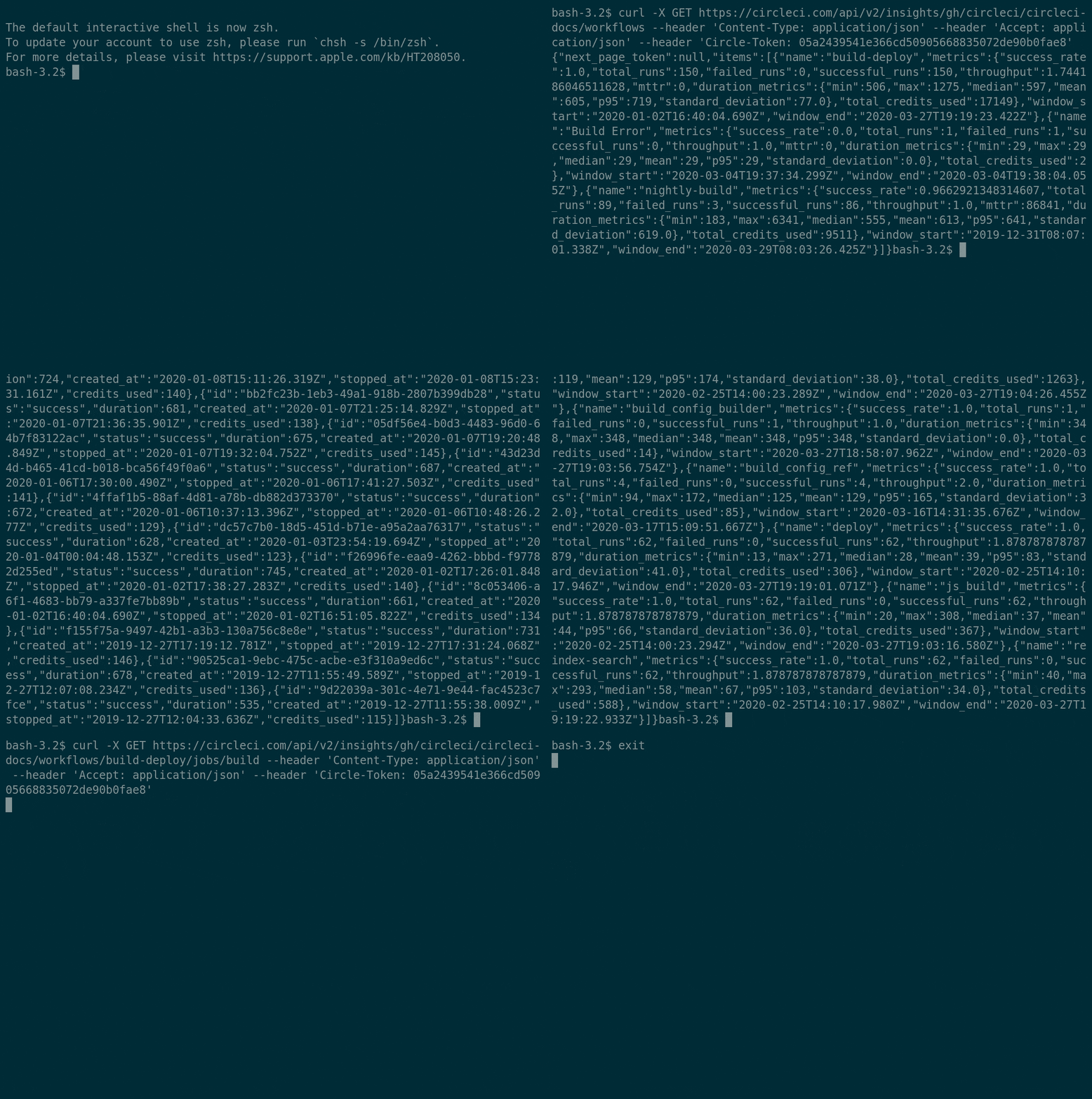
    CircleCI Surfaces More DevOps Insights

    CircleCI today announced it is making it easier for DevOps teams to determine the amount of resources being consumed by its continuous integration/continuous delivery (CI/CD) platform to help make application development teams more efficient.

    Kunal Jain, senior product manager for CircleCI, said via the application programming interface (API) that CircleCI exposes DevOps teams can now determine, for example, which workflows are taking the longest to run or what tests might be creating bottlenecks into the CI/CD pipeline.

    Armed with that insight DevOps teams can also optimize how credits to employ the CircleCI platform are allocated across their DevOps teams, added Jain. That capability should make it easier for DevOps teams to predict how much they are spending per month to run their CI/CD platform, said Jain. Many more IT organizations may opt to access CI/CD platforms using a software-as-a-service (SaaS) approach that limits the need for them to invest in their own IT infrastructure or in some cases even manage the platform.

    DevOps teams have always been sensitive to efficiency but given the current economic climate, minimizing costs is becoming a higher priority for many organizations. As such, DevOps teams need more insights into, for example, how to best break up workflows to keep CI/CD platform costs to a minimum, said Jain. In fact, Jain says the total cost of operating a CI/CD platform is likely to now play a bigger role in selecting a platform as IT leaders demand more visibility into DevOps processes.

    Of course, some DevOps teams may find themselves competing for credits based on how efficient they are. Teams who are more efficient than others could also allow IT leaders to reallocate credits as they best see fit based on the progress being made. In a previous era where compute resources were largely considered to be a nominal cost, many DevOps teams may find access to IT infrastructure might no longer be taken for granted.

    CircleCI claims it runs more than 30 million independent jobs run every month. The company last year committed to exposing more API endpoints to help DevOps team better understand the languages, architectural patterns, code testing patterns, delivery success rates and team practices being employed. Like most providers of CI/CD platforms, CircleCI has made a commitment to making available a much broader range of actionable insights to DevOps teams via its API.

    At this point, it’s unclear what the impact the economic downturn brought on by the COVID-19 pandemic might have on DevOps adoption. Undoubtedly, many organizations will put a hold on some application development projects as they reassess their priorities. On the other hand, with more people working from home, digital business transformation initiatives that require new applications are likely to become a higher priority as organizations seek to reinvent how they engage their end customers. Those projects may even be accelerated as part of a larger business continuity strategy. Regardless of the number of application development projects being launched, the scrutiny of how IT resources are being allocated and consumed is about to increase substantially.

    — Mike Vizard

  • Latest Chef Habitat Release Embraces On-Premises IT

    Latest Chef Habitat Release Embraces On-Premises IT

    Chef today announced that the Chef Habitat automation framework for building and deploying applications can now be used in on-premises IT environments.

    Mike Krasnow, a senior product manager for Chef, said version 1.5 of Habitat makes it possible to now store applications packages and their dependencies locally in addition to the cloud. In addition, pre-built application packages and dependencies from the Builder service can be deployed across multiple on-premises instances.

    An Applications tab in Chef Automate now shows the service groups and instances that are deployed to make it easier to understand what’s deployed where and the health of each service. Both the Habitat Builder installer and the application dashboard are integrated with Chef Automate, which uses the same installer as Chef Habitat.

    Finally, the Habitat Supervisor module is now more stable, easier to configure and manage, and provides improved support for Windows applications.

    Krasnow said Chef has seen a 300% increase in the use of the software-as-a-service (SaaS) instance of Chef Habitat in the last year. Organizations that have embraced Chef Habitat include Alaska Airlines, Rakuten, and Walmart. That rate of adoption should increase now that an on-premises edition is available, he said, including among IT organizations in highly regulated industries that are not allowed to employ cloud services. In fact, at least 70% of all application workloads are still deployed in on-premises IT environments.

    Chef Habitat appeals most to organizations that have embraced best DevOps practices to programmatically deploy applications, said Krasnow. There are rival automation platforms that make use of declarative approaches to automation that appeal more to IT generalists. However, he noted, organizations that want to empower DevOps teams tend to prefer a more programmatic approach.

    For more than a decade now Chef has been driving adoption of IT automation. However, it’s only relatively recently that organizations have been employing IT automation at scale as part of their efforts to embrace best DevOps practices. As interest in IT automation frameworks has risen, so too has the number of options. Some organizations are even employing multiple IT automation frameworks within different business units. They may one day standardize on a single IT automation framework, but many DevOps teams will simply opt to employ the IT automation framework the members of their team already know. If the members of that team in charge of IT operations don’t have a lot of programming expertise, chances are high they will opt for a more declarative approach. DevOps teams that have developers who deploy applications on their own are likely to prefer a more programmatic approach.

    Regardless of the platform chosen, it’s clear the days of manually deploying applications using custom scripts are coming to an end. IT organizations now require an industrial approach to managing IT as a factory. The biggest challenge achieving that goal is no longer the technology but rather the culture of the IT organization.

    — Mike Vizard

  • Red Hat Extends Runtimes Middleware Portfolio

    Red Hat Extends Runtimes Middleware Portfolio

    Red Hat has made available the latest instance of Red Hat Runtimes, a suite of lightweight open source components and frameworks that makes it easier to discover the middleware most appropriate for building a specific type of application.

    James Falkner, product marketing director for Runtimes at Red Hat, said as organizations embrace cloud-native application architectures based on microservices it’s become increasingly challenging to determine what middleware to deploy optimally and where. Red Hat Runtimes not only makes it easier to navigate all those options, Falkner said, but all the components and frameworks are certified to be pre-integrated.

    The latest version of Red Hat Runtimes adds support for Open Liberty, a lightweight runtime for building Java applications developed by IBM. Red Hat was acquired last year by IBM.

    The latest installment of Red Hat Runtimes also provides access to what has become a standard distribution of Node.js based on Red Hat Software Collections that will be implemented across all Red Hat offerings.

    Finally, Red Hat has also added support for Red Hat Single Sign-On, an access control framework based on the Keycloak project.

    Falkner said Red Hat Runtimes also serves to reduce the total cost by providing a single subscription through which organizations can access everything from container runtimes to the 3Scale application programming interface (API) management middleware, which Red Hat acquired in 2016.

    Very few IT organizations these days are standardized on a single class of middleware, especially as they embrace microservices-based applications built using containers. Most IT teams for the foreseeable future will need a flexible way to access multiple runtimes in support of everything from monolithic applications based on Java to applications built using Node.js code deployed using Docker containers.

    Rather than a piecemeal approach to the middleware infrastructure required to build, deploy and integrate all those applications, Falkner said Red Hat Runtimes provides a more holistic approach.

    It’s not clear how much or even whether IT organizations are centrally managing middleware in the age of DevOps and the cloud. Historically, many IT organizations preferred to standardize on a single application server platform to deploy various classes of middleware. However, many developers today are deciding what middleware to include within their application stacks without much input from a central IT function.

    Via Red Hat Runtimes, Red Hat is trying to make a case for providing developers with the flexibility they cherish in the form of a subscription service that provides IT teams with a modicum of control over what middleware gets employed.

    Tensions between DevOps teams and central IT organizations have arguably never been higher. In fact, many DevOps teams are operating within lines of business that are outside the direct control of centralized IT. As such, the level of standardization that can be imposed by central IT organizations has become more constrained. Many centralized IT organizations are now trying to influence middleware platform decisions rather than outright make decrees that might get ignored anyway.

    Regardless of the middleware platform choice that ultimately gets made, however, the one thing that most centralized IT teams will have to come to terms with is finding a way to support it.

    — Mike Vizard

  • GitLab Open Sources Monitoring Tools

    GitLab Open Sources Monitoring Tools

    GitLab has decided to make its monitoring and observability tools available as part of its core open source platform to help reduce the total cost of DevOps. Previously, the tools were available as part of the commercial tools in GitLab’s DevOps platform.

    Kenny Johnston, director of product/Ops products for GitLab, said that as responsibility for observability shifts left, it is clear developers are now exercising more influence over which monitoring tools are employed. As developers begin to employ monitoring tools early in the application development process, most of them prefer open source tools because it’s unclear whether the application being developed will ever make it into a production environment, he said.

    However, if the application does make it into a production environment, it can be challenging for developers to make a case for standardizing on whatever monitoring tools they’re using in place of an existing commercial offering employed by an IT operations team. In addition to reducing costs, the GitLab approach could serve to eliminate any potential friction in the DevOps environment, as applications move from development into production environments.

    GitLab’s move to make its monitoring tools available as open source software comes at a time when more telemetry applications being employed to collect data are also based on open source software. In addition, developers of modern cloud-native applications based on containers are taking advantage of open source Prometheus monitoring software developed under the auspices of the Cloud Native Computing Foundation (CNCF) to monitor their applications. GitLab already provides integration with Prometheus.

    GitLab is also making it clear it expects its monitoring tools to benefit from the contributions of a larger pool of developers. Specifically, GitLab is calling for help in the areas of ongoing integrations with Prometheus along with improved logging, tracing and alerting capabilities.

    It’s not at all clear just yet to what degree DevOps teams will prefer to rely on open source versus commercial monitoring tools. While open source tools have some obvious advantages in terms of cost, many organizations have already standardized on commercial monitoring tools for a wide variety of existing applications. Open source tools often are more difficult to deploy and don’t tend to provide as much observability depth for IT operations teams. In addition, most of the providers of commercial monitoring tools are integrating their offerings with both open source telemetry software and Prometheus to bridge any divide that might occur between when an application is developed and deployed in a production environment.

    The one thing that is clear is a lot more individuals within the IT environments will be accessing these tools now that developers increasingly are being held accountable for the performance of their applications in production environments. In addition, modern applications require monitoring tools to make sense of all the dependencies that existing between microservices. Previously, IT operations teams tended to limit usage of monitoring tools based on commercial software to their most critical applications because of the costs involved. With the rise of open source monitoring tools, the opportunity to apply monitoring more broadly becomes more economically feasible.

    Regardless of the path forward chosen, the more visibility into IT environments provided, the easier it becomes to embrace best DevOps practices.

    — Mike Vizard

  • Raytheon Leans on Red Hat to Advance DevSecOps

    Raytheon Leans on Red Hat to Advance DevSecOps

    Raytheon Company is partnering with Red Hat to drive the adoption of DevSecOps workflows and processes it developed around the OpenShift application development and deployment platform.

    Jon Check, senior director for cyber protection solutions for Raytheon Intelligence, Information and Services, said Raytheon has developed a set of DevSecOps practices for organizations building applications deployed in highly secure environments, involving government contracts.

    Raytheon and these customers have been challenged by a chronic shortage of IT professionals with the appropriate level of clearance to work on these classified projects. To overcome that issue, Check said Raytheon developed what it describes as a “code low, deploy high” approach to DevSecOps. Developers who lack security clearances can still build applications; however, those applications can only be deployed by IT professionals having the appropriate security clearance.

    In addition, Check said Raytheon has developed integrations between its DevSecOps framework and various IT tools based on the ITIL framework, which so many IT operations teams depend on to foster collaboration across the application development and deployment process. For example, he said, whenever code gets checked into a repository, an alert can be sent to an IT service management application from ServiceNow.

    That approach enables organizations to build applications quickly without compromising the integrity of the deployment platform, Check noted. Now Raytheon is working with Red Hat to drive adoption of its approach to DevOps to organizations beyond the core vertical industry and government sectors it serves.

    Check said Raytheon chose to work with Red Hat because organizations are now building applications employing microservices based on containers that they want to be able to deploy on any cloud computing environment. Those environments include edge computing platforms to process data in near real-time closer to the point where data is collected.

    In addition, Check noted Red Hat OpenShift is built on Red Hat Enterprise Linux (RHEL), the first operating system to achieve Common Criteria certification with Linux Container Framework Support. Red Hat also assumes responsibility for curating the underlying open source operating system and application deployment platform.

    In general, Check noted that while there’s a lot of interest in deploying code faster these days, the deployment of insecure applications is counterproductive. Organizations too often find themselves rolling back application deployments to deal with one cybersecurity issue or another. By separating application development and deployment, Raytheon is making the case for a DevSecOps approach that enables more secure application code to be deployed faster, he said.

    Each organization will have to determine what rate of application deployment is fast enough for them. The more sensitive the application is, the more an organization is likely to want to be more deliberate when it comes time to deploy and update an application. However, the need to be deliberate doesn’t necessarily mean organizations should continue to rely on legacy approaches to application development and deployment based on waterfall methodologies.

    — Mike Vizard

  • Oracle v. Google and Its Impact on APIs and Code

    Oracle v. Google and Its Impact on APIs and Code

    What, if any, impact will the Supreme Court’s rulings on Oracle v. Google have on the industry at large?

    TL/DR: It is unlikely to impact the vast majority of us, vendor and enterprise developer alike.

    Disclaimer: I am a technologist, not a lawyer. I have done some research, and talked to lawyers, but all that I say here is opinion—even my direct quotes of lawyers are their opinion. The Supreme Court can and has caught people off guard and taken cases in different directions than expected. Though I believe this path is the one it will follow, nothing is assured until the Court rules.

    Throughout this blog, references to The Case are actually using Harvard’s case document.


    Background

    On Nov. 15, the U.S. Supreme Court agreed to hear a dispute between Oracle and Google. The Oracle v. Google case has been going on for nearly a decade. And its roots go further back than that.

    The origins of the case go back to 2005, when Google and Sun Microsystems discussed the licensing of Java for Android. This will likely be important because it shows that Google knew it was someone else’s intellectual property (IP). More on this later.

    The crux of the case falls into three parts:

    1. Eight files that were decompiled and used. In one court case, these were found to never have made it into distribution and only used for testing (which limits liability).
    2. Two source files from Java used directly. These were found to be infringing, but damages were set to zero with consent of both legal teams.
    3. The part at issue: the copying of the entirety of Java’s interface from 37 modules. Most tech writers imply this as 37 APIs. It is not—it is hundreds of classes and thousands of methods. The 37 is the number of Java packages.

    The case has been through four court hearings/rulings so far. To sum up the relevant parts of these cases:

    1. The first case (split between a jury and district court, running at the same time) included patent violations. Those were defeated and Oracle has not appealed that defeat. On copyright infringement, the court found that Google did violate copyright on the 37 packages and the directly copied source code, but not on the eight decompiled files. The jury could not settle the issue of “fair use” of the 37 packages.
    2. The district court decided that the eight decompiled files and the copied source code for one function were violations, but remanded the rest back to the jury trial to settle the issue of fair use.
    3. In the end, the district court determined that APIs are not protected by copyright. Their decision involved two parts:
      1. That there is only one way to write a given API.
      2. The interface code and hierarchy can be replicated by third parties without violating copyright because it is an interface and not content.
    4. On appeal, the finding was reversed, and APIs were deemed copyrightable, sending the case back again.
    5. At this point, Google asked the U.S. Supreme Court to intervene. The court chose not to.
    6. Back at jury trial, the court found that while APIs may be copyrightable, Google’s use was fair use in the legal sense. This is the one topic the jury could not originally agree upon.
    7. Oracle appealed this decision, and the District Court ruled that it indeed was not fair use to copy the structure and exact interfaces.
      1. Where the jury and the district court appear to disagree is in the idea of APIs. Calling a publicly documented API is obviously fair use, and the jury latched onto that idea. The District Court appears to acknowledge the difference between calling an API and copying it.
    8. And after some tumultuous hearings and years in the court, the Supreme Court has agreed to weigh in on the issue.

    The real problem here is that copyright law is not a great fit for software. It never has been. If I rewrite your Java application in Python, using the same exact structure and naming, is that protected? All of the “words” have changed. It is akin to rewriting your Hindi book in English without a direct translation  … except that in software there is the added issue of it behaving exactly the same.

    But we can’t fix the misapplication of copyright law to software—only Congress can. So what to expect?

    A fair number of people, from the open source community and from businesses that see opportunity in a ruling that favors their world  view, are advocating that affording copyright protection to APIs is a horrible idea because it would hurt independent developers. This is not quite true. Independent developers are not generally copying Java. While this case does have bearing on coding practices and what developers can do, it does not have a huge impact on innovation, just on copying others’ work and how that is achieved—much like the “reverse engineering” court cases of the ’80s.

    There are good arguments on both sides of this case, but it seems to me that fair use will lose. They are public APIs in the sense that anyone can call them; indeed, some of these packages are so core to the system that you could argue every app must call them. But calling a function is not the same as re-creating it. In that sense, they are not in the public domain. Anyone can read a book, but that does not make it public domain.

    But no matter how this turns out, it is all good for the industry. This uncertainty has hung over the IT sector for nearly a decade. Just like when a new boss comes along and there is uncertainty in the department until everyone adjusts to the new demands/style of the boss, a solid ruling will allow settling to start. The industry can adapt once it knows what the rules are and we can move along.

    The real long-term answer is to have an equivalent to copyright and patent that is designed around the unique parts of computer code. Clearly, software is not the same beast as a book or magazine. The considerations are half-patent and half-copyright, and trying to bend those two to meet the needs of software has created some serious issues. Oracle quoted a 1995 case to showcase this problem—the company is quoting it to win the appeal, but it should be quoted as the reason the protections need to be designed for this medium that is not a publication and yet consists of words whose sequence matters: “Applying copyright law to computer programs is like assembling a jigsaw puzzle whose pieces do not quite fit.” (attributed by Oracle to the concurring opinion of J. Boudin in Lotus Dev. Corp. v. Borland Int’l, Inc., 1995).

    One interesting bit that the courts thus far have ignored, and I would love to see the Supreme Court take up, is this: If Google entered into licensing negotiations, the company knew it was Sun/Oracle’s IP. To then go and copy parts of it without licensing appears wrong on its face. It would be interesting to understand the process that ended in the copying and hear whether that bears upon the legal standing of the case. I can think of both malicious and innocent routes to get there; it would be interesting to hear testimony about motivations and thought processes.

    But even without delving into the licensing negotiations, this case stands to redefine copyright with regards to software. J. Michael Keyes, a partner at the international law firm Dorsey & Whitney, had this (and more) to say:

    “One of the issues that the court may decide is the scope of copyright protection for software. Google had early success below in convincing the trial judge that the snippets of copied code were not copyrightable. Google may urge to have the court take a look at this issue anew. Another huge implication is the scope of fair use. The jury found that Google’s use was “fair” and that it was not liable for infringement. The appellate court overturned that jury conclusion and found that Google’s use was not fair as a matter of law. The Supreme Court will likely wade into this thicket and provide guidance on the scope of fair use in the context of software code and what role an appellate court plays in reviewing jury decisions in that regard.”

    What we (all of us) do not want to do is confuse “good for the industry” with “legal standard.” It is not the court’s job to do what we think is best for the industry; it is the court’s job to determine applicable law and what that implies needs to happen. Presumably, the Supreme Court will do just that. And it may not please any of us. But if we think the current iteration of the law is flawed, that is something to take up with elected representatives, not ask a court to “fix” on the fly.

    For the vast majority of us, though, it impacts our development not at all. Using APIs or forking open source projects are all still perfectly acceptable, and no ruling by the Supreme Court is going to change that—because copying someone’s APIs is the issue here, not using them. And open source licenses allow for copying and improving projects. So carry on. Get the job done. And read about the Supreme Court’s final decision with a smile, because either way, the industry will adapt to the new normal and continue forward.

    — Don Macvittie

  • GitLab Survey Surfaces Major DevSecOps Challenges Ahead

    GitLab Survey Surfaces Major DevSecOps Challenges Ahead

    A report based on a survey of 4,071 software professionals published this week by GitLab, a provider of a continuous integration and continuous deployment (CI/CD) platform, found that while appreciation of the potential value of DevSecOps best practices is high, the ability to implement those practices is uneven at best.

    According to the survey, half of the respondents reported that security vulnerabilities are discovered mostly by the security team rather than developers after code is merged and in a test environment. And, when cybersecurity professionals participate in a DevSecOps process, the survey found those organizations are three times more likely to discover bugs before code is merged. In addition, a full 90% of those organizations are more likely to have tested between 91% and 100% of their code early in the development process.

    Obviously, that’s better than discovering them after they’ve been deployed in a production environment. On the downside, however, nearly half of security professionals participating in the GitLab survey (49%) said they struggle to get developers to make remediation of vulnerabilities a priority. That challenge may reflect the overall maturity of the DevSecOps practices in place. For example, only 25% of developers participating in the survey rated their security practices as being good. That compares to only 20% of security professionals who rated their processes as good. Only 14% of respondents said they are relying on application security tools to test more than 91% of their code. A full 44% are using these types of tools to test less than a third of their code.

    Priyanka Sharma, director of technology evangelism for GitLab, said the survey makes it clear that DevSecOps is now officially a thing in the enterprise. However, only 44% of the survey respondents said that security vulnerabilities are a performance metric for developers in their organizations. As such, it’s clear there is still a long way to go before anything approaching DevSecOps nirvana is likely to be achieved. In fact, Sharma noted building and deploying more secure applications may require organizations to slow down the rate at which applications are being built, at least initially.

    The GitLab survey makes it clear most organizations are still struggling with mastering DevOps. Only 28% of developers said they feel good about their organization’s level of DevOps sophistication, while less than half (45%) said they have been able to implement continuous code deployment at least somewhere in their organization. That level of adoption suggests there still is plenty of opportunity to refine DevOps processes that are not fully ingrained. In fact, it appears most organizations are still trying to master agile development methodologies—more than half of the respondents said they employ Scrum (54%) as their application development methodology, followed by Kanban at 37% and DevOps at 36%.

    Ultimately, most organizations will have no choice when it comes to embracing DevSecOps. There simply are not enough cybersecurity professionals available to secure every application on their own. That means developers will need to assume more responsibility for cybersecurity, regardless of whether they like it. DevSecOps processes will be required to validate whether developers have implemented all the security patches and controls required. Anything less than that going forward will be deemed as nothing short of reckless—which, as any lawyer will gladly share, means much higher penalties for everyone involved.

    — Mike Vizard

  • DevSecOps Implementation Process and Road Map – Security at Every Step

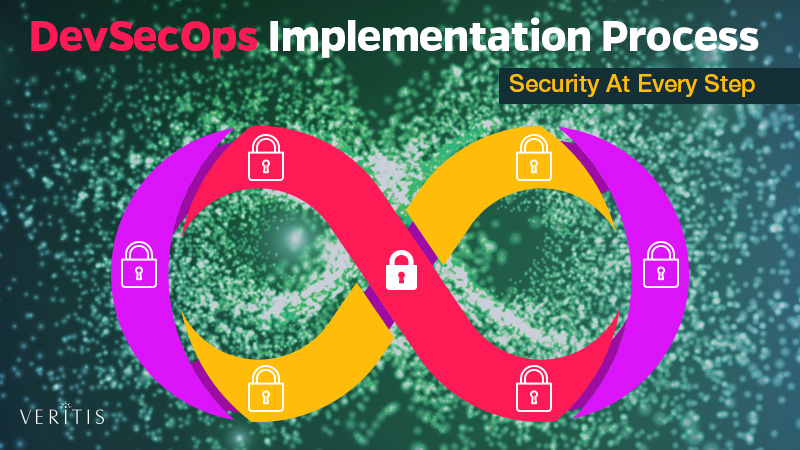
    DevSecOps Implementation Process and Road Map – Security at Every Step

    DevSecOps is changing our perspective toward security and is equipping us to deal with its challenges in an intelligible manner. The systematic approach of DevSecOps helps us add value to our business processes while ensuring security.

    Here’s a summary of the key inputs and a recipe for a successful software development project. Implementing DevSecOps with the primary goal of enhancing security requires a step-by-step procedure.

    It requires the unification of culturally disparate teams of Security, Operations, Development and Test for the sole purpose of building a product marked by quality and backed by security.

    The DevSecOps process will require effective planning, design and release, which will be put together with a collaborative toolchain of technologies to bring about a common goal.

    Furthermore, as organizations continue to rely on automated delivery, avenues are created for testing opportunities beyond traditional bugs. In-house experts will be able to identify potential loopholes, design errors and even code weak spots.

    Being able to identify weak spots and flaws well in advance helps organizations maintain a competitive front in the market and trustworthiness before its target audience.

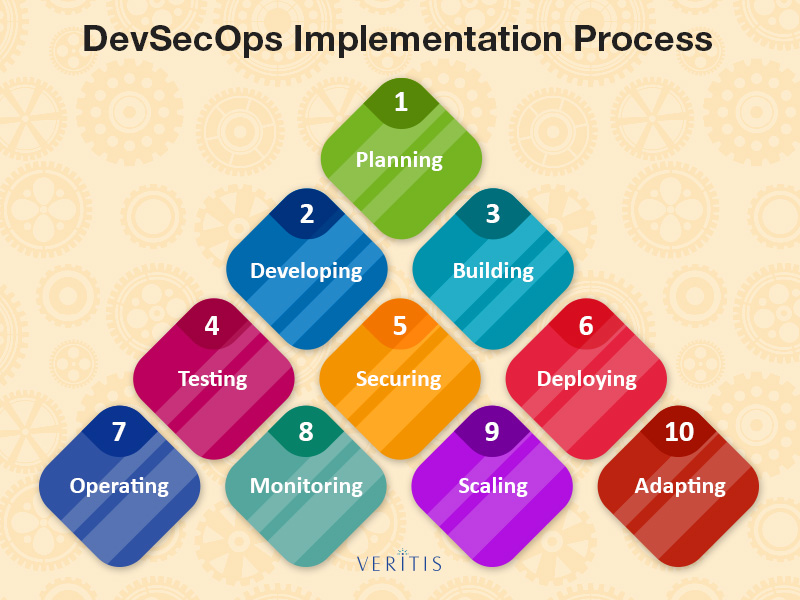
    DevSecOps Implementation Process and Road Map

    DevSecOps Implementation Process and Roadmap

    1) Planning: Planning is the first approach to any task at hand and the core focus of DevSecOps—security—begins from here. In the planning stage, DevSecOps professionals must go beyond creating feature-based descriptions. The focus should also be on security and performance, acceptance test criteria, application interface and functionality and threat-defense models.

    Tech terminology: Acceptance Test Criteria is used by DevSecOps professionals to understand user preferences and behavior to a software application behavior.

    2) Developing: Developers should approach DevSecOps with a “how to do it” approach, rather than a “what to do” approach. It is important for developers to bring together available resources for guidance, have reliable practices and a code review system in place for themselves and for others in the team to follow.

    3) Building: Automated build tools can uplift the whole DevSecOps implementation process tremendously. These tools ensure test-driven development, standards for release artifact generation and utilize tools to ensure the design aspect is in alignment with the team’s coding and security standards through statistic code analysis.

    They can also be used to identify vulnerable libraries being used in your application and replace them with new ones.

    4) Testing: Automated testing in DevSecOps should utilize strong testing practices including front-end, back-end, API, database and passive security testing.

    Tech Terminology: Passive Security Testing is a developmental stage testing where security testing is not conducted directly on the target.

    5) Securing: Traditional testing methods always remain in place in DevSecOps exercise. However, somewhere down the line, there is a tendency to identify issues toward the end of the development process.

    Through advanced practices such as security scanning, we tend to become more aware of the issues and can determine if the threat is a serious one or not.

    6) Deploying: Automated provisioning and deployment can fast-track the development process while making it a more consistent one. Infrastructure-as-code tools can perform the aforementioned audit properties and configurations and ensure secure configurations across the IT infrastructure.

    7) Operating: Regular monitoring and upgrades are the Operations team’s important tasks. DevSecOps teams ensure to deploy infrastructure-as-a-code tools to update and secure the entire organization’s infrastructure in a quick and efficient manner with no scope for human error. Operations personnel have to be especially watchful of zero-day vulnerabilities.

    Tech Terminology: Zero-Day vulnerabilities are a software breach that remains unknown to software productions personnel and can eat away at a computer program and other components such as a network.

    8) Monitoring: Constantly keeping a watch for irregularities in security can save an organization from a breach. Hence, it is essential to implement a strong continuous monitoring program with real-time to keep a track of system performance and identify any exploits in their early stages.

    9) Scaling: Gone are the days when organizations spent precious hours and money on the maintenance of large data centers. With the introduction of virtualization solutions and the cloud, organizations can scale their IT infrastructure or replace it in the event of a threat, which would be impossible to do with a traditional data center.

    10) Adapting: Continuous improvement is key to any organization’s growth. An organization will only be able to achieve the desired growth of it evolves in its practices including DevSecOps practices—security, functionality and performance. Therefore, an organization should adapt to continuous improvement and external changing trends.

    The DevSecOps is in itself a process of innovation that substantially adds value to an organization.

    Point to Remember: Security is everyone’s responsibility.

    — Veritis

  • The Benefits of Test-driven Development

    The Benefits of Test-driven Development

    It sounds like an oxymoron: Create test cases before coding. In the process of writing and using test cases before writing functionality, a developer can produce higher-quality software. That is the concept behind test-driven development (TDD), and it works.

    TDD Snapshot

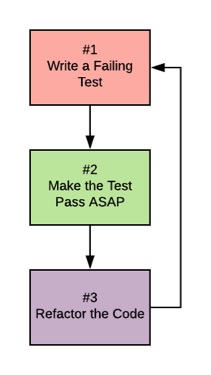
    TDD has been around since at least 1999, and it is part of the emerging test-first approach to development associated with extreme programming. In 2003, American software developer Kent Beck “rediscovered” TDD and applied it as a way to create simple designs and inspire developer confidence. Fast forward to today’s agile development world, TDD is a software development process using a very short feedback loop in which developers do the following:

    1. Create a test that will fail immediately.
    2. Write the necessary code to pass the test as quickly as possible.
    3. Refactor the code written in step two, using the created test as a reference.

    TDD Benefits

    So why might a long-in-the-tooth software development approach have tangible benefits in an agile development world? Because put in its simplest terms, TDD is a way to develop highly usable software.

    Following the TDD process, a developer must focus on the test cases before actually coding anything. That meansa developer is thinking more about the use of the software and the design of user interfaces to achieve that. As a result, the developer is more interested in the interface than in the implementation—and that leads to more usable software.

    There are several other tangible benefits for taking a TDD approach, including:

    • Creating a metric for the code quality that can be easy and quick.
    • Allowing for a quick visualization to determine if the code base has any functional issues.
    • Living documentation of functionality with new code written.
    • Allowing for safe refactors of code, whether based on attempts to improve code quality or a changed requirement.

    That final point is worth dwelling on for a moment. The TDD approach requires that the evolving code base is cleaned up frequently so that new tests and code are easy to introduce. That usually means that code moves from its current place to where it more logically belongs in the software. That has the effect of reducing any extraneous duplication of code and enforces a strong discipline around objects, classes, modules, etc. In this way, the overall maintainability of the software increases incrementally.

    The improvement in readability and maintainability will pay huge dividends during the expected life cycle of the software. Following a TDD methodology requires developers to focus on writing smaller units of testable code. By following the TDD methodology, this leads to more modularized, flexible and extensible software.

    Where Can TDD Fit?

    A TDD approach is appropriate for both new greenfield software and legacy systems. For a development team that has to deal with existing legacy software, the key is to start small and begin with working on bug fixes. A good practice is that for each bug reported, create a test that addresses the broken bug and then fix the functionality. After several iterations of this, the development team has created a repeatable working test to address bug fixes. When applying this methodology to new software applications, make a point of understanding the testing tools used for the technology stack.

    For example, when working in an Angular application that generally uses the Jasmine testing framework for unit testing, and when using the Angular CLI for creation, unit tests are created alongside modules of code. Using a TDD methodology, the approach would be to:

    1. Determine a portion of the functionality to be created with this component.
    2. Create a unit test that will fail immediately targeting this portion of functionality.
    3. Run the test runner to confirm the failing test (it may be useful here to leave the test runner on to run after each source file save, which speeds the process).
    4. Write code in the Angular component that will make the written test pass.
    5. Make any refactoring changes for the Angular component after confirming passing, using the test as a guideline to ensure code refactoring does not break functionality.

    Measuring Testability with Code Coverage

    Another essential consideration when improving testability in code is to use a code coverage tool. Code coverage is a metric to show the percentage of code that has a unit test written for it. Angular applications use Istanbul to calculate code coverage through the application. Running a single run of code coverage in an existing project gives the following output:

    The output provided by Istanbul gives a metric on the overall test coverage and the areas of code that need improvement in testing. Code coverage can be useful in a few ways:

    • Provides an idea of the overall testability, allowing for a threshold to ensure the total software testability does not drop past a certain point.
    • Identifies areas in the code base with poor testing, making them opportunities for refactoring.

    However, as effective as code coverage can sound, it’s important to understand that it’s just a metric. Writing good unit tests is a matter of following what the code will do, and metrics such as these should not drive significant decisions.

    Considerations When Using TDD

    It’s important to note that TDD does not solve all problems. There are many different types of testing required to create a fully comprehensive testing strategy, including acceptance testing. In TDD, the focus is on a single unit of code at a time. A sophisticated software application may have many thousands of units of code and their corresponding tests. That’s why it’s critical to make sure that testing quality stays high when following the TDD methodology. Tests cannot become something bypassed in the pursuit of more functionality or expediency. Avoiding testing generates the risk of test creation becoming a hindrance for developers.

    For example, ignoring failing tests makes it difficult to determine the actual state of the application. It’s also important to have buy-in for a TDD approach form all the teams involved in the effort. Buy-in is particularly true on the business side. Time must be spent up front discussing the nature and benefits of a TDD approach, and the belief that using TDD will improve the resulting software. Otherwise, business management sees writing tests as an activity that doesn’t contribute to the bottom line.

    Conclusion

    TDD emphasizes the importance of an effective and sustainable testing approach. TDD also contributes directly to the overall quality of software. It’s a truism for small or large system development that often goes missing in the day-to-day hustle to get new functionality into production. Quality software gets built when there’s an acknowledgment that quality test code should receive the same amount of attention and resources as quality production code, as they are equally essential in development.

    — Dave Farinelli

  • Understanding the App Development Life Cycle

    Understanding the App Development Life Cycle

    More and more businesses nowadays are shifting to mobile. And that’s absolutely reasonable choice:

    • More than 50 percent of digital media consumption accounts for mobile apps;
    • Ninety percent of the time smartphone users spend on their mobiles goes to mobile apps;
    • A typical user has about 30 apps installed on his mobile and spends more than 35 hours a month using them;
    • Forty-two percent of the mobile purchases were completed from mobile apps;
    • Eighty-five percent of consumers prefer native mobile apps over a mobile website.

    When deciding on developing a mobile app, it’s important to picture the entire range of stages and procedures to go through.

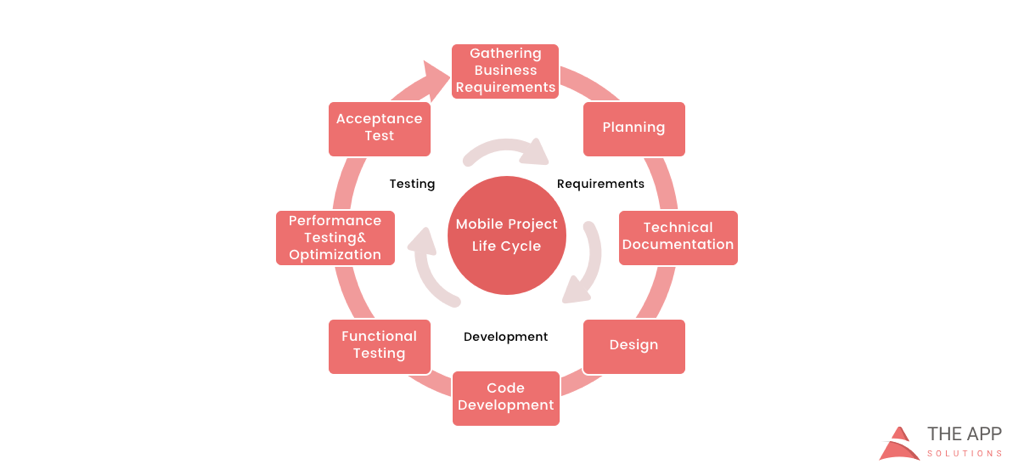
    According to the mobile app projects approach by The App Solutions, here is the life cycle of a typical development project, no matter the complexity:

    1. Planning stage (project manager, marketer, and business analyst are involved) – carrying out the business analysis and crafting mobile strategy.
    2. Technical documentation (covered by the technical writer) – describing all tech requirements and details.
    3. Prototyping (usually made by a UX/UI designer) – creating the sketch, wireframes, prototype and final app skins upon approval.
    4. Development (performed by the developers) – front-end and back-end segments of coding.
    5. Quality Assurance (usually performed continuously after each agile sprint is completed; followed by bug fixing) – testing tech requirements, device compatibility, interface, security aspects, etc.
    6. Publishing & Maintenance (covered by DevOps) – publishing to the app store, updates releases, infrastructure, and entire app maintenance.

    Planning stage

    When creating a mobile app, it is crucial to take time to go through the necessary research and planning steps.

    Business analysis:

    • Idea evaluation – a preliminary stage, when experts investigate the idea, correct it, give their advice and create a rough logics for it.
    • Competition analysis – study of activities of other players in the market.
    • SWOT-analysis – evaluation of strengths and weaknesses of the product, insights into opportunities and other aspects.
    • ROI calculation – assessment of the future app market performance help realize the real value and adjust budget accordingly.
    • Requirements scope – summing up requirements for the future product at all levels.

    Mobile strategy:

    • Market research – this study shows the overall situation on the market to help adjust the concept of the product to current demand.
    • Defining user personas – understanding who is your target audience is crucial in crafting advertising approach.
    • Technologies & tools assessment – study of specific tools required for the industry and select a set of technologies to meet the objectives of the project.
    • Complex promotion strategy – a step-by-step action plan for acquisition and retaining users.

    Technical documentation:

    Also known as a technical specification or a software documentation, this paper is a complex manual of your product, outlining requirements, business logic and leading your specialists through all stages of the project:

    • Makes your software universally understandable.
    • Provides flexibility for future changes.
    • Adds value to your app by providing a clear manual.
    • Helps to keep control of your own product.
    • Allows reusing existing parts of the developed application.

    Prototyping:

    Prototyping is a process of defining a concept in visual terms and evaluating how the app might develop to correct a misconception.

    • Creating a sketch – the draft version of your app on paper that sets up the main logic, number of screens and the way they interact with each other.
    • Creating wireframes – provides the visualization of the draft structure.
    • Creating a clickable prototype – helps to find out and analyze all possible use cases, discover logical breaks and technical inconsistencies in the original idea.
    • Designing app skins – collecting all wireframes and put them together to get the final design.

    Code Development:

    This segment usually consists of two main parts:

    • Front-end development – client-side development, creating a presentation layer of the software for a direct user interaction with it.
    • Back-end development – a server/database part of development, connecting a front-end part of the mobile app with the data access layer.

    Quality Assurance:

    In the agile development, it’s usually a continuous process following every sprint of development:

    • Compatibility testing – running the app on different devices and screen sizes.
    • Interface testing – checking the navigation, menu and buttons performance.
    • Device compatibility testing – checking how the app looks and performs on various screen sizes.
    • Low-level resources testing – examination of the app in conditions of low battery, slow internet connection, etc.
    • Security testing – provides quality assurance of users data safety.
    • Beta testing – giving users access to the app to get feedback.

    Publishing & Maintenance:

    • Publishing of the app and following updated versions to a chosen app store.
    • Infrastructure support – either you have admin panel to post on or cloud service attached, you’ll need to make sure it functions fully.
    • App store optimization – helping your app move onto the tops of search lists and this way gain more users.

    Making the Most of Your App Development Project

    Here are a few tips for getting the most out of your own app development project:

    • Mind what’s trendy + study the market and your target audience. It is a crucial preliminary stage that will impact literally every side of the project and every decision to make.
    • Specify as particularly as possible the product you expect to see at the end of the project. Defining the smallest features and functions of the software at the planning and prototyping points of the project will help find areas to save money on the actual development.
    • Negotiate your idea with various development teams (study the profile of the app development company and find evidence for their credibility, debate the best price). Make sure they hear you and understand what you mean—simply put, that you’re on the same page.

    About the Author / Charlie Shabe

    Charlie Shabe is a professional Digital Marketing Strategist. He has over 20 years Digital Marketing experience in helping global organizations use the Internet to drive their online visibility and generate leads. In addition to his PR and online marketing experience, Charlie is an expert in writing. Connect with him on Facebook and Twitter.