Tag: bug fixes

  • 5 Steps to an Open Source DevOps Strategy

    5 Steps to an Open Source DevOps Strategy

    Open source technology thrives during times of mass disruption, and this pandemic has been no different. Across the board, companies are accelerating their digital transformation and DevOps strategies, looking to open source technology as a way to streamline operations. While deploying open source software (OSS) in DevOps can help organizations lower costs and avoid vendor lock-in, the tools are often not backed by an ecosystem that makes them transferable across the enterprise, leading to interoperability issues across the board and creating a haphazard workflow.

    Before embarking on an open source migration, companies need to plan out their strategy. Following these five steps will help companies create an organized plan and a seamless open source stack so that they can capitalize on the lower costs and tap into the benefits of the open source community.

    Determine if you Can Self-Support Your Strategy

    A recent Gartner study determined that at least 75% of open source policies don’t yield effective results. This stat is largely due to companies believing that they can self-support their open source stack. However, as technology becomes increasingly complicated, companies should take a step back and evaluate if they actually have the right resources and skill sets to get the job done. Enterprise architects with open source expertise are a niche group that’s in high demand, so don’t worry if you don’t have the resources – there are plenty of trusted vendors out there who have a proven track record of delivering results.

    Consolidate

    Fewer vendors equal fewer problems. When evaluating potential partners, keep in mind that working with a few key partners (versus several) will be beneficial in the long run by ensuring that applications will work together seamlessly, while also avoiding vendor finger-pointing if they don’t. Assess potential partners to see which packages, application stacks and infrastructure they support, and what level of freedom you have to switch out various components. Avoiding vendor lock-in is key, as switching vendors will be a costly undertaking if you ultimately decide to go in another direction.

    Invest in Security

    Security is a major concern in enterprise open source software, and it’s critical to make sure you have the ability to act quickly on potential issues and vulnerabilities. Consider partnering with a vendor who specializes in OSS security, and can keep clients informed of the latest security updates and bug fixes to ensure that your program isn’t vulnerable to security threats. Having a security specialist on standby is a must-have for organizations so that when security is breached, it can be remediated immediately.

    Pick the Right Tools

    Not all tools are alike. There are plenty of options out there that can help elevate your open source strategy, but consider how each will affect your overall program. At each phase of your pipeline, test the open source tools selected to ensure that they can integrate together within the broader toolchain and every layer of your software stack, including databases, platforms and monitoring solutions. If you have questions about their connectivity, either consult with an expert who understands how the software will truly behave in various environments or engage with free apps that help developers determine if their tools are compatible across the broader stack. Doing so will help enterprises choose the right open source technology early on, saving both time and money.

    Adapt

    Open source implementation in DevOps is more than a one and done approach; it requires adapting and tweaking in order to stay relevant, keep a competitive advantage and optimize new technology. Ensure that your open source strategy can be improved to include new offerings and services that the company will implement down the road and that your vendors—or internal team—can modify the framework fairly easily when necessary.

    While open source technology continues to drive innovation in the DevOps industry, including it in a company’s DevOps strategy requires thoughtful planning. When done right, an open source policy will save a company time, money and people power, allowing them to collaborate seamlessly with the greatest minds in the industry.


  • Survey: Fixing Bugs Stealing Time from Development

    Survey: Fixing Bugs Stealing Time from Development

    A global survey of 950 developers published today finds more than a third (38%) of developers spend up to a quarter of their time fixing software bugs, with slightly more than a quarter (26%) spending up to half their time fixing bugs.

    Conducted by the market research firm Propeller Insights on behalf of Rollbar, a provider of artificial intelligence (AI) tools to detect software errors, the report also notes that 88% of developers find traditional error monitoring tools are not meeting expectations.

    Daniel Day, vice president of marketing at Rollbar, said the survey makes it apparent that continuing to rely on manual processes to surface errors in code is having a major downstream impact on both DevOps teams, in particular, and the business as a whole.

    For example, nearly nine in 10 developers (89%) also noted that undetected errors take a big toll on the business. More than one-fourth (26%) of developers also said that their employers have lost a significant number of users due to errors in software. The same share (26%) said software errors damage their company’s reputation and its ability to attract investments, and nearly a fifth (18%) said that undetected software problems anger their company’s investors.

    Nearly a third (32%) of developers said they spend up to 10 hours a week fixing bugs instead of writing code, while 16% said they spend up to 15 hours a week. Another 6% said they have to dedicate up to 20 hours a week fixing bugs instead of writing code.

    More than half of developers (55%) said that if they didn’t have to spend so much time fixing bugs, they would have the time to build new features and functionality. Many of these errors are not addressed because current tools require them to manually respond to errors (39%); it takes too long to find all of the details they need to fix bugs and errors (36%); focus on system stability and not enough on code health (31%); make it difficult to detect errors (29%); and have an approach to error aggregation that is either too broad or too narrow (23%).

    Nearly two-thirds of developers (62%) said they have found out about errors from users reporting through the application, while a quarter (25%) said that they have heard about errors from users sharing these issues on social media. Another 17% said media coverage clued them in about errors in their software, while more than a fifth (21%) said they heard about them from their CEO.

    Nearly a third of the survey group (31%) said that manually responding to errors makes them feel frustrated, while more than a fifth (22%) said they feel overwhelmed when using manual processes to address errors in software. Nearly as many (17%) said it leads to burnout. More than a tenth (12%) said it elicits feelings of resentment, and 7% said it makes them want to quit their jobs.

    Nearly two-thirds of all developers said they would rather do an unpleasant activity than fix errors, including pay bills (26%), go to the dentist (21%) and spend time with in-laws (20%).

    Rollbar clearly has a vested interest in convincing developers to increase reliance on AI to surface errors in code. The productivity paradox holds that, the more application code developers write, the more time they spend fixing existing code than writing new code. Most developers have a lot better things to do with their time than manually combing through lines of code looking for those errors. In fact, the problem is, many of them simply don’t have the time required to catch all the issues before an application makes it into a production environment.

  • Features or Quality? App Survey Shows Surprising Results

    Features or Quality? App Survey Shows Surprising Results

    Software is an essential part of our everyday lives, but that doesn’t mean that people are always happy with the app experiences that they’re having.

    We at DeepCode conducted a survey to learn more about what people really think about software quality today. Is it getting better or worse? How important are bugs and security vulnerabilities to the average user? The results are interesting, whether you’re building or managing software.

    I’m going to highlight the data from the eight questions contained in the survey, provide some analysis on each question, and then summarize the key points that we can learn from the overall results.

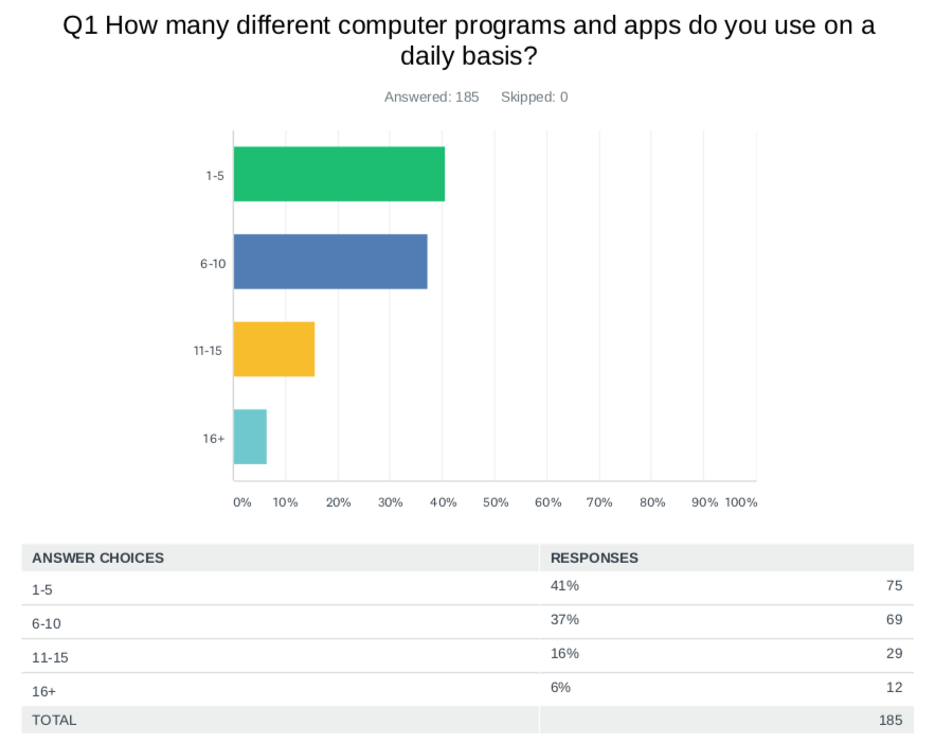
    People’s habits are baked in for a core group of apps: 78% use 10 or fewer apps each day, and 41% use five or fewer apps on a daily basis. When you consider the apps that we all use for activities such as email, web browsing, messaging, social media, entertainment and work, you can see that there’s only so much room for people to bring extra software into their daily routines.

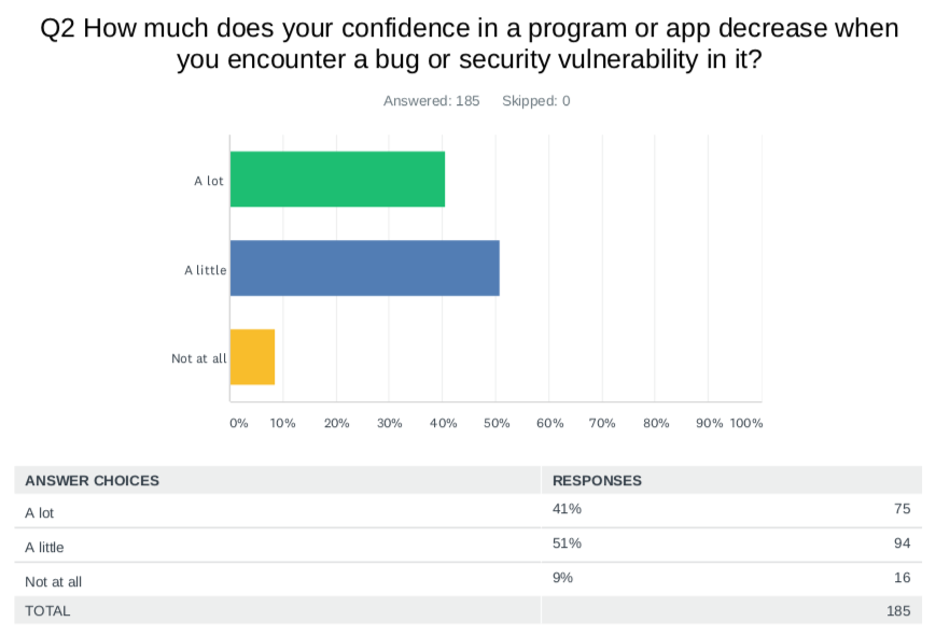
    Bugs and security vulnerabilities clearly have consequences: 92% of users lose confidence when they encounter them. People have high standards and they’re not willing to ignore issues.

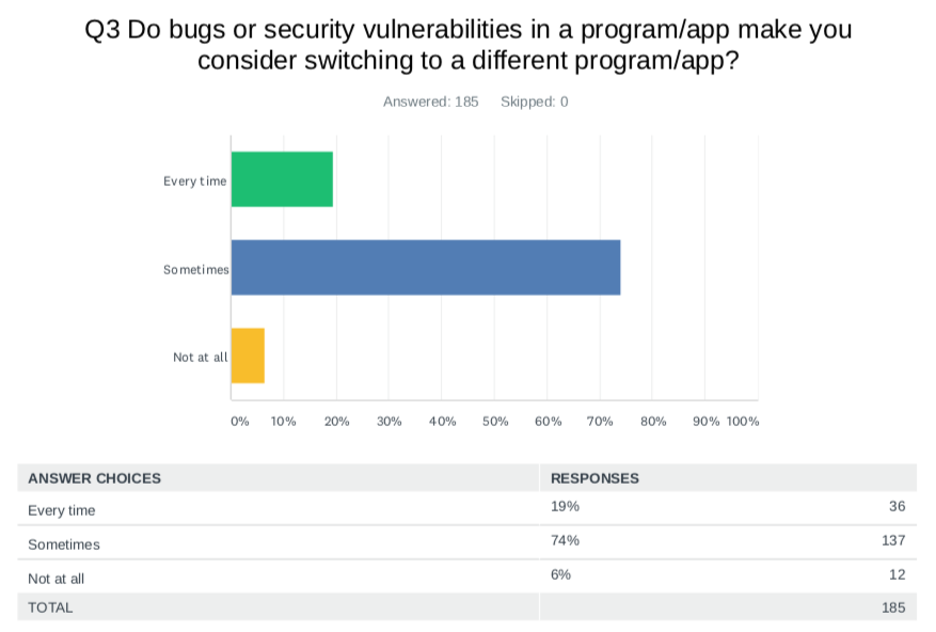
    Not only are software issues taken seriously, but they cause 93% of users to consider switching to a different app. With so many options available today that share a lot of similarities, software companies have to be careful not to push people in a different direction.

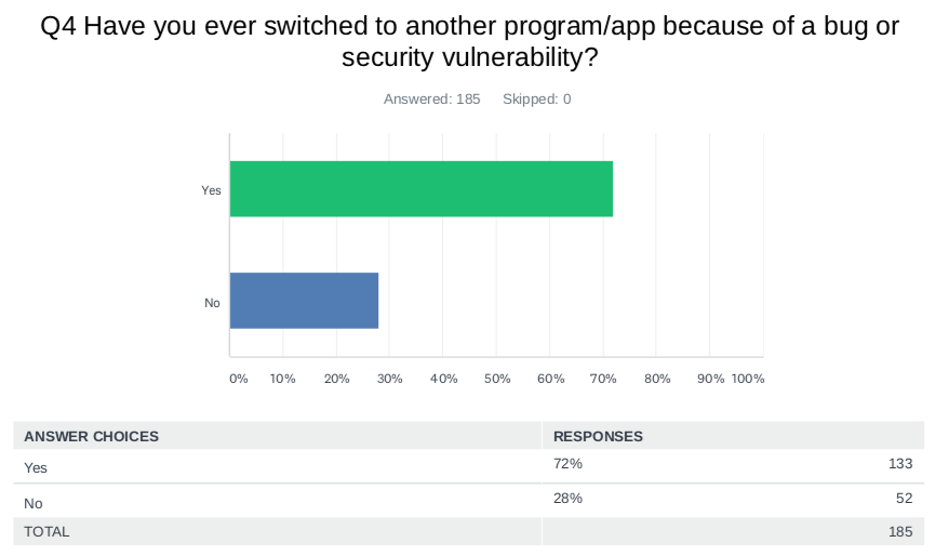
    Considering making a change to different software is one thing, but 72% have actually done it because of bugs and security issues. User loyalty doesn’t always last forever.

    A nice majority believe that software companies take quality issues as seriously as they should. Users know developers have a lot to deal with and are doing their best, but as we’ve seen so far, that doesn’t change the fact that they’ll have a negative reaction when your software lets them down.

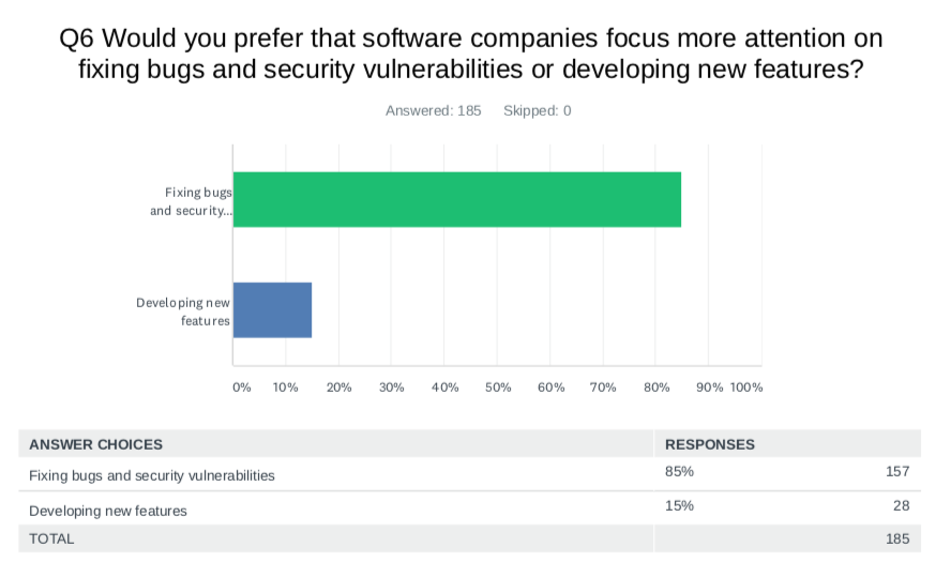
    There’s still a perception out there that all users care about are big, new features. Because of that, many times you’ll see software companies downplay bug fix releases as if they’re not worth mentioning. With 85% preferring bug/security fixes over new features, your best feature in any release is improved quality.

    The earlier statistic about software companies taking quality seriously carries over to this question because 83% think it’s improving. It’s encouraging to see that extra attention on bugs and security issues is directly resulting in better software.

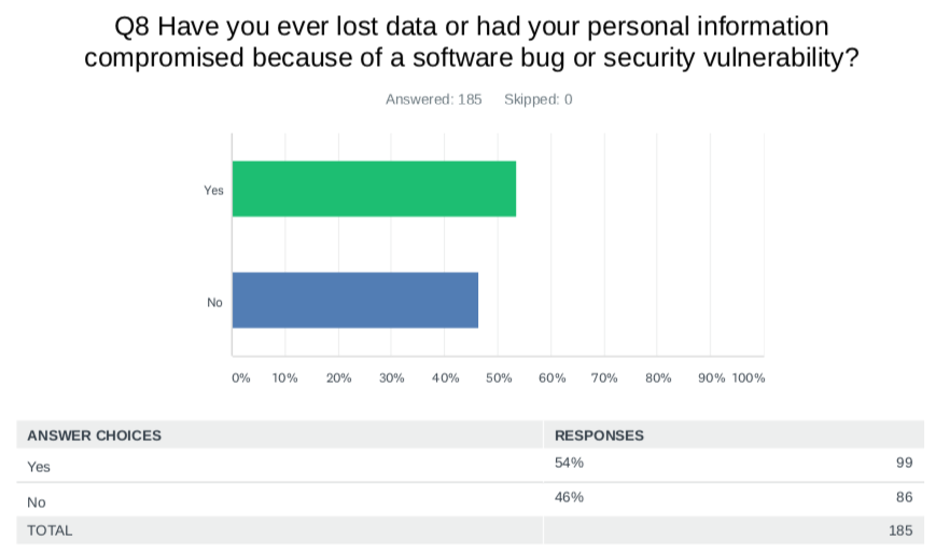
    This one is rather evenly split, but if software quality is indeed getting better, then hopefully the percentage of those impacted will trend downward over time. It’s important to be cautiously optimistic here, however, because as software gets more ingrained in our lives through the internet of things and beyond, we’re opening ourselves to data and privacy threats that none of us are properly prepared for.

    Quality Is Key

    The results of this survey prove that quality software matters. Our brains may be telling us that, but if we’re honest, sometimes our hearts convince us that new features are the most important thing—no matter the cost. Users prefer bug/security fixes, and if they encounter software problems, they’ll consider switching. It’s really that simple.

    Smaller software companies may not have the resources to innovate on the same level as some of the bigger players, but they can focus on improving the quality of what they offer. When a user has a bad experience with a competitor, your company can be known for quality and provide a safe haven for anyone comparing different options.

    The users have spoken: You’ll be rewarded for building quality into the software development process.