Tag: CIOs

  • How CIOs Can Measure Digital Transformation ROI

    How CIOs Can Measure Digital Transformation ROI

    To fully grasp how to measure success and gauge progress toward goals in any digital transformation, it’s important to understand the shifting expectations of CIOs who must report these objectives and outcomes. The pandemic has substantially changed the role of the CIO, giving them heftier goals and a shift away from IT.

    Today’s CIO is no longer solely responsible for the IT department. Instead, the expectation is for them to have a greater influence in solving strategic business challenges. CIOs are now held to higher standards and have great responsibilities, with the assumption that they excel at communication and facilitation. Today’s CIO role also includes business planning and monitoring, transformational development, testing and security and compliance.

    Gartner states that, in a technology-driven workplace, 41% of tech producers are within other business units, not in IT. Solutions are being created from those in charge of the bottom line, who make organizational and business decisions. Further, the rise of low-code platforms has accelerated the shift from IT to the business. Finally, as Generation Z moves into the workforce, there will be a significant shift in what this workforce wants and needs to be their most productive and fulfilled. Typically, this generation of workers are masters of autonomy and they strive to impact everything they touch and have greater control over what they handle and take on.

    Within this shifting landscape, it can be difficult to understand how to measure and set goals.

    Acquire the Right Tools and Frameworks

    The first thing CIOs need to provide to this decentralized organization is the right tools and frameworks. These tools, such as value stream delivery platforms (inclusive of CI/CD, testing, artifact management, etc.) coupled with agile frameworks like SAFe provide a consistent method to deliver apps within the organization.

    CIOs need platforms that allow them to visualize, manage and monitor progress on an ongoing basis. While this was largely a manual process before, solutions have vastly improved and, luckily, we no longer need to sit in a room and manually whiteboard progress.

    Leverage Value Stream Management

    This is often new territory for CIOs and can be daunting. CIOs need to be able to protect the organization, facilitate the quality of its solutions and take accountability for the tools being used and sold to its customers. Fortunately, this new power and influence can be managed with value stream management. It is what allows CIOs to keep track and monitor the bottlenecks in the development process. Further, the CIO can provide collaboration tools to help connect users around common processes.

    Value stream management can be a powerful improvement tool for organizations. It can serve as a material and information flow map that helps workers and executives continually view their performance and improvements. “Value” emphasizes that the purpose of the work process can prove the value and worth to the customer, while the term “stream” means that the flow of this value is being measured throughout the process.

    Set Business Goals, Not Just IT Goals

    Digital transformation success for the CIO not only means that technology works, but that it works for the business. That means the goals CIOs set for technology need to meet whatever bottom-line goals are set for the business, too.

    Define KPI objectives that align specifically with the business’ goals and focus on relevant metrics that matter. There are a number of types of metrics that CIOs should consider, but each organization will have to choose which are most relevant to their unique business, industry and their business goals: User engagement, customer experience, reliability, availability, active usage (think: Conversion rates, repeat customers/users, daily active users) are all examples.

    When choosing your metrics, find those that you can accurately benchmark against past performance. A baseline will prove your worth; without it, it’s difficult to understand value gained. Ultimately, the CIO must ensure that these metrics are valuable to everyone, and stakeholder buy-in is critical. Finally, everyone in the organization needs to be on board with these goals and metrics.

  • How 200 CIOs Responded to a Fully Remote Economy

    How 200 CIOs Responded to a Fully Remote Economy

    The COVID-19 global pandemic has ushered a significant priority shift for the digital workplace. As development teams become completely remote, executive priorities are rapidly adapting to meet the gravity of these unanticipated times.

    But, were IT leaders prepared for such a dramatic shift? What are they doing to evolve? To answer these tough questions, let’s turn to the data. A March 2020 study, conducted by Adobe and Fortune, surveyed 200 chief information officers (CIOs) on how their priorities are changing to meet the needs of a global crisis. Here’s what they found.

    Remote Work

    As it turns out, the majority of enterprises (84%) report they were prepared for remote work, with a slight increase for SMBs, at 94%.

    “Like most business leaders, CIOs now have to rethink priorities, or at least reorder them, and we must reinvent ourselves now as virtual leaders,” said Adobe CIO Cynthia Stoddard.

    We are living in a golden age of virtual collaboration tools—teams have Slack, GitHub, Zoom, Microsoft Teams and many other options. Yet, 53% of CIOs still cite communication as the biggest hurdle to remote work. Nevertheless, half of the CIOs surveyed reported their organizations are still actively hiring, indicating steady growth for IT.

    New Technologies

    Regarding technological adoption, some organizations are struggling to keep pace. Twenty percent of CIOs report serious shortfalls in technology tools. Interestingly, less than 25% of CIOs estimated increased financial spending for areas such as public cloud, infrastructure and artificial intelligence/machine learning (AI/ML).

    “Indeed, nearly all CIOs (90%) surveyed said they use a public cloud service for at least some of their data, but most is housed on-premises,” said Giselle Abramovich. “Only one in three organizations store half or more of their data in a public cloud.”

    One thing most enterprises agree on is the need for better security—seven in 10 anticipated increased financial investments into cybersecurity.

    Artificial Intelligence

    Only 50% of enterprise CIOs said they use AI in one or more projects (25% for SMB CIOs). However, it seems to be a growing discipline, as 90% of the organizations that have implemented AI have done so in the past year.

    Though AI has garnered significant interest, there are hurdles to actual implementation. According to the report, “the biggest issues related to AI include getting data in order, funding and finding the right talent.” With more people online and the importance of distanced communication, it is likely that investments into AI will increase, especially for use in IT support and customer interactions.

    “We’re making AI a strategic priority at Adobe. AI implementation is difficult for many organizations because it’s still new to most businesses, and there is a shortage in talent that has a deep understanding of it,” said Stoddard.

    Analysis: Impact on DevOps

    CIOs are in a unique position. Leaders are reevaluating business practices and also reassessing their technological investments. As the Adobe/Fortune study shows, many companies were prepared for 100% remote work, albeit some more than others.

    To endure a COVID-19 economical drought, CIOs are taking action. The report indicates increased investment into remote tools, AI and cybersecurity, while aligning hiring and new infrastructure to reach these goals.

    Institutions with a previous investment into cloud infrastructure as well as scalability practices, such as serverless, are likely well-equipped for increased online interaction and unanticipated usages. In this virtual realm, automation is also key to streamline deployments and monitor applications in remote fashions.

    Though the report doesn’t differentiate between company types, it’s likely that digitally native enterprises are well-equipped as well. In addition, the trend from physical storefront to “brick and click,” has only been magnified by the current climate, forcing retail and banks to invest heavily in digital technologies and DevOps.

    From a DevSecOps standpoint, increased end-user online action means an increased number of threats. Thus, security strategies for containers and service meshes should be reevaluated.

    By repositioning priorities, IT can adapt to the new state of interaction. With deliberate execution, CIOs and all executives alike could find themselves on the right side of the river once the economy resumes.

  • Many CIOs Left Out in the Cold, Survey Finds

    Many CIOs Left Out in the Cold, Survey Finds

    While many enterprises realize that the very success of their business depends upon how well they invest and execute in their technology deployments, a full quarter of CIOs don’t have direct access to their company’s board of directors. This was a finding from the recent “ITWeb Brainstorm CIO Survey.” The 2019 survey was conducted August through October and captured input from close to 200 CIOs.

    While a quarter of the CIOs surveyed said they don’t have direct access to their company’s board, more than half did say that they report to the CEO and half do have a seat on their board.

    Those results indicate that at least half of enterprises realize the importance of enterprise technology in their future.

    However, when it came to public sector IT, those CIOs expressed that their organization perceives IT as more of a technical support role than as a strategic business partner.

    The survey also found enterprises have significant work to do when it comes to their digital maturity. According to the survey findings, 54% of respondents self-reported as having a “basic” digital maturity. While 38% self-described their digital maturity as advanced, and only 6% as fully mature. That could explain, at least partially, why CIO respondents in private sector businesses said their organizations perceive them as a strategic business partner.

    How do CIOs say they spend their time? Forty-seven percent said they spend their time digitizing processes, while about a third of respondents said they spent their time discussing strategy with business leadership, security/risk management, governance/compliance and developing new products and services.

    When it came to what is holding back their efforts, the CIOs cited the following in order of importance: lack of skills, conflicting stakeholder priorities, unrealistic expectations around delivery, legacy constraining new developments and low budget. So it’s no surprise that 55% of respondents said their organizations are actively seeking new skills, while only 13% are not growing new talent.

    The survey also found that respondent IT budgets are outpacing core price inflation and those budgets are targeting cybersecurity (63%), data analytics (47%), ERP and core applications (44%), network infrastructure (40%) and automation/RPA (40%).

    What is so surprising with these findings is that only 36% of private sector organizations have an IT budget for innovation (only 15% for public sector organizations), and 17% of private sector CIOs said that they don’t have any time for innovation as they are too busy supporting their current systems. That figure leaped to 39% for the public sector.

    In today’s era of digitization, that’s not a tenable situation for enterprises that want to succeed and thrive. Our recent post, “CIOs See Dramatic Change Ahead,” covers the results of a 2019 Harvey Nash/KPMG CIO Survey, which found those organizations where the IT team is formally involved in business technology decision-making have better business outcomes.

    Also, according to that survey, those enterprises that consider themselves to be digital leaders outperformed in many categories including the time to market, customer experience, revenue growth and profitability in the previous year. Digital leaders were found to be more likely to introduce “major new changes to products and services” in the next three years and focus on profitability.

    When considering those findings, it’s clear maintaining legacy business-technology investments just isn’t good enough.

    — George V. Hulme

  • CIOs See Dramatic Change Ahead

    CIOs See Dramatic Change Ahead

    Driven by heightened competition and a rapidly changing business environment, many enterprises now find themselves faced with decisions that could make or break their future.

    Consider this: Within three years, 44% of respondents to the 2019 Harvey Nash / KPMG CIO Survey expect to fundamentally change their product, service offerings or business model. It’s a finding that spans enterprises both large and small, the survey said.

    This could explain why IT leaders reported their technology budget to be increasing the most in 15 years. The report found 45% of respondents favor budget increases for money-saving technology efforts, such as task automation. Interestingly, almost two-thirds, or 63% of organizations, report that considerable amounts of their enterprise technology efforts are managed outside of the control of their IT department.

    However, the survey showed those organizations where the IT team is formally involved in business technology decision-making have better business outcomes. These enhanced outcomes include improving new product time-to-market and employee experience to be better than their competitors. Still, four in ten companies are not formally involving IT in those business-led IT decisions.

    Increased investments in automation and artificial intelligence (AI) are expected to place considerable churn on the workforce. CIOs are expecting to witness one in five jobs being replaced by AI/automation within the next five years. However, 69% of CIOs also expect enough new jobs to replace those positions lost to automation.

    “Boards are asking their CIO and technology team to prioritize automation of jobs. How organizations adapt to automation will increasingly become a priority, and many are not at all ready,” said Albert Ellis, CEO of Harvey Nash.

    Despite CIOs enjoying a rising influence within their organizations, fewer CIOs have seats on the board of directors at their organization—having fallen significantly from 71% who held board seats just two years ago to 58% today.

    The 2019 Harvey Nash/KPMG CIO Survey, conducted between December 2018 and April 2019 across 108 countries, is based on the responses of 3,645 CIOs and technology leaders.

    While automation and AI may, or may not, displace workers in the future enterprises are counting on them today to help close their perceived skills shortage. According to respondent’s, enterprises continue to find it a challenge to obtain the talent they need. In fact, respondents reported skills shortages at their highest level since 2008.

    The employees most difficult to find are those in data analytics (44%), cybersecurity (39%) and artificial intelligence (39%).

    Finally, respondents surveyed who consider their organizations to be digital leaders (those who see themselves as very effective or extremely effective at using digital technologies to advance their business strategies, performed better than their competitors on every aspect surveyed.

    According to the survey, digital leaders outperformed in time to market (53% versus 34%), customer experience (65% versus 49%), revenue growth (55% versus 43%) and profitability in the previous year (50% versus 37%). Digital leaders, the survey said, are also more likely to introduce ‘major new changes to products and services’ in the next three years (55% versus 39%) and focus on profitability.

    — George V. Hulme

  • Strap in, CIOs: Analysts Predict Wild Ride for 2018-2020

    Strap in, CIOs: Analysts Predict Wild Ride for 2018-2020

    Digital transformation is the underlying theme of many of the 2018 and beyond IT predictions made recently by analyst firms Forrester, Gartner and IDC. Technologies such as cloud, AI, data analytics, big data, blockchain, IoT, conversational interfaces, DevOps and cybersecurity will also force CIOs to perform a juggling act. The rapid evolution of these technologies combined with the business opportunities they unlock will create a pressure cooker for CIOs, become an everyday topic of discussion for C-suites and possibly even a preoccupation of boards of directors.

    We’ve analyzed the predictions by the three research firms and have gathered the key themes as the seven most pressing issues for the C-suite next year and beyond:

    1. CIOs are at a Crossroads, Representing Both Challenge and Opportunity

    Forrester believes that CEOs will make digital business a top priority in 2018 and CIOs will lead the digital transformation at most companies. In a November report, “CIOs Make the Chief Digital Officer Obsolete,” Forrester summed up: “In 2018, boardroom discussions will focus on digital. Key questions will revolve around platform-based business models, new partnership ecosystems, and new ways to organize for success. CIOs will build new skills and competencies to help drive this change.”

    The challenges for CIOs during this period will demand that they step up, expanding their digital skill sets and employing technologies with both eyes focused on business value. Forrester predicts that CIOs will need to orchestrate the underlying technologies and supplier relationships for companies to manage their platform-based business approach. CIOs would also be smart to leverage cloud computing and open source software, and build on containers, APIs and microservices.

    CIOs also may need to develop new leadership skills to direct their company’s digital transformation. That includes displaying a laser-like customer focus, attracting the necessary talent, restructuring their organizations and developing the culture required to deliver tangible business results. Doing so, Forrester said, “will present CIOs with the opportunity of a lifetime, allowing them to demonstrate the level of trust and performance that their senior peers and boards require, and positioning them as leaders of the digital transformation — even the enterprise.”

    IDC’s November “Worldwide CIO Agenda 2018 Predictions” offers predictions that dovetail with Forrester’s view:

    • By 2020, 60 percent of CIOs will implement an IT business model and culture that shifts focus from IT projects to digitally oriented products.
    • By 2020, 60 percent of the CIOs who have crossed the digital divide will prevail in C-suite turmoil in competition to become digital business leaders for their enterprises.

    Advice to CIOs: Find a leadership coach. Choose one or two lieutenants you trust to delegate important roles to. Find a senior product manager-type person in your company to help you become more knowledgeable about generating business value. Make a point to talk to your CEO about the advantages of digital transformation. Develop a plan for adopting a new digital governance model. What should your digital platform look like?

    2. Digital Transformation Becomes Real for Most Companies in 2019-2020

    We’ve been hearing for a couple of years that companies are digitally transforming their businesses. The truth is that those companies represent the leading edge and they are a small minority. Most CIOs are still stuck doing more with less, the hangover from the last recession. CEOs: Your CIO needs more budget to position your company for digital success over the next few years. IDC predicted that “through 2019, 75 percent of CEOs and their enterprises will fail to meet all their digital objectives, dragged down by conflicting digital transformation imperatives, ineffective technology innovation, cloud infrastructure transition and underfunded end-of-life core systems.”

    That’s a lot of failure. CEOs and CIOs are going to need to work together to make digital transformation a reality. It’s not just about updating your technology, it’s about business innovation.

    Key points on digital transformation from IDC’s CIO 2018 predictions:

    • By 2019, 60 percent of CIOs will complete infrastructure and application replatforming using cloud, mobile and DevOps, clearing the deck for accelerated enterprise digital transformation.
    • By 2019, 60 percent of IT organizations will have deployed digital transformation platforms supporting new customer- and ecosystem-facing business models.
    • By the end of 2019, digital transformation spending is expected to reach $1.7 trillion worldwide.

    3. AI is No Panacea

    Forrester named one of its 2018 prediction reports “The Honeymoon for AI Is Over.” Conventional analytics are undergoing full disruption, largely because AI is perceived to be the solution to both programming analytics and solving the big data riddle. And while it’s likely that AI/machine learning will be able to help with both problems, you can’t just snap your fingers and make it so. Harnessing AI successfully requires specialized engineering talent, quality data, objective planning and some trial and error. According to a Forrester survey, 70 percent of respondents say their firms will have implemented AI in the next 12 months. They chose decision management as their most important use. One of the key points to remember is that the decision-making abilities of it machine learning tool can’t over calm a lack of quality data. Forrester warns: “Don’t be fooled by vendor claims that more intuitive human-to-machine interfaces are [a magic potion] that reduces the need for data and metadata management and curation.”

    Quick AI predictions from IDC:

    • By 2019, 40 percent of digital transformation initiatives will be supported by cognitive/AI capabilities, providing timely critical insights for new operating and monetization models.
    • By 2020, 85 percent of new operation-based technical hires will be screened for analytical and artificial intelligence skills, enabling the development of data-centric digital transformation projects without hiring new data-centric talent.

    4. One-Third of Enterprises will Abandon Big Data Repositories in 2018

    Has your company built a large data lake that hasn’t delivered any significant business value? Well, 2018 may be the year when you rethink that decision, according to Forrester.

    On the other hand, Forrester believes that AI will be able to resolve the longstanding issue of the boundary between structured and unstructured data because of vendors including Digital Reasoning, Expert Systems and Stratifyd.

    As you make your move to digital transformation, having more actionable data based on your pool of big data, especially unstructured text data, could deliver book valuable business insights. This might not be the best time to give up on big data. Especially if you’re actively engaged with AI.

    5. Blockchain: Confusing, Skills Gap, Steeped in Hype—but Full of Potential

    Blockchain will begin to show next year just how difficult it will be to employ but, at the same time, that it’s worth exploring.

    “By the year 2020, the banking industry will derive $1 billion of business value from the use of blockchain-based crypto-currencies,” states Gartner’s October “Top Strategic Predictions for 2018 and Beyond.” “When compared to the estimated $7.6 trillion that is the industry gross output of the world’s banking industry, $1 billion may not seem like much. However, the value is more about the tacit endorsement of crypto-currency as a legitimate option by the banking industry.” Cryptocurrency is just one application of blockchain.

    Advice: Build your blockchain ecosystem early, Forrester recommends in its 2018 prediction report, “Be Ready to Face the Realities Behind the Blockchain Hype.” “The blockchain terminology will remain confusing,” Forrester noted. “The term ‘blockchain-inspired’ is already a common descriptor for software that has some of the characteristics of blockchain or reflects some of the principles of the blockchain network, but isn’t a blockchain in the true sense.” There is a growing skills gap pertaining to software engineers and security professionals who have experience with blockchain. It’s a nascent technology; make sure your team sets realistic goals.

    6. IoT Hits Prime Time, but it Might Not Be Ready

    By 2020, IoT technology will be in 95 percent of new product electronics designs, Gartner said. IoT’s growth is very rapid, even for the computer industry. But that growth comes at a cost. The technology has not overcome what many believe to be rampant security vulnerabilities. “Through 2022, half of all IoT security budgets will be spent on fault remediation, recalls and safety failures rather than protection,” Gartner predicted.

    Forrester is far more positive about the business advantages of IoT in its report, “IoT Moves from Experimentation to Business Scale.” Its predictions are also more detailed in the several areas where IoT might gain traction in 2018. But the security issues are not lost on Forrester, either. The research firm predicted: “IoT will be at the center of broader and more damaging cyberattacks. The Mirai botnet was a harbinger of future IoT security-related attacks and breaches. … Most firms still haven’t shown a consistent commitment to mitigating IoT-specific threat vectors.”

    Advice: IoT is an accident waiting to happen. For B2C companies, the consumer backlash could be fierce if there is a major incident. Make 2018 be the year that you start plugging up those IoT security vulnerabilities and protection gaps.

    7. Most Companies Won’t Comply with GDPR in 2018

    The European Union’s General Data Protection Regulation (GDPR) takes effect May 25, 2018. Forrester predicted in its November report, “A Year of Reckoning,” that 80 percent of companies will fail to comply with the GDPR. Perhaps more to the point, Forrester additionally predicts that 50 percent of those non-compliant firms will do so intentionally, “meaning they have weighed the cost and risk, and are taking the path that presents the best position for their companies.” The other half of the 80 percent will try to comply but will fail.

    Advice: It seems likely that some large company will be made an example of. You don’t want that to be your company.

    Takeaways

    Those are the standout IT-related issues for the C-suite in 2018 and beyond. If you weren’t tuned in to some of them, knowing is half the battle right? Well, probably not. These are tough challenges. Each organization has its own strengths and weaknesses. But generally speaking, if you parse this list by investing time and budget on the first four while minimizing the potential downsides of last three, you’ll be doing very well.

    — Scot Finnie

  • Survey: CIOs Driving Digital Transformation

    Survey: CIOs Driving Digital Transformation

    A survey from IT World Canada (ITWC) apparently shows that CIOs are preferred by their companies to shepherd the digital transformation process in part because of their knowledge of legacy systems. The fifth annual CanadianCIO Census concludes that CIOs are “able to bridge in-place technologies required to run the business, while increasingly guiding their companies on how to grow and transform the business using digital technologies.”

    Going hand in hand with that notion is the survey’s finding that the rise of the chief digital officer is a myth.

    There are other interesting takeaways from the survey, which was completed by 164 IT leaders, mostly CIOs, in April:

    The 2017-2018 time frame is shaping up to be a growth year with nearly half of respondents expecting to add IT staff this year, and only 7 percent expecting to decrease staff. Increased IT budgets are also the trend for 2018, with 57 percent of the respondents reporting that they expect an increased IT budget. Some 11 percent expect an increase of more than 15 percent.

    Although the No. 1 concern of respondents is data security/data privacy, the more significant bit of data may be that the third-highest concern is business innovation, which rose significantly in priority over last year’s survey. Canadian CIOs also seem less enthralled with some of the latest technologies that some of their U.S. counterparts ballyhoo. Social media, artificial intelligence, blockchain and even internet of things rated lowest in terms of “benefits realized to date from investment” in these technologies.

    The picture that emerges from the survey is a strong tension between opposing forces faced by IT executives. Cloud services, though heavily embraced and widely successful, still haven’t brought down the price of keeping the lights on sufficiently to divert enough IT budget to digital transformation and business innovation projects. The transition of funding toward digital business is inevitable in some companies, and senior IT leaders need to avoid being run over by that freight train. If IT budgets grow year over year, investment in digital transformation should be stepped up significantly, too. Find ways to automate processes that were more labor-intensive before.

    Analysis

    Although the survey finds that the CIO is the de facto digital transformation technology leader, I’m not sure you can draw that as a hard conclusion from a survey of 164 mostly CIOs. CIOs are a logical choice for this role, assuming they possess strong technical acumen, in-depth knowledge of the systems in place and up-to-date insights on the latest tools and services at their disposal. Many CIOs have shrewdly focused on the business innovation end of things—in other words, what you can do with a digitally transformed enterprise. And in the long run, that may be the smarter position for a CIO to take.

    No CIO should assume they are in the driver seat on digital transformation. On the other hand, grooming and selecting a lieutenant to execute on the digital plumbing while you plan and implement your first digital business wins may be the better approach for some CIOs.

    — Scot Finnie

  • What Can Digital Transformation Do For You?

    What Can Digital Transformation Do For You?

    Contrary to what the massive articles around digital transformation suggest, your business lines’ primary concern isn’t the amazing technology innovations that pop up every day but how well they’re going to deal with your industry’s disruption. Something is sure, your IT organization’s digital transformation cannot be narrowed to technology changes; that’s a simplistic vision which ignores the disruptive impacts on businesses, particularly on the IT function.

    Howard King, writing in “What is Digital Transformation?” published in The Guardian, makes it clear, “Transformation is a whole scale change to the foundational components of a business: from its operating model to its infrastructure. What it sells, to whom and how it goes to market.” He’s right, the business-oriented vision of IT demands a transformation of your IT organization including its infrastructure, applications delivery approach and operating model, and DevOps increasingly is cited as the foundation of the new IT.

    This article shares my experience and lessons learned implementing DevOps as the foundation of digital IT organizations.

    Top Priority: Dealing with Your Industry Disruption

    The belief that implementing a continuous delivery infrastructure is all your business need to survive digital disruptions is a marketing hype DevOps practitioners have grown accustomed to. It’s a myth that prevents you from making informed digital transformation decisions. Emphasizing the technology at the expense of your industry’s disruption forces you to make technology change prematurely; your priority actually should be to figure out how to deal with the disruptions hitting your industry.

    Ask yourself this: What’s the interest in investing in scattered continuous delivery infrastructure implementations, when your favorite vendors and consultants aren’t able to clearly address these concerns:

    • How can you restructure your business value stream to make it lean and agile so that the right services are timely delivered to the right market segments?
    • How can you integrate DevOps, IT as a service, cloud, Internet of Things and big data into a coherent and consistent business capability so that the right services are timely delivered to the right market segments?
    • What’s the architecture of your future information system, including your virtual data center and application delivery infrastructure?
    • What will your role be as the CIO? How will the relationships with your business lines and vendors be managed?

    Make no mistake about it, these are your business line concerns of the moment. Unless you address them, Chef, Puppet, CodeDeploy or any other software application alone won’t help to keep up the pace imposed by Uber, Apple, Google and the like. You’ll need to bring together your business and IT staff in a lean and agile capability, which demands a re-engineering of your IT structure, processes, practices and governance.

    DevOps is the Foundation of Your Digital IT Organization

    Let’s remove the ambiguity: Infrastructure as code isn’t DevOps. The increasing confusion of DevOps with continuous delivery infrastructure is slowly but surely killing it—it’s even disqualifying it as a competitive advantage. That vision focused on tools has nothing to do with the logic underneath DevOps.

    As I’ve been making clients happy with it, DevOps is primarily an application delivery model that seeks to make businesses responsive to market opportunities through accelerating added-value applications delivery and with the goal of continuously generating value. It’s based on three principles helping businesses survive digital disruptions, then grow and prosper:

    • Using continuous delivering infrastructure to speed application delivery doesn’t make sense unless tangible business benefits are generated.
    • Applications are the means by which value is brought to customers and business benefits are brought in.
    • Agile principles across your software development life cycle makes your value stream lean and agile which in turn results in continuous value.
    DevOps Delivery Model - Philippe Abdoulaye
    DevOps Delivery Model – (Credit: Philippe Abdoulaye – ITaaS Now LLC)

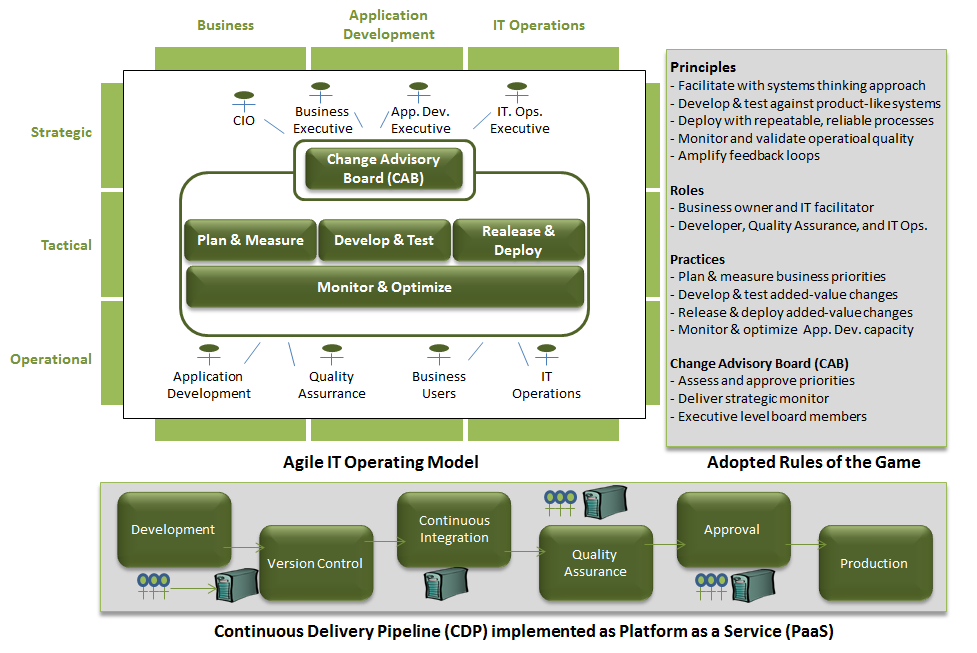
    The delivery model uses three levers to implement the above principles and establish DevOps as the foundation of your digital IT, they include:

    • The rules of the game, which are agreed-upon principles, practices, roles and responsibilities and tools institutionalized to ensure agility and accelerated applications delivery;
    • The operating model, which is the lean and agile work environment resulting from the application of the rules of the game; and
    • The continuous delivery infrastructure, which is a platform that leverages infrastructure-as-code solutions to accelerate applications development and deployment.

    The Digital IT Organization: Approach, Principles, Tools

    Success in IT organization transformations often come more from a stream of small wins than from a one-time flood. That’s what I call incremental transformation, illustrated in the following digital five-stage transformation journey:

    The digital IT organization implementation process
    The transformation journey – (Credit: Philippe Abdoulaye – ITaaS Now LLC)

    The following recommendations definitely will make you instrumental to your IT transformation and help your business meet the digital economy’s competitive challenges.

    Strategize

    A CIO who’s expected to help business lines survive their industry’s disruption, grow and prosper first must clarify their business objectives; estimate potential gains, losses, and risks; and create a consensus on the DevOps delivery model to implement in terms of high-level architecture and implementation timing. That’s the purpose of the Strategize stage.

    Never skip this stage—it’s where the executive buy-in is obtained and the vision of the future IT capability is developed. Make sure the following is accomplished:

    • Creating an executive task force co-led by the CIO and a business representative;
    • Scheduling one to three workshops addressing your transformation business case, transformation road map, high-level blueprint of the future IT capability and the DevOps adoption plan;
    • Designating a project manager; and
    • Communication by task force members regarding the whys and wherefores of the transformation initiative.

    Plan

    Digital transformation involves many functions within your business in the form of a cross-functional team: the concerned business and IT staff. Your responsibility as the CIO is to bring the voice of the business across the transformation journey, from business objectives clarification, to design and implementation, to pilot experiment, to deployment.

    Again, do not overlook this stage—it’s about translating the effort into team structure, implementation schedules and operational and strategic reviews. It’s where the risks likely to hamper projected objectives are anticipated. Make sure workshops involving the business and IT are set up to address the following:

    • Team structure and roles and responsibilities;
    • Transformation road map steps translated into operational timelines associated along with expected outcomes; and
    • The project’s operational and strategic reviews, including a risk management plan.

    Design and Implementation

    The third stage is when the three dimensions of the digital IT organization are designed and implemented. They include the DevOps rules of the game, the operating model and the continuous delivery infrastructure.

    Never improvise this stage—use a proven approach to address the dimensions. Favor a collaborative approach that includes workshops or brainstorming sessions with the concerned business and IT staff.

    In the rules of the game brainstorming sessions, make sure the following is addressed:

    • Organization and operational dysfunctions preventing cross-functional collaboration, rapid problem-solving and decision-making;
    • Recommendations to the dysfunctions in terms of agile processes, practices, roles and responsibilities and tools;
    • Recommendations mapping to the appropriate DevOps principles, practices, roles and responsibilities and governance structure; and
    • The IT organization’s DevOps charter, thought to accelerate the rules of the game and the operating model adoption.

    In the continuous delivery infrastructure workshops make sure the following is addressed:

    • A delivery pipeline, including steps and for each of them what follows:
      • Required staff, skills and background
      • Implementation, testing and deployment agile processes and practices
      • Implementation, testing and deployment tools, such as Chef, Jenkins or CodePipeline

    Experiment

    For this stage, set up a pilot experiment involving, in a small-scale real-business setting, a panel of business and IT staff to evaluate the likelihood of the project benefits.

    Neither skip nor overlook that step, it’s where improvements are identified. Throughout the pilot project, make sure the following is in place:

    • Executive task force monitoring the pilot project through bi-weekly reviews;
    • Concerned business lines and IT business lines are involved;
    • Training campaigns are organized around the DevOps charter, the operating model and the continuous delivery infrastructure;
    • Strategic management tools, such as balanced scorecards to monitor progress, risks and achievements; and
    • Measurement of the impacts of the operating model and the continuous delivery infrastructure against the projected benefits.

    Deploy

    This final stage is a Go-No-Go milestone in which your task force, based on the pilot’s outcome, decides whether to deploy your digital IT capability at the scale of the company. Throughout the deployment:

    • Capitalize on the benefits generated by the pilot experiment to launch an information campaign emphasizing the benefits for the company and for the staff; and
    • Train business and IT staff on the DevOps charter, the operating model and the continuous delivery infrastructure.

    Wrapping up

    Today’s DevOps practices focused on continuous delivery infrastructure aren’t likely to help businesses grow and prosper in the digital economy. Thought leader Joe McKendrick in, “The road to digital bliss is paved with service thinking and DevOps,” confirms that fact.

    The approach discussed in this article are detailed in my recent book, written to help make IT leaders instrumental to their business digital transformation:

    Rethink Your IT with DevOps

    If you’re considering a DevOps-focused IT transformation, what will be your first steps? I’d love to hear your thoughts, let’s meet @TheFutureOfYourIT.