Tag: cloudpassage

  • CloudPassage Halo Now in Solution-Specific Packages

    SAN FRANCISCO – August 23, 2016 – CloudPassage today announced new packaged offerings for CloudPassage Halo to more cost-effectively address enterprises’ need for workload security. Award-winning CloudPassage Halo is now comprised of three packages–Halo Protect, Halo Segment and Halo Detect–which can be purchased separately or in any combination to provide workload protection, microsegmentation, compromise detection, compliance, DevSecOps and AWS EC2 security. At one-third the full platform pricing, the new packages provide enterprises with a more cost-effective entry point to workload security and the flexibility to add fully integrated functionality as the need arises.

    “While most of our customers eventually use the full range of security controls in CloudPassage Halo, many are initially looking for a more tailored solution to a specific security problem,” said Jack Marsal, Product Marketing Director, CloudPassage. “These solution-focused packages allow enterprises to address their most acute security problem in the most cost-effective manner while giving them flexibility to add a broader range of security controls as their security needs evolve. Customers can evolve their security systems and posture at the pace which is right for them.”

    The new CloudPassage Halo packages are designed to meet specific security challenges:

    Halo Protect reduces the software attack surface of workloads by ensuring proper security configuration, discovering software vulnerabilities, and controlling administrative access.  

    • Configuration Security Monitoring (CSM) automatically monitors operating system and application configurations, processes, networks services, and privileges and compares them to the latest policies and standard industry benchmarks.
    • Software Vulnerability Assessment (SVA) automatically scans servers and cloud workloads to check for software vulnerabilities and to maintain continuous exposure awareness in the cloud and across all environments.
    • Server access management lets IT security managers monitor, audit and evaluate account access and privileges of all servers in any operating environment though a single online management console.

    Halo Segment  reduces the network attack surface through traffic discovery, host firewall orchestration, and multi-factor network authentication.

    • Traffic discovery and visualization lets IT security managers visualize the IP connection patterns and listening ports of workloads and servers, both between Halo-protected systems as well as connections to and from remote systems. This makes it easy to create dynamic firewall policies that prevent unwanted lateral movement of threats.
    • Workload firewall management lets IT security managers easily deploy and manage dynamic host firewall policies across all environments. Policies are based on the server tags, not the IP addresses, so changes to host firewall tables are made automatically as new servers are added, retired, or as IP addresses change.
    • Multi-factor network authentication lets IT security managers keep server ports and IP addresses hidden and secure while allowing temporary on-demand access for authorized users.

    Halo Detect alerts you if any of your workloads have been compromised by monitoring whether important files have changed and by monitoring important server log files.

    • File Integrity Monitoring (FIM) protects cloud server integrity through constant monitoring for unauthorized or malicious changes to important system binaries or files.
    • Log-based Intrusion Detection (LIDS) continuously monitors key server log files for suspicious activity that could indicate misuse, misconfiguration or compromise.

    Additional details specific to CloudPassage Halo solutions can be found at https://www.cloudpassage.com/solutions/.

    CloudPassage Testimonials

    “Xero moved to a Security-as-a-Service model based on three principles: repeatable security automation, security at speed, and security on-demand,” said Aaron McKeown, Lead Security Architect, Xero. “CloudPassage Halo fits those principals, and for workload protection, we’ve mandated that Halo be included with every new EC2 instance we deploy. This has enabled our hundreds of developers to securely build and release over 800 new features last year alone.”

    “Qualpay has been using CloudPassage for two years, primarily to monitor our servers for compromise detection,” said Todd Troutman, System Administrator, Qualpay. “Halo has become critical to our PCI compliance posture. With Halo, we can rapidly meet new PCI requirements as well as new interpretations of existing requirements. We’ve recently started leveraging CloudPassage Halo’s traffic discovery and visualization functions in order to microsegment workloads and add visibility.”

    “Consensus Corporation chose CloudPassage for initial use in compliance,” said Dmitriy Dunavetsky, Director of Information Security, Consensus Corporation. “We were first focused on finding a solution that was easy to use and automated. We also wanted to make sure our decision was future-proofed for our evolving security needs. CloudPassage was the only automated, on-demand security platform we found that provided a broad range of security controls for compliance as well as workload protection, microsegmentation, compromise detection and DevSecOps and could work on any infrastructure.”

    About CloudPassage

    CloudPassage® Halo® is the world’s leading agile security platform that provides instant visibility and continuous protection for servers in any combination of data centers, private clouds and public clouds. The Halo platform is delivered as a service, so it deploys in minutes and scales on-demand. Halo uses minimal system resources; so layered security can be deployed where it counts, right at every workload – servers, instances and containers. Leading enterprises like Citrix, Salesforce.com and Adobe use CloudPassage today to enhance their security and compliance posture, while at the same time enabling business agility. Headquartered in San Francisco, California, CloudPassage is backed by Benchmark Capital, Lightspeed Venture Partners, Meritech Capital Partners, Tenaya Capital, Shasta Ventures, Musea Ventures and other leading investors.

    For more information, visit www.cloudpassage.com.

    CloudPassage® and Halo® are registered trademarks of CloudPassage, Inc.
  • CloudPassage Named “Most Innovative Cybersecurity Company”

    SAN FRANCISCO, CA–(Marketwired – May 05, 2016) –  CloudPassage today announced it has been recognized as the “Most Innovative Cybersecurity Company” in the 2016 Cybersecurity Excellence Awards, which are voted on by the more than 300,000 security professionals who participate in the LinkedIn Information Security Community. From nearly 200 cybersecurity vendors that were nominated, CloudPassage was selected as the winner of the mid-size company category, focused on the most innovative organization that has between 101 and 1,000 employees.

    “Enterprises are in the middle of a massive transformation of their IT infrastructure designed to let them move faster and stay competitive,” said Robert Thomas, CEO of CloudPassage. “Agile IT delivery models involve lots of automation, high rates of change, mixed environments and on-demand IT services. But traditional security tools don’t work with these modern IT environments. We’re winning recognition as a leader in the space because CloudPassage Halo is now a proven platform that enables this transformation.”

    CloudPassage Halo is an on-demand, security-as-a-service (SaaS) platform that deploys in minutes and automates a comprehensive set of security and compliance controls for servers in any combination of public cloud, private cloud or data center environments. The result is fast, effective security that solves problems of visibility, microsegmentation, compliance and speed of deployment.

    The 2016 Cybersecurity Excellence Awards honored individuals, products and companies that have demonstrated excellence, innovation and leadership in information security. Winners were selected based on the content of their nominations and the popular vote by the Information Security Community on LinkedIn, one of the largest online networks of cybersecurity professionals with over 300,000 members.

    As part of the company’s efforts to remain innovative, CloudPassage was recently awarded three patents that extend the scope of its original, agent-based, agile security model, making it the first company to obtain a U.S. patent for universal cloud infrastructure security.

    About CloudPassage

    CloudPassage® Halo® is the world’s leading agile security platform that provides instant visibility and continuous protection for servers in any combination of data centers, private clouds and public clouds. The Halo platform is delivered as a service, so it deploys in minutes and scales on-demand. Halo uses minimal system resources; so layered security can be deployed where it counts, right at every workload – servers, instances and containers. Leading enterprises like Citrix, Salesforce.com and Adobe use CloudPassage today to enhance their security and compliance posture, while at the same time enabling business agility. Headquartered in San Francisco, California, CloudPassage is backed by Benchmark Capital, Lightspeed Venture Partners, Meritech Capital Partners, Tenaya Capital, Shasta Ventures, Musea Ventures and other leading investors.

  • SecDevOps: the new black of IT

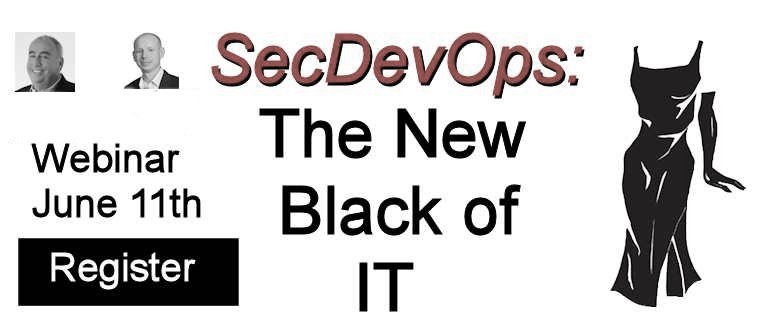
    SecDevOps: the new black of IT

    Much has been written about the role of Security in a DevOps culture. Almost universally the thought is that DevOps can help improve security.

    Why?

    How?

    Really?

    An old friend of mine from the security world Andrew Storms and I will discuss this and other issues around DevOps and security on June 11th at 1pm eastern time, 10am pacific time on a webinar entitled “SecDevOps: the new black of IT“.

    Andrew is the Sr. Director of DevOps at CloudPassage. Prior to that Andrew headed up the security research team at nCircle. He is oft cited in the security press and highly respected.  Andrew and I ill discuss how just when DevOps is catching on, adding to security to the mix can make it even more powerful. How can security help DevOps to succeed? How can DevOps help us with better security?

    We will discuss what this means in terms of different kinds of security tools and services, the cloud and more.

    If you are interested in security and DevOps register now and  tune in to the webinar next Tuesday

  • What’s new @DevOps.com

    What’s new @DevOps.com

    All of us here at staging-devopsy.kinsta.cloud have been very busy. In addition to adding some new writers and great new content, we have been working “outside the 4 walls of the website”.  Here is an update on what’s new:

    CampDevOps-logo-align_left1. Camp DevOps – We held our first Camp DevOps event last week in beautiful Boulder, Colorado at the University of Colorado, Boulder Campus.  It was a great event featuring a lot of great sessions.  Sanjeev Sharma of IBM, author of DevOps for Dummies (and a staging-devopsy.kinsta.cloud contributor) kicked things off with a great keynote. Andi Mann of CA had a great talk on implanting DevOps from the top down. Rajat Bhargava and Topher Marie of JumpCloud also had some great insights in their sessions. Rich Mogull’s “KickaaS Security” session was a great look at the top things you need in terms of security.  Another very popular track was Craftsy VP of engineering, Matthew Boeckman’s using S3 and Glacier for backup. There were some other great sessions but I can mention them all here. You can check out the Camp DevOps website for the full agenda.

    We will be conducting more Camp DevOps in the near future in cities throughout the US.  Some will be in conjunction with larger events or conferences within conferences, others will stand alone events. Stay tuned for more details.

    I was asked the question of whether Camp DevOps competes with DevOps Days. Short answer, no. We support DevOps Days and the culture they represent. Camp DevOps shares with DevOps Days the desire to advance DevOps, but takes a slightly different tack.  We will have both highly technical, as well as business orientated tracks. Camp DevOps will feature both learning on DevOps culture, as well as tools. We will also be adding more exclusive Camp DevOps activities to the events in the future.

    gluelogo

    2. Gluecon 2014 – Camp DevOps Boulder was held in conjunction with Gluecon in nearby Broomfield.  Gluecon was fantastic this year and also featured a full DevOps lineup. I was the moderator of the DevOps tracks on day one. Again some real quality presentations on Ansible, Saltstack and more. We will be posting video here soon.

    Look for more announcements regarding Gluecon and Camp DevOps soon.

     Webinars:

    Compuware APM – I was invited as a guest on a webinar by CompuwareAPM in an intro to DevOps. The webinar was hosted by Steve Wilson. It was a good conversation about several interesting areas of DevOps.  The recorded version of the webinar will be available shortly and we will post a link on our events page.

    cloudpassageSecDevOps – I am joining Andrew Storms of CloudPassage to discuss SecDevOps, the new black. You can register for this here. Andrew is a really bright fellow that is very well known in the security space and this promises to be a great webinar!

    staging-devopsy.kinsta.cloud Media Sponsored events

    staging-devopsy.kinsta.cloud is working with several organizations to promote events for DevOps learning. If you would like to have staging-devopsy.kinsta.cloud media sponsor your event contact sponsor@devops.com

    devops summit

    velocity


    mongodbworld

  • Security Policies For DevOps 101

    Security Policies For DevOps 101

    A while back I was talking with some friends about how to ensure security inside a devops environment.  The simple first thought was that no where does DevOps say to do away with security.  Instead, consider how your existing information security practices and policies need to adjust given the changes that DevOps brings to the working environment.  Veteran security professionals understand that many security practices begin with policies.  Furthermore, no policy is ever set in stone. Failing to update policies and procedures at least every year is already a recipe for disaster.

    I tell a lot of people to think back when the iPhone was first introduced.  The natural tendency of security professionals inside IT organizations was to either 1) simply ignore the device or 2) establish a flat out denial kind of policy.  Neither choice was even near the right answer.  I can say first hand that I was victim to this kind of tunnel decision making.  We updated our mobile device policies with a flat out “no iPhone for you…come back in 2 years” doctrine.  My feeble attempts to fend off iOS devices lasted maybe a year.  Meanwhile, lots of people at the office were seen with iPhones in hand who continuously said things like “but I’m not using it for work”.  Flat out denial on both mine and their parts.

    Bottom line, policies are meant to be changed for the changing environments.  DevOps is no different.

    The Minimum Requirements

    Just like in development how we talk about the minimum viable product, we can apply the same concepts to implementing security practices.  For starters, make sure your organization has a few policies drawn up, agreed upon and stamped with the approval of your executive staff.  The minimum set of policies any organization needs should include: network or Internet security, computer security, information and intellectual property security policies; secure software development policies and procedures.

     Be the Champion

    But the job doesn’t stop at policy creation.  Even having your executives agree to the policies doesn’t mean they will be followed or even understood by your DevOps teams.

    I speak to security heads often and tell them they need to get out of their seats and speak to all the employees in a company.  One of the first conversations to have is to begin championing the security policies.  Make sure people understand the policies and more importantly understand the reasons for the policies which have been selected.

    Do you remember going to high school and being told you have to follow a rule that you thought was totally asinine?  Non security folks will probably think the same about silly policies and might even act out purposely against them. A champion needs to teach and live those policies.  And when someone challenges the policies, then take the time to have a two-way conversation with them.  Make sure you understand their point of view first before you try and push your silly security ideals on them.

    Taylor Your Policies

    While the policy template available online, like those available from SANS, are a great starting place, don’t just slap those on the intranet as-is.  Read them and make adjustments for your company, for your culture and your development practices.  Even better, include policies that are specific to cloud and DevOps.

    One area of customization to start with is to create policies for specific cloud vendors.  For example, consider setting policies around how to the company should be using the Amazon’s IAM feature.  Make specific policies around how IAM users and groups should be configured and used.  Use the doctrine of least privilege and design a sane access control policy.  Consider a policy where only a few trusted users have full admin access and other users are in a power users group where they can launch instances, but cannot alter AWS console configuration or access.  You might want to give your accounting team limited access to the console as well to review billing and usage.  While you are at it, develop specific policies around the use, distribution and storage of cloud API keys.  Furthermore, consider enforcing two factor authentication.  These kinds of specific use case policies will go a long way for security teams in gaining confidence with the DevOps teams.

    DevOps might be the cool new hotness that is making waves in every kind of organization, but that doesn’t mean we can forget our information security requirements in a DevOps environment.  One of the starting points in ensuring DevOps organizations follow good security practices is to start with a minimum set of security policies.  Make sure you champion these policies and tailor them to your specific organization and use case.  With a little luck and determination even your DevOps teams can follow security best practices.