Tag: code

  • Are Developers Your First Line of Security Risk or Defense?

    Are Developers Your First Line of Security Risk or Defense?

    Every organization on the planet, whether public or commercial, is facing an ongoing challenge: to exist in an increasingly digital space. Past products must transform to meet the digital expectations of their customers, and new products must be built with “digital-first” frameworks in mind. After all, if they fail to meet these expectations, there’s almost certainly a competitor ready to swoop on the opportunity.

    So, what does that mean for all these businesses, old and new? It means they are employing teams of developers to create line after line of the code that forms their digital product or service.

    In this fast-moving, high-pressure environment, CIOs have become the new innovators, and are in positions of immense influence. However, they face a strong demand to meet rapid speed-to-market goals, enhance product quality with each update and increase flexibility. This has led to complex, often fragmented development teams whose primary focus is on rapid development of features and functions, without consideration of the vulnerabilities they could be creating in the code they are so quickly churning out.

    If our data is to remain safe, we must implement a new way of working. Just look at the catastrophic damage Equifax faced following its recent breach: a disaster that occurred as a direct result of insecure coding practices.

    CIOs and CISOs need to consider carefully whether their development teams are in fact the first line of data breach risk in the organization or the security champions, their company’s true “first line of defense” against cyberattacks. If they’re not the latter, they certainly could be.

    Secure Coding Checklist

    Where does your own dev team fit? I have created this Secure Coding Checklist to help CIOs and CISOs identify whether their development teams are truly equipped to be secure coding champions, helping to innovate with faster, better and safer code (or, indeed, whether you’re in need of a more robust security program):

    1. Is there acknowledgment at your executive C-level that traditional network security is no longer enough?

    These days, securing the network layer using traditional security measures is simply not good enough (and, let’s face it, is rarely successful anyway) even against semi-professional hackers. Among many consistent reports, Verizon’s “2017 Data Breach Investigations Report” cites that 35 percent of data breaches today are caused by web application vulnerabilities.

    Web application security is equally as important as network security; ignoring fundamental, protective AppSec measures could leave you well and truly open to a breach.

    2. Are you considering security from the start?

    The current approach to application security utilizes tools that focus on moving from right to left in the software development life cycle (SDLC). This, by design, supports a detection and reaction outcome. This means that security teams search for and detect vulnerabilities code that is already written, then react to fix them. According to the National Institute of Standards and Technology (NIST), it is 30 times more expensive to detect and fix vulnerabilities in committed code than it is to prevent them as they are written in the IDE. This doesn’t even take into consideration the production delays, double-handling and time spent in remedying any issues. Secure code champions start at the extreme left of the SDLC, with a focus on continually training their developers in secure coding, so they can be the first line of defense in their organization, preventing common vulnerabilities from occurring in the first place.

    3. Do you actually make the effort to build security skills, or are you just feeding knowledge?

    The vast majority of security training solutions (online and in-classroom) focus on building knowledge instead of building practical skills. For developers to thrive and engage in writing secure code, they need regular access to hands-on learning that actively encourages them to learn and build their skills in a real environment. They need to learn about recently identified vulnerabilities, in real code, and be able to work in their own languages/frameworks. This learning experience should help them understand how to locate, identify and fix known vulnerabilities in the code they are actively working on in the course of their jobs.

    4. Are you measuring your secure coding skills with real-time metrics?

    A vital step in ensuring a security-first mindset is being built within a development team is to collect and review evidence. Metrics seek to prove to the developer and their organization that their hard work is paying off, and secure coding skills are improving. You can’t improve what you cannot measure. There should be relevant assessments, and these should help identify the progress of your development teams in real-time as well as benchmarking their secure coding strengths and weaknesses for continuous improvement.

    5. How sure are you that any outsourced vendors are actively using secure coding techniques?

    Many organizations decide to contract out development work to other development houses. Whether they exist on- or offshore, their general secure coding abilities and practices are a relative mystery. In the best case, the only form of assurance an organization will receive relating to security is a statement in the contract requiring the deliverable to be “secure.” Few companies actually take the step to verify the skills of these development houses upfront, thus winding up with software that has been built without following sound secure coding practices. Worse yet, if the company is not aware of them, it risks going live with a vulnerable application.

    The most common scenario is that any vulnerabilities get picked up by dedicated security specialists (that come at a high cost) and you are faced with a delay of your go-live date, and possible contractual discussions on who needs to pay for fixing these security weaknesses. However, if you’re smart upfront and assess the application security skills of the developers who are going to build your next application, you save a lot of potential delay, frustration and cash.

    6. Are your developers aware of the most common security weaknesses?

    More than 85 percent of exploited web application vulnerabilities are attributed to just 10 known vulnerabilities—the OWASP Top 10. At a bare minimum, your application security training must cover these, in addition to many more vulnerability types. The training challenges your developers contend with must be actively revised and updated on a regular basis, with new challenges for either new coding frameworks or new vulnerability types.

    7. Do you have in-house security champions?

    Every developer-heavy organization should invest in a security champion—someone who is going to take responsibility for a security standard within the dev team. Their purpose is to be a support point of contact for anyone with questions around security, as well as become the chief advocate for following security best practice.

    8. Have you invested in tools for your developers to make secure coding easier?

    If your organization is one in which agile development is practiced, or indeed you are faced with frequent updates to company-built applications, automating parts of your security is one of the only ways to keep up with the frantic pace and volume of work.

    There are tools available at each stage of the SDLC that will serve as advisers, quality gatekeepers or detection tools. Ideally, you should have IDE plugins that focus on certain types of security bugs and act almost like a “spell-checker” while developers are writing their code. There are others that integrate with the build process, detecting certain types of weaknesses as the code is being submitted to a code repository.

    In addition, some tools run automated tests over the code, simulating attempted hacking once the software is in production. All have their own set of benefits and challenges, and none can provide a catchall, 100 percent guarantee that no security threats exist within the application. The No. 1 preventative measure you can employ is that the earlier you can capture the weakness, the faster and cheaper it is to remediate it with the least impact on your business.

    CISOs and CIOs are essentially forced to quickly and aggressively build their enterprise agile capabilities. As such, secure coding skills will be a weapon—not a hindrance to—innovation, and foregoing them could spell the absolute destruction of company reputation and data. Think twice before you skip this critical capability.

    So, how did your organization fare against this checklist?

    — Pieter Danhieux

  • WhiteHat Security Looks to AI to Advance DevSecOps

    WhiteHat Security Looks to AI to Advance DevSecOps

    WhiteHat Security is now embedding artificial intelligence (AI) into the application security review services it provides, as part of an effort to advance adoption of DevSecOps processes.

    Joseph Feiman, chief strategy officer for WhiteHat Security, said the biggest resistance factor to DevSecOps has been the amount of time it takes to test applications for vulnerabilities. By injecting machine learning into that process via a suite of WhiteHat Sentinel Dynamic tools, which are being made accessible as a software-as-a-service (SaaS) application, developers will be more inclined to conduct security reviews as part of an integrated DevSecOps process, he said.

    The AI engine identifies vulnerability patterns in a code-based data lake of 95 million identified vulnerabilities that WhiteHat Security has identified via its dynamic application testing service (DAST). WhiteHat Sentinel Dynamic identifies known vulnerabilities in seconds, Feiman said, and any anomalies indicative of potential unknown vulnerabilities are then reviewed by human WhiteHat Security cybersecurity experts.

    Feiman said DevSecOps is going through a period of disillusionment because security reviews of code are taking too long. AI technologies represent an opportunity to reignite interest in DevSecOps by giving developers more control over an application security review process that no longer slows down development.

    In addition, WhiteHat Sentinel Dynamic enables developers to learn about their potential mistakes without necessarily requiring them to disclose them to the entire DevOps team. Any humiliation a developer might experience is avoided when the developer conducts the security review prior to committing code. IT security teams are still in charge of creating the policies that need to be implemented, but processes associated with implementing those policies make a decidedly shift left to the developer, he said.

    Feiman noted that the rise of AI within DevSecOps processes may help alleviate some of the current chronic shortage of cybersecurity expertise. There will always be a need for human cybersecurity researchers to train AI models what to look for as new vulnerabilities are discovered. But algorithms never take a day off or decide to abruptly quit because they suddenly got a better offer.

    It may take a while for IT organizations to completely trust AI engines to scan code for vulnerabilities. But currently many applications are not being reviewed at all because any time set aside to conduct that reviews is being eaten up by an application development process that has fallen behind schedule. Too many developers would still prefer to take a chance on a breach than be reprimanded for delivering code late, especially when there’s a chance to address vulnerabilities that might get discovered in the next scheduled release of a patch. WhiteHat Security is making the case for eliminating much of that risk by making it feasible for developers to quietly address vulnerabilities long before an application is deployed in a production environment.

    There’s no doubt that AI soon will be employed to automate large swaths of cybersecurity. But it may turn out that the most effective place to apply AI from a cybersecurity perspective early in the DevOps process as possible.

    — Mike Vizard

  • Adding Accountability with ‘You Build It, You Run It’

    Adding Accountability with ‘You Build It, You Run It’

    Let’s see if this scenario resonates with anyone: Your department, organization, company, etc. is beginning to embrace DevOps practices, which is, of course, an amazing step in the right direction! One of those key practices is the “You Build It, You Run It” (YBI/YRI) mantra that helps facilitate a higher level of quality and accountability. This common practice also solves the mentality of throwing your solution/code over the fence for some other team to fix.

    I’m a huge proponent of YBI/YRI. However, in the case of existing brownfield solutions, there are several things you need to consider when transforming into the YBI/YRI model, including:

    • What if you have an existing solution where the collective “Y(ou)” in ‘You Build It’ does not include any or many of the original team that built it? This would be anyone who was part of the end-to-end creation of the solution and was empowered to make decisions impacting the design, development and delivery of a solution. In this case, it becomes, “Someone else built this mess, now you run it,” [SEBTM/NURI] which not only makes for a horrible acronym but is also a very realistic scenario that requires special consideration we’ll discuss below.
    • What if you are still heavily siloed and have a squad spread across multiple organizations, each with different goals and objectives? If you are still running outside of a true squad model, it can be difficult to ensure everyone’s priorities and goals are aligned to produce quality solutions with the right functions customers want.
    • What if you have varying definitions of “You” within your organization? Often in the YBI/YRI model, the interpretation makes some roles or key decision makers exempt from the glory of pager duty or answering to an angry customer. This can be especially true when you’re still trying to get to a point of having fully cross-functional, empowered squads.

    I think it’s fair to say that most DevOps transformations don’t necessarily happen on greenfield solutions, which means, especially at the enterprise level, the reality can end up being a beast of a monolithic solution(s) built by others who may or may not still be around.

    How do you fix it? My suggestion is that every person who was empowered to make a decision that contributed to the “B” (Build), becomes a “Y”(You). Of course, this doesn’t work if “Y” is no longer with the group or company, in which case I think it becomes a different issue of ensuring the new “Y” is 100 percent empowered with the ability to make decisions that enables that team to successfully run it.

    One more complication that adds to the mix of a YBI/YRI strategy is putting that strategy in place without a solid foundation of agile practices. Ideally when you are adopting DevOps practices, you already have a solid agile foundation with empowered cross-functional squads; however, in practice we often see the agile foundation still being built and/or refined at the same time as incorporating DevOps practices. As a result, there still exists a lot of hand-offs while two transformations are trying to run in parallel. If you have hand-offs combined with team’s with separate business objectives, those blurry lines of accountability will become an issue sooner than later.

    During transformations, if you find yourself in that in-between state of not having fully empowered accountable teams and are working with solutions your team may not have actually built, below are a few suggestions to get through those initial challenges:

    1. Ensure you allow for enough time to address technical debt during your sprint planning. Continuing to add features and functions on a poorly designed and/or broken solution will only cause further issues and likely increase the level of frustration on the team.
    2. Ensure that EVERY person who contributes to key decisions on a solution is included in the pager rotation in some way. Until you are in a state of fully empowered cross-functional squads, it’s important to drive the importance of accountability. As an example, if you have an architect in one organization who is working with a development team in another organization, that architect needs to be included on the pager as well to be aware of any problems resulting from a key architecture decision.
    3. Get in the habit of operational retrospectives. Begin (or continue) the habit of operational retrospectives that bring together the end-to-end squad into a cross-functional review of the operational incidents, root cause assessment and stories/tasks that need to get added to the backlog and prioritized.

    Although the transition into YBI/YRI for brownfield solutions can be muddy, empathizing with the mountains of technical debt and fully empowering solution teams can go a long way in truly helping your team’s succeed through the beginning phases of your DevOps transformation.

    About the Author / Shelbee Smith-Eigenbrode

    Shelbee

    Shelbee Smith-Eigenbrode is a senior software engineer/IT architect at IBM and has been in IT for 19 years.  She has worked across varying roles spanning the software development life cycle. Her experience across functional roles as well as performing that work deeply inside traditional silos has contributed to her passion for embracing the DevOps culture and transforming the way teams are delivering technologies by adopting DevOps practices. She is a member of the IBM Academy of Technology committed to driving innovation and technical advancement.

  • Continuous Integration vs. Delivery vs. Deployment: What’s the Difference?

    Continuous Integration vs. Delivery vs. Deployment: What’s the Difference?

    “Continuous” is one of the most popular words in the DevOps lexicon. What does it really mean, and what is the difference between continuous delivery, continuous deployment and continuous integration? Keep reading for some perspective.

    Like many technological concepts, continuous integration, continuous delivery and continuous deployment are terms that DevOps teams tend to use without defining them precisely. For that reason, it’s worth taking a closer look at what each of these terms actually means.

    Continuous Integration

    Continuous integration can really mean one of two things, depending on the context.

    In the narrower sense, continuous integration refers to the work done by a continuous integration server, such as Jenkins or Bamboo. A continuous integration server automatically tests code written by individual developers to make sure it can be merged into the main code base. By automating this process, continuous integration servers help developers to write and test small chunks of code on an ongoing basis, which minimizes the risk that a code change could cause serious problems and force developers to revert their application to an earlier state.

    In a broader sense, continuous integration means the constant integration of changes to an application at all stages of the delivery chain. This includes but is not limited to the automated integration testing and code merging performed by an integration server. In this broader definition, continuous integration can include the integration of new design concepts to the delivery pipeline, for example. It also can involve other types of software testing beyond just automated integration tests.

    Continuous Delivery

    In most definitions, continuous delivery refers to the process of delivering software updates to users on a nearly constant basis. Continuous delivery is made possible by continuous integration and other optimizations at earlier stages of the development process. But the definition of continuous delivery gets a little cloudy when you start comparing it to continuous deployment.

    Continuous Deployment

    What’s the difference between continuous delivery and continuous deployment? For some DevOps teams, nothing. People tend to use these terms interchangeably. In fact, they are usually simply abbreviated as “CD,” leaving it up to the listener to decide what the speaker is actually talking about when he hears the term during a conversation about DevOps.

    Some developers draw a distinction between continuous delivery and continuous deployment, however. For example, Mirco Hering writes that continuous delivery requires that the DevOps team manually release updates to users. In contrast, the continuous deployment pipeline is fully automated; users get updates as soon as they are written and tested, with no manual intervention by developers.

    This distinction is a good way to think about the difference between the closely related concepts of continuous delivery and continuous deployment. It’s a distinction that will become increasingly important as technologies such as Docker make it easier to automate application deployment by allowing DevOps teams to drop new container images into production.

    What Does Continuous Mean, Anyway?

    It’s worth mentioning, too, that the word “continuous” is usually something of an exaggeration when used by DevOps folks. It implies that software changes roll down the pipeline in a totally constant, never-stopping fashion.

    That is an exaggeration. Integration, delivery and deployment are almost never completely continuous. In practice, a “continuously” integrated application is likely to be rebuilt and delivered something like every 24 hours, not every single time a code change reaches the end of the pipe.

    That rhythm is still a lot faster, and closer to continuous, than the “waterfall” delivery pipelines that were common before the introduction of DevOps. But it’s still important to understand that, even with all of the automation tools available today, software development is rarely completely continuous.

    — Chris Tozzi

  • Continuous Integration vs. Continuous Delivery: There’s an Important Difference

    Continuous Integration vs. Continuous Delivery: There’s an Important Difference

    If you read DevOps blogs today, it can be easy to assume that Continuous Integration (CI) and Continuous Delivery (CD) are synonymous terms. People often use them that way. But that’s a mistake.

    As an example of conflation of the terms CI and CD, take this page, which purports to be a “history of CI/CD tools.” The author does provide a truly excellent history of CI platforms.

    But CI tools are the only subject that the page discusses. It’s not a history of CI and CD. It’s just a history of CI platforms. To work the history of CD into the picture would require discussion of how software testing and delivery practices have changed over time, not just an overview of the history of CI software over the past several years.

    I don’t mean to knock the page. It’s a great read, and the mistake the author makes in treating CI and CD as synonymous is hardly rare. He or she is just repeating a common confusion. You see the same lack of distinction between CI and CD on Docker’s discussion of CI/CD, for instance.

    The Difference between CI and CD

    It’s unclear how this conflation of the two terms originated. But it’s easy enough to clear up.

    Simply put, CI is the process of integrating code into a mainline code base. In almost all scenarios today, CI is done using platforms designed specifically for the purpose. Implementing CI is, therefore, as simple as using the right tools.

    CD is more complicated. CD is about the processes that have to happen after code is integrated for app changes to be delivered to users. Those processes involving testing, staging and deploying code. There is no single type of tool that does all these things. These processes take different forms, depending on the culture of the team and the type of app it is creating.

    In actuality, then, CI and CD share little in common. Besides starting with the same word (“continuous”) and being different stages in modern software delivery pipelines, they don’t have much to do with one another.

    Why the Difference Matters

    Why is it important to steer clear of this confusion? The main reason is because, by conflating CI with CD, organizations can end up doing only the former but thinking they have implemented the latter.

    Setting up a CI server such as Jenkins or Bamboo to integrate code changes continuously does not mean you are doing CD. It just means you are using a CI server.

    To get to CD, you also have to organize your software testing, staging and deployment processes in a way that automates them as much as possible and makes them continuous. Doing so requires more than simply turning on a certain type of tool.

    How you actually do CD is fodder for a separate, much longer article (or you could just read the book about it). But recognizing that CI is not CD, and avoiding confusing formulations including CI/CD, is a start.

    — Chris Tozzi

  • The Dark Side of Infrastructure as Code

    The Dark Side of Infrastructure as Code

    We spend a lot of time extolling the virtues of infrastructure as code. All of it is true. Treating infrastructure as code can add great value in terms of its ability to promote consistent, predictable and repeatable results during the application deployment process. One of the ways in which infrastructure is treated as code is through the use of programmability.

    Programmability is an integral component in software defined architectures and a part of the DevOps approach is automation through integration with traditionally development lifecycle focused tools and technologies. APIs, app templates and the ability to programmatically interact with the data path are enabling rapid provisioning of services in the network. That’s important to the business. Improving service velocity in the network is critical to achieving faster time to market and enabling the operational scale necessary to meet growing pressure on networks arising from the growth of applications driven by cloud, mobile and the Internet of Things.

    Speeds and feeds of processes are now as important to gain a competitive advantage as speeds and feeds of packets.

    Those who see DevOps and SDN as having a strategic impact on their organization view programmability as having even greater importance.

    But that does not mean that treating infrastructure as code doesn’t have its dark side. Because adopting a programmatic approach to anything means you get both the benefits and the risks.

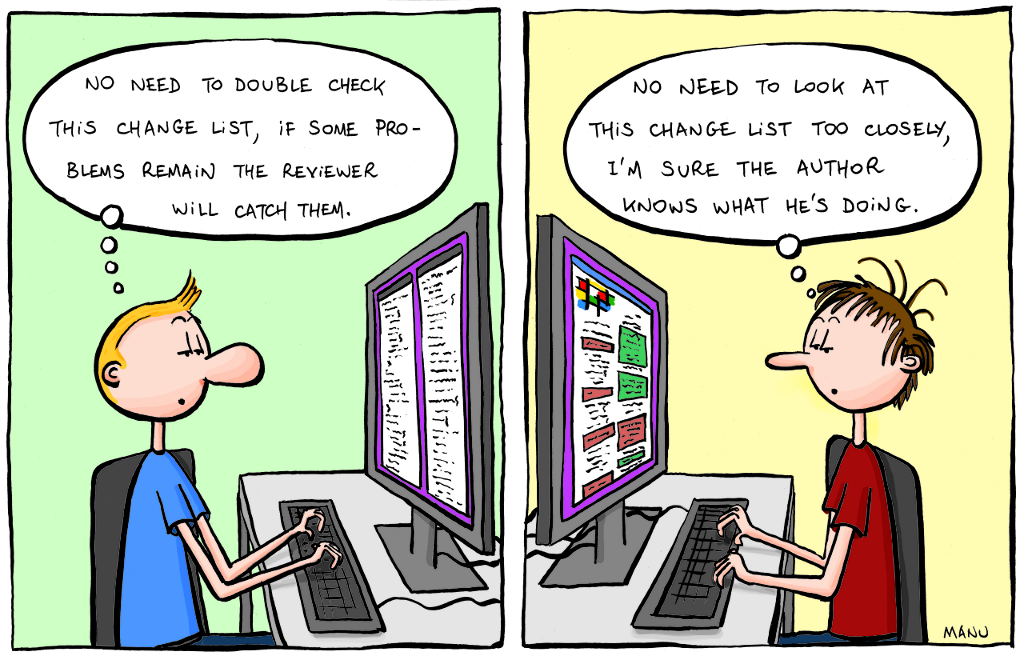
    I happened to be cogitating on this topic when I stumbled across a post reminding us of the importance of code reviews. The content was so-so, but the premise was spot on: code reviews are a must for those embracing the notion of treating their infrastructure as code.

    Why is that (or should it be) an imperative?

    Consider some stats from InitialState, “a technology startup helping engineers capture and understand product data. Our cloud-based log visualization-as-a-service platform helps engineers make sense of the exploding number of logs being produced by “smart”, complex products and applications.”

    According to their data, developers have to find and fix 100 bugs per 1000 lines of code. And it takes 30 times longer to fix one of those bugs than to write one line of code. Overall, developers end up spending 75% of their time (about 1500 hours per year) debugging code.

    Now spend a moment thinking about what that means when you start treating infrastructure as code, writing scripts to automate provisioning and integrating with other systems to orchestrate deployment processes.

    2011.09.18_code_reviews

    I won’t lie, code reviews can be tedious. But the first time someone points out an error, particularly one that could have resulted in a security breach or an undesirable service outage, the pain is more than made up for. In the long run, code reviews are beneficial to eliminating disruptive errors. A SmartBear survey in 2012 found that “70% of organizations indicated that code reviews are very important” and “Those that do code reviews clearly have a greater level of satisfaction in the overall quality of their software – they were twice as likely to indicate that they were very satisfied with their software quality.”

    In other words, code reviews are an important part of the software development lifecycle (SDLC). Which means it should be a part of the software deployment lifecycle when it leverages programmability to treat infrastructure as code.

    Therefore it is important in the early stages of DevOps (or SDN if you’re going that way) adoption that you put into place processes to check (and perhaps double check) the scripts, templates and integrations you’re using to automate application and service deployment along the entire operational chain – from the app to the network.

  • DevOps makes coding more social, social coding makes better code

    DevOps makes coding more social, social coding makes better code

    One of the main principles of DevOps is to break down silos. What’s more like a silo than the image of a lone developer, shutting himself off from the world in order to code more and interact with people less? “I’m just here to write code and that’s all I do.” There’s nothing collaborative or DevOps about that scenario and unfortunately, it’s one that is all too frequent within organizations.

    Enter social coding. This is a concept that didn’t exist twenty, or even ten, years ago and one that continues to grow in popularity. At its essence, social coding is an approach to software development that puts the focus on formal and informal collaboration. There are many benefits to social coding but the most important is probably the opportunity it presents for mutual growth and learning. Developers are allowed to collaborate in an environment that fosters discussion, creation and sharing.

    When talking social coding, you can’t avoid a mention of GitHub. Take everything you love about your favorite social network and then apply those same ideas to a code repository. That’s basically what GitHub did, and continues to do, with much success. You can create a profile, follow or message someone, see what others are doing with their code (or yours) and even go so far as to subscribe to RSS feeds of activity streams. GitHub started to take off a mere five years ago and is now held up as one of the more successful examples of how social coding can be commercialized.

    Companies like GitHub and SourceForge are leading the way in revolutionizing how developers commit and share their code but the foundation of social coding still rests with code review in a public forum. As Mark Chu-Carroll puts it…

    “If you’re programming and you know that your coworkers are going to look at your code, you program differently. You’ll write code that’s neater, better documented and better organized — because you’ll know that people whose opinions you care about will be looking at your code. Without review, you know that people will look at code eventually. But because it’s not immediate, it doesn’t have that same sense of urgency, and it doesn’t have the same feeling of personal judgement.”

    What’s next for social coding? After it’s start in the open source community, this is one idea (like many others) that is heading towards the enterprise market. Companies are beginning to recognize that even internal projects can be managed and treated as open source efforts. From wikis to crowdsourcing, there are many ways that the enterprise market can take advantage of social coding. The end user is the one who stands to benefit the most from such a change.

    Dave West, a Principal Analyst at Forrester Research, has this to say about social coding:

    “We’re social animals, and the development of stuff tends to be social in nature. We think a better way of thinking about it is as social development. It’s not just about coding; it’s about enabling business change and delivering business value in a social way. It will be interesting to see how companies broaden the idea from social coding to social development. Social coding is a fundamental change.”