Tag: composable infrastructure

  • VMware Embraces SmartNICs to Extend Virtualization

    VMware Embraces SmartNICs to Extend Virtualization

    VMware, as part of a bevy of updates to its portfolio announced today at its online VMworld 2020 conference, previewed its Project Monterey initiative to provide IT teams with composable infrastructure.

    At the core of that effort will be support for smart network integration cards (NICs) within VMware Cloud Foundation, the suite of software through which VMware bundles its vSphere, vSAN and NSX platforms. SmartNICs make it possible to offload network and storage I/O function from a virtual server by enabling its ESXi hypervisor to run on a SmartNIC.

    VMware also revealed plans to rearchitect VMware Cloud Foundation to enable disaggregation via SmartNICs that can be plugged into either a bare-metal server or a server running virtual machines from VMware. That capability will make it possible for applications to invoke bare-metal servers via an application programming interface (API) and will also enable VMware to extend its management framework to bare-metal servers that have SmartNICs installed.

    The decoupling of networking, storage and security functions will also allow IT teams to patch and update IT infrastructure independently from the server running VMware vSphere.

    VMware also noted that via Project Monterey each SmartNIC will be capable of running a stateful firewall along with other security software. IT teams will be able to enhance security by deploying thousands of firewalls on SmartNIC across the extended enterprise.

    There is no timetable for when Project Monterey will be available. Chris Wolf, vice president for the Advanced Technology Group in the Office of the CTO at VMware, said SmartNICs will play a major role in enabling IT organizations to compose IT infrastructure either using graphical tools employed by IT administrators or via APIs programmatically invoked by DevOps teams.

    Separately, VMware today also announced plans to update to its Virtual Cloud Network, a platform through which it bundles VMware NSX, VMware SD-WAN by Velocloud and VMware vRealize Network Insight in a single offering.

    VMware is committing to bringing more automation, making available predictive analytics enabled by machine learning algorithms, increased virtual networking scale enabled by VMware NSX-T 3.1. VMware will double the scale of NSX Federation, add advanced routing and multicast capabilities based on APIs and add support for configuration tools based on open source Terraform tools.

    Version 6.0 of vRealize Network Insight 6.0 will add assurance and verification capabilities as well as expanded support for VMware SD-WANs. VMware Edge Network Intelligence, meanwhile, adds a tool that applies artificial intelligence (AI) to optimize network performance.

    VMware also announced that its Virtual Cloud Network platform can now support Kubernetes clusters.

    In addition, VMware announced that VMware vRealize AI Cloud, a cloud service for optimizing application performance using machine learning algorithms, formerly known as Project Magma, is now available and that CloudHealth by VMware services has been extended to add support for Oracle Cloud Infrastructure along with tools for analyzing the security of workloads deployed on Google Cloud.

    Finally, VMware is making a series of other security updates, including providing access to VMware NSX Advanced Threat Prevention, which combines NSX Distributed IDS/IPS with malware detection software and network traffic analysis (NTA) technologies acquired from Lastline Inc.

    VMware is also committing to reselling a secure web gateway from Menlo Security as part of the VMware SD-WAN portfolio and formed an alliance with Zscaler to manage security as a service.

    Finally, VMware today launched VMware Carbon Black Cloud Workload, which combines vulnerability reporting with workload hardening software for both legacy platform and microservices-based applications deployed on Kubernetes clusters.

    VMware now has one of the broadest portfolios of offerings of any enterprise IT vendor. It’s not clear to what degree IT organizations are consuming all that software on top of VMware vSphere. However, for IT teams looking to reduce the number of vendors they need to engage VMware has become a compelling option.

  • Breaking Up and Making Up: Composable Persistent Storage for Kubernetes

    Breaking Up and Making Up: Composable Persistent Storage for Kubernetes

    Kubernetes is rapidly emerging as the standard for application management in the data center. Kubernetes defines applications in a container model for deployment and delivers most of the software-as-a-service features of virtualized infrastructure at a lower cost and with less performance degradation. In this article we’ll cover the intersection of Kubernetes and scale-out data-intensive applications, what problems Kubernetes solves for those applications and why composable infrastructure provides the remaining piece for a total solution.

    For heavy-duty data-intensive applications, such as Spark, Kafka, Aerospike, Vertica, Cassandra and Elasticsearch, ML-model training/service with TensorFlow, Kubernetes promises a common application orchestration solution. These applications are termed scale-out because they allow additional performance and capacity to meet any use case simply by adding more nodes. The challenge introduced by these applications is managing large production deployments of each application, compounded by managing multiple applications each with their own configuration requirements. Kubernetes provides an answer here for managing these disparate data-intensive, scale-out applications with a common container orchestration platform.

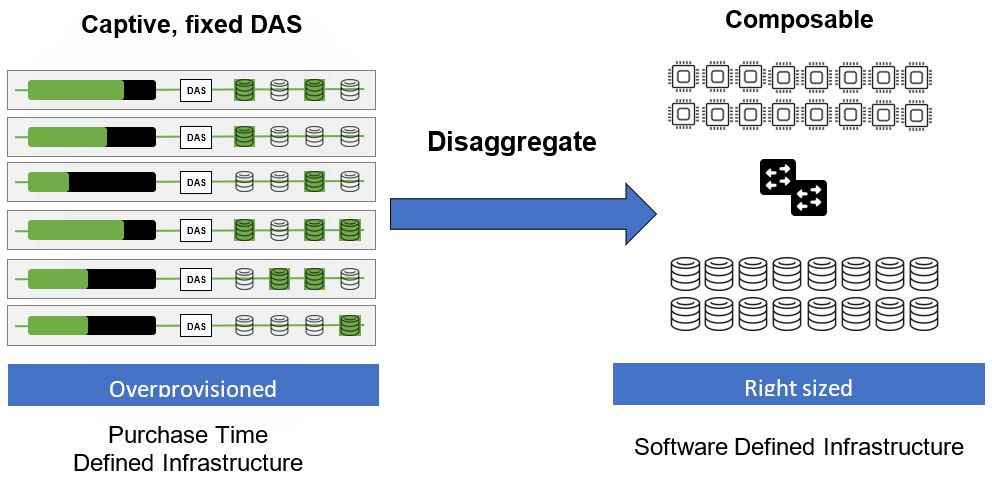
    Scale-out applications are distinguished from typical enterprise applications in three ways. First, scale-out applications take a divide-and-conquer approach to problem solving: if you have a bigger problem simply deploy additional capacity and performance by adding nodes. Second, since performance and data capacity are simply increased by adding building blocks, you can exploit cheap commodity-off-the-shelf (COTS) nodes, avoiding the money pit that is the case in big iron hardware purchases required by traditional scale-up applications. Third, the data-intensive applications typically integrate an optimized storage stack within the application itself that effectively uses the cheap local storage available within the COTS nodes. The last point has become a problematic area for scale-out application deployment as overprovisioning is now common to overcome the difficulty in predicting workload behavior at initial deployment time.

    Composable infrastructure tackles the last problem presented by embedded local storage for data intensive applications. Looking back over various transformations in the data center, one thing the legacy enterprise storage vendors got right was separating compute and storage. Both during acquisition and throughout the application lifecycle, separating persistent storage components from compute nodes running the actual application yields opportunities for cost efficiencies and flexibility.

    Composable infrastructure brings the capability of separating compute from storage for these scale-out applications, which sport their own embedded optimized storage software stack because it does not dictate a new storage architecture, it simply says “take your existing servers with embedded local storage and disaggregate them”–placing the storage on the ubiquitous high-speed low-latency fabric you’ve already deployed for your applications: Ethernet. From the application perspective in a composable infrastructure, storage still appears local and the application runs as it did before.

    In this way, applications run unchanged and the infrastructure they run on can be expanded, reduced or replaced in real-time. This is true software-defined infrastructure where infrastructure is treated as code. Being able to modify the node configuration ratio of compute and storage dynamically avoids the issues of purchase time lock-in of possibly under-provisioned nodes (which has simply led to overprovisioning). Composable infrastructure eliminates the downside of purchasing static resources that define the resources available before the workload is run.

    Kubernetes launched not long ago in 2015. Many of the early adopters of Kubernetes focused on stateless applications that did not depend on persistent storage to deliver useful services. It is only recently that support for persistent storage emerged (an obvious requirement for data-intensive applications). After a couple of approaches to persistent storage integration, the key players in Kubernetes (and other container orchestration platforms) settled on an orchestration-independent persistent storage API, the Container Storage Interface (CSI). The CSI provides a standard method for storage providers–and composable infrastructure providers–to define and attach persistent storage to containers.

    Why should you be interested in composable infrastructure when considering how to deploy your data-intensive applications on Kubernetes? Because Kubernetes only provides application and container orchestration–it does not fundamentally change the way the application works. These data-intensive applications were defined to exploit, and are most efficiently deployed, over COTS node and commodity storage. Each application still has its own storage stack, each carefully optimized for their particular workload. It is likely that deploying storage appliances, or software-defined storage solutions that aggregate pools of HDDs or SSDs, under data-intensive applications will only result in degraded performance and unnecessary costs.

    A composable infrastructure solution is only useful as an underlayment for a Kubernetes deployment if it meets several requirements.

    First and foremost, the composable infrastructure must scale to 100,000s of devices in support of the applications being deployed on top of the platform.

    Second, the composable infrastructure platform must not destabilize or diminish Kubernetes capabilities and scale accordingly with commodity networking in mind. The composable infrastructure solution must share a similar design philosophy with Kubernetes, allowing it to scale. Kubernetes implements a distributed desired state model where work is distributed amongst the mostly autonomous nodes to reach a desired deployment configuration. Such an approach provides scaling on the order required by hyperscalers. You must ensure the composable infrastructure solution you choose provides a similar scalable approach.

    Third, Kubernetes emphasizes a configuration state that is durable in the face of any individual node failure or network partitions. Durable configuration state in the face of large, highly interconnected commodity component deployment is critical for correct automatic operation at scale of business-critical applications, and your composable infrastructure solution must similarly support this.

    Fourth, Kubernetes defines a model for application deployment in terms of groups of containers called Pods. For a manageable persistent storage solution, the support for CSI and Kubernetes must provide a native Pod view of the storage bindings since the Pod (the managed set of containers) is the proxy for an application node instance and the unit of expansion and migration.

    Kubernetes has ushered in an exciting new chapter in data center architecture by providing a lightweight, richly featured application software orchestration platform. Think of Kubernetes as the ideal software application orchestration platform. What is missing is the scalable hardware orchestration solution that supports the dynamic model for application orchestration that Kubernetes defines. A feature rich, well-integrated composable infrastructure platform provides the needed hardware orchestration to enable the application migration and elasticity promised by the Kubernetes solution.

    — Brian Pawlowski