
As organizations embark on their DevOps journey, many successfully implement Continuous Integration (CI) and Continuous Delivery (CD) pipelines, the hallmarks of the First Way of DevOps. This initial phase emphasizes achieving a fast, smooth flow of work from development to production, allowing teams to deliver software at high velocity. However, a significant number of organizations encounter a formidable obstacle once they reach the Second Way of DevOps — Continuous Feedback. The ability to integrate feedback loops that enable quick detection and correction of issues is critical to achieving DevOps mastery, but crossing this chasm proves to be an immense challenge for many.
According to the State of DevOps Reports, nearly half of all organizations are “stuck in the middle” of the DevOps performance spectrum, implementing CI/CD practices but struggling to progress beyond the initial improvements. These organizations experience diminishing returns from their DevOps efforts due to a lack of effective feedback loops, leaving them unable to optimize quality, security and performance continuously. While they have laid the foundation, they fail to unlock the full potential of DevOps, and as a result, they fall short of becoming high performers.
My new book, “Continuous Testing, Quality, Security, and Feedback“, directly addresses the core challenges organizations face when trying to cross this chasm. It provides a practical transformation roadmap for integrating all aspects of continuous feedback into DevOps, ensuring that teams not only detect issues early but also improve the quality and security of their software at every stage of development. In this blog, we’ll explore the critical aspects of crossing this chasm, helping organizations move from merely automating CI/CD pipelines to mastering the full scope of DevOps by embracing Continuous Feedback.
Challenges to Crossing the Chasm
One of the core challenges of mastering the Second Way of DevOps is the implementation of Continuous Testing. Many organizations struggle to shift from traditional, manual testing to a fully automated, continuous testing environment that integrates seamlessly with CI/CD pipelines. Continuous Testing requires not only robust tools but also a mindset shift — where testing happens early, often, and across all stages of the software development lifecycle. It demands strong collaboration between developers, testers and operations to ensure testing isn’t a bottleneck but a catalyst for rapid iteration. The lack of proper test automation, coverage and feedback loops can leave organizations vulnerable to undetected bugs or security flaws that may only surface in production.
Continuous Quality is another critical aspect that is difficult to achieve without carefully integrating people, processes and technologies. Achieving continuous quality requires real-time monitoring of software performance, reliability and user satisfaction across different environments. To ensure quality at every stage, organizations need to implement practices such as automated code reviews, advanced monitoring and chaos engineering. Without these mechanisms in place, it becomes nearly impossible to maintain the level of quality necessary for rapid software delivery. Moreover, quality assurance processes often operate in silos, making it hard for feedback on quality issues to flow upstream, thereby delaying the response to quality degradation.
Lastly, Continuous Security and Continuous Feedback represent perhaps the most significant challenges in the Second Way of DevOps. Continuous Security involves embedding security checks within every stage of the development and deployment pipeline—this means automating vulnerability scans, compliance checks, and threat detection, which can be resource-intensive and complex to manage. Continuous Feedback, on the other hand, requires the right metrics and tools to capture feedback from both users and systems in real-time. This feedback must be actionable and seamlessly integrated with existing DevOps tools. The challenge lies in harmonizing security and feedback mechanisms with the rapid, automated workflows of the First Way, ensuring that both quality and security improvements are made in lockstep with new deployments.
Transforming to Cross the Chasm
To successfully transform from basic CI/CD pipelines to achieving Continuous Testing, Quality, Security and Feedback, organizations must adopt a strategic transformation approach. The journey begins with goal alignment, where leaders clearly define the desired outcomes of the transformation, such as reducing defect rates, improving time-to-market, or strengthening security. All stakeholders, from developers to security teams, must align their goals to ensure that everyone is working toward a shared vision. This phase also involves discovery and gap assessment, where the current state of CI/CD pipelines, testing practices and security frameworks is evaluated. The assessment identifies weaknesses and areas for improvement, setting the foundation for designing a more comprehensive solution.
Value stream mapping and Value stream engineering are essential tools for this transformation. Value stream mapping enables organizations to visualize the entire workflow, from development to deployment, identifying where bottlenecks or inefficiencies occur. It also reveals where feedback loops are missing or ineffective. Once the value stream is understood, Value stream engineering comes into play to design an optimized process flow that integrates Continuous Testing, Quality, Security and Feedback into existing CI/CD pipelines. This design phase includes selecting the right tools, creating cross-functional teams, and ensuring that these new workflows are automated and measurable. Implementing these solutions requires careful planning and piloting, using techniques like incremental deployment to ensure minimal disruption.
Generative AI can significantly accelerate this transformation by automating key elements of Continuous Testing, Security and Feedback. For instance, AI-driven tools can analyze code for vulnerabilities in real time, flagging issues before they reach production. In testing, AI can generate a broad spectrum of test cases, improving coverage and reducing the likelihood of defects slipping through. For Continuous Feedback, AI can analyze large volumes of telemetry data to surface actionable insights, predicting potential failures or performance issues before they occur. By automating these complex tasks, AI reduces the cognitive load on teams, allowing them to focus on higher-value activities, such as innovation and process improvement.
Finally, measuring success is critical for maintaining momentum in the transformation. Organizations need to establish key performance indicators (KPIs) that track improvements in testing speed, quality metrics, security posture and feedback response times. Regular retrospectives and continuous improvement cycles should be built into the transformation process, ensuring that any gaps or inefficiencies are addressed in real time. Generative AI also plays a role here, offering predictive analytics to help organizations understand where future problems might arise, thereby allowing teams to proactively address issues before they impact the overall value stream.
Conclusion and Call to Action
In conclusion, crossing the chasm to successfully implement the Second Way of DevOps — Continuous Testing, Quality, Security and Feedback — is essential for organizations aiming to become DevOps high performers. By embracing a strategic transformation approach, which includes goal alignment, gap assessment, value stream mapping and engineering, organizations can overcome the common hurdles that prevent them from fully integrating continuous feedback loops. Automation, collaboration and a commitment to continuous improvement are the foundation of this journey.
If your organization is facing these challenges, now is the time to act. My new book, “Continuous Testing, Quality, Security, and Feedback,” provides the tools, strategies and real-world examples needed to guide your team through this critical transformation. By leveraging the insights in this book and implementing the solutions discussed in this blog series, you’ll be well on your way to crossing the chasm and mastering the Second Way of DevOps. Stay tuned for the next blog in this series, where we’ll dive deeper into specific case studies and actionable insights to help you take your DevOps practices to the next level.

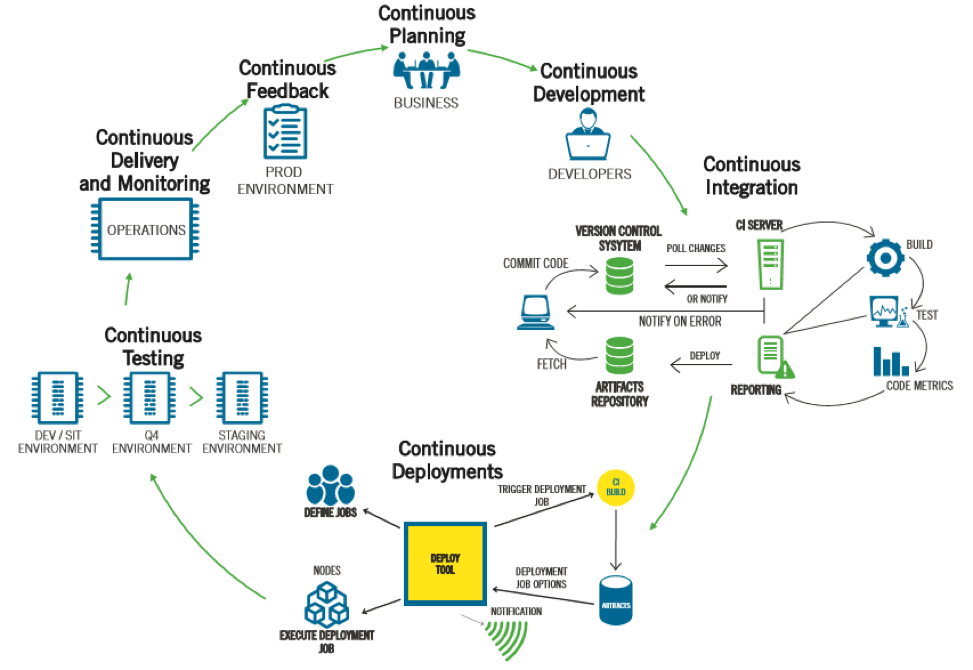 The main objective is to ensure agile delivery by embracing continuous planning, continuous development, continuous Integration, continuous deployments, continuous testing, continuous monitoring and continuous feedback.
 Arsalaan Kashif is associate director of Marketing, Product Engineering Services at