Tag: delivery

  • Why Your Best People Can’t Save a Broken Delivery System

    Why Your Best People Can’t Save a Broken Delivery System

    When delivery falls apart, the reflex is to blame the team. Missed dates, quality slips, a burned-out squad — leadership tends to reach for a personnel fix and quietly move on. The uncomfortable pattern in most enterprise organizations is that the system itself is the failure mode. Decision latency, priority misalignment, and layers of governance that were designed for a slower era grind against the very people leaders keep asking to grind harder. Talented engineers cannot outrun a delivery pipeline that is structurally set up to stall.

    Marnus Marx, founder and Delivery Confidence Coach at Elanvia Consulting, joined Alan Shimel to unpack what that structural failure actually looks like from the inside. Marx came up through Unix and Linux systems before moving into DevOps and delivery coaching, which shapes how he diagnoses these breakdowns — as engineering problems in the socio-technical system, not character flaws in the humans stuck inside it. His frame of “delivery confidence” is a leadership discipline: the degree to which an organization can trust that what it promises externally will actually ship.

    Marx walks Shimel through the systemic issues that get mislabeled as execution failure. Decision latency is the biggest culprit — the days or weeks it takes to answer a simple question with real consequences, while everyone downstream burns cycles waiting or guessing. Priority misalignment is the second, where the work that gets pulled into a sprint has almost no relationship to the outcomes leadership actually cares about. Both wear down teams in ways that no amount of individual effort can compensate for.

    The bigger thread is how the shift to agentic AI is going to expose those cracks fast. Marx argues coaching has to run in two directions — pulling over-eager AI adopters back to the outcomes that actually matter, and pulling anxious resistors forward by redefining employee value around outcomes instead of tasks. The organizations that survive that transition will be the ones that stop protecting broken delivery systems and start rebuilding them around clarity, decision speed and alignment.

  • The Great Debate: The Future of Humans and Software in the Age of AI

    The Great Debate: The Future of Humans and Software in the Age of AI

    Listening to the two sides of the debate regarding how much AI will take over software development, delivery and support tasks and its impact on jobs is both exciting for technology and scary for humans. The debate goes something like this:

    AI Advocate: Welcome to the future! With AI’s capabilities today, we’re looking at a world where software applications can practically develop, deliver and support themselves. The need for human involvement is diminishing rapidly.
    AI Antagonist: That’s an overly optimistic view. You’re underestimating the value of human creativity, empathy and ethical judgment. There are areas where AI simply cannot replace the human touch.
    AI Advocate: Consider design and specification. AI can generate prototypes and suggest improvements. It’s about efficiency and leveraging AI to cut down on the grunt work.
    AI Antagonist: But who sets the vision? AI lacks the understanding of user needs and market demands that only humans possess. The strategic decision-making and nuanced understanding of user psychology are irreplaceable.
    AI Advocate: True, but AI’s role in supervision and training cannot be overlooked. It can manage its operations, needing only minimal human oversight to update data and rules.
    AI Antagonist: And yet, who ensures these AI systems are aligned with ethical standards and current practices? Humans are crucial for overseeing these systems, ensuring they operate as intended and do not deviate into unethical territory.
    AI Advocate: I’ll give you that. However, in quality assurance and testing, AI significantly reduces the human workload by automating many processes.
    AI Antagonist: Automation has its place, but human insight is vital for identifying complex issues and understanding user experience in a way AI cannot. There’s a depth to exploratory and usability testing that AI can’t reach.
    AI Advocate: Ethical and legal oversight might be your strongest point. AI does struggle with nuanced decisions in privacy, security and bias. I concede that humans are necessary to navigate these complex fields.
    AI Antagonist: And don’t forget about customer support. AI can handle routine queries, but complex problems and sensitive issues require human intervention. The personal touch is something AI can’t replicate.
    AI Advocate: Innovation is a collaborative effort, I admit. AI assists, but human creativity drives continuous improvement and adapts to market trends.

    What Are the Implications if the AI Advocate is Correct?

    If the AI advocate’s vision comes to fruition, the implications for humanity could be profoundly transformative. First, the automation of routine and complex tasks alike would herald a new era of efficiency and productivity, potentially liberating humans from the drudgery of monotonous work. This shift could lead to an increased focus on creative, strategic and interpersonal tasks that leverage human strengths and foster innovation. Moreover, the widespread adoption of AI in software development could drastically reduce the time and resources needed to bring new technologies to market, accelerating the pace of technological advancement and potentially solving critical challenges in fields like healthcare, education and environmental protection. However, this future also raises concerns about job displacement and the need for societal adjustments to manage the transition, emphasizing the importance of re-skilling and education to prepare the workforce for a new economic landscape dominated by AI and automation.

    What Are the Implications if the AI Antagonist is Correct?

    On the other hand, if the AI antagonist’s perspective holds, the implications underscore the indispensable value of human involvement in technology. This scenario suggests that despite AI’s advancements, the nuanced understanding, ethical judgment and creative problem-solving capabilities of humans remain crucial. It highlights the potential risks of over-reliance on AI, including ethical dilemmas, privacy concerns and the perpetuation of biases if not carefully overseen by human intelligence. The emphasis on human skills and creativity could lead to a more balanced approach to technological development, where AI is used as a tool to augment human capabilities rather than replace them. This future would prioritize the development of technologies that are not only innovative but also ethical, user-centric and socially responsible, ensuring that technological progress benefits all of society.

    A Balanced Future

    Ultimately, the truth likely lies somewhere in between these two viewpoints, suggesting a future where AI and human capabilities are intertwined. The implications of such a balanced approach would be a collaborative ecosystem where AI enhances human efforts, leading to unprecedented levels of productivity and innovation while also creating new opportunities for human workers. This future emphasizes the importance of adaptability, lifelong learning and ethical considerations as central pillars of technological advancement. It also highlights the need for policies and educational systems that support the workforce in transitioning to roles that leverage human strengths in creativity, empathy and strategic thinking, ensuring that the benefits of AI are distributed equitably across society.

    Image source: https://vecteezy_futuristic-technology-concept-mixed-media-innovations-data_7019122_167-3.jpg

  • Jenkins World, Training and Infostretch

    Jenkins World, Training and Infostretch

    I’ve talked to a fair number of vendors about Jenkins World 2017, and I’ve spent a decent amount of time lately supporting DevOps training initiatives at a variety of vendors.

    The thing is, the DevOps world is changing fast enough and there are enough options out there that training is not something you need only before moving to DevOps. During one recent project, I ended up learning about a particular topic as I was developing support materials for a training session on that topic. And I’m pretty steeped in the DevOps world.

    So, while I don’t write about every vendor I’ve talked to about Jenkins World, Infostretch‘s new training program is worth talking about. Infostretch is unveiling an array of training solutions to help companies not only get a handle on DevOps needs, but also to grow their DevOps maturity.

    Among the offerings will be a DevOps maturity assessment and new Jenkins training programs. In conjunction with its visit to Jenkins World, Infostretch will be offering a free 90-minute webinar on adopting Jenkins 2.0.

    Demands of the job will keep me from attending Jenkins World, but if you’re there, it might be worth checking out Infostretch’s booth (#415) to see what there is to learn. If you do, feel free to drop me a line—I’m intrigued to learn more about the training and how it fits in with other available offerings. As an added bonus, the company is giving away “Game of Thrones”-themed DevOps Journey Maps marking various stages of DevOps journey and the “happy flow” of DevOps, and including the various tools available in the market for each stage. So you can snag that while stopping by for me to learn about Infostretch’s training.

    The other thing that interested me was a presentation. Sanil Pillai, director of Infostretch Labs, will be presenting a 15-minute demo titled, “Auto-Convert Your Freestyle Jenkins Jobs to Coded Pipeline” on Wednesday, Aug. 30, at 10:45 a.m. at the Sponsor Theater, in the Expo Hall. The variety of scripts that can make up the components of a Jenkins build environment are a problem many of us have struggled with; while better than what we had because they’re part of an automated process, the components are still technical debt with variable maintenance requirements. Someone, please go see the talk/demo and report back. It would be cool if Infostretch has an answer for this problem.

    I Reiterate: Training is Imperative

    It is human nature to make a large change and settle in with the known new world. DevOps is not designed to be that way. It is still growing and changing, so don’t get complacent. Challenge yourself and seek out training, tool enhancements and opportunities to improve. As others have said repeatedly and well, DevOps is a journey, not a destination. Learn, get better, find better ways and tools and keep improving.

    And, keep rocking it. Eliminating IT as a bottleneck is a huge step to improving product development and being more in sync with the business.

    Of course, now that I’ve written out the reasons why Infostretch’s plans for Jenkins World interested me, I am tempted to dig into some of the other offerings. Or to try and figure out how to go to Jenkins world without missing important things at work.

    You may be hearing more of Jenkins World from me before it arrives.

    — Don Macvittie

  • 7 Strategies for Continuous Delivery and Deployment Success

    7 Strategies for Continuous Delivery and Deployment Success

    One of the key advantages of cloud-native applications is the ability to quickly push updates into production for specific microservices—giving developers the ability to respond rapidly to changing business requirements without having to upgrade the entire application. Successfully doing this requires far more than just leveraging a continuous delivery platform. Everything from the culture of the development group to the type of testing required to the underlying platform it will run on is critical.

    Based on applying DevOps principles across several projects to date, I have found that development teams can benefit from following these seven key strategies before launching continuous delivery and deployment initiatives. By doing so, you’ll increase your opportunity for success.

    Culture

    Just having the right tools and technology isn’t enough in today’s enterprises. Successfully adopting an agile, continuous delivery and deployment process will require a culture shift within most development shops. Developers are no longer responsible only for their code; they must take full ownership of the development, testing, automation tools and, most importantly, building operational capabilities into the pipeline so the move to production is easier. Getting developers and the operations team on board with this may take some time and training, but the effort is critical, and your projects won’t succeed without this.

    Automation Platform

    Carefully consider the tool you’ll use for your continuous delivery pipeline because the current tools on the market have different optimal use cases. For example, if you need to do A/B testing you’ll want a tool that has capabilities for phasing the rollout based on the test results. If your application requires multiple updates in a short time span, you’ll need a tool that has advanced release management capabilities including good pipeline visualization and support for the management of cloud environments.

    App Architecture

    Design your applications so they are cloud-native. This is typically associated with microservices and containers and will enable you to independently and frequently update each service independently. The typical stages of a deployment pipeline are build, unit testing, integration testing (including functional testing), API testing, performance and staging, then, finally, on to production. However, with microservice architectures and advanced deployment techniques, more and more customers are bypassing certain stages and testing in production, albeit very contained production environments.

    Each stage also can include the creation of dynamic environments in the cloud, enabling the stage itself to be provisioned, executed and decommissioned as a part of the pipeline. If you choose to do this, look for a tool that has a number of built-in cloud plugins, so creating and destroying environments in AWS, Google Cloud and other clouds can be done easily.

    The application and infrastructure stack for each microservice also should be specified. This could include the application Jar file, a Docker file, or server image such as an AMI; any related services such as AWS Lambda functions; and all configurations and policies. These specifications all should be managed in an infrastructure-as-code manifest, which ensures versioning, consistency, change auditing and testing. It also ensures that the build resources, such as baked images, JARs and AWS Lambda functions, are consistently passed to each stage of the pipeline, from testing to production, eliminating the risk of imposing inconsistent environments and configurations. An AWS CloudFormation template is an example of an infrastructure-as-code manifest.

    Security

    Security is a necessity in the world of increasing threats that we live in; however, the common approach of waiting to test security right before the push to production is the wrong approach. Security should be built in to the pipeline itself and automated as part of the DevOps CI/CD process. It’s essential to validate the building blocks without slowing down the process. For example, leading companies are automating code scanning, template checking and other security tests in within the phases of the pipeline itself.

    Insight

    Visualizing and tracking pipelines, environment variables, test results, versions, issues and other artifacts allows developers and the operations team to share a common view throughout the project life cycle. This improves collaboration and traceability.

    Delivery Strategies

    Automating tests is critical to pipeline design and delivery. Without comprehensive, high-quality, fully automated tests of the deployment pipeline, production failures will occur. Code coverage no longer is a good representation of code quality. In the cloud-native world, test cases and test suites need to be mapped to functionality and business outcomes desired to ensure that the test team gives the green light and then everything goes red in production. In situations where time limitations prevent a comprehensive approach, first automate the critical capabilities and flows, then assess the cost-benefit of automating additional tests.

    Be sure that the data and environment for testing and automating purposes mirrors the production data and environment as closely as possible. Most pipelines have a “pre-production” stage before pushing software into production. You may consider building multiple stages across multiple AWS regions before pushing the software to production.

    If your goal is to update software in production very frequently and without any downtime, make sure your pipeline tool can easily manage multi-region deployments, such as blue/green and canary deployments for server groups and clusters across AWS and other public infrastructure-as-a-service (IaaS) clouds.

    Monitoring and Feedback

    Finally, it is essential to get continuous feedback on the user experience, response times, performance of key business services, and the technical metrics from all stages of the life cycle—development, QA and production. Only through this continuous feedback can you ensure that no degradation occurs as you push out releases with increasing frequency. This too needs to be built into each phase of the pipeline to understand performance and improve things earlier in the process, where it costs much less.

    There’s no doubt that a successful continuous development and deployment process can deliver significant benefits to users, who constantly require new and enhanced capabilities and can’t wait the weeks or months that a traditional development cycle requires By carefully considering these seven strategies, your projects will benefit from reduced application errors, less downtime and much happier users.

    About the Author / David Cramer

    david-cramerDavid Cramer is vice president of Product Management for the Cloud/DCA business unit at BMC. Prior to BMC, David was head of product management for CA Technologies. During his tenure at CA, David was responsible for application delivery, cloud management, virtualization and Infrastructure automation solutions. Before joining CA, David held executive positions at AlterPoint, Motive, NetSolve and Nortel Networks. David’s focus is on continuous delivery, cloud management and web-scale IT. David received his MBA from Southern Methodist University and a BS in Finance from Georgia State University. Connect with him on LinkedIn and Twitter.

  • Chef rolls out some tasty new dishes

    Chef rolls out some tasty new dishes

    Chef has announced some major additions to their lineup today. We will look at each of these but in total here is the news from Chef today:

    Screen Shot 2015-11-03 at 12.25.29 AM


    First of all the previously announced Chef Delivery is now in GA for everyone. Chef Delivery defines and manages the entire DevOps workflow. The diagram below is a good illustration of this:

    Screen Shot 2015-11-03 at 12.27.28 AM

    According to Chef, Delivery, “provides a prescriptive process to automate changes to infrastructure, applications and containers in a single prescribed pipeline.”

    Beyond the general availability of the previously announced Delivery, Chef also announced that they are moving into services in a big way. They are spinning up a new DevOps transformation practice to help enterprises adopt DevOps and transform their models. Justin Arbuckle, chief enterprise architect at Chef is heading up this new practice.  I would assume they will compete with professional service organizations like IBM, HP, PWC and others in helping large enterprises transform and adopt DevOps practices. It is a natural move for Chef as it continues to mature along with the DevOps market in general.

    Finally, Chef is going to roll out compliance as code, part of something Justin Arbuckle has spoken to me before of compliance at velocity. In order to bring this capability to market Chef has bought a smaller German security provider called VulcanoSec.  VulcanoSec has done a good job of developing a shift-left security product that allows for continuous compliance. I am sure we will see the Chef team expand this as they seek to bring more and more security into the DevOps process and they see opportunity for improving the entire development/deployment environment to make it more secure. They will also have to integrate and work with existing enterprise security solutions.

    All in all this is quite a series of announcements from Chef, which were made at the European Chef Community Summit in London.  Chef has been a leader of the DevOps movement from the very start and they continue to show that they will continue to lead and innovate in bringing DevOps and everything as code to enterprises everywhere.

  • Three Ways Dev and Ops Teams Can Manage the Integration Lifecycle

    Three Ways Dev and Ops Teams Can Manage the Integration Lifecycle

    Many enterprise organizations did not invest enough money into integration as they built their cloud or hybrid infrastructures. As if integrating on-premise systems and applications wasn’t tough enough, in today’s cloud era with the rise of hybrid environments, connectivity has only gotten more complicated – especially when combined with the increased speed of deployment. Puppet Labs found that high-performing organizations deploy code 30 times more frequently than their lower-performing counterparts, meaning dev and ops teams are struggling to break down data silos while simultaneously managing constant technology upgrades for line-of-business users.

    There’s no doubt that, whether public or private or hybrid, the cloud is now part of most companies’ infrastructures, and its share will only increase. Goldman Sachs estimates that spending on cloud computing infrastructure and platforms is expected to grow at a 30 percent CAGR from 2013 through 2018 compared with 5 percent growth for overall enterprise IT, while Forrester predicts that 25 percent of all software applications purchased will be cloud-based by 2020.

    With the speed and agility the cloud imposes on businesses, dev and ops need to come together to look at data integration throughout its entire lifecycle, from developing new apps or services on top of existing apps, all the way to the ongoing service, maintenance and upgrades of those applications. The two teams must join forces to manage this process as one comprehensive integration lifecycle, where dev and ops play equal roles solving for new data integration challenges brought about by hybrid deployments and siloes created by line of business users’ cloud purchasing habits.

    Today’s dev and ops teams have to look at data integration as a service, not just a one-off implementation they can hand off. Here are three strategies to help bring the two teams together to jointly manage the data integration lifecycle.

    1. Assess Current Integration Challenges Collaboratively
      Without alignment between dev and ops teams, integration lifecycle can’t be managed successfully. Organizations need to align on the people and process portion first, asking questions like: what systems does each business unit need data from? How likely is it that their needs will change, and how can you plan for a flexible integration as a service? What capabilities will ops need after dev implements the integration?

    After reaching agreement, teams will need to jointly assess and select a data integration as a service technology or platform that allows for joint requirement setting, collaboration, testing and ongoing adjustments throughout the lifecycle of the applications. Selecting the right integration platform as a service at the onset is critical to minimize cost, time and wasted dev and ops cycles down the line as business and technology needs change. The most agile integration option typically consists of a plug-and-play, flexible platform that makes use of APIs and also allows for deeper customization down the road.

     2.Understand the Four Key Stages of Integration Lifecycle Management
    Dev and ops teams are now part of the same cycle dealing with frequent updates and agile product development. It’s no longer about developing, testing and then having ops maintaining, but about a seamless and transparent handoff from dev, to ops and back throughout the entire application and data integration lifecycle.

    To capture the most value from disparate organizational data and to minimize ongoing data and application synchronization costs, dev and ops teams need to adopt a joint integration management strategy that accounts for the four distinct phases of data and application connectivity. These include:

     3. Design phase. After understanding business use cases and selecting a platform, dev and ops must collaborate on priorities – what near-term functionality can they design for based on the plug-and-play layout, and how can they tackle that low-hanging fruit while maintaining the flexibility to meet future requirements?

    By starting with the right technology and a common integration framework, dev and ops teams can design connected core systems and data early on with plug-and-play API connectivity for solutions like CRM and ERP, while maintaining the ability to easily expand functionality with custom/deeper integration capabilities with marketing automation, business intelligence and other apps.

    In addition to functional capabilities, the design phase should address performance and scalability by taking into account throughput and latency. This process involves planning to meet performance expectations, even with the customization and extensions users will likely want down the road. Dev and ops should ask themselves questions like: which company systems will be on premise, in the cloud or hybrid? What are the performance, scalability and security tradeoffs of each approach?

    1. Develop phase. Dev and ops need to work together in the development phase to carefully document key aspects of the integration while building connectivity for specific use cases. This documentation will be critical to the seamless handoff between the two departments, so they both need to be involved in the process. Strategic collaboration and thorough documentation can improve the efficacy of maintenance and debugging activities, help companies adjust to staffing changes and more easily transfer integrations to and from the two teams during the ongoing development and roll-out process.
    2. Deploy phase. Given that you’ll likely deploy in a hybrid environment, make sure you test both on-premise and cloud integrations to ensure that data is flowing freely. To help test integrations and move them into a production environment, look into staging and production environment tools that streamline the process. Infrastructure costs should also be considered, as they may increase unexpectedly if you don’t watch them throughout the deploy phase.
    3. Run phase. Continuously monitor to confirm that the data is flowing as designed. If dev and ops selected the right technology platform, the teams won’t have to worry about ongoing API management, because the platform takes care of it.

    The right platform will also lower downtime and maintenance costs with a multi-tenant management environment that allows the expert for any given situation to dive into the integration backend or runtime. The platform should also provide ongoing diagnostic reports and proactive alerting to allow ops to home in on potential performance issues.

    1. Build a Responsive IT model
      With dev and ops coming together to take advantage of the speed and agility offered by the cloud, the resulting just-in-time services for businesses are turning IT from a cost center into an innovation center. The data integration lifecycle is another result of the new cloud-shaped world, helping dev and ops teams create a more responsive IT model and allowing them to better meet business needs while driving innovation. While shared environments bring with them an additional element of risk, a responsive IT model is an important step towards both short-term and long-term success in the modern connected enterprise.

    These three steps allow dev and ops teams to offer the value, speed, efficiency and opportunity that today’s enterprises require. By adding collaboration and agility at every stage of the integration process to plan, implement, track, debug and update continually, dev and ops teams can scale to respond to the data-driven needs of the business more precisely.

    How have you overcome cloud and hybrid application and data connectivity challenges in your organization? Connect with me in the comments below, or on Twitter at @scribesoft.

    About the Author/John Joseph

    John-Joseph head shotJohn Joseph, VP of marketing for Scribe Software, earned a master’s degree in business administration from the MIT Sloan School of Management, a master’s degree in electrical engineering from the University of Southern California and a bachelor’s degree in electrical engineering from MIT.

  • DevOps Transforms Copyright Clearance Center

    DevOps Transforms Copyright Clearance Center

    Copyright Clearance Center (CCC, www.copyright.com) works primarily with business, academic, and medical institutions, enabling them to access the vital content that supports their work. CCC manages fee payments to the license holders and content creators who own the content. DevOps approaches have transformed CCC, a global leader in content rights-licensing solutions, resulting in expanded service to an increasing market.

    “In production, CCC is already processing millions of dollars in transactions. This came to life within a year of the inception date for the DevOps project. For a startup that would be fast. For a medium-sized enterprise, I think that is outstanding,” says Babis Marmanis, CTO & VP of Engineering, Copyright Clearance Center.

    The DevOps transformation that took place in the internal structure of CCC’s engineering department continues today, allowing the organization to respond to the massive disruption in the publishing industry, which is due in part to digital content and the Internet. Using DevOps, Marmanis and CCC have accelerated product development, sped time to market, and provided a stronger consumer experience with the product.

    Accelerated Product Development

    “The Copyright Clearance Center vision is to create the most comprehensive portfolio of global licensing and content solutions (products) that make copyright work for everyone. My product platform strategy stems from that,” says Marmanis.

    CCC has multiple software-based products, each performing the same or similar functions and acting on the same or similar data. “There are certain fundamental things that we must abstract appropriately and encapsulate into common components to make development work optimally,” says Marmanis.

    But when Marmanis came to CCC, there were no common components. And what is more the internal systems lacked interoperability, skills were different across internal teams, and there was no cohesiveness to the development approach. These factors slowed software product development.

    A DevOps mindset was crucial to changing the status quo, to treating infrastructure as code, and to bringing in automation, says Marmanis. A DevOps approach would help to speed the delivery of software projects into the marketplace.

    “Now we use Jenkins (www.cloudbees.com) to glue together elements of the continuous integration process. We have Jenkins build jobs that retrieve the source code from GitHub (https://github.com). We publish software artifacts to Artifactory (www.jfrog.com),” says Marmanis.

    For each release, Marmanis’s teams use Jenkins to execute Chef (www.chef.io) recipes. They deploy artifacts from Artifactory onto a pre-specified execution environment. “In addition, and this is key to the overall scheme, we execute the schema updates with Liquibase (www.liquibase.org), and everything is coordinated with Jenkins,” says Marmanis.

    Further, CCC built its cornerstone platform from the ground up using DevOps-related tools, build detection software, and software libraries. The infrastructure that CCC added is based on best-of-breed open source libraries.

    “Using programming languages such as Java (www.java.com) and Groovy (http://groovy.codehaus.org), Gradle (www.gradle.org) scripts, postgreSQL as the relational database, Liquibase for database objects, Tomcat (http://tomcat.apache.org) as a servlet container, Apache Camel (http://camel.apache.org) for messaging and enterprise integration, and countless other tools including Apache Directory Studio (http://directory.apache.org/studio) and Bootstrap (http://getbootstrap.com/)—the list is very long—we were able to create a harmonious ecosystem,” says Marmanis.

    Stronger Consumer Product Experience

    CCC offers its consumers a better product experience through DevOps approaches and through a homogeneity of standards and technologies, which is available when using open source tools.

    “When we’re building the product platform, these initiatives allow us to embody timeless design principles such as crisp abstractions, but also allow us to scale in a number of dimensions including the number of works that we can represent, the number of publishers we can admit and manage, the number of customers that we have, the number of applications that we can build and deploy, and the number of market verticals that we can occupy,” says Marmanis. This is crucial to customer satisfaction.

    One product that is a prime example of how CCC keeps customers happy is RightsLink for Open Access. “Using RightsLink for Open Access, we facilitate fee collection for articles published under an Open Access license, mediating between the publisher and the author to collect those fees,” says Marmanis. Then CCC aggregates those transactions and presents them to the publisher.

    “Obviously, we give the money to the publisher, but we also create reporting for the authors, publishers, and institutions as well as the founding agencies that gave the money to the author or the institution respectively for funding that research,” says Marmanis. The RightsLink for Open Access product keeps transactions simple, integrating with publisher workflows to expedite publication.

  • The Failings of Multitasking

    The Failings of Multitasking

    I often find myself coaching colleagues (and reminding myself) about managing down the number of simultaneous tasks or work assignments. Everyone in IT knows that demand always outstrips the capacity of IT to take on work. IT is in demand by all parts of the organization, often at no direct or hard cost to departments or individual staff, which can balloon workloads and exacerbate the growing backlog of requests.

    This capacity limit, or constraint, to do work isn’t the only reason IT continues as the big bottleneck in organizations. I believe the “silent killer” is the wasted cycles, or “overhead”, that comes with taking on too much concurrent work. Said another way, one of the greatest challenges of managing work is managing work-in-progress within IT. This is one of the reasons the Kanban approach brings great benefit to IT organizations struggling to stay above water.

    The Context Shift Tax

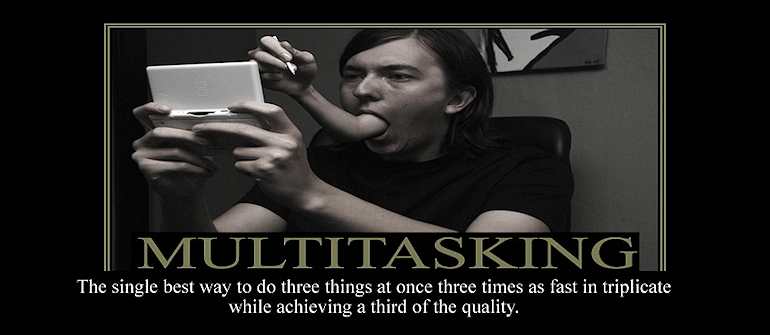
    We frequently pride ourselves on our ability to multitask but there is a cost, or tax, we pay when juggling too many work items. Each time we pause on one task and shift to another, time and effort is required to reset, reload and return to a point we can productively make progress on that work. Think of this as a context shift that functions much like paging between memory and swap space in a computer operating system. If you’re multitasking 5 items, each swap to a different task requires another knowledge context shift. Expand the list to 12 or 15 work items, add the interruptions we all experience, and we’re potentially spending more time during the day making those mental shifts than doing actual work.

    A legitimate argument can be made that over-multitasking increases complexity and decreases quality. As our mental bandwidth is split across too many work assignments, focus and concentration pays a price. We also experience a form of memory loss — some details are forgotten over time, even what the original problem was or why we are doing the task.

    IT organizations function much in the same way — shifting from project to project, task to task, as priorities change, new needs arise and existing work is delayed. As the list of priorities and projects increase, the organization and its people expend more and more on this context shift tax, wasting energies multitasking, losing focus, extending delivery times and decreasing customer satisfaction.

    Kanban – Keeping a Lid on the Multitasking Dragon

    Kanban’s secret sauce isn’t just about organizing work differently, it’s about thinking about work differently. Kanban provides a visual image of work in any system, how it flows, and where bottlenecks appear. The true secret sauce is in applying a limit or constraint to work in progress. If you’ve tried kanban, you know what I’m talking about. Much has been written about the profound effects of limiting work in progress.

    Using Kanban we can decrease multitasking, both by individuals and the organization. This reduces the context shift tax, freeing up cycles to maintain focus, perform work and complete tasks. I like to think of it as keeping a lid on the multitasking dragon.

    Limiting work in progress means work items are completed, in shorter time frames, with fewer context shifts. Imagine spending 5% or less during the day making context shifts, versus a heavy multitasking load that could consume 20% or more overhead when shifting between work. Less or no memory loss is experienced, decreasing complexity and reducing the opportunity for quality to suffer. By limiting multitasking we also free up cycles to focus on measurement and improvement, essential ingredients to any truly successful IT organization.