DevOps World | Jenkins World has long established itself as a leading venue for DevOps practitioners to learn, share their knowledge and build a top-notch community. But, what about leaders, the people in leadership roles at companies who utilize DevOps as a vital part of their business and technology strategies?
Sam Fell, CloudBees area VP enterprise markets, joins DevOps Chats to discuss the newly announced Software Delivery Leadership Forum. DevOps World 2020 is expanding its focus and content by bringing leaders together with content specifically tailored for business and technology leaders. Accelerated Strategies Group, where Mitch Ashley is CEO, is leading the programming of the DevOps World 2020 Software Delivery Leadership Forum.
As usual, the streaming audio is immediately below, followed by the transcript of the conversation.
Transcript
Mitch Ashley: Hi, everyone, this is Mitch Ashley with staging-devopsy.kinsta.cloud, and you’re listening to another DevOps Chat podcast. Today, I’m joined by Sam Fell, area vice president, enterprise marketing at CloudBees. And we’re talking about, actually, a subject of interest to both of us. It’s the new Software Delivery Leadership Forum, and we’ll get into that.
Welcome to DevOps Chat, Sam.
Sam Fell: Thank you, Mitch. Pleasure to be here, as always—great speaking with you.
Ashley: Absolutely. I always enjoy talking with you. For folks who don’t know you, I know you’ve been in the industry around DevOps for a while. [Laughter] So, a lot of folks know you, but—
Fell: Are you calling me old? Is that it?
Ashley: Actually, I didn’t say that. I’ve got the gray hair; you’re still young, so.
Fell: [Laughter]
Ashley: Just to introduce yourself, for folks that may not know you.
Fell: Alright, wonderful. So, I am Sam Fell. I am area vice president at CloudBees, where I’ve been for the past year. We were acquired in, as part of the Electric Cloud acquisition where I ran marketing at Electric Cloud.
Ashley: Yeah, a lot of folks know Electric Cloud, so probably know you from that as well as CloudBees, of course.
Fell: Yeah. That’s right.
Ashley: How long ago did that acquisition happen?
Fell: That was literally a year ago in May.
Ashley: Okay.
Fell: So, we are just a year, really just coming up on a year. So, all the exciting stuff was happening, all the stuff that made me lose my hair and all that was happening right now. And we were just so thrilled with the outcome to be, you know, the company that Electric Cloud was. We had a pretty nice name in the space. But when you look at CloudBees and you look at the community that they’ve created and you look at the access to the brains that they have, it’s a tremendous opportunity. You know, obviously, I’m really excited to be able to be here. And I’m excited about sharing this journey with the Accelerated Strategies Group, right?
Ashley: Well, thank you. I’m excited about that, too. Yeah, CloudBees is a great organization, as was Electric Cloud.
So, let’s get into the—we made an announcement, or actually, you did a press release about the Software Delivery Leadership Forum, and there’s a connection to DevOps World and some other things. Maybe we start with that and then we can talk about Accelerated Strategies’ involvement in it.
Fell: Lovely. Awesome. Okay, so, you know, we’ve been running probably, people would say, the most successful DevOps conference for years now, DevOps World/Jenkins World. Almost 2,000 people show up to learn more about what’s happening in the space, there’s hands on practitioner based workshops and training for people to really get their hands on and get them dirty about how to implement these changes that have to happen as you’re digitally transforming your organization.
One of the things that we took a step back and we were thinking about is, what we don’t really have is a place for the leadership to be able to participate. And, you know, we’ve done leadership seminars and workshops before, but we’ve never said that DevOps World needs to be a place where not only the practitioners are coming, but where the leaders are coming to learn not the practitioner level information, but how to lead the practitioners. What are the processes, what are the methods that people are learning and using and trying and failing with and learning from?
And so, we thought we would add that to the program. And as we were thinking about adding it to the program, we also thought, because of the way that the DevOps World/Jenkins World show has evolved, I as a vendor looked back at DevOps World/Jenkins World and I was always very willing to sponsor that event when I was at Electric Cloud, because it was an open event. There was not a ton of bias towards CloudBees products, necessarily. It was really about the community, and it was about educating people.
And so, in that same spirit, when we were thinking about how do we make sure that there’s some objective independence in the way that we’re putting out the ideas around, “How do you lead? How do you lead this transformation? How do you make sure that your teams are all on the same page?” We felt that it was really helpful to have a third party help us with that programming. And so, that’s, of course, this is the cue to Accelerated Strategies, this is why we sort of reached out to you. There’s obviously great synergy between the work that we’re doing, and we thought, who better to help us craft this program, the programming for this conference than the fine people over at Accelerated Strategies?
Ashley: Good.
Fell: So, that’s pretty much where we’re going, and then you and I have had lots of conversations about what that Software Delivery Leadership Forum should look like at the event, and so maybe I would pitch it back to you and you could talk a little bit about what we’re thinking about for DevOps World Software Delivery Leadership Forum.
Ashley: Absolutely. And thanks so much, we appreciate you approaching us, and it was exciting to work with you on this. And I agree—you know, DevOps World, yes, it’s CloudBees behind it, Jenkins World, but the community that you talk about really elevates it above any one vendor, to use that word.
Fell: Yeah.
Ashley: And just the fact that Electric Cloud, you know, would—and many others would sponsor a conference that’s put on by another vendor.
Fell: Yep, yep, coopetition. The competitors were there and happy about it because the audience is the right audience. These are the people that are in the weeds making it happen with their fingers, and now what we’re saying is, “Hey, these people over in the weeds that are using their fingers, they need other people to help on the top that can help support and pave the road for them.”
Ashley: They do.
Fell: And so, we’ve been trying to do that.
Ashley: Well, and I would imagine, too, that, you know, one of the drivers behind leadership as a topic is organization scale. You know, trying to do DevOps on more than two or three or four independent projects, that’s when you get into the heavy lifting. That’s when you’ve got to have management support. And now I see—I know you do, too—leaders reaching out and trying to find resources for themselves, educate themselves, lessons learned, pitfalls, community that they can be part of as well as the technical folks be part of their community and that’s in large part from what we’ve talked to why to go after this Software Delivery Leadership Forum.
Fell: That’s right, exactly. Do you wanna talk a little bit about what the proposed format would be at the—
Ashley: Yeah.
Fell: —Software Delivery Leadership Forum? Wonderful, okay.
Ashley: Yeah, I’m happy to. We have some research that we’re gonna be launching, and talking about around software delivery that we’ll be discussing and presenting some of the findings from.
But the main point of how we’ve crafted this to be, it’s a parallel track. It’s not a separate venue, separate place, it’s just a set of content that’s specifically directed at leaders, people in SE or VP director software leader kind of role, but it’s also product leaders as well as transformational leaders. And those are the folks that we really would like to attract to attend to this, because that combination is always what needs to come together to achieve some business strategy, disruptive strategy product delivery, some kind of financial effect that we’re trying to have on the organization.
So, it’s a track of about 22 different sessions, but we’re gonna have a number of things that will be highly interactive. So, we’re gonna have some panels, we’ll have some audience participation, kinda open forum for questions and answers with different experts, and we’ll have people that—yes, there’ll be some folks who are product company, there’ll be folks who are analysts like from Accelerated, but not only Accelerated; we’ll have other analysts there. And then, we’d like to have as many practitioners in a business role technical leadership role as well to get that perspective.
Fell: Right.
Ashley: And we’ve planned some workshops and some things like that. So, my goal is that everybody take three things away from this conference. Whatever those three things are, come back to your company, to your team, to your organization and say, “You know? I picked up some really good stuff. This one, I had no idea somebody was facing the same issue and they actually solved it—”
Fell: And they fixed it, right.
Ashley: “—a way I was thinking about, so it validated our thinking.” Or, you know, “Threw it out the window and we’ve got a whole other approach, but I’m sure glad I didn’t march down that Bataan death march.” [Laughter]
Fell: Waste my time—failing fast is winning, exactly.
Ashley: Exactly, exactly. So, the call for presentations is open right now.
Fell: Yep.
Ashley: You can go to DevOpsWorld.com, and there’s a button there that is a call for presentations, fill out information, we’d love to have folks, and we are reviewing submissions actively right now, so it’s a good time to get this out.
Fell: Yeah. We’re getting—actually, from that release, we’re getting quite a few submissions, which is really nice. There’s some suggestions around some of the topics that we’re looking to have people talk about—governance, security, those are big topics. So, yeah, definitely interesting to get people’s perspectives and to see what they have to say. We’re excited about that.
Ashley: It is. So, full disclosure, we both have an interest in this and participating, but it’s good to be on with you to talk about it.
Fell: Yeah, for sure.
Ashley: You know, I’m curious, too, because you’re doing this—well, let me ask you, why did you decide to name it the Software Delivery Leadership Forum? Because I know we went around a couple names, a couple of ideas.
Fell: Yeah. So, well, when you think about the work that the fine people are doing, whether they’re doing it from a DevOps perspective or they’re just in dev or they’re just in ops or they’re part of the executive team who’s not part of development or operations, but they have a vested interest in development and operations getting their stuff done, right?
Every—this is such a hackneyed expression, it’s very overused, but every business is a software business. And now, in this age we find ourselves in, the digital connection with your customers is more important than ever.
Ashley: Mm-hmm, mm-hmm.
Fell: And so, there are other people beyond just dev and ops. And so, originally, it was going to be the DevOps Leadership Forum, but it’s really, we think it’s more about that, delivering that software or delivering those services that are foundationally built on top of software, and you can call it whatever you want, but down at the base layer, somebody’s written code, somebody’s built that code, somebody had to deploy it to a server so that people could get any value from it.
And so, the software delivery life cycle, the SDLC, is something that we think a lot about in the SDLF, like, the Software Delivery Leadership Forum. Because the SDLC is still alive, it’s still kicking, and application life cycle management matters, even in the age of DevOps. And so, we thought that this would be an appropriate name for what we’re trying to put together with you is a place for people, a community to come together that’s built on the community that we already have of all these practitioners who already understand how a lot of this stuff works, but now, they’re just looking for some guidance and some, “Hey, I don’t wanna go down that road again, because that guy already failed,” right? Failing fast and learning from it is not a failure.
Ashley: Exactly. There’s so much sharing that happens in the technical community, I’m confident we can build that with the business product and technology leadership.
Fell: Yep.
Ashley: It’s interesting. We’re in the midst of, maybe we’re still in the early part of this, I don’t know the whole COVID-19 and being in lockdown and, of course, there’s the health and, in some cases, even losing people that we know in our family, or friends. So, in all due respect to that, you know, I’ve talked—some of the things I’ve talked about on another venue, which is TechStrong TV, is, it’s interesting to see this—
Fell: Congratulations on that launch, by the way.
Ashley: Thank you. It’s a lot of fun to do.
Fell: Yeah, I love it. Yeah, that’s great.
Ashley: It’s a lot of fun to do. Some great content on there. If you haven’t checked it out, go to TechStrong.tv.
Fell: Yes.
Ashley: Two to four hours a day, Monday through Friday, so—keep you company. I call it “the view” for technology people. [Laughter]
Fell: Nice. Very nice.
Ashley: So, even in this situation, you know, we’re locked down, right? Everybody’s working from home. Most people are. I’ve noted, you know, restaurants have all gone to delivery. They’ve gone to curbside delivery. Even restaurants around here have now started to come up with new offerings to essentially take home packaged meals, kinda like you would from one of those box delivery services.
And even places like Best Buy has curbside delivery. I had to build a computer, and the delays of shipping something from a manufacturer were so long, you know, and they had to change their apps. They rebuilt their app or added to their app and their web notifications to have, you know, a button to push to say, “I’m in the parking lot and I’m in a white this car and here I am, and by the way, here’s my QR code or scan code,” or not even have to do that.
Fell: To validate—yeah, exactly.
Ashley: And that happened in weeks. That wasn’t—you know, that’s a few weeks that those two examples happened. Now think about—
Fell: Life finds a way. Commerce finds a way, maybe that’s [Cross talk].
Ashley: It does, it does. And kudos to those folks and many others who were looking for—maybe we didn’t disrupt it, but disruptive business strategies. [Laughter]
Fell: Yeah. I mean, they have to respond.
Ashley: Delivery through software.
Fell: Yeah. They need to respond. Life finds a way, I love it—DevOps finds a way.
Ashley: It’ll be interesting, I think, you know, given the time frame, the dates are September 21st through the 24th in Las Vegas. And, you know, we’ll have several months behind us, hopefully not too bad, but several months of experience. I bet there is gonna be a lot of stories, many stories of folks who have reacted and responded and some successes, and—
Fell: Led through that change, right, exactly. Led through that change.
Ashley: So, talk about a good test—well, not good, but talk about a test situation for the flexibility and agility of our businesses.
Fell: Yeah. This is the crucible. That’s really the crucible, right here.
Ashley: Yeah. It truly is.
Fell: And so, one of the other things, you know, that we’re doing—and Mitch, you’re part of this as well—is that we’re so excited about the Software Delivery Leadership Forum that we actually don’t wanna wait for the September event to get started.
And so, what we’re actually doing is, we’re creating an online virtual series of Software Delivery Leadership Forums, with our first one coming up at the end of this month in April. Episode one of this series is gonna be on upskilling. It’s on adapting humans at the speed of DevOps and we’re gonna be joined by our friend, Jayne Groll—our mutual friend Jayne Groll—and Eveline Oehrlich, who is her head of research.
Ashley: Both are mutual friends, yeah.
Fell: Right, and Eveline—
Ashley: Both are analysts with Accelerated, too.
Fell: She’s with you over at Accelerated Strategies, right. And we’ll be joined even further after they’ve given their little talk about the survey results, and we’re actually gonna get an interesting cut of data for the European, because we’re doing two versions of that, event—one for the U.S. time zone friendly and one for EMEA time zone friendly.
Ashley: Mm-hmm.
Fell: And so, for the EMEA one, there’s gonna be a different cut of the data that’s gonna be much more focused on that geography, which we’re really excited about. But we’re having a whole bunch of other folks join us as well to be able to have that conversation, because we’re really wanting to try and create, again, a community where there’s interaction between the attendees and the folks who are on the webinar or on this virtual event. Because so many events, people parade out folks that are saying, “Yeah, here’s how we’re successful” and then maybe you get five or 10 minutes at the end for questions and answers.
And so, we’re kinda gonna flip that on its head and we’re gonna have 30 minutes up front for the Software Delivery Leadership Forum—30 minutes up front for Jayne and Eveline to go through their findings to talk as subject matter experts about this topic that they certainly know a lot about. And at that point, we’re going to introduce a couple of other panelists to join us on camera and start fielding questions directly from the audience.
And so, the folks who are going to be joining us this time around, we’ve got Ellen Thorne, who is the head of HR here at CloudBees, so who better than a person who’s in HR to talk about what’s—that’s an interesting perspective. What’s unique about that from a—
Ashley: Skills and training of their people, yeah.
Fell: Yeah, training. Robert Reeves, who’s the CTO at Datical, right? So, how is the technical person who used to hire technical people, what is that like? What kind of people are you looking for? What skills do you find deficient? What skills do you find lacking that you’d like to see? Of course, you’re joining us.
And so, really, really excited about that. And then over in Europe, we’ve got a couple of other people joining as well—Eveline Oehrlich will be on that one as well as Cheryl Razzell, who is over at, I think, PolyCom right now, and she used to be at HSBC. She’s not a customer, I think, any more, but she was a customer ad she definitely has an opinion about this.
So, we’re really looking for people with different perspectives to have a conversation. I’m gonna be on there, you’re gonna be on there. I’ll be moderating, I’m gonna be looking at the chat window the entire time. All the panelists will be able to respond to the questions that are posed in the chat. There’s gonna be a mechanism for people to vote the different answers up or down, which is pretty cool.
Ashley: Mm-hmm.
Fell: And my role is really gonna just be to interject and speak on behalf of the people on the chat and say, “Hey, Bill brings up a good point,” “Hey, Debbie just brought up a really good point, she disagrees with you,” “He thinks that that is wrong,” whatever. I’m gonna try and be a conduit to make sure that the audience feels like they’re part of that conversation.
So, we’re gonna have 30 minutes of up front, set the table subject matter expert speaking stuff, and then we’re gonna have an hour of live Q&A or as long as that audience has questions, we’re gonna work on trying to get to them.
Ashley: Wow, an hour. That’s great, that’s fantastic. I mean, you know, community in some ways starts with conversation. That’s what draws people in and say, “What’s happening? What are those folks talking about? What is that? Oh, I have a question, I have a thought.” And I’m sure we’ll get some opinions coming in on those questions. [Laughter]
Fell: That’s right.
Ashley: Sometimes, they’re sort of written that way, that, “Hey, don’t you think this is true, instead of the way you said it?”
Fell: Yeah, exactly.
Ashley: Which is actually, it’s some of the challenge as well as seeking information that helps advance it for all of us, and—you know, there’s more than one way to skin a cat, if you will.
Fell: I was on a crowd chat with DevOps Institute, I think it was about a week ago, and we had folks from all over the world chiming in and giving their, some prompts that we were asked. It’s fantastic to see people, like you said, to challenge the status quo, to give their opinion of what’s worked for them to understand. Because that—you know, you get an understanding of how some people’s situations are just different. And you can’t—there is no best practice. I think Manuel Pais and Matthew Skelton, they talk about this all the time. There’s no best practice, there’s just lots of good practices—
Ashley: Good practices.
Fell: —that you can apply to various different, apply to different areas, but you can’t just say that there is one best practice.
Ashley: So, kind of a variation on the best practice theme, I’ll just ask you your—neither one of us can predict the future that accurately. [Laughter] But what are your thoughts about this virtual event, virtual conferences? Is that something you think will stay with us in a meaningful form post COVID and whatever, how we’re working, all that environment?
Fell: I do. You know, you saw O’Reilly has canceled all of their physical conferences.
Ashley: Yeah, yeah.
Fell: And so, regardless of what ends up happening, I think the same way that the businesses like Best Buy and the other folks that you talked about are transitioning and they’re shifting.
Ashley: Mm-hmm.
Fell: I mean, I’m seeing—this week, I’m starting to see all the activities that my children were involved in are now, they’re finally acquiescing and saying, “Okay, we’re transitioning, and now, here’s the Zoom link for you to join for the kung fu class and you’re just gonna do it in your living room, but you have to still wear all of your things and you still have to show up and be polite.”
So, they’re also transitioning, and businesses are transitioning. They’re learning how to work more remote. I’m very lucky to be working at a company that’s, you know, we’re 99, 90% remote already, so it’s not a huge change for us, but it is a huge change for the folks that are working remotely in my company who have, now, children at home.
Ashley: Mm-hmm.
Fell: And so, education is gonna be impacted and I’m talking with Charlie Betz, who’s an analyst over at Forrester, he’s a teacher over at the University of St. Paul—or St. Thomas, excuse me. And he’s talking, he and I talk all the time about how is education gonna be impacted by this? What are—as a parent, I’m sitting at home and I’m working, but my children are here, and they should be doing some school things, but it’s very hard for me to keep up with that and keep track of it. And I think it’s hard for a lot of the educators, because they haven’t had the experience in the virtual meeting space that we’ve all been sort of used to for a while.
And so, I think there’s a lot of learning that needs to come out of this, but I see—and one of the things that Charlie says is, when people have no jobs, they can do a couple different things, but one of the things a lot of different people do is they go back to school, which is a fantastic thing to do.
Ashley: Mm-hmm. Oh, yeah, absolutely.
Fell: And if you give people viable options to educate themselves and make themselves—again, all about the upskilling conversation that we were just having. How do we enable these people to be able to make sure that they’re gonna stay relevant, and how do we help them get jobs for the folks that are right now, that they don’t have a job because they’re forced to be in an office that’s closed?
Ashley: Right.
Fell: So, I think that there will be quite a bit of focus on how do we educate at a distance, how do we make the collaboration work better. And I think it’s happening already naturally. People are getting more accustomed to being on video calls, right? People who used to never want to be on a video call, now they’re flipping on their video, because it’s like—you know what? We’re all in this together, and one of the things that I really appreciate, before we started scheduling this, I ran around to everyone in my house and I said, “Hey, guys, please don’t scream for the next 30 minutes, because I’m gonna be recording something.”
Ashley: [Laughter]
Fell: But the fact is, is that I’m on meetings with people and, you know, my kid or my wife will walk by and we’ll speak. And now, it’s—it used to be where I was embarrassed by that, because it was an intrusion into my workday. And sort of the mind shift that I think is happening is that now, what’s happened is that I’m allowing work into my home.
Ashley: Yep. And you’re entering into other people’s homes at the same time.
Fell: And I’m also entering—yeah, absolutely, I’m entering into other people’s homes. But I think there’s a much more understanding and a much more—I’m more comfortable, anyways, with there being life happening outside of me. It’s like the classic BBC video of the girl, the 2-year-old girl who runs in the room. He was—he was, like, appalled that that would happen. And now, if that happened, hopefully, he wouldn’t be, right?
Ashley: It’s called life.
Fell: So, I think, as an organization—it’s life, right? And hopefully, as a humanity, we’re getting better about that, and I think we will.
Ashley: You know, to give you some, a little bit of data to back up part of what you were saying is, we’ve launched—we started an IT, health emergency IT preparedness survey back in February, and things happened so fast that just a traditional survey couldn’t keep up with the changes that are happening with work at home and how this has evolved.
So, we’ve also launched a flash poll survey, and I’ll be talking about it on TechStrong TV this week. But one of the initial ones before we announced this flash poll, one of the initial ones was, “What is the most critical—you’ve only got one choice—between kinds of services that you use to support your work at home staff? There’s e-mail, collaboration services, meeting, file sharing, phone—all kinds of things.
Fell: And which ones had degradations, yeah.
Ashley: Well, yeah. And it’s, surprisingly, collaboration and online meeting services were equal. Those are the top two, within 1% of each other.
Fell: The top two worst performing?
Ashley: No, this is of our most critical to my business.
Fell: Most critical—okay, got it.
Ashley: Supporting it. We’re gonna do another survey on what have you had issues with that’s actually launched this week.
Fell: Yeah, I just—that’s why I saw it, because I just saw that one. I was like, “What?”
Ashley: You just saw it. [Laughter] So, 37 and 36%, I think, online meetings was 37. And so—and email was, like, 20. So, that tells me people have already made this shift into Slack and Microsoft Teams and Hangout and Google and whatever other forms they have for kinda their corporate chat.
So, I think that skill of collaborating that way is something that will be a natural outcome of the situation we’re in.
Fell: Yeah, I think so. I mean—yeah, hard times force people to think differently.
Ashley: Mm-hmm.
Fell: And we’re a very resilient species. We’ve been around for a while, and we’ll figure this out, but it’s terrible to have to go through it.
Ashley: It is, it is. We just hope everybody gets through okay.
Fell: Yeah, exactly.
Ashley: That’s what we’re hoping for. Well, Sam, it’s a great pleasure, a lot of fun, always, to talk with you. Thanks for being on the podcast and for joining us today, sharing and also sharing with Accelerated Strategies the Software Delivery Leadership Forum. Excited to do all of those events with you and take that dialogue to the next level and really build the community amongst the leadership side.
Fell: Me, too—wonderful. Thank you, Mitch. I appreciate your invitation and stay safe.
Ashley: You bet. So, you’ve listened to another DevOps Chat podcast. This is Mitch Ashley thanking everyone for joining us today. Be safe, be careful out there.

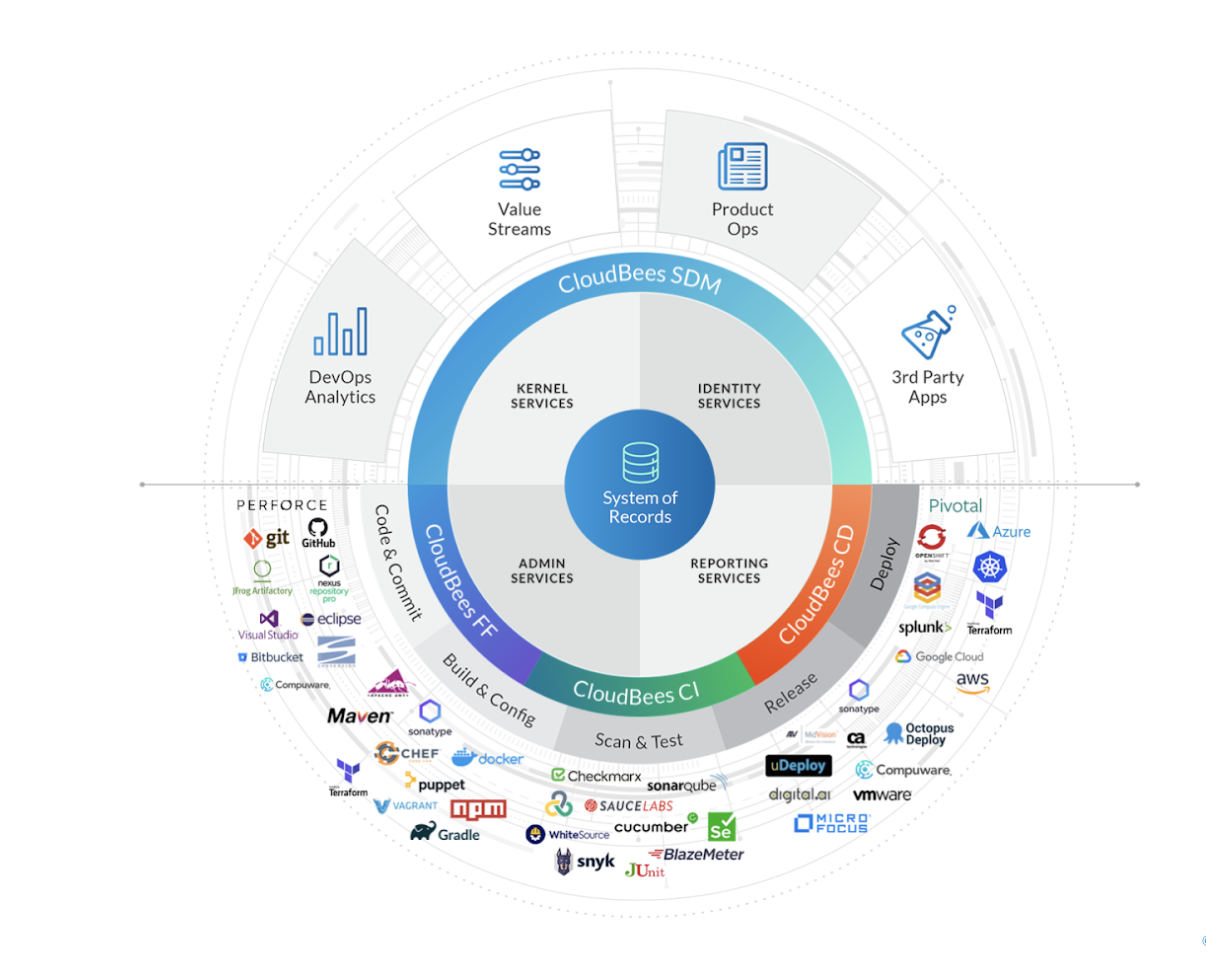 The DevSecOps offerings, meanwhile, provide IT teams with a hardened instance of the CloudBees CI offering, along with hardened audit-ready pipelines to ensure only immutable, approved components and environments are used without any drift or tampering. CloudBees is also adding support for role-based access controls based on fine-grained permissions as well as tighter integration with the feature-flagging capabilities of the CI/CD platform. If issues arise in a production environment, specific features can be pulled back with full traceability provided automatically.