Tag: devsecops

  • GrammaTech Allies with GitLab to Advance DevSecOps

    GrammaTech Allies with GitLab to Advance DevSecOps

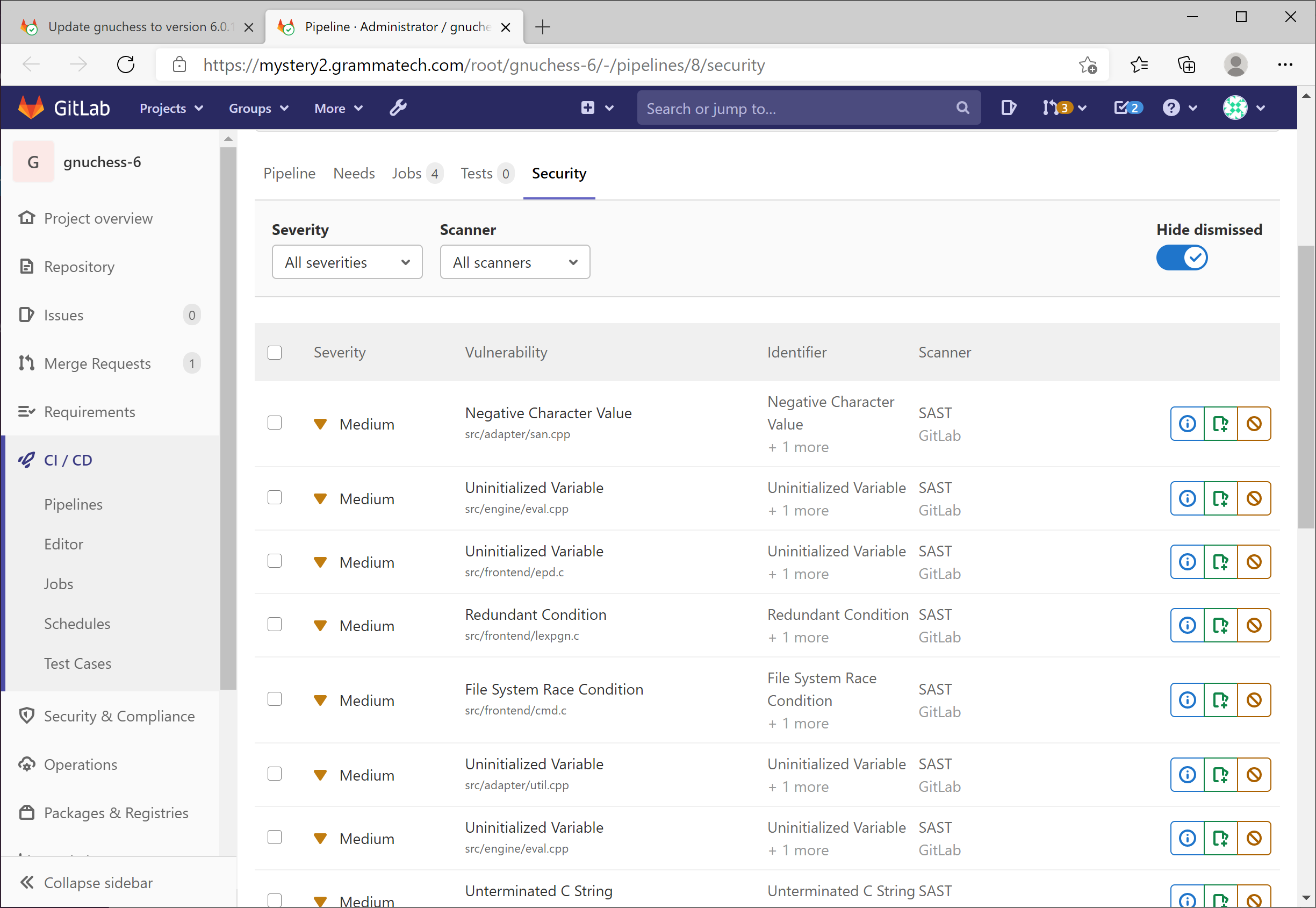
    GrammaTech announced today it has partnered with GitLab to integrate its GrammaTech CodeSonar static application security testing (SAST) tools with the GitLab Ultimate DevSecOps platform.

    Vince Arneja, chief product officer at GrammaTech, said integration with continuous integration/continuous delivery (CI/CD) platforms such as GitLab is critical because it enables security scans to run automatically any time code is merged. That capability reduces the amount of code that is scanned at any one time, Arneja said.

    GrammaTech is partnering with multiple CI/CD platforms and integrated development environment (IDE) providers to make it simpler to create multiple points for scanning code during the application development process, Arneja noted.

    GitLab, meanwhile, is providing its own tools for analyzing artifacts as they move through the software development life cycle. The GrammaTech tools, available via the highest tier level made available by GitLab, analyze code at a deeper level, said Arneja.

    Ultimately, the goal is to enable developers to discover security flaws as early as possible in the application development life cycle. The later those flaws are discovered, the more expensive they become to fix, Arneja said.

    Developers, naturally, tend to postpone security scans as they race to meet an application deadline. That practice creates issues; the more code there is to analyze, the longer such scans take. It’s generally more efficient to scan smaller amounts of code more frequently. Otherwise, developers can become overwhelmed by the number of security bug fixes that need to be addressed at the back end of the application development process. Automating security scans allows an organization to move toward embracing DevSecOps best practices in a way that doesn’t rely on a developer remembering to initiate a scan.

    Most developers are not deliberately ignoring security issues – it’s just that the existing, manual processes for discovering those flaws is inefficient.

    Automated scans also provide the added benefit of simplifying discovery of common security flaws long before a code review, creating more time to address significantly more complex issues.

    Application development teams are also under pressure to reduce the total number of bugs that need to be fixed after an application is deployed. As the number of applications being deployed steadily increases, developers can find themselves spending more time fixing bugs than writing new application code.

    Most organizations are not very far along in their journey toward embracing DevSecOps. However, as it becomes easier to integrate a variety of scanning tools within DevOps workflows, the number of organizations moving up the DevSecOps maturity curve should increase. In the wake of some recent, high-profile attacks on software supply chains, the sense of urgency surrounding the adoption of DevSecOps best processes has undoubtedly increased.

    In the longer term, there may soon come a day when security is viewed as just one of many quality assurance gates that code needs to pass through before it’s allowed to be promoted. In the meantime, an ounce of cybersecurity prevention at the front end of any application development is most certainly going to be worth more than several pounds of cybersecurity cure applied too late.

  • Cybersecurity 2021: Are You Really Prepared for a Cyberattack?

    Cybersecurity 2021: Are You Really Prepared for a Cyberattack?

    As the majority of businesses are increasingly moving to the online world, employees keep working remotely and more cyberattacks keep happening all over the globe, there is no doubt that embracing DevSecOps should be the new normal for every company. Organizations need to be able to adopt DevSecOps practices and adapt to new and evolving threats in order to protect their data and systems from malicious attacks.

    At Cybersecurity 2021: The New Normal Virtual Summit, taking place March 4 and 5, the brightest minds in the security and IT industry will come together to discuss new security threats, empower DevOps teams with the latest security tools and provide practical tips and guidance to help developers and ops teams make the right security decisions to keep their data secure.

    The two-day virtual event features thought-provoking discussions, networking opportunities and educational sessions focused on:

    • DevSecOps tools and practices
    • The main challenges of security and development teams when it comes to AppSec
    • Identity and Access Management (IAM)
    • Passwordless and the long-term future of identity management
    • Policy-as-Code and how it impacts security
    • How security threats changed with COVID-19 and what to expect in 2021
    • How to manage AppSec
    • How to mitigate API vulnerabilities
    • How to break the silos and advance towards DevSecOps maturity
    • How to expand your security program through low-to-no cost initiatives
    • Time series database for security monitoring
    • Machine identity management
    • Top 10 Hacks From the Past Decade
    • Runtime observability techniques for security and compliance
    • Securing AWS credentials on DevOps machines

    Cybersecurity 2021 features an outstanding lineup of industry leaders, including:

    • Ira Winkler, author and president at Secure Mentem
    • Chenxi Wang, founder and general partner at Rain Capital
    • Ron Gula, president at Gula Tech Adventures
    • Richard Stiennon, founding member of The Analyst Syndicate and chief research analyst at IT-Harvest
    • Joe Levy, CTO at Sophos
    • Rajat Bhargava, founder and CEO at JumpCloud
    • Myla Pilao, head of security research communications for TrendLabs at Trend Micro
    • Upasna Gupta, senior product marketing manager for Prisma Cloud at Palo Alto Networks
    • Julian Waits, general manager of cyber business unit and public sector at Devo
    • Joseph Feiman, chief strategy officer at WhiteHat Security
    • Ian Murphy, founder and CEO at CyberOff
    • Mike Jones, security researcher at H4unt3d Hacker Podcast
    • Rhys Arkins, director of product management at WhiteSource
    • TJ Jermoluk, co-founder and CEO at Beyond Identity
    • Jim Ducharme, general manager of the anti-fraud business unit at RSA

    Attendees will have the chance to enter a raffle for a chance to win a free copy of “You can Stop Stupid” by Ira Winkler and another one for a free copy of “Security Yearbook 2020” by Richard Stiennon. There will be valuable resources available for download and attendees will be able to interact with sponsors to learn more about their security tools and services.

    To see the full agenda and to register, please visit the Cybersecurity 2021 website.

  • Game On: Secure Coding Virtual Summit 2021

    Game On: Secure Coding Virtual Summit 2021

    Agile organizations are looking for ways to win at security without slowing down their release cycles. That’s where DevSecOps comes in. The days of a hands-off security approach for developers are over. Organizations implementing DevSecOps to integrate security into their DevOps framework are able to release secure software faster. Developers test code for potential security vulnerabilities earlier in the pipeline to fix security issues in real time to avoid costly delays.

    At Secure Coding Virtual Summit 2021, industry-leading AppSec and DevSecOps practitioners, analysts and visionaries will come together to share their best pro tips and power ups to level up your code security. The agenda for the virtual event, taking place March 24 from 10 a.m. to 6 p.m. ET, features a mix of topics including AppSec, threat modeling, API security, container security, case studies and more.

    The most brilliant security luminaries from OWASP, Okta, Microsoft, Secure Code Warrior, WhiteSource and many other well-known IT companies, will discuss:

    • How to level up your secure coding strategies
    • How to run an AppSec program with open source projects
    • The best practices for securing your APIs, the attack surface of an API and common authorization problems
    • The concept of threat modeling, its objectives and its role in the SDLC
    • How to transform developers into security people
    • How easy (or not) it is to get a container or Kubernetes cluster hacked on purpose
    • How to create an AppSec pipeline with containers in a short period of time (demo)

    This year’s Secure Coding features outstanding industry leaders, such as:

    • Vandana Verma Sehgal, global board of directors at OWASP
    • Simone Curzi, cybersecurity principal consultant at Microsoft
    • Keith Casey, API problem solver at Okta
    • Matias Madou, CTO and co-founder at Secure Code Warrior
    • Matthew Coles, senior principal product security engineer at Dell
    • Sarah Young, security architect at Microsoft
    • Chris Romeo, CEO and co-founder at Security Journey
    • Dr. Phillipe de Ryck, web security expert and founder at Pragmatic Web Security
    • Richard Greenberg, founder and CEO at Security Advisors LLC
    • Izar Tarandach, principal security engineer at Squarespace
    • Jeroen Willemsen, principal security architect at Xebia
    • Shiri Ivtsan, director of product at WhiteSource
    • Justin Hutchings, director of product management at GitHub
    • Matt Tesauro, senior partner at 10 Security
    • Matthew Butler, principle engineer at Laurel Lye

    Attendees will have access to useful resources and will be able to interact with sponsors to power up their secure coding strategies. There will be live Q&A chats with keynote speakers to get your burning questions answered. Attendees will also have the opportunity to hunt for Easter eggs to boost their player score for a chance to win a PlayStation 5.

    To see the full agenda and to register, please visit the Secure Coding website.

  • GitLab Releases Updates to CI/CD Platform

    GitLab Releases Updates to CI/CD Platform

    GitLab this week made available a 13.9 update that adds more than 60 new features and updated capabilities to its namesake open source continuous integration/continuous delivery (CI/CD) platform.

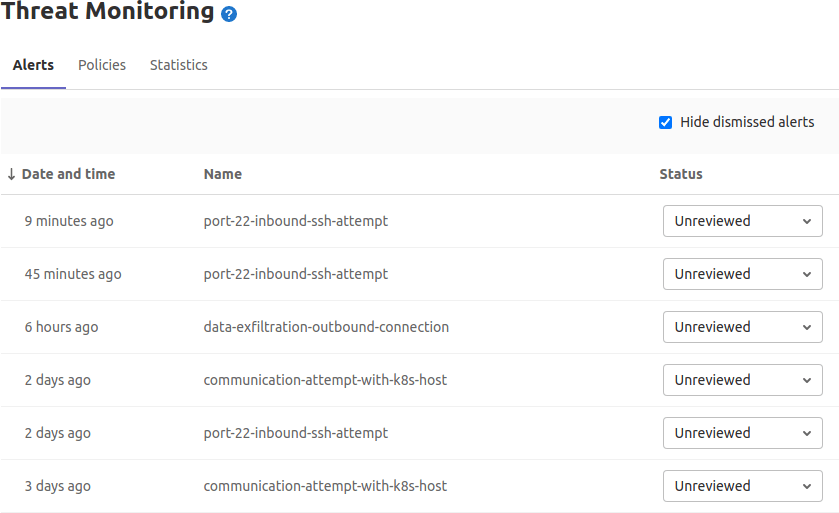
    Brian Glanz, a product marketing manager for GitLab, said chief among those capabilities is a Security Alert Dashboard that enables DevOps teams to triage high-priority alerts more easily. As more organizations embrace DevSecOps best processes, application development teams need to be able to prioritize which security issues are more pressing than others, Glanz said.

    Other new capabilities include the ability to reuse a pipeline of a CI/CD configuration, and a maintenance mode option that keeps instance available while administrative tasks are being performed.

    Additionally, it’s now possible to view group-level analysis of release metrics, in addition to the ability to view a version of a pipeline configuration with all of the include and extends configurations merged together.

    Glanz said GitLab continues to gain traction, because all the capabilities it provides are based on the same integrated code base. The effort a DevOps team needs to exert to take advantage of new capabilities is substantially less than rival platforms, Glanz said.

    At the same time, Glanz noted that the number of contributors to GitLab coming from outside the company also continues to increase. The latest version has 299 merged contributions from the wider GitLab community.

    It’s not clear how much of an appetite organizations have, these days, to replace an existing CI/CD platform. However, it’s not uncommon for organizations to have multiple CI/CD platforms employed by different DevOps teams. In the meantime, the number of teams within enterprise IT organizations that are embracing DevSecOps processes to advance digital business transformation initiatives continues to rise. As more organizations realize how dependent they are on custom software to differentiate themselves from rivals, more enterprise IT organizations will opt to standardize on a single CI/CD platform to both reduce costs and increase overall efficiency.

    A report published last year by GitLab noted organizations can improve application development and delivery by 87%, resulting in a savings of more than $23 million. Overall, the report claims organizations can see a 407% return on investment (ROI) on the GitLab platform.

    Naturally, competition among CI/CD platform providers remains fierce. With most developers working from home to help combat the spread of the COVID-19 pandemic, these platform providers have been touting their ability to support remote work. It’s not clear if developers will be returning to the office en masse now that COVID-19 vaccines are being distributed. However, it’s clear that even once the pandemic subsides, the way application code is created and maintained will be a lot more fluid. Many organizations are now more comfortable hiring developers wherever they can find them.

    Of course, many of those developers are going to be wary of joining organizations that have disjointed workflows, especially when it comes to shifting responsibility for application security further left toward developers. In fact, the ability of any organization to effectively recruit developers is now directly tied to the overall sophistication of their DevOps workflows.

  • Application Security and Continuous Observability with DeepFactor

    Application Security and Continuous Observability with DeepFactor

    Today’s modern applications are becoming increasingly complex and released more frequently than ever before, therefore increasing security, privacy and compliance risks. How do you identify the security and compliance risks hidden in your application before you deploy it to production?

    Continuous observability enables DevSecOps teams to observe millions of application telemetry events and find runtime security, compliance and privacy risks within the DevOps pipeline, while providing AppSec teams the ability to set guardrails and have continuous visibility with every build.

    In this TechStrong TV interview with DeepFactor Founder and CEO Kiran Kamity, we discuss the concept of observability and how to apply it for security and compliance. We also talk about the increasingly important role of AppSec and DeepFactor’s new Observability-as-Code API, which enables DevSecOps engineers to leverage observability functionality in their CI pipeline and gate builds.

    The video of the conversation is below, followed by the transcript. Enjoy!

    Transcript

    Mitch Ashley: I have the pleasure of being joined by Kiran Kamity, who is founder and CEO with DeepFactor. Welcome, Kiran.

    Kiran Kamity: Thank you, Mitch.

    Ashley: Great to have you. We’re gonna be talking about observability, super-hot topic, but before we get there, tell us a little bit about yourself, a little bit about your background, and then a little bit about DeepFactor.

    Kamity: Awesome, yeah. I came to the Bay Area about 20 years ago. I did my undergrad at the Indian Institute of Technology in India in Chennai, and then I came here to Stanford for my grad program. Once I came to the Bay Area, you get addicted to the entrepreneurial spirit, you never leave, this becomes your home. Happened to most people—happened to me as well.

    So, the Bay Area is my home, and I’ve had a mix of enterprise and infrastructure cloud computing, virtualization, and DevOps/AppSec kind of background over the last 20 years. I’ve done two companies as a Founder, which were acquired by other companies like Citrix and Cisco. My first company, RingCube Technologies, was acquired by Citrix. We built a container run time for the Windows Operating System before the Docker days. This was acquired by Citrix in 2011, so I was responsible for some of the product teams at Citrix after the acquisition.

    Then the bug bit me again, and I started ContainerX, which was a turnkey containers in a box type company, which was acquired by Cisco, and it’s now called Cisco Container Platform. While at Cisco, I was Head of Product for the Cisco Cloud Business Unit, which included container—container networking, OpenStack, and some of the other initiatives that they had.

    During that time, as I was looking at what to do next and analyzing the market, a lot of the learnings came to the following. There’s a lot of momentum that has happened so far in cloud native architectures, DevOps, et cetera. And the learnings were that the next wave of innovation is going to be as DevOps becomes DevSecOps. And that’s why I started DeepFactor, and we believe that the next wave of innovation in the world of DevSecOps is observability.

    Ashley: That’s something I both relate to and also am just fascinated by other entrepreneurs is that story of, you’re working on what you’re doing now and you’re still kinda looking at, “Well, what’s the next thing coming up, and what might I go do next?” and then you go off and solve the next problem.

    Kamity: Yeah, absolutely.

    Ashley: Start another company to do that—like you said, you get the bug, it’s kind of a fever. [Laughter] It definitely is.

    Well, cool. We’re talking about observability, and it does seem to be the hot topic of kinda late 2020, early 2021. So, let’s first start with kinda how did we get there—get here? How did we get to this place where suddenly observability is a thing and not only a thing, but important to a lot of people?

    Kamity: Yeah. Just to qualify it a little bit, our focus at DeepFactor is applying the concepts of observability for security and compliance, which is truly novel, and there’s very few companies that are trying to do that.

    Ashley: True. Observability can mean just sort of the next elevated monitoring, right?

    Kamity: Exactly.

    Ashley: So, you’re [Crosstalk] around security.

    Kamity: So far, a lot of the observability plays have been in the logs metrics tracing. Applying the concepts of observability, truly as the next generation of evolution of APM. But at DeepFactor, we’re leveraging the concepts of observability for identifying security and compliance risks in your applications before they go to production.

    So, to answer your question about how did we get here, let’s take a step back and analyze what has happened over the last few years, with respect to application development, right? Apps have become a lot more complex than they have ever been today. I mean, think about it—a common application is made of a bunch of different languages. You have a Java service, you have a Node.js service, and you have Angular in the front end, you have lots of different pieces, you have a database, et cetera.

    You have a lot of third parties—third party libraries that are baked into your services, third party components that are not built by you such as Nginx and MySQL and MongoDB, et cetera, that become part of your application.

    Ashley: A lot of open source, right, in that stack.

    Kamity: A lot of open source. Applications are now also being deployed in a bunch of different ways. You have applications that are not containerized, still mainstream. You have containerized applications, you have full on Kubernetes applications, and you have land applications as well, so the deployment of applications has become complex as well.

    So, in this world of applications becoming a lot more complex than they’ve been, what essentially happened from a security perspective is that the attack surface area of your application has significantly increased. It is the highest it’s ever been so are, and it’s only gonna go that way.

    Let’s take a look at a few other trends that have bene happening in industry. The velocity of releases—that has gone up as well due to DevOps. You’re no longer building or releasing an application once at three months, once at six months. You’re releasing that multiple times a week with DevOps, and different companies are different aspects of that spectrum, there.

    Now, when things are more complex and they’re being released at such a rapid pace, there is no way humanly possible for your AppSec teams to find all of the security risks and compliance risks that lie in your application before they deploy to production. At the same time, the risk of these issues being in production is higher than it’s ever been. If you think about it, the sophistication of the bad actors has increased significantly as well over the last few years, and therefore, the nature of the breaches, the size of the breaches, and the damage that they can cause has increased as well. Coupled with that, privacy concerns have increased, resulting in standards like GDPR and CCPA and all of those things emerging as well.

    Now, in such a landscape, you’ve got to automate identifying the security and compliance risks that are hidden in your application before you deploy your application to production. And that is where the current tools of just code scanning or identifying issues based on signatures or just DAST scanning your application, et cetera, don’t cut it. You need something that watches your application while the application is actually running in both pre-production environments as well as in a canary deployment of minimal production deployment before you release it to your broader production deployment.

    And in that environment, you’ve got to be able to watch the millions of events that are happening inside your application, take that data, analyze and find the needles in the haystack, and therefore determine where the security and compliance risks are and pass on all of this information with rich evidence such as stack traces, metrics, and whatever it takes to fix these issues back to the developers. And a lot of this has to happen in a seamless manner that is nicely tied into your DevOps kinda pipeline, and that’s where observability applied to security and compliance comes in, and that’s exactly what we call continuous observability at DeepFactor.

    Ashley: Interesting. I know, talking with you previously and kinda hearing about DeepFactor, you all talk about start left, not shift left—this idea that, really, it starts from the beginning, not, “Let’s kinda push it as far left as we can.”

    Kamity: Yeah, absolutely. If you think about it, we’ve had operator specific tools emerged in the last five years with respect to security. So, you’ve had container security tools that identify issues in your Kubernetes configuration or your Docker configuration or vulnerability scanners that identify issues in your host operating system if you’re deploying your app in a VM.

    Now, those are all the types of insights. Are there any misconfigurations that could lead to security issues that are very relevant for the Ops people? And those tools are coming up with the idea of shifting left, because you need to find these configuration issues before you go to production so that the Ops people can deploy these applications properly.

    But when it comes to developers, their agenda is not securely deploy your application. They don’t care, honestly, about how you’re Docker or Kubernetes is configured, for the most part. They care about what is in their application, securing at the source. And when the agenda for Dev teams is to secure at the source, then all you care about is—what is my application doing, whether it’s my application or some third party that I brought in, or just my interpreter itself when it is running? And can I identify the risks involved and understand my attack surface within the application ahead of time? And that’s why we call it start left.

    So, we think that operators care about shifting left. Developers should truly care about starting left.

    Ashley: Yeah, it’s interesting, because your point about code scanning and DAST approaches to security is, from a code standpoint, you do wanna be writing a secure code, so it’s a valid thing, of course, to be doing. But you mentioned Lambda, you mentioned, of course, infrastructure as code, essentially, where all this is dynamic, right, in our environments today, and more so, not less, every day, right?

    Kamity: Yes.

    Ashley: Every day, it gets to be more dynamic. Now, you’re really talking about the whole context of the environment with the application. Kind of, if you thought about it in the network, you’d say all seven layers, right? If you think about it in the security stack of software, it’s application plus all of the other things, right?

    Kamity: Yes.

    Ashley: It’s interesting what—how do you find people are accepting this idea of run time information being provided with context, you know, this rich information you were talking about, is that something new to developers or like, “Oh, my gosh, I’ve been waiting for this forever” or, “Well, this is really cool. Look at—let me see what I can do with it”? What’s more the experience that developers have?

    Kamity: Yeah, so, I think different organizations react differently to something like this. The old way of thinking is—oh, developers don’t care about security or compliance.

    Ashley: I’ve never met a develop that wants to write insecure code or unsecure code. [Laughter]

    Kamity: Exactly, right? That is exactly what’s happening now where, given the consequences of shipping insecure applications and given the need to be more and more secure at the source, I think developers—and just simply because it’s just not humanly possible for your AppSec teams to identify all these things. Given the talent shortage of the AppSec skill set as well, it is, the responsibility if identifying these risks has to be borne by the developers. Because at the end of the day, the developers are the ones that are writing the code and you’ve got to make sure that you’ve shipped secure code.

    Engineering leadership and AppSec teams in various organizations that we’ve been working with have been fully accepted. In fact, they’re fully aware. In fact, a lot of them want this kind of concept, it’s just the lack of tooling today. Because if you think about the current tools that are available, they’re doing the best they can with the existing set of tools.

    I mean, they’re scanning the code, they’re trying to scan the application from time to time—but those tools don’t lend themselves well, nicely into seamless integration into your CI pipeline, and therefore, giving developers the insight about, “Hey, here’s where we saw your application did this.” That can only happen with observability tools like what we’re building, because we watch every thread of every process of every service in your application when it is running in test and even canary deployment in your part of production before you deploy that thing widely to a larger section of production. And that is the kind of insight developers do care about.

    What we have gotten repeated feedback as we have been building this product with a few development partner type enterprises so far is that, the insights that we have needs to be enriched with richer evidence information so that developers can actually take that evidence information and directly go fix the problem. So, we’ve augmented our insights with stack traces wherever appropriate. You know, obviously, the good old things like CVE numbers and things like that, we have that.

    But what we focus more on is not just giving you a list of CVEs, but complementing the insights that your software composition tools give you by giving you run time usage information of that CVE. For example, we can tell you if a tool like Snyk will tell you there are 250 vulnerabilities in your application, DeepFactor will tell you, “Hey, there are 250 vulnerabilities according to what Snyk is telling you. Fifteen of those things have been used by your application at this time, when your application was executing here, ad here is the function, here is the call stack.”

    So, that will make it easy for a developer to go, “Okay, now I don’t have to get overwhelmed with fixing all of the 250 things or adding that to my backlog, I can actually prioritize which ones to fix first, because that’s what my application is actually doing.” It’s not about the whole thing that has been checked into your source code, it is what your application’s actually doing that will help you catch the more important things. It’ll help you also reduce the number of alerts that can inundate you.

    Now, with all of these changes, the rich evidence, reducing the number of alerts, and to the point, alerts based on what your app is actually doing, developers are finding it more and more meaningful, our insights. And as we grow the company, that’s gonna be our primary focus.

    Ashley: That’s always been the challenge with vulnerability scanners and code scanners is, yes, I get all of those results. What of those are real? Yes, they’re all theoretically possible. I may not be using it in a way that actually exposes me to that CVE, that vulnerability.

    But what you’re saying is, you’ve actually detected the use in the application or the software stack of something around that CVE that’s worth looking at. Hopefully, you’re cutting down on the number of things that are actually, they go look at. You can ignore the rest, if you will, or at least know that they’re much less likely to be an issue.

    Kamity: Yeah. We do not give you too many alerts. We give you the alerts that are relevant for your application because we watch the millions of events that are happening in your application in every part of your application, across various layers of the stack—like, system caller interface, library calls that your application has made, network behavior, web and API, all of that.

    And based on that data, we treat it as a data problem. So, we take that data and then we try to identify anomalies and detect that these are the risks that lie in your application from a security perspective, and this is how it maps into compliance. So, we will tell you that these are the security risks in your application and in our next module of the product, we’re gonna tell you that this can hurt your PCIDSS, and here’s the number, basically.

    Ashley: Mm-hmm. It definitely is gonna improve your relationship with the security and compliance team, right? If you’re solving these problems before it gets to them, they have to ask, “Well, did you do anything about this? Are we susceptible?”

    Kamity: Yeah.

    Ashley: Talk a little bit about—so, where in the tool chain and the workflow pipeline, where do you fit? Where does DeepFactor play?

    Kamity: Yeah. The best way to think of us is, if you take a step back, if you are thinking about your DevSecOps initiative in total, you want to plug in into a bunch of different points from a security perspective into your CI pipeline. Your developers write code. The next step should be you try to find risks in your code. That’s where the SaaS tools come in, they find the risks that are there in your code.

    Then you create your build artifacts—let’s say, your executables, your container images, and whatnot. Then you try to find risks that lie in your build artifacts. That includes your code, any third parties that you’ve compiled together and created your services. It’s still static, though. You’re not running them yet. Tools that allow you to identify risks in your build artifacts could be container scanning tools, like image scanning tools that scan your container images and find issues or software composition analysis tools like Snyk and Black Dock and tools like that. These tools find vulnerabilities that exist in your components after they’ve been built.

    Then you run your application, you’re testing your application. Either you’re testing it in a test environment or you’ve deployed and you’re testing it in a minimal configuration of your—like, a canary deployment in your production. During that time, you’ve flicked DeepFactor on. DeepFactor doesn’t require any changes to the code of your application; you’re simply running your application.

    And that’s where we’ve built a significant amount of IP. You know, my Co-founder, Mike Larkin, he’s the CTO, he’s the father of the OpenBSD hypervisor. And our senior engineering leadership members came from Qualys and FireEye, having been in the area for 20 plus years working on security products, each.

    So, we’ve created something that involves zero touch, pretty much. You don’t have to touch your application at all, you simply run a command called DFCTL, just like KubeCTL, we came up with DFCTL. So, you do DFCTL, run your app; or DCFTL, run your container; or you drop it into Kubernetes. We have a webhook admission controller that you simply drop into Kubernetes, and then any pod that you want to be monitored, you simply can specify a config file and that pod gets monitored automatically with DeepFactor.

    Now, the way DeepFactor inserts itself is completely behind the scenes. It’s language agnostic. You don’t have to worry about, is it Java, is it Node.js—DeepFactor figures out that it’s Java or Node.js and does some specific things and finds out more information.

    So, you simply run this, your application is running in your test environment or your minimal production environment, DeepFactor observes everything that it’s doing. When the tests are done, it tells you—you throw your automated tests at it while your application is running, just like normal. And then when it’s done, DeepFactor gives you all of that information about what insights have been found and what’s the evidence information that’s pointing to the insight. Is the issue or the risk presenting the attack factor lying in the code that you wrote? Is it lying in a third party that you brought in, or is it at the interpreter level itself? All of them are risks as far as the attacker is concerned that could be exploited, so you need to be aware of where your risks are.

    Ashley: Now, are developers putting in some library calls or DeepFactor code into their application stack as well, then? Is that how you’re getting into the software, knowing what’s happening inside as well as outside?

    Kamity: Actually, that’s the beauty of our IP, and we’ve filed a few patents in that area. Developers do not need to write any code to change, or change anything in their application. You simply enter DFCTL and run your app and DeepFactor inserts itself into the application at your run time, completely seamless to the developer, and when it’s done, it unplugs itself and your application and gives you all the insights.

    Ashley: Wow. That sounds pretty cool. I can imagine that’s a big plus for developers. [Laughter] Yet something ls they don’t have to debug, right?

    Kamity: Exactly, yeah. That’s the significant part of our IP.

    Ashley: You know, it’s interesting you mentioned your team comes from a number of other security companies that have been around for a while—you know, you mentioned Qualys and others starting in the scanning, the vulnerability management space some time ago; that’s about when I got into security, too.

    What do you think we’ve learned from those types of companies and those experiences that we’ve sort of changed our perspective about where we are today, just given—yes, we have much more complexity in software, much more porous security issues, but what have we learned from all of that security scanning that’s helping us?

    Kamity: Yeah, no, I think there have been numerous, numerous learnings, and the learnings have evolved over time as the landscape of application development has changed as well. You know, you’ve had tools in the past that were designed based on the applications of the past. But tools of today and tools of tomorrow are different, because the applications of today or the applications of tomorrow are definitely trending in a different direction.

    One example of the thought process itself is that, you know, when things are in single digits or a lesser number, it’s okay to have manual scanning, manual testing, once in a while test it and then find information, which is kinda the old kind of scan once in a while, identify it, or bring in a pen tester once in three months, you know, check some boxes and get it done kind of thing.

    Those are all great and they’re still relevant even now. What has become even more important is why you do those once in a while scans and checks. You’ve got to make sure that you get in the habit of securing at the source. You can no longer imagine that your infrastructure or the perimeter is gonna secure your application properly. You’ve got to make sure that you build your application securely to start. And that fundamentally has changed the kind of tools that we need to build in order to equip the developers who build applications to secure at the source.

    At the same time, I think the role of AppSec has become even more important than it has ever been. Because, you know, sometimes I keep getting asked, “Oh, are you saying that developers should use these security tools? That means the AppSec teams are no longer relevant?” That is totally wrong, because AppSec teams, their job is increasingly more relevant. Because if you take a step back and you look at the number of attack vectors that are there in your application, we just talked about how your pipeline should be architected—secure at the source, making sure that you scan your code, scan your builds, test your running applications, and identify risks in all of these areas—who ties them together? Who comes up with this overall strategy? Who comes up with that triaging process and passing the evidence back to the developers, identifying which ones are important and which ones are not?

    All of that should come from the AppSec person in the team—AppSec or if AppSec is assimilated into your DevOps and we call it the DevSecOps person, that’s the role of this person is to make sure that he or she is the shepherd of your CI pipeline from a continuous security perspective and then feeds all of that information back to the relevant parties. Some of that could be your developers, some of that could be to your engineering leadership, and some of that could be to your security leadership.

    Ashley: Mm-hmm.

    Kamity: That is how I see the organizations of tomorrow shaping up, learning from what has happened over the last 15 years to 20 years of innovation in this area.

    Ashley: I think that makes a lot of sense. Otherwise, (a) we’re just throwing tools at it, everybody’s doing whatever and who knows whether that’s helping us improve and improve security. And you mentioned the data coming out of it, right? That can also be used for continuous improvement, continuous learning, what are trends that are happening in our application?

    Suddenly we’re seeing much more of this technique or this architecture or this environment being deployed that, you know, not always do the security people have exposure to that early on in the process. So, it’s a good way just to know what the heck is goin’ on and then also, you have an idea about how all of your security tools, developer or non-developer, fit into an architecture that makes sense.

    Kamity: Yeah, exactly. I mean, imagine flipping a switch and identifying, “okay, these are all the touch points that my application has and these are the millions of things that it’s doing” and condensed very well to, “these are the red dots in that whole story, and this is where your risks lie.” That’s powerful, and I think it’s the AppSec person’s job to set all of that up and make sure that a framework is created and then say, any time something that comes up, you know, make sur that you pass it on to the developer with the appropriate evidence and work with the engineering team to decide.

    Because when you have so many different services and so many different languages, the AppSec people, especially because they’re already short staffed, cannot possibly know everything about the business logic of the application, resulting in those decisions that could have been made to bring in component X and component Y and whatnot.

    Ashley: Mm-hmm. You know, Kiran, one of the things that I’ve said over time is that security people need to get a greater understanding of software architecture. They don’t need to have to be developers, right, that’s not what their skill set is, nor necessary their desire. But you can’t treat security as this hard outer shell, you know, we just keep making it smaller and smaller. And now all you’ve got is thousands or hundreds of thousands of small outer shells and now you’re not securing anything, any more.

    It seems like the AppSec team can play a really important part of helping bridge that gap of what are we doing specifically, what are the architectures that we’re using, what might be some of the security risks that maybe a security engineer is just not fully up to speed on or trying to keep up to speed on as it’s changing?

    Kamity: Yeah, absolutely. Imagine the power of flipping the observability switch and the AppSec person going and saying, “Hey, Dev team, we noticed that in this particular piece of your code, you’re using an API that has been deprecated by the operating system” or, “In this particular piece of code, you’re invoking memory improperly, because this tool is showing me exactly what was done when this particular area of memory was allocated with the wrong permissions. Or, “This is an area of code where your interpreter is doing something wrong. Is it possible for us to go change the version of the interpreter that we’re using, maybe upgrade it to the latest version or put a patch?” Or, “Do we need to, in order to mitigate this thing, assuming that there’s no fix in the interpreter, do we need to go put something in our WA in our infrastructure to block the particular attack from happening?” Or, “Should we report this problem upstream to Java itself, the Java community itself, so they can go fix the problem in there?”

    So, lots of different things that could be done once the AppSec team is empowered with this much rich information about what’s happening in the application.

    Ashley: You know, something I don’t know that we talked enough about, we talked about how rapidly and how quickly we’re delivering software applications now. The environment of the software, the API calls we’re using, the libraries, the services, interpreters—all of that is changing in parallel very quickly. Sometimes you don’t feel like you have time to keep up with it, or that’s all you do is spend your time keeping up with that, not kinda delivering business value.

    I think folks that are maybe not involved too deeply in the software creation process really realize not only the complexity but how much change there is to deal with. There’s a lot that goes into that. We talk about technical debt or backlog or whatever—it’s a lot more than that, there’s much more to it. [Laughter]

    Kamity: Absolutely, there’s a lot more than that, and I think having an informed security team as well as, you know, coupled with a structure and the right tools baked into your pipeline, which results in informed Dev team, can result in goodness overall. You’ll end up identifying security and compliance risks earlier in your Dev cycle. You’ll end up fixing those things earlier, and therefore, you will end up shipping a much more secure application, and it’s a cycle. Every time more developers check in code, you know, this kind of identification happens automatically, and you end up identifying more and more risks and fixing more and more things, resulting in more and more secure applications into prod.

    Ashley: Mm-hmm. Awesome. Well, what are some things folks might have access to you can help them get started? Obviously, they can download HIV testing product or get involved that way. Do you have some other tools or things that they might be able to use to make it approachable to get into this kind of an approach?

    Kamity: Yeah, they can go to DeepFactor.io to check out the product, understand more about the product. And if they want to get started, they can either download the community edition that is now free for 10 user teams or less. If you need any help with setting up the product, you can reach out to our Customer Success person.

    We’re also giving away a free DevSecOps Risk Assessment to companies that are working with us as we expand our organization more. This will help any engineering team or any security team to get a free assessment of what DeepFactor can find in their applications so that they will be able to identify, “Okay, these are the kinds of things DeepFactor finds, and it’s useful for me and here’s where I need to go next” kind of thing.

    So, that DevSecOps Risk Assessment is completely free. Contact us, hello@deepfactor.io or just go to the website to learn more.

    Ashley: Awesome, great. I know you’re also speaking at the Cybersecurity 2021, I think you have a couple of sessions there, right? The dates are March 4th and 5th for that event.

    Kamity: Yeah. We have a couple of speaking sessions at Cybersecurity ’21. We have a virtual booth there as well, so do check us out. There is a—you know, our team can answer any questions or even try to explain to you or help you understand what DeepFactor can do and identify in your application.

    Also, today, we’re launching Observability-as-Code. It’s a new module that we’ve created, and a product that allows people to bake in observability into their CI pipeline, similar to how Infrastructure-as-Code enables DevOps and DevSecOps folks to spin up, spin down infrastructure in their CI pipeline itself and other related scripts. You can do, now, the same thing with observability for security and compliance with DeepFactor. So, you can use our API, we have a Swagger doc ready, you can use our API to invoke DeepFactor as part of your CI pipeline, get the results, triage the results, use that results to block, if there’s any P1s you want to block the _____, you can do that. You can do things like that with the Observability-as-Code API that we just announced.

    Ashley: Excellent. Well, I hope folks will check you out. I think it’s a great path to be going down, and I’m sure developers appreciate writing more secure code, but completing an application that’s more secure that they’re involved in developing.

    So, Kiran Kamity, great to have you here, CEO and founder, co-founder—I guess founder [Laughter] of DeepFactor.io. And be sure and check out the speakers that you all have at Cybersecurity 2021. It’s a great conference and we look forward to hearing more from you, there. Thanks for joining me today. Great to talk with you.

    Kamity: Thank you much. Appreciate the opportunity.

    Ashley: You bet.

    Kamity: Bye.

  • Protecting Data from Insider Threats

    Protecting Data from Insider Threats

    “Insider threat” can be defined as the threat an employee or a contractor will use their authorized access to, wittingly or unwittingly, do harm to an organization’s security. Certainly, as organizations become data-driven, embrace data democratization and release new applications at breakneck speed, the probability of an insider threat is rising sharply.

    A common example of an insider threat is granting permissions to on-call SRE engineers who may need to access system tables across multiple databases, inspect contents of S3 buckets and make changes to the production environment to fix availability issues. Every two weeks, the composition of the team may change, and the composition of services and databases may vary dramatically.

    While it is impossible to completely safeguard against insider threats, organizations can better protect their data by investing in best practices that (a) reduce the likelihood of such a threat playing out, (b) limit the blast radius from an insider attack and (c) help detect the attack as quickly as possible. The third point is especially important – the Ponemon Institute’s recent Cost of Insider Threats 2020 Global Report claims that it takes, on average, 77 days to detect and contain an insider attack.

    A DevOps Framework for Protecting Data From Insider Threats

    For security measures to be effective, they must be non-invasive, especially in agile organizations where DevOps teams are expected to push releases several times a day.

    Implementation of Access Policies-as-Code

    Implementing access policies-as-code automates workflows for user and service access authorization. Using this approach, manual policy practices are replaced with “code” (policy files readable by your team and by the systems that enforce the policies) so that the right people on your team can request, approve and publish policy changes instantly.

    As an example, here’s how the above scenario may be implemented as code:

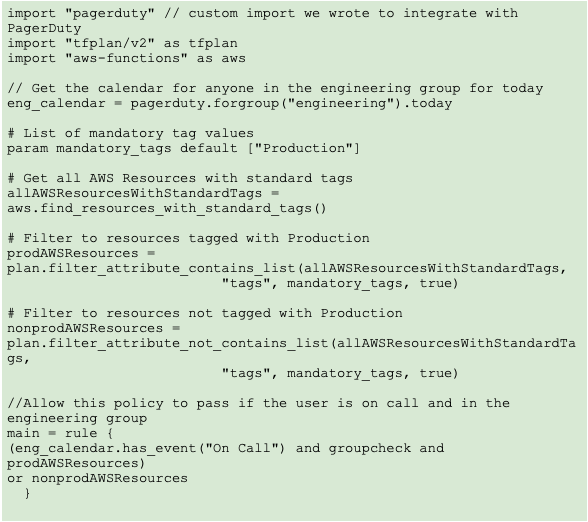
    Engineers can add themselves to on-call status with a code push in GitHub to a Terraform script, with only the team lead authorized to approve this action. (See example 1, below.)

    insider threats
    Example 1

    Using frameworks like Sentinel, changes to production environments can be limited to only on-call engineers. (See example 2, below.)

    insider threats

    Example 2

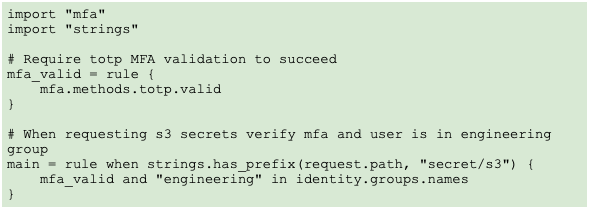
    Similar policies can limit only those engineers who are able to read unencrypted content of S3 buckets by fetching keys from Vault. (See example 3, below.)

    insider threats

    Example 3

    The above examples demonstrate guardrails that allow engineers to perform their duties, while drastically reducing the administrative burden on leads, resulting in fewer errors. An additional benefit of this approach is that it forces a public review of all changes to policies, which makes the security model more robust.

    Zero Standing Permissions

    Zero Standing Permissions (ZSP) is a DevOps-friendly security tenet that requires any administrative privilege to be available to users only when needed, and only for as long as needed. It enables teams to configure access, via administrative privileges, to highly critical components of their infrastructure for a limited duration, with restrictions on the scope of those privileges.

    Here are a few examples of how teams can implement ZSP for their databases:

    • Create an SRE role on the database that can update and delete database tables and a private Slack channel of db-admins that can allow on-call engineers to assume this role.
    • Implement a service that can be used to request and grant access via this SRE role for a default of 60 minutes. After that time, the access is automatically revoked and needs to be granted again.
    • Further implement policies in BrewOPA that restrict an SRE from dropping tables and databases, which avoids any disasters.

    Audit Trail for Privileged Activity

    SIEMs are increasingly the nerve center of every security organization. While effective threat-hunting and incident response requires several years of expertise, DevOps teams can significantly bolster the security of their cloud platforms by investing in log collection and basic analytics for all privileged activity in their environment.

    These tools include services such as the following:

    • Session recording for all Linux boxes using Cmd
    • Logging activity across databases with Data Cloud services
    • Centralizing and collecting all environment logs using services like CloudTrail.

    These logs can be visualized in tools like Kibana, where teams can look at activity pattern anomalies. These could include:

    • Someone opening up an FTP connection to outside the organization
    • Creating a manual copy of tables outside of the database
    • An increased number of authentication failures across resources

    While the concept of “least privilege” as a safeguard against insider threats to data has existed for some time, the advent of cloud-native and DevOps methodology has exacerbated the challenge of implementation. In recent years, security-as-code and infrastructure-as-code have emerged as good models for implementing security solutions, and are rooted in the above framework. The future encourages collaboration across various stakeholders, documents security policies for easy review and builds on existing tools and workflows. It will help limit insider threats, limit privilege sprawl and prevent “user fatigue.”

  • DevSecOps Trends to Know For 2021

    DevSecOps Trends to Know For 2021

    For DevSecOps leaders, 2021 will be the year of the open source supply chain attack. It’s already starting, in fact. On January 7, security researchers at Sonatype identified three malicious Java components in the Maven Central repository. The components had identical names to reputable components. Then on January 20, the same research team found three more compromised packages in the node package manager (NPM). In all cases, these malicious components had nearly identical names to common Java and NPM packages.

    The bad packages were downloaded thousands of times before they were removed, compromising the open source software supply chain. Such incidents are increasingly common. The practice of intentionally or unintentionally deploying poorly vetted code — we call it shadow code — is inevitable. Shadow code happens when developers include  third-party software code in applications without approval or sufficient safety validations. Developers do this for the same reason that they use libraries and other components – it is quicker than writing the functionality from scratch. Often, these components offload compute-intensive or specialized features. Some examples are shopping cart software, payment systems or responsive design requirements. Sometimes, too, developers mistakenly include shadow code that is fake, but has a similar name (this is referred to as typosquatting), like the examples we described above.

    Shadow code, plus a growing reliance on open source, magnifies the security risk and attracts more bad actors. Modern applications are composed of anywhere from 50% to 90% open source code, depending on the code audit. Rapid code iterations make it impossible for security reviews to police all code changes and dependencies. With many open source libraries containing hundreds of internal dependencies, even the best-automated code checking tools cannot keep up.

    How Shadow Code and Supply Chain Attacks Play Off Each Other

    The compounding risks of shadow code and supply chain attacks are one of the most pressing issues that will face DevOps and DevSecOps teams in the coming year. Security researchers at Sonatype tracked a 430% increase in supply chain attacks against 24,000 open source software components in 2020. The report blamed the growth of these types of attacks on two factors; first, DevOps teams are increasing code velocity to accelerate time to market. Second, security teams are responding to traditional zero-day vulnerabilities more quickly, shortening the window for exploits. Combined, the two factors encourage more supply chain attacks.

    Attacking the Modern Extended Software Supply Chain

    In modern web applications, most front-end and middleware application code comes from third-parties. Some is proprietary, but most code is open source, due to cost considerations. Open source component source code is a massive attack surface that is often poorly monitored, measured and inventoried. DevSecOps teams should create plans to reduce the impact of these attacks in 2021 and beyond.

    Because supply chain attacks are often used either as launch pads for other attacks or to steal sensitive information, the business and financial risk from these compromises is considerable. In its annual “Cost of Breach” survey, IBM found that the average data breach cost $3.8 million and required 280 days to fully contain.

    Supply chain attacks are likely an even more expensive subset of attack, due to several factors. Because they take advantage of trusted relationships, these attacks may go undetected for months or even years. Supply chain attacks also tend to be sophisticated and target an organization’s most valuable assets.

    Evidence is emerging of coordinated attacks attempting to take advantage of supply chain weaknesses at the same time. Multiple attackers have targeted known users of vulnerable and end-of-life (EOL’d) versions of the online shopping platform Magento (aka Magecart attacks). We suspect that advanced hacking groups are either running the same scanning software packages to identify vulnerable targets, or are buying lists of viable targets via the dark web.

    The Open Source Supply Chain Risk

    The benefits of using open source software in building web and mobile applications is clear. Development teams, DevOps and DevSecOps teams can reuse code or libraries maintained by someone else to ship code faster and reduce the amount of code they must maintain.

    Nowhere is this more of a risk than JavaScript and Node.js. The meteoric rise of Node.js as middleware has dramatically increased the number of packages and libraries that can be used by developers. NPM, the package manager for Node.js, is the most frequently downloaded piece of software in use today.

    The rapid usage growth of Node.js and JavaScript has created a chaotic environment conducive to supply chain attacks. Attackers can inject code into trusted open source packages in a variety of ways. (To be clear, Java, Python, PHP, Golang and Ruby have the same potential supply chain vulnerabilities. But JavaScript is, by far, the largest target and it dominates the front-end and near-front-end, where user data is easiest to skim).

    Some big, corporation-backed libraries, such as React (backed by Facebook), are well maintained. But many other commonly used libraries are maintained by under-resourced groups of developer volunteers. These unpaid maintainers have little incentive to do the “grunt work” of following rigorous security best practices, such as setting up automated code analysis or responding quickly to reports of security problems.

    The cost of running all widely used open source JavaScript libraries through a proper code review would likely be in the tens or hundreds of billions of dollars. Because the maintainers of this code rarely profit from their work, they are not inclined to pay for and set up automated review systems. This is true even when maintainers work at large companies; the sheer amount of work behind maintaining a popular open source project can be backbreaking without major organizational support. Even code reviews and running code analysis tools is no panacea. Many popular open source projects change rapidly due to numerous and frequent code commits. So, a clean code review is no guarantee that the component remains safe a week or a month later.

    For projects run by unpaid developers, commit access to core repositories is often poorly regulated, because maintainers are happy to get any help at all on their project. Reviews of pull requests may be superficial and miss well-obfuscated attacks. Worse, sometimes developers just get tired and stop maintaining their library. They may or may not notify users. Their ghost library may sit in GitHub or NPM, still downloading properly, but with no one paying any attention to bug reports or other suspicious activity.

    The problem of abandoned or outdated code is often underestimated. According to a May 2020 study by Synopsys, 91% of commercial applications contain abandoned or outdated open source components. For these reasons, compromising open source libraries that have either been abandoned, are outdated or are lightly policed is a favorite tactic of malicious hackers looking to mount supply chain attacks – and that threat will only grow in 2021.

    Learning to Live with Shadow Code and Supply Chain Risk

    Getting rid of all shadow code is not an option. There’s just too much of it in use; halting the process entirely would negatively impact development cycles. Restricting developer behaviors in a heavy-handed manner usually ends badly (with more shadow code). Likewise, getting rid of the supply chain risk is impossible. Modern applications are too complex, with dependencies on open source components that themselves contain numerous third-party dependencies.

    That doesn’t mean DevSecOps should do nothing. Developers can and should be educated about the risks of shadow code and supply chain attacks. Taking some simple steps to reduce the risk can go a long way. For example, ask developers to create simple checklists for every piece of third-party code they use to ensure the component meets the most basic risk standards. A checklist might include, “recently updated, responds to emails, has more than X number of downloads.” For open source code, use modern software composition analysis tools like Snyk and Sonatype that check open source libraries and can be dropped into the DevOps pipeline as part of the continuous integration process.

    From the other direction, DevSecOps teams should attack the shadow code/supply chain problem by thinking about what application behaviors might indicate a compromise. To this end, teams should create a list of behaviors that are anomalous and create filters or notifications for those. For example, if a sign-up page starts taking consistently longer for users to complete, that might be a red flag for form jacking. As a final backstop, look at using machine learning systems to spot anomalous application behaviors. These systems can monitor all application behaviors, at scale, in a way that humans never can.

    Combined, these defensive practices should reduce shadow code and supply chain risks for DevOps and DevSecOps teams. While thinking about these problems is not fun, a proactive approach to tackling this malicious duo will keep your development process and applications far more secure.

  • DevSecOps May Be Key to Prevent Data Leaks

    DevSecOps May Be Key to Prevent Data Leaks

    Data leakage has become something of a norm in the digital realm, despite the fact that cybersecurity budgets are growing and more engineers are assigned to these very issues. Nowhere does this seem more true than in the realm of health care, where breaches that expose sensitive patient data are, sadly, a fairly common occurrence. 

    A recent report by Approov illustrates how severe the problem has become. According to Approov’s  All That We Let In research report, many of the mobile healthcare applications in use today are leaking sensitive patient data through APIs, potentially compromising millions of patients. 

    The study tested 30 popular mobile health (mHealth) apps, and the research estimates that some 23 million mHealth users are exposed, at a minimum. The average number of downloads for each app tested was 772,619. Analysts expect that the total number of users exposed by the 318,000 mHealth apps now available on major app stores is likely far greater. Among vulnerabilities detailed in the report:

    • 50% of the records accessed contained names, Social Security numbers, addresses, birthdates, allergies, medications and other sensitive data for patients.
    • 50% of the APIs tested allowed users (medical professionals) to access the pathology, x-rays and clinical results of other patients.
    • 50% of the APIs tested did not authenticate requests with tokens.
    • Of the 30 popular apps tested, 77% contained hardcoded API keys, some of which don’t expire, and 7% contained hardcoded usernames and passwords. Seven percent of the API keys belonged to third-party payment processors that warn against hard-coding their secret keys in plain text.

    “Look, let’s point out the pink elephant out in the room,” said Alissa Knight, researcher and author of the report. “There will always be vulnerabilities in code, so long as humans are writing it. Humans are fallible. But, I didn’t expect to find every app I tested would have hard-coded keys and tokens, and all of the APIs to be vulnerable to broken object-level authorization (BOLA) vulnerabilities allowing me to access patient reports, X-rays, pathology reports and full PHI records in their database. The problem is clearly systemic.”

    The report helps to illustrate a critical point: Sloppy code can lead to data leakage. “These findings are disappointing, but not at all surprising. The fact is, leading developers and their corporate and organizational customers consistently fail to recognize that APIs servicing remote clients, such as mobile apps, need a new and dedicated security paradigm,” said Approov founder and CEO David Stewart. “Because so few organizations deploy protections for APIs – that ensure only genuine mobile app instances can connect to backend servers – these APIs are an open door for threat actors, and present a real nightmare for vulnerable organizations and their patients.” 

    For organizations deploying apps using a DevOps methodology, it becomes very clear that much more must be done on the cybersecurity side to prevent data leakage. However, the general consensus is that data protection falls under the purview of CISOs and cybersecurity teams in the enterprise. Perhaps there is no better argument for adopting DevSecOps than the data leakage problems caused by insecure code and sloppy APIs. The report echoes that sentiment and offers several recommendations for developers creating and organizations using mobile applications. In other words, organizations should take several key steps to protect their customer data and sensitive resources, including:

    •  Address both app security and API security: Recognize that synthetic traffic to the API is an issue, and arises from bots and automated tools, not from genuine apps and legitimate data requests.
    • Shift left and shield right: Secure the development process and harden apps, but ensure that runtime protection is also in place.
    • Protect against X-in the middle attacks: Certificate pinning is critical, but often left undone because expired certificates can block apps and impact customer experience. However, when done correctly, certificate pinning does not impact either performance or availability.
    • Improve visibility into controls: Organizations and developers need to monitor the effectiveness of the controls they implement and adjust them easily – both for compliance with legislative mandates and to sustain data security and privacy.
    • Continuous testing: Penetration testing and static and dynamic code analysis should be performed regularly.

    Interestingly, those recommendations fit squarely into the role that DevSecOps should take in the DevOps process. 

  • DevSecOps Implementation: Patch Management

    DevSecOps Implementation: Patch Management

    Patch management has been a thorn in IT’s side for decades. While it is undeniably necessary for security and stability purposes, the staggering array of patches that are available make managing them effectively nearly a full-time job – or a job better left to users. Few IT professionals want to be the “patch person,” and yet, nearly all IT professionals want their systems protected by the latest patches. No one wants to find out an intrusion was easily preventable via patching. It goes without saying that the SolarWinds attack has left quite a few IT departments scrambling for an alternate solution.

    The world of patch management has gone through several evolutions that we won’t cover in much detail here. Instead, we’ll focus on what’s available, what you should look for and where the market is headed. Suffice it to say that patch management as a practice has grown from an individual applying patches to servers and server apps while employees were encouraged to patch their equipment, to complex systems that manage the patching themselves, with IT oversight. Currently, patch management is often bundled with endpoint management, simply because many of the patches are going to end points (user machines and devices).

    Out of this growth have come several market differentiators that you should be aware of when looking into a way to manage the avalanche of updates the average organization is seeing.

    • Centralized or de-centralized? Increasingly, patch management is run on servers/cloud and pushes changes out to those machines/devices that need them, or agents on each machine manage updating themselves. Which is best for a given organization really varies. If a lot of machines are running at the edge of their capability, an agent running updates in the background might be too much to ask. In that scenario, a server-managed install environment is probably better. Conversely, if a centralized location to run updates from is considered an architectural weakness (because it requires access to the update pushing engine), agents might be the better plan.
    • OS support. We’re way past the days when single-OS solutions were considered useful. List the operating systems used in your environment, and choose a product accordingly. Most products on the market support Windows/Mac/Linux, but there are variances. First off, make certain your chosen product supports all three. Then ask, “Which flavors of Linux?” Make certain the flavors running in-house are supported by the software.
    • App support. There are a lot of applications out there. Which are supported by the tool? How much leeway does the customer have for adding applications by pointing the tool at update locations? Does it support FOSS updates? There are a lot of those too, and which ones matter. Make certain the tools the organization uses are supported or can be added.
    • Many tools will scan machines for update issues. Understand what your chosen tools scan for, and how the scans impact performance on the target machines.
    • Updates are not 100% perfect. There will inevitably be problems. Make certain the tool can roll back changes. Updating 50 core infrastructure machines, only to find, hours or days later, that the update breaks something demands roll-back capability.
    • Inter-relationships. Updating a piece of software can require that another piece of software or a driver be updated, which can demand that UEFI/BIOS be updated. Or the CMOS on a RAID controller. Understand how cascading updates are handled by the tool, and if the cascading updates can be packaged, so that a failure automatically rolls back the updates applied thus far.
    • Approvals. Speaking of driver and BIOS updates, what tools are available to allow a human to approve changes? No one wants willy-nilly updates to the drivers on core systems – or even to drivers on user systems.
    • Security of the tool itself. We’re in perilous times where IT security is concerned, and frankly, an update command-and-control server is an attacker’s dream machine – take it over, put your back-door update into the mix, and tell it to update every machine it manages. It cannot be understated: an update management tool must be as protected as possible – both by the customer locking down the installation and by the developer making sure the code is solid.

    Once the system is chosen and worked into your DevSecOps environment, updates will be more responsive, which leaves one more thing to consider – does it feed into your agile tools? If the update management tool notifies a project management tool like JIRA when it updates a server, then if code on the server breaks, the developers aren’t in the dark about changes, and will have breadcrumbs to help them track down the source of the problem.

    Imagine if manual updates became a rarity instead of the norm. There is a cost associated with this process, but most of the products on the market can be had for a reasonable price – if you waste a couple hours a month (or for some products, a year) on updating, they’re paying for themselves. Of course, your time is a sunk cost, and the cost of these is an operational cost, so there is an evaluation your organization will have to undertake. Given how busy everyone in DevOps and DevSecOps is, it is likely worth the investment for all but over-staffed organizations. What? There are a few!

    Find what suits your organization, and put it to use. Faster updates, less time investment. The idea is sound, you just need to figure out what suits your needs. And keep rocking it. You are managing updates already, this is just a way to make your life easier. And we could all use a bit of easier in a busy, complex IT environment.

  • ZeroNorth Adds Analytics App to Advance DevSecOps

    ZeroNorth Adds Analytics App to Advance DevSecOps

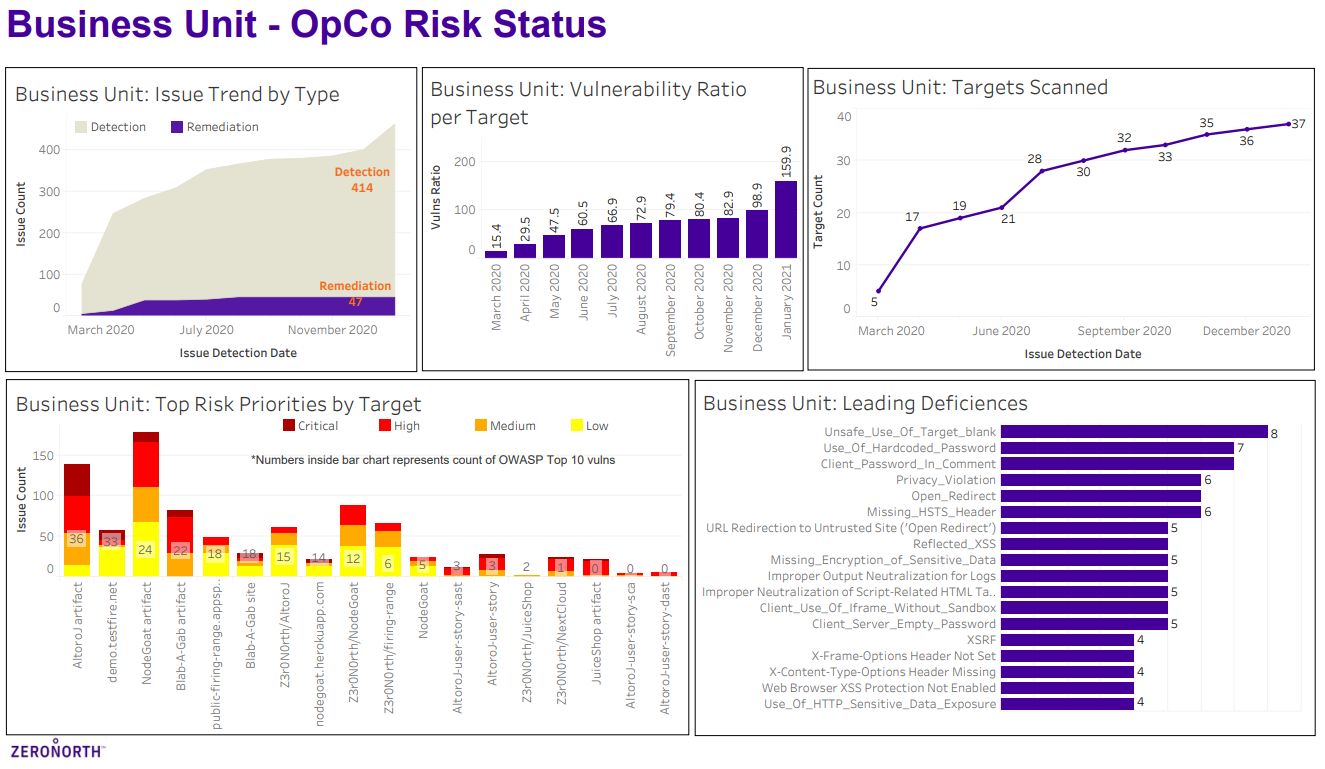
    ZeroNorth today added an Advanced AppSec Risk Analytics module to its platform for orchestrating DevSecOps processes.

    John Worrall, ZeroNorth CEO, said the analytics tool pulls vulnerability data generated by a variety of security tools to provide both DevOps and cybersecurity professionals with a single source of truth for assessing security within an application environment.

    The ZeroNorth platform is designed to enable IT organizations to orchestrate multiple vulnerability scanning tools within the context of a larger DevSecOps workflow, and can apply analytics to a large pool of security data. That data can be viewed in the context of specific groups, such as a business unit or specific application development and deployment team, or within the context of whichever application generates the most revenue for the business, Worral said.

    Additionally, the Advanced AppSec Risk Analytics module will surface types of vulnerabilities detected and the vulnerabilities most encountered, ranked by criticality, along with other trends in types and number of vulnerabilities detected/remediated, such as the number and criticality of vulnerability findings per specific scanner. It also tracks the applications and entities scanned, number of vulnerabilities detected per application/entity and the applications/entities that have the highest risk.

    ZeroNorth

    Armed with that analytics data, Worral said it becomes easier for IT teams to prioritize and focus their efforts, in addition to identifying areas of the business that may need additional cybersecurity resources and training. IT leaders can also get a snapshot view of the top application security risks to better assess the organization’s overall security posture, Worral noted.

    The Advanced AppSec Risk Analytics module will also surface vulnerability remediation bottlenecks spanning multiple applications within the context of a software development life cycle (SDLC), Worral added. Longer term, Worral said the data collected by the ZeroNorth analytics application will also create an opportunity for the company to apply machine learning algorithms to DevSecOps.

    In general, Worral said the only viable path toward achieving DevSecOps is to foster more collaboration between developers and cybersecurity teams. Getting those teams on the same page in terms of the security data that needs to be analyzed is a crucial first step, Worral said.

    It’s still early on in the adoption of DevSecOps best practices within organizations, however, it’s apparent a lack of cohesion between software developers and cybersecurity teams about which vulnerabilities to prioritize is a major source of dysfunction. Cybersecurity teams tend to create long lists of vulnerabilities discovered within applications without providing much context. Developers are then left to weigh, on their own, when to address a vulnerability versus focusing on writing additional code needed to make an application delivery deadline. Developers take potential vulnerabilities seriously, but there are only so many hours in a day to write code.

    Unfairly or not, developers are being held more accountable for application security. The challenge – and the opportunity – is to find a way to make the entire DevSecOps workflow a whole lot less contentious by helping DevOps and DevSecOps teams more aware of which tasks should be prioritized when.