Tag: event

  • DevOpsDays Ukraine: Disaster Recovery

    DevOpsDays Ukraine: Disaster Recovery

    DevOpsDays Ukraine is a part of the global DevOpsDays family, focused on the DevOps Culture. This September, we will have two evenings of online talks and discussions on hottest DevOps topics. And we’re happy to invite you to DevOpsDays Ukraine: Disaster Recovery on September 14-15th.

    Get ready for a two-day journey with Ignites & Tech Talks, from top speakers. Furthermore, during the live fireside chat, you can ask questions to the founder of DevOpsDays, Patrick Debois, and learn more about his ideas.

    And finally online networking on Open-Spaces with like-minded experts from around the world. 

    Check out the agenda:

    • Live Fireside Chat with Patrick Debois, founder of DevOpsDays and vice president of engineering at Showpad
    • Beyond Engineering: The Future of Platforms — Manuel Pais, IT organizational consultant and trainer at Team Topologies
    • How to Deliver Despite Wartime. Manager’s view — Iaroslav Molochko, director of engineering at SQUAD
    • Keeping Your Engineers Happy: The Case for Self-Service Tooling” — Adriana Villela, senior developer advocate at Lightstep, and Ana Margarita Medina, staff developer advocate at Lightstep
    • DevOps in GameDev — Valeriia Ivanova, DevOps team lead at Plarium
    • Level 7 Egress Control: Just Now Emerging in Kubernetes — Joshua Fox, senior cloud architect II at DoiT International
    • Socio-Technical Engineering: Let’s Treat Socio-Technical Systems as … Systems — Yevgen Nebesov, requirements engineer/software architect at Deutsche Bahn
    • How to Start Estimating the Cost of Disaster Recovery Process of the Cloud Resources — Natalie Serebryakova, staff cloud engineer at Altruist
    • Oleksiy Zayets from National Bank of Ukraine, PrivatBank will share the experience of Migrating to the Cloud during the first months of a full-scale invasion of Ukraine
    • Techtalk from Charity Majors, CTO at honeycomb.io

    Joining us once again as our host is Daniel Maher, developer relations at Scaleway.

    Stay tuned for more!

    When: September 14-15
    Where: Online at the DevOpsDay website

    Click here to save your spot. Can’t wait to see y’all!

  • What To Expect at a Virtual DevOps World 2020

    What To Expect at a Virtual DevOps World 2020

    DevOps World is coming soon and this means you can look forward to plenty of opportunities to learn about all things DevOps, network with like-minded professionals, attend in-depth training courses and technical workshops and just generally have some fun.

    DevOps World 2020 will have all those things. But, with the pandemic still impacting society, this year’s conference will be different. It will be held virtually Sept. 22-24, with all sessions and activities free of charge.

    The conference, hosted as usual by CloudBees, will bring all the elements of the world’s biggest and best DevOps-focused event to the people themselves—making it all available with a few clicks of the mouse. We have created a tremendous array of content and added new technological features that will enable attendees to interact virtually like you are really there.

    Here is a brief rundown of what to expect at DevOps World 2020.

    DevOps World 2020: Transforming the Future of Software Delivery

    The pandemic has spurred companies across the world to embrace a whole new way of working. It has taken people outside their office environments and placed them into new situations where the lines between work and home start to blur. This has disrupted our work patterns, but at the same time has given people a chance to gain a new perspective.

    During DevOps World, we’ll be exploring what people’s worlds are like now—and how DevOps is transforming the world of software delivery. We’ll host sessions that focus on how businesses are adapting their ways of thinking during the pandemic. They’ll talk about how they’re using new technologies, changing processes, adjusting timelines and engaging in new ways with employees, customers and business partners. Software is driving change in today’s world, and we’ll be discussing how DevOps done well can lead the way into the future.

    Interaction

    Conferences, of course, are great places to engage in impromptu meetups, establish new contacts and just enjoy the benefits of an upbeat gathering. The pandemic has put in-person events on hold for 2020, but we’ve come up with a lot of fun ways to interact virtually. Attendees can use new chat features installed to interact not only during Q&As with the speakers but also for random meetups with other attendees. We even have virtual expo booths where you can interact via live video and chat with DevOps experts from companies around the globe. The one we’re especially looking forward to is a new “speed meeting,” during which attendees can be paired with another attendee randomly for a 30-second video chat.

    Keynotes

    DevOps World has always been known for its vibrant and thought-provoking set of keynote speakers. This year’s conference will push the envelope once again with nine industry leaders presenting talks focusing on where DevOps is now, where it’s headed and how the audience can best leverage advanced practices to succeed in the future.

    Speakers include:

    • Mitch Ashley, CEO of Accelerated Strategies Group.
    • James Governor, co-founder of Redmonk.
    • Dr. Ann Marie Imafidon, co-founder and CEO of Stemettes.
    • Marky Jackson, director of open Source and CDF community ambassador, OpsMx.
    • Tracy Ragan, CEO of DeployHub and CDF governing board member.
    • Jacqueline Salinas, director of ecosystem and community development at the CD Foundation.

    I will offer perspectives on industry trends alongside two other CloudBees executives, CEO Sacha Labourey and SVP and GM of SDM Shawn Ahmed.

    Breakout Sessions

    There will be more than 100 business and technical breakout sessions hosted by a wide cross-section of DevOps rock stars including:

    • “Data-Driven DevOps: The Key to Improving Speed & Scale,” by Jenkins founder Kohsuke Kawaguchi.
    • “Automated Testing as a Part of Pipelines,” by IBM’s Rosalind Radcliffe.
    • “Chaos Engineering the Chaos Engineers,” by Gremlin’s Jason Yee.
    • “eBay’s Journey Building CI at Scale,” by eBay’s Ravi Kiran Rao Bukka and Vasumathy Seenuvasan.
    • “Bad Code Kills: Five Essential Quality Gates You Need in Your CloudBees Core Pipeline,” by OverOps’ Eric Mizell.

    Training and Certification

    As a reward for participation in the sessions and engagement with the sponsors, DevOps World participants will have the chance to receive a free certification voucher, which can be used for CloudBees 2, Certified Jenkins Engineer or CloudBees Certified Jenkins Engineer certifications. More information about these certifications can be found on CloudBees.com.

    In addition, the conference will hold a series of post-show workshop sessions Friday, Sept. 25. The following sessions will be offered: CloudBees CI Workshop – Manage Continuous Integration at Scale, Getting Started with Jenkins Configuration as Code, CloudBees CI Workshop – A Developer Centric Experience, Free Tools for Evaluating Open Source Dependencies and Risk, Hands-On Workshop: Getting Starting With Feature Flags and Measuring and Projecting the Business Impact of DevOps: A Hands-On Workshop.

    The Fun Part

    This year’s DevOps World will have a virtual fun element to it. We are running a social media campaign with the hashtag “#ShowUsYourWorld.” Over the last few months, our offices and homes have blended together into a truly organic work-life balance and we want to see what the attendees’ world looks like: How you’ve adapted, what you’ve learned, what obstacles you’ve overcome, how your priorities have shifted. Our aim is to celebrate the global DevOps community by giving individuals the chance to share their stories with us. Another fun thing that we’ll be doing during the conference is a 5k run competition tracked via a fitness app, with prizes going toward charity donations.

    DevOps World 2020

    DevOps World has set the standard as the premier DevOps event on the calendar. While this year’s edition won’t gather all 15,000 attendees under one roof, it’ll still promise to do what it always does: exceed expectations. To ensure your free spot at DevOps World 2020, register today!

  • DOES18: Challenges and Enablers for DevOps Success

    DOES18: Challenges and Enablers for DevOps Success

    “What happens in Vegas, doesn”t stay in Vegas” … a great quote to end the recent DevOps Enterprise Summit 2018 (DOES18) in Las Vegas, urging attendees to take and share the new insights and knowledge gained. This article is an attempt at sharing my discoveries.

    This article contains a summary of the challenges that delegates told me about when visiting the GamingWorks stand at the summit. These closely match our global findings, with more than 400 teams having participated in the Phoenix Project business simulation workshop.

    This article also describes highlights from the sessions I had time to attend—highlights mostly in relation to the challenges mentioned above, and biased toward toward people, culture and behavior, as this to me is the No. 1 success or fail factor for the successful adoption of DevOps ways of working.

    Challenges

    I asked more than 100 people, “What is your top challenge or barrier for your adoption of DevOps ways of working?” I have ordered them based upon the number of times mentioned, highest first. Many of these I captured before the opening of the summit:

    Leadership:

    • Leaders applying the “pointy-fingered” approach. “You are now self-empowered. Make IT happen.‘
    • Lack of “empowerment” and not “walking-the-talk” to foster the right culture.
    • Not wanting to let go of a “command and control” management approach and fear of becoming less relevant.

    Product Management:

    • The need to shift from a “feature” focus to more “outcome” and “business value” focus.
    • Product owners “demand” but don”t share why.
    • Low focus on “technical debt” and “issues” versus “benefits.”
    • Need higher-level product management (business decision makers) to balance “innovation” with “risks” (e.g technical debt).

    Value Stream:

    • Poor end-to-end visibility (including business “before” and “after” activities).
    • A narrow focus on Dev and Ops, mostly a Dev “pipeline.”
    • No impediment backlog visible for the stream.
    • Too much local optimization.

    Value and Metrics:

    • Too much focus on internal, proxy metrics.
    • Need more “value” and “outcome” metrics to gain buy-in to scale up.

    End-to-End Communication and Team Collaboration:

    • “Them” and “Us” – lack of trust.
    • Poor listening and communication skills to explore and understand.
    • Lack of end-to-end understanding of the business impact and value we are all working toward.

    Poor Management of WIP:

    • Poor balance between types of work, feature vs technical debt, improvements, training and knowledge-sharing.
    • Engineer disconnect between “what you are working on and the business impact.”

    Continual Learning and Improvement:

    • Not enough WIP reserved.
    • Poor team ownership and ability to structure this.
    • No visible backlog of impediments/improvement.
    • No prioritization of improvements.

    Project to Product:

    • Projects claiming resources.
    • Product owner resource conflicts and challenges.
    • Flip-flopping, context switching work.

    Buy-in and Resistance:

    • Why should we change?
    • Fear, uncertainty, doubt.
    • Suspicion of intentions.
    • Managers not wanting to change and lose “power.”

    Certainly not a lot of CI/CD or technology stuff mentioned here!

    What were some of my highlights as they relate to these challenges?

    DOES18: Introduction and Opening

    In his introduction, Gene Kim revealed one of the goals of the summit was a need to “Elevate focus on spanning business/technology divide,” which clearly relates to a high-scoring challenge. Another topic in the intro was the need to “upskill,” announcing a new skills research project to be launched. The challenges above and the highlights from the sessions give a clear indication of some of the skills needed. Considering the challenges above, I sincerely hope the survey also focuses on business skills as well. In the “Lean Coffee” roundtable sessions, one of the announced topics was “Transformational Leadership,” clearly linking to the top scoring challenges mentioned. More about this topic in my closing.

    DOES18 Sessions

    In a session titled, “Product Management Meets DevOps” a key recommendation was to “build and run teams combined with service ownership,” stressing a need “to connect people to your strategy” and declaring “IT cannot be separate from the business,” and finishing with a need to “manage product value streams, not projects.”  (This was the only session in which I heard the word “service”). To me, these highlights clearly make a link back to the challenge teams have in understanding business impact and value. These recommendations will require a changing role for product management to ensure strategic priorities are embedded in the value stream, and a more engaged role of product owners in teams to ensure a shared understanding and focus on “outcomes” and “value” in relation to strategy, rather than on features.

    Benefit: Enabling the flow of strategic intent

    Mark Schwartz explained that almost all large enterprises are faced with “impediments” that are a barrier to DevOps success, and these are usually people and organizational issues, not technology. He introduced his new “War and Peace and IT” book, and explained an impediment faced by Napoleon in his Russian campaign—Napoleon had “long decision cycles.” By the time he got the right information to make a strategic decision, the fast-changing short decision cycles at the battlefield meant his decision-making was ineffective. The same applies to the way we currently manage IT: long decision-making cycles from idea to business case to program and project resourcing while DevOps teams operate at a fast, agile pace. Mark suggested a need to speed up the “entire lead time from idea to impact” (a topic also explored in Mark Smalley’s latest DASA whitepaper, “The Business Value of DevOps“).

    Benefit: Enabling the faster flow of strategic intent

    Schwartz went on to suggest three ways to build more agility into the end-to-end value stream and delegate decision-making to a lower level: the “product model,” decentralizing decision to the product team; the “budget model,” decentralizing budget to the team to manage both “innovation” and “keeping the lights on”; and the “objective model,” just give the team the key objectives to be achieved and let them decide how to make it happen anyway they can.

    This to me represents a considerable mindset shift from the hierarchical “command and control” management paradigm and requires transformational leadership. In my mind, whatever model is chosen needs to fit with the highlight from the previous session, “Connect people to your strategy.”

    Benefit: Enabling faster decision-making around strategic intent

    Anders Wallgren‘s session, “Measuring DevOps – The Key Metrics That Matter” was standing room only, with a packed audience taking pictures of all of the slides. I must admit to being surprised, as this is the fifth DOES conference and organizations have had five years to put metrics in place! I can only assume the vast majority were just starting their journey. I was pleased to see not just the traditional metrics often quoted such as “deployment frequency,” “lead time to change,” “mean time to recover (MTTR),” and “change failure rate,” but also business value metrics such as revenue growth; customer value metrics such as customer experience satisfaction; team culture metrics such as education and growth; and the pipeline metrics such as release velocity. This was one of the top-scoring challenges facing delegates who visited our table: “Fhifting from internal metrics to business value metrics.” This focus on business value metrics ties in again to the highlight from the first session above, “Connect people to the strategy,” and the important role product owners have in sharing the strategic intent.

    Benefit: Enabling measurement of strategic intent.

    Dr. Mik Kersten presented “Project to Product: How Value Steam Networks will transform IT and the Business,” suggesting that project management and traditional cost models are the wrong models, an idea supporting Mark Schwartz’s observations. He went on to add, “Fragmented value streams kill personal productivity,” as well as “impact employee satisfaction.” Silos and proxy metrics not related to business value will also destroy a DevOps transformation. He made some powerful arguments for a complete end-to-end value stream (Not just a DevOps value stream).

    These messages were further endorsed by Carmen De Ardo in his session, “Connecting IT to the Business at BMW Group,” during which he also stressed, “Flow time is not just code-to-commit but also, and more importantly, idea-to-value.” Carmen also stressed that the “flow to value” is not just the flow of “features” but also “defects,” “risks” and “debts,” which to me represents a need to manage “value optimization,” a balance of “value creation” and a reduction of “value leakage.”

    Benefit: Enabling value optimization of strategic intent.

    Damon Edwards, in his session “Operations: The Last Mile,” expanded on the theme of end-to-end value streams, with a powerful case about disruption, context switching, waiting, escalations, lack of trust and employee dissatisfaction—all this because of “four forces that undermine operations” that need to be addressed to empower operations:

    • Reduction of Toil—non-valued repetitive work that can be automated.
    • Queues, which disintegrate and obfuscate value streams.
    • Silos, causing disconnects and mismatches.
    • Low trust—the need for “psychological safety, the No. 1 predicate for success.”

    Benefit: Enabling the removal of behavioral flow barriers and waste.  

    Dominca Degrandis in her session, “Making Connections Visible: How to Defrag Your Value Stream,” stressed, “The hardest thing we do is communicate across teams,” making a call to make connections visible as well as “how the different types of work enters the system, where they enter and which tools are used.” This touched on a topic I discussed with DeArdo at itSMF Fusion: the information value stream.

    Benefit: Enabling the removal of end-to-end information and behavioral flow barriers and waste.

    One of the most powerful sessions for me was the presentation from Dr. Steve Spear: “Discovering Your Way to Greatness: How Finding and Fixing Faults is the Path to Perfection.” He suggested, “Design all work to SEE problems.” Make this part of a philosophy: “See, Solve, Spread (Share knowledge).” He suggested, don’t ask “How is it going?” Ask, “What is not working, and what can we do about it?” This ties in nicely with a finding from the latest State Of DevOps report: “Relentless improvement work leads to excellence and high performance.”

    Benefit: Enabling the relentless removal of barriers and waste and the optimization of strategic intent.

    DOES18: A Customer Case

    Mascha Boender  and Stefan Groot presented an ABN AMRO case, “Crossing the DevOps Chasm: From Taboo to Enterprise DevOps,” in which they discussed their bottom-up journey of experimentation. They designed their approaches to see problems. They admitted failure, demonstrating their learning and how they made iterative improvements. They stepped away from a maturity model to a capability model, recognizing that one size doesn’t fit all teams. They provided a “Moonshot workshop,” focusing on specific team goals and ambitions and how these aligned to business strategic goals. They provided a DevOps playbook (based on captured team best practices) to help new teams develop practices at their own pace. To develop team “soft skills” such as communication and collaboration, they used the Phoenix Project business simulation workshop. This was done also with more than 30 leaders to create a mindset shift and demonstrate the change of leadership behaviors required to empower the teams and foster an enterprisewide culture change.

    Benefit: Enabling bottom-up and top-down “skills” and “culture” and aligning team goals to strategic intent.

    The State Of DevOps

    Nicole Forsgren and Jez Humble presented, “The Data Behind DevOps: Becoming a High Performer,” in which they shared findings from the latest “State Of DevOps” report. I won’t go into detail. I suggest you read the report, then read it again. Suffice to say their key messaging echoed many of the other sessions above: “Focus on outcomes, not output,” the need to “identify constraints and continually improve,” and for me an important topic: “Influencing culture through leadership and autonomy.”

    The ABN case above was an example of how they gave teams autonomy to change and  how they helped change leadership behaviors.

    DOES18: Final Thoughts

    As I stated at the start, culture to me is the No. 1 success or fail factor. The “State of DevOps” report stressed the importance of leadership on culture. Leadership was the top challenge mentioned by delegates visiting our stand. I”d like to share with you an article on staging-devopsy.kinsta.cloud on how to influence leadership behaviors: The article is written through the lens of “communication,” tying back to a comment from Dominica Degrandis: “The hardest thing we do is communicate across teams,” and tying in with the ABN AMRO case about developing communication and collaboration skills.

    And finally, getting back to the start of the summit and the need to “upskill,” with the announcement of a skills survey, I’d like to provide some input. Here is a DevOps Agile Skills Association (DASA) article, “DASA Provides Core Skills Key for DevOps Success,” which summarizes the “people and culture” elements from the “State of DevOps” report (this year and previous years) matching these with findings from more than 400 teams having participated in the Phoenix Project DevOps simulation. This I believe can provide input into the survey.

    — Paul Wilkinson

  • BMC to Infuse AI Across Software Portfolio

    BMC to Infuse AI Across Software Portfolio

    At its recent BMC Exchange event, BMC Software announced it will be infusing machine learning algorithms and other artificial intelligence (AI) technologies across its entire portfolio of IT operations software.

    The first instance of BMC software to make use of machine learning algorithms is the latest version of TrueSight AIOps platform, which ingests data from multiple data sources to automate processes across BMC service desk, IT operations and tools for managing DevOps processes. BMC also is working with IBM to employ the cognitive computing services known as the IBM Watson cloud service across its portfolio.

    In addition, the company launched TrueSight Cloud Cost Control, a tool for managing and tracking usage of cloud services across multiple providers, and BMC SecOps Policy Service, which easier to embed compliance and testing via an external service that gets included in their software development processes.

    Finally, BMC announced it has signed an alliance with Amazon Web Services (AWS) under which the two companies will work to accelerate the migration of application workloads to the AWS public cloud.

    Dan Streetman, a senior vice president for worldwide sales and marketing at BMC, says his company is developing a product strategy around three major themes:

    • IT organizations will require management tools that will work across multiple clouds;
    • As part of general “shift left” developers now expect to be able to programmatically invoke IT operations and security services; and
    • IT professionals now expect the tools they use to manage IT to have the same types of advanced capabilities that consumer applications provide via speech interfaces such as Apple Siri or Microsoft Cortana. Various IT and customer service desks also soon will use speech interfaces to provide a highly automated self-service experience to end users.

    In fact, given the complexity of the IT tasks that now need to be managed, Streetman says a race is now on between IT vendors to live up to those expectations. Much less of a concern, he says, is any notion that AI technologies might one day replace IT professionals that by and large are already overtaxed; rather, it is apparent that IT vendors are now being evaluated on their ability to maximize existing investments in IT professionals that are already in short supply. The real opportunity is to free IT professionals to enable them to concentrate on higher-value tasks.

    Naturally, it remains to be seen how various AI technologies will impact the management of IT. It certainly will take a while for IT administrators to put their faith in AI. But as those technologies continue to mature, there may soon come a day when IT professionals look back with wonder at all the things they used to have to accomplish one manual task at a time.

    — Mike Vizard

  • 5 Can’t-Miss DevOps Sessions at Jenkins World

    5 Can’t-Miss DevOps Sessions at Jenkins World

    In less than a month many Jenkins users and DevOps professionals will gather in San Francisco for Jenkins World, taking place Aug. 28-31. With more than 60 sessions to choose from, covering a wide range of topics, it can be difficult to narrow down your schedule. That’s why it’s important to go into the show with a goal in mind.

    For those of you specifically looking to hone your DevOps skills, here are five can’t-miss sessions that fall under the DevOps tracks.

    NOTE: staging-devopsy.kinsta.cloud readers get 20 percent off their registration with the promotional code JWDEVOPSCUST.

    DevOps: Delivering on the promise of innovation, agility and velocity

    Forrester Analyst Rob Stroud will discuss recent Forrester research that confirmed organizations are leveraging agile development techniques, automated CI/CD pipelines, testing and release automation to deliver differentiated products. The interactive discussion will allow attendees to review their DevOps maturity versus that of the market. Stroud also will lead discussions of how DevOps is adding value within enterprises and how the adoption of containers and serverless computing will further drive DevOps adoption.

    DevOps Leadership Panel

    Attend this panel to hear from a variety of experts on topics such as software delivery challenges, business value realized from DevOps, building internal support and more. Panelists will include:

    • Rob Stroud, Principal Analyst, Forrester – moderator
    • Kolby Allen, AWS Architect, WatchGuard Technologies
    • Andrey Falko, Principal Engineer, Salesforce
    • George Swan, Director of Engineering Solutions, Autodesk
    • Stas Zvinyatskovsky, Engineering Leader and Architect, Accenture

    Mapping Your DevOps Journey with the DevOps Quadrant Maturity Model

    In this session, Brian Dawson, DevOps evangelist at CloudBees, will map the DevOps journey to the DevOps Quadrant Maturity Model. He’ll go through the characteristics of organizations within each quadrant and present strategies for moving to the next stage of DevOps maturity. The DevOps Maturity Model is a great way to assess your current state of DevOps.

    Banking on DevOps: How Leading Financial Services Organizations Are Driving the DevOps Transformation

    Hear from financial services executives about how their organizations are embracing DevOps practices to speed innovation and deliver more value to customers. The financial services industry faces specific security, governance and regulatory hurdles that can prove challenging when changing processes and technology. This session will be moderated by Andre Pino, VP of marketing at CloudBees. Speakers will include:

    • Brock Beatty, Director, Software Engineering, Capital One
    • Karthrik Loganathan, Director, Business Technology, ESQM, Discover
    • Stefan Simenon, Head of IT Tooling & Software Development, ABN AMRO Bank N.V.
    • Moied Wahid, Director, Software Development, PayPal

    Leading a DevOps Transformation

    In this session, Jez Humble, CTO at DevOps Research & Assessment LLC (and also a Jenkins World keynote speaker), will discuss how implementing DevOps is more than just implementing tools. He’ll walk through how a DevOps transformation requires a different way of thinking about everything from budgeting to management to compliance. He’ll also break down exactly what DevOps is and isn’t.

    Don’t miss out on the hundreds of DevOps leaders and trailblazers to learn from at Jenkins World. You can view the full Jenkins World agenda to see what other sessions can help boost your DevOps skills!

    If you haven’t registered yet, make sure you to do so today with the promotional code JWDEVOPSCUST.

    — Alan Shimel

  • Why Your Manager Will Want to Send You to Jenkins World 2017

    Why Your Manager Will Want to Send You to Jenkins World 2017

    Jenkins World 2017 is right around the corner. The conference will be held in San Francisco Aug. 28-31 and will be the biggest event of the year for Jenkins users, with approximately 2,000 people expected to be in attendance! You will not want to miss out on this event, full of learning and networking opportunities.

    Need some help convincing your manager why you should attend? No problem—we have laid out all the reasons why attending would be beneficial to you and your company. Once you have convinced your manager to attend, don’t forget to register today! (As a media sponsor for Jenkins World, we are providing a special offer for our readers. Register with this promotional code and get 20 percent off your registration: JWDEVOPSCUST.

    Educational Value

    Jenkins World will be offering more than 60 educational sessions given by real Jenkins experts—a chance to learn from the most experienced users. Did we mention that you can also receive a free Jenkins exam with the purchase of a full conference registration? Imagine the benefits for both your résumé and team.

    At the conference, you’ll be able to take advantage of great training sessions to better enhance your Jenkins capabilities. The training sessions include Jenkins Certification Training, Introduction to Jenkins, DevOps Leader Certification Training and DevOps Test Engineering Certification Training. We recommend highlighting to your manager what sessions you will want to attend in advance. Check out the full agenda here.

    Jenkins World is offering keynotes from many industry leaders. Be sure to emphasize to your manager the importance of hearing from the very best in the Jenkins community, live on stage and in the breakout sessions. From Jenkins founder Kohsuke Kawaguchi to CloudBees CEO Sacha Labourey and featured speaker Jez Humble, your manager will greatly appreciate the knowledge you bring back to the office from listening to such experienced industry experts.

    Networking Opportunities 

    The Jenkins World conference will provide numerous networking opportunities. Learn what similar problems and challenges other organizations are facing in the industry. Make it known to your manager that you will be exposed to people like you, with like business needs and challenges, that you will be able to connect with.

    Prove ROI

    When convincing your manager to let you attend, it is first important to make them aware of the potential ROI of this opportunity. Detail exactly your expenses including airfare, hotels and meals. This will better help your manager understand the exact cost to send you to Jenkins World. Make sure you also present how this knowledge will help push you and your team forward, ultimately propelling your entire organization forward. The ROI will be evident – make that clear! (And the ROI just got better, because staging-devopsy.kinsta.cloud readers can use this discount code and get 20 percent off: JWDEVOPSCUST.)

    We hope this provides enough information to help you convince your manager to let you attend! We have also created an email template to use when sending all this over to your manager for review. Once you have successfully convinced your boss, go register!

    — Alan Shimel

  • SauceCon Speaker Profile: Mike Millgate, Optum

    SauceCon Speaker Profile: Mike Millgate, Optum

    Automation architect Mike Millgate wants to work himself out of a job. Of course, he doesn’t want to make himself obsolete. He simply wants to automate testing so that QA teams can free their time to do other strategic exercises, such as exploratory testing and focus on security.

    Mike knows what he’s talking about. At Optum, a health services and innovation company, he manages a suite of tests that runs in three hours, testing 18 different applications and more than 24,000 total test cases. He is passionate about parallelization, and notes that if the tests weren’t running in parallel, they would take 55 days to run.

    At the upcoming SauceCon conference, Mike will present, “Testing at the Speed of Concurrency,” taking attendees on a journey of in-house machine testing into cloud-based testing. He will show what works and what doesn’t, and how to use parallelization to improve efficiency as the machines are increasingly doing the work.

    Mike hopes his presentation will help attendees learn how to perform massive numbers of tests in parallel, whether they are using Sauce Labs or another test platform. His mantra is, “Quality is a team effort,” and says the entire team needs to be equally invested to be successful.

    Mike has been at Optum for 15 years. As an expert in test automation in the healthcare industry, he was brought into the tech surge to help fix healthcare.gov in 2013. His work in the industry helps Optum achieve its goal: to help people live healthier lives and to help make the health system work better for everyone.

    A resident of southern Utah, Mike loves hiking and exploring nearby national parks with his family. He is passionate about foster care and adoption, having adopted three young boys with his wife. Mike also runs daily and has competed in two marathons.

    Would he say test automation is a marathon or a sprint? “If you do it right, you can get a marathon’s worth of testing done in a sprint time frame,” he says.

    Join Mike and other presenters at SauceCon, the first-ever Sauce Labs user conference. SauceCon is a three-day event filled with training, workshops, best practices and visionary content from the leading minds in automated testing. For more on upcoming SauceCon presentations or to register, visit the SauceCon website.

    About the Author / Rebecca Cramer

    Rebecca Cramer is a writer and communications strategist specializing in technology. With more than 20 years of experience across disciplines including marketing, internal and executive communications at companies such as Dell and Quest Software, Rebecca is passionate about creating and sharing good content of all kinds. In her spare time, she enjoys spending time at the beach and hiking in her native Southern California.


  • Digital Transformation Top of Mind at PagerDuty Summit 2016

    Digital Transformation Top of Mind at PagerDuty Summit 2016

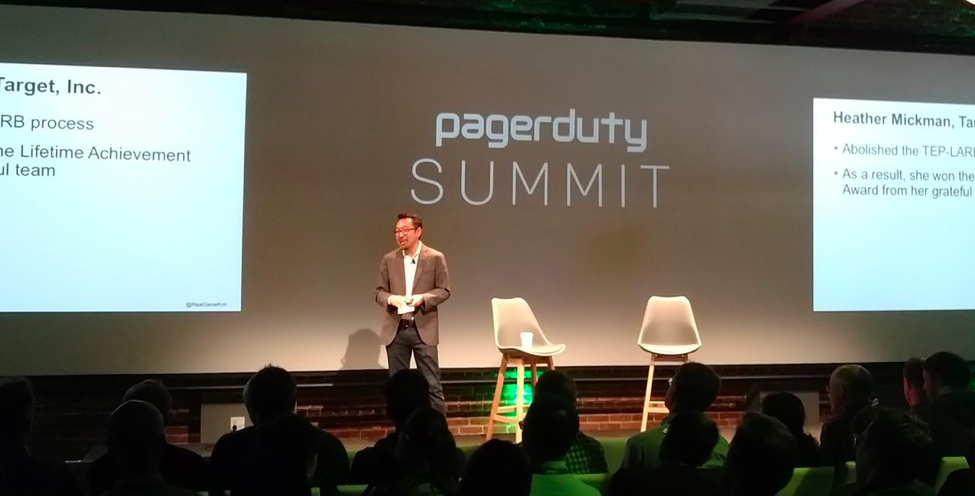
    Digital transformation may seem like the enterprise tech buzzword of the moment, but it completely came to life for attendees at the inaugural PagerDuty Summit. C-level executives, industry leaders, developers and IT operators all came together to discuss why and how companies are navigating our digital world with operational maturity and excellence.

    picture1PagerDuty Summit was described as one jam-packed day filled with an impressive lineup of speakers, panelists and industry leaders including Gene Kim, author, researcher and founder of IT Revolution; Maynard Webb, chairman of the board at Yahoo!; and execs and ITOps folks from Google, IBM, Airbnb, Netflix, Splunk and more.
    Digital Dependencies

    Jennifer Tejada, PagerDuty’s CEO, kicked off the conference with an opening keynote noting digital is no longer just a convenience, but a dependency. Based on the flurry of tweets from the audience, her message about the importance of delivering digital experiences to consumers and how DevOps fits into the greater picture resonated with the audience of C-level execs, VCs, IT managers and engineers alike. Tejada pointed out how the importance of micro-moments matter in a world where the stakes are higher than ever before and just how much the end-user experience suffers if applications or services go down.

    Getting the Crucial DevOps Piece Right

    Soon after, Gene Kim took the stage to share his top five DevOps surprises and learnings for digital transformation, delivering key insights from his 17-year journey of studying high-performing technology organizations. He was preaching to the choir when he noted that the business value of DevOps is even higher than thought, and all agreed that he made a compelling case for the importance of measuring code deployment lead time. Surprise No. 5 on Kim’s list was that DevOps isn’t just for the unicorns; it’s for the horses, too. DevOps enables dynamic, learning organizations—and, equally as important, digital transformation itself, for companies in all walks of life, whether they are legacy enterprises or agile startups.

    picture2Twitter activity made it clear that attendees were particularly pleased to receive advance copies of Kim’s latest book, “The DevOps Handbook,” which has been five years in the making.

    Highlighting New Features

    No event would be complete without the announcement of new features. There were positive reports when PagerDuty took the stage to demo and share details around new platform features to make incident management and response better than ever, including:

    • Workflow Extensions: Building on PagerDuty’s ecosystem of more than 175 native integrations, organizations now can configure operational workflows between PagerDuty and other third-party services. This bi-directional flow of information helps provide consistent information across teams and services for faster incident resolution.
    • Live Call Routing: This feature allows anyone inside the organization to directly reach the operations team to report a problem by simply calling a number. Calls get routed via the same on-call schedules and escalation policies in place, and the ability to report incidents in real-time helps restore services faster.
    • Response Notes: This capability ensures that all relevant contextual and human generated data around incidents are captured and time-stamped, creating a clear timeline of the actions taken and the people involved. Response Notes delivers clear visibility on the current status of incidents and a historical record for postmortems, resulting in a reduction of future resolution times.

    Wrapping up PagerDuty Summit 2016

    picture4From the fireside chat with Maynard Webb discussing cloud wars, containers and where he sees the industry going over the next five years, and the inspiring breakout sessions on all things ITOps, the first-ever PagerDuty Summit was, from all accounts, both informative and poignant. Attendees said it spoke to how DevOps and operational excellence form the backbone of successful digital initiatives and transformation, and all walked away with strategies, best practices and use cases for adapting to the evolving digital landscape.

    For a more in depth look at PagerDuty Summit 2016, visit the blog: https://www.pagerduty.com/blog/pdsummit16-event-recap/.

    Joe Franscella is a regular staging-devopsy.kinsta.cloud contributor and full time Bhava Communications employee. PagerDuty is a Bhava Communications client, but Joe Franscella does not work on the company’s account.

    — Joe Franscella

  • DevOpsDays London 2016: Making Happy

    DevOpsDaysLondon16logo

    We haven’t had a DevOpsDays event in London since 2013. The audience size was about the same at this year’s event, held April 19-20, as I remember from last time, but about 85 percent of the audience were attending a DevOpsDays event for the first time. It was great to see so many new faces, and I guess the high proportion of first-time visitors could be a sign of the maturing and proliferation of DevOps thinking.

    I’m delivering a webcast April 26 titled, “DevOps for Architects,” so on the way to the event I read this book in preparation. At Ranger4 we ask people a lot: “Are you having a good day?” or, “How do you know you are having a good day?” Something has always discomfited me slightly about this, in the same way that “What does good look like?” and, “Just good enough,” trouble me. Can’t we aim higher? What does “great” look like? In the book, the authors talk about “happy days,” and this makes me happy. And this was the theme I took away from the first day at DevOpsDays London 2016—DevOps makes happy.

    Here are a few reasons how:

    First up on the stage was Bridget Kromhout, a DevOpsDays organizer I last saw speak at the DevOpsDays five-year anniversary in Ghent in 2014. Her talk was titled, “Cloudy with a Chance of DevOps”—a succinct introduction to DevOps as it looks today with some key takeways:

    • “Automation is not everything.” Most people get this now, but we meet a lot of people who started with automation and realized they’d skipped to the end. Start with culture.
    • “DevOps is practiced, not purchased.” You might be surprised to find us supporting this, since we make a living out of selling DevOps. But we don’t. We believe that the best way to help organizations transform using DevOps principles is to partner with them—to coach, motivate, guide, challenge and help them move through their journey. This is what we do.
    • “It is not necessary to change. Survival is not mandatory.” This is a quote from the “Godfather of Lean,” Deming.

    Bridget was followed by Joanne Molesky, the co-author of “Lean Enterprise,” a frequently cited must-read for DevOps enthusiasts.

    Key messages from Joanne’s talk were her assertion that technology is no longer the bottleneck, particularly now that conventional business models are under attack. Joanne also cited quantum computing as the key disruptor she sees coming through in the near future. It was particularly interesting to think about what she said about Tesla disrupting not because the company has designed a better, more affordable electric car, but because it is changing the game in terms of how individuals will access the power grid.

    Following on from Bridget’s recognition that not all companies are any where near delivering on the velocity promise of DevOps and the subsequent happiness, key barriers Joanne identified include slow decision-making processes and conflicting goals embedded into many enterprises that have been around for a significant amount of time. She described “process madness” and how most enterprises “plan, do” and forget the “check, act” part of the PDCA cycle. She explained how many organizations have created walls of “no’s”—effectively, “Culture says no”; a sentiment shared by many individuals we spoke with after her session.

    A popular quote that was tweeted multiple times from Joanne was: “You only fail when you fail to learn.”

    Speaking with organizations that are moving to agile and DevOps, many of them talk about their difficulties moving from project-centric thinking to product-centric thinking, a point reiterated by Joanne. She recommended the three horizons framework as a useful tool to plan and enact change while managing the current state. She also had some very useful advice for organizations trying to tackle regulatory requirements: “Understand the intent.” Organizations have a habit of misconceiving and conflating what the regulations say.

    “The best code is that which you don’t write”—a bit like the advice to writers: “kill your darlings.” This is about being lean, planning properly and removing extraneous effort.

    Close to our own hearts, Joanne also emphasized the importance of measuring the things that matter. Similarly, she pointed out that organizations that have a classic “command and control” structure have no hope of being able to do DevOps. When organizations perform cultural change, they must amplify their feedback loops at all levels. By using principles like holacracy, organizations can understand who the sensors are in their business and learn to hear ideas, how to make the process madness sane and let ideas germinate and blossom.

    I frequently quote John Willis:

    “DevOps finally proves how IT can be a strategic advantage that allows a business to beat the pants off the competition. This is the moment we’ve all been waiting for.”

    For far too long IT has been seen as the guys in the dungeon, (ever seen the IT Crowd?) but as John said, these are exciting times for us in IT. As Joanne put it, we used to say IT supports the business, then we said IT is aligned to the business, now we say IT is integrated to the business or, even better IT is the business. This should make us all happy.

    Kris Saxton followed Joanne with a talk we were anticipating highly: “Bi-Modal IT and other snake oil.” We’ve been challenging this term recently, too, so I was happy to find more support that this is an oversimplification of the situation organizations are in and is counterproductive, undermining the type of culture we are trying to create by creating more silos, more “them and us-es.” Put succinctly, Kris said: “Bi-modal IT is poison.”

    As Jez Humble recently said:

    “Gartner’s model rests on a false assumption that is still pervasive in our industry: that we must trade off responsiveness against reliability… This assumption is wrong.”

    Kris said there is a “happy place” where we can have both responsiveness and reliability, velocity and quality, speed and stability. DevOps helps us do this by shifting left, having multi-disciplinary teams, a people-focused culture working to small, scalable scope—and more.

    The rest of day one was filled with slots from the many sponsors of the event, a demo from Pivotal, Ignites and Open Spaces. The last three thoughts I’ll leave you with though were:

    1. Sponsor ServerDensity used its pitch to highlight health and well-being in IT; #hugops. The company is setting up a MeetUp group in London for HumanOps, emphasizing that DevOps is not just automation and it’s here to make humans happy
    2. Microsoft’s Thiago Almeida shared stats on how DevOps initiatives at Microsoft have positively influenced employees’ work/life scores
    3. John Clapham spoke on how he set fire to his car and what this taught him about the currency of empathy and how this can be used to improve life at work

    Check back for coverage of Day 2 of DevOps London.

  • DevOps Days returns to London

    DevOps Days returns to London

    On April 19, after a break of nearly two and a half years, the DevOps Days conference is returning to London. Expect great things: All DevOps Days events are extremely interactive, making use of the Open Space format, and this year’s event includes a world-class set of presenters ready to share their experiences and guidance.

    The emphasis of the conference is on DevOps in the Enterprise, with specific reference to the financial services industry. That said, the event is open to any delegate, and participation is encouraged for enterprises that may be finding DevOps to be a struggle.

    The conference kicks off with a talk from Joanne Molesky a global expert in improving IT at large enterprises and co-author of, “Lean Enterprise: How High Performance Organizations Innovated at Scale.” Molesky’s talk, “We Are Great at DevOps but the Enterprise is Failing,” will include legacy management practices in finance, IT governance and procurement, and how they inhibit our ability to extend the benefits. She will offer up many real-world examples challenge us to apply Lean thinking and principles to break down these management barricades and deliver even more value to our customers.

    Kris Saxton, organizer of the London Infracoders meetup group, is slated to present a discussion with the provocative title, “Bimodal IT and other Snake Oil.” Saxton will draw on experience from five projects (four within large retail or investment banks and one with a large re-insurer) to challenge the idea that reforming legacy estates while continuing to innovate shouldn’t be attempted. Saxton hopes to convince you that this thinking is a flawed oversimplification which, when adopted, results in lost opportunities, delays crucial decisions and ultimately cripples innovation.

    Expert in everything from platform-as-a-service to people and culture to Perl—with the proud claim that modern Macs still ship with some of his Perl code, Casey West plans to discuss platform applications. He will play close attention to the operations, and, in particular, the operability end of DevOps. In fact, he won’t just be talking about it: Instead using 100 percent open source software, he will be performing a demo on stage in what he promises to be an “interactive live explosion” of a modern platform that will highlight quite how accessible in 2016 they are now.

    Day two kicks off with Gene Kim, award-winning CTO, researcher and author of, “The Phoenix Project: A Novel About IT, DevOps, and Helping Your Business Win.” With all his immense dedication to DevOps operations and IT security, when Gene offers to share, “My Top Five Lessons Learned: DevOps In Large, Complex Organizations,” you know it’s going to be extremely valuable. In Gene’s own words: “I can’t wait to share with the DevOpsDays community what I’ve learned, share the problem road map that’s been verbalized, and some of the things we’ve been working on to help people overcome those problems!”

    Gareth Rushgrove is perhaps most well-known for writing the Devops Weekly newsletter, which is now more than 5 years old, but his talents don’t stop there. He is also a senior software engineer at Puppet Labs; a former infrastructure, operations and information security specialist for the UK government; and an established conference speaker. In his talk, “Rate of Change, (Un)opinionated Platforms and Devops Coevolution,” he will share insights on how the adoption of practices such as DevOps, microservices and tools such as platform-as-a-service are interconnected. He will explore the power of co-evolution, which makes cause and effect bi-directional, making it possible to leverage what you do and how you do it to improve your organization as a whole. Be prepared!

    Philippe Guenet is an expert in DevOps, in particular transforming banks toward continuous delivery. With his talk, “From Lean in Automative to Lean IT,” Guenet plans to draw heavily from what other industries learned in the 20th century dating back to Henry Ford and, of course, Toyota. He will revisit fundamental Lean concepts and principles applicable to IT and explore how they can be applied to improve organizations. The topics will include Total Quality Management, organization optimization, simplification and improved time-to-market.

    This is of course all just a taster. Slated also are talks from Thiago Almeida (Microsoft), Michael Coté (Pivotal), Jeromy Carriere (Google), Clair Agutter, Benjamin Wooton, Oliver Wood and John Clapham. In addition a panel is scheduled that will include at least one chief operations and technology officer. Last but not least, on top of all of the great interaction in breaks and Open Spaces and great presenters, we promise a great social event the evening of April 19, including a few surprises.

    The last few tickets are available here, so get one before they are gone!

    See you there!

    About the Author/Mark Rendell

    me_profileMark is a DevOps and continuous delivery specialist at Accenture with 11+ years of experience in development, configuration management, infrastructure as code, continuous delivery, environment management, build, deployment and testing automation as well as tooling. Currently, he runs a team specializing in implementing continuous delivery for large-scale, transformation deliveries across multiple industries.  He is also a proud contributor to the DevOps Platform.

    Blog: https://markosrendell.wordpress.com/

    Twitter: @markosrendell