Tag: f5

  • F5 Looks to Streamline Application Networking

    F5 Looks to Streamline Application Networking

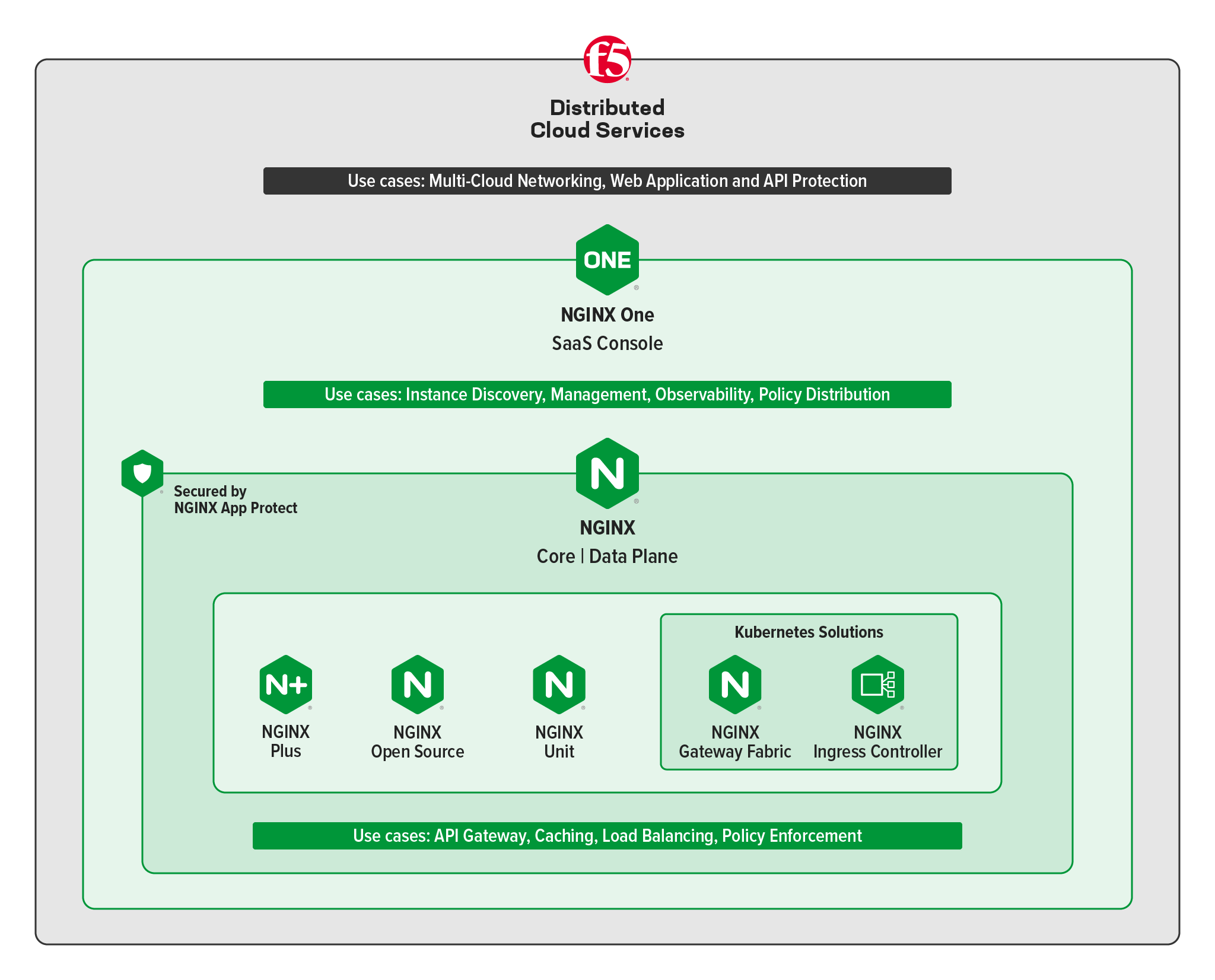
    At its AppWorld 2024 conference this week, F5 announced a software-as-a-service (SaaS) edition of its NGINX application networking portfolio, which are now all available under a single enterprise license.

    Shawn Wormke, general manager for NGINX, said NGINX One will eliminate much of the friction enterprise IT teams currently encounter when implementing NGINX Plus, NGINX Open Source, NGINX Unit, NGINX Gateway Fabric and the Kubernetes Ingress Controller the company provides.

    As part of that effort, F5 is also now making available a unified console across its application networking portfolio that promises to streamline the management of the F5 application networking portfolio.

    Currently available under an early access program, NGINX One creates an as-a-service platform through which enterprise IT organizations can invoke and pay for these capabilities on an as-needed basis, said Wormke. The overall goal is to reduce the total cost of application networking by eliminating the need for IT teams to integrate the various elements of NGINX One on their own, he added.

    In general, application networking has become more complex with the rise of cloud-native applications based on microservices. By reducing the cognitive load required to network those applications, it becomes simpler to make network operations a more natural extension of DevOps workflows, noted Wormke.

    Most organizations have some level of experience with application networking using proxy servers, but as application environments have become more complex, the need for gateways and ingress controllers to provide these capabilities at scale has become more apparent. As a result, more IT organizations are starting to revisit how they are structured. There may always be a need for dedicated networking specialists to manage the physical network underlay, but as other networking services become more integrated with DevOps workflows, responsibility for some networking services is starting to shift further left toward DevOps teams that will either deploy these capabilities themselves or take advantage of a SaaS platform such as NGINX One. The overall goal is to be able to dynamically provision application networking services without having to wait for a network administrator to provision them.

    There are, of course, a lot of approaches to application networking that are now emerging. Regardless of how application networking evolves, however, the rigidity that has characterized the delivery of network services for decades should finally start to fade away. Today, outside of a cloud computing environment, it’s still common for IT teams to provision virtual machines or Kubernetes pods in hours only to wait days or even weeks for network connectivity to be provisioned. As IT environments become more hybrid and more workloads are pushed to the edge, there is a clear need for a more agile approach.

    Each organization will need to decide how best to approach application networking across legacy monolithic applications, microservices and event-driven applications at a time when IT environments have become much more complex to manage. The challenge, as always, is reducing as much friction as possible without unduly raising the total cost of IT to a point where it becomes unsustainable.

  • NETSCOUT Taps F5 to Optimize Custom App Performance

    NETSCOUT Taps F5 to Optimize Custom App Performance

    Through its alliance with F5, NETSCOUT Systems has extended the reach of its nGeniusOne enterprise performance management platform to support custom applications.

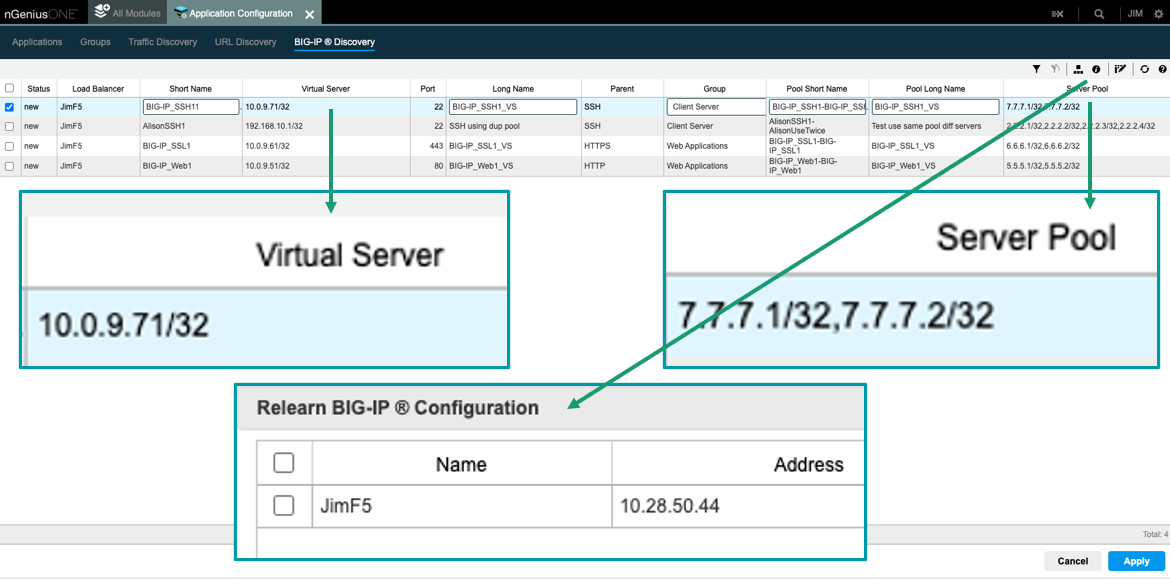
    The nGeniusONE platform supports more than 1,000 voice, video and business data applications using NETSCOUT InfiniStreamNG appliances in combination with nGeniusONE to provide visibility into any infrastructure environment, including data centers, private and public cloud and co-location facilities. The integration with F5 extends those capabilities to add support for custom applications via integration with F5 BIG-IP server pool definitions that can now be directly imported into nGeniusOne.

    Eileen Haggerty, area vice president for enterprise product and solutions marketing for NETSCOUT, said that approach enables nGeniusOne to access clear, unencrypted traffic from the BIG-IP Local Traffic Manager.

    As more cloud-native applications built using microservices are deployed across distributed computing environments, network latency is becoming a bigger DevOps challenge. A wide range of networking issues can adversely impact application performance, but without any visibility into network traffic, it can be challenging to determine the root cause of an issue. NETSCOUT has deployed a global network of appliances to surface those issues.

    A recent report published by Cloud Security Alliance (CSA) found the average enterprise uses 464 custom applications and expects to deploy 37 new applications in the next 12 months. At that rate, the number of organizations likely to encounter networking issues is only going to increase, noted Haggerty.

    It’s not clear to what degree network operations (NetOps) teams are becoming integrated with DevOps teams that build and deploy custom applications. The need for both teams to collaborate more effectively is becoming more apparent as more application code is deployed at the network edge. In some cases, developers are now programmatically invoking network resources directly, while other organizations provide developers access to a portal to self-service their requirements within the context of a set of pre-defined guardrails. Regardless of approach, the need for greater visibility into the underlying networks that custom applications depend on has become critical.

    Exactly how much that need will drive organizations to embrace one networking vendor over another remains to be seen. DevOps teams are starting to exercise more influence as organizations realize how much they depend on custom software to drive digital business processes. DevOps teams need to be able to understand whether an issue is the result of a networking problem or an inherent problem with the code written or the way an application has been deployed.

    Of course, DevOps and NetOps teams don’t share a common nomenclature so the cultural divide between these teams can be wide. The simpler it becomes for NetOps teams to share visibility into networking services the easier it becomes to bridge that divide. Developers should be able to see for themselves how changes to application code might potentially improve network performance. In the absence of any proof to the contrary, most DevOps teams will simply assume there is a fundamental flaw in the networking services being provided.

  • Survey Shows Shift to SRE Principles to Automate IT Management

    Survey Shows Shift to SRE Principles to Automate IT Management

    A global survey of 1,500 IT decision-makers conducted by F5 found that, on average, organizations are managing more than 200 applications deployed across an extended enterprise as well as more than 20 different security and delivery technologies.

    Lori MacVittie, principal technical evangelist in the Office of the CTO for F5, said that level of complexity makes it apparent that IT teams will need to embrace higher levels of automation to manage the IT environments that are now at the core of a wide range of digital business transformation initiatives. The survey revealed that more than three-quarters of respondents (77%) were embracing site reliability engineering (SRE) principles to automate the management of IT.

    A full 95% of respondents also planned to mine operational data for insights they could use to improve the customer experience and drive business growth. However, 98% of respondents also said they are currently unable to extract those needed insights from their existing systems. A total of 90% said they planned to implement some form of artificial intelligence (AI) to achieve that goal. More than two-thirds of respondents said their organizations realized that creating superior digital interactions for customers will require modernizing business processes and back-office functions.

    As part of those efforts, the survey suggested that application workloads are being shifted across highly distributed computing environments. In addition to the 84% of respondents that are planning to move workloads to the edge, the survey found two-thirds of organizations (67%) are currently or planning to repatriate applications from the cloud to a data center environment in the next 12 months. A total of 93% of respondents reported using some type of as-a-service offering delivered via the cloud today.

    Naturally, securing that many platforms also represents a major challenge. However, despite inherent risks, more than three-quarters (76%) of respondents said, given the choice, they’d turn off security measures to improve performance. That lack of willingness to sacrifice performance suggests that attitudes to security may not have changed much despite all the breaches that now regularly occur, said MacVittie.

    It’s not clear to what degree managing enterprise IT environments has become untenable; however, it’s clear that legacy manual processes will need to become automated. Organizations can’t afford to keep hiring IT staff to manage IT platforms that span everything from the network edge to public clouds. In fact, the survey makes clear that DevOps practices—in the form of the SRE principles first defined by Google—are gaining traction. That doesn’t necessarily mean everyone managing IT is becoming an SRE or an engineer, but it does suggest that automation frameworks are being more widely used.

    It may be a while before those automation frameworks are ubiquitous. However, one way or another, many of the tasks that have historically conspired to make working in IT tedious are going to disappear. The issue, of course, is to not wind up with islands of disconnected automation that introduce more complexity.

  • API Sprawl a Looming Threat to Digital Economy

    API Sprawl a Looming Threat to Digital Economy

    New estimates say the total number of public and private APIs in use is approaching a whopping 200 million. APIs are becoming increasingly crucial to the global digital economy. They are the backbone of many digital platforms and drive the composable enterprise model. But this ubiquity presents sprawl issues.

    F5 recently released a study that examines the conditions of the API economy at large. Authored by Rajesh Narayanan and Mike Wiley of F5, the paper, Continual API Sprawl: Challenges and Opportunities in an API Driven Economy, articulates the state of API sprawl and the conditions behind its arrival.

    According to Narayanan and Wiley, “If data is the new oil, then APIs will become the new plastic.” This looming reality will require a continuous approach to API management to avoid further polluting the digital ecosystem.

    Below, I’ll review the report’s main takeaways to see what has given rise to API sprawl and consider how IT leaders should respond.

    State of API Growth

    APIs have evolved as a standard mechanism for businesses and services to connect and share value. And, as more companies begin to rely on them, the API economy is becoming big business—83% of organizations today consider API integration a critical part of their business strategy, according to the 2020 Cloud Elements State of API Integration Report.

    There is a proliferation of API styles. Thousands of public productized APIs exist, but more private and partner APIs are in use. Technically speaking, APIs come in many different forms—they may be web-based, browser-based or embedded into devices. The report also identifies single-purpose APIs and those that aggregate multiple data providers.

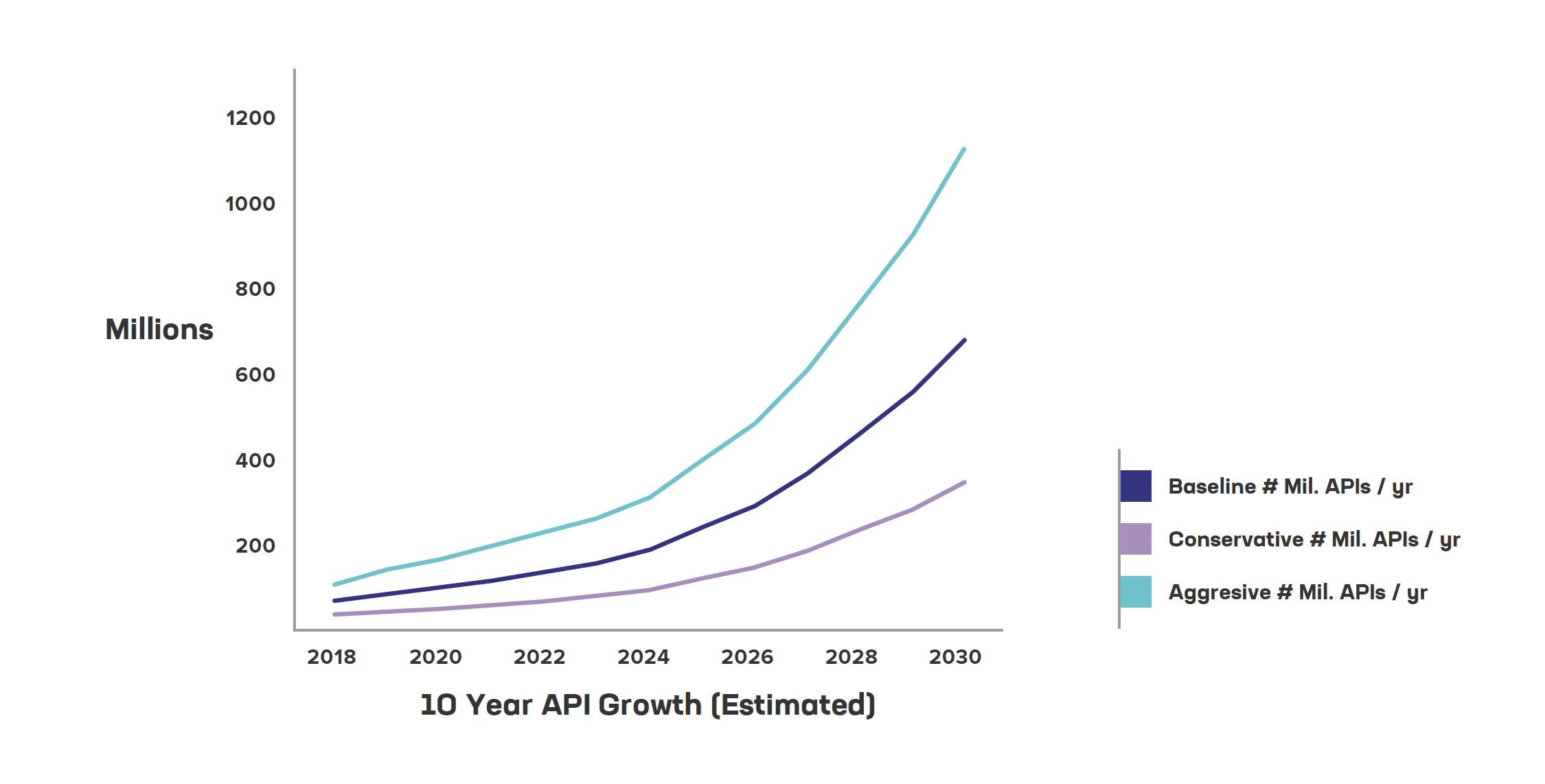
    API use cases are pervasive, from hotel bookings to weather, stock tickers, transportation, IoT, DevOps workflows and many other areas. “API-powered apps have permeated every aspect of our lives,” said the report. Yet, typical market estimates are usually quite conservative when sizing up this market, said F5. According to F5’s aggressive calculations, we will be approaching 1.7 billion active APIs by 2030.

    APIs present a high value from startup use cases to enterprise applications. However, a downside is that this growth is leading to sprawl, said Narayanan and Wiley.

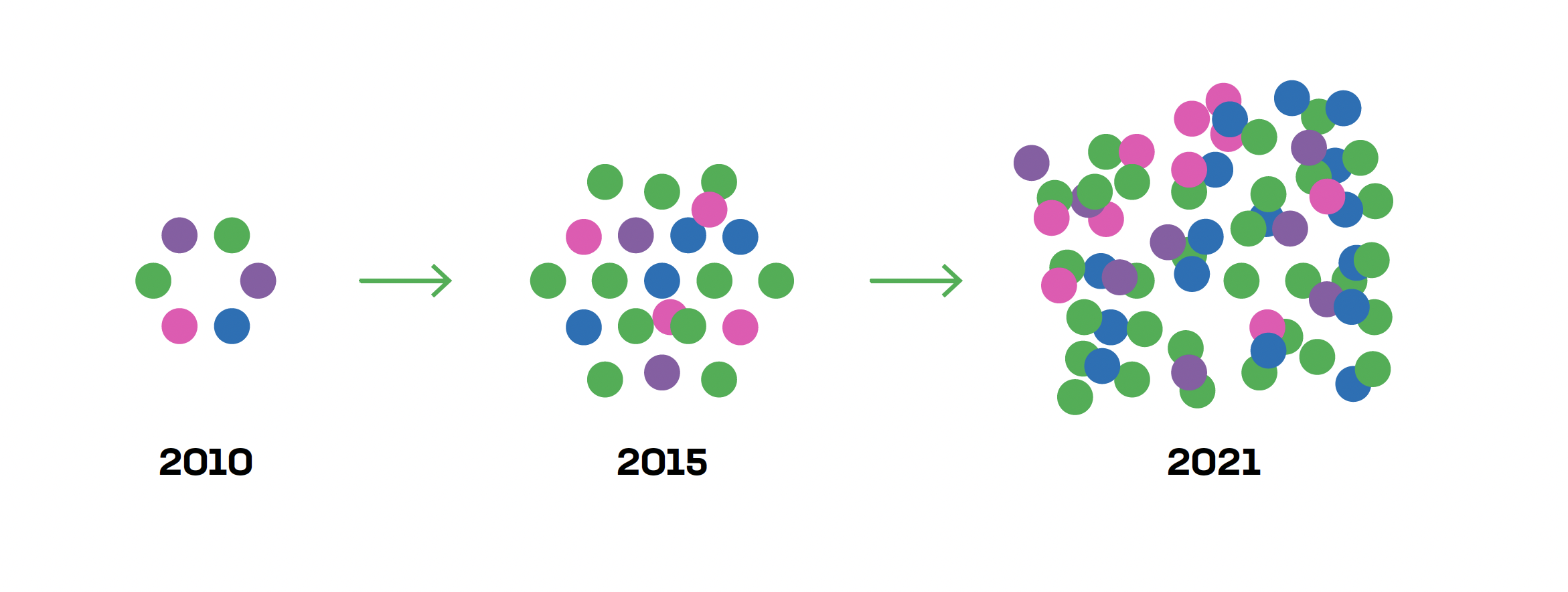
    API sprawl is the term used to describe both the exponentially large number of APIs being created and the physical spread of the distributed infrastructure locations where the APIs are deployed.

    Factors Driving API Sprawl

    Sheer growth. Sources predict the number of developers will grow to 45 million by 2030. SlashData also estimates that 30% of developers already use APIs. As the number of APIs on the market moves into the millions, managing growth poses a significant challenge, especially without proper governance and best practices.

    Lack of standards. “The lack of a common shared model contributes to API sprawl,” the report said. API design standards do exist, yet guidelines often leave room for nuances between services. Standards have also emerged around specific industries, like financial data exchange (FDX). While helpful for a single sector, this doesn’t advance multiple industries simultaneously. A lack of standardization leads to differing versioning approaches and integration challenges.

    New development approaches. Integration requirements are forcing many new APIs to unite disparate business apps. The microservices architecture trend is also adding to sprawl, as “APIs are both northbound to interfaces via microservices and horizontally between microservices.”

    Continuous software development. Continuous development, paired with the need to connect business units with bespoke requirements, could produce multiple versions of the same API. This quickly leads to maintenance difficulties, out-of-date documentation and broken clients. The report also cites rising data creation and “everything-as-a-service” trends as harbingers of an API sprawl.

    Various computing evolutions. New computing trends are also prompting a sprawl, says the report. Business units may be operating on different on-premises or cloud environments. When this hybrid situation occurs, APIs could get dispersed over many locations and become difficult to track. Specific connections may be created to cater to new environments like edge computing and IoT devices, further increasing sprawl.

    Problems With API Sprawl

    A digital economy reliant on APIs also relies on the underlying stability and availability of these services. Yet, “APIs have a shelf life and become unsupported if ignored by the developers,” the paper acknowledged. It could be hard to maintain service reliability for APIs sprawled across a distributed cloud. In addition to reliability issues, there are many other possible repercussions of an API sprawl.

    For one, management and operation at scale become difficult. Not all APIs are based on a specification, like OpenAPI. This means that API documentation may not be as streamlined and accessible, thus hurting discoverability and onboarding. “A simple means to connect these APIs may not be possible with conventional or legacy networking approaches,” the report added.

    As developers are top consumers of APIs, a sprawl could negatively impact their integration experience. Maintaining a swelling library of API dependencies can be cumbersome. Plus, APIs are prone to evolve and version over time and when endpoints are altered without advance notice, it leads to broken clients. Even small changes in API functionality can have a huge impact since all observable API behaviors will become relied upon, whether documented or not. (This is known as Hyrum’s Law).

    But the security ramifications of API sprawl are perhaps the most troubling. A whopping 91% of enterprises experienced an API security incident in 2020. Malicious API traffic also rose by a staggering 300% in mid-2021, Salt Labs found. Increased API use will undoubtedly cause more frequent attacks.

    “Unmanaged API sprawl is a security breach waiting to happen,” said the report. APIs typically adopt API keys for authentication and authorization, but this method is prone to misuse. Credentials are often exposed or misconfigured. Bad actors can use APIs to steal loads of data and computing power. As a result, sprawl is undermining trust in API connections and responses.

    Mitigating The Sprawl

    With the growth of the API economy slated to reach the billion mark in the next ten years, figuring out secure, stable inter-cluster communication will become more critical. According to F5, existing solutions (gateways, ingress controllers, service mesh and forward and reverse proxies) are not an adequate response.

    “We believe the solution should hence involve an intermediary (proxy) device focused on solving inter-cluster connectivity, security and integration challenges.” The writers call this solution API Gateway 2.0, which they describe as a bi-directional application-level proxy. The technology exists to implement such middleware and perhaps it could help companies address sprawl issues.

    Outside of Narayanan’s and Wiley’s recommendations, there are plenty of actions API owners can take to avoid adding to the sprawl. Here are a few:

    • Treat the API as a product
    • Improve developer experience
    • Use spec-driven development
    • Ensure up-to-date documentation and code libraries
    • Use consistent endpoint naming
    • Set clear guidelines for versioning and deprecation
    • Go beyond API keys with OAuth and OpenID Connect

    For more context, check out Continual API Sprawl: Challenges and Opportunities in an API Driven Economy for free without an email gate here.

  • Instart and F5 partner to deliver customers end-to-end reliability, performance, and control to enable exceptional web experiences

    Partnership combines advanced application delivery with an intelligent CDN and browser-level control to optimize web experiences from the origin to the browser

    PALO ALTO, Calif. – April 25, 2019 – Instart, the company helping leading brands around the world deliver amazing web experiences, today announced its partnership with F5 to deliver improved performance and complete control of a customer’s web app, from the origin to the browser. Customers will benefit from an end-to-end solution that leverages technologies from both providers to ensure reliability and performance for all application traffic from the cloud down to each visitor’s browser.

    To deliver amazing web app experiences today, brands must make their applications available everywhere, deliver performant, personalized web content, and leverage best-in-breed third-party services to add modern capabilities. This means relying on a microservice architecture across a hybrid cloud environment, delivering core web content through an enterprise CDN, and using dozens of third-party JavaScript tags. As user experience is impacted by third-party services, customers need solutions that work from the infrastructure to the browser to ensure performance.

    Instart cloud services for application performance and control analyze, control, and optimize the website at the point of experience – the browser. F5, the global leader in multi-cloud application services, provides availability and performance solutions to give the world’s largest businesses the freedom to deliver every app, anywhere. Together, Instart and F5 will provide a comprehensive web application delivery solution with technologies such as F5’s industry-leading traffic management and optimization capabilities and Instart’s CDN and browser-level controls, that optimize the entire path from the application to point where visitors experience the website – the browser.

    “This partnership strengthens F5’s ADC capabilities by extending control from the infrastructure and workload directly down to the browser,” said Kara Sprague, Senior Vice President and General Manager, Application Services at F5. “F5 customers will continue to benefit from the performance capabilities of F5’s BIG-IP while at the same time have the visibility and control of what is happening on their customer’s browser, using Instart, to ensure the best performance from third-party services running in the browser.”

    “Partnering with F5 gives our shared customers complete application visibility and control from the cloud to the browser,” said Sumit Dhawan, CEO of Instart. “Instart’s unique cloud solution seamlessly adds to F5’s leading application delivery solutions a browser technology that provides continuous insights and real-time control and an intelligent CDN, to ensure organizations can provide their customers exceptional web experiences every time they visit the site.”

    About Instart

    Instart helps leading brands around the world create web experiences that more than 250 million customers a day use and love. Through its cloud services for application performance and control, Instart continuously analyzes, secures, and optimizes web apps beyond the edge at the point of the customers’ experience to provide ultra-fast, visually immersive, and highly secure digital experiences on any device. Learn more at www.instart.com or follow us on Twitter at @Instart.

    About F5

    F5 (NASDAQ: FFIV) gives the world’s largest businesses, service providers, governments, and consumer brands the freedom to securely deliver every app, anywhere—with confidence. F5 delivers cloud and security application services that enable organizations to embrace the infrastructure they choose without sacrificing speed and control. For more information, go to f5.com. You can also follow @f5networks on Twitter or visit us on LinkedIn and Facebook for more information about F5, its partners, and technologies.

    F5 is a trademark or service mark of F5 Networks, Inc., in the U.S. and other countries. All other product and company names herein may be trademarks of their respective owners.


  • DevOps Chat: F5’s NGINX Acquisition, with F5’s Lori MacVittie

    DevOps Chat: F5’s NGINX Acquisition, with F5’s Lori MacVittie

    F5 Networks has acquired NGINX, the leading open source web server player. The move clearly puts F5 in the DevOps space, as well as the open source market.

    In this DevOps Chat, we speak with Lori MacVittie of F5 along with Sidney Rabsatt of NGINX. Some great insights into why this acquisition makes sense for both parties.

    As usual, the streaming audio is immediately below, followed by the transcript of our conversation.

    Transcript

    Alan Shimel: Hey everyone, it’s Alan Shimel, staging-devopsy.kinsta.cloud, DevOps Chat, and you’re listening to another chat. Today’s chat features two folks from an acquisition announced yesterday. In case you haven’t heard, F5 Networks has acquired NGINX. We’re going to hear more about it from two folks. Number one is our friend, Lori MacVittie from F5 Networks. Lori, welcome. Glad to have you here.

    Lori MacVittie: Thanks, happy to be here.

    Shimel: Fantastic. Joining Lori and I is Sidney Rabsatt. Sidney is VP of product at NGINX. Correct, Sidney?

    Sidney Rabsatt: That’s right, and I’m happy to be here too.

    Shimel: Well, everyone’s happy to be here. That’s not a bad thing. Are you happy to be here at the DevOps Chat or are we happy to be here talking about F5’s acquisition of NGINX? Let’s hope it’s both. Lori, give us a little background here. When I saw the deal yesterday. I said, “Wow, that’s a big deal.” I’m not sure – it’s certainly an expansion, up the stack, if you will, for F5.

    MacVittie: Up the stack, deeper into the app. It’s all about application delivery. One of the – Sidney mentioned earlier when we were chatting, building on NGINX’s vision, which as I read it, is flawless application delivery. That’s certainly something that F5 has always aspired to achieve as well, but there’s just pieces in the application stack that we don’t play in, or haven’t played in until yesterday with the acquisition. NGINX is the leading webserver. They’ve got an app server. They do some app delivery. They’re very prevalent in many, many places. So we’re very excited to have them on board to see how we can bridge the gap between those two worlds.

    Shimel: Absolutely. What about the perspective of NGINX? Money is always nice. Don’t get me wrong. What’s the attraction to F5 here?

    Rabsatt: I think there’s at least two sides of it. Working with the folks on this early on, we got to get a sense of the culture of the organization. It felt very compatible. The people we met were great. We had a great time talking, hanging out, sharing ideas. There’s some real optimism about what can be done together. The thing that really gets folks excited, especially on my side of the house, on the NGINX side of the house is the opportunity to do even more faster. We’re a startup. It’s grown to a good size. The set of resources that we have, but looking at F5 and talking to those folks, understanding that they have a shared vision. They see the world very similarly and bringing more resources to bear to execute on the vision that we’re always working towards. It’s something that’s very exciting for us.

    Shimel: I can’t disagree with you. I think we’re in violent agreement on it. It is a great opportunity. I guess the next question is how do we integrate, Lori or Sidney, how do we integrate the NGINX webserver, appserver, and the rest of the toolset into the F5 family? Or do we not?

    Rabsatt: Do you mind if I take a stab at it?

    MacVittie: Go ahead, Sidney, please.

    Rabsatt: Sure. Look, I think on the surface of things it might seem as if there’s a ton of integration that needs to happen, and a lot of overlap needs to be addressed, but quite frankly, I’ve been pleased to see how much complementary capabilities we actually have. Oftentimes, in the marketplace, folks will actually deploy both solutions side by side. It’s because we do slightly different things, both super important to folks. When we think about integration, there’s opportunity for F5 customers to be able to leverage NGINX solutions in places where they couldn’t necessarily before. That should be a net benefit to them.

    There’s the ability for folks that leverage NGINX solutions to take advantage of things that F5 does, that we don’t particularly do. I think that’s going to be another win for them as well. The integration is really focused on making sure we have the right extensions to the product line identified so we can really give customers the things they need to succeed in delivering those end to end applications, and yes, of course, we’re going to be looking to bring the best of both sets of technologies together in the places where it makes sense, but we’ve been pleased to see it’s not as many overlapping things as we might have found in some situations. We’re very optimistic about the path forward here.

    Shimel: So crystallize for me, where do you see things that overlap versus things that play well together? Can you give us some specifics?

    Rabsatt: Sure. Things that play well together fall into the category of “Hey, can I bring better scrutiny, better analytics, to the types of solutions that I might already have with NGINX?” On the NGINX side, I’m sorry – on the F5 side, “Hey, can I leverage solutions to give me a little bit more freedom and flexibility to build my apps wherever or however I might choose to?” So I think there’s some goodness there that folks will definitely get access to.

    On the integration side, you’ll find most of it is just around making sure that the products work seamlessly together. So to the extent of I have multiple devices in my environment. How do I have a single solution that gives me the ability to manage it the way that I need to? We still need to go through the work of understanding exactly how the different buyers are going to need to interact with the different solutions that we use going forward, but all that work is in progress and again, the overlap tends to be the little stuff. Oh, do you draw a report? Oh yeah, we draw a report. Do you guys do that too? Sure. So how do we bring the best of those technologies together? It’s that kind of thing.

    Shimel: Got it. Lori, interested to hear, you heard Sidney here. What do you add to that? What are your feelings on it?

    MacVittie: I think he encompassed everything well. We already – you already see both of us in F5 and NGINX together in a lot of environments. From our perspective, I think we’re looking at – one, continuing to invest and amplify the NGINX vision and what they’re trying to execute on, but also where can we add security? Security is a big deal that has to extend from end to end. Right now, that’s a very disjoint process sometimes. That’s why we keep telling security to shift let. I think this is an opportunity that we’re going to be looking for to be able to do those kinds of things and shift that security even lefter with NGINX.

    Shimel: Absolutely. It’s funny when you think about security being a driving force behind this acquisition. With NGINX being a webserver, that’s been an area and app server, that’s been an area where security has been required and important forever, even going back to IIS in the day, Internet Information Server and stuff. Here’s an area though I was thinking about. So many people in the public cloud use NGINX as their webserver of choice, whether we’re talking about Amazon or even Microsoft Google or any of them. Lori, does F5 maybe view this acquisition as a way to expand your footprint in public cloud? If so, how?

    MacVittie:  I don’t think we looked at exactly how that’s going to play out, and what we’re going to do with that. The webserver is something different from the proxy technology that most of our products are built on. So there’s some differences there in how that works. We’re still looking at roadmaps and trying to figure that out. For right now, we’re just going to keep going ahead with both sets of road maps and moving forward. As we continue to explore what we can do together, we’ll figure out where it makes sense.

    Shimel: Sidney, same – flip side of that coin – of that question to you around public cloud. Do you see an angle where F5 helps there?

    Rabsatt: Yeah, I think F5 already had strong relationships with quite a few of the cloud vendors as do we, and we expect that – we ultimately want to give folks a choice. This all boils down to organizations are trying to build the applications that make sense for them. They want to be able to leverage the best tools and capabilities that help them deliver those applications while giving them the freedom to build the application they want. So whether that is on one cloud, on multicloud, across clouds, and on prem locations, they need that flexibility to do what makes sense for them. A big part of what we’re trying to accomplish here is making sure that F5’s large customer base has the capabilities that NGINX large user base has, which is again, that freedom of flexibility. That means that whether it’s on Amazon Google, Microsoft, any cloud, or any on prem solution, they get to deliver their applications with the security, controls, the visibility that they desire.

    Shimel: Excellent. I’m just – in hybrid situation, what about – one of the hottest topics certainly in technology today is the whole Kubernetes container thing. I know both F5 and NGINX had Kubernetes-related solutions and playing in that market. What, if any, does this acquisition, what if anything does this acquisition bring to that? Either one?

    Rabsatt: I would say it should be a net benefit. NGINX, there was a recent report I saw. It’s in the public domain. NGINX is the most commonly used ingress controller for Kubernetes environments today. If you think about what Kubernetes means for organizations that are building these modern applications, it’s giving them an environment that allows them to build typically microservices-based applications. So getting those applications exposed to the outside world requires the first thing, the foundational element, the hierarchy of need. It’s getting traffic in and out of that Kubernetes environment. How do you do that? Through the ingress capability.

    Our ingress controller is pretty much the number one solution out there for doing that today. That’s the first place people have to start before they get into some of the more complex or exotic things they’d like to be able to do. So our customers, our users are already benefitting from that. It’s allowing them to do what they need to do when it comes to adopting or testing Kubernetes for their own uses.

    Shimel: Sure. Lori, even independent of NGINX, what effect is this whole move to Kubernetes and container-ized environment having on F5’s business?

    MacVittie: Wow. On the business? Don’t really know. No. There is – we see a lot of customers asking. One, they want guidance on how to do this at scale and safely. A lot of our customers are very concerned about security, about performance. How do they bridge those two worlds, coming out of Kubernetes and trying to get into an environment where there’s a lot more traditional apps and infrastructure still supported? It’s trying to bridge those two worlds.

    Our customers are looking at it and they’re bringing it in and they’re adopting it, but they’re also having challenges with the deployment side where NetOps traditionally sit that they don’t have the skills to do the automation. They have problems with integration of the toolsets to build those pipelines. So one of the things that this kind of an acquisition does is bridge that gap. Hopefully we’ll see better integration and easier in and out, both actually in the flow of traffic, but also just between the teams in the businesses, so we think this will help address some of the pains at the people level in organizations by having this end to end delivery chain with both F5 and NGINX.

    Shimel: Sure. Sidney, maybe you would know. What are the plans with some sort of common interface or more integration between the two lines?

    Rabsatt: I’d say it’s still very early on. We have some good ideas, but we’re not really in a position to preview too much. I will say there’s going to be a focus on again, making sure we’re bringing the best of both solutions together. Again, not nearly as much overlap as you might have expected, or we – I should say as we might have expected. Yeah, what we’re looking at is really the opportunity to bring more features to the things we already have, more so than trying to get rid of things. We’re looking forward to getting this innovation stuff underway. We’ve had some very early conversations, but over the next days and weeks, we’re going to be digging into it very deeply.

    Shimel: Makes sense. Lori, so this was as we said right from the outset, what we’re turning to is a move up the application stack. What – is F5 done with that? Will we see more F5 potential either via the acquisition or holistically – organically moving up this stack here in the application world?

    MacVittie: I can’t obviously comment on any kind of [laughter] –

    Shimel: Can’t tell _____ acquisition is. I get that one.

    MacVittie: That’s right. With any company, that’s always a possibility. We have been transforming ourselves in the past year really moving forward with a lot more innovation in terms of exploring things and looking at – we’ve got Aspen mesh going, which is service mesh trying to bring some sanity to Kubernetes inside for scaling. Cloud services, we’ve made a lot of our services as a service. You just hook them up. We’ve been moving deeper into the application stack for a while. This is just going to accelerate that transformation from ADC to application services company.

    Shimel: Understood. Understood. Well, guys it really is exciting. One of the things I sit here at staging-devopsy.kinsta.cloud and Security Boulevard and we go to all of the conferences and we cover all the news, and you hear so much “What’s bleeding edge, bleeding edge, bleeding edge?” We tend to forget, or we overlook what are the nuts and bolts, the bread and butter that keeps the internet and these applications going? It is things like the NGINX web server that is the dominant web server in the world today. It is things like the F5 lineup of software and of _____ actually that have been delivering the internet to the public since 2002 or whatever it is. Lori, you probably know, but so it’s good to see innovation continuing to happen. It’s good to see new combinations taking place.

    I’m excited to see what comes out of – Sidney, as you said, it’s very early on. It’s a day after the acquisition was announced. Maybe we could check back in six months and see how things are progressing along these lines. In the meantime though, just the usual questions. Everyone from NGINX is staying on? There’s not going to be layoffs as part of the consolidations and stuff, or again too early to tell?

    Rabsatt: I mean what we know is F5 is interested in our organization and not just products. They’ve made it very clear they want the vast majority of folks to stay and we expect that to continue to be the case. We look forward to what the future holds together.

    Shimel: Yep, understood. Look, I wish you a lot of success, both you guys individually, as well as F5 and NGINX. It’s an exciting combination. Congratulations to both organizations and Lori, I think congratulations on especially to F5 for really making a real great addition to the family there.

    MacVittie: Thank you. I know there’s a lot of us. We’re just really excited about this and about the future and what we can do together.

    Shimel: Cool, cool, cool. All right, congratulations, guys. We’re going to call it a rap on this edition of DevOps Chat. Lori MacVittie for F5 networks. Sidney Rabsatt for NGINX, soon to be F5 Networks. Thanks for being our guest today on DevOps Chat. Thank you everyone for listening. You’ve just listened to another chat. Bye bye.


    — Alan Shimel

  • F5 Acquires NGINX to Bridge NetOps & DevOps, Providing Customers with Consistent Application Services Across Every Environment

    • F5, the global leader in multi-cloud application services, announces the acquisition of NGINX, an open source leader in application delivery.
    • Strategic acquisition and organic investment to secure long-term revenue and EPS growth.
    • Together, F5 and NGINX will enable multi-cloud application services across all environments, providing the ease-of-use and flexibility developers require while also delivering the scale, security, reliability and enterprise readiness network operations teams demand.
    • F5 is committed to continued innovation and increasing investment in the NGINX open source project to empower NGINX’s widespread user communities.
    • F5 will maintain the brand with current NGINX CEO, Gus Robertson, and founders, Igor Sysoev and Maxim Konovalov, joining F5 to continue to lead NGINX.

    SEATTLE & SAN FRANCISCO–(BUSINESS WIRE)–F5 Networks, Inc. (NASDAQ: FFIV) and NGINX today announced a definitive agreement under which F5 will acquire all issued and outstanding shares of privately held NGINX for a total enterprise value of approximately $670 million, subject to certain adjustments.

    “F5’s acquisition of NGINX strengthens our growth trajectory by accelerating our software and multi-cloud transformation,” said François Locoh-Donou, President & CEO of F5. “By bringing F5’s world-class application security and rich application services portfolio for improving performance, availability, and management together with NGINX’s leading software application delivery and API management solutions, unparalleled credibility and brand recognition in the DevOps community, and massive open source user base, we bridge the divide between NetOps and DevOps with consistent application services across an enterprise’s multi-cloud environment.”

    “We believe every organization can benefit from the agility and flexibility enabled by modern technologies without compromising on security, manageability, and reliability,” continued Locoh-Donou. “The combined company will enable every customer—from the app developer to the network engineer to the security specialist—with the tools they need to ensure their apps are available and secure across every platform, from the enterprise data center to private and public clouds.”

    F5 will enhance NGINX’s current offerings with F5 security solutions and will integrate F5 cloud-native innovations with NGINX’s software load balancing technology, accelerating F5’s time to market of application services for modern, containerized applications. F5 will also leverage its global sales force, channel infrastructure, and partner ecosystem to scale NGINX selling opportunities to the enterprise.

    “NGINX and F5 share the same mission and vision. We both believe applications are at the heart of driving digital transformation. And we both believe that an end-to-end application infrastructure—one that spans from code to customer—is needed to deliver apps across a multi-cloud environment,” said Gus Robertson, CEO of NGINX, Inc. “I’m excited to continue this journey by adding the power of NGINX’s open source innovation to F5’s ADC leadership and enterprise reach. F5 gains depth with solutions designed for DevOps, while NGINX gains breadth with access to tens of thousands of customers and partners.”

    NGINX’s thriving open source community was one of the most attractive elements of this combination, and F5 recognizes the trust that the user community has in NGINX’s technology. Open source is a core part of F5’s multi-cloud strategy and a driver for F5’s next phase of innovation. As such, F5 is committed to continued innovation and increasing investment in the NGINX open source project to empower NGINX’s widespread user communities. F5 expects the combination with NGINX will accelerate its product integrations with leading open source projects and will enhance its strong technology partnerships with open source vendors.

    Upon closing of the acquisition, F5 will maintain the NGINX brand. Gus Robertson, along with NGINX founders Igor Sysoev and Maxim Konovalov, will join F5 and will continue to lead NGINX. Robertson will join F5’s senior management team, reporting to François Locoh-Donou. F5 will maintain NGINX’s operations in San Francisco, California and other locations globally.

    Transaction Details

    The acquisition of NGINX is expected to increase F5’s software revenue growth and increase the Company’s software revenue mix in fiscal year 2019. It secures F5’s Horizon 2 (fiscal year 2021 to fiscal year 2022) objectives of mid-to-high single-digit revenue and double-digit non-GAAP earnings per share growth. Short-term, the Company expects that the acquisition and organic investment in new and emerging solutions will result in modest earnings dilution in fiscal years 2019 and 2020.

    F5 provided the following regarding its Horizon 1 (fiscal year 2019 to fiscal year 2020) outlook, following the completion of the NGINX acquisition:

    Analyst and Investor Meeting
    Horizon 1 (FY19-FY20) Outlook, March 2018

    Post-NGINX Acquisition
    Horizon 1 (FY19-FY20) Guidance

    Total Revenue Growth Low-to-mid single-digit growth Mid-single-digit growth
    Software1 Revenue Growth 30%-35%+ growth 35%-40%+ growth
    Software1 as a % of Product Revenue Mid 20s% 25%-30%
    Non-GAAP Gross Margin ~85% ~85%
    Non-GAAP Operating Margin 35%-37% 33%-35%
    Non-GAAP EPS Mid-to-high single-digit growth Low single-digit growth

    1

    Software includes standalone Virtual Editions, including subscriptions & utility, and as a Service offerings

    All forward-looking non-GAAP measures included in the outlook exclude estimates for amortization of intangible assets, share-based compensation expenses, significant effects of tax legislation and judicial or administrative interpretation of tax regulations, including the impact of income tax reform, non-recurring income tax adjustments, valuation allowance on deferred tax assets, and the income tax effect of non-GAAP exclusions, and do not include the impact of any restructuring charges, facility exit costs, or other non-recurring charges that may occur in the period. F5 is unable to provide a reconciliation of non-GAAP guidance measures to corresponding U.S. generally accepted accounting principles or GAAP measures on a forward-looking basis without unreasonable effort due to the overall high variability and low visibility of most of the foregoing items that have been excluded. Material changes to any one of these items could have a significant effect on our guidance and future GAAP results. Certain exclusions, such as amortization of intangible assets and share-based compensation expenses, are generally incurred each quarter, but the amounts have historically varied and may continue to vary significantly from quarter to quarter.

    F5 intends to fund the transaction through cash on its balance sheet. In conjunction with the transaction, the Company is suspending its common stock share repurchase program. The Company will continue to evaluate market conditions and other factors including F5’s capital requirements in determining when and whether to continue such program and the levels of such program. The program does not require the purchase of any minimum number of shares and the program may be modified, suspended, or discontinued at any time.

    The acquisition has been approved by the boards of directors of both F5 and NGINX and, following execution of the definitive agreement, received the requisite shareholder approval of NGINX. It is subject to regulatory approvals and other customary closing conditions and is expected to close in the second calendar quarter of 2019.

    Foros acted as financial advisor and Wilson Sonsini Goodrich & Rosati provided legal counsel to F5 on this transaction. Qatalyst Partners served as financial advisor to NGINX.

    Investor Conference Call Details

    F5 will host a live webcast and conference call to discuss the transaction beginning at 5:30 p.m. ET, today, March 11, 2019. The live webcast can be accessed at: https://www.f5.com/company/investor-relations.

    To participate in the live call via telephone in the U.S., dial 800-593-9913. Outside the U.S., dial +1-212-287-1824. Please call 10 minutes prior to the call start time. The webcast replay will be archived on F5’s website.

    Additional Information

    About F5

    F5 (NASDAQ: FFIV) gives the world’s largest businesses, service providers, governments, and consumer brands the freedom to securely deliver every app, anywhere—with confidence. F5 delivers cloud and security application services that enable organizations to embrace the infrastructure they choose without sacrificing speed and control. For more information, go to f5.com. You can also follow @f5networks on Twitter or visit us on LinkedIn and Facebook for more information about F5, its partners, and technologies.

    About NGINX

    NGINX, Inc. is the company behind the popular open source project trusted by more than 375 million sites. We offer a suite of technologies for developing and delivering modern applications. The NGINX Application Platform enables enterprises undergoing digital transformation to modernize legacy, monolithic applications as well as deliver new, microservices-based applications. Companies like Netflix, Starbucks, and McDonalds rely on NGINX to reduce costs, improve resiliency, and speed innovation. NGINX investors include Blue Cloud Ventures, e.ventures, Goldman Sachs, Index Ventures, MSD Capital, NEA, Runa Capital, and Telstra Ventures.

    F5 is a trademark or service mark of F5 Networks, Inc., in the U.S. and other countries. All other product and company names herein may be trademarks of their respective owners.

    F5 Forward-Looking Statements

    This press release contains forward-looking statements including, among other things, statements regarding the continuing strength and momentum of F5’s business, future financial performance, sequential growth, projected revenues including target revenue and earnings ranges, income, earnings per share, share amount and share price assumptions, share repurchases, demand for application delivery networking, application delivery services, security, and software products, expectations regarding future services and products, expectations regarding future customers, markets and the benefits of products, and other statements that are not historical facts and which are forward-looking statements. These forward-looking statements are subject to the safe harbor provisions created by the Private Securities Litigation Reform Act of 1995. Actual results could differ materially from those projected in the forward-looking statements as a result of certain risk factors. Such forward-looking statements involve risks and uncertainties, as well as assumptions and other factors that, if they do not fully materialize or prove correct, could cause the actual results, performance or achievements of the company, or industry results, to be materially different from any future results, performance or achievements expressed or implied by such forward-looking statements. Such factors include, but are not limited to: customer acceptance of our new traffic management, security, application delivery, optimization, and software and F5aaS offerings; the timely development, introduction and acceptance of additional new products and features by F5 or its competitors; competitive factors, including but not limited to pricing pressures, industry consolidation, entry of new competitors into F5’s markets, and new product and marketing initiatives by our competitors; increased sales discounts; the business impact of the acquisition of NGINX and potential adverse reactions or changes to business or employee relationships, including those resulting from the announcement or completion of the acquisition; uncertainties as to the timing of the transaction; uncertain global economic conditions which may result in reduced customer demand for our products and services and changes in customer payment patterns; global economic conditions and uncertainties in the geopolitical environment; overall information technology spending; litigation involving patents, intellectual property, shareholder and other matters, and governmental investigations; natural catastrophic events; a pandemic or epidemic; F5’s ability to sustain, develop and effectively utilize distribution relationships; F5’s ability to attract, train and retain qualified product development, marketing, sales, professional services and customer support personnel; F5’s ability to expand in international markets; the unpredictability of F5’s sales cycle; F5’s common stock repurchase program and activities thereunder and differences may result from, among other things, actions taken by the Company or its management or Board regarding operations or strategy, and activities and conditions relating to pricing, trading, capital requirement and repurchasing of shares of F5 common stock including continued suspension or modification or discontinuation of the common stock repurchase program; future prices of F5’s common stock; and other risks and uncertainties described more fully in our documents filed with or furnished to the Securities and Exchange Commission, including our most recent reports on Form 10-K and Form 10-Q and current reports on Form 8-K and other documents that we may file or furnish from time to time, which could cause actual results to vary from expectations. The financial information contained in this release should be read in conjunction with the consolidated financial statements and notes thereto included in F5’s most recent reports on Forms 10-Q and 10-K as each may be amended from time to time. All forward-looking statements in this press release are based on information available as of the date hereof and qualified in their entirety by this cautionary statement. F5 assumes no obligation to revise or update these forward-looking statements.

    GAAP to non-GAAP Reconciliation

    F5’s management evaluates and makes operating decisions using various operating measures. These measures are generally based on the revenues of its products, services operations and certain costs of those operations, such as cost of revenues, research and development, sales and marketing and general and administrative expenses. One such measure is net income excluding stock-based compensation, amortization of purchased intangible assets, acquisition-related charges, net of taxes, and certain non-recurring tax expenses and benefits, which is a non-GAAP financial measure under Section 101 of Regulation G under the Securities Exchange Act of 1934, as amended. This measure consists of GAAP net income excluding, as applicable, stock-based compensation, amortization of purchased intangible assets, litigation expense, restructuring charges, facility exit costs, gain on sale of patents, non-recurring tax expenses and benefits, and acquisition-related charges. This measure of non-GAAP net income is adjusted by the amount of additional taxes or tax benefit that the company would accrue if it used non-GAAP results instead of GAAP results to calculate the company’s tax liability. Stock-based compensation is a non-cash expense that F5 has accounted for since July 1, 2005 in accordance with the fair value recognition provisions of Financial Accounting Standards Board (“FASB”) Accounting Standards Codification (“ASC”) Topic 718 Compensation—Stock Compensation (“FASB ASC Topic 718”). Amortization of intangible assets is a non-cash expense. Investors should note that the use of intangible assets contribute to revenues earned during the periods presented and will contribute to revenues in future periods. Acquisition-related expenses consist of professional services fees incurred in connection with acquisitions. In addition, non-recurring costs associated with the relocation of the company’s corporate headquarters have been excluded from GAAP net income for the purpose of measuring non-GAAP earnings and earnings per share in the first quarter of fiscal year 2019.

    Management believes that non-GAAP net income per share provides useful supplemental information to management and investors regarding the performance of the company’s core business operations and facilitates comparisons to the company’s historical operating results. Although F5’s management finds this non-GAAP measure to be useful in evaluating the performance of the core business, management’s reliance on this measure is limited because items excluded from such measures could have a material effect on F5’s earnings and earnings per share calculated in accordance with GAAP. Therefore, F5’s management will use its non-GAAP earnings and earnings per share measures, in conjunction with GAAP earnings and earnings per share measures, to address these limitations when evaluating the performance of the company’s core business. Investors should consider these non-GAAP measures in addition to, and not as a substitute for, financial performance measures in accordance with GAAP.

    F5 believes that presenting its non-GAAP measures of earnings and earnings per share provides investors with an additional tool for evaluating the performance of the company’s core business and is used by management in its own evaluation of the company’s performance. Investors are encouraged to look at GAAP results as the best measure of financial performance. However, while the GAAP results are more complete, the company provides investors these supplemental measures since, with reconciliation to GAAP, it may provide additional insight into the company’s operational performance and financial results.

  • Blue Medora Announces VMware vRealize Orchestrator Plug-In for F5 BIG-IP Solutions


     GRAND RAPIDS, Mich. June, 27 2016 – Blue Medora, a leading innovator in enterprise cloud and data center management, today announced the release of the VMware vRealize Orchestrator Plug-In for F5 BIG-IP™.

    Working together, F5 Networks and Blue Medora simplify and automate the process of provisioning BIG-IP Software-Defined Application Services™. In addition, organizations can seamlessly provision BIG-IP services as part of the natural workflow of provisioning applications and networks with NSX.

    The BIG-IP® system from F5 Networks helps secure and improve the reliability of applications in the cloud, data centers, and software-defined networking environments. The vRealize Orchestrator (vRO) Plug-In for F5 BIG-IP is part of Blue Medora’s VMware portfolio that consolidates IT management across VMware vRealize to optimize health, reduce risk and increase efficiency.

    “By integrating vRealize Orchestrator with F5 BIG-IP, IT administrators are accelerating the application deployment process and decreasing deployment time from days to minutes,” said Mike Kelly, CTO at Blue Medora. “With the new Blue Medora vRO extension, administrators have full control of BIG-IP objects and commands through the well-established iControl® API. Easy-to-use vRO workflows, provided out-of-the-box, standardize and streamline application deployment.”

    “Combined development work between Blue Medora and F5 continues to pay dividends for shared customers,” said Calvin Rowland, senior vice president of Business Development at F5 Networks. “Collaboration with industry leaders like Blue Medora in our partner ecosystem helps ensure that integrations and plug-ins are designed to optimize joint deployments. With today’s announcement, vRO and BIG-IP provide an agile services framework to support SDN technologies.”

    The vRealize Orchestrator Plug-In for F5 BIG-IP is immediately available from Blue Medora and resellers. Blue Medora and F5 Networks will host a webinar on June 29th to demonstrate the benefits of VMware vRealize Orchestrator Plug-In for F5 BIG-IP.

    About Blue Medora

    Blue Medora software solutions tie together data from virtualized and cloud-based databases, applications and services with the critical underlying compute, storage and network infrastructure to create a unified view of the infrastructure. These capabilities are delivered as value-added platform extensions for VMware’s vRealize Operations, New Relic and Oracle Enterprise Manager Cloud Control platforms.

    Blue Medora’s products enable administrator teams to work collaboratively on the infrastructure to avoid downtime, resolve performance problems and make predictive insights using advanced analytics. Blue Medora believes true visibility into business critical applications is only achieved when enterprise cloud management systems communicate without barriers.

    For more information, visit www.bluemedora.com

    F5, BIG-IP, Software-Defined Application Services, and iControl are trademarks or service marks of F5 Networks, Inc., in the U.S. and other countries. All other trademarks are property of their respective owners. The use of the words “partner,” “partnership,” or “joint” does not imply a legal partnership relationship between F5 Networks and any other company.

    Media Contacts

    Bill Robbins/David Tutin

    Touchdown PR

    Email: bluemedora@touchdownpr.com

    Phone: (512) 547-0921

    Phone: +44 (0) 1252 717040


    Twitter

    LinkedIn

    YouTube

    Facebook


    Connect With Us

    www.bluemedora.com


    http://www.linkedin.com/company/bluemedora

  • F5 Releases 2016 ‘State of Application Delivery’ Customer Survey Results

    SEATTLE–(BUSINESS WIRE)–F5 Networks (NASDAQ: FFIV), today released the results of its second annual State of Application Delivery customer survey. Expanded to include feedback from more than 3,000 customers worldwide, this year’s report details how they are delivering applications successfully, how they keep data and users secure, and how hybrid cloud, software-defined networking (SDN), and DevOps are changing IT. In addition, F5 executives will host a series of live panel sessions and a webinar that will offer attendees deeper insights into the data. The first live panel session is on January 28, 2016, and will be hosted by F5’s CTO and EVP of product development, Karl Triebes. Sign up for the panels and webinar, and download the full report at: http://f5.com/SOAD.

    Survey Highlights

    This year’s report goes bigger and broader with input from F5 customers in the Americas (AMER); Europe, the Middle East, and Africa (EMEA); and Asia-Pacific (APAC) regions. A variety of industries are represented, with the widest participation from customers in finance, technology, telecom companies, and government entities. Key takeaways include:

    • Application services are essential and pervasive: Ten or more application services are used by well over half of respondents, who recognize that slow, unresponsive, and unsecured applications can have a substantial negative impact on revenue and operations.
    • Hybrid cloud is the new normal: The vast majority of respondents (81 percent) are moving toward a hybrid cloud environment to leverage the flexibility and potential cost savings it offers, especially for small and mid-sized organizations.
    • Security focus is on protecting users, data, and applications:Security professionals who have the highest level of confidence in their ability to ward off attacks are protecting clients, requests, and responses—the critical points at which data can be easily compromised.
    • DevOps and SDN are key to improving operational efficiency:Because DevOps and SDN enable automation and orchestration, they are both seen as key factors for reducing operating costs and improving time to market.

    “Applications are vital to business success. Used by every employee, applications contribute to greater efficiency, lower costs, and increased margins,” said Triebes. “Without the correct services to support applications, they won’t be available, secure, or fast enough to meet companies’ needs. The results of this year’s State of Application Delivery survey offer valuable insights into how customers are managing and implementing their application services within dynamic and complex IT environments.”

    Additional Resources

    The following items are available at: http://f5.com/SOAD

    • Download the full 2016 State of Application Delivery report
    • Summary infographic
    • Register for the free online live panel sessions and webinar

    About F5

    F5 (NASDAQ: FFIV) provides solutions for an application world. F5 helps organizations seamlessly scale cloud, data center, telecommunications, and software defined networking (SDN) deployments to successfully deliver applications and services to anyone, anywhere, at any time. F5 solutions broaden the reach of IT through an open, extensible framework and a rich partner ecosystem of leading technology and orchestration vendors. This approach lets customers pursue the infrastructure model that best fits their needs over time. The world’s largest businesses, service providers, government entities, and consumer brands rely on F5 to stay ahead of cloud, security, and mobility trends. For more information, go to f5.com.

    You can also follow @f5networks on Twitter or visit us on LinkedIn and Facebook for more information about F5, its partners, and technologies.

    F5 is a trademark or service mark of F5 Networks, Inc., in the U.S. and other countries. All other product and company names herein may be trademarks of their respective owners.

    Forward-Looking Statements

    This press release may contain forward-looking statements relating to future events or future financial performance that involve risks and uncertainties. Such statements can be identified by terminology such as “may,” “will,” “should,” “expects,” “plans,” “anticipates,” “believes,” “estimates,” “predicts,” “potential,” or “continue,” or the negative of such terms or comparable terms. These statements are only predictions and actual results could differ materially from those anticipated in these statements based upon a number of factors including those identified in the company’s filings with the SEC.

    Contacts

    F5 Networks
    Nathan Misner, 206-272-7494
    n.misner@f5.com
    or
    WE Communications
    Holly Luka, 415-547-7054
    hluka@we-worldwide.com

  • F5 Delivers on Its Synthesis Vision to Accelerate the Expansion of Mobile Broadband

    F5’s reference architectures and solutions enable service providers to optimize, secure, and monetize their mobile networks

    SEATTLE–(BUSINESS WIRE)–F5 Networks (NASDAQ:FFIV) announced today offerings and reference architectures that extend its F5 Synthesis™ framework and bring new benefits to service providers. F5 will be showcasing these reference architectures and demonstrating the benefits of its service provider offerings at Mobile World Congress, taking place next week in Barcelona.

    F5 Synthesis provides an elastic services platform to help service providers effectively scale their networks and realize the benefits of emerging technologies such as Network Functions Virtualization (NFV) by delivering Software Defined Application Services™ (SDAS™). SDAS leverage F5’s fabric-based approach by efficiently and intelligently combining virtualization, scalability, programmability, orchestration, and other capabilities.

    The F5 Synthesis vision leverages core F5 technologies—including those announced earlier this week—and enhanced service provider solutions focused on the data, signaling, and application planes to further enable the secure, optimized, and orchestrated delivery of application services. F5 helps service providers adopt service-driven business practices, empowered by policy, subscriber identity, Diameter signaling, and other context- and application-aware solutions. Moreover, by delivering services in an efficient, unified manner, innovative service provider products aid organizations in managing and monetizing the way services are introduced to the market.

    As an architectural framework, F5 Synthesis:

    • Combines physical, virtual, and cloud-based deployments to form a unified, elastic high-performance services fabric. This enables more efficient network architectures for service providers and an optimized migration path to advanced LTE services and emerging technologies like NFV.
    • Provides agile, orchestrated application service creation and automation capabilities through the dynamic programmability of SDAS via open REST-based APIs, allowing integration with third-party management and orchestration systems.
    • Offers F5 application services with flexible licensing models to make it cost-effective for service providers to extend valuable services for all applications on demand, with the agile technology fabric scaling as needed.
    • Enables dynamic, multilayer security across networks, applications, and devices.
    • Delivers advanced “application-driven” capabilities, service experiences, and improved economics for service providers by significantly reducing TCO for critical services and accelerating the delivery of revenue-generating VAS.1
    • Aligns and complies with current and developing industry practices. F5 is supportive of standards and guidance affecting service providers, including IETF, 3GPP, GSMA, ETSI NFV, and SDN-related standards such as ONF.
    • Supplies service provider-focused reference architectures that deliver prescriptive guidance on how to address evolving business challenges.

    KEY BENEFITS

    New F5 technologies and solutions continue to augment the company’s traffic and signaling management solutions portfolio, enabling service providers to cost-effectively build and scale their networks, achieve high service velocity and quality of experience for customers, and further monetize the network by introducing innovative services and business models. The unified F5 Synthesis architectural framework transforms the economics, experience, and enablement of application services for service providers by:

    • Unleashing Broadband Services for Optimum Performance –F5 is the leading vendor in providing intelligent service chaining, dynamic policy enforcement, Diameter routing and interworking, and DNS functionality to enable new services and business models, and enhance mobile broadband capabilities.
    • Enabling Multilayer Security for Maximum Protection –To support more flexible capabilities, LTE networks are inherently less secure than their 3G and 2G predecessors. This can open up mobile networks to a greater number of significant threats, while mobile operators are increasingly being expected to offer enhanced protection for users, network, and applications in concert. F5’s security solutions are designed to protect end-user devices, networks, and cloud deployments with industry-leading performance and scale.
    • Delivering Future-Proof Scale and Extensibility for Ultimate Value – F5 gives organizations a multiservice platform that provides important network services, such as security, policy enforcement, local DNS, IPv6 migration, and content filtering, with additional granular control over traffic policies and steering provided by programmable iRules® capabilities. F5 delivers unrivaled scale and extensibility to offer further investment protection looking forward.
    • Providing Integration Points with an Ecosystem of Technology Partners – F5’s comprehensive programmability and APIs provide enhanced opportunities for technology partners to collaborate on joint offerings and interoperability. F5 solutions have undergone extensive evaluation to promote seamless integration with technology partners in the next-generation service provider ecosystem.

    DEPLOYMENT GUIDANCE WITH SERVICE PROVIDER-FOCUSED REFERENCE ARCHITECTURES

    As a complement to its Synthesis framework, F5 provides a growing library of reference architectures designed to help service providers address some of the industry’s most pervasive challenges. Individual reference architectures provide prescriptive guidance focused on efficiently deploying SDAS to achieve a specific business purpose.

    F5 reference architectures designed for service providers include:

    • S/Gi Network Simplification – The F5 solution simplifies S/Gi design and operations while also offering advanced content- and subscriber-aware features. Service providers can consolidate multiple services such as advanced firewall solutions, DNS, IPv6 carrier-grade NAT migration, policy enforcement, and intelligent traffic steering to enable dynamic service function chaining.
    • Security for Service Providers – Dynamic, intelligent security is implemented at the network, session, and application layers, with centralized command and distributed control. F5’s unified service delivery platform offers unmatched scalability, capacity, and performance to simplify security architectures and reduce TCO.
    • LTE Roaming – A Diameter signaling solution seamlessly enables roaming from LTE systems in a secure manner. F5’s LTE Roaming solution uses an advanced Diameter Edge Agent (DEA) for high-performance subscriber- and context-awareness for operators and IPX providers while delivering enhanced quality of experience for subscribers.
    • Network Functions Virtualization (NFV) – F5’s solution for NFV architectures helps leverage the benefits of cloud and SDN within the service provider network environment. In addition to delivering capabilities such as load balancing and global server load balancing that are essential for NFV to succeed, F5 technologies provide a unified, orchestrated environment to realize the full benefits of a virtualized service infrastructure.

    SUPPORTING QUOTES

    “S/Gi network simplification, LTE roaming, voice over LTE, security, and NFV are very important topics for service providers to look at over the next few years in considering their next-generation mobile network deployments. We are pleased to see F5 Synthesis addressing important issues within the industry.”

    Vic McClelland, Managing Director of Networks, Optus

    “As mobile operators continue to deploy LTE (4G) and look further towards 5G networks, scaling and securing the data, signaling, and application planes become increasingly important. F5 Synthesis binds these three realms to provide an architectural framework to address critical issues for mobile operators.”

    Dimitris Mavrakis, Principal Analyst, Telecoms & Media, Informa

    “Service providers are going through a fundamental architectural shift to SDN and NFV, which increases the importance of automating the scalability, security, virtualization, and programmability of their networks. In our view, F5 is the first in the industry to focus this shift on the mobile broadband segment across the data, signaling, and application planes, with the aim of helping providers with flexible scaling and rapid service introductions. We believe that service providers will want to look at how F5 software can help them develop new service and business models that will increase their ability to monetize mobile broadband.”

    Michael Howard, Principal Analyst, Infonetics Research

    “Service providers have traditionally deployed many stateful session-based devices on their S/Gi network, which are inherently not high capacity or are very expensive to scale to sufficient levels to meet growing bandwidth demands of 4G/LTE and 5G/Advanced LTE networks. With F5’s S/Gi network simplification solution, service providers can consolidate these disparate functions into one platform and scale to meet future bandwidth demands, in turn reducing TCO by 36 percent over five years compared to their traditional approach.”

    Dr. Ray Mota, Managing Partner, ACG Research

    “The explosive growth of always-connected devices running thousands of applications is requiring service providers to rethink how services are offered, scaled, and monetized. Virtualization and orchestration within a flexible architectural framework will become increasingly important as service providers look to build seamless Application Delivery Networks.”

    Patrick Donegan, Senior Analyst, Heavy Reading

    “Changes in the service provider market are being driven by the desire for services that better address new economic models and customers’ evolving interests. The F5 Synthesis framework provides a unified technology fabric and intelligent services orchestration, enabling service providers to accelerate the transition from just providing connectivity to delivering enhanced, differentiated mobile experiences for subscribers.”

    Dr. Mallik Tatipamula, VP of Service Provider and Cloud Solutions, F5 Networks

    F5 AT MOBILE WORLD CONGRESS

    F5 will be exhibiting its service provider technologies in Hall 5, Stand 5G11, at this year’s Mobile World Congress event, taking place February 24–27 in Barcelona. In addition, the F5 Traffix™ Signaling Delivery Controller™ has been shortlisted for recognition in the Best Mobile Infrastructure segment of the Global Mobile Awards 2014, presented at the event.

    SUPPORTING RESOURCES

    AVAILABILITY

    The F5 solutions and reference architectures mentioned in this announcement are generally available now. Please contact a local F5 sales office for product availability in specific countries.

    [1] ACG Research, Business Case for S/Gi Network Simplification, February 2014

    ABOUT F5

    F5 (NASDAQ:FFIV) provides solutions for an application world. F5 helps organizations seamlessly scale cloud, data center, and software defined networking (SDN) deployments to successfully deliver applications to anyone, anywhere, at any time. F5 solutions broaden the reach of IT through an open, extensible framework and a rich partner ecosystem of leading technology and data center orchestration vendors. This approach lets customers pursue the infrastructure model that best fits their needs over time. The world’s largest businesses, service providers, government entities, and consumer brands rely on F5 to stay ahead of cloud, security, and mobility trends. For more information, go to f5.com.

    You can also follow @f5networks and @F5CSP on Twitter or visit us on Facebook for more information about F5, its partners, and technology.

    F5, F5 Synthesis, Software Defined Application Services, SDAS, Traffix, Signaling Delivery Controller, iRules, and DevCentral are trademarks or service marks of F5 Networks, Inc., in the U.S. and other countries. All other product and company names herein may be trademarks of their respective owners.


    This press release may contain forward-looking statements relating to future events or future financial performance that involve risks and uncertainties. Such statements can be identified by terminology such as “may,” “will,” “should,” “expects,” “plans,” “anticipates,” “believes,” “estimates,” “predicts,” “potential,” or “continue,” or the negative of such terms or comparable terms. These statements are only predictions, and actual results could differ materially from those anticipated in these statements based upon a number of factors, including those identified in the company’s filings with the SEC.

    Read More At Investor’s Business Daily: http://news.investors.com/newsfeed-business-wire/021914-141560666-f5-delivers-on-its-synthesis-vision-to-accelerate-the-expansion-of-mobile-broadband.aspx#ixzz2tlyPjVqa
    Follow us: @IBDinvestors on Twitter | InvestorsBusinessDaily on Facebook