Tag: micro focus

  • Old Software Never Dies – But What is it Really Worth?

    Old Software Never Dies – But What is it Really Worth?

    I’ve been thinking about the news from last week that OpenText acquired Micro Focus for what seems to be $6 billion in cash. Mike Vizard did a nice write-up on the news with his take on it here on staging-devopsy.kinsta.cloud (and if you’re interested in the security industry implications, Techstrong Research’s Mike Rothman talked about that, too). While I don’t flat-out disagree with Mike Vizard’s opinions, I do have a slightly different view.

    To me, this is part of a trend we have been seeing from some of the largest tech companies who are sitting on or have access to loads of dry-powder cash. In tougher economic times, cash is king and it is not unusual for the large companies to come in and pick up other companies and lines of business, usually on the cheap. 

    For instance, Broadcom’s acquisition of VMware (though I don’t know that you could call $61 billion cheap). It seems, at first blush, the Micro Focus deal would seem to fit the same kind of bill. I don’t think people believe OpenText overpaid based on these numbers:

    • Total purchase price is 2.2x Micro Focus’ pro forma TTM revenues
    • Total purchase price is 6.3x Micro Focus’ pro forma TTM adjusted EBITDA

    However, I think there’s more here than meets the eye. By OpenText’s CEO’s own admission, it is going to take at least eight quarters (two years) to integrate the Micro Focus portfolio into OpenText’s cloud delivery model.  

    In the meantime, Micro Focus has struggled to maintain profitability and previously announced a $300 million cost-cutting program which will continue with the acquisition. Additionally, the company is saying they will cut another $100 million in costs on top of that; so, a total of $400 million in cuts. 

    Where are the cuts coming from? It’s not like Micro Focus’ broad portfolio of software products are revolutionary new technology—quite the opposite, in fact. Micro Focus, through various acquisitions over the years, has largely scooped up mature product lines from large technology brands that unloaded unwanted or non-strategic software lines-of-business. Of course, the HP/HPE deal was a whole different animal, but the result was not much different. 

    Some mature software came under Micro Focus’ control and Micro Focus has done a decent job of keeping those lines of business turning out what cash they can. They haven’t really “reinvigorated” that software, but have been running out the cycle. Now, OpenText says moving it to their cloud service over the next eight quarters is going to turn things around. I’m skeptical, to say the least.

    I think it will be old software that will be two years older and delivered via the cloud. What must be done goes beyond just putting that software in the cloud—they have to commit to truly relaunching it. Move it to cloud-native architecture; kill some of the older product lines that are near end-of-life and, frankly, which should have been put out to pasture some time ago. Build on the brand equity, sure, but launch some new software.

    At the end of the day, $6 billion is a lot of money—but more money than that has been wasted buying old software in the past. Without a much bolder plan from OpenText, just mumbling about digital transformation and cloud will not be enough to make the Micro Focus portfolio worth anything close to the amount of money they paid for it.

    Like Mike Vizard—and, I am sure, many OpenText investors and Micro Focus users—I will be looking for signs that OpenText are not settling for a lift-and-shift with the old Micro Focus software wrapped in the cloud. It is going to take more than that for this deal to pay dividends. 

    I am not saying it can’t be done. When this deal closes, OpenText will be a software powerhouse with a broad set of customers. Finding new software and services to sell to those customers is the key to this deal.

  • OpenText to Create Software Powerhouse – Acquires Micro Focus for $6B

    OpenText to Create Software Powerhouse – Acquires Micro Focus for $6B

    OpenText this week announced it will acquire Micro Focus for $6 billion. The acquisition is part of an effort to reinvigorate a broad portfolio of information management, application development and testing, integration and cybersecurity platforms by accelerating the rate at which they are transitioned to OpenText’s managed private cloud.

    The acquisition is expected to close in the first quarter of 2023, and the combined company expects to reduce costs by an additional $100 million on top of the $300 million Micro Focus previously committed to cutting as part of an ongoing effort to return to profitability and growth.

    OpenText CEO Mark J. Barrenechea told analysts the ultimate goal is to enable organizations to accelerate their digital business transformation initiatives using a set of application programming interface (API)-centric offerings that reside on a private cloud.

    Digital transformation represents the largest opportunity in the history of computing, he said, but Barrenechea also acknowledged that a lot of companies are still struggling with making that transition. “There has to be a better way to get digital transformation right,” he said.

    The Micro Focus portfolio includes everything from a robotic process automation (RPA) offering, a recently-launched IT service management (ITSM) offering—dubbed Service Automation Management X—along with the Vertica database and LoadRunner testing tools. There is also a slew of cybersecurity platforms that include ArcSight, Fortify, IDOL Zenworks and Sentinel along with legacy COBOL application development tools and even the remnants of Novell.

    In effect, OpenText now has one of the broadest software portfolios in the industry after previously acquiring Documentum, Carbonite, Hummingbird and Zix. “The strategy appears to be to simply gather up all the pieces on the chess board,” said Mitch Ashley, principal analyst for Techstrong Research, an arm of Techstrong Group that is also the parent company of staging-devopsy.kinsta.cloud.

    Despite the disjointed Micro Focus portfolio, OpenText has no intention of selling off any of those offerings, said Barrenechea. Going forward, the strategy is to not only accelerate the transition to the cloud but also expand application license renewal services, he added. OpenText also sees an opportunity to expand the appeal of the Micro Focus portfolio into the small-to-medium business (SMB) market, noted Barrenechea.

    All told, it will take six quarters once the deal is closed to align the Micro Focus business model with the one OpenText currently employs, which Barrenechea said should result in growth starting eight quarters after the deal closes.

    There’s no doubt that, once the deal closes, IT organizations that rely on Micro Focus will be closely watching the level of ongoing investment in the portfolio for any signs of one platform being deemphasized in favor of another. It’s also probable that many customers will be relieved to see the stewardship of those platforms assumed by a company that is on firmer financial footing.

    Regardless of how the OpenText portfolio evolves in 2023, however, one thing that is certain is IT organizations have no shortage of alternatives to consider.

  • Micro Focus Announces Expanded AI-Powered Capabilities for the UFT Family

    Functional Testing Portfolio Receives Enhanced Artificial Intelligence Support to Accelerate Test Automation, Improve Resiliency, and Reduce Test Maintenance for Application Teams

    Santa Clara, Calif. – July 6, 2020   Micro Focus (LSE: MCRO; NYSE: MFGP) today announced AI-powered enhancements to the intelligent testing capabilities of the UFT Family, a unified set of solutions designed to reduce the overall complexity of automating the functional testing processes. As businesses place increased emphasis on developing innovative applications that better support users, scaling testing efforts becomes an elusive goal. These new AI-based capabilities ensure application teams can meet growing demands in an effective, efficient and agile way by increasing test coverage and test asset resiliency, and reducing test creation time and maintenance efforts.

    The increase in pace and frequency of software releases, the proliferation of operating environments, and the exponential growth in the number of test cases has demanded the use of AI to revolutionize software test automation and positively impact both the efficiency and effectiveness of functional testing. “Over the past two years we’ve steadily infused our existing products with artificial intelligence features. Last June we debuted new AI-based capabilities to help organizations overcome the challenges of mobile testing and this announcement extends the same support to web-based testing,” said Raffi Margaliot, Micro Focus Senior Vice President, Application Delivery Management. “More importantly this customer-centric innovation is available to our extensive customer base, with intelligent tools to accelerate adoption of AI within their existing testing assets.”

    Micro Focus AI-powered test automation in the UFT Family enables users to:

    • Streamline automation – Instead of creating multiple scripts for every possible combination and transaction, users only need to compose a single script that will automatically run on multiple platforms and browsers. This reduces the overall time spent on creating and maintaining test assets, while increasing test coverage and allows teams to keep up with the evolving technology landscape and user demands.
    • Consistently improve with little effort – The UFT Family’s AI framework evolves and adapts based on a crowd-sourced feedback mechanism. Customers are invited to expand and refine the AI model’s training data by securely and privately contributing information about their unique user interface paradigms, to constantly improve accuracy of object recognition.
    • Shift testing everywhere – A combination of an AI Software Development Kit (SDK) and Natural Language Processing (NLP) allows technical and non-technical testers to easily write tests and reduces the time and effort of technical testers in the creation/maintenance of automation code.

    “To adequately test a new mobile application, we knew that generating and maintaining all the test scripts required for our quality standards was going to be difficult within the required timeframes. With the new UFT One AI-based testing capabilities, we were able to leverage a single set of multi-platform scripts across iOS and Android and reduced mobile test maintenance by an estimated 35%,” said Chris Trimper, Enterprise QA Automation Architect, Quality Assurance Engineering at Independent Health Insurers. “It also enabled us to provide rapid feedback to project teams from CI builds and to focus more on overall quality of the new mobile application.”

    On June 18, 2020, independent analyst firm Forrester Research named Micro Focus a “Strong Performer” in The Forrester Wave™: Continuous Functional Test Automation Suites, Q2 2020. Micro Focus also received the highest scores possible in the “product vision” and “innovation roadmap” criteria. According to the report, “Micro Focus has introduced innovation based on AI, ML, and RPA. The new vision of Micro Focus is “shift everywhere,” leveraging a broad suite of tools composed of UFT One, UFT Developer, and UFT Mobile infused with AI and NLP capabilities.”

    The Micro Focus UFT Family of functional test automation solutions includes UFT One, UFT Developer, and UFT Mobile.These solutions help teams deliver quality applications using intelligent multi-platform functional test automation with AI-based capabilities. They represent just one of the ways Micro Focus helps customers run and transform their business and accelerate application delivery in the race for digital transformation.

    About Micro Focus
    Micro Focus delivers enterprise software to empower our 40,000 customers worldwide to digitally transform.  With a broad portfolio, underpinned by a robust analytics ecosystem, the company enables customers to address the four core pillars of digital transformation: Enterprise DevOps, Hybrid IT Management, Predictive Analytics and Security, Risk & Governance. By design, these tools bridge the gap between existing and emerging technologies so customers can run and transform at the same time.

    Disclaimer

    The information contained in this communication from the sender is confidential. It is intended solely for use by the recipient and others authorized to receive it. If you are not the recipient, you are hereby notified that any disclosure, copying, distribution or taking action in relation of the contents of this information is strictly prohibited and may be unlawful.

    This email has been scanned for viruses and malware, and may have been automatically archived by Mimecast Ltd, an innovator in Software as a Service (SaaS) for business. Providing a safer and more useful place for your human generated data. Specializing in; Security, archiving and compliance. To find out more Click Here.

  • Micro Focus Announces Major Enhancements to DevOps Governance in Latest ALM Octane 15 Release

    Update Introduces New Capabilities for Enterprise Readiness and Application Delivery


    Santa Clara, Calif. – December 17, 2019   Micro Focus (LSE: MCRO; NYSE: MFGP) today announced the general availability of ALM Octane 15, the comprehensive DevOps governance solution for high-quality application delivery. The newly improved Micro Focus ALM Octane 15 release provides added capabilities for SDLC analytics, continuous quality, lean requirements management, DevOps support, usability and enterprise readiness to better support enterprise application delivery with first-class criteria and continuous visibility across the application lifecycle.

    “As companies are looking to increase the agility and speed required to deliver their products and applications faster, they are in need of a platform that can define, manage and govern activities while gaining insight from conception to production,” said Tal Levi Joseph, Vice President of Product Management for Application Lifecycle Management, Micro Focus. “With this latest release of ALM Octane 15, we added new unique features that were suggested directly by our customers to continue increasing the speed, quality and scale of their software delivery.”

    Micro Focus ALM Octane 15 New Features and Benefits:

    • New capabilities allow users to track the cycle time of features and resolution time of defects. In addition, insight cards can be opened from the widget with helpful trends and comparison data.
    • Enhanced test planning now allows users to target a specific milestone when planning and running both manual and automated tests. You can now track quality and testing progress per milestone and to release.
    • Support for Azure DevOps Services as a CI server and for Gherkin test injection in Bamboo, giving the ability to sync Azure Boards backlog into ALM Octane. Also included is enhanced Bamboo support with gherkin support, multi branch and multi shared-spaces capabilities.
    • Ability to create a customizable Word or PDF report with information about your ALM Octane entities.
    • Scale Agile Management with enhanced auditing, board printing, URL attachments and more flexible commenting on tasks.

    The latest version of Micro Focus’ ALM Octane technology enables companies to accelerate Agile transformations for high-quality application delivery at enterprise scale while leveraging their existing investments.

    Micro Focus ALM Octane 15 is now available to customers.

    Additional Information

    For more information on the release of Micro Focus ALM Octane 15, visit our product page.

    Join Micro Focus on LinkedIn and follow @MicroFocus Twitter.

    About Micro Focus
    Micro Focus helps organizations run and transform their business through four core areas of digital transformation: Enterprise DevOps, Hybrid IT Management, Predictive Analytics and Security, Risk & Governance. Driven by customer-centric innovation, our software provides the critical tools they need to build, operate, secure, and analyze the enterprise. By design, these tools bridge the gap between existing and emerging technologies—enabling faster innovation, with less risk, in the race to digital transformation.


  • Micro Focus Advances Capabilities for DevOps in Latest Deployment Automation Release

    Update Enables Rapid Enterprise-wide Adoption for Release Teams and DevOps Transformation Projects

    Santa Clara, Calif. – September 30, 2019   Micro Focus (LSE: MCRO; NYSE: MFGP) today announced the general availability of Deployment Automation 6.3, offering new deployment improvements for its Release Orchestration solution set. The newly enhanced Micro Focus Deployment Automation product provides essential tooling for IT teams that are embracing the DevOps movement, as well as those actively looking to increase their software application release cadence.

    “As DevOps has become a primary driver for IT organizations delivering business critical software applications, the speed and frequency with which applications get enhanced directly impact how quickly a business can respond to customer requests, competitive moves and changing market conditions,” said Tal Levi Joseph, Vice President of Product Management for Application Lifecycle Management, Micro Focus. “With the latest release of Deployment Automation, teams can orchestrate complex deployments across all delivery environments with greater ease while also cutting down on costs and time.”

    Micro Focus Deployment Automation 6.3 New Features and Benefits:

    • Simplified, intuitive navigation helping novice users become productive in less time
    • Rapid enterprise-wide adoption among release teams with minimal training, reducing the time to automate application releases
    • Updated user interface with a consistent look and feel between other Micro Focus Application Delivery Management solutions
    • New plugin supporting Sonatype’s Nexus Repository Manager that provides seamless integration and a single source of truth ensuring deployed components are identical to those tested in preproduction environments

    The latest version of Micro Focus’ Deployment Automation technology enables companies to easily and quickly automate the deployments of application releases across physical, virtualized, and cloud environments.

    Micro Focus Deployment Automation 6.3 is now available to customers and will be demonstrated at booth 400 of the DevOps Enterprise Summit in Las Vegas on October 28th.

    Additional Information

    For more information on the release of Micro Focus Deployment Automation 6.3, visit our product page.

    Join Micro Focus on LinkedIn and follow @MicroFocus Twitter.

    About Micro Focus
    Micro Focus helps organizations run and transform their business through four core areas of digital transformation: Enterprise DevOps, Hybrid IT Management, Predictive Analytics and Security, Risk & Governance. Driven by customer-centric innovation, our software provides the critical tools they need to build, operate, secure, and analyze the enterprise. By design, these tools bridge the gap between existing and emerging technologies—enabling faster innovation, with less risk, in the race to digital transformation.


  • Micro Focus Announces Vertica in Eon Mode for Pure Storage

    Industry’s First and Only Analytical Database Solution with Separation of Compute and Storage Architecture Available for On-Premises Environments

    AUSTIN, TX – September 17, 2019 – Today at Pure//Accelerate 2019, Pure Storage’s annual user conference, Micro Focus (LSE: MCRO; NYSE: MFGP) announced the general availability of Vertica in Eon Mode for Pure Storage. The industry’s first and only analytical database solution that separates compute from storage for on-premise environments, Vertica in Eon Mode for Pure Storage drives better economics and greater choice for customers by expanding the ability to dynamically manage workloads and simplify operations beyond public clouds.

    Organizations in every industry are challenged by the volume of data and speed of analytics required to lead the market. Two industry trends are coming together to meet these challenges — object storage such as S3, and the separation of compute from storage. Object storage provides a cost-effective means of storing massive data volumes. The separation of compute from storage helps to manage more dynamic workloads and enables workload isolation for individual teams and projects. But, until now, these capabilities have been largely limited to the cloud. Vertica in Eon Mode for Pure Storage addresses these trends and delivers the high data volume management, unmatched performance, and ease of operations that analytics-driven businesses need to become data disruptors, on-premises or in public clouds.

    “Public cloud architectures deliver value to many organizations, but many companies need the same advantages in on-premises or in hybrid deployments,” said Colin Mahony, Senior Vice President and General Manager of Vertica at Micro Focus. “Now, with Vertica in Eon Mode for Pure Storage, organizations can leverage cloud architecture if they choose hybrid environments or remain on-premises. With support for Pure Storage FlashBlade, Vertica provides our customers with a unified analytics platform that brings cloud architecture down to earth.”

    Many organizations, particularly in highly regulated industries, have chosen not to migrate to the cloud due to talent gaps, complex migrations, loss of control, governance and cost management challenges, vendor lock-in, and more. Others need the flexibility of hybrid deployments. Vertica in Eon Mode for Pure Storage brings all of the capabilities and benefits of cloud-optimized architectures to on-premises environments, providing customers even greater choice.

    “Pure Storage FlashBlade makes fast object storage a reality,” said Brian Schwarz, Vice President of Product Management, Pure Storage. “By collaborating with Vertica to deliver Vertica in Eon Mode for Pure Storage to market, customers now have the best of both worlds – fast object storage with the highest analytical performance in a dense, power efficient, and simple-to-manage system within their own data centers.”

    Vertica in Eon Mode for Pure Storage enables organizations from financial services to telecommunications, healthcare to retail and beyond to address their variable workload requirements, with these available advantages:

    • Elastically scale storage as the database grows from terabytes to petabytes
    • Deliver the concurrency and performance needed as more and more users require analytics for business decisions
    • Isolate workloads based on specific department needs and use cases and eliminate the costs and headaches of database replication
    • Size compute to “hot data” rather than to the overall database for further cost savings
    • Combine siloed data on-premises and develop practices and procedures before moving to a completely new environment as a stepping stone to the cloud
    • Prepare for hybrid deployments that feature the same “tech stack” for on-premise and in the cloud for operational simplicity and flexibility

    More Information
    Attendees of Pure Storage Accelerate can get immediate information by attending 3 breakout sessions, including:

    Session ID 277: Fast Object Storage: Oxymoron or Reality?

    Session ID 375: Deep Dive: Eon Mode on-premise with FlashBlade

    Session ID 276: Build a Modern Data Hub with Vertica

    Also learn more about Vertica in Eon Mode for Pure Storage and access Vertica classes, workshops, and training at your own pace and terms at the newly launched Vertica Academy. Join Micro Focus on Twitter, LinkedIn and Facebook.

    About Micro Focus

    Micro Focus helps organizations run and transform their business through four core areas of digital transformation: Enterprise DevOps, Hybrid IT Management, Predictive Analytics and Security, Risk & Governance. Driven by customer-centric innovation, our software provides the critical tools they need to build, operate, secure, and analyze the enterprise. By design, these tools bridge the gap between existing and emerging technologies—enabling faster innovation, with less risk, in the race to digital transformation.


    ###

  • Micro Focus Lays DevOps Foundation for RPA

    Micro Focus Lays DevOps Foundation for RPA

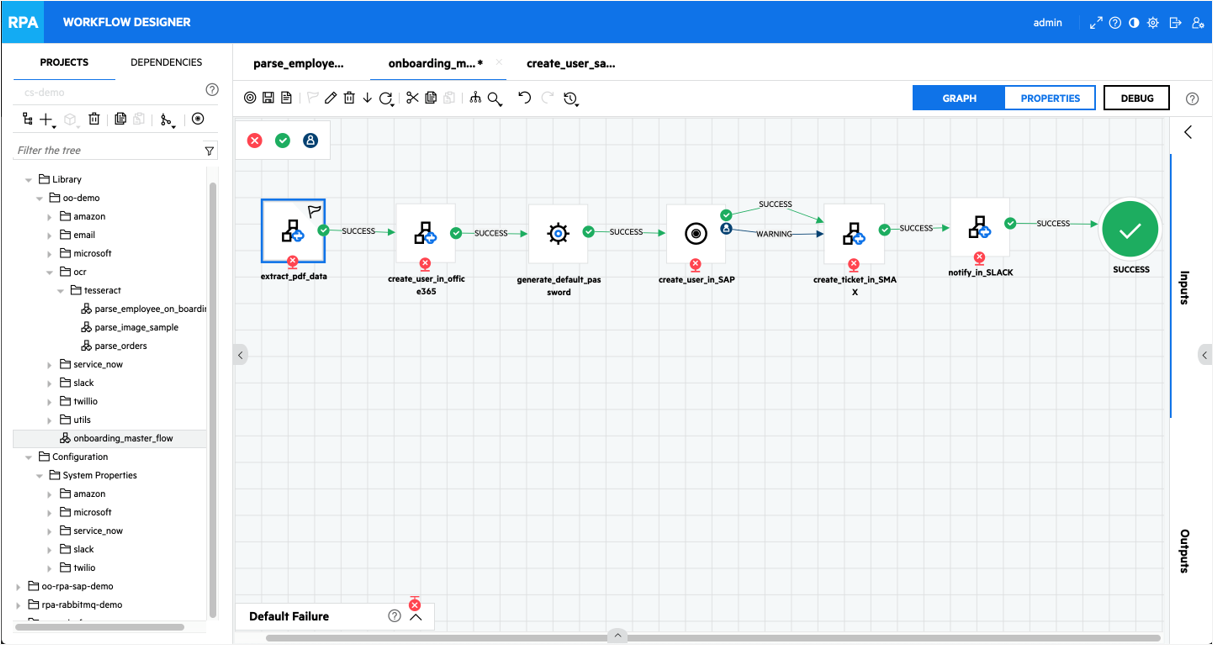
    Micro Focus has announced the general availability of Micro Focus Robotic Process Automation (RPA), which sets the stage for employing DevOps processes to construct highly automated business processes.

    Thanks to the rise of artificial intelligence (AI) and digital business transformation initiatives, interest in RPA has increased significantly. However, rather than merely using RPA to build bots to automate a narrow set of static processes, RPA is now leveraging machine and deep learning algorithms to optimize a wider range of dynamic business processes and adjust more easily to changes within an application.

    Travis Greene, senior director for IT operations management ay Micro Focus, said new capabilities such as object recognition technology included within Micro Focus RPA enables the platform to detect and automatically adapt to changes to the user interface.

    Other new capabilities now include the ability to visually or programmatically create workflows using a tool that records screen actions, the ability to more easily combine graphical and programmatic workflows spanning multiple platforms and the ability to deploy hundreds of thousands of bots as needed. A centralized dashboard manages the bots, all of which have unique IDs and encrypted, role-based credentials.

    As RPA and other forms of AI continue to be integrated and embedded with applications, Greene said it’s a matter of time before DevOps practices are extended to RPA platforms. Organizations will seek to train bots continuously as more data is made available, which in turn will drive updates to applications that are dependent on those bots. In most cases, depending on the complexity of the task, the bots will be built using a mixture of application programming interfaces (APIs), command-line interfaces (CLIs) and graphical tools. Organizations will need to define the processes to determine how and when each organization will opt to invoke one interface instead of another, either in isolation or combination, added Greene.

    Historically, organizations have been able to apply RPA to static processes with mixed success. With the rise of AI, the scope of those efforts has become more ambitious. Business leaders are too inclined to believe that just about every business process can be automated using a combination of AI and RPA. However, AI and RPA still are confined to relatively narrow use cases involving highly predictable outcomes.

    That’s changing, however, and RPA and AI are becoming more pervasive across the enterprise. DevOps teams will need to find ways to update both their applications and RPA/AI models without breaking one or the other. Most of the current RPA/AI models are highly sensitive to any change made to the application environment they are monitoring. And, unfortunately, the data scientists who are largely responsible for constructing those RPA/AI models don’t yet tend to have much of an appreciation for best DevOps processes. There will, however, come a day soon when these two worlds will collide.

    — Mike Vizard

  • Micro Focus Introduces New Robotic Process Automation Product, Ignites Enterprise Productivity

    Designed for the enterprise, the scalable and resilient solution is first to deliver UI and API-based RPA

    SANTA CLARA, Calif., July 15, 2019 – Micro Focus (LSE: MCRO; NYSE: MFGP) today announced the general availability of Micro Focus Robotic Process Automation (RPA) which gives companies the power to build, secure, and scale automated business processes, from legacy to modern, across the enterprise.

    According to Gartner, “The ability to integrate legacy systems is the key driver for RPA projects. By using this technology, organizations can quickly accelerate their digital transformation initiatives, while unlocking the value associated with past technology investments.”  Micro Focus RPA automates repetitive, error-prone UI-based human actions on legacy apps and integrates them with modern IT process automation in a single product.

    “Micro Focus RPA delivers on key capabilities such as scalability, resiliency and security that our customers and partners demanded,” said Tom Goguen, Micro Focus Chief Product Officer. “It adapts to UI changes, automates UI and API-based applications, and includes real-time auditing and traceability, giving our customers the confidence to deploy RPA across the enterprise while providing for centralized governance and compliance for their digital workforce.”

    “As we have worked closely the last few years with our customers and partners to leverage test automation for their first RPA projects, it presented a convenient way to evaluate the potential of business-related automation and further prove its value to the organization,” said Raffi Margaliot, Micro Focus General Manager for Application Delivery Management. “With Micro Focus RPA, we augmented our core capabilities to be purpose-built for RPA, and we believe our innovations in making automation more resilient to change will deliver a lower TCO compared to existing solutions.”

    Micro Focus RPA capabilities include:

    • Easy-to-use design studio: An intuitive design interface that allows users to easily record screen actions and design sophisticated end-to-end RPA workflows, visually or with code.
    • Cross-platform connections: A technology-rich product that combines UI automation with API and other integration methods to connect business processes spanning old and new applications.
    • Scalable robots: A worker-queue-based architecture to scale robots up or down as workloads change, making it possible to run hundreds or thousands of robots at once.
    • Centralized security: A centralized dashboard to manage the robots that have unique IDs and encrypted, role-based credentials.
    • Resilient robots: Advanced object recognition technology to detect UI changes and automatically adapt as needed, saving time on maintenance.

    “Our customers demand genuine improvements through integrated service delivery, and we know this can only occur with advanced service offerings and innovative partnership in technologies like robotic process automation,” said Denham Seneviratne, National Sales Manager for Winthrop Australia. “We believe Micro Focus is well placed to help deliver on this promise, and we hope our customers are the beneficiaries.”

    “At Kinetic IT, we strengthen our personalized service offerings by minimizing effort on activities better suited to automation,” said Brett Roberts, Chief Product Officer of Kinetic IT. “The release of Micro Focus RPA opens up new opportunities to explore and pursue for the benefit of our customers.”

    “As a Platinum partner of Micro Focus, we are excited about the release of the RPA product and see the definite benefits it can start to bring our clients,” said Jamie Duffield, CEO of Revolution IT. “The RPA product will enable us to automate their processes and focus areas of their application stack to drive value into repetitive tasks quickly and efficiently.”

    With cost-effective licensing, companies can keep their RPA costs predictable and scalable. Pricing starts at $15,000 USD per robot, with special pricing that extends to Micro Focus Unified Functional Testing and Operations Orchestration customers.

    Additional Information

    For companies looking to start their first RPA projects, Micro Focus has professional service offerings available for best practice and process improvement guidance.

    For more information on the release of Micro Focus Robotic Process Automation, visit www.microfocus.com/rpa.

    About Micro Focus
    Micro Focus helps organizations run and transform their business through four core areas of digital transformation: Enterprise DevOps, Hybrid IT Management, Predictive Analytics and Security, Risk & Governance. Driven by customer-centric innovation, our software provides the critical tools they need to build, operate, secure, and analyze the enterprise. By design, these tools bridge the gap between existing and emerging technologies—enabling faster innovation, with less risk, in the race to digital transformation.


  • DevOps Chat: Enterprise DevOps Adoption, with Micro Focus’ Mark Levy

    DevOps Chat: Enterprise DevOps Adoption, with Micro Focus’ Mark Levy

    Adopting DevOps means changes from how you build software to organizational processes and cultural behaviors. Large enterprises have even greater challenges to overcome, including supporting a large number of applications and addressing technical debt while also taking on new development initiatives like digital transformation.

    What can we learn from experienced DevOps practitioners?

    In this DevOps Chat we spoke with Mark Levy, director of strategy, software delivery at Micro Focus, covering seven keys to successful DevOps implementations at large enterprises.

    As usual, the streaming audio is immediately below, followed by the transcript of our conversation.

    Transcript

    Mitch Ashley: Hi, everyone, this is Mitch Ashley with staging-devopsy.kinsta.cloud, and you’re listening to another DevOps Chat podcast. Today, we’re tackling the topic of large enterprise adoption of DevOps—no small task, for sure.

    I’m very happy to welcome Mark Levy from Micro Focus. Mark, welcome.

    Mark Levy: Thank you, Mitch, and glad to be here.

    Ashley: Would you just tell us a little bit about yourself and what you do at Micro Focus?

    Levy: My name’s Mark Levy. I am a director and working in the product marketing organization, and I focus a lot on strategic marketing initiatives as an evangelist, a DevOps evangelist. I develop and write content and commentary about the DevOps market. I’ve had a 25-plus-year career, and like many people, I’ve had many positions. I started out as like a sysadmin and was a developer and managed dev teams.

    But, in 2007, I started to focus exclusively on application delivery. And so, that has been—this whole area of application delivery, software delivery is something that I’ve been really focused on for the last 10 or so years.

    Ashley: Well, tell us briefly, a little bit about Micro Focus. Not all of our listeners might know what you all do.

    Levy: So, Micro Focus has also gone through this major transformation over, I would wanna say, the five to eight years or so. You know, we’re a global enterprise software company. We were established in 1976, we have 14,000 employees and 40,000 enterprise customers, about 4,800 software engineers, and we really focus on large enterprises, helping them run and transform their business. We have sort of focused on four key areas of how do we support our customers through their digital transformation journey, and enterprise DevOps is one of them.

    Ashley: I imagine that our folks, listeners that are from large enterprises are gonna be particularly interested, and I’m sure there are learnings and information that will be useful to other folks as well.

    So, you talked about playing in the space with large enterprises. I imagine that’s probably some global international companies, maybe some that are both European or U.S.-based as well. How would you describe how you differentiate what you do as Micro Focus as compared to other folks? There’s a lot of companies, of course, working to try to help enterprises adopt DevOps.

    Levy: Yeah, of course. And that’s sort of what I’d like to do first maybe is just sort of set the stage, because I always look at this, especially in the enterprise IT world, it’s so interesting. You know, Gartner made this sort of—you know, their strategic assumptions. And they said something like, through 2021, at least 80% of the DevOps initiatives will fail.

    Ashley: I have not seen that, no. Interesting.

    Levy: I don’t know if you’ve heard that, but—yeah. So, it’s interesting. What does that tell me—tell us, I believe? One is, the business is already in the fight. The enterprise, the business side is already in this digital economy and fight. We see that on the streets.

    And the other thing is, you know, IT is sort of behind the curve. And the reality is that our customers, the IT customers, the IT organizations have this incredibly complex hybrid landscape, it spans mainframe, mobile, on-prem, off-prem, and while the principles—the main DevOps principles—are similar to what the unicorns, so to speak, are delivering, that it’s really a whole different challenge.

    Because what’s critical is that there’s this above the line mandate to drive new digital revenue, but at the same time, you know, optimize the enterprise. And, you know, I sort of—I like one of my colleagues, his reference. It’s like, redesigning a jet plane while you’re flying it, you know? And so, I think that’s how, you know, what’s critical with large enterprises is that they’re trying to transform themselves and at the same time run the business.

    Ashley: Yeah, I would almost describe for a large enterprise, it’s like trying to build or transform the entire fleet of planes while you’re building it.

    Levy: Yes! Exactly.

    Ashley: Talk a little bit about—I mean, we all, I think, can appreciate in every business, especially large enterprise, they’re saddled with technical debt; they, of course, are working on operational efficiencies; they have applications that they’re trying to support and maintain.

    How do they take on something like a DevOps initiative successfully, as you were pointing out earlier, so that it doesn’t just stop at one group and kind of fall off from there, they really wanna be able to transform their part of their business? How do you do that?

    Levy: Right. So, I think one of the key things that we focus on enabling our customers to build on what already works, okay? They have all these core investments, and how can they take their core investments and leverage the ROI that they’re already having today, but implement new technologies and DevOps practices and capabilities? And I think that’s critical. I mean, how do they implement and scale DevOps practices, for example? It’s very, very important, and it’s hard.

    And so, we look at it from the basis of, how can our solutions and our products help them really get from point A to B? What is their current state now? Which is what they really need to understand. And it’s amazing how many companies really don’t have a current understanding, detailed, of their current state.

    Ashley: Mm-hmm, or a common one. [Laughter]

    Levy: Or a common one, because, you know, it changes a lot, but how do they deliver value to the customer? You know, what are their value streams, and what are the processes and the flow of artifacts? And so, they need to understand their current state.

    And then, they need to do a number of things that I know the people that are helping the DevOps community, the DevOps community have been evangelizing for a while—I think critical, especially in large organizations and enterprises, you know, they need to first really create this culture of continuous improvement. I think that’s critical.

    Ashley: Okay.

    Levy: You know, they need to enable, motivate and empower the teams, and the leaders really need to get on board, right? Without the leaders, it just will not work.

    Ashley: Yeah, I can speak from personal experience—instituting a continuous improvement culture is no small task in and of itself.

    Levy: Right, and you know, the thing is, the leadership style must also change, right? I mean, command and control really doesn’t work, decisions—it’s about empowering your product teams to drive as much decision making as possible. And that sort of has gone contrary to, you know, the organizational structure of the large enterprises.

    Ashley: Mm-hmm.

    Levy: So, that, I think, you know, is one of the critical challenges that these companies are faced with. Edward Deming made a great quote, “A bad system will beat a good person every time,” right?

    Ashley: Mm-hmm.

    Levy: And when I think of a bad system, I think, in its largest sense, the system. And this is where I think Micro Focus can help quite a bit is, anyone wanting to change this culture really needs to define the actions and behaviors that they desire and then design sort of the work processes that are necessary to reinforce those behaviors.

    So, you know, systems, processes, tools, help with and enforce good culture. But you know, if you have a bad system, it’s not gonna work. So, I think, you know, these are areas that we can help on the cultural side. I come back to thinking about the idea that, you know, sort of the general friction between dev and ops teams, where ops teams are really, initially, only measured by mitigating risk, and dev teams are only measured by delivering change. You know, there’s the conflict that has to be resolved. That’s critical.

    Ashley: You’re talking about culture; the other thing that occurs to me is, there can also be inherent or built in incentives that are counter to the culture that you’re trying to create. That friction is a good example for one. But, you know, there may be past punishment for failures or, you know, emphasis on down time, so the answer is always minimize change or whatever it might be. You’ve gotta take those things head on.

    Levy: Exactly, yeah. And so, I think, you know, you ask sort of where people start. I think, you know, you need to start—and everyone, a lot of people talk about this, and it is true. You really need to start instituting this culture of change, because DevOps drives a lot of change. It’s a transformational journey in the enterprise.

    Ashley: When you said, the number one thing you said was, “Leverage what works.”

    Levy: Yes.

    Ashley: What do you look for? What kind of things are you trying to say, “That’s a practice you do well, and let’s keep that, or let’s build upon that”—what do you look for?

    Levy: Well, you know, I think about, there’s a lot of legacy systems, core investments that these large enterprises have had and invested lots of money and time into it. And take, for example, COBOL, okay? That language, I think people are not necessarily aware how invasive it is. There’s still about 250 billion lines of COBOL around, right?

    Ashley: Mm-hmm, mm-hmm.

    Levy: It drives 70%, they say, of all business transactions—still, in the world.

    Ashley: That’s amazing.

    Levy: It is amazing.

    Ashley: [Laughter]

    Levy: And so, you know, I’ll give you an example of sort of what we’ve done and we’re, you know, we are very good at managing and understanding those environments. We have, you know, that’s a big part of our business. So, we can, you know, lift—if we can lift and shift, you know, COBOL workloads off of, you know, sort of the more legacy platforms into, let’s say, AWS, you know, that’s a big win for our customers.

    As an example, we had one customer that basically had—it was a major global insurer, had about eight different IT environments with a back end COBOL app sitting on the mainframe and then front end and WebOps. And basically, each environment cost about $3 million a year. And, to request that environment, to provision that environment, took six weeks.

    Ashley: Mm-hmm, mm-hmm.

    Levy: And so, we built, through our solutions, we were able to lift and shift that workload to AWS and reduce the cost from 3 million to 120K and reduce the provisioning time from six weeks to two hours.

    Ashley: And I wanna mention, too, to our listeners, too, we just had a webinar in the last week talking about mainframe APIs and frameworks specifically to mainframe environments to make it a little bit easier to adopt WebOps. So, though it doesn’t get the kind of sex appeal that necessarily new technology does, it is a huge, huge issue for enterprises and how do you bring the mainframe environment with the rest of the cloud and everything else.

    Levy: Right, it’s—you know, back to the theory of constraints. I mean, in your value stream, if—you know, you can develop and you can be an agile team, but if it takes six weeks to provision, you know, your mainframe environment?

    Ashley: Where do you suggest people get started? Is it go pick a new, from scratch greenfield project, or pick something that’s, you know, reasonably mission critical so we’ll get the support?

    Levy: Yeah. Well, I think one is, I like, initially, to set up a lab, like taking a greenfield. You need a place to learn. A lot of these things aren’t easy, or they’re not, people are not, the teams are not used to. So, like, I love the idea of what a lot of the community’s doing with DevOps dojos and building sort of a team level, maybe CI/CD, have a place to experiment and take that.

    But then, you know, ultimately, in large enterprises, they’re gonna come up. They might get easy wins early, right, but the challenge is, once they scale, they’re gonna run into some of the more challenging times. And that’s where, back to what they have to really start doing is taking this broader, system level view of the enterprise.

    So, you know, if they understand how they’re delivering value to their customers—and in enterprise, there’s many ways to do that—then they need to understand and prioritize according to the business objectives. Let’s say one business objective might be, we need to recapture value. Maybe our IT budget isn’t really growing, but we need to drive for more innovation. So, we need to—our objective is to recapture that value and redeploy it into delivering value and innovation. And so, that would drive a lot of your decisions in where you optimize.

    Ashley: Speaking of budgets being flat or not growing, digital transformation is all the rage, that’s what many, many companies are taking on, not just in customer experience, but across the enterprise, bringing them into the digital world. How does that fit on top of this if you’re trying to introduce DevOps?

    Levy: I don’t see how they can really run their digital transformation without DevOps. I mean, software today—you know, I talk about this a lot where business innovation and software innovation are generally becoming one and the same, right?

    Ashley: Mm-hmm.

    Levy: And going quick, innovating faster with less risk is critical. And so, IT is, you know, it’s imperative to really deploy DevOps practices to support the digital transformation of the business. So, I think, you know, the IT organizations that implement DevOps, those people are the drivers.

    Ashley: Well, and it’s hard to imagine how you were gonna transform systems and applications you already have as well as ones you might leverage as SaaS services or create yourself without an environment to integrate those altogether due to continuous integration testing, etcetera, as well as be responsive to the business.

    Levy: We’ve seen enterprises, they will typically start out, right, with their team level implementation and they might do really well, and it might be a greenfield app. Maybe it’s a new growth app, which is great, and they may get some early wins, which is super, but it’s still not their core business.

    Ashley: Mm-hmm.

    Levy: And so, they have to, ultimately, really transform their core business in order to be competitive in the market.

    Ashley: Mark, what’s the one thing organizations should not do when they’re looking to adopt DevOps—don’t make this mistake?

    Levy: I think the idea that they can just automate their way out of it, I think, is something that could get them in trouble. Because, you know, really leaving out the whole cultural aspect of it, it really is—you know, it’s interesting, if you read Jeff Bezos’ letter to shareholders every year, he just provides some incredibly insightful, you know, insights on how Amazon runs. He talks about this accelerated decision making process that they run, and they make these decisions, really, based on only 70% of the information that they need, basically. Whereas, large enterprises wait until they typically have 90%.

    And so, they are able to make decisions earlier because of the agility that they’ve built into their system and their culture of change. And this allows them to not only, you know, get earlier into the market, but it allows them to—everyone, it allows them that if they make a mistake, they can recover from their mistakes faster, and the cost of making a mistake actually goes down.

    Ashley: Mm-hmm.

    Levy: But this whole idea of organizational agility and providing that—there’s more than just delivering value faster to the customer, because it’s never a straight line, right, to success. So, we make a lot of mistakes and wrong turns in our journey, and being able to identify that quickly and have the agility to correct that quickly is actually more of a differentiator than just delivering fast.

    Ashley: It’s certainly required for any kind of agility. It’s not just getting things and getting decisions made faster, but changing when things aren’t headed in the right direction—or change.

    Levy: Right, right. And so, this is where, you know, if people are looking at DevOps, they’re saying, “Okay, well, we’re just gonna automate the deployment pipeline and we’re done?” No, there’s no “done,” it’s about really, ultimately, improving as an organization, right, and having that continuous improvement, the Kaizen kind of mentality of the organization. And that, to me, is what is so transformative as a company.

    Ashley: Going back to what you said in the beginning about having a culture of continuous improvement.

    Levy: Yeah, absolutely. And that, it would be, you know, frankly, the most powerful thing leaders can do—is that change. Because it really just changes the whole business. The business, then, gets more confidence, which is critical, right? With all this change, sometimes they’re not confident to make business decisions, but if you can provide them the confidence to go out there and really be aggressive, you know, that’s—you’re gonna see, you know, a whole bunch of positive results on the revenue side, on the public side of the business that’s been driven from, traditionally, the back office IT organization.

    Ashley: Well, Mark, I’d like to thank you. I’d like go for another 30 minutes, [Laughter] but I’d like to thank you for the time on the podcast. You know, I walk away with several things from our conversation. The things you shared that I heard were leverage what works, define your current state, create a culture of continuous improvement, command and control doesn’t work—you’ve got to empower product teams. Start with a lab or a dojo, some learning environment. I think your premise of, you can’t do digital transformation without DevOps is pretty intriguing. And last but not least is organizational agility, being able to make decisions quicker, get out ahead of things without having to have 100% of the information, kinda the Amazon model.

    Well, and that should wrap things up. I’d like to thank Mark Levy from Micro Focus for joining us. This is Mitch Ashley with staging-devopsy.kinsta.cloud, and you’ve listened to another DevOps Chat.

    — Mitchell Ashley

  • SUSE Preps Independent DevOps Path

    SUSE Preps Independent DevOps Path

    Once SUSE completes a separation from Micro Focus sometime next year, the goal for the again independent company will be to drive continued investments in a range of open source technologies that collectively advance DevOps.

    Michael Miller, president of strategy, alliances and marketing for SUSE, said the acquisition by EQT, a private investment firm, is part of a three-to-five-year plan to invest in technologies that complement existing SUSE products and services. Core products and services are centered around a distribution of Linux, the OpenStack cloud management framework, the Cloud Foundry platform-as-a-service (PaaS) environment and Kubernetes container orchestration software, he said.

    As part of that strategy, Miller said that may mean acquiring complementary open source or proprietary security and management technologies. Any proprietary technology that SUSE would acquire would be turned into an open source project later, he said.

    Because it has been operating as an independent business unit, no one should expect to see any significant changes to the overall SUSE strategy beyond making additional investments in products and services or how the company will be going to market in 2019, he noted.

    At the core of its strategy is a portfolio of open source PaaS and container-as-as-service (CaaS) environments that organizations of all sizes are employing to drive digital process transformation using custom applications that have now easier to deploy and maintain, Miller said.

    Unlike many other investments involving private equity firms, EQT’s decision to acquire the company is being driven by a desire to invest for the long term rather than sell assets off in a piecemeal fashion, Miller noted. Micro Focus this week agreed to sell SUSE to EQT for $2.54 billion in part to help pay for the software assets it gained following a $8.8 billion merger with the software business unit of Hewlett-Packard Enterprise (HPE). The company has been part of Attachmate, which Micro Focus acquired in 2014. Earlier this year, Micro Focus CEO Chris Hsu was replaced by Stephen Murdoch, who was COO of Micro Focus.

    Once the deal closes, SUSE will become an independent company for the first time since 2003, when it was acquired by Novell. Attachmate acquired Novell in 2010.

    It remains to be seen whether SUSE will be spun out as public company or sold off to yet another vendor. For now, however, it may end up with more resources to combat its rivals, including Red Hat, than it would have had as a unit of Micro Focus.

    In the meantime, the company—much like Red Hat—should continue to benefit from the massive amounts of research and development being poured into projects such as Kubernetes and OpenStack. At the same time, it continues to invest in Linux. The company recently released SUSE Linux Enterprise 15, SUSE Manager 3.2 and SUSE Linux Enterprise High Performance Computing 15 as part of an effort to drive a multimodal IT strategy around a common code base that includes MicroOS, which is optimized for containers and makes use of the same code base as SUSE Enterprise Linux.

    While Red Hat may be the dominant provider of open source operating systems, SUSE has not given up. Meanwhile, the battle for control over open source PaaS and CaaS environments is still in its early stages. In fact, DevOps teams distributed across the enterprise most likely will determine the ultimate victor.

    — Mike Vizard