Tag: network virtualization

  • VMware Embraces SmartNICs to Extend Virtualization

    VMware Embraces SmartNICs to Extend Virtualization

    VMware, as part of a bevy of updates to its portfolio announced today at its online VMworld 2020 conference, previewed its Project Monterey initiative to provide IT teams with composable infrastructure.

    At the core of that effort will be support for smart network integration cards (NICs) within VMware Cloud Foundation, the suite of software through which VMware bundles its vSphere, vSAN and NSX platforms. SmartNICs make it possible to offload network and storage I/O function from a virtual server by enabling its ESXi hypervisor to run on a SmartNIC.

    VMware also revealed plans to rearchitect VMware Cloud Foundation to enable disaggregation via SmartNICs that can be plugged into either a bare-metal server or a server running virtual machines from VMware. That capability will make it possible for applications to invoke bare-metal servers via an application programming interface (API) and will also enable VMware to extend its management framework to bare-metal servers that have SmartNICs installed.

    The decoupling of networking, storage and security functions will also allow IT teams to patch and update IT infrastructure independently from the server running VMware vSphere.

    VMware also noted that via Project Monterey each SmartNIC will be capable of running a stateful firewall along with other security software. IT teams will be able to enhance security by deploying thousands of firewalls on SmartNIC across the extended enterprise.

    There is no timetable for when Project Monterey will be available. Chris Wolf, vice president for the Advanced Technology Group in the Office of the CTO at VMware, said SmartNICs will play a major role in enabling IT organizations to compose IT infrastructure either using graphical tools employed by IT administrators or via APIs programmatically invoked by DevOps teams.

    Separately, VMware today also announced plans to update to its Virtual Cloud Network, a platform through which it bundles VMware NSX, VMware SD-WAN by Velocloud and VMware vRealize Network Insight in a single offering.

    VMware is committing to bringing more automation, making available predictive analytics enabled by machine learning algorithms, increased virtual networking scale enabled by VMware NSX-T 3.1. VMware will double the scale of NSX Federation, add advanced routing and multicast capabilities based on APIs and add support for configuration tools based on open source Terraform tools.

    Version 6.0 of vRealize Network Insight 6.0 will add assurance and verification capabilities as well as expanded support for VMware SD-WANs. VMware Edge Network Intelligence, meanwhile, adds a tool that applies artificial intelligence (AI) to optimize network performance.

    VMware also announced that its Virtual Cloud Network platform can now support Kubernetes clusters.

    In addition, VMware announced that VMware vRealize AI Cloud, a cloud service for optimizing application performance using machine learning algorithms, formerly known as Project Magma, is now available and that CloudHealth by VMware services has been extended to add support for Oracle Cloud Infrastructure along with tools for analyzing the security of workloads deployed on Google Cloud.

    Finally, VMware is making a series of other security updates, including providing access to VMware NSX Advanced Threat Prevention, which combines NSX Distributed IDS/IPS with malware detection software and network traffic analysis (NTA) technologies acquired from Lastline Inc.

    VMware is also committing to reselling a secure web gateway from Menlo Security as part of the VMware SD-WAN portfolio and formed an alliance with Zscaler to manage security as a service.

    Finally, VMware today launched VMware Carbon Black Cloud Workload, which combines vulnerability reporting with workload hardening software for both legacy platform and microservices-based applications deployed on Kubernetes clusters.

    VMware now has one of the broadest portfolios of offerings of any enterprise IT vendor. It’s not clear to what degree IT organizations are consuming all that software on top of VMware vSphere. However, for IT teams looking to reduce the number of vendors they need to engage VMware has become a compelling option.


  • How Mobile Testing Converts to Greater Earnings

    How Mobile Testing Converts to Greater Earnings

    From a business’ sales strategy to the type of coffee it decides to stock in the company lounge, every decision boils down to this: How will it impact this year’s earnings? That’s what makes testing critical for any business with a mobile app: Having a poor-performing app is just like throwing money away.

    There are three primary ways mobile testing translates into more cash for the company: corporate image, performance and speed to market. Read on for the details.

    Testing and Corporate Image

    Treat your mobile application like the face of your brand.

    The majority of time people spend on anything digital is over a mobile application. Users spend more time on their smartphones than they do on their desktop and even television. From a business perspective that means any customer, both real and potential, will experience your brand over a mobile app more than on your TV commercials, physical billboards and even website.

    They will see you over their phone more than in your store.

    devops1

    Mobile testing makes sure that the lights are on in your business, and that the air conditioner is working. We take for granted that when we enter a place of business everything is working properly. If something is off, we immediately recognize it. The same holds for a mobile application. If a function is not working right or is performing slowly, it will impact the user’s decision whether or not to become a customer.

    If it is working perfectly, the larger audience that mobility commands will generate a larger customer interest in your brand.

    Testing and Application Performance

    The faster the app, the happier the customers.

    The instinct for testing applications is to make sure the code itself is working. This is the basis of functional testing. In the age of desktop apps that work directly over the computer’s operating system, or even web apps that work over a local connection, the speed at which your application moved was usually assured.

    Mobility has changed the rules. A mobile app working on a portable device can operate over any of the 400 mobile networks worldwide. It can have to brave poor network conditions, being confined to an elevator, or even riding through a tunnel. All of these different environments affect the speed at which your functions execute, which is no longer static.

    devops2

    If a function moves to slowly, the app will be considered broken. In fact, 90 percent of the mobile applications on a phone right now won’t be there in a year’s time. This is the need for performance, namely network virtualization testing: It makes sure your application provides potential customers with a smooth experience.

    A smooth experience is the best way to guarantee return business, and retaining a customer is 5 times more cost-effective than acquiring a new one.

    Testing and Speed to Market

    Time is more important than money—with the right tools.

    There are 20,000 mobile devices out there, running on four different type of mobile operating systems, all with their own set of versions both new and old. Every day there are devices and operating systems enhancing their capabilities with expanded capacity and new features. This demands that your mobile application adapt by including new features and capacities that capitalize on what the platforms are now offering.

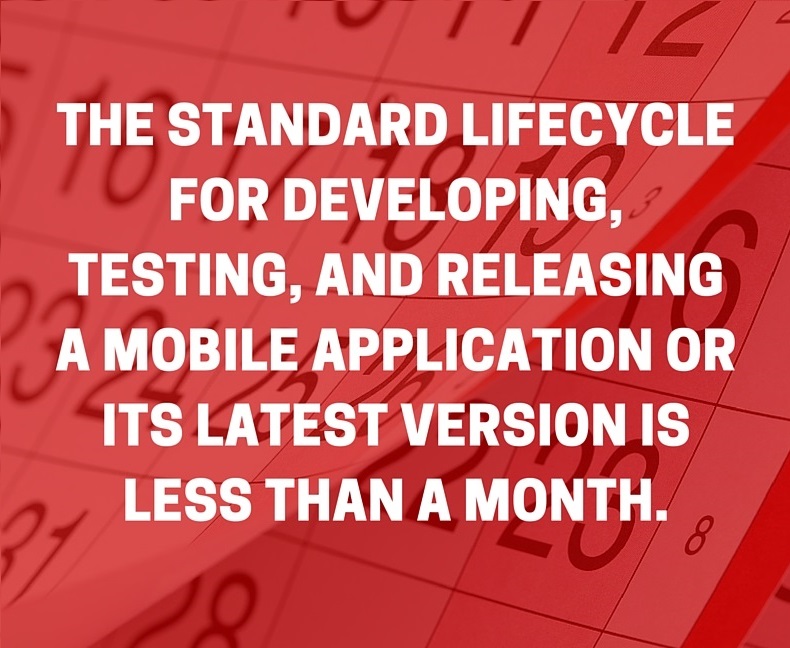
    The key to DevOps is to develop, test, and release the most cutting-edge version of your mobile application as quickly as possible without sacrificing quality in speed or execution.

    devops3

    Even if it is for only a short time, offering features your competitors are not ready to release is like having monopoly on a part of your market: You stand alone. Those customers looking for the best app will have only you to go to.

    Mobile testing is the most arduous step in the DevOps process. A quality test automation tool that includes both performance and functional testing, connecting to a mobile lab enabled by a mobile cloud-testing tool, will accelerate your mobile testing while shortening the release time for your latest app incarnation.

    Conclusion

    In the age of mobile, everything that impacts your mobile application impacts your bottom line. Mobile testing reduces expenses, retains customers and enables your development team to design and release an application that can add solid growth to your company’s coffers.