Tag: OpenJDK

  • Eclipse Foundation Opens Marketplace for OpenJDK Binaries

    Eclipse Foundation Opens Marketplace for OpenJDK Binaries

    The Eclipse Foundation this week opened an Adoptium Marketplace through which DevOps teams can access Java binaries based on the OpenJDK specification. OpenJDK was created based on the Java standard edition (SE) of the programming language and virtual machine.

    Mike Milinkovich, executive director of the Eclipse Foundation, said the goal is to make it easier for IT teams to access open source binaries via a vendor-neutral marketplace that complies with the Java SE Technology Compatibility Kit (TCK) that was created to make sure runtimes based on OpenJDK conform to the original Java specification.

    The marketplace has been set up in collaboration with the Adoptium Working Group that was set up by the Eclipse Foundation to govern OpenJDK, an open source implementation of the Java SE originally created at Sun Microsystems and later acquired by Oracle.

    Members of The Adoptium Working Group include Alibaba Cloud, Azul, Huawei, IBM, iJUG, Karakun AG, Microsoft, New Relic and Red Hat. That group created an Eclipse AQAvit project to test binaries for compliance with the Java SE TCK specification.

    OpenJDK is a reference implementation used by multiple vendors to create their own binaries, which are only guaranteed to be compatible with the standard until the next update arrives; updates are released approximately every six months. The Eclipse Adoptium project will make it simpler for developer teams to identify which binaries are compatible with specific implementations of OpenJDK. Ultimately, the goal is to encourage developers to build applications using frameworks that make use of new OpenJDK features as they are added to the platform versus continuing to rely on older binaries.

    Java remains the dominant language for developers working in enterprise IT organizations. Over the last few years, however, OpenJDK has gained traction as organizations adopted an open source implementation of the specification that enabled providers of application development frameworks to reduce licensing costs.

    It’s not clear at what rate enterprise IT organizations are replacing proprietary editions of Java with OpenJDK. However, during an economic downturn, more organizations tend to rely on open source software. Many organizations are also now looking to build microservices-based applications using Java frameworks based on OpenJDK runtimes.

    It’s obviously taken quite a bit of time for the OpenJDK community to put together a vendor-neutral marketplace. In the meantime, a wide range of other programming languages gained traction in the enterprise. There is still a lot of dependency on Java for building backend applications and services, but it’s more common than ever to see frontends that access those backend applications and services being built using, for example, a framework based on JavaScript.

    Java, of course, isn’t going away any time soon. The sheer number of enterprise developers that rely on it to build applications will ensure its continued longevity. The important thing to note, however, is that as more open source platforms are employed, the pace at which the overall community will innovate should continue to accelerate.

  • Eclipse Foundation Creates Adoptium Working Group for OpenJDK Binaries

    Eclipse Foundation Creates Adoptium Working Group for OpenJDK Binaries

    The Eclipse Foundation announced today a working group that will establish a governance framework for an Eclipse Adoptium project that enables developers to download compatible runtimes based on OpenJDK source code.

    Members of the Adoptium working group include Alibaba Cloud, Huawei, IBM, iJUG, Karakun AG, Microsoft, New Relic and Red Hat.

    OpenJDK is a free and open-source implementation of the Java Platform, Standard Edition that is provided by Oracle. AdoptOpenJDK was created in 2017 to provide open source, high-quality Java runtimes based on OpenJDK. Since then, AdoptOpenJDK has been downloaded more than 240 million times.

    The Eclipse Foundation is now continuing that effort under an Eclipse Adoptium project that aims to become the primary source for OpenJDK-based binaries. The Eclipse Adoptium working group has negotiated with Oracle to create an OpenJDK Community TCK License Agreement (OCTLA) that will enable it to run compatibility tests to ensure conformance to the Java specification.

    Mike Milinkovich, executive director of the Eclipse Foundation, said the Adoptium WG will provide the infrastructure, marketing, community building and developer education required to ensure timely releases and adoption of Eclipse Adoptium runtimes.

    OpenJDK is a reference implementation used by multiple vendors to create their own binaries, which are only guaranteed to be compatible with the standard until the next update arrives; updates are released approximately every six months. The Eclipse Adoptium project will make it simpler for developer teams to identify which binaries are compatible with specific implementations of OpenJDK. Ultimately, the goal is to encourage developers to build applications using frameworks that make use of new OpenJDK features as they are added to the platform versus continuing to rely on older binaries.

    At the same time, however, the Eclipse Foundation is also looking at making it simpler for enterprise IT teams to rely on long term support (LTS) licensing agreements that would be based on Eclipse Adoptium runtimes, Milinkovich noted.

    Despite the plethora of programming languages developers use and even after 25 years, Java remains the dominant language for developers working in enterprise IT organizations. Over the last few years, OpenJDK has gained traction as organizations adopted an open source implementation of the specification that enabled providers of frameworks for building applications to reduce licensing costs.

    It’s not clear at what rate enterprise IT organizations are replacing proprietary editions of Java with OpenJDK. However, in the wake of the economic downturn brought on by the COVID-19 pandemic, reliance on open source software has increased to reduce costs. At the same time, many organizations are looking to build microservices-based applications using Java frameworks that are based on OpenJDK runtimes.

    Regardless of the underlying platform employed, as developers are asked to build and deploy applications faster, most of them will rely on the programming language they already know rather than take the time to master another.

  • Oracle Includes GraalVM Support in Java SE Subscription

    Oracle Includes GraalVM Support in Java SE Subscription

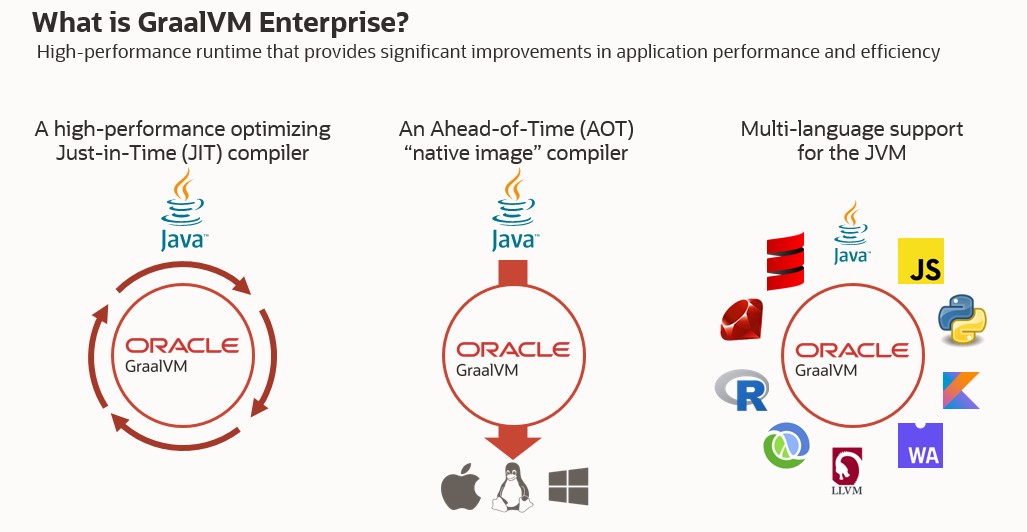
    Oracle announced today it is adding a GraalVM Enterprise virtual machine for building Java applications to Java SE Subscription at no additional cost.

    Donald Smith, senior director of product management from the Java Platform Group at Oracle, said GraalVM Enterprise provides developers with a high-performance application runtime, built on Oracle Java SE, that includes a compiler that accelerates Java application execution. That’s critical as developers look to build microservices-based applications employing microservices that tend to be latency sensitive, Smith said.

    The first stable release of GraalVM arrived last fall. It consumes less memory, and enables Java applications to spin up faster by taking advantage of capabilities such as a just-in-time compiler. GraalVM Enterprise adds a native image utility that compiles Java and JVM-based applications ahead-of-time (AOT) into self-contained native executables. That approach only includes the classes and libraries needed to run the application, which reduces the size of the binary that gets generated.
    Including GraalVM Enterprise in the Java SE Subscription make it easier for Java developers to switch to that Java virtual machine (JVM) to build microservices rather than having to learn another language, Smith said.

    Smith said most organizations will continue to build monolithic applications at the same time they’re attempting to construct microservices. The Java SE Subscription makes it possible for developers to employ different JVMs depending on the type of application being constructed or updated, Smith said. A survey of 560 developers conducted by Oracle last month finds nearly half (48%) are already employing GraalVM to build microservices using Java.

    How much will organizations rely on Java to build microservices, given all the other programming language options available? That’s up for debate. However, being employed in the enterprise for more than 25 years, the number of developers that know Java well is substantial. Rather than waiting for those developers to become proficient in another programming language, there’s a natural tendency for organizations to want to stick with a familiar language. Each additional language introduced to build applications also tends to complicate DevOps processes in a way that can increase the total cost of IT.

    At the same time, however, the number of developers that know how to develop applications using everything from JavaScript to Go is also increasing. Oracle, via ongoing investments made in the OpenJDK project, is moving to make sure Java stays relevant at a time when the number of programming languages being employed has never been greater. For what it’s worth, GraalVM is designed to support multiple programming languages, including JavaScript.

    It’s unlikely Java will fade into obscurity any time soon. IT organizations have a vested interest in embracing next-generation JVMs, if for no other reason than making Java applications more efficient, regardless of how they are built.

    It’s also worth mentioning that frameworks – such as Quarkus from Red Hat – that enable Java-based microservices to run natively on Kubernetes clusters already rely on GraalVM. In some cases, developers may wind up employing such a framework without realizing it relies on GraalVM. In other cases, the challenge will be getting developers to opt for GraalVM as their JVM of choice when so many of them have routinely used the same JVM for more years than they care to admit.

  • Azul Adds OpenJDK Migration Services

    Azul Adds OpenJDK Migration Services

    Azul today announced today it will provide migration services for IT organizations looking to transition from the proprietary Oracle Java Standard Edition (SE) developer platform to the Zulu edition of an open source OpenJDK equivalent.

    OpenJDK is based on the HotpSpot edition of the Java virtual machine, the Java Class Library and the Java compiler. The Zulu edition was originally developed by Azul and Microsoft and has since been supported by Oracle, IBM, Apple, Amazon, SAP and Red Hat.

    Azul CEO Scott Sellars said that while OpenJDK is compatible with Oracle Java SE there are some minor differences that enterprise IT organizations need help with to make the transition. While distributions of OpenJDK have been around for years now, Sellars said the fees for support that Oracle has been charging for Oracle Java SE have reached a point where more organizations are now ready to make the jump to OpenJDK.

    In the wake of the economic downturn brought on by the COVID-19 pandemic organizations of all sizes are looking to reduce costs by transitioning to open source software whenever possible, he added. Rather than reduce the size of their IT staff most organizations would prefer to rein in their IT budgets by reducing their dependency on proprietary software, Sellars noted. The United States Transportation Command (USTRANSCOM), for example, earlier this month revealed it is replacing Oracle Java SE with Azul Zulu builds of OpenJDK to in part lower Java support costs. Taboola, an online advertising platform, also made a similar switch.

    Azul is now offering two classes of migration services. A Level 1 offering helps organizations migrate directly from Oracle Java to Azul Zulu builds of OpenJDK and includes creating an inventory of the Java estate by vendor, by Java version, by Java security patch level and by which Java runtimes are currently being employed. A Level 2 service brings in a third-party IT services firm to enable organizations to migrate older implementation of Java Virtual Machines (JVMs) to either the Java 8 or Java 11 platform.

    A recent Forrester Consulting study commissioned by Azul finds the Azul Zing Java Virtual Machine pays for itself in less than three months by reducing development and infrastructure costs, with a three-year 224% return on investment (ROI).

    Regardless of the open source instance of a Java platform, it’s clear that going forward most of the ongoing innovation is shifting to platforms that multiple vendors are now contributing to more frequently. OpenJDK, for example, is now on a release cadence of every six months. Each distribution of an open source Java platform serves to reduce costs in a way that enables IT organizations to achieve backward compatibility.

    Despite first being employed in the enterprise more than two decades ago, reliance on Java platforms remains high. There has been widespread adoption of multiple programming languages but most back-end systems in the enterprise are still based on Java. Many developers that have mastered Java have also been reluctant to abandon it no matter how many other programming languages they may learn.

  • Pivotal Software Embraces OpenJDK

    Pivotal Software Embraces OpenJDK

    Pivotal Software has officially thrown its weight behind OpenJDK, the open source version of the standard edition of Java, by adding support for OpenJDK to the Pivotal Spring Runtime on its Spring framework.

    At the same time, Pivotal announced it is extending its commercial support for open source Apache Tomcat servers in addition to providing commercial support for all the major open source Spring projects, including Spring Framework, Spring Boot, Spring Cloud and Spring Cloud Dataflow.

    Since 2011, Oracle, IBM and SAP have been making a case for employing OpenJDK. Ryan Morgan, vice president of engineering for the application platform at Pivotal, said that while other languages have become increasingly popular, the primary workhorse for building back-end applications in the enterprise remains Java. Now that Oracle has formally relinquished control over Java source code to The Eclipse Foundation, research and development into the legacy programming environment should accelerate. Oracle retains licensing rights to the name Java, but versions 8 and higher of Java Enterprise Edition are being converted to an open source platform known as Jakarta.

    Morgan said much of the work going forward would be focused on modernizing monolithic Java applications to make it either to turn them into microservices or at least make it easier for microservices developed in other languages to make calls via application programming interfaces (APIs) to those back-end applications. As enterprise IT organizations make the shift, they increasingly will rely on DevOps processes to manage the transition. The effort should accelerate the extent to which many organizations will need to rely on modern best DevOps practices.

    As both OpenJDK and Jakarta continue to move forward, Morgan said Pivotal is committed to continuing investment in the Spring framework, which has done much to make developing Java applications a much more agile endeavor. The most immediate benefit, of course, is the reduction of licensing fees associated with employing Java platforms. Many IT organizations that have mandated open source code-first and adopted alternative programming languages now may want to reconsider their options, especially when the number of developers who know how to write applications in more modern languages is comparatively small.

    Of course, it will take many years for enterprise IT organizations to fully make this transition. In the meantime, many of them will continue developing applications in Java simply because they have large teams that have mastered a programming construct that has been in place for three decades or more. Many of those same organizations may be making greater use of rival programming constructs, but Java and its descendants will play a major role in the enterprise well into the next decade. The primary challenge Pivotal will face is maintaining dominance of the frameworks employed to build new applications based on Jakarta and OpenJDK, in addition to updated existing Java applications.

    — Mike Vizard