
Tag: Puppet

  • Survey Surfaces Substantial Platform Engineering Gains

    Survey Surfaces Substantial Platform Engineering Gains

    A global survey of 500 application development and deployment professionals finds that while 43% work for organizations that have had a platform team in place for three to five years, there doesn’t appear to be much consistency regarding where that team reports within an organization.

    The survey, conducted by Puppet by Perforce, a provider of an automation framework, found that among organizations that have platform teams, well over half (58%) operate within the context of a larger DevOps or infrastructure management organization, compared to 40% that have their own dedicated leadership.

    David Sandilands, a principal solutions architect for Puppet by Perforce, said the survey makes it clear that platform engineering, in general, is not a new concept, but it’s clear more organizations are trying to reduce the level of toil currently associated with building and deploying applications.

    Regardless of where platform teams reside in an organization, nearly two-thirds of respondents (65%) said they are important to their organizations and would receive continued funding. The primary purpose for forming these teams is to increase productivity (58%) and automate standardized processes (51%), the survey finds. Top goals for platform engineering teams are to solve problems (30%), enforce security processes (27%) and accelerate transitions to cloud-native computing environments (26%). A full 70% said security was built into their platforms from the start.

    That suggests that, in addition to assuming responsibility for traditional DevOps workflows, many platform teams are now also being asked to ensure DevSecOps best practices are followed at a time when application security requirements are becoming more stringent, noted Sandilands.

    More than three quarters (76%) also reported that they had deployed two or more self-service portals, with 27% having deployed five or more.

    Only 22%, however, said they have deployed applications on Kubernetes in a production environment, with just under half (46%) reporting they have no current plans to deploy a cloud-native computing platform, which are widely seen to be challenging to deploy and maintain.

    Overall, the survey makes it clear the primary focus is to ensure platforms continue to evolve as developer requirements continue to evolve, said Sandilands. Platform teams are not necessarily trying to dictate what tools should be used; instead, they are finding ways to automate processes that are increasing the level of friction developers encounter, he added.

    In the longer term, advances in artificial intelligence (AI) will make it simpler to achieve that goal using natural language interfaces that DevOps teams can more easily invoke, noted Sandilands.

    Each organization will need to decide for itself whether platform engineering makes sense as a methodology for managing DevOps at scale, but as application development and deployment continues to evolve, more nuanced approaches will be required. In general, organizations are trying to strike a balance between empowering developers and the need to streamline backend processes to increase productivity while also simplifying compliance and improving security.

    The challenge, of course, is enticing developers to buy into that concept rather than using their expertise to resist platform teams that might, from their perspective, limit their prerogatives in ways that ultimately stifle innovation.

  • Internal Developer Platform (IDP) Reference Architectures

    Internal Developer Platform (IDP) Reference Architectures

    If you’ve been following the DevOps space recently, you’ve probably noticed the excitement brewing around platform engineering. Despite uncertainty in other areas of tech, it seems like platform engineering is poised for growth—Gartner even expects that by 2026, 80% of software engineering organizations will have established platform teams.

    The platform engineering idea hinges on an internal tooling system known as an internal developer platform (IDP), which platform teams own and operate and is exposed to developers to improve their efficiency, satisfaction and release fluidity. IDPs have been the talk of the town. But what does an IDP actually look like? What sort of components are they usually composed of?

    Well, at PlatformCon 2023, McKinsey representatives shared a reference architecture for building out IDPs. This framework was modeled after hundreds of internal platforms and could be a helpful benchmark for other organizations as they begin developing and standardizing their internal developer platforms.

    Below, we’ll examine the sample IDP reference architecture and its components. We’ll also have a refresher on the platform engineering concept and offer some expert tips on overcoming potential obstacles while implementing platform engineering and IDPs.

    Why Engineer Internal Platforms, Why Now?

    First, for those new to the idea, let’s explain what platform engineering is. I’ve previously defined platform engineering as “maintaining an internal self-service platform that serves the needs of developer consumers.” The practice doesn’t necessarily supplant DevOps, rather, the experts I’ve spoken to view it as the next evolution.

    This trend is essentially a response to developers overseeing more and more aspects of software life cycle management. Complexity in enterprise-level software delivery workflows has escalated in the last decade, leading to what The State of Platform Engineering Report describes as “increased cognitive load on engineers.” This is negative, as it could lead to shadow operations and burnout.

    The fact is, most developers require the same sort of technologies, which could be standardized across the board. For instance, take the consolidation around containers and Kubernetes, infrastructure-as-code and the need to implement similar build configurations and security policies across applications.

    By outsourcing the maintenance of tools for shipping and running cloud-native applications to a common platform, you take the burden off developers and free them up to code. Also, by centralizing DevOps tooling, you can enforce more governance and build out internal standards. Which should help reusability and overall deployment agility … at least, that’s the promise of it all. 😉

    Sample IDP Reference Architectures

    So, let’s turn to some real-world examples to see how this is being implemented. Mike Gatto, senior DevOps engineer, McKinsey, shared an internal platform reference architecture for AWS-specific environments:
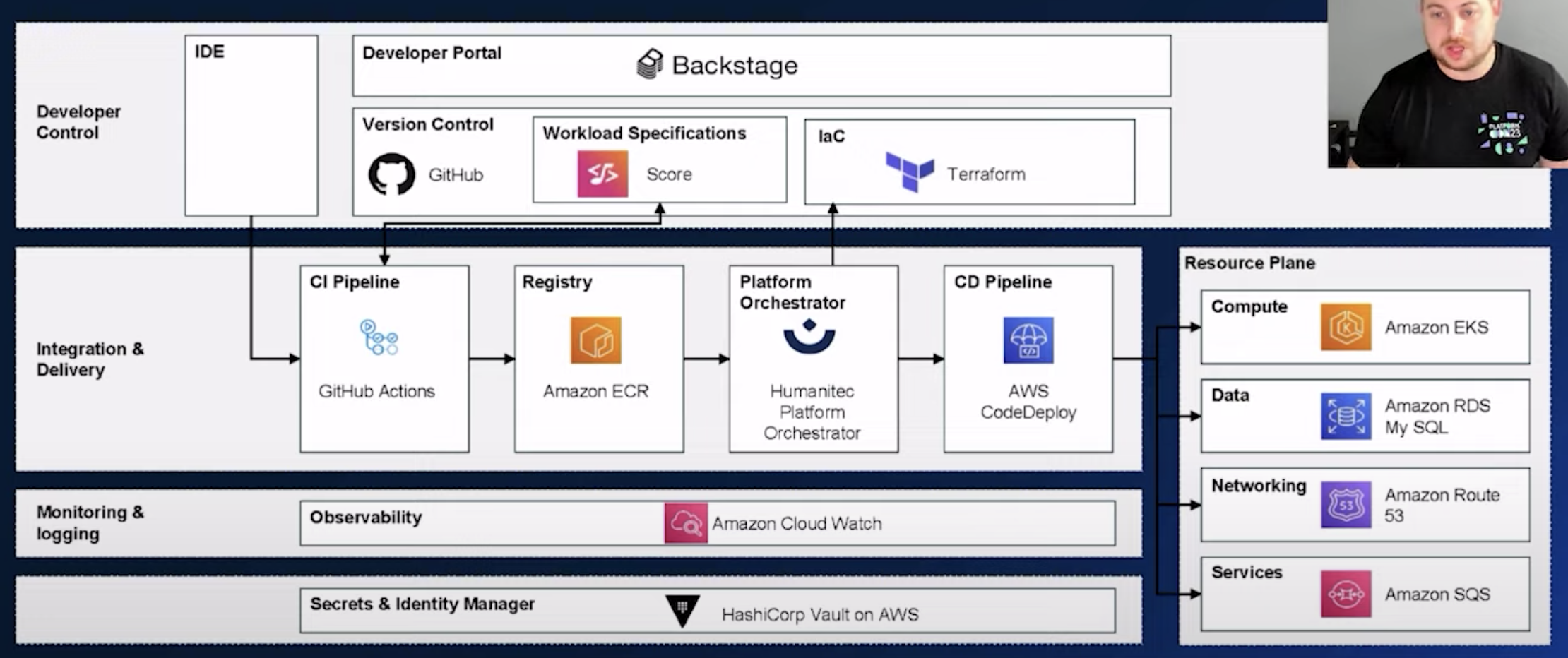
    McKinsey’s Internal Developer Platform reference architecture

    As you can see, the architecture is divided into these subgroups. At a high level, they perform the following functions:

    • Developer control plane: This is the version control, where developers publish their code. They provide a workload specification (in McKinsey’s case, a Score file) that codifies specific configurations.
    • Integration and delivery: This includes the CI pipeline to build application code into a container and publish it to a registry. This notifies the platform orchestrator to initiate a build. Then, resources are provisioned. This area also includes a CD pipeline and infrastructure control plane.
    • Monitoring and logging: This plane includes tools for observability, analytics, and application performance monitoring.
    • Security plane: This area includes tools for secrets management, policies, and security vetting.
    • Resource plane: This plane encompasses cluster management, database tools, networking, and messaging architectures.

    “By separating developer and platform team concerns and allowing them to control the respective areas they’re experienced in separately, without requiring too much overlap,” said Gatto, “we’re making deployments more compliant and better aligned with client initiatives.”

    Humanitec has also created internal developer platform reference architectures for GCP and Azure, displayed below.
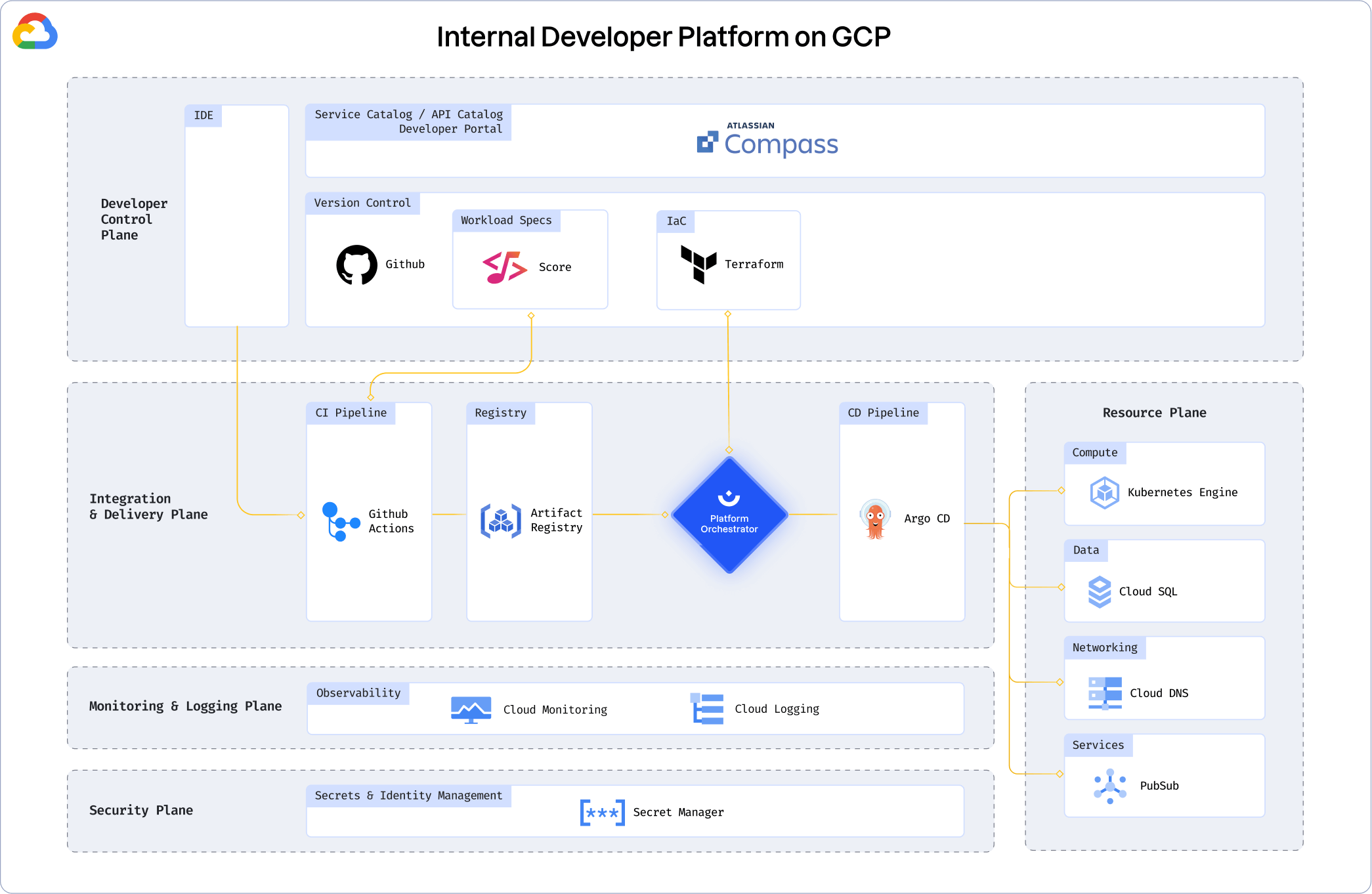
    IDP Reference Architecture for GCP
    IDP Reference Architecture for Azure

    PlatformEngineering.org has also expanded McKinsey’s original IDP reference architecture with a tooling landscape that adopts the same umbrella subgroupings but includes other pluggable tools.
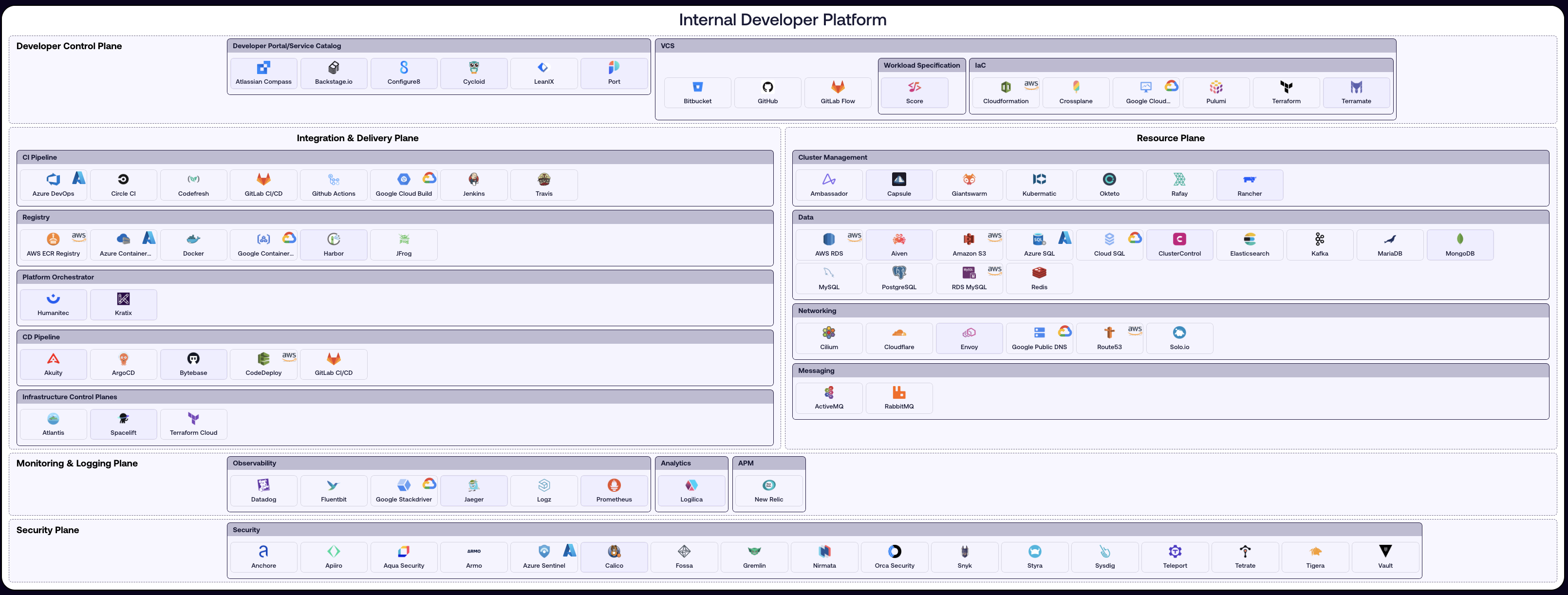
    The Internal Developer Platform tooling landscape

    Roadblocks to Developer Platforms

    Starting from a blueprint could be a big help to rapidly construct IDPs. Yet, there will still be some potential roadblocks associated with adopting an internal developer experience platform. One of them is creating common platforms that actually cater well to all environments.

    “You can not and should not try to please everybody,” said Kaspar von Grünberg, CEO and co-founder of Humanitech. “Platform engineering is an 80/20 game.”

    “Platform organizations often face a lot of pressure when it comes to meeting demands for building more services that are both agile and agnostic to cloud and data center environments,” said Venkat Ramakrishnan, VP, product management and engineering, Portworx by Pure Storage. “At the same time, almost all platform engineering teams are understaffed while facing the need to support large application development initiatives and developer teams twice their size.”

    Tips to Get Platform Engineering On Track

    Reference architectures for various clouds could help cater IDPs to different scenarios. But outside of that, it will take a product mindset approach to strategically accept feedback and iterate the platform. This will involve doubling down on developer experience and adopting cloud-native foundations that can scale.

    “Platform engineering teams must consider adopting Kubernetes as it enables them to manage and deploy applications in production at scale, without having to manage applications at the individual level,” added Ramakrishnan. “Additionally, it may not be realistic to expand platform engineering teams alongside growing platforms, so teams should also consider leveraging automation and self-service capabilities to help them better manage projects at scale.”

    Is ‘You Build It, You Run It’ Dead?

    The idea of ‘you build it, you run it’ is starting to look a little antiquated next to the new and shiny platform model. It’s tough to say, but I’ll be keeping an eye on this area to see if all the effort to standardize the internal engineering approach pays off!


  • State of DevOps Report Finds a Rise in Platform Engineering

    State of DevOps Report Finds a Rise in Platform Engineering

    The speed of software development velocity is increasing, and to enable this, platform engineering is emerging to evolve the DevOps practice. Interest in platform engineering is rising—so much so that Puppet emphasized platform engineering in its 2023 State of DevOps Report.

    A whopping 94% of respondents agreed that platform engineering is helping their organizations better realize the benefits of DevOps. The move toward platform engineering has increased over time, bringing benefits such as increased release velocity, reliability and efficiency.

    Below, we’ll highlight some of the key takeaways from the report. We’ll define what platform engineering is and highlight its benefits. We’ll also consider obstacles on the path to embracing a platform-based development culture.

    Platform Engineering Supplants DevOps

    DevOps has been in use for a decade or more at most institutions, maturing steadily with new automation and infrastructure abstraction. The latest evolution of DevOps is a practice known as platform engineering—51% of organizations have already adopted this practice within the last three years and 93% said it’s a step in the right direction.

    Platform engineering is the discipline of designing and building self-service capabilities to minimize cognitive load for developers and to enable fast-flow software delivery.

    In essence, platform engineering is the process of creating standardized, self-service infrastructure that helps developers get up and running quickly. These self-service platforms typically handle capabilities like deployment (43%), operation of infrastructure (43%), monitoring production applications (42%) and security and compliance (42%).

    These shared internal platforms are maintained by a central platform team that embraces a product mindset to iterate the technology based on user feedback.

    State of Platform Engineering

    Platform engineering is relatively new— 27% of platform teams have formed within the last two to three years. Notably, big tech companies hopped on the bandwagon years ago, and non-tech companies are now following. Regardless, 70% believed their timing was “just right.”

    The goals of a platform engineering team are numerous. According to the Puppet report, 54% said problem-solving is the top goal. This is followed by educating and empowering developer teams (47%), setting best practices (46%) and optimizing iteration (44%). A platform engineering team’s scope of work is primarily focused on automating workflows and building and managing infrastructure.

    The ‘correct’ number of internal platforms is a moving target. The majority of organizations (57%) have between two and four platforms, and 30% have five or more internal self-service platforms. This demonstrates that although platform engineering is somewhat centralized, it’s also flexible to the needs of an organization.

    Benefits and Hurdles

    So, what are some benefits as opposed to traditional DevOps? Well, the most common benefit is improved system reliability, at 60%. This tracks, as a standardized platform could reduce human error and missteps in the development workflow. Following this benefit is improving efficiency (59%), speeding up delivery time (58%) and improving workflow and process standards (57%).

    The most common driver of adoption is increasing the speed of delivery. Slight more than half of respondents (51%) said development speed has somewhat increased since the inception of the platform team, and 42% say it’s increased by “a great deal.” Other top drivers include the need to scale, free up engineering time, control infrastructure spending and avoid duplication across teams. Those with more mature adoption tend to be more satisfied with the result, indicating that results increased over time.

    Of course, no new technological introduction comes without its hurdles, and platform engineering is not immune from certain pain points. For example, 34% said that cycle time is slower than expected. This might be due to nascent industry adoption and a lack of best practices.

    Just under one-third (32%) also noticed resistance to platform team adoption, and 32% reported a lack of communication around changes. Organizations will likely have to increase transparency and reduce siloing to encourage productive platform adoption that satisfies the needs of various stakeholders.

    According to the report, product management skills can help realize these goals. Some of the most fundamental product management skills here include strong communication skills (61%), problem-solving expertise (60%) and the ability to foster collaboration (54%). Many companies will also have to convince senior management to invest in platform engineering—nearly half agreed that senior management doesn’t yet understand its value.

    Future Outlook

    Confidence around platform engineering is increasing, especially for teams with mature DevOps approaches. As a result, the practice will likely gain more traction in the coming year—71% of respondents reported their firm plans to hire people with platform engineering experience over the next 12 months.

    Over the next year, organizations that adopt the practice will want to increase awareness of platform capabilities and set expectations across the organization. This will also include setting governance policies and satisfying the needs of specific developers, departments and the organization as a whole.

    Above, we’ve scratched the surface of the current state of platform engineering, its benefits and its pain points. For plenty of other insights, you can pick up a copy of The State of DevOps Report 2023: Platform Engineering Edition from Puppet by Perforce here.

  • Russian Dev Exodus | Puppet IPO FAIL | Intel 18A Ahead of Sched.

    Russian Dev Exodus | Puppet IPO FAIL | Intel 18A Ahead of Sched.

    Welcome to The Long View—where we peruse the news of the week and strip it to the essentials. Let’s work out what really matters.

    This week: More than 100,000 tech workers leave Russia, Perforce buys Puppet, and Intel moves faster than planned. (more…)

  • Puppet Survey Suggests DevOps Adoption is Stagnant

    Puppet Survey Suggests DevOps Adoption is Stagnant

    Puppet today published an annual State of DevOps report that suggests overall adoption of DevOps practices has stagnated.

    The survey of 2,650 IT, development and information security professionals finds 83% are implementing DevOps practices, to a degree. However, only 18% of respondents are working for organizations that have highly evolved, automated DevOps processes in place. More than three-quarters of respondents (78%) are somewhere along the path toward achieving that goal.

    A full 90% of highly evolved DevOps teams have automated most repetitive tasks compared to only 67% of mid-level organizations, the survey found. In addition, 91% of highly evolved teams report a clear understanding of their responsibilities.

    Not surprisingly, the biggest hurdles identified are more cultural than technical. The most common culture blockers at mid-level organizations include a culture that discourages risk (21%), unclear responsibilities (20%), deprioritizing fast flow optimization (18%) and insufficient feedback loops (17%). In contrast, less than 2% of highly evolved organizations report resistance to DevOps from the executive level, the Puppet report found.

    Nigel Kersten, a field CTO at Puppet, said during an online panel that, after more than a decade of DevOps advocacy, people continue to be the biggest limiting factor when it comes to adoption. Specifically, from a compensation perspective, many IT operations personnel tend to feel undervalued compared to developers, noted Kersten.

    Another challenge enterprises encounter is trying to balance the need to create a standardized IT environment that can be managed and secured consistently and the desire of DevOps teams to embrace new tools as they see fit. Senior IT executives often tend to make platform decisions based on cost criteria that don’t always account for the need to enable agile development methodologies. Most of those platforms are designed to be managed by an IT administrator using a graphical tool rather than via a command line interface (CLI) and application programming interfaces (APIs) that appeal to DevOps teams.

    As a result, individual pockets of DevOps teams that select and maintain a platform of their choosing are emerging within enterprise IT organizations. Those teams often view their chosen platform as a better alternative for advancing developer productivity. Finding and retaining site reliability engineers (SREs), for example, to manage those DevOps platforms is a major challenge for most enterprise IT organizations. Most IT administrators lack the programming skills needed to become an SRE, and it’s not clear how many IT administers are inclined to acquire those skills.

    Conversely, it’s not clear how many programmers want to programmatically manage IT infrastructure at the expense of time they would otherwise devote to writing code. Organizations that can only hire a limited number of developers may not want to shift responsibility for managing IT operations to the proverbial left simply because they need more code to be written faster. Finding and retaining developers, in many cases, is just as much a challenge as hiring and retaining SREs.

    Advances in automation and artificial intelligence (AI) should make it easier for organizations to embrace DevOps best practices in the months and years ahead. However, it should be apparent to all that adoption of those best practices across an entire enterprise still requires a significant amount of time and effort, and will for many years to come.

  • Despite the Pandemic, DevOps Salaries Rose in 2020

    Despite the Pandemic, DevOps Salaries Rose in 2020

    Puppet today published the results of an annual global DevOps survey that found, despite the downturn in the global economy brought on by the COVID-19 pandemic, most DevOps professionals saw their salaries rise in 2020.

    However, for the first time since Puppet started collecting this data, DevOps professionals working in the life sciences, health care and pharmaceutical sectors, on average, made more than those working in the financial services sector. Not surprisingly, the report also found that DevOps professionals working in the U.S. made more than their global counterparts.

    Nearly two-thirds of respondents in the life sciences, health care and pharmaceutical sectors earn more than $100,000. That compares to 53% in the financial services sector and 45% of those working for technology companies.

    The survey was based on responses from 2,243 DevOps professionals, and noted that organizations with highly evolved DevOps practices pay better than those that are less evolved. Among respondents working at highly evolved companies, 80% earn $75,000 per year or more. That compares to 57% that earn as much at less evolved companies. Much of that discrepancy is attributable to DevOps managers that make much more at highly evolved companies compared to their counterparts at less-evolved companies, the report noted. Two‑thirds of practitioners make less than $100,000 per year, the survey found. In general, respondents working at companies with revenue over $1 billion had the highest percentage of those earning $150,000 to $250,000 (22%).

    The largest percentage increases in salaries among DevOps professionals occurred in Japan and the United Kingdom (UK). Salaries, on average, did not rise in Singapore, Germany, New Zealand and Australia. In the U.S., the demographic that saw the most growth was among DevOps professionals earning between $150,000 to $250,000, most of whom are managers. More than half of all DevOps managers in the U.S. fall within this salary range, the report noted.

    The Puppet report also noted that DevOps professionals working in dedicated engineering and application development tend to make more than those that are part of a larger IT team. A third of respondents in engineering or development report salaries over $125,000 per year, compared to 22% percent in IT and 15% percent in information security.

    The Puppet report also showed a divergence between what men and women earn as salary ranges increase. For both men and women earning up to $75,000 a year, salaries are similar. Between $100,000 and $125,000, women actually earn more. However, at $125,000, men (28%) earn more than women (17%). The survey, however, does not mention the experience levels of any respondents.

    It’s also not clear whether the higher salaries among DevOps professionals found in the life sciences, health care and pharmaceutical sectors represent a fundamental shift, or is an aberration based on the amount of COVID-19 research being conducted.

    Alanna Brown, a senior director of marketing for Puppet, said the one thing that COVID-19 has changed forever is that competition for DevOps expertise is now global. Organizations are no longer limiting themselves to hiring individuals within 50 miles of their office. In fact, DevOps professionals that have shown they can successfully work remotely will, in the months and years ahead, be in greater demand than those that have only worked in an office setting, Brown predicted. Organizations of all sizes are trying to reduce their commercial real estate expenses, Brown added.

    In the meantime, the most important thing for IT professionals is to stay relevant. Site reliability engineers (SREs) with certified programming skills will make more than a traditional IT administrator. It’s up to each IT professional to make sure they have the skills that are highest in demand at a time when many IT functions are being ruthless automated by increasing numbers of DevOps professionals.

  • Puppet Adds DevOps Consulting Practice

    Puppet Adds DevOps Consulting Practice

    Puppet has launched a DevOps consulting service that promises to help organizations implement best practices that will ultimately make their IT organizations more efficient.

    Nigel Kersten, field CTO, Puppet, said the Scaling DevOps Service is especially focused on improving workflows among organizations that have already started down the DevOps path.

    Most IT organizations that embrace DevOps eventually encounter bottlenecks that conspire to limit the rate at which they can build and deploy applications. Puppet will make available DevOps experts capable of assessing DevOps workflows as part of an effort to reduce operational friction, said Kersten.

    Those consultants can also identify integration opportunities that might further streamline workflows, in addition to providing an overall assessment of an organization’s DevOps maturity based on a model Puppet developed.

    Kersten said in many cases, enterprise IT organizations, especially, are trying to adapt DevOps principles that were originally created for small startup companies, with mixed success. Puppet consultants, using observations gleaned from their own engagements with customers that have embraced its tools for automating the management of IT, are often in a better position to identify ways to optimize DevOps workflows across larger IT organizations, Kersten said.

    It’s also easy for large enterprise IT organizations to misinterpret how one DevOps principle or another should actually be implemented, Kersten said.

    DevOps consulting, of course, has become a cottage industry within the IT services sector over the last decade. Now, almost every systems integrator has a DevOps practice. Most of those practices are focused on enabling organizations to embrace DevOps, versus helping organizations optimize workflows after they have already begun the transition, said Kersten.

    It’s not clear to what degree organizations that have not embraced Puppet’s automation framework will embrace consulting services based on a DevOps model created by observing Puppet’s customers. However, it’s apparent many IT organizations have inconsistently implemented DevOps practices across various departments. In many cases, bottlenecks that result in various departments within a larger IT organization are being addressed using a set of manual processes that have been created as a workaround to a specific problem.

    Of course, optimizing DevSecOps best processes is only going to become more challenging as emergent technologies such as containers, Kubernetes clusters and serverless computing frameworks are added to the IT mix. More challenging still, many organizations are now trying to shift responsibility for security further left as part of a DevSecOps workflow.

    Many IT teams are, naturally, resistant to paying for advice, while others routinely hire small armies of consultants in the hope that ideas and concepts that have worked well elsewhere can make their IT teams more efficient. Regardless of the approach pursued, IT leaders need to remember that DevOps is a continuous journey. Every time a new platform is added to an IT environment, a DevOps workflow will need to evolve. The real issue IT leaders need to come to terms with is how long it will take for their internal teams to adapt, whether it’s via the school of hard knocks or relying on external expertise that has handled most of the issues an internal IT team is likely to encounter.

  • Puppet Report Sees Long DevOps Journey Ahead

    Puppet Report Sees Long DevOps Journey Ahead

    A recent report published by Puppet suggests the level of DevOps maturity within most organizations is still relatively slight. In fact, most of the respondents reported high levels of manual work still occurring across configuration management, deployment, testing and change approval processes.

    Alanna Brown, director of product marketing for Puppet, said the “State of DevOps: Market Segmentation Report” makes it clear that DevOps is being embraced to solve specific pain points with specific IT departments. As a result, silos of DevOps processes are springing up across the enterprise. That next challenge IT organizations will face is trying to unify all the DevOps processes, she said.

    The survey finds deployment automation, version control, continuous integration and infrastructure automation were the most common starting points for DevOps. Less-common starting points were lean practices, visualization of key quality and productivity metrics and setting limits on work in progress.

    Brown said the one surprising thing that study found is there is little correlation between the size of the companies surveyed and their relative DevOps maturity. Reliance on DevOps process may have more to do with needs arising from satisfying customer demand than anything else, noted Brown. The survey finds that media and entertainment and retail industry have the lowest percentage of low IT performers, while financial services, insurance and manufacturing companies had the highest proportion of low performers.

    Not surprisingly, given the relative amount of DevOps immaturity, the survey also finds that reliance on IT automation frameworks is not yet especially widespread.

    The Markets Segmentation report is based on the 2017 “State of DevOps” survey of 3,200 IT professionals that Puppet previously published. While it’s possible many companies may have advanced further down the DevOps journey since then, the report makes it clear that for both technical and cultural reasons fully embracing DevOps is an extended process. In fact, Brown said the report shows DevOps is still mainly being driven by the bottom of the organization up rather than by senior IT leaders. It’s only when DevOps success becomes visibly demonstrated that organizations attempt to replicate that success elsewhere in the organization. At the same time, widespread usage of DevOps processes suggests that DevOps itself is now much more than a grassroots movement, she said.

    Change obviously comes hard to enterprise IT organizations. Many DevOps concepts were initially pioneered by web-scale companies that have the luxury of not having to support legacy applications and processes. Traditional enterprise IT organizations now typically are trying to support DevOps processes alongside process based on Waterfall and ITIL methodologies. Not every application being supported requires that number of release updates that many modern applications require.

    Nevertheless, it’s also clear that as the number of applications being built, tested, deployed and supported continues to grow, the average IT organization is increasingly short-handed. Finding IT professionals with DevOps skill sets is a major challenge. But as more companies come to realize they are really a software company that happens to be selling a specific thing, the higher priority DevOps becomes.

    — Mike Vizard

  • VMware Cloud on AWS Will Bring DevOps Issues to a Head

    VMware Cloud on AWS Will Bring DevOps Issues to a Head

    Now that instances of VMware are starting to become available on Amazon Web Services (AWS), a DevOps ecosystem is starting to emerge around the management of applications workloads moving into and out of AWS.

    Among the more than 4,500 applications that VMware claims already support VMware Cloud on AWS are those from Blue Medora, CA Technologies, Chef, Cloudbees, Dynatrace, Jfrog, Puppet, SaltStack and the Ansible arm of Red Hat.

    VMware CEO Pat Gelsinger told attendees at the recent VMworld 2017 conference that VMware and AWS are just now scratching the surface of what they plan to accomplish together. AWS CEO Andy Jassy added that, unlike other alliances, which consisted mainly of marketing, engineers at both companies are working closely together to deliver VMware globally across all AWS availability zones. At present, VMware Cloud on AWS is available in the AWS availability zone hosted in Portland, Oregon. The service soon will be extended to the east coast of the United States, followed by rest of the world over the course of 2018.

    The availability of VMware Cloud on AWS should force several DevOps issues within enterprise IT organizations that have deployed the VMware stack of software mainly on-premises. Many of those organizations have also been employing public clouds such as AWS. But because those environments are based on different hypervisors, it was never easy to migrate workloads between the two platforms. There are plenty of options for running VMware software in the cloud, but because AWS is the largest provider of public cloud services, there are many customers who want to seamlessly move workloads between their on-premises IT environments and AWS via a common stack of VMware software.

    In many organizations the desire to shift applications workloads into AWS will bring many DevOps issues to a head, as VMware and AWS use has occurred in independently of each other. There could be many workloads running on each platform, but for all intents and purposes, IT organizations have managed both platforms in isolation. Now that VMware is becoming available on AWS, all the challenges associated with moving workloads between a public and private cloud come to the fore.

    Most of those DevOps issues will be focused first on moving some classes of workloads running on VMware into AWS. Application workloads that don’t need to run constantly will be among the primary candidates followed by a slew of data protection applications that will enable IT organizations to back up and archive massive amounts of data inexpensively. Next up will be applications that need to be distributed globally to increase availability.

    At the same time, a lot of VMware shops will be moving application development into the cloud. But just because an application is developed in the cloud doesn’t mean it will stay there. Many IT organizations have already discovered that when it comes to long-running applications, the total cost of deploying them on-premises is less than deploying them on a public cloud. The DevOps tasks ahead, of course, will start with figuring out which VMware-based applications make the best candidates from a financial and availability perspective to be deployed on AWS.

    — Mike Vizard