Tag: RapidAPI

  • The API Economy: Increasing Potential to Monetize Public APIs

    The API Economy: Increasing Potential to Monetize Public APIs

    API-first strategies are becoming more commonplace throughout today’s digital strata. APIs connect microservices architectures, power new digital transformations and help development teams avoid reinventing the wheel for common functions. And although most are built to connect internal components, studies indicate a movement toward more externalization and monetization of public APIs.

    Over three-fourths of developers now view participating in the API economy as a priority for their organization or plan to prioritize it soon, found Rapid’s newly released 2022 State of APIs report. The survey, which surveyed hundreds of professional developers, also uncovered a modest increase in companies seeking to generate direct revenue from APIs.

    Below, we’ll review some intriguing statistics from the Rapid report and consider the major takeaways technology professionals should consider in the year ahead.

    API Reliance Increases

    Reliance on APIs is rising across the board. Over 62.6% of developers reported relying on them more in 2022 than in 2021. Internal APIs help avoid development duplication and third-party APIs can quickly integrate standard functionality related to payments, messaging, geolocation, data sharing and many more areas. For example, ChatGPT has demonstrated the power of standard APIs to deliver advanced AI/ML to the masses in a programmatic way.

    As a result of this interest, the majority of organizations now consider participating in the API economy as a top priority. And as an organization grows larger, its reliance on APIs is likely to increase. A full 40% of the largest companies surveyed reported having more than 250 internal APIs. Nowhere is this more prevalent than in financial services. This finding makes sense, given how APIs can automate payments and underpin the open banking movement.

    In terms of who is using APIs, it’s most commonly full-stack or backend developers, the report found. One intriguing factoid is just how much of this work is now dominating developers’ time. Impressively, 65.5% of developers reported spending ten hours or more working with APIs in their job; 14.5% of them said that work takes up all of their time.

    In terms of design styles, various standards are used throughout the web development sphere. Yet REST is still king—69.3% of engineers used REST in production. REST is followed by webhooks, WebSockets, AsyncAPI, serverless and FaaS, SOAP, GraphQL, Kafka and gRPC, in descending order of popularity. Across the board, these statistics showed a steady increase from last year.

    Of note is that most APIs are built for internal purposes. These often wrap a database or provide open access to an internal microservice. Private use cases are by far the most common approach; according to the report, 75.1% of respondents worked on internal APIs. These findings aligned with other industry reports, such as the Postman State of the API Report, which found that, in 2022, 58% of API initiatives were private.

    Third-party APIs (53.9%) and partner-facing services (48.9%) trailed behind internal APIs in popularity. Interestingly, while internal use cases have remained steady, both partner and public-facing strategies have increased since last year. While the growth was a modest 5% for most sectors, partner-facing APIs in some industries grew by nearly 10%.

    Spotlight on Monetization

    Many still view APIs as operational glue for internal data or connecting partner services. Yet, the possibility of monetization through self-service developer portals shouldn’t be overlooked—countless API-first startups are actively gaining traction and funding. And monetizing this power is seen as a holy grail to some unicorn-chasing VC funds.

    Most APIs are purely for in-house internal integrations and are typically not externalized to the outside world for profit. However, this is slowly changing. In fact, 42.6% of organizations are now monetizing APIs, representing an increase of about 5% from 2021.

    As one may have guessed, financial services are leaders in monetizing their external APIs. The telecommunications industry is also noticeably active in monetization, too. Furthermore, with size comes increased monetization potential—about half of the companies with a large footprint of ten or more internal or external APIs also monetized them.

    API Economy in 2023

    Looking to the future, most anticipate more reliance on APIs across sectors — 69.2% expect to rely on APIs even more in 2023. Yet, organizations will have to grapple with particular hurdles in this newfound landscape. For example, a cloud skills gap might bar some groups from realizing the benefits of an API strategy. Other concerns include ungoverned sprawl, authorization concerns, shadow APIs and escalating attacks on public-facing endpoints. Also, some organizations are still determining how to best secure and scale their use of new styles, like GraphQL.

    A standards-based approach that applies platform-wide governance will likely be necessary to maintain an efficient yet stable API footprint. To meet these high quality standards, testing is nearly universally applied—92.7% of those surveyed test their APIs or plan to do so. The most common tests ranged from functional testing to integration testing, acceptance testing and performance testing.

    The Rapid 2022 State of APIs report received 850 responses from over 100 countries. For more insights, readers can view the complete results here.

  • RapidAPI Adds Tool to Make Building APIs Simpler

    RapidAPI Adds Tool to Make Building APIs Simpler

    RapidAPI today added a free RapidAPI Studio offering to its portfolio that makes it easier for developers to build, consume, manage and monetize application programming interfaces (APIs).

    Wade Wegner, senior vice president and head of product at RapidAPI, said RapidAPI Studio, available in beta, makes it simpler for developers to move between design and development, testing and management without losing context.

    It is also designed to be slipstreamed into developer workflows by either being accessed via a browser, as a desktop application, a macOS-native application or as an extension to the VS Code tools provided by Microsoft, added Wegner.

    That approach also makes it easier for teams of developers to collaboratively work on API projects, he noted.

    APIs are foundational to every modern application development initiative. Each microservice included in a modern application has its own API. As a result, the number of APIs—internal and external—that organizations are building and exposing has increased exponentially, especially as the number of digital business transformation initiatives continues to expand. While the bulk of APIs employed today are internally facing, the number of external-facing APIs being employed tends to rise sharply as more business processes become digitized.

    Less clear is who within the organization is responsible for managing those APIs after they have been deployed. In some cases, developers assume responsibility for them along with every other component of an application. Developers, however, tend to move on to other projects; DevOps and cybersecurity teams are being tasked with managing, securing and updating APIs. This is part of a larger effort to better secure software supply chains in the wake of a series of high-profile breaches.

    Unfortunately, documentation of those APIs has been somewhat lax within many organizations. In many cases, organizations are not even sure how many APIs have been deployed. Many organizations also discover, to their chagrin, that so-called zombie APIs previously abandoned by developers can still be exploited by cybercriminals to exfiltrate data.

    At the same time, the management of APIs is becoming more complex. Along with existing REST APIs and legacy web services based on XML, organizations are now deploying GraphQL APIs. The result is a mix of API schemas that require different levels of expertise to manage and secure.

    It’s not clear how the increased focus on securing software supply chains might impact API management. However, it’s apparent that cybercriminals are becoming more adept at discovering insecure APIs through which they can exfiltrate data. The challenge organizations face is that it’s not feasible to secure those APIs without first having a framework in place for managing them.
    One way or another, an API management crisis will soon come to a head as it becomes even simpler to build and deploy APIs. The only thing that remains to be seen is to what degree organizations will get ahead of that issue before it spins out of control altogether.

  • RapidAPI Raises $60M to Support Developer Growth and Fuel Expansion of Leading API Platform

    New fundraise supports company’s accelerated growth as API-first digital transformation becomes a top initiative across all industries

    SAN FRANCISCO- April 21, 2021 – RapidAPI, a next-generation API platform that enables developers and enterprises to find, connect to, and manage thousands of APIs, announced today that it has raised $60M million in its Series C funding round. The financing was led by Green Bay Ventures and includes new investor, Stripes. Existing investors include Andreessen Horowitz, DNS Capital, M12 (Microsoft’s Venture Fund), Viola Growth and Grove Ventures, bringing the total amount raised for RapidAPI to $122.5 million.  

    The investment comes on the heels of a  high-growth year for RapidAPI amidst a pandemic that drove a record number of developers and companies to the RapidAPI platform to advance their digital initiatives and accelerate the delivery of their software and services to the market. 

    Driven by the explosion of APIs, federation of API programs, acceleration of cloud initiatives, and the push to microservices, companies have turned to RapidAPI to modernize their infrastructure in order to remain competitive in today’s environment of digital disruption. 

    The recent fundraise will be used to support the influx of new developers to the platform, the onboarding of leading API providers to the public marketplace, and the expansion of the API platform, including RapidAPI’s Enterprise Hub  to serve the rapidly-growing  enterprise customer base.

    “As APIs become the building blocks for digital transformation efforts across all industries, we’ve seen a fundamental shift toward API platforms and tools like RapidAPI that are built to handle the realities of today’s complex, multi-cloud, multiservice, and multi-API environments,” said Iddo Gino, RapidAPI Founder and CEO. “RapidAPI’s next-generation platform is uniquely built for modern software development, providing a unified experience across the entire development life cycle, allowing millions of developers to connect with thousands of APIs and microservices.”

    Added Gino, “Over the course of the year, we’ve made significant investments in our platform, adding API testing and API design through the acquisition of Paw in February. The additional funding will enable us to continue to build a flexible API platform with the features and functionality needed to provide developers and organizations with a flexible platform that  integrates with an organization’s existing software development environment, making it easier to find, connect to, and manage APIs.”

    A Year of Developer Adoption, Product Innovation, and Enterprise Traction

    Recent reports, including the second annual RapidAPI Developer Survey Report , indicate that developer reliance on APIs accelerated during the pandemic and will continue to increase in 2021. In fact, according to the survey, 61% of developers used more APIs in 2020 than in 2019, and 71% plan to use even more this year.

    This trend was also apparent by usage of the RapidAPI platform. Over the last 12 months,  RapidAPI  has experienced significant growth across its platform. RapidAPI has almost 3 million developers on the marketplace, adding more than 750,000 new developers over the course of the year.  Additionally, there are now more than 35,000 APIs on the Marketplace, doubling the number from the same time last year. RapidAPI is continuing to add more than 1,000 new APIs per month, offering APIs from providers that include Microsoft, IBM, Twilio, SendGrid, Nexmo, Crunchbase, and more.

    Paid API subscriptions were also on the rise in 2020, as 12,000 new API subscribers were added to the platform. Another area of significant growth is with RapidAPI for Teams. RapidAPI for Teams enables developers to create a private workspace to share and collaborate on internal APIs and microservices within their team. Today, there are more than 55,000 teams on RapidAPI.

    RapidAPI has also seen an increase in the number of enterprises that are using the RapidAPI Enterprise Hub, a white-labeled version of its Marketplace that enables development teams, partners, and customers  to discover and connect to internal APIs as well as external API subscriptions. Over the last year, RapidAPI has more than doubled the number of companies using the RapidAPI Platform, including Fortune 500 organizations across the financial services, insurance, telecom, and hospitality sectors.

    Finally, the company expanded its API Platform to add a host of new capabilities and features from Gateway integration to support new types of APIs such as Kafka and new products such as RapidAPI Testing and RapidAPI Design by Paw,

    RapidAPI By the Numbers

    • 3 million developers have signed up on the RapidAPI Marketplace

    • More than 35,000 APIs are currently available on the marketplace, X are added every week.

    • Trillion+ API calls go through the marketplace

    • Doubled the number of enterprise customers: RapidAPI Enterprise customers include Fortune 500 customers across financial services, telecom, manufacturing, and hospitality

    • $60M Series C funding raised

    • $122.5M raised to date

    For more information

    About RapidAPI

    RapidAPI, the world’s largest API Marketplace, is used by millions of developers to find, test and connect to thousands of APIs—all with a single account, API key and SDK. For enterprise organizations, RapidAPI offers RapidAPI Enterprise Hub, a white-labeled version of the marketplace that enables the company’s developers, customers, and partners to find, manage, and connect to hundreds of internal APIs, as well as external API subscriptions.

  • RapidAPI Adds Library to Invoke Kafka via API

    RapidAPI Adds Library to Invoke Kafka via API

    RapidAPI announced it has added support for the open source Kafka messaging software as another type of application programming interface (API) that DevOps teams can centrally access.

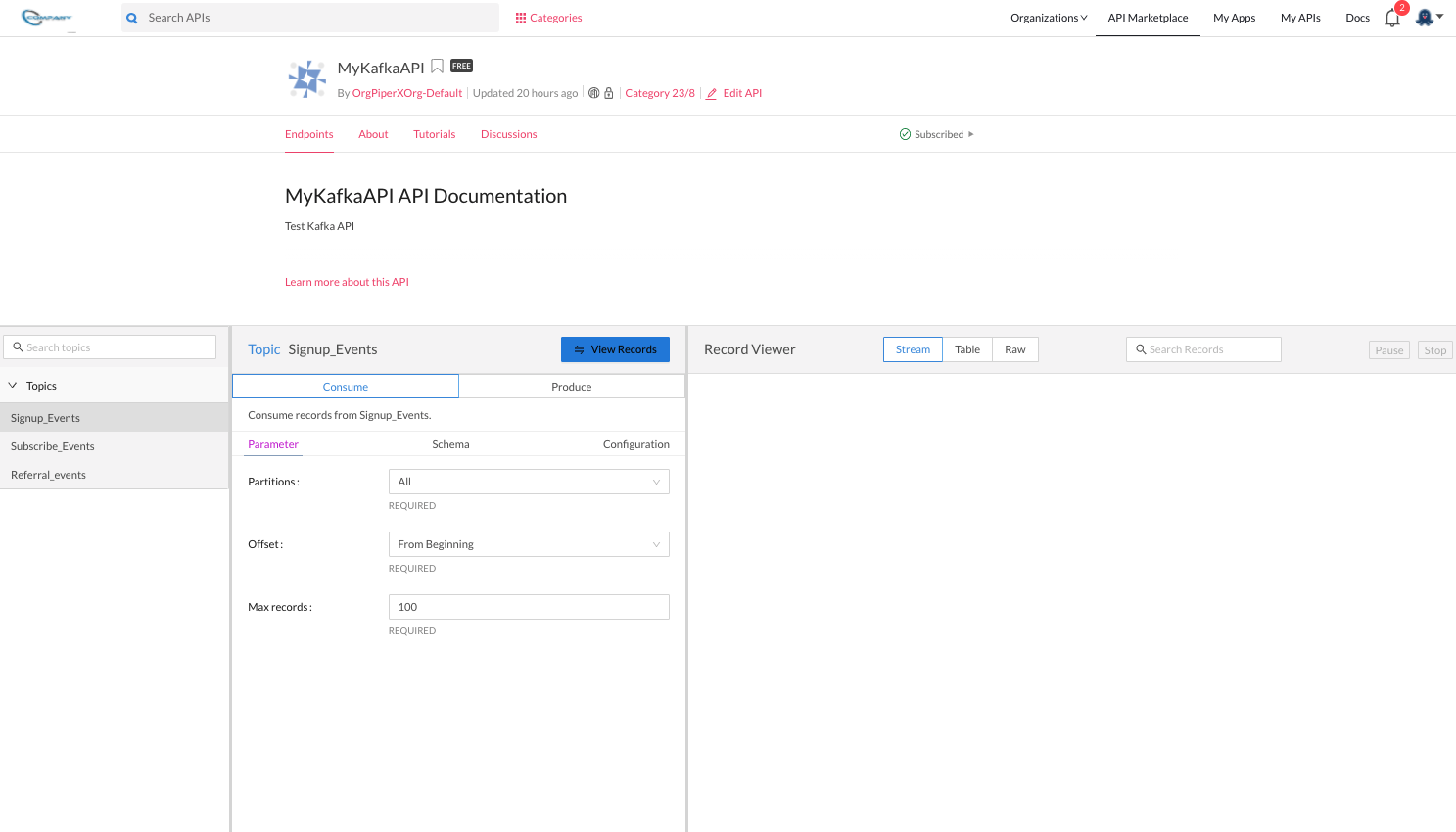
    An open source library provided by RapidAPI, available in beta, makes it possible to discover Kafka clusters and topics, view schemas and test and consume records from a browser via either the RapidAPI Marketplace or the RapidAPI Enterprise Hub. The library is based on Apache Avro and Confluent wire formats found in the open source confluent-schema-registry library. RapidAPI extended that library to add support for JSON and a protocol buffer, which is now being shared with the open source Kafka community.

    RapidAPI CEO Iddo Gino said DevOps teams can now discover all available Kafka clusters and instances in the same location where they find, test and connect to microservices based on REST, SOAP and GraphQL APIs. That effort is designed to complement initiatives, such as the AsyncAPI specification, that is now being advanced under the auspices of the Linux Foundation, Gino noted.

    RapidAPI is adding this capability because usage of Kafka to enable asynchronous communication across event-driven applications has significantly increased, Gino said. As the number of digital business transformation initiatives increased in the wake of the COVID-19 pandemic, Gino said reliance on asynchronous messaging platforms such as Kafka became a requirement. In many cases, synchronous communications across highly distributed applications simply isn’t feasible, Gino added.

    That doesn’t mean asynchronous requirements will replace the need for traditional synchronous APIs. Rather, developers will find themselves incorporating a greater mix of both as enterprise IT environments become more distributed, noted Gino. Applications are increasingly become one large puzzle that developers need to construct using various classes of APIs, added Gino.

    The library created by RapidAPI is expected to be generally available in the third quarter. In the meantime, adoption of Kafka continues to accelerate. The open source community that oversees development of Kafka, under the auspices of the Apache Software Foundation, claims more than 80% of all Fortune 100 companies are using the platform for everything from constructing data pipelines to running streaming analytics applications. In some cases, data is being queried directly while in transit versus waiting for it to be stored on-premises or in the cloud.

    Regardless of how Kafka is employed, developers are rediscovering event-driven architectures, that can trace their lineage to the 1980s, for building applications. The difference now is there an open source framework for handling the asynchronous communications required to build and deploy those applications at scale.

    It’s not quite clear how the rise of event-driven applications will impact DevOps workflows, as event-driven applications become more commonly built and deployed. However, as the APIs become more widely employed within the context of these applications, it should become simpler to incorporate them.

    The challenge is event-driven architectures typically requires developers to think differently about how their applications are structured, so it might be a while before Kafka – and other similar platforms – are pervasively employed across the enterprise.

  • RapidAPI Acquires Leading API Design Solution Paw, Extends Next-Generation Platform Across the API Development Lifecycle

    Latest Paw release integrates with the RapidAPI platform, expands support beyond Mac to include Windows, Linux, and web versions

    SAN FRANCISCO—February 10, 2021—RapidAPI, a next-generation API Platform that enables developers and enterprises to find, connect to, and manage thousands of APIs, announced today the acquisition of Paw, a leading API design and collaboration tool. The acquisition enables RapidAPI to extend its open API platform across the entire API development lifecycle, creating a connected experience for developers from API development to consumption, across multiple clouds and gateways.

    Additionally, RapidAPI and Paw announced the first successful collaboration between the two companies – Paw will now support Windows and Linux in addition to Mac. This latest release brings the intuitive UI, advanced features, and superior performance that tens of thousands of Mac users have come to rely on with Paw, to an even broader audience. With Paw, users can simplify development workflows and streamline API collaboration, enabling organizations to accelerate API delivery and improve the developer experience.

    “As digital transformation efforts have accelerated over the last year, so has the demand for the modern API tooling that developers require to build digital services and business models,” said Iddo Gino, RapidAPI founder and CEO. “Although there has been a surge in the number of API products and services on the market over the last year, RapidAPI is one of the few that is truly built with the developer in mind.” 

    Added Gino, “With the addition of Paw, we will offer developers a unified experience from designing and developing APIs with Paw, to testing and monitoring them with RapidAPI Testing, to sharing and managing them on the RapidAPI marketplace. And to ensure that Paw is more widely available beyond its loyal Mac users, we’ve been working together to implement support for Web, Windows, and Linux versions.”

    Fully-Featured for Mac, Windows, and Linux

    As part of the RapidAPI platform, Paw provides a fully-featured API client that supports complex design and development workflows with intuitive UX, cross-platform collaboration, and integration with RapidAPI Marketplace and RapidAPI Enterprise Hub. It supports any type of web API, with an emphasis on REST and GraphQL APIs. With Paw, developers can:

    • Improve Developer Experience: Paw has an intuitive UX and provides superior performance, providing users with a better developer experience. With Paw, users can quickly create, find, and run API requests with an intuitive top-level sidebar navigation and a simple interface for setting up arguments, headers, and parameters.

    • Accelerate API Delivery: Paw eases design and development workflows for ongoing API projects by offering powerful environment variables and dynamic values that improve productivity for developers. Unlike other design solutions, Paw can be extended through its JavaScript API to allow custom API flows.

    • Collaborate Across Teams: Paw enables multiple development teams to collaborate while keeping all API calls in sync, increase productivity for all team members involved in designing and consuming APIs, including product managers designing the API structure, backend developers implementing the API, QA engineers testing the API, and frontend developers consuming the API.

    “Paw has gained traction over the last six years by building an API design tool that was beloved by Mac users for its strong UI and performance,” said Micha Mizaheri, founder and CEO of Paw. “By joining forces with RapidAPI, we are able to take that developer experience to the next level by making Paw available across multiple platforms and integrating it across RapidAPI’s domain of developer tools. I’m thrilled to share the same vision as Iddo of creating products where the developer experience is always prioritized

    The latest release with cross platform support is currently in beta and is free for individual users. Sign-up to be part of the Paw trial.

    For more information

    About RapidAPI

    RapidAPI, the world’s largest API Marketplace, is used by millions of developers to find, test and connect to thousands of APIs—all with a single account, API key and SDK. For enterprise organizations, RapidAPI offers RapidAPI Enterprise Hub, a white-labeled version of the marketplace that enables the company’s developers, customers, and partners to find, manage, and connect to hundreds of internal APIs, as well as external API subscriptions.

    About Paw

    Paw is a full-featured API design tool for API design, discovery, and collaboration. Widely recognized for its time-saving UX, extensibility, and performance, Paw has been the number one choice among Mac developers for the last five years.  Paw enables you to visually  build your API requests and describe each parameter through textual descriptions, typing, and constraints. Founded in 2014, Paw was privately funded until its acquisition by RapidAPI at the end of 2020.

  • New RapidAPI Developer Survey Highlights Accelerated API Adoption

    Second annual RapidAPI Developer Survey Report provides key insights on the API landscape and emerging technology trends for the coming year

    SAN FRANCISCO—January 27, 2021—RapidAPI, the world’s largest API Marketplace that helps developers find and connect to thousands of APIs, today released a new report measuring developer trends and API usage. The second annualRapidAPI Developer Survey Reportsurveyed individuals from 250 countries and across different roles in software development, with a majority identifying as professional developers, managers or leadership. 

    A key insight from the survey was that developer reliance on APIs increased over the past year amidst the global  pandemic and will continue to increase in 2021. Organizations of all sizes from a wide range of industries plan to join the API economy this year, and API testing and security were top concerns among survey respondents. 

    “During the pandemic, many companies rapidly accelerated their digital transformation journeys. So, it makes sense that their investment in software development and particularly in the API economy continues to rise,” said Iddo Gino, RapidAPI founder and CEO. “RapidAPI makes it easier for companies to take advantage of the API economy by connecting their developers to thousands of APIs and microservices that can help them test and manage APIs more efficiently.”

    Key Data Insights

    Among other insights, the report revealed that:

    Developer reliance on APIs continues to increase:Developer reliance on APIs accelerated during the pandemic and will continue to increase in 2021; 61% of developers used more APIs in 2020 than in 2019, and 71% plan to use even more this year. 

    Participation in the API economy is a priority across industries: Overall, 58% of executives said participating in the API economy was a top priority for their organization. The figure was even higher in certain industries: 89% of telecommunications executives will take advantage of APIs and standards like Fast Healthcare Interoperability Resources (FHIR) and the Open API Initiative are driving adoption among a majority of healthcare (75%) and financial services (62%) executives.

    The adoption of new API technologies is increasing: This year’s survey also suggests that API technology and usage are becoming more varied. REST continues to be the most popular standard among those surveyed, and there was strong interest in emerging technologies like serverless, FaaS, WebSockets, and gRPC. AsyncAPI tripled in production usage (from 5% in 2019 to 19% in 2020), and GraphQL doubled (from 6% in 2019 to 12% in 2020).

    API testing and security are top priorities:Testing and security are top priorities for almost all developers—95% cited security as a top consideration, and 92% plan to test APIs in 2021. More than 43% of developers will use tools to write or manage tests, and 15% plan to use a tool in the future. Another 38% will write tests in their code.

    More than half of professional developers spend 10+ hours a week working on APIs:  Organizations dedicate significant resources to API development, including time—58% of professional software developers spent at least 10 hours each week working with APIs. Nearly 30% said they spend more than 20 hours a week working with APIs.

    JavaScript continues to be the most popular programming language:Despite the changes in API technology, the top five most popular programming languages remained the same in 2020 compared to 2019, with JavaScript leading the list as the most popular. Python, Java, PHP, and C# followed closely behind.

    For more information

    About RapidAPI

    RapidAPI, the world’s largest API Marketplace, is used by millions of developers to find, test and connect to thousands of APIs—all with a single account, API key and SDK. For enterprise organizations, RapidAPI offersRapidAPI Enterprise Hub, a white-labeled version of the marketplace that enables the company’s developers, customers and partners to find, manage and connect to hundreds of internal APIs, as well as external API subscriptions.

  • RapidAPI Expands its Enterprise Hub Platform with New Enterprise Management Capabilities

    New Platform API, enhanced governance, and advanced customization features enable organizations to move to a next-generation API infrastructure

    SAN FRANCISCO- December 9, 2020 – RapidAPI today announced new enterprise management capabilities for RapidAPI Enterprise Hub, a next generation, white-labeled marketplace that enables developers and enterprises to find, connect to, and manage thousands of APIs. RapidAPI Enterprise Hub is a key component of a modern enterprise API infrastructure, integrating seamlessly with existing API gateways and management systems and enabling organizations to manage hundreds to thousands of APIs as well as multiple API types including SOAP, REST, and GraphQL. The latest update to RapidAPI Enterprise Hub includes a raft of enterprise management capabilities that enable organizations to integrate easily with their existing API environment, create enhanced governance and security policies, and customize and brand their white-labeled marketplaces to align with their business objectives.

    “As APIs become the essential tools for building software, enterprises have felt the urgency to evolve beyond their current API infrastructure,” said Iddo Gino, RapidAPI Founder and CEO. “RapidAPI Hub is built for the next-generation of APIs with a centralized platform that scales to support API growth while providing an abstraction layer that unifies an API development environment that often includes multiple API gateways, multi-cloud environments, and a diverse collection of developer tooling. The latest advanced API management capabilities provide the integration, governance, and security features needed to transition to a more efficient software development process that will enable companies to compete and survive in an environment of increasingly accelerating digital transformation and disruption.”

    RapidAPI’s Enterprise Hub can be deployed internally as a centralized hub for internal collaboration among API providers and consumers. Additionally, companies can use RapidAPI Enterprise Hub to develop branded, external marketplaces that enable customers and partners to also find and connect to their APIs. With the additional integrations, governance, customization and security capabilities now available, companies can accelerate innovation and bring software to market even faster and more efficiently.

    New Platform and Event APIs Enable Integration Across the API Infrastructure

    RapidAPI Enterprise Hub’s integration capabilities enable organizations to create an abstraction layer across their entire API environment to integrate to and expose APIs from multiple different API gateways and work seamlessly with existing development tooling. With the Platform and Event APIs, enterprises can build event-driven integrations that can trigger custom business logic. Using these integrations, enterprises can connect actions on RapidAPI Enterprise Hub to third-party gateways, CI/CD tools, management systems, analytics, or applications.

    For example, you can use the Platform API to centralize observability by syncing analytics from multiple gateways, with the ability to drill down to the API level. Or a discussion on RapidAPI’s Hub can trigger the Event API to send a message into a helpdesk system such as Zendesk. Then, the Platform API would be used to communicate a response back to RapidAPI’s Hub. By leveraging these integrations within RapidAPI Hub, the possibilities for integrating your API environment across your entire development pipeline are endless.

    Enhanced Governance Enables Fine-Grained Access Control and Management over API Usage

    New comprehensive governance, security, and management capabilities such as role-based access control (RBAC) and federated identity provide enhanced visibility and control over who publishes and consumes your APIs. With RapidAPI Hub, you can manage workflows and approvals, enforce OWASP authentication best practices, and manage API versioning.

    • Role-based Access Control (RBAC): Secure APIs and enforce access and usage policies by assigning permissions. Organizations can use this capability to create different roles for team members with varying permission levels. Additionally, they can manage permissions at the role, team, and environment level to restrict which users and organizations can view, edit, and publish APIs and applications as well as manage team memberships.
    • Enhanced Security: Enforce OWASP authentication best practices including two-factor authentication (2FA), hardened password requirements, and lockout after multiple incorrect login attempts.
    • Workflows/Approvals: Enable organization administrators to easily review and approve or deny requests for API access, RapidAPI Hub access, and API publishing with approval workflows.
    • IdP Integration – Integrate to any 3rd-party identity provider to support authentication with any identity layer including OpenID Connect, OAuth 2.0, and SAML.
    • API Versioning – Increase efficiency for API providers and consumers to update APIs with improvements. With API versioning, you can simplify discovery and upgrades for API consumers by publishing updates as new versions within an existing API in the Hub dashboard and enabling developers to switch between versions from the Hub UI. Additionally, you can enhance visibility and control for API providers by managing multiple API versions from a single interface, with the ability to analyze usage at the aggregate and API level.

    Customization Features Enable Enterprises to Create a Branded Experience

    With RapidAPI Enterprise Hub, you can customize your white-labeled marketplace to reflect your brand identity and extend the RapidAPI Hub to meet specific business needs, whether it is for internal API consumption or for extending your APIs to partners and customers.

    • Theming: Customize your white-labeled marketplace to reflect your brand identity with a simple UI for theming updates (no coding required).
    • Custom Extensions: Extend Enterprise Hub with new tabs and custom developed applications enabling enterprises to highlight APIs and services in the Hub UI.

    Availability

    The new features and functionality are available with RapidAPI Enterprise Hub.

    For more information

    About RapidAPI

    RapidAPI, the world’s largest API Marketplace, is used by millions of developers to find, test, and connect to thousands of APIs – all with a single account, API key, and SDK. For enterprise organizations, RapidAPI offers RapidAPI Enterprise Hub, a white-labeled version of the marketplace that enables the company’s developers, customers, and partners to find, manage, and connect to hundreds of internal APIs, as well as external API subscriptions.

  • Introducing RapidAPI Testing, a Modern and Intuitive Testing Solution for Creating and Managing Comprehensive API tests from Dev to Deployment

    RapidAPI expands its leading API Platform to offer developers and enterprises  functional API testing, global monitoring, and seamless  integration with existing CI/CD tooling


    SAN FRANCISCO- October 14, 2020 – RapidAPI, a next-generation API platform that enables developers and enterprises to find, connect to and manage thousands of APIs, announced today that it had launched RapidAPI Testing, a modern and intuitive testing solution for easily creating and managing comprehensive tests from development to deployment.  RapidAPI Testing supports any API type including REST, SOAP, and GraphQL, simplifies monitoring across multiple geographies, and integrates with existing tooling throughout the development lifecycle.  Additionally, RapidAPI Testing automatically syncs with the RapidAPI Marketplace and RapidAPI Enterprise Hub to ensure test coverage across all of an organization’s APIs.

    “APIs are the glue between back-end infrastructure and end-user applications, which makes APIs a great insertion point for testing,” said Iddo Gino, RapidAPI Founder and CEO. “API testing allows teams to quickly uncover usability and performance issues before their users are impacted. With RapidAPI, it is easy to create complex tests in the way that works for each user – whether using a drag-and-drop builder or a code-based editor. Because RapidAPI Testing is a powerful tool, it works in every user’s  environment, enabling them to build modern software.”

    Comprehensive testing using visual, automated, or code-based test generation

    RapidAPI testing enables you to create customizable functional test flows that provide deep validation of REST, SOAP, and GraphQL APIs. An easy-to-use interface offers users three options for test generation, enabling developers and non-developers to create API tests:

    • Drag-and-Drop Editor – Enable no-code and low-code users to easily create intricate test flows and perform deep validation of APIs with an intuitive visual interface.
    • Code-based interface –  Refine testing flows by  writing and running custom code.
    • Automatic Test Creation – Simply define your API and upload an OpenAPI spec file to infer API properties and automatically generate tests that perform deep assertions on the APIs.

    RapidAPI Testing also enables you to secure every step of the testing process with testing for any authentication and authorization method including OAuth 2.0/OpenID Connect, header validation to check headers are configured correctly and do not contain sensitive information, and passing SQL, NoSQL, and other commands via queries and body parameters to prevent injection flaws.

    Global Monitoring ensures the performance of your applications, APIs, and microservices

    RapidAPI testing enables you to ensure performance for users everywhere by running tests across multiple global data centers. You can continuously run the API tests and monitor them with sophisticated reporting and analytics, including detailed execution reports and an intuitive management dashboard that enables you to pinpoint issues and accelerate resolution times.

    RapidAPI testing integrates with leading developer and  incident management tooling such as GitHub, PagerDuty, Slack, and Twilio, enabling you to constantly ensure that your API is performing properly. You can also set up SMS or email alerts to notify you if the API is down.

    Seamless Integration and Collaboration across the CI/CD Pipeline

    Organizations can improve development efficiency by seamlessly integrating API testing with existing tooling and utilizing built-in collaboration capabilities across the software development pipeline. Using a dedicated webhook, you can run API tests using popular CI/CD tooling including Jenkins, CircleCI, GitHub, Travis CI, and GitLab. Additionally, built-in collaboration capabilities allow you to organize developers into teams, assign API and test permissions at the team and role level, and work with team members to run tests and inspect results.

    RapidAPI Testing also automatically imports APIs published to the RapidAPI Marketplace into the RapidAPI testing dashboard to ensure quick testing coverage and eliminate the need to manually add APIs to the testing environment. Because RapidAPI testing is enterprise-ready, you can pull and push tests from the cloud UI to a local agent for behind firewall execution of testing flows.

    User Testimonial

     “RapidAPI Testing was very intuitive and enabled us to manage all of our existing testing requirements and shed a light on some areas where we needed to pay closer attention. Directly connecting to existing RapidAPI endpoints was seamless and facilitated a faster time between our development and production-ready products.”

    • Andrew Fraine, Director of Product Development and Data Science at Automata LLC

    “As an API provider, we always aim to provide a service that has high availability and low latency for any user in the world.  Being able to simultaneously run tests from different locations of our choice has greatly helped us to improve our API for users and been a major asset for our team.”

    -Jérémy Gaudin, CTO, API-SPORTS

    “Although RapidAPI Testing was incredibly easy to set up and use, it was powerful enough to manage all of my API testing needs. RapidAPI Testing  has all of the features that you would expect and more and was flexible enough for me to use in many different use cases.”

    –  Marco Arrigo – ElenaSport Founder

    “As a non-developer, I was impressed by how quickly and easily I was able to create my first tests and get everything up and running. I love that you can set up text/email notifications when a test fails as providing reliable, constant access to the API is our #1 concern  and instant notifications help ensure our API is always available.”

    -Crystal Schlegelmilch,  Co-Founder, Spoonacular


    Pricing and Availability

    RapidAPI Testing is available in a variety of pricing plans. RapidAPI Testing can be purchased standalone or as an add-on to RapidAPI Enterprise Hub.

    For more information

    About RapidAPI

    RapidAPI, the world’s largest API Marketplace, is used by millions of developers to find, test, and connect to thousands of APIs – all with a single account, API key, and SDK. For enterprise organizations, RapidAPI offers RapidAPI Enterprise Hub, a white-labeled internal marketplace that enables technology teams  to help developers reuse and connect to existing APIs faster while providing IT with enterprise-wide visibility and governance of API consumption.