Tag: Skillsoft

  • Skillsoft Taps ChatGPT to Improve Developer Training

    Skillsoft Taps ChatGPT to Improve Developer Training

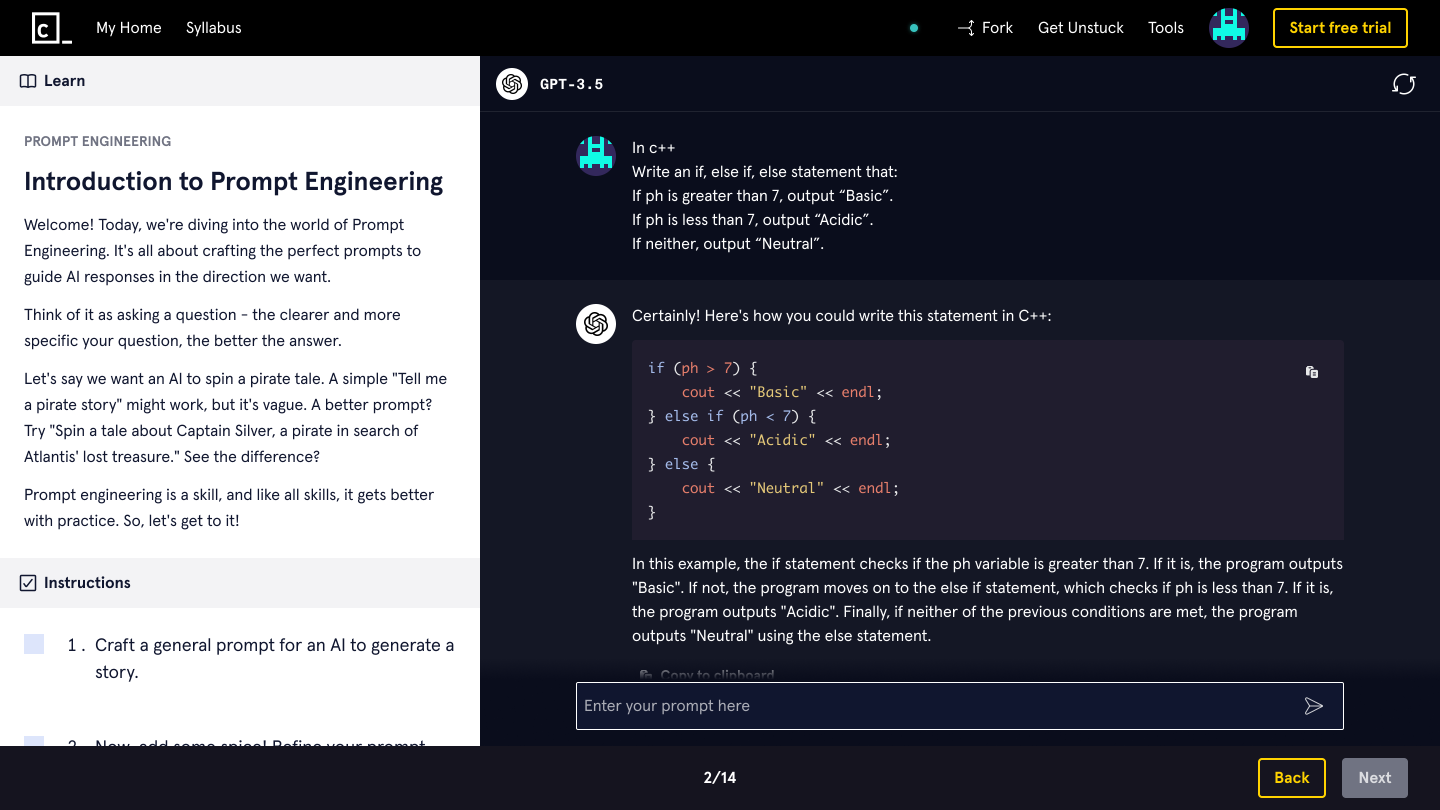
    Skillsoft today revealed it plans to add generative artificial intelligence (AI) capabilities to its Codecademy online training platform to provide developers with hands-on experience using ChatGPT to write code.

    Kunal Ahuja, general manager for Codecademy consumer business at Skillsoft, said the goal is to give developers a more curated path toward teaching them how to define prompts that will result in better code being generated. These enhancements will be made available to Codecademy Plus and Pro users as well as enterprise customers in the coming months, he noted.

    There’s no doubt that developers are relying more on generative AI to write code, but not all the output generated by platforms that are based on a general-purpose large language model (LLM) is going to be consistent. Codecademy provides a more immersive experience that enables developers to refine their prompt engineering expertise, said Ahuja.

    AI-enabled capabilities include code explanations and project hints to improve debugging skills, along with other real-time feedback surfaced via a virtual coding assistant. There are also courses such as “Prompt Engineering for Software Engineers” available.
    Finally, Skillsoft is also providing access to a mock interview simulator that developers can access to help determine if they are ready for a job interview.

    As it becomes more apparent that prompt engineering is a skill application development teams will need to master to build and deploy software, there’s a clear need to teach nearly everyone in IT how to craft prompts efficiently. Ultimately, the number of prompts used to generate code will have an impact on the total cost of building software.

    In the longer term, Skillsoft plans to build its own LLM using data it collects via its platform to provide training using an LLM that has been trained using code that has been curated, said Ahuja. One of the issues with a general-purpose LLM is that it is trained using examples of code pulled from across the web that varies widely in quality. That can result in outputs of code that have known vulnerabilities or that simply run inefficiently. Of course, it may be just as likely that a developer augmented by generative AI is, depending on their level of expertise, actually delivering higher-quality code.

    Despite those concerns, however, it’s still important to provide developers with the training they need today to remain competitive, said Ahuja.

    It’s not clear how much code these days is being generated by machines versus humans, but as the volume increases, the number and size of the software builds that need to be managed is only going to increase. Hopefully, as much AI will be applied to the DevOps workflows used to manage those software builds as there is being applied to writing code, but in the short term, at least, DevOps teams might soon find themselves overwhelmed.

    The one thing that is certain is DevOps teams have a vested interest in making sure the code being written by developers is of the highest quality possible. After all, whenever there is an issue with that code, it usually falls to the DevOps team to fix it.

    Image source: https://vecteezy.com/programming-background-with-person-working-with-codes-computer-e1679047506780.jpg

  • Skillsoft Survey Sees AI Driving Increased Need to Retrain IT Teams

    Skillsoft Survey Sees AI Driving Increased Need to Retrain IT Teams

    More organizations than ever will need to invest in IT training as advances in artificial intelligence (AI) transform roles and responsibilities in the coming year.

    A survey of 2,740 IT decision-makers conducted by Skillsoft, a provider of an online training platform, finds two-thirds (66%) were already dealing with skills gaps in 2023. As AI becomes more pervasively applied to the management of IT, that skills gap is only going to widen given the limited pool of IT professionals that have any experience using AI to manage IT.

    Skillsoft CIO Orla Daly said it’s already apparent AI creates an imperative for training because there are simply not enough IT people with the requisite skills required. In fact, the survey finds nearly half of IT decision-makers (45%) plan to close skills gaps by training their existing teams. That training is crucial because the primary reason IT staff change jobs is a lack of growth and development opportunities, noted Daly.

    While there is naturally a lot of consternation over the potential elimination of IT jobs, in the final analysis, AI will add more different types of jobs than it eliminates, adds Daly. Each of those jobs will require new skills that will need to be acquired and honed, she notes. “Training is the price of innovation,” said Daly.

    In the meantime, there is much interest in finding ways to automate existing IT processes to create more time for IT teams to experiment with AI technologies, said Daly.

    The report also finds well over half of IT decision-makers (56%) expect their IT budgets to increase to help pay for new platforms and tools, compared with only 12% expecting a decrease.

    It’s not clear to what degree AI will transform the management of AI, but it’s already apparent that many manual tasks involving, for example, generating reports are about to be automated. The instant summarization capabilities that generative AI enables also promise to dramatically reduce the time required to onboard new members to an incident response team. Rather than having to allocate someone on the team to bring new members up to speed, each new member of the team will use queries framed in natural language to determine for themselves the extent of the crisis at hand.

    In addition, many tasks that today require expensive specialists to perform might become more accessible to a wider range of organizations as, for example, more DevOps processes are automated. That doesn’t necessarily mean that DevOps as an IT discipline disappears as much as it leads to the democratization of best DevOps practices.

    Each IT organization in the year ahead will need to determine to what degree to rely on AI to manage IT processes. It may take a while before IT teams have enough confidence in AI to rely on it to manage mission-critical applications but many of the tasks that today conspire to make the management of IT tedious will undoubtedly fade away. The challenge and the opportunity now is identify those tasks today with an eye toward revamping how IT might be managed in the age of AI tomorrow.