Tag: vmware

  • Envoy Gateway Makes Using Envoy Proxy Easier for Developers and Reverses Fragmentation

    San Francisco, CA and Valencia, SPAIN — May 16, 2022 — Members of the steering group for Envoy Gateway (EG), including Envoy creator Matt Klein and representatives from Ambassador Labs, Fidelity Investments, Tetrate, and VMware, Inc. today announced their joint commitment to the project, which launched today at KubeCon + CloudNativeCon, Europe 2022, under the auspices of the Cloud Native Computing Foundation® (CNCF®). Envoy Gateway is a new effort within the Envoy proxy open source project to simplify Envoy use in cloud-native application development. 

    Envoy Gateway will reduce existing, redundant efforts around Envoy and make it much easier for application developers to use Envoy as a basic API gateway “out of the box” and as a Kubernetes Ingress controller. Exposing a simplified set of APIs, and implementing the Kubernetes Gateway API, EG makes it easier to extend Envoy. Developers will now have a cost-free, unfettered way to provide external access to their work in progress. At the same time, Envoy Gateway will not replace API management features currently found in commercial products.  

    “Envoy has achieved a great deal of success since we first released it in 2016,” said Matt Klein, founder of the Envoy proxy project. “And community has been at the heart of Envoy from the beginning. With the community-driven Envoy Gateway project, we see the opportunity to make Envoy accessible to many more users through the addition of simplified APIs and new capabilities explicitly targeted at north-south / edge proxy use cases.”

    Envoy is already widely used for traffic between separate services in a microservices application – that is, east-west traffic. With Envoy Gateway, Envoy will also be easy to use for north-south traffic—that traffic between an application and the outside world, as with consumers of an application’s APIs. 

    Envoy Gateway—Core Open Source Infrastructure for the Cloud-Native Future

    IT organizations worldwide want to establish and use a rich, robust, modern stack of open source software for cloud-native application development and delivery, under the management of organizations such as the Linux Foundation and the CNCF. Commercial offerings and projects within each IT team can then add value on top of this core infrastructure.  

    Envoy is fast becoming the go-to networking substrate within this modern, cloud-native stack. However, recently, the need for API access, traffic routing, and other ingress capabilities has led to fragmentation in the Envoy ecosystem. Envoy Gateway will bring this needed functionality back into the main Envoy project and make it less confusing and time-consuming for developers to access Envoy. 

    Implementation Via Kubernetes Gateway API

    Envoy Gateway will expose a version of the Kubernetes-native Gateway API, with Envoy-specific extensions. This is an expressive, extensible, role-oriented API well-suited to use by developers. Gateway API is either implemented, or in progress, for Istio, the Contour project (which originated at VMware), Emissary-Ingress (which originated at Ambassador Labs), and others. 

    When users create Gateway API resources, they will be translated into native Envoy API calls, so Envoy and its native API, xDS, will not need to be changed to add this new support. 

    Advantages for Developers, Infrastructure Administrators and Business Decision-Makers

    Application developers will experience the most positive impact from Envoy Gateway. They will be able to run Envoy Gateway and begin routing traffic to their applications. They will no longer need to build their own control plane, or extend an existing control plane such as a Go or Java control plane, or bring in a vendor solution at the early stages of their projects. They can just configure routes for the application and share them.  

    Infrastructure administrators will be able to easily offer an Envoy-native experience to application teams, without needing to adopt a vendor solution just to get basic gateway functionality. They will be able to manage instances of Envoy Gateway without interfering with developer access to them. Envoy Gateway will allow them to deliver consistent application networking capabilities across heterogeneous environments.  

    Executives and decision makers will have Envoy as a standard and, we expect, widely used solution for API access and Kubernetes ingress. They will also benefit from faster and easier development and delivery of more secure and robust software and services. 

    Additional Resources

    • Explore CNCF announcements. 
    • Review the official blog of the Envoy project.
    • Learn more about Envoy Gateway goals.

    About Envoy

    Originally created by Matt Klein and built at Lyft, Envoy is a high performance C++ distributed proxy designed for single services and applications, as well as a communication bus and “universal data plane” designed for large microservice “service mesh” architectures. Built on the learnings of solutions such as NGINX, HAProxy, hardware load balancers, and cloud load balancers, Envoy runs alongside every application and abstracts the network by providing common features in a platform-agnostic manner. When all service traffic in an infrastructure flows via an Envoy mesh, it becomes easy to visualize problem areas via consistent observability, tune overall performance, and add substrate features in a single place. 

    Contact Matt Klein at mattklein123@gmail.com. 

    About Ambassador Labs

    Ambassador Labs, the cloud native developer experience leader, enables developers to code, test, ship, and run applications faster and easier than ever. Maker of top Cloud Native Computing Foundation (CNCF) open source projects, including Emissary-ingress and Telepresence, Ambassador Labs delivers a developer control plane for Kubernetes that integrates the development, deployment, and production infrastructure for developers and organizations worldwide including Microsoft, PTC, NVidia, and Ticketmaster. Ambassador Labs is backed by top investors including Insight Partners and Matrix Partners. Learn more and get started for free at www.getambassador.io.

    Contact Lisa Williams of Ambassador Labs at lisawilliams@datawire.io.

    About Fidelity Investments

    Fidelity’s mission is to inspire better futures and deliver better outcomes for the customers and businesses we serve. With assets under administration of $11.3 trillion, including discretionary assets of $4.2 trillion as of March 31, 2022, we focus on meeting the unique needs of a diverse set of customers. Privately held for over 75 years, Fidelity employs more than 57,000 associates who are focused on the long-term success of our customers. For more information about Fidelity Investments, visit www.fidelity.com/about-fidelity/our-company. 

    Contact Kathleen Bentley of Fidelity Investments at kathleen.bentley@fmr.com. 

    About Tetrate

    Started by Istio founders to reimagine application networking, Tetrate is an enterprise service mesh company managing the complexity of modern, hybrid cloud application infrastructure. Its flagship product, Tetrate Service Bridge, provides an edge-to-workload application connectivity platform to deliver business continuity, agility, and security for enterprises on the journey from traditional monoliths to the cloud. Customers get consistent, baked-in observability, runtime security and traffic management in any environment. Tetrate remains a top contributor to the open-source projects Istio and Envoy Proxy. Find out more at www.tetrate.io. 

    Contact Annie Fink of Bospar at annie@bospar.com. 

    About VMware 
    VMware is a leading provider of multi-cloud services for all apps, enabling digital innovation with enterprise control. As a trusted foundation to accelerate innovation, VMware software gives businesses the flexibility and choice they need to build the future. Headquartered in Palo Alto, California, VMware is committed to building a better future through the company’s 2030 Agenda. For more information, please visit www.vmware.com/company.

    Contact Eloy Ontiveros of VMware Global Communications at eontiveros@vmware.com.

  • Newly Independent VMware to Focus on Multi-Cloud

    Newly Independent VMware to Focus on Multi-Cloud

    As an independent company once again, VMware will focus its efforts on providing management planes that span multiple cloud computing environments after officially spinning out of Dell Technologies.

    Ray O’Farrell, executive vice president for the cloud-native apps business unit at VMware, said the company now has a unique opportunity to work closely with providers of cloud services, builders of on-premises IT infrastructure and providers of telecommunications services.

    The terms of the spin-off included an $11.5 billion special cash dividend that resulted in a $27.40 per share dividend payment to all VMware stockholders. VMware claims the simplified financial structure that arises from the deal will provide it with additional operational and financial flexibility.

    Going forward, much of the development work will focus on providing management planes that not only span multiple clouds but also address specific cross-platform requirements such as security. It’s not likely there will ever be one single uber control plane for all of IT, noted O’Farrell. Rather, IT teams should expect VMware to deliver a series of well-integrated control planes to automate specific tasks in a way that breaks down IT silos, he said.

    VMware, however, under terms of its existing alliance, will also continue to work closely with Dell to create server environments that are optimized for VMware hypervisor platforms, O’Farrell said.

    Key to the strategy is a portfolio of observability tools that VMware plans to continue to expand, noted O’Farrell. VMware will also address the requirements of both traditional monolithic applications running on virtual machines as well as cloud-native applications running on distributions of Kubernetes, such as VMware Tanzu, that may be deployed on top of a hypervisor or on a bare-metal server, he added.

    Given the complex state of IT environments today, it’s all but inevitable something will go wrong, said O’Farrell. The challenge and the opportunity for VMware is to provide IT teams with the observability tools required to discover as many issues as possible before they adversely impact the business, he added. Once those issues are discovered, IT teams should be able to automate the remediation process using the rest of the portfolio of VMware management frameworks, he noted.

    Those management frameworks will also provide the foundation for unifying traditional approaches to IT service management (ITSM) with DevOps best practices that are now being used more widely, especially to manage cloud-native applications, said O’Farrell.

    When it comes to on-premises IT environments, VMware continues to dominate. Its hypervisor is, by far, the most widely used on servers in local data centers. VMware has spent much of the last two years expanding its reach into multiple clouds to enable IT organizations to standardize on a series of management frameworks. The goal is to reduce the total cost of IT by reducing reliance on what would otherwise be a hodgepodge of isolated management frameworks. The challenge VMware regularly encounters is the IT teams that manage cloud computing environments are not always the same ones that are managing on-premises IT environments. As such, many IT teams that have deployed cloud applications tend to embrace the management frameworks provided by their cloud services provider.

    VMware, however, is betting that as more organizations look to reduce the total cost of IT, the economic pressure to converge IT management using its frameworks will be simply too great to ignore.

  • AttackIQ Helps VMware NSX Customers Validate Efficacy of Their Network Security Controls

    AttackIQ Helps VMware NSX Customers Validate Efficacy of Their Network Security Controls

    Santa Clara, CA, June 10, 2021 – AttackIQ®, a leading independent vendor of Breach and Attack Simulation (BAS) systems, today announced the company is working with VMware to enable VMware NSX customers to improve the way they validate the efficacy of their network security controls. Using the AttackIQ Security Optimization Platform with the MITRE ATT&CK framework, mutual customers can now leverage the power of automation to continually emulate realistic attacks and prove that controls are working as expected to help protect them from breaches and attacks.

    “As we have seen from supply-chain and ransomware intrusions, organizations need to assume breach and adopt advanced security capabilities to prevent successful attacks,” said Carl Wright, AttackIQ Chief Commercial Officer. “VMware is one of the world’s leading security providers, and we are excited to work with the VMware team to elevate our mutual customer’s security program performance.”

    “While traditional penetration testing and red teaming can provide useful insights into security control effectiveness, their infrequent scheduling and limited scope fail to provide holistic, up-to-the minute data during security proof of values,” said Chad Skipper, Global Security Technologist at VMware. “AttackIQ will enable VMware NSX customers to proactively validate NSX Advanced Threat Prevention controls against emulated adversary behaviors, with the end result being increased confidence in their cybersecurity performance.”

    AttackIQ conducts automated security testing to improve program performance

    AttackIQ operates under the “assume breach” mindset, recognizing that it is not a question of if but when an intruder will break past an organization’s perimeter defense. Aligned to the MITRE ATT&CK framework, AttackIQ’s Security Optimization platform contains a deep library of adversary emulation scenarios to emulate post-breach adversary behaviors and continuously validate an organization’s defenses. The Security Optimization Platform tests and validates security controls continuously, safely, at scale and in production.

    By combining AttackIQ with VMware NSX, teams can gain comprehensive, data-driven control over their security program through continuous testing. With clear performance data generated from AttackIQ’s automated testing capabilities, security teams identify program challenges, adjust their security program operations, and make data-informed decisions about their security investments. The outcome is that the organization’s security controls work as intended, resources are aligned to address the most important threats, and the organization maximizes its return on investment.

    VMware simplifies network security by leveraging the infrastructure to protect apps and data from endpoint to cloud. By virtualizing the network security stack, companies gain better protection that is built into the infrastructure to help mitigate risks and enable compliance, lower costs, and simplify operations. The VMware NSX security family includes the VMware NSX Service-defined Firewall, a distributed, scale-out internal firewall purpose-built to protect east-west network traffic, and VMware NSX Advanced Threat Prevention for network detection and response capabilities with network traffic analysis, distributed IDS/IPS, and advanced malware analysis. These solutions provide deep visibility into network traffic regardless of whether it is north-south or east-west and are coupled with advanced machine learning techniques. As a result, cybersecurity teams can respond to advanced threats more quickly and effectively by providing high-fidelity alerts with a very low rate of false positives, plus visualize the entire attack chain.

    About AttackIQ

    AttackIQ, the leading independent vendor of breach and attack simulation solutions, built the industry’s first Security Optimization Platform for continuous security control validation and improving security program effectiveness and efficiency. AttackIQ is trusted by leading organizations worldwide to plan security improvements and verify that cyberdefenses work as expected, aligned with the MITRE ATT&CK framework. The Company is committed to giving back to the cybersecurity community through its free AttackIQ Academy, open Preactive Security Exchange, and partnership with the MITRE Center for Threat-Informed Defense. For more information visit www.attackiq.com. Follow AttackIQ on Twitter, LinkedIn, and YouTube.

    VMware and NSX are registered trademarks or trademarks of VMware, Inc. or its subsidiaries in the United States and other jurisdictions. 

  • VMware Enhances Management Portfolio

    VMware Enhances Management Portfolio

    VMware today rolled out a series of updates to its automation and monitoring portfolio as part of an ongoing effort to simplify management of highly distributed IT environments.

    Updates to the VMware vRealize Cloud automation portfolio include VMware vRealize Automation 8.4’s tighter integration with the open source Salt automation framework the company gained by acquiring SaltStack last year, in addition to a range of tools for provisioning and governing instances of VMware software running on Google Cloud, Microsoft Azure and VMware Cloud on Amazon Web Services (AWS).

    There is also a set of tools to enable organizations running NSX network virtualization software for vSphere to migrate to NSX-T, an instance of network virtualization software that can be deployed anywhere.

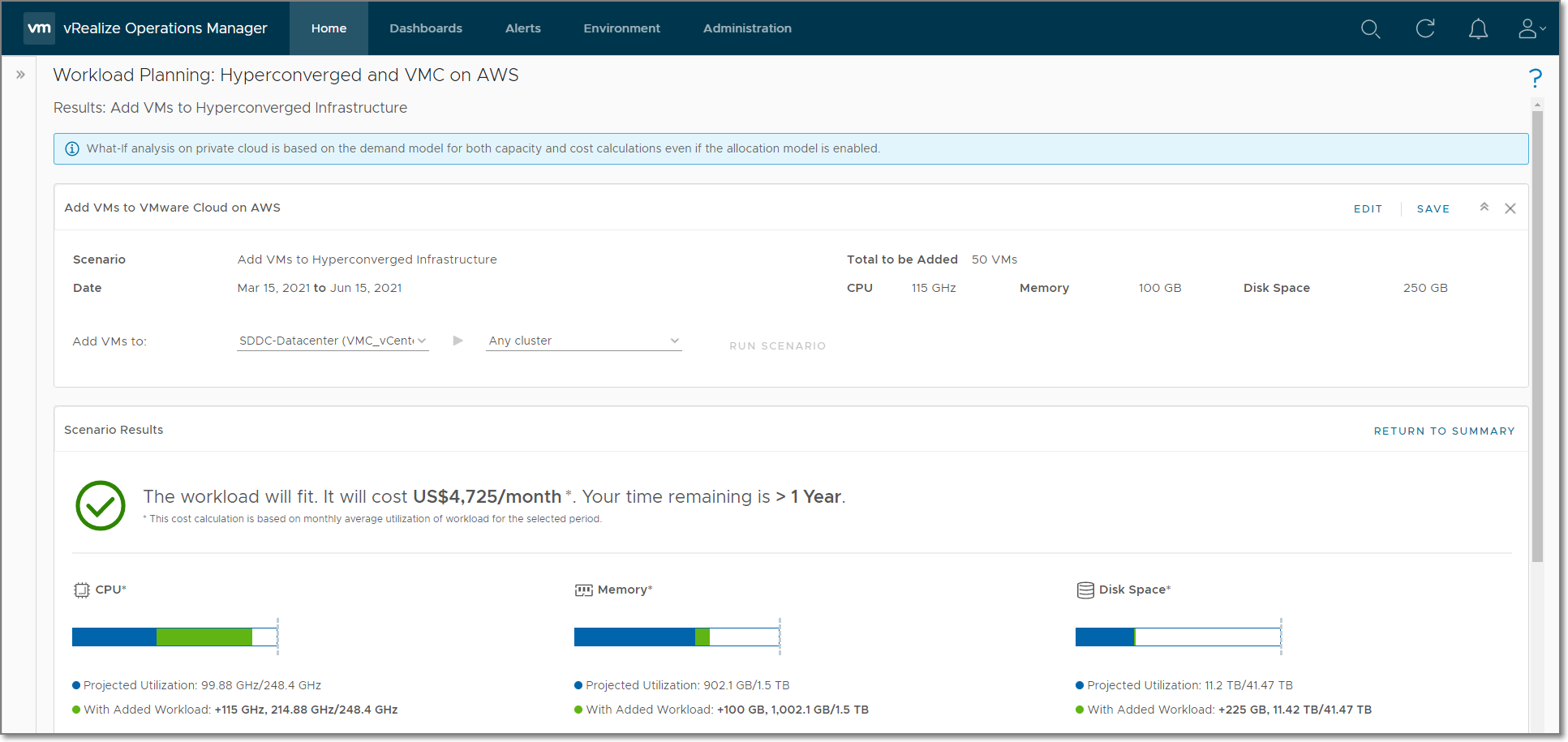
    VMware vRealize Operations, meanwhile, is being updated to support a total of 57 AWS services along with the ability to predict the cost of deploying VMware Cloud on AWS. The latter capability includes tracking potential savings generated by powering off idle or unused virtual machines as well as snapshots, orphaned disks and oversized virtual machines. There are also now ten additional dashboards for tracking various costs, including return on investment, total cost of ownership and potential cost savings. IT teams can also more easily track capacity utilization trends on AWS.

    VMware is adding support for the open source Telegraf Agent to enable IT teams to collect metrics from any platform, in addition to providing an update to VMware vRealize Log Insight 8.4 and vRealize Log Insight Cloud that enables these monitoring tools to store data collected from multiple cloud services more efficiently. IT teams will also be able to collect logs from both Microsoft Azure and AWS.

    Finally, VMware is expanding its network monitoring tools to provide greater visibility across multiple clouds.

    Fidelma Russo, senior vice president and general manager for cloud services at VMware, said the rate at which IT teams are consuming the software-as-a-service (SaaS) editions of VMware management and observability tools or full-blown managed services has increased sharply since the start of the COVID-19 pandemic, as IT teams managed on-premises and cloud instances of VMware software from home.

    It’s not clear what percentage of VMware’s installed base are now consuming the company’s automation and monitoring tools, but as the number of VMware instances deployed on public clouds increases alongside on-premises IT environments, so, too, do the management challenges. The choice IT teams generally have to make is deciding between automation and observability tools that are optimized for a specific platform versus adopting frameworks that work more broadly. With the acquisition of Salt and support for Telgraf, it is apparent VMware is moving to expand the reach of its management portfolio beyond its own software.

    In the meantime, IT teams are not only being asked to manage more complex IT environments, but the expectation that, through automation, they will be able to more effectively implement cost controls. This is happening at a time when many organizations have not been quite so sensitive to the total cost of IT. The challenge, of course, is those organizations are being asked to spend money on automation today in the hopes of spending less because of it tomorrow.

  • VMware Refreshes vRealize Cloud Management to Better Optimize, Protect and Modernize Customers’ Hybrid and Multi-Cloud Environments

    Customers IHS Markit and Provident Mexico Benefit from VMware vRealize Cloud Management Solutions


    PALO ALTO, Calif., February 4, 2021 – VMware, Inc. (NYSE: VMW) today announced innovations across its VMware vRealize Cloud Management portfolio of on-premises and Software as a Service (SaaS) solutions. The new and enhanced capabilities combine to enable customers to more securely deploy and operate their hybrid and multi-cloud environments.

    VMware customers IHS Markit and Provident México are using VMware vRealize Cloud Management solutions to attain greater IT and business agility for faster achievement of business outcomes.

    “In today’s uncertain world, enterprises are seeking to increase agility and efficiencies to remain competitive and to drive faster business growth,” said Purnima Padmanabhan, senior vice president and general manager, Cloud Management Business Unit, VMware. “As more businesses pursue cloud as an agility strategy, vRealize Cloud Management helps customers run their applications anywhere while maintaining consistent operations and common governance across all environments.”

    Consistent Deployment and Operations of Apps, Infrastructure and Platform Services

    VMware vRealize Cloud Management enables customers to consistently deploy and operate their applications, infrastructure, and platform services, from the data center to the cloud to the edge. It helps them accelerate innovation with quick and easy access to services, gain efficiency by improving visibility and automation, and improve control while mitigating risk through unified operations and governance. Today, VMware introduces new releases including VMware vRealize Automation 8.3, VMware vRealize Operations 8.3, VMware vRealize Log Insight 8.3, vRealize Suite Lifecycle Manager 8.3 VMware vRealize Network Insight 6.1 and VMware Skyline; along with enhancements across VMware vRealize Operations Cloud, VMware vRealize Log Insight Cloud, and VMware vRealize Network Insight Cloud.

    Enhanced Event and Data-Driven Infrastructure Automation

    VMware vRealize Automation 8.3 delivers enhanced solutions for customers’ most critical automation use cases including self-service multi-clouds, network automation, and DevOps with actionable insights, greater security and improved performance. New VMware vRealize Automation capabilities include:

    • Property Groups: The ability to create, update, read and delete property groups with predefined data. This helps customers work more efficiently by reusing groups of properties, tracking resource usage and storing metadata. vRealize Automation makes the VMware Cloud Templates development more powerful and dynamic by reusing these attributes and keeping them up to date.
    • Security Properties: The ability to create a secure variable in Cloud Assembly and apply it to a cloud template or ABX action. This enables customers to better secure sensitive data in encrypted form and introduces a new method to produce secure variables for project and consumption.
    • VMware NSX-V to NSX-T migration: This release now supports NSX-V to NSX-T migration enabling customers to benefit from multi-hypervisor, multi-cloud networking, declarative APIs for full stack automation, built-in distributed security, advanced threat protection with intrusion detection and prevention, network threat analysis, unified networking and security for cloud native applications, and consistent policy and streamlined operations across deployments.

    Additionally, this new release delivers improved performance, deployment speed, increased efficiency and helps complete tasks quicker. This includes reducing the time it takes to deploy a virtual machine — a 2x improvement from vRealize Automation 8.2. (1) The new release also enables customers to distribute a deployment across cloud zones via enhancements in placement logic.

    Improved Security for AI-Powered Operations

    VMware vRealize Operations delivers self-driving operations from apps to infrastructure to better optimize, plan and scale private, hybrid, and multi cloud environments. Powered by AI and predictive analytics, vRealize Operations delivers continuous performance, capacity and cost optimization, proactive planning, intelligent remediation and integrated compliance. VMware vRealize Operations 8.3 and VMware vRealize Operations Cloud feature:

    • Data Security Standards: VMware vRealize Operations 8.3 modules meet Federal Information Processing Standard (FIPS) 140-2 and follow the Security Technical Implementation Guide (STIG) for U.S. Federal data security requirements.
    • VMware Cloud Configuration Maximums: Provides customers with better visibility into their VMware Cloud limits and their consumption relative to those limits.


    VMware vRealize Log Insight Cloud introduces enhanced ML analytics for errors and Knowledge Base (KB) correlation, ERI-FIPS compliance, VMware HCX and VMware Site Recovery Manager log integration, and native data archiving support.

    Network Visibility and Troubleshooting for Applications, Networks, and Security

    VMware vRealize Network Insight 6.1 and VMware vRealize Network Insight Cloud provide an end-to-end network view by learning from multiple data sources across virtual and physical infrastructure. Using machine learning for application discovery as well as assurance and verification capabilities, vRealize Network Insight makes it easier to plan, build, and manage complex networks. This new release includes:

    Customization: Enhancements to Pinboards for users to customize persistent dashboards to preserve widget filter state at the time of pinning the ability to see others’ pinboards in the Auditor role, as well as new abilities to allow users to pin no result pins;

    • Multi-Cloud: VMware Cloud on AWS edge router interface statistics for improved network troubleshooting;
    • NSX-T Integrations: Data from NSX Intelligence can now be integrated for more application-centric network operations and troubleshooting visibility; and,
    • VMware SD-WAN: New analytics intent for better service level agreement (SLA) monitoring and visibility with SD-WAN link utilization and metering.

    Increased Visibility into Potential Issues and Support Requests Across Teams

    VMware Skyline provides proactive intelligence across customers’ VMware environments to help prevent issues and unscheduled downtime. The latest release of Skyline Advisor provides expanded visibility into the vulnerabilities Skyline identifies and improved Support Request visibility enables easier use of the Log Assist automated log upload feature. This release also includes 31 new proactive Findings and Recommendations.

    • Findings Catalog: New catalog provides increased visibility into all the at-risk issues and vulnerabilities that Skyline checks.
    • Improved Support Request Visibility: A top customer request, this new feature provides Skyline Administrators with visibility of Support Requests across teams, making it easier to leverage Log Assist for automated support log bundle upload.


    IHS Markit Automates Cloud Environment for Competitive Edge

    IHS Markit is a business information provider headquartered in London, serving

    more than 50,000 business and government customers worldwide. To speed its time to market, the company uses vRealize Cloud Management offerings including vRealize Network Insight with VMware NSX-T to help release products faster to maintain a competitive edge.

    “We are making VMware vRealize Network Insight Cloud IHS Markit’s standard tool for application, network and security visibility and troubleshooting,” said Andrew Hrycaj, Principal Network Engineer, IHS Markit.

    Provident México Speeds Innovation with Cloud Adoption

    Financial services firm Provident México sought to drive business growth by moving all of its applications to the cloud. After selecting VMware Cloud on AWS to run workloads and apps, Provident México used vRealize Cloud Management to reduce its migration risk. The solution empowered IT leaders at the firm to optimize application delivery infrastructure and innovate faster to meet business speed and agility requirements. Specifically, Provident México has improved its efficiency, lowered its risk and reduced its overall capacity requirements by 30% when comparing consumption of on-premises and cloud environments.


    “It’s intimidating to think about putting high-value workloads in the cloud, especially in financial services, but adopting cloud is both necessary and practical to achieve IT and business goals,” said Néstor Rodríguez, Director of Technology and Change, Provident Mexico. “It used to take me around a year and a half just to place an application in production. With VMware vRealize Cloud Management, I now do it within months. It’s a game changer.”


    Product Availability

    VMware vRealize Automation 8.3, VMware vRealize Operations 8.3, VMware vRealize Log Insight 8.3, VMware vRealize Suite Lifecycle Manager 8.3 VMware vRealize Network Insight 6.1 and Skyline Advisor are available. The new capabilities and enhancements to VMware vRealize Operations Cloud, VMware vRealize Log Insight Cloud and VMware vRealize Network Insight Cloud are also available.

    Additional Resources

    —

  • VMware Cloud on AWS Will Bring DevOps Issues to a Head

    VMware Cloud on AWS Will Bring DevOps Issues to a Head

    Now that instances of VMware are starting to become available on Amazon Web Services (AWS), a DevOps ecosystem is starting to emerge around the management of applications workloads moving into and out of AWS.

    Among the more than 4,500 applications that VMware claims already support VMware Cloud on AWS are those from Blue Medora, CA Technologies, Chef, Cloudbees, Dynatrace, Jfrog, Puppet, SaltStack and the Ansible arm of Red Hat.

    VMware CEO Pat Gelsinger told attendees at the recent VMworld 2017 conference that VMware and AWS are just now scratching the surface of what they plan to accomplish together. AWS CEO Andy Jassy added that, unlike other alliances, which consisted mainly of marketing, engineers at both companies are working closely together to deliver VMware globally across all AWS availability zones. At present, VMware Cloud on AWS is available in the AWS availability zone hosted in Portland, Oregon. The service soon will be extended to the east coast of the United States, followed by rest of the world over the course of 2018.

    The availability of VMware Cloud on AWS should force several DevOps issues within enterprise IT organizations that have deployed the VMware stack of software mainly on-premises. Many of those organizations have also been employing public clouds such as AWS. But because those environments are based on different hypervisors, it was never easy to migrate workloads between the two platforms. There are plenty of options for running VMware software in the cloud, but because AWS is the largest provider of public cloud services, there are many customers who want to seamlessly move workloads between their on-premises IT environments and AWS via a common stack of VMware software.

    In many organizations the desire to shift applications workloads into AWS will bring many DevOps issues to a head, as VMware and AWS use has occurred in independently of each other. There could be many workloads running on each platform, but for all intents and purposes, IT organizations have managed both platforms in isolation. Now that VMware is becoming available on AWS, all the challenges associated with moving workloads between a public and private cloud come to the fore.

    Most of those DevOps issues will be focused first on moving some classes of workloads running on VMware into AWS. Application workloads that don’t need to run constantly will be among the primary candidates followed by a slew of data protection applications that will enable IT organizations to back up and archive massive amounts of data inexpensively. Next up will be applications that need to be distributed globally to increase availability.

    At the same time, a lot of VMware shops will be moving application development into the cloud. But just because an application is developed in the cloud doesn’t mean it will stay there. Many IT organizations have already discovered that when it comes to long-running applications, the total cost of deploying them on-premises is less than deploying them on a public cloud. The DevOps tasks ahead, of course, will start with figuring out which VMware-based applications make the best candidates from a financial and availability perspective to be deployed on AWS.

    — Mike Vizard