Author: staging-devopsy.kinsta.cloud

  • Christopher Krebs to Keynote in Live Fireside Chat/Q&A Session at DevOps Connect: DevSecOps at RSA Conference 2021

    Christopher Krebs to Keynote in Live Fireside Chat/Q&A Session at DevOps Connect: DevSecOps at RSA Conference 2021

    Former Director of Department of Homeland Security’s Cybersecurity and Infrastructure Security Agency (CISA) to headline free one-day event

    Boca Raton, FL, April 26, 2021 — MediaOps, the place to tell your story in the most powerful way, today announced that Former Director of the Department of Homeland’s Cybersecurity and Infrastructure Security Agency, Christopher Krebs, will be its keynote speaker at DevOps Connect: DevSecOps, a free one-day virtual event to take place on Friday, May 19, during the week of RSA Conference 2021. For the keynote session, Krebs will participate in a live fireside chat with MediaOps Founder and Editor-in-Chief Alan Shimel, which will also include questions fielded from attendees.

    “I am excited to have Chris headline our DevOps Connect: DevSecOps security event at RSA Conference this year. His experience in both the public and private sector of managing risk to businesses and government agencies, enabling them to defend themselves against cyber and physical threats is impressive. Chris probably knows as much about election security and working in a public-private partnership to safeguard our critical infrastructure as anyone. I look forward to an engaging discussion with him,” said Shimel.

    Krebs is a founding partner of the Krebs Stamos Group, and previously served as the first director of the federal Cybersecurity and Infrastructure Security Agency (CISA) for two years. Before serving as CISA Director, Krebs served in various roles at the Department of Homeland Security (DHS), responsible for a range of cybersecurity, critical infrastructure and national resilience issues. Prior to his time at DHS, he directed U.S. cybersecurity policy for Microsoft and advised industry and government clients on complex cybersecurity and business risk matters while serving in positions with Obsidian Analysis and Dutko Consulting. Finally, he also served in the George W. Bush Administration, advising DHS leadership on domestic and international risk management and public-private partnership initiatives.

    Krebs holds a Bachelor’s degree in environmental sciences from the University of Virginia and a J.D. from the Antonin Scalia Law School at George Mason University.

    For the sixth year in a row, DevOps Connect: DevSecOps is again part of the RSA Conference. Each year, MediaOps puts together a line-up of internationally recognized speakers to bring security and DevOps professionals the best in peer-to-peer knowledge exchange. In addition to keynote speaker Christopher Krebs, this year’s event features a powerhouse lineup of 30 cyber DevSecOps experts.

    Additional Resources

    About MediaOps

    MediaOps, the place to tell your story in the most powerful way, is an omniversal media company covering IT industries and practices that are re-shaping the world of technology, including DevOps, Cloud-Native, Cybersecurity and Digital Transformation. Through a convergence of new media distribution platforms, we deliver the experiential stories IT professionals need to gain fresh insights and learn new skills. For marketing partners, MediaOps delivers unparalleled access to inform and engage with a highly involved IT community, for thought leadership, demand generation and specialized campaigns. MediaOps is not only the most trusted name in technology media, but the most loved as well.

    ###

    Contact

    Rebecca Auguste

    rebecca@mediaops.com

    (561) 430-3347

  • With Explosive Revenue Growth, MediaOps Recognized in Inc. Magazine’s List of Florida’s Fastest-Growing Private Companies

    With Explosive Revenue Growth, MediaOps Recognized in Inc. Magazine’s List of Florida’s Fastest-Growing Private Companies

    Companies on the 2021 Inc. 5000 Regionals: Florida list employed more than 83,000 people in 2019.

    Boca Raton, FL , March 16, 2021 – MediaOps, the place to tell your story in the most powerful way, announced that Inc. Magazine has ranked MediaOps as No.146 on its second annual Inc. 5000 Regionals: Florida list, the most prestigious ranking of the fastest-growing Florida-based private companies. Born of the annual Inc. 5000 franchise, this regional list is a unique look at the most successful companies within the Florida economy’s most dynamic segment—its independent small businesses. 

    “This recognition of our place within the thriving Florida ecosystem is very gratifying for us at MediaOps. We are also pleased that even through 2020, we have been able to continue our growth trajectory,” said Alan Shimel, CEO of MediaOps. “This recognition and others like it are testaments to the great work by our team of professionals here at MediaOps, who are really the engine that drives our growth. We are honored to be recognized by Inc. 5000 Regionals.”

     The companies on this list show stunning rates of growth across all industries in Florida. Between 2017 and 2019, these 250 private companies had an average growth rate of 202% and, in 2019 alone, they employed more than 83,000 people and added nearly $11 billion to the Florida economy. Companies based in major metro areas—Miami, Fort Lauderdale, Jacksonville, Tampa and Orlando—brought in the highest revenue overall.

    Complete results of the Inc. 5000 Regionals: Florida, including company profiles and an interactive database that can be sorted by industry, metro area and other criteria, can be found at https://www.inc.com/inc5000/regionals/florida starting March 16, 2021.

    “This list proves the power of companies in Florida no matter the industry,” said Inc. Editor-in-Chief Scott Omelianuk. “The impressive revenues and growth rates prove the insight and diligence of CEOs and that these businesses are here to stay.”

     ABOUT MEDIAOPS

    MediaOps, the place to tell your story in the most powerful way, is an omniversal media company covering IT industries and practices that are re-shaping the world of technology, including DevOps, Cloud-Native, Cybersecurity and Digital Transformation. Through a convergence of new media distribution platforms, we deliver the experiential stories IT professionals need to gain fresh insights and learn new skills. For marketing partners, MediaOps delivers unparalleled access to inform and engage with a highly involved IT community, for thought leadership, demand generation and specialized campaigns. MediaOps is not only the most trusted name in technology media, but the most loved as well. For more information, visit https://mediaops.com.

    ABOUT INC. AND THE INC. 5000 REGIONALS

    Methodology

    The 2021 Inc. 5000 Regionals are ranked according to percentage revenue growth when comparing 2017 and 2019. To qualify, companies must have been founded and generating revenue by March 31, 2017. They had to be U.S.-based, privately held, for profit, and independent—not subsidiaries or divisions of other companies—as of December 31, 2019. (Since then, a number of companies on the list have gone public or been acquired.) The minimum revenue required for 2017 is $100,000; the minimum for 2019 is $1 million. As always, Inc. reserves the right to decline applicants for subjective reasons. 

    About Inc. Media

    The world’s most trusted business-media brand, Inc. offers entrepreneurs the knowledge, tools, connections, and community to build great companies. Its award-winning multiplatform content reaches more than 50 million people each month across a variety of channels including websites, newsletters, social media, podcasts, and print. Its prestigious Inc. 5000 list, produced every year since 1982, analyzes company data to recognize the fastest-growing privately held businesses in the United States. The global recognition that comes with inclusion in the 5000 gives the founders of the best businesses an opportunity to engage with an exclusive community of their peers, and the credibility that helps them drive sales and recruit talent. The associated Inc. 5000 Conference is part of a highly acclaimed portfolio of bespoke events produced by Inc. For more information, visit www.inc.com.

    ###

    Rebecca Auguste

    rebecca@devops.com

    (561) 430-3347

  • MediaOps Teams With Boca Code To Launch “Engineer the Change” Scholarship Supporting Disadvantaged Minorities in the South Florida Tech Community

    MediaOps Teams With Boca Code To Launch “Engineer the Change” Scholarship Supporting Disadvantaged Minorities in the South Florida Tech Community

    MediaOps funds two full scholarships annually for Boca Code’s Software Engineering Career Course to help diversify the local skilled talent pool and create a more inclusive tech industry.

    BOCA RATON, Fla., March 2, 2021 —  MediaOps, the place to tell your story in the most powerful way, is teaming up with Boca Code, which offers adults comprehensive training in software development using real projects for real companies, to offer two “Engineer the Change” scholarships to help foster diversity in the local tech industry and empower individuals from underserved communities.

    MediaOps will sponsor two full scholarships annually to students from disadvantaged communities interested in pursuing a career in the tech industry. The scholarships, each valued at $10,000.00, will enable students to enroll in the flagship Software Engineering Career Course at Boca Code, an immersive coding school that provides in-depth technical training. 

    “The ‘Engineer the Change’ scholarships bring together two themes that are important to the MediaOps team and to me personally. The first is supporting the South Florida tech community on its journey to becoming a world-class destination for tech startups and tech professionals. The second is helping individuals from disadvantaged communities acquire the skills they need for a successful career in the tech industry,” said Alan Shimel, CEO and founder of MediaOps. “While the scholarship will help two students a year, we hope it will inspire other local companies to offer similar programs in support of these two worthy goals.”

    Research shows a staggering lack of diversity in STEM fields, most noticeably within computer and engineering positions. It is a glaring workforce disparity that requires both recognition and responsibility from those at the highest levels in the tech world to create a more diversified and equitable workforce. 

    Boca Code is a new venture bringing an immersive, hands-on approach to helping adults acquire valuable tech skills by working on real projects for companies. It is the first of its kind in South Palm Beach County. Boca Code offers a wide range of courses taught by experts with real-world experience.

    “We are excited for our partnership with MediaOps,” said Boca Code CEO Todd Albert. “It is important to us that we seize every opportunity to help foster inclusivity within the tech industry, and the Engineer the Change scholarship is a great start to empowering disadvantaged minorities within the South Florida community to grow their technical skill set.”

    How To Apply

    The “Engineer the Change” scholarships will be awarded to two deserving recipients on an annual basis. To be eligible, applicants must be over the age of 18 and be part of an underrepresented community (i.e. women, African Americans, Hispanic Americans, Native Americans or other minority groups). To be considered, applicants will be required to submit an essay detailing how they can serve as a role model to other disadvantaged individuals hoping to acquire the skills to become successful tech workers, and what type of career in the tech industry they are hoping to pursue. While the idea is to help the South Florida tech community, applicants can apply from anywhere, as long as they include in their application essay why they are coming to South Florida to launch their tech career.

    Submissions for the first scholarship for the Software Engineering session, taking place April 5-June 4, are now open. The deadline to apply is March 15. The second scholarship application process will open Aug. 1 for the session taking place Sept. 20-Dec. 3. 

    To learn more about how to apply for the scholarship, please visit: https://mediaops.com/engineer-the-change/

    To learn more about Boca Code’s different financing options, please visit https://bocacode.com/finance

    ABOUT MEDIAOPS

    MediaOps, the place to tell your story in the most powerful way, is an omniversal media company covering IT industries and practices that are reshaping the world of technology, including DevOps, Cloud-Native, Cybersecurity and Digital Transformation. Through a convergence of new media distribution platforms, we deliver the experiential stories IT professionals need to gain fresh insights and learn new skills. For marketing partners, MediaOps delivers unparalleled access to inform and engage with a highly involved IT community for thought leadership, demand generation and specialized campaigns. MediaOps is not only the most trusted name in technology media, but the most loved as well.

    ABOUT BOCA CODE

    Boca Code offers adults comprehensive training in software development using real projects for real companies to best prepare you for and help place you in a career in the tech industry. For more information, visit https://bocacode.com/finance

    ###

    For more information:

    Rebecca Auguste

    Rebecca@devops.com

  • MediaOps Expands Executive Bench to Capitalize on Explosive Growth With Addition of Industry Luminaries Andre Pino and Mitchell Ashley

    MediaOps Expands Executive Bench to Capitalize on Explosive Growth With Addition of Industry Luminaries Andre Pino and Mitchell Ashley

    Andre Pino, DevOps industry leader, joins as COO/CMO and Mitchell Ashley, Accelerated Strategy Group Founder, joins as CTO to drive growth of award-winning MediaOps

    BOCA RATON, Fla., January 5, 2021 —  MediaOps, the place to tell your story in the most powerful way, today announced the appointment of two key executives to the team. Andre Pino and Mitchell Ashley join MediaOps as COO/CMO and CTO respectively. Both bring exceptional track records of success and experience in leading organizations through high growth and profitability.

    For more than two decades, Pino has driven significant growth in technology and services businesses ranging from Fortune 500 to startups. Most recently, he served as VP of Marketing at CloudBees, where he drove the organization’s growth from startup to one of the leading players in the DevOps/Digital Transformation market. He was responsible for CloudBees’ brand awareness, demand generation and partner marketing to deliver on strategic growth imperatives in software development and DevOps. While at CloudBees, Pino launched the widely regarded DevOps World annual conference, which today has a global audience of thousands.

    Prior to CloudBees, Pino was a principal analyst at Forrester Research and held senior leadership positions at Unisys, HP and several successful startups.

    Ashley, founder and CEO of Accelerated Strategy Group (ASG), will assume additional responsibilities as CTO at MediaOps. As CTO, he is responsible for technology and cybersecurity strategy, innovation and execution for the company. Ashley brings a wealth of experience leading technical teams as a successful CTO, CIO, CEO and VP of Engineering at various startups, spinouts and large enterprises.

    “We are so lucky to have Andre and Mitchell join us at this critical stage of MediaOps’ growth,” said Alan Shimel, CEO of MediaOps. “After years of steady growth, the last few have seen us really accelerate. I knew that continuing and building on that growth required us to bring on experienced leadership to grow to the next level. Having worked with Mitchell for many years and knowing Andre for a long time now, I am so excited to have both joining us and bringing their talents to the team.”

    “Modern IT initiatives are transforming IT at a pace not seen before. All of this change is challenging the communities of IT professionals to try to keep up with the accelerating pace of change and technology adoption,” said Pino. “I am proud to be joining MediaOps at a time when the IT professional community needs us more than ever to help them stay on top of it all.”

    “Acceleration of digital transformation initiatives, cloud migration and modern software architecture adoption are occurring at a pace we’ve never experienced,” said Ashley. “Software is the new business and the MediaOps team brings crucial knowledge, insights and expertise on a suite of innovative platforms that meet the changing demands of how we consume information.”

    Both new executives start Jan. 4 to help MediaOps build on the momentum it has established.

    ABOUT MEDIAOPS

    MediaOps, the place to tell your story in the most powerful way, is an omniversal media company covering IT industries and practices that are reshaping the world of technology, including DevOps, Cloud-Native, Cybersecurity and Digital Transformation. Through a convergence of new media distribution platforms, MediaOps delivers the experiential stories IT professionals need to gain fresh insights and learn new skills. For marketing partners, MediaOps delivers unparalleled access to inform and engage with a highly involved IT community for thought leadership, demand generation and specialized campaigns. MediaOps is not only the most trusted name in technology media, but the most loved as well.

    ###

    Rebecca Auguste

    rebecca@devops.com

    (561) 430-3347

  • Broadridge’s Annie Michelia on Why DevOps and the Cloud Go Hand-In-Hand

    Broadridge’s Annie Michelia on Why DevOps and the Cloud Go Hand-In-Hand

    Brian Dawson: Hello. Welcome to DevOps Radio, live at DevOps World | Jenkins World 2019. I have the pleasure of having a chance to interview Annie Michelia. She is a database architect at Broadridge, and really not just a database architect. As we talked and as I understand your bio, you actually have a wide range of skills and it appears that you do a lot there at Broadridge. Can you start by telling us a bit about what you do and about how you arrived there?

    Annie Michelia: Yes. By trade, I’m an Oracle DBA, to start with. So I’ve been working as a database administrator for most of my professional life. Right now in Broadridge, I work as an architect, in the sense, I work with on-premise database technologies as well as AWS cloud technologies. So I play a major role in cloud initiative projects for lift and shifts. So that’s when the DevOps kicked in.

    Brian: Okay. While you’re there, can you tell me a bit about DevOps at Broadridge? You mentioned DevOps kicked in. I’m curious to know where you guys are on your DevOps journey in terms of Broadridge, and why you guys are pursuing it?

    Annie: That’s a good question. So we in Broadridge have been using DevOps practices for more than five years now, successfully, to do all the application deployments, infrastructure deployments seamlessly. So the database was always standing in the backbench because of its complexity, not just complexity. Also, the thing is we handle mission-critical business data, which is persistent data, which we cannot touch and play around with.

    Brian: Your systems of record that need to be maintained can’t break, right.

    Annie: True. We are a financial solutions company. So for financial services, the criticality plays a very high role. So that’s why it has been staying aside. So when we started the initiatives for the cloud, the management decision was they said everything has to flow through automation, so no manual deploys, no manual installs. So we started this initiative just for the cloud piece, so for the database side.

    Brian: Okay.

    Annie: So what we thought is whatever we did manually in the past for databases needs to be automated, not just infrastructure, but also the ongoing deployments.

    Brian: The delivery and the deployment portion of it.

    Annie: Exactly. So all the schema changes, code changes and data changes, everything has to be in a no-touch environment. So that’s when we started practicing DevOps for database.

    Brian: So DevOps and cloud went hand-in-hand for Broadridge.

    Annie: Exactly, yeah.

    Brian: Okay. What drove the decision to go to the cloud? Do you know? Was it cost, speed?

    Annie: That’s one of the reasons, also the technology. So we evolved. We don’t want to be using the old technologies. The other reason could be cost, because of the licensing for the traditional enterprise DMS’s. So that’s why the organization has made a decision to do a lift and shift of most of the applications to cloud. So when we moved to the cloud, the decision was made that the environment should be zero-touch.

    Brian: Okay. I’m going to want to drill into, in a moment, lift and shift, which people have different opinions and it has different meanings, and also, some of the challenges of really integrating data and traditional relational databases into a CI pipeline. But before we do, I’d like to ask have you seen benefits of DevOps so far? Is Broadridge benefiting? Are customers benefiting? If so, how?

    Annie: When we thought of this automation for databases, it was really, really scary because we are dealing with critical data. So it was taking, actually, quite a time to understand and to convince the customers for the automation piece. But the whole point, if you look around the process itself, the manual process took a lot of time, but not just the time. The process, when you see it in manual, it actually involved multi-team participation. So not just the time, not just the human errors or something like that, it took multiple technical people from various teams to do a simple deployment process.

    Normally, the DBAs are doing – most of the time, the product – I’m sorry. Most of the time, the production support DBAs, who are hired to do production support, end up doing deployments all the time. We are a quite large company, so we have a lot of applications to support. So rather than doing the real production support work, the DBAs ended up doing deployments all day and weekends.

    Brian: And that’s at the cost of both the DBAs and potentially production support is now lacking, potentially, and not as responsive, right?

    Annie: True, yeah. When it comes to automation, one real big drawback is doing the manual setup of deployment. There is no traceability for what we deployed and where we deployed. Did we do it in a test environment? Was it successful? Are we ready to do it in production? Can we go forward? So there is no traceability, so that creates a big chaos.

    So when you break all this stuff into the DevOps automation, you have a version-controlled deployment. So there is a big traceability, and you know what you do in test, which can be promoted to production or not. So that’s the biggest advantage I see as a DBA over other constraints like time and other things.

    Brian: Right. You gain efficiencies.

    Annie: Efficiency, reliability.

    Brian: Visibility, traceability, which is huge. Now, I cannot claim by any means to be a database expert. I will share, I spent a bunch of years in the game industry as a software engineer/programming, and I didn’t quite get the importance of databases, the science behind it, the complexity. As I moved into the other phase of my career, more focused around enterprise development, and began to spend more time in traditional databases, I realized how complex it can be. Something I learned there is really in that space there are a lot of manual controls into place.

    Annie: True, yeah.

    Brian: A lot of responsibility put in the experts’ hands, because traceability was not really built into the database updates and migration process.

    Annie: That’s a little bit different. For a simple deployment, multiple teams are dependent on it and everybody ought to be on the spot for installation, validation, and then verification. So in this automation process, with a push of a button in Jenkins, that’s how we put it together. Any nontechnical person can run this. So there is not DB involvement. There is no one’s involvement, not a development involvement or a service delivery team’s involvement. Any nontechnical person can push a button from Jenkins, which can do all the magic.

    Brian: Okay.

    Annie: It retrieves the artifact from source control, extracts, makes a SQL connection, executes. Before execution, if there is a requirement for database backup, pre-deployment backup, advance into it, it takes the backup and runs the deployment, creates the log file, publishes the logs to all the interested parties.

    Brian: Awesome.

    Annie: Just the push of a button. So Jenkins does all the magic.

    Brian: I always love to hear Jenkins doing all of the magic.

    Annie: Yeah. That’s the only tool we are using for this automation.

    Brian: I’m going to want to dig into the hows of how you did this. Again, before we shift, I have a precursor question. Are you seeing customer or business benefit from this process? I think the internal benefit is immense. We talked about productivity, visibility, traceability. Is there error reduction? Is there reduction of failure rates that are bettering the service for the customer?

    Annie: Exactly. When we do the same thing manually, the errors may not be huge or quantifiable, but the impact of even one error is huge because we are in the financial industry.

    Brian: Yes, right. It could be millions, billions of dollar error, one error in data.

    Annie: Exactly. So we are fined with the _____, so we’ll be fined or penalized. The penalty is really huge for a single mistake in a year. So we completely eradicated the incidents. That’s a bigger achievement I could see.

    Brian: So the DevOps automation provided more reliability, safety, and security for your customers.

    Annie: Yes.

    Brian: I bet if we were to measure blood pressure, it probably also lowered blood pressure for the DBAs and team members.

    Annie: That is true, yeah.

    Brian: So let’s talk a bit about the technical implementation. Look, I’ll admit that oftentimes when we talk about DevOps and how to implement DevOps, there are some rough edges and some difficult areas that oftentimes the luminaries, evangelists, speakers tend to sort of gloss over. Security is one of those that isn’t fully integrated. Oftentimes, it’s difficult. Management of environments has improved considerably. But data is one that I think people still struggle with.

    Now, you guys chose to lift and shift. What I’ve seen a lot of greenfield teams do is sort of move directly to cloud technology, move directly to NoSQL databases, possibly do some level of ETL, but largely say, “We’re going to take our traditional data store and leave it behind because it’s so difficult.” You guys chose to lift and shift and bring along the data in the databases that you had invested in, correct?

    Annie: Correct.

    Brian: It sounds like it was challenging.

    Annie: It’s a challenge, but when you look at the organization’s perspective, the total infrastructure maintenance cost is completely removed or eradicated. So the technical people can spend more of their time on architecting things, rather than sitting and supporting things, the traditional work. So it’s just we are losing the job, but the nature of the job has been elevated.

    Brian: Right. You can focus on things that matter.

    Annie: Yeah.

    Brian: Can you share with me –? We talked a bit about some of the technical difficulties. Maybe you can take me on a journey. Tell me a bit about what the solution looks like at Broadridge, for integrating first your traditional relational databases into CI/CD. And what are the solutions? What challenge did you run into? How did you implement it? We’d love to understand some more of the details.

    Annie: Okay. We just use two tools to do this. One is for the source control, GitLab. So we just tell the developers to check in their code in GitLab. And when it’s ready for deployment and when it converts to an artifact, then the process can kick in. So a nontechnical person will run this build from Jenkins. So this is the whole point.

    The first and very – difficulty, I would say, is the understanding. The whole Jenkins is integrated with the other tools, like GitLab or Nexus or any other tool. So that was a challenging thing for me.

    We really need to understand how they can talk to each other, with what credentials. So that’s the starting point. So, luckily, our DevOps team has a very good standardized process. So they have created service accounts for each technology, for each build. So those cannot be shared. The password cannot be given to the individuals.

    So the service accounts can talk to the other tools, the other DevOps tools. It could be GitLab or Nexus or whatever. So that’s the first challenge from my side.

    Brian: And do you use credential management in Jenkins for this?

    Annie: Yeah. We have credentials created in Jenkins itself, which is highly encrypted. So Jenkins uses the credential file to talk to the other tools.

    Brian: Talk and execute the automation or orchestrate.

    Annie: Exactly. The same applies for the database credentials as well. In our setup, as I said before, when you click the button, the system downloads the artifact, makes SQL connections. It’s how it’s going to make the connection. So it needs credentials.

    So we instruct the developers to submit a configuration file for us, which just had the connection information, nothing more than that. So what is your target server name, target DB name? Which object do you want to backup or do you want to skip the backup? So it’s like a ten-line config file. They just need to say yes or no or they need to fill the right-hand side.

    So we just give them the template. So they are just going to fill the right-hand side of the config file. So there they give us all the connection information, but the credentials are managed by DBAs. So we create the user name and password in the credentials file to make the connections.

    Brian: Okay. And then they are submitting – to stay in the technical implementation level for a bit, the developers, one, I notice you’re shifting left. They’re empowered to deliver at a speed that they need to deliver versus filling out a ticket, having a phone call, crafting an email. You guys are empowered as the DBA or the database team to focus on higher order, higher level issues. So there’s a lot of benefit there.

    Now, I’m curious. Was it a shift for the developers? Are the developers directly submitting SQL or DDL?

    Annie: No. They’re not allowed to. The Jenkins setup is like we have non-prod and prod server setup. In non-prod, the developers can play around with it, like in a development environment. So they can submit a sample artifact, and they can just try to run the code – sorry – Jenkins job to understand how it works. That’s all they can do. Then when the artifact is ready to be promoted for the higher environments, they can’t touch anything. So there is a different promotion process we have on the DevOps team.

    Brian: Okay. I was curious about that. Right.

    Annie: The DevOps team actually has a process. They call it a promote artifact process. So even they can’t do anything about it. Once they say the code is tested in development, the process kicks in that promotes the artifact to a different source repository. So after that, they have no luxury to go and change the code. So that’s done. So when you test something in development, that is going to production. So that’s the word I use, traceability, right.

    Brian: Right, and it’s similar to retrieving application artifacts and the value of binary repositories, which is build once and promote.

    Annie: That’s it, yeah. I wouldn’t say it’s continuous delivery, but we are targeting that continuous delivery. What I understood is when you push a button for development, when it completes, it goes to QA prod. So that’s what continuous delivery, what I understood so far. So that is not actually in place, because that is actually handled, coordinated within teams, because there is a different change control process.

    Brian: Right. So there’s manual intervention. You’re automating, but your automation has to work with existing change control processes.

    Annie: Exactly, yeah.

    Brian: And in reality, when we’re dealing with data in a financial institution, those change control or change management processes are likely going to stay.

    Annie: Exactly.

    Brian: It’s not practical or not –

    Annie: Yeah. We have a governance team to approve the change for production. So that’s when there is an intervention. But even there is a manual … that’s like a release management flow. So that flows automatically. Then when it’s ready to go, the button can be pushed for prod. So CI in place, CD on the way.

    Brian: Right. CI in place, CD with manual gates is in place.

    Annie: Exactly. That’s the right word.

    Brian: People get on themselves. I speak to many organizations, “Well, we haven’t implementing continuous delivery.” I maintain that at the end of the day that there’s objectives for higher quality, optimization of effort, and increased velocity. If you can do that while still maintaining your manual checks, well, you’ve achieved your goal. It might not be pure continuous delivery. Maybe you guys will get there one day, but –

    Annie: Exactly. I don’t believe in this CI/CD.

    Brian: There’s a place for it at Broadridge today. But that’s where the DevOps comes in. I’m curious. Alignment is always a struggle, right. So this, yes, you still have governance in place. These changing systems, cloud, DevOps and automation must have changed the way you work and have had sort of some cultural implications.

    What did Broadridge do to get teams aligned, to get everybody sort of shifting into this new way of working?

    Annie: Right now in Broadridge, every week have center of practice conferences, where we educate people to understand the existing model. Then we tell them how to onboard themselves into this process. So we educate them.

    We have Confluence pages created for them. So we publish periodically. Then in every COP and COE meeting, which is conducted by the DevOps team, they invite us as a guest, as a speaker, to tell them how any team can get into this process. So every day we get customers. That’s how I would say it.

    So we have multiple application teams. After each and every meeting, we would get five to ten emails saying, “Hey, I want to jump into this process.” Even this morning I got an e-mail. I’m out of the office. I got an e-mail saying, “Hey, I want to jump into the process.” I said, “I’ll give you a demo by next week.” So that’s how it goes.

    So people are interested to come. Even though they know the criticality, but they love the process because it eradicates the manual time and errors completely. So that’s a big thing they look at.

    Brian: Would you say that marketing – so you’re getting people aligned by taking a service approach. I heard you use the words, “We’re getting customers every day.”

    Annie: Yeah, that’s what I feel. I belong to the shared services group from the technology solutions team. So we provide solutions to the teams. That’s our goal, so I see them as a customer.

    Brian: Okay. Like a business that’s customer-facing, it sounds like there’s education and awareness. There’s training and marketing.

    Annie: Yep. That’s what we do every week.

    Brian: Continual training and marketing has let to alignment and adoption. And how important was it that you show success? What I’m also gathering is as part of this, you’re positioning what the benefits are of adopting your service. Right?

    Annie: Mm-hmm.

    Brian: I guess I’d ask how important to the growth has it been that you guys transparently share your successes and possibly even some of your struggles and failures?

    Annie: Normally, after we present the first framework, we get a lot of suggestions from the application teams. So I took this very positively. They actually told me, “Hey, your interface could look like this, man. It could look prettier.” I agreed to it because I was only focusing on the logic of the implementation, not the interface look itself. But when it comes from the development teams, they are already well-versed in programming.

    So they tell me, “You could change this. You could modify this. You could put less parameters.” So I adopted those things. So it’s not just a one-way knowledge-share. It’s like a two-way understanding, yeah.

    Brian: Awesome. I’d say for our listeners as well as you, when I hear you talk about creating a baseline, communicating that and getting the feedback from the developers, it very much aligns with software delivery management messaging you’re going to hear at the keynote at CloudBees today, and this concept of not just automating, but continuously improving, so you can get stuff out there, get feedback, and make it better.

    Annie: Better, yeah.

    Brian: So yeah, look at SDM. I hear a bit of your experience being similar. I.e., it’s not just business to customer. It’s also internal critical systems, where you can bring these to bear.

    So can you tell me, in terms of security and compliance, and you’ve touched a bit upon this in terms of data, but the security and compliance, as you stated, is tantamount, is critical in financial institutions. How do you guys leverage DevOps to help ensure audit and compliance, and help ensure that you’re achieving your security and compliance goals at Broadridge?

    Annie: Basically, first and foremost, I would say the source control artifact. That is the first level in auditing and security. So if you want to go back and see, you have a service ticket with a version control artifact. So you know what was installed, on which date, on which server. That is so helpful for auditing purposes.

    Brian: Okay.

    Annie: So for the security purpose as well, since the credentials are managed locally in Jenkins as an encrypted file, it is very secure and it’s not –

    Brian: Centralized secure –

    Annie: A centralized place, so that it’s not being shared with multiple teams or multiple people. Normally, DBAs hold the credentials, but now, no one is holding any credentials. So once it’s created, it’s stored. That’s it. It works very well.

    Brian: Awesome. Thank you. Now I’m curious. I’m going to ask a couple of sort of fun questions, but questions we also like to help inform our audience about who our guests are. So one of those is who is your favorite DevOps superhero and why?

    Annie: I would pick someone from my company. I’m sorry. I’m being selfish. Daniel Ritchie I would say.

    Brian: Daniel Ritchie.

    Annie: Yeah. He’s the man who introduced DevOps to me. Because when I had an interest, I approached him. Everyone in my company said Daniel is the go-to guy. So I approached him. He spent quite a few hours with me, explained about the DevOps CI/CD process. That actually impressed me to do this framework. So I would say he’s my hero.

    Brian: So let’s dig into – Daniel or Danny?

    Annie: Daniel Ritchie.

    Brian: Daniel Ritchie. Thank you, Daniel, and hello, Daniel. So what’s Daniel’s role at Broadridge?

    Annie: He’s a DevOps architect at Broadridge, and he has been wonders for the past five or six years.

    Brian: Awesome. I also noticed this loop here of there’s curiosity. There’s someone that has some experience and expertise. They service the curiosity with that. So it’s sharing and training. People marketed Daniel to you, to be able to go find him. Then now, you’re doing the same, to spread the word within your company.

    Annie: Yeah, true.

    Brian: So yeah, it’s awesome and I love how it underscores that at the end of the day, while there may be top-down components to DevOps improvements, at the end of the day, DevOps is really about sharing, collaboration, and community. I think what you’ve shared with us has demonstrated that.

    Annie: Thank you.

    Brian: So to shift, I like to ask guests to share what we call a dev-oops moment. And that’s not D-E-V-O-P-S, but rather D-E-V-O-O-O-P-S. That’s a moment where either dangerously, precariously or humorously something went wrong and you learned from it. Do you have a dev-oops moment that you can share with us?

    Annie: Yeah. When I was initially developing the framework, I didn’t know how to mask the password in Python script, because I’m not a developer. So when I ran the build, I saw the password displayed on the console output. It was like, “Oops.” I was like –

    Brian: And now you’re like, “How do I get rid of it? Where are the logs?”

    Annie: Then I went back to the CloudBees, how to wrap the password. Then I found the syntax, came back and had –

    [Crosstalk]

    Brian: Shhh. Nobody tell anybody.

    Annie: Yeah. So that was an embarrassing moment for me, but that was just with me, so I just canceled the build.

    Brian: That’s good to know. I’ll tell you. I have had something similar happen. I don’t think it was in a critical environment, but I didn’t catch it right away. So that meant that I’m SSH into servers, combing through logs, trying to figure out everywhere where this unmasked password would have leaked.

    So thank you for sharing that. That’s why those DevOps moments are important. And in that, you said you were able to go to CloudBees and they explained it.

    Annie: Yeah.

    Brian: Do you happen to recall how you masked it?

    Annie: I saw some blocks, block spots, and those guys were really good. So I just posted a question and I got an answer instantly. Yeah, within like a few minutes I got an answer, with syntax, so I could wrap like this. They gave some examples.

    Brian: Then on interpretation and complexity it’ll obfuscate it.

    Annie: I just used it for my thing and then I went back and learned.

    Brian: Also a lesson about testing locally first, right, before it went into the pipeline.

    Annie: Exactly.

    Brian: Awesome. Do you have any final thoughts that you’d like to share with us, in addition to the experience and knowledge you’ve already provided, any final words for the listeners?

    Annie: No. I’m so glad that I’m here to share my experience about the framework we have. I’m so happy to be here.

    Brian: Awesome. I’m going to poke and prod you a little more. Now that you’re at DevOps World/Jenkins World, was this your first one or have you –?

    Annie: Yeah, very first one.

    Brian: Okay. What are you looking forward to getting out of it?

    Annie: I would like to know about the things which I do not know so far, because my level of DevOps is very limited. So I would like to know how I can improvise my framework with the available sources. So I looked into the topics and they were so interesting.

    Brian:Awesome, great. I’m pretty convinced that in terms of better understanding CI/CD, DevOps and what you can do in particular to do it, to apply it within and enterprise, you will learn more here. I’d love to hear from you, if I see you again later in the show. I’d love to hear from you how your experience has been and what you’ve learned.

    Annie: Thank you so much.

    Brian: All right. Thank you, Annie.
  • What is DevOps?

    What is DevOps?

    From conferences to articles and books, the term DevOps has taken the IT world by storm. The buzz is understandable, as many IT groups are looking for a way out of the morass of delayed projects, questionable quality and missed deliveries in which they often find themselves.

    It’s clear DevOps has potential to address the challenges IT faces. Organizations that have embraced DevOps – including companies such as Etsy, Netflix, Target, Walmart, Ticketmaster, Amazon and Facebook – have shown that DevOps principles can lead to competitive differentiation by enabling teams to deliver higher quality software at the speed required with customer expectations of 24/7 uptime and instant access. As a result, it’s not a stretch to say DevOps is becoming the industry standard for software development.

    Why DevOps anyway?

    A little more than 100 years ago, the automotive industry was revolutionized by the first moving assembly line. Once industrialization and automation were applied to dramatically reduce the time required to produce an automobile, there simply was no going back. Certainly a few car manufacturers resisted the change, clinging to their existing approach, but the holdouts all eventually adapted or they perished.

    DevOps computer image

    Companies that have adopted DevOps principles are innovating faster and leaving competitors behind. So what is the DevOps culture and why do we need it? By changing to a DevOps culture, these companies have aligned all stakeholders – from dev and ops teams to management and more – around the common objective of delivering quality software rapidly and reliably.

    Today’s technically savvy customers expect immediate access to the benefits of technological innovation and they’ve grown increasingly intolerant of software that is buggy, unstable or not secure. Customer expectations are driving what is known as the continuous economy, in which customers experience a business through its software and how they deliver it using continuous integration/continuous delivery (CI/CD). In this economy, technology is a business enabler and the ability to reliably deliver quality software is critical.

    Organizations will need to transition to DevOps soon to remain competitive in the continuous economy – even to stay relevant. This may sound like hyperbole, but an increasing number of companies are finding out the hard way that almost every company is a software company and that DevOps is a common sense way to gain a sustainable, competitive business advantage. In addition, developers will seek employment at companies where they can innovate instead of fight fires all day.

    Even companies in industries far afield from software have found that they need to make software companies part of their core business. Take Ford Motor Company. You may not think of trucks as software, but the Ford F-150 truck features more than 150 million lines of code. A lead engineer on the Ford EcoBoost engine team noted that the “secret sauce” in the success of EcoBoost technology is software.

    There is no going back. It’s safe to assume that your more successful competitors will be embracing DevOps sometime within the next five years. The question you must answer is, “Where will your organization be in five years?”

    Why you should care about DevOps

    Simply put, companies that have embraced DevOps are better positioned to solidify their position in existing markets and expand into new ones. Indeed, adopting DevOps is rapidly becoming the de facto standard for software development. A quick look at industry examples – think Apple, Netflix, Tesla, Uber, AirBnB and many others – reveals early successes and tremendous potential.

    Once DevOps is implemented, companies have seen an increase in satisfaction for development process stakeholders. Because they are applying modern software development practices, these companies are attracting and retaining better talent, who will drive further quality improvements, productivity improvements and ultimately success at the company. When developers no longer perform tedious, rote manual coding tasks and are free to innovate and make a difference, they are happier.

    A large financial software company saw a 15 percent improvement in employee satisfaction just weeks after adopting CD in support of DevOps principles. Just as important, a happier and more engaged workforce means increased productivity, lower costs and better software.

    At the end of the day, any company that needs to deliver quality software faster needs to care about DevOps and the supporting practice of CD, which enable continuously building, testing and deploying software in frequent, incremental releases.

    Companies that fail to embrace DevOps will bleed talent and fall further behind their competition, serving as illustrations of the adapt-or-perish maxim that is as true in the software development world as it is in the natural world.  Which company do you want to work at?

    What is the DevOps model?

    There’s been a lot of talk about what DevOps is and is not, but recent consensus is that DevOps is primarily about culture. Organizations that have adopted this culture value collaboration, experimentation and learning. In a DevOps culture, all participants in all phases of the software delivery lifecycle align around a shared goal: the rapid delivery of stable, high-quality software from concept to customer.

    Automation of software development, testing and deployment through continuous delivery goes hand-in-hand with DevOps. Automation enables organizations to deliver software more quickly while ensuring operations can have confidence in what is being deployed, and customers get the quality, security and stability they require.

    The DevOps trinity

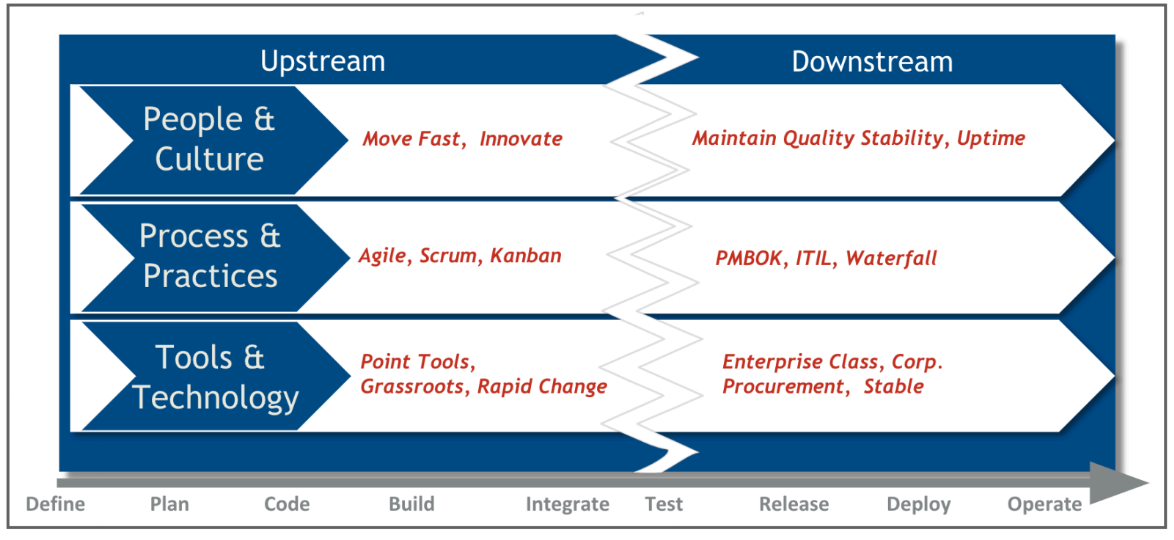
    At its core, DevOps is being about gaining alignment between all software development lifecycle participants on three planes – people, process and tools – often called the DevOps trinity. In this framework, the software development lifecycle is viewed as having upstream (development) and downstream (operations) halves. The two halves are part of the same software delivery process but in many traditional IT organizations these halves are highly disconnected (Figure 1).

    DevOps Upstream Downstream

    Figure 1: The disconnect between upstream and downstream people, process and tools.

    Upstream, the development culture usually prioritizes speed and innovation, whereas downstream the operations culture is tasked with a focus on maintaining quality, stability and uptime. Upstream, development uses point tools to define and build software using agile methods. Downstream, enterprise class tools are the norm for managing the test, release, deployment and operation of the software.

    Downstream meetings are much more likely to be filled with talk of Information Technology Infrastructure Library (ITIL) and Project Management Body of Knowledge (PMBOK) than Kanban and the latest scrum. DevOps is about connecting these worlds and eliminating the chasm that exists between the upstream and the downstream.A look at the “How” of DevOps

    Often, discussions on the how of DevOps are too narrowly focused on the technical core of what happens from the time developers commit code to the time software is deployed to a server. In reality, DevOps extends from the initial concept to the customer deployment.

    The full DevOps cycle starts with understanding the customer’s needs. Once they are clear, then you create a plan to define a solution, a plan to deliver it and a plan to support it once it moves into operation, where you gather customer feedback and the whole cycle begins again.

    Figure 2: Agile methods, continuous integration and continuous delivery provide the foundation for a DevOps transformation.

    DevOps –fad or here to stay?

    Anyone who’s been in the software industry for any length of time has seen fads come and go. The buzz for software-oriented architectures (SOA) was all the rage a few years ago, but that buzz faded to a whisper.  Waterfall methods are fading fast, replaced by agile development. How can you tell if DevOps is just the latest in a line of operational strategies that will fade out?According to a Harvard Business Review survey sponsored by Google, 86 percent of the 654 respondents say that it is important to their company to develop and put new software into production quickly. That leaves 14 percent who do not realize that they need solutions like DevOps. At times like this, it pays to step back, take a breath and take stock of where we are and where we are going. When we do, it becomes clear that DevOps is not a fad; rather it is the way successful organizations are industrializing the delivery of quality software today and will be the new baseline tomorrow and for years to come.

    DevOps today

    When research shows that most companies surveyed are planning to or are already transitioning to DevOps enabled by CD, that speaks to the current popularity of DevOps. In taking a closer look at the companies that have already adopted CD practices and a DevOps culture, many of these companies are the established leaders in their respective industries and hold a dominant market position. Having made substantial, long-term investments in CD and DevOps, they are already seeing impressive benefits. For example:

    • Amazon, the leader in public cloud infrastructure, now releases on average every second
    • Etsy, the leading peer-to-peer e-commerce marketplace, went from deployments that took hours to deploying changes 50 times per day
    • Ticketmaster, the world’s leading ticketing company and one of the world’s top 10 e-commerce sites, deploys to production at the end of every sprint or multiple times per sprint
    • Netflix, disrupter of the entire cable and TV industry and responsible for about 30 percent of North American internet traffic, deploys thousands of times daily
    • Nordstrom, a leading fashion specialty retailer with 323 stores in the U.S., increased the pace of releases to monthly from just twice per year
    • Allstate, the largest publicly held personal lines property and casualty insurer in the U.S. is now delivering new applications in half the time it took to deploy a single new feature
    • Coca Cola, the world’s third most valuable brand, has accelerated project delivery as much as 50 percent and cut defects in production by about half

    While some organizations have resisted making a DevOps transition – either due to confusion about what DevOps entails, concerns that it may just be a passing fad or a simple aversion to change – other organizations have jumped in with both feet.

    The organizations who’ve made the jump are eager to reap the benefits being realized by competitors and other companies that have already transitioned to a continuous delivery and a DevOps culture. These companies are differentiating themselves and delivering higher quality software faster by aligning development and operations across the DevOps trinity – people and culture, process and practice, and tools and technology. Better alignment across these three planes enables organizations to improve time to production, drive business value and reduce IT costs.

    CloudBees drives DevOps, CI and CD

    The CloudBees Suite enables companies to automate their software delivery with a layer of visibility and governance all built on DevOps and CI and CD best practices. CloudBees Core delivers Jenkins for the enterprise with a tested and verified Jenkins core, advanced enterprise features that extend the power of Jenkins, fully-tested updates and professional support for the Jenkins core and all 1,500 community plugins. The flagship offering provides high availability to support continuous delivery processes, as well as simplified manageability, security and scalability of Jenkins to ease administration across distributed Jenkins environments and IT architectures, on-premise or in the cloud.

    CloudBees DevOptics offers businesses the visibility into the software delivery pipelines to visualize their value streams and determine their DevOps performance based on industry metrics. CloudBees CodeShip enables teams to get up and running fast using CI/CD as a service while the CloudBees Starter Kit gets teams up and running for free with CloudBees Core and CloudBees DevOptics.

    DevOps customers including Capital One, IHG, Autodesk, Mabl and a host of others can attest to their DevOps transformations using CloudBees products. See what they’ve done by reading their case studies and decide on whether deploying a DevOps model is best for you.

    Where will your organization be in five years?

    Additional resources

  • Bitnami Offers Popular Application with Managed Database Configuration in Azure Marketplace

    Multi-tier Packages of WordPress and Drupal with Azure Database Services Remove Complexity of Deploying Enterprise Configurations

    SAN FRANCISCO, CA – January 15, 2018 —Bitnami, the leading provider of application packaging, is excited to announce the availability of WordPress and Drupal pre-configured with support for Azure Database for MariaDB in the Azure Marketplace. Bitnami has collaborated with the Azure Database Services team to deliver packages that make it much easier for companies to deploy enterprise configurations of these popular and widely used applications to Microsoft Azure.

    Deploying one of these new ‘Bitnami Certified’ application packages enables companies to realize the benefits of stability, security, and simplicity, while harnessing the power of a fully managed Azure database. The result is the ability to scale quickly and reach global distribution without worrying about costly downtime.

    “The new Bitnami packages significantly improves enterprise productivity by reducing the effort involved in packaging and deploying complex multi-tier architectures, while offering guaranteed high-availability, security, and dynamic scale with Azure OSS Database services” said Sudhakar Sannakkayala, General Manager, Azure Data engineering. “Our customers can now simply scroll through the Azure Marketplace, select an offering, and click ‘launch’ to deploy one of these applications.”

    “Bitnami has worked with the Azure Database team to create packages that deliver the reliability, security and ease of use of Bitnami Certified applications and the flexibility and power of Azure,” said Bitnami Vice President of Business Development and Sales Pete Catalanello. “Because Bitnami optimizes packaging for Azure, it is easy to utilize platform services such as databases, auto-scaling, and load-balancing. The combination of Bitnami and Azure delivers what customers say they care about most.”

    A long-term Microsoft partner, Bitnami provides a wide range of pre-packaged, easy to deploy open-source applications and development stacks to the Azure Marketplace. It supports Microsoft enterprise customers in multi-tier environments in numerous ways, and actively works with the Azure Database team to provide enterprise solutions and promote best practices. Other multi-tier Bitnami solutions for Azure include:

    • Stacksmith, which enables enterprises to package their own multi-tier applications for Azure and AKS. Users can define best practices once and enforce them when packaging and updating. This includes configuration requirements for the use of Azure Databases for MySQL, PostgreSQL, and MariaDB.
    • Kubeapps, an open-source web-based interface for discovering and provisioning applications on a Kubernetes cluster. Microsoft has partnered with Bitnami to integrate Kubeapps with Open Service Broker for Azure. With Kubeapps, users can create and present Helm charts that leverage Azure-native PaaS services as part of the architecture.

    With this combination, a user could deploy an application tier on AKS and an Azure Database backend to achieve a highly-scalable application with a highly available database. They could then use Stacksmith to maintain and update these applications with their PaaS service integrations going forward.

    Bitnami continues to expand the scope and number of enterprise solutions to make it ever easier for users to set up and deploy complex environments that leverage first party Azure services. For a closer look at these multi-tier enterprise solutions, register for the Create an Application-Centric DevOps Experience with Stacksmith and Azure OSS Database Services webinar. To access the new WordPress or Drupal packages, visit the Azure Marketplace.

    About Bitnami

    Bitnami provides packaged applications for any platform. The Bitnami application automation platform delivers and maintains a catalog of 130+ ready-to-run server applications and development environments in partnership with the world’s leading cloud providers including Amazon, Google, Microsoft and Oracle, driving over 1.3 million deployments per month. Bitnami is helping to shape the future of software deployment via its leadership role in the evolution of the Kubernetes ecosystem, including being the authors and maintainers of Kubeless and Kubeapps projects and major contributors to helm. Based in San Francisco and with offices around the world, Bitnami is a privately held, rapidly growing company. For more information, visit https://www.bitnami.com, or follow us on Twitter (@Bitnami) and Facebook.

    Kris Kraves

    Cogenta Communications, Inc.

    Let us amplify your message

    www.cogentacom.com

    @kriskraves

  • Nokia Releases Upgraded CloudBand Infrastructure Software to Secure 5G Cloud Deployments, Enhance Service Delivery and Reduce Costs for Customers

    • New converged CloudBand Infrastructure Software delivers secure, unified virtual infrastructure management software to secure 5G cloud deployments
    • The new release includes OpenStack directly from the open source community in order to move new capabilities to customers faster and to support the smaller footprint required for edge deployments
    • Enables management of virtual machines (VM) and containers in the cloud to ease the transition to the multi-vendor, cloud-native environments of the 5G era

    15 November 2018

    Espoo, Finland – Nokia today announced its latest CloudBand Infrastructure Software to give communication service providers (CSPs) and other customers sharper cloud management solutions that improve service delivery and significantly reduce operating costs as 5G deployments get underway.

    CloudBand Infrastructure Software gives CSPs the capability to unify their Network Function Virtualization Infrastructure/Virtualized Infrastructure Manager, or NFVI/VIM, in order to support centralized and distributed edge cloud deployments and workloads.

    The CloudBand Infrastructure Software upgrade streamlines operational procedures by providing a single NFVi/VIM for all cloud deployment needs, such as support and management for both VM and containerized workloads. In a 5G digital services era, there is greater dependence on containers in the cloud and Nokia CloudBand Infrastructure allows CSPs to gain experience with cloud-native architectures without introducing completely different tool chains.

    Addressing a combination of IT and Telco use cases enables Nokia CloudBand customers to reduce cost and complexity compared to proprietary siloed approaches.

    “Operators risk unwanted complexity and costs in their OpenStack infrastructure by creating new virtualized silos, and they stand to benefit from a unified approach ,” Peter Fetterolf, CTO of ACG Business Analytics. “By streamlining process definition, execution, and maintenance across multiple vendors for activities like onboarding Virtual Network Functions, deploying and updating software, and troubleshooting using disparate tool chains, operators can reduce the cost of managing and maintaining cloud infrastructure by 92% over a five-year period and total cost of ownership by 56% over the same period.”

    Nokia CloudBand Infrastructure Software includes OpenStack software directly from the open source community to address several challenges facing OpenStack adopters; for example, providing timely maintenance and feature updates and localized infrastructure security compliance. It also includes full Software Defined Networking domain controller pre-integration to give customers an end-to-end solution with lower integration costs and improved time-to- market.

    Guy Shemesh, Head of CloudBand at Nokia, said: “Nokia’s latest CloudBand Infrastructure Software improves on OpenStack’s operational state and removes risk and complexity for CSPs. CloudBand Infrastructure Software supports a combination of IT and Telco network cloud deployments, including stringent radio requirements, as well as Enterprise cloud needs. It is the best-in-class solution for converged cloud management solutions. This next-level solution is being swiftly rolled out for Nokia customers.”

    Nokia’s CloudBand management and orchestration (MANO), including CloudBand Infrastructure Software, have been key components in several multi-year customer deployment agreements in 2018. These have included StarHub to accelerate mobile data speeds to 1Gbps; BSNL to support the roll out of 4G and Voice over LTE services in India; and T-Mobile to support their nationwide, multi-band 5G network rollout across the United States.

    Resources

    • Web page: Nokia Cloudband Solutions
    • Press release: StarHub Accelerates Mobile Data Speeds to 1Gbps
    • Press release: Nokia and T-Mobile leading the way with nationwide 5G multi-band network rollout across the United States
    • Press release: Nokia and BSNL to roll out 4G and Voice over LTE services in India

    About Nokia We create the technology to connect the world. Powered by the research and innovation of Nokia Bell Labs, we serve communications service providers, governments, large enterprises and consumers, with the industry’s most complete, end-to-end portfolio of products, services and licensing.

    We adhere to the highest ethical business standards as we create technology with social purpose, quality and integrity. Nokia is enabling the infrastructure for 5G and the Internet of Things to transform the human experience. nokia.com.

    Media Inquiries: Kelly Stone The Hoffman Agency for Nokia Software Communications Phone: +1 206-618-2028 Email: kstone@hoffman.com

    Nokia Communications Phone: +358 10 448 4900 Email: press.services@nokia.com

  • InfluxData Time Series Database Extends Industry Lead with Performance and Data Compaction Enhancements in Latest Release

    Company Also Launches Technical Preview of Industry’s First Purpose-Built Functional Query Language for Time Series Data Ready for Developer Community Trial and Feedback

    SAN FRANCISCO — Nov. 7, 2018 — InfluxData, the modern Open Source Platform built specifically for metrics, events and other time series data that empowers developers to build next-generation monitoring, analytics and IoT applications, today announced the release of InfluxDB 1.7, delivering important query performance and data compaction enhancements to the leading Time Series Database. Announced at InfluxDays SF 2018, this new functionality gives developers powerful tools they have been asking for to query and process time series data used for monitoring IoT, DevOps, cloud, containers, and real-time analytics data.

    InfluxDB is InfluxData’s Time Series Database used as a data store for any use case involving large amounts of time-stamped data – including DevOps monitoring, application metrics, IoT sensor data, and real-time analytics. These enhancements announced today, as recommended by the community, further the gap between the functionality of InfluxDB – recognized as the overwhelming leader among Time Series Database management systems, according to DB-Engines’ latest results – and the competition.

    InfluxData has also announced the technical preview of Flux, the industry’s first purpose-built functional query language for time series data. Flux combines data query and processing in a single powerful and extensible open source language, which is enriched through user contributions. Developers are encouraged to use Flux and provide feedback to help shape the future of the time series data scripting.

    “InfluxDB is one of the most popular data sources for Grafana, and Flux is a powerful query processing engine, so we were excited to develop a first-class integration for Flux,” said David Kaltschmidt, Director, UX, Grafana Labs. “The Flux plugin comes with a new query environment which includes syntax highlighting, tag completion, raw table preview, and inline function documentation to help you get the most out of using Flux with Grafana.”

    The open source InfluxDB 1.7 delivers major improvements around query performance and throughput when using the Time Series Index (TSI), which supports large numbers of unique time series data that is ephemeral and stored in Time Series Databases.

    The technical preview for Flux is available today for developers’ trial and feedback. A getting started guide is available now from https://bit.ly/2qph9Xx which provides specific examples along with a reference for the language semantics. Developers are encouraged to use the InfluxData community site (https://community.influxdata.com) to ask questions and share experiences. To launch the Flux technical preview, InfluxData will host Office Hours today at InfluxDays SF 2018 to continue efforts towards finalizing the language, address questions, and take additional feedback.

    “Performance, data compaction and Time Series Index improvements help InfluxData maintain its leadership position in this category by delivering superior performance and meeting the advanced needs of the developers,” said Tim Hall, VP of Products. “InfluxData has been working closely with the developer community in defining the Flux language. We look forward to developers downloading Flux, using it and providing us with useful feedback to help make the language a success.”

    Metrics, events, and other time-based data are being generated at an exponential rate, as there is a growing requirement for analyzing today’s complex environments. The InfluxData Platform provides a comprehensive set of tools and services to accumulate metrics and events data, analyze the data, and act on the data via powerful visualizations and notifications.

    InfluxData has rapidly built its developer and customer base across industries – including manufacturing, financial services, energy, and telecommunications – by delivering the fastest growing Open Source Platform that enables customers to derive better business insights, data-driven real-time actions, and a consolidated single view of their entire infrastructure – from applications to microservices, and from systems to sensors. More than 450 customers, including Cisco Systems, Coupa Software, IBM, Houghton Mifflin Harcourt, Nordstrom, and Tesla, have selected InfluxData as their modern data platform for metrics and events. InfluxData is pioneering the shift to time series in a modern metrics and events platform, and is making it possible for customers to become data-driven and take on digital transformation initiatives.

    Availability

    InfluxDB 1.7 is available today. It is available for download at https://portal.influxdata.com/downloads .

    About InfluxData

    InfluxData, the creator of InfluxDB, delivers a modern Open Source Platform built from the ground up for analyzing metrics and events (time series data) for DevOps and IoT applications. Whether the data comes from humans, sensors, or machines, InfluxData empowers developers to build next-generation monitoring, analytics, and IoT applications faster, easier, and to scale delivering real business value quickly. Based in San Francisco, InfluxData’s more than 450 customers include Cisco, eBay, IBM and Siemens. Visit https://www.influxdata.com/. Twitter: @influxdb.


  • Dell Boomi Enhances its Enterprise iPaaS Portfolio

    Dell Boomi Announces New API Gateway and Developer Portal, Self-Service Offering, Blockchain Integration, Data Services for Pivotal Cloud Foundry, Enterprise Innovation Services and Bot SDK 

    https://boomi.com/press_release/dell-boomi-enhances-its-enterprise-ipaas/

    LAS VEGAS – BOOMI WORLD 18 – November 6, 2018 – Dell Boomi™ (Boomi), the leading transformation provider of cloud integration and workflow automation software to build The Connected Business, announced, at Boomi World 18, the company’s latest additions to its integration Platform as a Service (iPaaS) for today’s enterprise. The only vendor to offer a unified platform with built-in data quality and connectivity across the enterprise —from people, applications and databases to devices and things—Boomi defines the iPaaS industry today.

    With its latest capabilities for The Connected Enterprise —Boomi Connect Now, Boomi Data Services for Pivotal, Boomi API Gateway and Developer Portal, Bot SDK and new Professional Services offerings —Boomi provides the tools organizations need to support a breadth of use cases across all personas, ensuring both high productivity and IT control. Boomi democratizes integration, making it accessible to all users regardless of their level of technical expertise or role in the organization from citizen developers, business analysts and integration experts.

    “Sky’s mission is to connect customers to more of what they love. Dell Boomi’s ability to connect data, processes and people has an extremely positive impact on the experience Sky provides its 12 million UK customers,” said Olive Perrins, Service Strategy Manager at Sky. “Our people are critical to our success and being able to bring together our rich talent along with critical applications and data will be key to our continued success.”

    New highlights of Dell Boomi’s capabilities geared toward the enterprise include:

    • Boomi Connect Now – Allows partners and select customers to provide a centralized self-service offering for users who don’t have integration expertise. Boomi Connect Now increases productivity for the business user, customer, vendor or supplier by assisting in accomplishing quick, foolproof integrations, while IT still maintains total control.
    • Boomi API Gateway and Developer Portal – As we look to redefine the definition of integration to evolve beyond data and applications to include people, it’s increasingly important to facilitate secure and scalable interactions with external parties. By leveraging the gateway functionality, our customers will have increased confidence in the security and scalability of the services that they provide. Furthermore, with the developer portal, our customers will greatly enhance the discoverability and be able to engage at scale with their broader API consumers.
    • Data Services for Pivotal – Boomi and Pivotal now offer customers even faster deployment of the Boomi iPaaS, with deployment options available for Pivotal Kubernetes and Pivotal Application Services environments (PKS/PAS) from the Pivotal Cloud Foundry marketplace. This allows joint customers to rapidly respond to changing customer needs and provides a modernized IT infrastructure to help organizations become agile and cloud-first. Deep integration and seamless runtimes allow Boomi integration to fit seamlessly into Pivotal’s Continuous Integration and Continuous Delivery (CI/CD) framework.
    • Boomi Enterprise Innovation Services – The latest professional services offering from Boomi allows enterprise customers to collaborate with Boomi experts to achieve innovation and excellence at scale and fully capitalize on Boomi’s industry-leading integration cloud to build a connected business. Available as a subscription, Dell Boomi Enterprise Innovation Services provides a package of integration services, support and resources, with the flexibility to customize to specific customer needs.
    • Architectural Services – Allows customers to harness the full power of evolving IT architectures by partnering with Dell Boomi’s architectural experts. With this service, customers can collaborate with Boomi technical, solutions, business and enterprise architects who offer unmatched industry experience.
    • Blockchain – The evolution of business will require the ability to integrate with blockchain smart contracts. Boomi’s world-class platform offers support for the industry-leading blockchain platforms Ethereum and Hyperledger Fabric, so customers will now be ready to quickly and easily incorporate smart contracts into their business processes.
    • Bot SDK – an accelerator toolkit that packages everything a Boomi developer needs to build a bot. Customers can now achieve faster time to market with bots that are highly integrated into their existing infrastructure and optimized for lead generation and ROI in as little as 15 minutes.

    Additional Leadership Quotes

    “Just as is the case today with most businesses requiring an integration platform solution like Dell Boomi that helps them solve their integration challenges of a hybrid landscape, business will need to solve challenges that now require integration of their hybrid landscape and blockchain smart contracts,” said Michael J. Morton, CTO, Boomi.

     “We are seeing Boomi developers build their presence at every enterprise organization, extending their reach within a line of business and influencing business decisions,” said Steve Wood, Chief Product Officer, Boomi. “With the continued growth of our enterprise offerings, we are committed to improving organizational productivity and helping developers lead their organizations—whether that’s doing their own custom work in the Boomi environment, supplementing it with outside sources and expertise or providing their organization the tools it needs to enable its own citizen integrators.”

    “Perficient has strong, strategic partnerships and implementation experience with Dell Boomi and Pivotal, key technologies which support IT modernization,” said Vishal Rajpal, general manager of Perficient’s cloud platform solutions group. “The depth and breadth of our experience and expertise positions us to expertly deliver these platforms, accelerating digital transformation for our clients. Together, these technologies unleash powerful application development and cloud integration capabilities that our customers need.”

    About Dell Boomi

    Dell Boomi (Boomi), an independent business unit of Dell, is the leading provider of a unified platform to build The Connected Business, from cloud integration to workflow automation. Boomi helps organizations accelerate business agility by connecting data, applications and people to run faster and smarter. Visit http://www.boomi.com for more information.

    © 2018 Boomi Inc. Dell, Boomi, and Dell Boomi are trademarks of Dell Inc. or its subsidiaries. Other names or marks may be the trademarks of their respective owners.