Category: DevOps Toolbox

  • Watch Your Language(s)

    Watch Your Language(s)

    Just about every organization I am familiar with today is using more languages, frameworks, libraries, etc. than they were a decade ago. Back then, most organizations were doing a lot of Java, and maybe a little bit of PHP or .NET (almost always VB.NET). Now we have Java, Python, Ruby, Go, Swift, etc. And etc., etc.

    The problem is that employees don’t come pre-instructed with your selection of languages. Most developers can bring Java or Python and most know at least one other language well. All of them can learn (more on that in a moment), but when hiring, an organization needs to focus on the one or two languages the hiring team is using, not all the languages an organization might ask a developer to learn over the course of their employment. After all, when hiring 20 years ago, the tools of the mainframe team weren’t generally listed as requirements for a desktop developer. While there is a difference (desktop developers were only asked to work on mainframes when the shortage of experienced big iron devs got really bad), it is a similar situation today.

    You can hire with an eye to training, and most developers will be more than willing to pick up a new language and learn its ins and outs. But ask any manager that pays close attention, and they’ll let you know that there is a huge difference between time-to-productive and time-to-proficient. One manager told me that any programmer with experience could start contributing relatively quickly in Ruby, but to do the important stuff—things like knowing which array access methods were faster and the most efficient communication between Ruby and other languages—took far longer. His numbers seemed too high, in my opinion and based on my experience, so I asked around. All the managers I know that worked with Ruby (because to a great extent, this is language-dependent, so I didn’t want to make hasty generalizations though, in hindsight, the same data point in Python would have given me more responses) agreed there is a curve, and the range was somewhere between six months to two years. This is strictly anecdotal, but it seems the more technical the team in question, the longer the manager thought proficiency would take.

    But even if the lower number is accurate and applies more generally, it is an argument for keeping your language count down. Yes, some languages are better at X or Y or Z than others, but most modern languages can do just about everything an average enterprise team will ask of them. So, keeping languages within a smaller pre-defined set still allows teams to choose the best tool for the job while keeping the number of skills developers at the organization might need down to a manageable level.

    And keep wowing them. No matter what languages you are using, your user base is logging in and using the results daily—or perhaps your devices are reporting the results daily or processing them. No matter how you are delivering, you are, as our digital world shows. Keep rocking it, and do what you can to keep the number of languages under your roof down.

  • Using Data Fabric for Real-Time Processing

    Using Data Fabric for Real-Time Processing

    Charlene O’Hanlon and Scott Gnau from InterSystems talk about silos in organizations and how data fabric enables organizations to process, transform, secure and orchestrate data from disparate sources in real-time. The video is below followed by a transcript of the conversation.

    Announcer: This is Digital Anarchist.

    O’Hanlon: Hey, everybody, welcome back to Tech Strong TV. I’m Charlene O’Hanlon, and I’m here now with Scott Gnau, who is the VP of Data Platforms at InterSystems. Scott, thank you so much for taking the time and getting on the call with me, I really appreciate it.

    Gnau: And likewise—thanks for having me. It’s great to be here.

    O’Hanlon: Alright. So, tell me a little bit about InterSystems.

    Gnau: InterSystems is a creative data technology company, we’re based in Cambridge, Massachusetts. We’ve been around for about 40 years, and we actually build data integration, data platform technology that’s used by a lot of very sophisticated applications around the world—in fact, more than half of medical records in North America go through our systems, 15 percent of global equity trades touch an InterSystems data platform or interface along the way.

    So, we’re known for solving very large, complicated, business critical problems that are centered around data.

    O’Hanlon: Well, data is the new oil, right, is that what I’ve heard? Time and time again, so many companies now rely on the data to make their business decisions and find areas of opportunity and so much more just, you know, ways to do their business better. So, data—you guys are definitely in the right space, for sure.

    Gnau: Absolutely.

    O’Hanlon: [Laughter] So, let’s talk a little bit about, then, the issue of silos when we’re talking about data and access to data, especially when we’re talking about things such as customer experience or uncovering those opportunities within the business, whether it’s improving internal processes or external applications and issues and things that do touch end users.

    So, we’ve been talking for a long time about breaking down silos when it comes to data, but do you think that that’s something that’s feasible or do you think that it’s kind of one of those wishes that will never really come true?

    Gnau: [Laughter] I’ve kind of given up on the breaking down the silos, and I’ll back into that with, you know, I’ll hit on a couple of things that you said. Because I think some of the things you said are actually really, extremely relevant, right? Data being the new oil and, you know, people have been saying that, and it’s absolutely the case. If you look at the wealth that was created in the 18th Century, it was railroads, and if you look at the wealth that was created in the 20th Century, it was energy and oil, right? Look at the wealth that’s been created in the last 20 years. It’s all about data centric kinds of companies, right?

    O’Hanlon: Right.

    Gnau: And that’s a really cool thing. And the difference really is, you know, companies can leverage that data not only to understand their business and have a rearview mirror view of what happened in the business and be able to make better decisions about it, but actually synthesize that data into building new businesses for themselves and new ways to interact with customers and so on. So, it’s absolutely critical and important.

    And sadly, I’ve been in industry, I guess, about 35 years. It feels like just five, but a long time. And throughout that career, we’ve been talking about how do we break down silos in data and silos in data processing? And, you know, silos crepe up for many different reasons. They can creep up because you’ve deployed an application that’s very specialized to go solve a problem that’s extremely important and the data that gets collected is kind of in that application and not shared easily, and that becomes, eventually, a silo in and of itself.

    Certainly, there are business model and political silos that get created, right? I’ve got a business unit model and the mortgage folks don’t wanna talk to the consumer lending folks don’t wanna talk to the deposit folks and so on. And it’s also very easy for silos to build up because of geographic differences in the business, right?

    O’Hanlon: Mm-hmm.

    Gnau: And so, this has been going on for a long time, and for a long time, we in technology have tried to solve and advise our clients, “Hey, don’t let silos control you.”

    O’Hanlon: Right.

    Gnau: I would say that the problem of silos and how they come up has actually gotten larger and is increasing at almost an unimaginable pace. Certainly, with the advent of the cloud and microservices and easy to spin up applications, more and more silos can come up very, very quickly. The fact that data and relevant data, the oil of our businesses used to be created inside the business, inside the firewall by our application, so we actually had some semblance of control over it. Now, a lot of the data that we need to use, understand, consume, and drive decisions from may live its entire life cycle outside the firewall of our business and out of our control.

    So, you think about one of the drivers of silos, and it just has now gone kind of exponentially very different.

    O’Hanlon: Mm-hmm.

    Gnau: Certainly, the pandemic has created more geographic silos, but also, the need to be able to deploy data and decision making very quickly as many of us have been remanded to our home offices and trying to manage customer relationships and run our businesses remotely in a new and a different way.

    So, I think kind of the drive for silos is going to continue to increase. And so, I think it’s also then unimaginable to think that we will live in a world without data silos. So, if that were the case, it’s kinda like, how do we come up with an approach that lets us leverage and build beyond that?

    O’Hanlon: Yeah. So, you know, it’s a very good point that you make, the fact that we’ve had so many silos, the number and the velocity of silos has increased multifold, I would imagine, since the onset of the pandemic. And with this remote and hybrid work environment that we’re now entering into, I don’t think those silos are gonna be going away.

    So, short of I don’t know what, short of whatever an organization needs to do to break down those silos, how can an organization work effectively to access that information and to get the information they need and really kind of make the most of it without being able to break down those silos? Is there a way that they can still utilize that information as effectively as they could if there was—you know, if everything was kinda linear and they could just kind of skip across the data meadow, if you will, and kinda pick the flowers as they went along? I don’t know where that analogy came from, but [Laughter].

    Gnau: Well, listen, it would be less interesting if it was equally kind of a serial thing when you go pick up those flowers.

    O’Hanlon: Right, right.

    Gnau: And certainly, we talk and work with our clients, really, about this concept that we call the data fabric and a lot of technology ins and outs and all that kinda stuff with data fabric, which we probably won’t get into a lot today, but it’s almost at a mindset. And the way I describe it, being a pilot myself, is—think about being able to have a control tower kind of impact to how you manage and integrate your silos.

    So, think about control towers in flight, right? What is the purposes of having control towers? Well, obviously, the mission is to provide safe flights. How do they do that? Well, they connect different kinds of data together and synthesize that data for decision making, right? They don’t consolidate it, they don’t fly the planes, necessarily, but they collect that data and then disseminate it in a way to kind of control and coordinate the flow.

    O’Hanlon: Right.

    Gnau: They also, it’s not a single point of contact kind of consolidation, right? There’s a control tower at every airport, right? And they connect to each other as well to manage traffic between their segments and sectors in that grid. And so, the notion of control tower is a way to think about, how do you apply that technologically speaking into thinking about your infrastructure more as a data fabric and the things that are necessary from a mindset—again, not a specific technology or a vendor, necessary—but just a mindset of how to manage through the notion of silos.

    And so, the first thing, really, is something that’s also kind of nontraditional in data processing, at least during my career, it’s all about connecting data and not consolidating data, right? And for many years, it was like, “How do I consolidate all this stuff into one place to make it more manageable to take cost out?” and all that kinda stuff. Again, in a cloud-centric world, almost unmanageable.

    O’Hanlon: Mm-hmm.

    Gnau: So, instead of thinking about consolidating it, really think about how do you connect the different data across different places? And that obviously becomes a key part of your data fabric—the connectivity, the pipes, and the widgets, and how they fit together. Connectivity isn’t enough without context.

    O’Hanlon: Mm-hmm.

    Gnau: So, data that’s created in the silo may have a certain context inside of the silo, but that context needs to be reflected externally just like the control tower needs to understand what kind of plane you’re flying, because they’ll understand the operating capacity of that plane—how fast does it go, how high can it go, and what are its maneuvering capabilities, right?

    Same kind of thing in a control tower kind of aspect to data fabric—connect the data and provide context for the data so that, as the data get connected, there’s some relevance to what is happening and something could actually be derived from it.

    O’Hanlon: That makes a whole lot of sense, and to your point, having the data remain kinda siloed and just being able to kinda select the data that you’re looking for, you know, that’s most relevant to you at that time, I imagine actually, is a little bit easier than kinda sifting through an entire haystack for one little needle. So, that’s a really interesting concept.

    Is this a technology that is currently being used within the data management space, the data science space?

    Gnau: You know, there are more and more people talking about it, and I’m sure there’s some folks that maybe have different words to describe it. We’re thinking, and some of the analysts that we work with as well, are talking about the data fabric. I’d say first and foremost, it’s a mentality, but like I said, connect, don’t consolidate. Provide the context. Have the control towers communicate amongst themselves so it’s not a single control tower but multiple different control towers for the context or the application that’s required and kinda think about the network effect of being able to build that out.

    Once you have that mentality, then it comes down to a checklist of, you know, certainly a list of what is the existing technology that we have and what is the existing technology that we use, how are the data created, how are the data stored—you know, kind of just a roadmap of what ya got. And then, think about the connectivity and the context provisioning that you want to create and look at other technologies that might need to be added to the mix to make that work in an end to end state.

    So, it’s a mindset first, and then it’s a collection of some technologies to enable that, and it’s a combination of the existing stuff that you’ve got, and certainly, an application that’s been deployed in a business-critical nature, you’re not gonna yank that out for some technology decision. So, again, it’s all about that connectivity and fitting it together and piecing it together.

    The other thing that most of the clients that we’re talking with about this are very pragmatic, it’s not a—like anything ever really should be, it’s not a 10-year plan, but it’s an, okay, how do I map this sector? How do I put a control tower at this airport and this airport and how do I leverage that, right? So, how do I go connect this silo and that silo, and then let’s go get the next silo and let’s go get the other business unit and figure out how to kinda build that out over time.

    And what’s really cool is, the value accelerates as you start to collect more of these things together. And, you know, you’ve got three or four and then you add the fifth one—the value doesn’t go up 20 percent, the value actually, of what you can do with that can go up dramatically, much higher, because of being able to understand all of the customer interaction points and create new programs, or leverage that data to actually go build a new line of business that your customers weren’t expecting.

    O’Hanlon: Mm-hmm. Right, right. Interesting. That’s really, really fascinating to me. Now, does this also kinda democratize the data? Does it enable other parts of an organization to access the value from a lot of this data by using this data fabric without the need for maybe a data scientist or somebody who’s a specialist in this in an organization?

    Gnau: Yeah, absolutely, absolutely. And again, it’s a mentality and needs to be kind of thought of with a design going in, right?

    O’Hanlon: Mm-hmm.

    Gnau: So—right, in today’s world, thinking about security and privacy on one plane and then democratization of data on the other plane, they’re almost kind of at odds. So, there needs to be some forethought that goes into what is appropriate for the appropriate eyeballs in these different spaces, and then again, making sure that the technology stack that’s been built out has the capability to deliver that. But certainly, companies that—in my experience, at last, companies that have the most success in kind of refining their oil, their data, are the ones who are actually getting data anywhere that the data need to be for a decision that’s local, right?

    So, you know, people talk about real time decisions and real time AI models and all that kinda stuff. All really compelling, all really valuable, but all completely worthless if you can’t leverage that to deliver a yes to a customer when the customer asks a question, right? And so, democratization and the architectural democratization of the data is an important key component to making your data fabric really successful and really showing up with a lot of value for the business.

    O’Hanlon: And I would imagine that AI, machine learning—you know, those technologies can actually add a whole lot to making this a much more intelligent way of gathering data as well.

    Gnau: Yeah, and it’s a symbiotic relationship, right? So, you know, machine learning and AI are all the rage and all really good stuff. A lot of the math behind it is not particularly new. What’s interesting is, the math behind it dictates that the more data you add to the model, the more accurate the prediction becomes, right? And that is very different than some of the previous kind of data mining and data science stuff that went on.

    And so—okay, that means you need lots of data. How do you get lots of data? Well, you don’t if it’s in a bunch of silos that don’t talk to each other with no context and no connectivity.

    O’Hanlon: Right.

    Gnau: So, I actually think they’re kind of symbiotic in that an effective data fabric could actually enhance the capabilities of your AI programs, and your AI programs can actually enhance the value of your data fabric in return.

    O’Hanlon: That’s really, really fascinating. [Laughter] I love this topic. I think this is definitely something that more organizations should be considering, because you know, especially if you think about just the sheer volume of data that’s out there and, I mean, really, what organization today is not basically putting their entire business on the shoulders of data without having that information that they need to make those business decisions to uncover those opportunities to just basically survive and thrive in today’s environment. I really—short of having that data, I just don’t know how organizations today can do it.

    So, I think anything that’s going to make it easier for them to uncover those areas of opportunity and find those nuggets of information that’s in all of that data, I think, is gonna be a huge, huge value add for organizations.

    Gnau: Yeah. I mean, and the last piece, really, of success for a data fabric and why I think data fabric is so important—I tried to come up with something that started with a C, because I said connect and then context. But the last one really is lineage, because lineage creates trust.

    O’Hanlon: Mm-hmm.

    Gnau: So, you know, it’s interesting, the other interesting thing about some of the AI models out there is that the answers they create are actually sometimes not intuitive.

    O’Hanlon: Right.

    Gnau: And as human beings going to execute these things, we’ve gotta really trust that the models and the data are effectively connected, so that we’re gonna risk our business on these decisions, right?

    O’Hanlon: Yep, yep.

    Gnau: And so, you know, connectivity, context, and ultimately lineage or trust of the data are kind of the three key components, again, of the mentality. Nothing to do with technology, but you’ve gotta kinda build in what’s your framework, what’s your appetite in your business for these pieces and then go look at the technology landscape to start building it out.

    O’Hanlon: That’s a very intelligent way of going about that, too, so—I love that. Scott, thank you so much for having the conversation with me about data fabrics. I know we’re gonna be hearing more about it in the future. I think it’s a great mindset and a great way to approach data access and data use in an organization. So, thanks again for your time and your expertise, I really do appreciate it.

    Gnau: Thank you.

    O’Hanlon: Yeah. Alright. Alright, everybody, please stick around, we’ve got lots more Tech Strong TV coming up, so stay tuned.

    [End of Audio]

  • Kong Enterprise 2.7 Simplifies API Management

    Kong Enterprise 2.7 Simplifies API Management

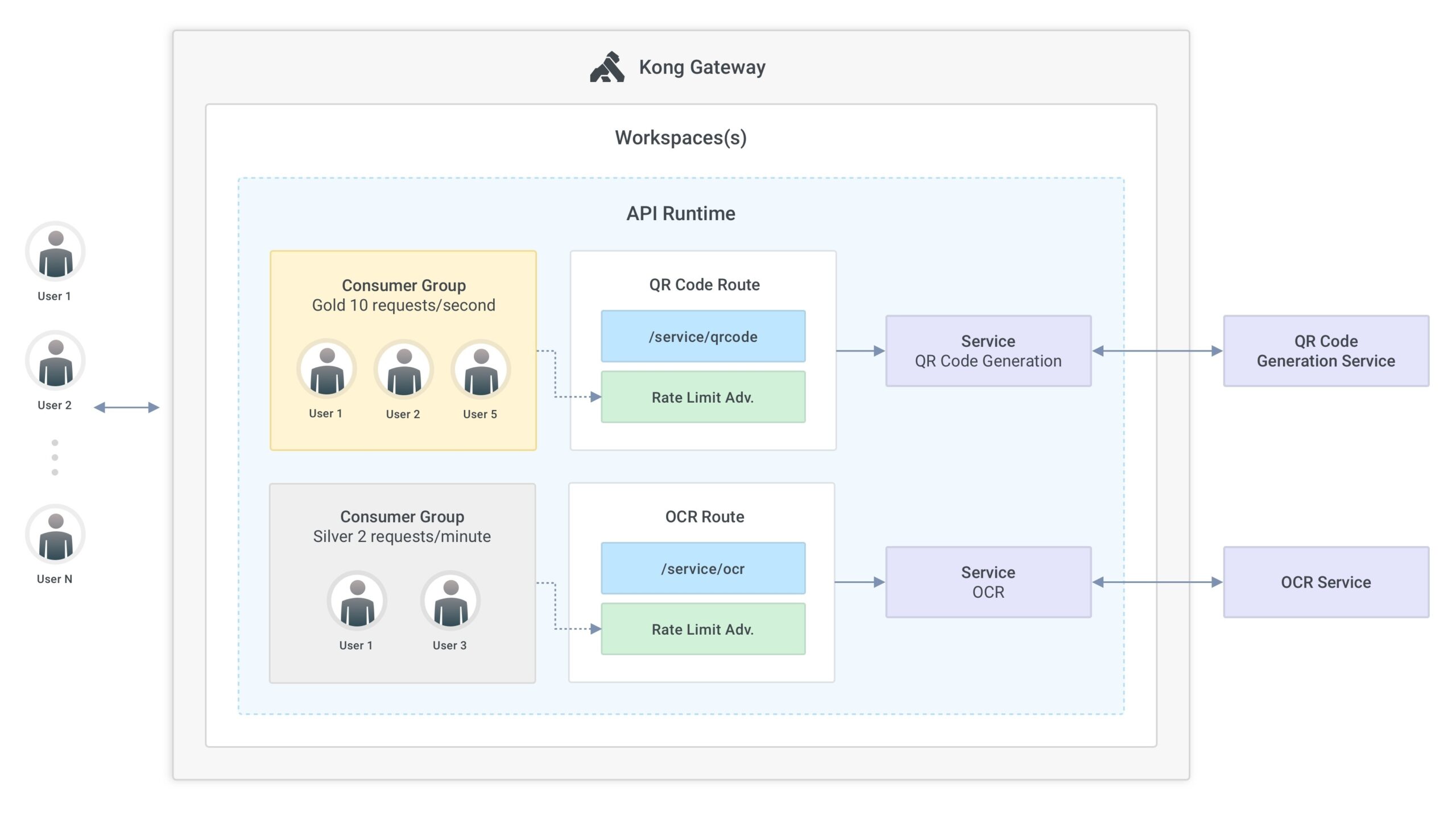
    Kong Inc. this week advanced its service connectivity platform strategy with an update to Kong Enterprise that makes it simpler to collectively manage groups of application programming interfaces (APIs).

    Michael Heap, director of developer experience for Kong, Inc., said that capability will make it simpler to, for example, assign rate limits to different tiers of APIs.

    In addition, Kong Enterprise version 2.7 adds support for real-time and event-based use cases involving the open source Kafka streaming platform and webhooks. Usage of event-driven architectures is rising as more organizations embrace digital business transformation initiatives that require near-real-time processing versus relying on traditional batch-oriented applications, noted Heap.

    Finally, IT teams can now also securely store secrets such as user names/passwords, API tokens, database credentials and private keys that might be used to access Kong Gateway. An improved user interface for Kong Manager UI makes it simpler to configure the Kong OpenID Connect (OIDC) Plugin for the Kong Gateway.

    Overall, Heap said, the latest update also provides 25% increased throughput and improved latency. In tests run by GigaOM, a third-party research firm, Kong Enterprise 2.7 achieved 52,250 transactions per second (TPS) maximum throughput with a 100% success rate.

    Kong is making a case for a service connectivity platform that enables an IT team to manage APIs at a higher level of abstraction by integrating all Layer 4 through Layer 7 services for both monolithic and microservices-based applications. Rather than having to manage an array of networking services and associated services in isolated silos, that layer of abstraction makes it simpler to manage distributed applications that have dependencies on a wide range of APIs.

    In general, the number of APIs that organizations are using both internally and externally has expanded tremendously over the last several years. The challenge now is finding a way to not only manage and secure all those APIs but also retire them as new services come online. Many APIs are created and simply forgotten about because their developer neglected to inform IT operations of their existence. Those so-called “zombie APIs” then become a cybersecurity liability when cybercriminals discover they can surreptitiously exfiltrate data via those APIs.

    APIs are, of course, an integral element of any software supply chain. But as high-profile security breaches put software supply chain security in the spotlight, it’s only a matter of time before IT teams look for more efficient ways to manage and secure APIs at scale.

    Inevitably, that also means organizations will need to decide how much they want to rely on proxy software, API gateways and service meshes to achieve that goal within the context of a larger service connectivity platform.

    In the meantime, the days when APIs were managed in isolation from the rest of the IT organization are coming to an end. The only thing left to determine is how involved API developers need to be in their ongoing life cycle management.

  • Codenotary Launches Cloud Service to Generate SBOMs

    Codenotary Launches Cloud Service to Generate SBOMs

    Codenotary has launched a Codenotary Cloud platform that can automatically generate a software bill of materials (SBOM) and make it easier to discover what components have been included in an application.

    Moshe Bar, Codenotary CEO, said that capability can also play a key role in identifying which components in an application might contain, for example, the Log4jShell vulnerabilities that were recently discovered in Java applications.

    That capability can reduce the time required to remove insecure artifacts by as much as 80% simply because organizations are not dependent on scanning tools to search for vulnerable components, added Bar.

    Codenotary Cloud is based on an immutable open source immudb database that cryptographically attaches an identity to each software artifact. In the wake of a series of high-profile breaches, there’s now a lot more focus on the integrity of software supply chains. In fact, the Biden administration recently issued an executive order requiring all federal agencies to, among other things, make sure an SBOM is available for all the software they use.

    Codenotary claimed Codenotary Cloud can scale to millions of integrity verifications per second across source code, builds, repositories, Docker container images and Kubernetes deployments in a way that doesn’t require DevOps teams to upload data to a centralized platform, noted Bar. That makes it possible to notarize and verify the provenance of all the code being employed, he added.

    Codenotary Cloud can also be fully integrated with most vulnerability scanners and popular cloud-native continuous integration/continuous delivery (CI/CD) systems running on any cloud or on-premises host via a managed service. Pricing starts at $5,500 for a workgroup of 10 developers.

    It’s not clear to what degree the Biden administration’s executive order will improve overall software security. There have been multiple vulnerability issues over the years that have not resulted in any material change in how organizations manage their application development processes. However, the executive order issued by the Biden administration, coupled with a recent summit on the state of open source software security, means more senior business and IT executives are at least aware of growing concerns.

    The one thing that is certain is there will be more zero-day vulnerabilities discovered. Developers today routinely reuse open source software and free components maintained by a small number of volunteer programmers. Like any other developer, the amount of security expertise those individuals have is limited. Many organizations reuse that code without contributing anything meaningful back to the project—either in terms of financing or vulnerability identification and remediation support. Contributors to these projects freely donate their time and expertise to build these components. Many of those contributors feel the onus for securing the software they created is on the organizations that decide to deploy that software.

    Regardless of who is responsible for security, it’s apparent cybersecurity teams are going to be reviewing application development processes. Theoretically, that should benefit all concerned and lead to DevSecOps best practices being more widely adopted.

  • How Does IT Management Govern EverythingOps?

    How Does IT Management Govern EverythingOps?

    The number of tools engineers use to provision software architecture in the cloud is starting to get a little out of hand. There are many competing ways to do one thing. Most often, people simply adopt a new tool to solve a DevOps problem in the moment, not always considering the longevity of the solution or how other departments are handling it. This could result in fragmentation and technical debt, making it difficult to find consistency and increase speed simultaneously across all company divisions.

    I recently interviewed Jeff Kukowski, CEO, CloudBolt Software, to explore why these issues persist and how executives should approach cloud management within their organizations. According to Kukowski, many flavors of Ops now permeate large companies. Different approaches often exist per department or interdepartmental, with teams using various software stacks.

    According to Kukowski, a new frame of mind will be necessary to remain agile in the new cloud order and to address this state. Doing so will require organizations to erode false dichotomies around ownership and IT governance.

    Everything’s Going Ops

    At this point, most large suites of digital services have adopted a complex hybrid and multi-cloud modality. And many teams have embraced their own unique form of DevOps to get a handle on the management difficulties of delivering software and maintaining reliability for microservices architectures. Different groups pulling in various directions create an ongoing battle of EverythingOps, explained Kukowski.

    You can think of it as separate Ops approaches emerging around different business functions. For example, FinOps is emerging to control spending, ITOps is about delivering services, DevOps is improving release fluidity and DevSecOps aims to bring security to the forefront of the release process. Lastly, BizDevOps is about increasing observability for business outcomes.

    At a high level, CIOs have committed to digital transformation to move quicker. Yet the problem now is “battles between different Ops can easily lead to broken IT governance,” said Kukowski. This tension introduces several false dichotomies, he explained. In addition to slowing agility, a lack of DevOps unity eschews reusability, contributing to waste and increased IT expenses, said Kukowski.

    Solution: Shifting Governance Left

    There is a belief in IT that true innovation will come if you only give engineers the keys to use anything they want. While that may be true, without better leadership with regard to the basics in this new cloud order, some things can get out of control very quickly, Kukowski warned. Instead, he argued that built-in guardrails for provisioning tools are necessary. “We have too many tools—we need better frameworks to tie this together.”

    Not only would increased cloud governance help tie together disparate tooling decisions, but Kukowski argued it also can reduce the cognitive load necessary to onboard each tool. “Shifting left will increase speed—it won’t slow people down,” he said. Contrary to popular belief, he said that shifting guardrails left can have the effect of increasing speed, which may greatly outweigh the negatives of shackling developers to a single approach.

    CloudBolt predicted siloed management will shift to organizational governance around tools in the coming year. But it’s not only the tooling decisions that require forethought, “it’s the leadership and cultural approach,” said Kukowski. A common area where greater leadership is required is in tagging workloads for applications, he said. “It’s not being done well anywhere.”

    Or, consider containerization. Containers have become fundamental to most modern cloud technology stacks, yet, the cognitive load required to deploy, configure and run a contain remains quite high, explained Kukowski. Do you allow every developer to custom-code each container, or do you enable a self-service repeatable provisioning process? If standard code is not being reused, you’re not getting speed or governance, he explained. Furthermore, with green IT initiatives becoming a priority, companies should be looking at ways to reuse processes and reduce waste where they can.

    Final Thoughts: Shift Left, Automate and Reuse

    For a cloud-native company, the emphasis is constantly on speed and growth. And engineers are absolutely driving this focus and the resulting innovation. Yet, this innovation can’t come at the expense of bringing all departments onto the same level of innovation. “Innovative stuff in the cloud can’t be separated from governance, ESG and security,” said Kukowski.

    A big hurdle of tomorrow’s cloud management will be identifying and uniting these islands of automation, these pockets of tools and preferences that differ between departments. It will also require a different frame of mind across divisions. “There’s a difference between solving the problem for the task and solving the problem for reuse and speed,” explained Kukowski. Delivering on reuse and speed will require less bespoke DevOps automation and better foundations for solving future problems, he said.

    “Shift left, automate and reuse—people shouldn’t have to touch it. That’s the thinking that needs to be applied to this new cloud order,” said Kukowski.

  • Embedded Connectivity Solves the Right (and Left) Problem

    Embedded Connectivity Solves the Right (and Left) Problem

    In Steven Bellovin’s book, “Thinking Security: Stopping Next Year’s Hackers,” (2015) he wrote:

    “Companies are spending a great deal on security, but we read of massive computer-related attacks. Clearly, something is wrong.

    The root of the problem is two-fold: We’re protecting (and spending money on protecting) the wrong things, and we’re hurting productivity in the process.

    InfoSec is hurting productivity in the organization it is supposed to be protecting.”

    Bellovin clarified what he meant by “the wrong things.” He observed that security measures tend to stick around even when the threat they were intended to address has faded into the past. Those security costs have only increased since 2015 when the book was published, and today represent a trillion-dollar drag on the global economy despite the emergence of security-integrated models of software delivery such as DevSecOps, shift left and shift right.

    The 2021 IBM Security Threat Intelligence Index reports the No. 1 attack vector was a surveillance technique known as scan-and-exploit. Defenders face an asymmetric engagement with such network threats. The successful attacker needs only to exploit a single vulnerability whereas defenders must secure 100% of the network’s ports of entry 100% of the time. The fundamental problem is the anonymous and permissionless nature of the internet. This makes it both useful and easily abused. Anyone anywhere may conduct reconnaissance and launch attacks at a massive scale with little cost or risk. How can we make it prohibitively difficult or costly to successfully surveil and attack our own applications? What if we could reliably defend against the entire category of active scanning tactics?

    There are no secure networks, only isolated networks. Taking this back to first principles, a network’s purpose is to convey packets of data from sender address to recipient address. The network has no built-in ability to identify either party or to discern the legitimacy of any activity. Active scanning techniques identify potential targets that are then probed by scripts that may be intrusive or stealthy or both. We could simply reject all incoming network traffic with a firewall, but application servers must be continually reachable in order to listen for incoming requests. Any interruption of availability causes errors like “connection refused” and “service unavailable” for the user. 

    This necessary network exposure leaves the upper layers of the network and the application server itself vulnerable to intrusion and denial of service attacks. “Private” enterprise applications are similarly exposed to the famously-vulnerable group that are VPN users’ devices, and so are by no means immune to this problem. This presents the problem of automatically discerning which incoming connections are legitimate, continually, forever. Are we trying to solve the wrong problem?

    Ideally, we would identify the sender before they connect to the application server. That way, we can know whether they have permission to connect at all. This is something we simply can not do when the sender is known only by a network address. We can’t ask for a credential because that introduces yet another application layer with all of the same problems. This is precisely why VPNs do not go far enough: A superficial barrier is erected for users that prevents the application server from checking for permission until after surveillance and subsequent attacks have occurred. 

    Embedded connectivity-as-code solves the right problem. This represents a shift in thinking about the relationship between the application and the network. Now, the application brings its own point-to-point overlay with a verifiable identity on both ends. This has significant implications for the security of the application that can be summarized in terms of shifting security left in the development timeline and shifted right in the life span after deployment.  

    Shift left: OpenZiti makes embedding connectivity-as-code convenient for developers and transparent for auditors and users. As open source software, it fits into DevSecOps processes that scan the source code. The management side of the OpenZiti network is cloud-native and API-driven and fits into the DevOps paradigm of continuous integration testing. For example, a network-as-code may be continually created and destroyed by a pipeline to exercise any imaginable configuration of endpoints, services and policies, or to facilitate dynamic scanning of the data edge and fabric APIs. 

    Shift right: OpenZiti allows us to shift right security to measure and monitor applications after development, in production, with a novel ease and without compromising security. Operators maintain perfect visibility of deployed applications and need not cope with the complexity of hopping through security gateways or bastions or worrying about external malicious actors and inbound connections. This best-of-both-worlds reality is a natural effect of  an access control scheme that is based upon verifiable cryptographic identity, not a weak identifier like an IP address. Importantly, this means it is always knowable which identity is accessing what services, when they were accessed and to what extent.

    OpenZiti gives applications superpowers! To name a few: Identity-driven addressability, private domain name system, shelter from unauthorized connections, portable and programmable micro-segmentation, end-to-end encryption, solves the IPv4 shortage without IPv6, smart routing to choose optimal routes across the internet and is transparent to end users.

    Learn more about OpenZiti by checking out our Quickstarts or engaging in conversation on Discourse. 

  • AI: It’s What Staff Crave!

    AI: It’s What Staff Crave!

    If you’ve seen Idiocracy (Side note: I am not recommending the movie; I’m using a phrase from it we’ve all heard. The movie itself was a comedy not at all meant to be family-friendly when it was made, and changes in social mores since its 2006 release make it far less acceptable today), you are familiar with the title phrase I’ve used here. That’s what is repeated almost religiously to justify why they buy/use/drink Brawndo, an energy drink.

    One of the scenes involves people telling the star that plants need Brawndo—“It’s got electrolytes … That’s what plants crave!” This is repeated over and over until he asks, “What are electrolytes?” After some stuttering and failures to answer, someone says, “It’s what they make Brawndo out of.” Someone else inevitably tacks on, “It’s what plants crave.”

    Now, substitute “AI” for “Electrolytes”. That’s where we seem to be. Ask a vendor what algorithms they’re using, where their training data comes from, the difference in results between the test reservations and the real world. Most will end up saying a lot, not answering your questions and ending with, “It’s what staff crave!” or some such.

    A few companies will lay it all out there, assuming you can parse through the information and are familiar with the AI training algorithms they are using or the algorithms they’re using to classify inputs against the dataset. And these companies are grand because they (a) know what they’re actually doing beyond “It’s got AI/ML, it’s what staff crave,” and (b) Expect that you are knowledgeable about the data you’ve asked for or are capable of looking it up in this age of wonder that has boundless information at your fingertips.

    Don’t let your vendors get away with just repeating “It’s got electrolytes” over and over. AI and ML are a massive help in some areas, but they’re not yet a panacea and success rates vary wildly whether we’re talking problem domains, datasets, algorithms, training style, etc. Make them tell you the details. Where the data comes from and how big that dataset is. How much was reserved for testing and whether it was reserved randomly. Ask them what they hope AI will achieve, then ask them how that correlates to human interaction. Most AI today is still evaluating or replicating human interactions with something—most AI in IT particularly so. What algorithms were used to validate? And finally, make sure to ask for real-world results. I know people in data science and one has confidently said to me, “My models are 95% accurate.” When I finally dug into that claim (because my experience is that real-world use of AI/ML is almost never that accurate) it turned out that claim was true … for the reserved test data. So, the same dataset used to train got the same results on the reserved subset. That’s a good thing, but it is no indication of how said algorithm will do in the wild with unfiltered data. The big problem really is the switch from test data to real-world data.

    In fact, in IT, we are a little better off than most spaces wrestling with AI/ML, because very often there is no difference between test and training data in IT. A network security vendor will test against actual traffic—because they have access to massive volumes of it and it shortens the iterations to use what’s at hand and what the system is being trained for.

    And keep rocking it. The current iteration of IT is the opposite of the dark comedy future depicted in Idiocracy. You all are putting up systems and keeping them running at increasingly fast cadences; sometimes remotely because of COVID-19 or other work-related issues. Don’t stop turning out success for your coworkers and customers and take a moment to force vendors to explain what they’re doing with AI. If you’re a generalist like me, ask over email, though, so you can go look up the answers and make sure you understand the details.

  • Survey Predicts Massive Migration to the Cloud

    Survey Predicts Massive Migration to the Cloud

    A global survey of 1,600 enterprise IT decision-makers found more than half are working for organizations that plan to eliminate the use of data centers over the next two years.

    The survey was conducted by Aryaka, a provider of a secure access service edge (SASE) platform, and found a quarter of the respondents have closed 25% to 50% of their office sites; 75% of respondents said at least a quarter of their employees will remain remote permanently post-pandemic. Just under a third (32%) expect at least half of their workforce would be permanently remote.

    Despite the apparent accelerated shift to the cloud, the report found a full three-quarters of respondents (75%) are projecting at least a 10% growth in IT spending, with a quarter expecting IT budgets to grow 25% or more. Nevertheless, more than a third (36%) report they have IT cost concerns.

    David Ginsburg, vice president of product and solutions for Aryaka, said the shift to the cloud in the wake of the COVID-19 pandemic is being driven mainly by digital business transformation initiatives that require applications be quickly built and managed by IT teams that are working from home themselves. With the pandemic entering the third year, a hybrid workforce that regularly shifts between home and the office is now permanent, he noted.

    Consequently, with more people working from home, nearly two-thirds of respondents (64%) said they will shift toward a SASE-based approach over the course of the coming year to provide secure access to cloud applications over a software-defined wide area network (SD-WAN). Over two-thirds of those respondents said they will opt for a managed SASE offering rather than build and maintain these platforms themselves.

    SASE was originally coined by Gartner to describe a cloud-delivered service that brought together networking and security offerings. Those offerings should include a firewall-as-a-service (FWaaS), secure web gateway (SWG), cloud access security broker (CASB) and zero-trust network access (ZTNA). In effect, it’s a secure software-defined wide-area network (SD-WAN). As organizations adopt SASE-based platforms and services, just under a third of respondents (61%) are recognizing that dynamic bandwidth reallocation will be a very important requirement as workers shift between the office and home.

    The transition to SASE involves setting a strategy (35%), phasing out of legacy virtual private networks (32%) and consolidating cloud security with zero-trust (29%). Top desired capabilities include SWG (47%), SD-WAN (36%) and FWaaS (28%). A full 41% reported that responsibility for networking and security decisions have now been consolidated into a single team. However, only slightly more than a third (34%) said security is a major priority.

    The implications of a shift to the cloud at this rate and level of scale are likely to have a profound impact on DevOps teams. While cloud infrastructure is designed to scale on demand, accessing applications across an SD-WAN can have a significant impact on application performance. The survey, however, finds only 29% of respondents are concerned about whether applications will perform properly. Nevertheless, well over two-thirds (69%) said there will be an increased focus on observability and control, while 42% noted identifying slow performance for remote and mobile users will be a key issue and 37% expected slow performance at the branch office to also be an issue. Lackluster application performance is a time sink, according to 42% of respondents.

    Naturally, many IT teams will add new tools and platforms to deploy and manage cloud applications. The Aryaka survey found that only slightly more than a quarter of respondents are concerned about the newness of the technology they might employ.

    The coming year is shaping up to be incredibly disruptive to the IT landscape. The challenge is making sure balance is maintained between cost, flexibility and application performance.

  • Securing Software with Intelligent Pipelines

    Securing Software with Intelligent Pipelines

    One of the biggest cybersecurity risks involves vulnerabilities in the application layer. After all, the best firewall is useless if the web application itself is vulnerable. Many companies have worked to mitigate these risks by investing in their AppSec programs. According to a recent whitepaper written by ESG (commissioned by Synopsys), 71% of companies surveyed now use AppSec tools for more than half of their software projects. Notably, over two-thirds of companies already use 11 or more automated application security testing (AST) tools, such as SAST, DAST, IAST, fuzz testing and container scanning solutions.

    This is due, at least in part, to the fact that tool manufacturers have now made their products “DevOps-ready” and support suitable integrations with CI/CD pipelines. This makes it tempting to simply let AppSec scanners run in the pipelines, but that can introduce other problems.

    Problems with AppSec in CI/CD Pipelines

    Too many results: Developers can be inundated with findings, yet only a small percentage are likely to pose such a high risk that they need to be fixed immediately. But the prioritization guidelines are often formulated in separate documents and are ambiguous.

    Development pipelines are slowed down: Build pipelines often run at frequent intervals; every second to every minute. Scans with AppSec tools may take several minutes or even hours.

    Manual AppSec activities are left out: Not all AppSec activities can be automated, such as architecture risk analyses, threat models and penetration tests. Nevertheless, these are an essential part of the AppSec strategy.

    Intelligent pipelines (i.e., intelligent, purpose-optimized automation and orchestration of the various AppSec tools and activities) are ideal for overcoming this challenge. Combined with the consolidation of scan results, a new category of solutions has emerged here, which Gartner dubbed application security orchestration and correlation, or ASOC for short, in 2019.

    How Pipelines Become Intelligent

    The “intelligence” lies in deciding which tools need to run at what time and what to do based on the results. So instead of scanning the entire codebase with AppSec tools at every commit, it dynamically decides which scanner needs to run and to what extent. This decision can take into account various parameters such as the scope of the actual code change, the risk profile of the application or the development stage of the software.

    The risk profile of the application should also be considered. Web applications that are accessible from the internet and process sensitive data pose a greater security risk than an internal tool for generating documentation. Such risk profiles usually emerge from prior architectural risk analyses and threat models.

    Furthermore, the scope of AppSec testing should be appropriate to the development stage of the application. Individual commits of a feature branch should be checked mainly by static code analysis for passwords and API tokens contained in the code and compliance with coding guidelines, such as SEI CERT, to support rapid development. Later on, during the merge request into the main branch, more extensive scans should be added, including deeper data flow analyses, which then detect cross-site scripting or SQL injection attacks. A longer runtime can be accepted here since such merge requests usually have to be approved according to the dual control principle.

    Code Security Policies

    The core of intelligent pipelines lies in individual guidelines or policies. These define when specific AppSec activities are executed. Additionally, these policies describe how to proceed with the combined results (e.g., whether the code may be integrated into the master branch or the web application may go live).

    The policies are described in a configuration file; this is policy–as-code. Just as with other as-code methods, this enables or improves uniqueness, reproducibility and automation. Simple policies can be created according to the “If this, then that” principle. For example, a software composition analysis (SCA) scan can be triggered when either the project file changes (package.json, go.mod, pom.xml, etc.) or new files or directories are added, but not when only existing source code files are changed.

    Conclusion

    Whether with or without orchestration tools, anyone who wants to make their software more secure must inevitably consider which AppSec activities make sense at what time. In other words: The right scan at the right time. Furthermore, it should be determined how to proceed with the results before ordering or even automating a scan. To do this, you need to understand what the greatest risks are and how to protect the software from those risks.

    Intelligent pipelines help to implement and, above all, automate an AppSec strategy. A corresponding strategy is a prerequisite. But even (or especially) without a clear strategy, it makes sense to look at the architecture of an intelligent pipeline, as this both encourages collaboration between development, AppSec and DevOps teams and raises the right questions that lead to a successful AppSec strategy.

  • When to Use API Management and Service Mesh Together

    When to Use API Management and Service Mesh Together

    Though sometimes described as competing architectures, API management and service mesh have slightly different use cases and can actually work well together. Whereas API management provides the business logic for outside-facing traffic, a service mesh excels at handling intercommunication between microservices. An organization could certainly adopt both simultaneously across their projects. So, when does it make sense to use both API management and service mesh?

    I recently chatted with Mark Cheshire, director of product, Red Hat, to discuss the nuances between API management and service mesh. According to Cheshire, API management and service mesh can work quite well side-by-side for particular use cases. For example, a large organization using service mesh could benefit from applying API management that wraps microservices in a usable contract for internal departments. Or, API management could help a company expose specific APIs from the mesh to outside partners.

    When to Combine API Management with Service Mesh

    Say you already have service mesh—do you need API management, as well? Cheshire offered four questions to keep in mind that may influence your decision.

    1. Consider the number of connections and the number of consumers: Is it many-to-one or one-to-many?

    Within a monolithic application, communication is more centralized—there is more of a one-to-one relationship. However, when you break apart services into microservices and reuse them across an organization, a service may now have many consumers. This is a good indication you need an API management approach for the interface.

    “When environments get larger and larger, you can’t manage that as a flat mesh,” explained Cheshire. “You need some kind of organizational grouping by line-of-business or by the functions that you may have.”

    API management can create more formal interfaces between internal groups in a large organization that likely have little to no contact with one another. For example, perhaps the customer data team needs a formal method to connect with the sales organization. Or, maybe a security team supporting a login microservice needs to access financial details from an accounting division.

    2. What sort of access control and limiting does the system require?

    Consider what access control is necessary to secure your environment and avoid service disruption. A service mesh will typically use a zero-trust approach, applying mutual TLS over every ingress to each microservice. API management can also bring authentication controls and more advanced authorization and traffic mechanics.

    API management can provide a streamlined way to apply fine-grained controls for inter-domain traffic that follows the business logic. This helps assign access to specific resources to different requesting parties, such as read-only access for basic users or update access for admins. Amid increasing API attacks, setting fine-grained policies and permissions around your endpoints is becoming increasingly important to avoid data overexposure. This imperative increases as the binary between external and internal traffic fades with more public cloud use, remote work and third-party contractors.

    API gateways also place greater emphasis on communication rules and patterns. Rate limiting, for example, is very important to avoid collapsing entire networks, explained Cheshire. In addition to rate limiting, filtering, pagination and content negotiation are also standard API management capabilities that further optimize the exchange between the client and server.

    3. Do you require documentation for the services?

    In a monolithic setup, you likely have all developers sharing the same repository, explained Cheshire. This may still be true within an internal network of distributed microservices wherein each microservice is independent, yet developers can still access each other’s repositories. When you’re connecting services inside a domain, it’s often just the code itself (and perhaps some in-line commenting) that represents the contract between services.

    However, north-south traffic requires much more formalization, he said. Formal contracts are often necessary when one domain is communicating with another within the same company. In this scenario, there’s less tribal knowledge around how things work. API management is useful, in this case, to produce a developer portal with human-readable documentation that explains the methods, request types, URL structures and sample calls. This makes it much easier for someone without preexisting knowledge of the system to integrate with it.

    This formal contract is often generated from a specific file, such as OpenAPI Specification, which has emerged as industry-standard metadata for describing REST APIs. Groups can use OpenAPI to automatically generate documentation and even drive specification-first development. All in all, standardizing the way you document APIs and microservices can significantly improve the knowledge-sharing around how services connect.

    4. What is the nature of interactions?

    Another trait to keep in mind is the nature of interactions between services, Cheshire said. He divided systems into two large types: First is a graph model, in which any service can connect to any service. The second is a hierarchical model in which north-south traffic enables one service to have multiple consumers. A hierarchical model is necessary for productization and SaaS since it creates a single intercept point to the underlying resources. Maintaining hierarchy here is vital to retain simplicity, as you wouldn’t want the consumer to be able to hit all private microservices in a connected graph (unless that’s the intent!).

    API management thus enables the sharing of APIs on the mesh. “While they both use communication proxies, and while there are parallels in function, the differences in domain set them apart, and most companies will see significant benefits from using them together,” wrote Dino Chiesa and Greg Kuelgen on the Google Cloud blog.

    Better Together

    In summary, API management and service mesh go well together. “The two are complementary and can work together,” added William Morgan, CEO, Buoyant. Joaquim Moreno wrote, “they are not mutually exclusive; we should think about them as different layers in your infrastructure.”

    Specifically, combining the two is beneficial when:

    • Exposing and productizing APIs on the mesh
    • Formalizing inter-service communication in large corporate networks
    • Applying fine-grained access control; rate limiting for API-based microservices
    • Standardizing services with more formal documentation
    • Interaction is a more hierarchical communication model
    • Providing access to partners
    • When you need to externalize data to third-party plugins or integrations

    “The worlds of APIs and services mesh are becoming ever more closely connected,” said Cheshire. And API management won’t stop at REST—as developers adopt new integration styles like Kafka, GraphQL and asynchronous formats, the solutions will evolve. “It’s essentially a governance layer for all your integration points.”

    Large companies that seek to standardize inter-domain traffic within organizations will likely benefit from API management. But API management also offers the potential to productize internal infrastructure. Another benefit is that an API management gateway may also monitor and log requests, helping spot actors at the perimeter and keeping a helpful tally of incidents.

    Of course, adopting both API management and service mesh may be overkill for some scenarios. And, it’s good to remember that introducing additional layers inherently increases overall latency. It’s up to developers and architects to weigh the options and determine what’s appropriate for their unique environment. To enable this, a healthy culture of open communication is important to ensure teams are on a similar page across divisions, to avoid mismatched adoptions that only increase technical debt.