
Category: DevOps Toolbox

  • Copado Acquires Qentinel to Gain AI Testing Tools

    Copado Acquires Qentinel to Gain AI Testing Tools

    Copado has acquired Qentinel as part of an effort to incorporate AI-infused application testing within a DevOps platform and build applications using low-code tools across multiple software-as-a-service (SaaS) platforms.

    The Copado continuous integration/continuous delivery (CI/CD) platform was originally created to accelerate the development of low-code applications on top of the Salesforce platform. Now, however, Copado is expanding the scope of its DevOps reach to include other SaaS platforms.

    Andrew Leigh, chief marketing officer for Copado, said as organizations increase the number of SaaS platforms they employ in the wake of the COVID-19 pandemic, it quickly became apparent there would soon be a need to build applications that enable organizations to unify business processes spanning multiple SaaS applications.

    As part of that effort, Copado’s acquisition of Qentinel aims to advance that goal by making it simpler for both developers and end users to participate in the application testing process, Leigh said.

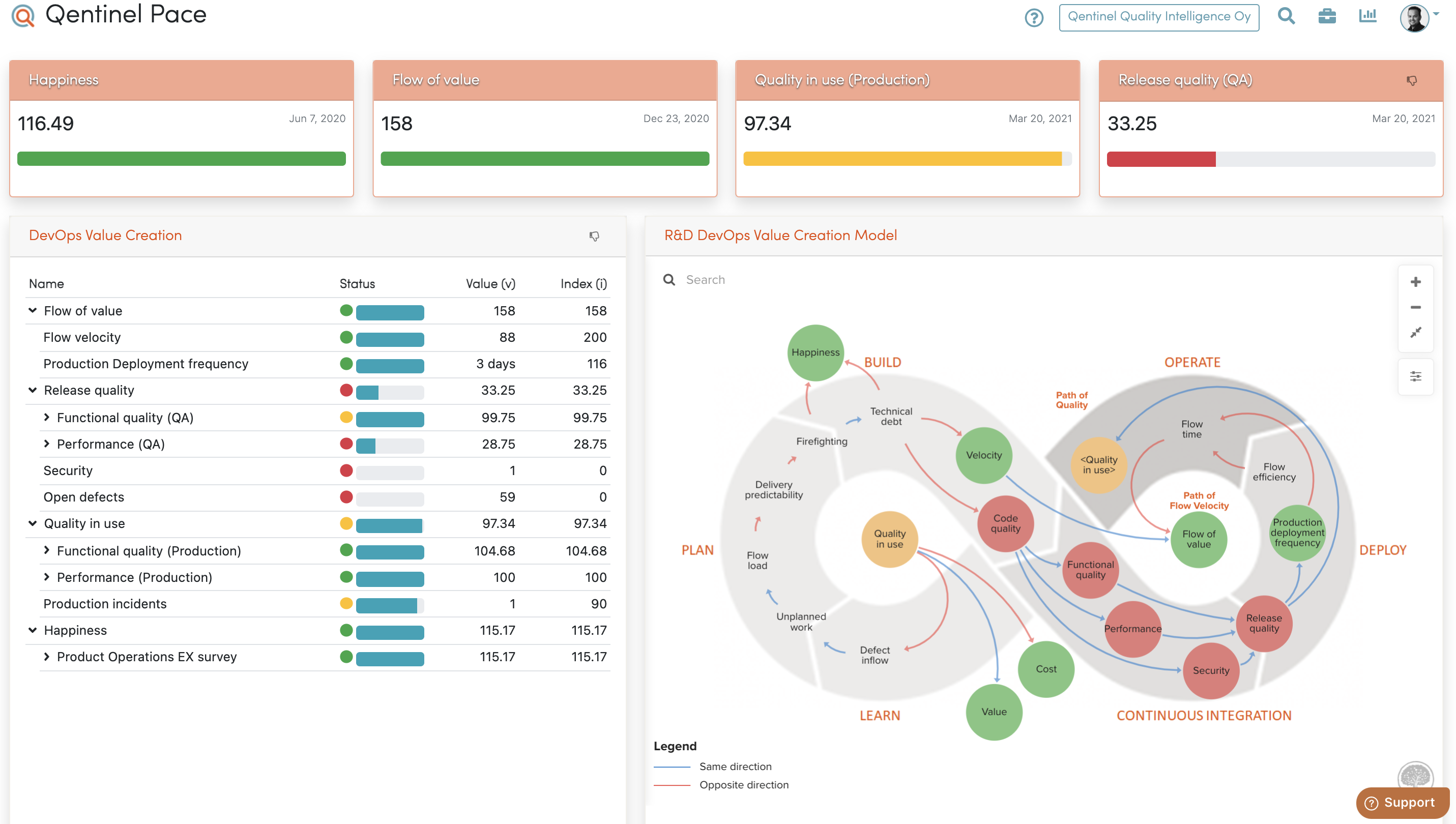
    Qentinel is accessed mainly via the cloud to automate the creation of application tests. Rechristened Copado Robotic Testing, the core of the Qentinel platform is based on the open source Robot Framework that understands scripts, executes them and generates logs and reports. A set of built-in libraries comes packaged with Robot Framework and addresses a wide range of testing scenarios. Qentinel customers include Brunswick, Elisa and Konecranes.
    Copado AI testing

    Gartner is forecasting that, by 2024, 75% of large enterprises will be using AI-enabled test automation tools to advance continuous testing across different stages of the DevOps life cycle. Much of the interest in AI-infused application testing tools is being driven by necessity as the pace of low-code application development exceeds the pace at which manual testing processes can work. As application testing becomes a bottleneck, organizations will naturally look toward automation platforms that employ machine learning algorithms capable of testing applications at scale.

    It’s not clear to what degree those platforms might eliminate the need for humans to test applications. The expectation is humans will be able to test application functionality at a deeper level versus, for example, merely checking to see if compliance mandates have been met. Many smaller organizations building low-code applications don’t have any meaningful application testing capabilities at all. Testing platforms infused with AI will prove to be especially crucial for citizen developers that require guidance to build a secure application that can actually scale, noted Leigh. The more SaaS application environments those applications span, the more critical testing becomes, added Leigh.

    One way or another AI is coming to application testing. After all, machine learning algorithms don’t ever need to take a day off or suddenly leave to take a better offer elsewhere. In fact, soon, most organizations soon won’t even consider a test automation platform that doesn’t have AI capabilities as they attempt to reduce the level of manual, monotonous and repetitive testing tasks. It may take a while for everyone to gain confidence in the algorithms, but it’s now more a question of the degree to which AI will be employed rather than if.

  • BMC Extends DevOps Reach from the Mainframe

    BMC Extends DevOps Reach from the Mainframe

    BMC today announced it has extended its DevOps platform for mainframe environments to provide integrations with GitHub Actions, a framework for managing workflows, and HCL Launch, a continuous delivery platform from HCL Software. BMC gained the DevOps platform with the acquisition of Compuware in June 2020.

    John McKenny, senior vice president and general manager for intelligent Z optimization and transformation at BMC, said those integrations—along with existing support for DevOps platforms such as Jenkins, GitLab and VS Code—make it possible to accelerate the development of applications that include mainframes as part of a larger distributed computing environment. DevOps teams, for example, can now employ an HCL Launch plug-in for the BMC AMI DevOps for Db2 tool to automatically capture and propagate database changes across IBM Db2 databases.

    At the same time, BMC also enhanced a BMC AMI Ops Monitor for Java Environments that automatically discovers all Java virtual machines (JVMs) running on z/OS environments on a mainframe. The BMC AMI Ops Monitor for Java Environments now includes the ability to discover the application programming interfaces (APIs) and services invoked by those JVMs.

    BMC also revealed today that its Workflow WiZard tool has been accepted as part of the open source Zowe initiative launched by the Open Mainframe Project. The Workflow WiZard makes it easier to install, configure and maintain software installed on mainframes running z/OS.

    Finally, BMC revealed it has extended its privileged access management (PAM) tools by enhancing the supervisor call screener and Unix System Service (USS) data enrichment capabilities of BMC AMI Security software. Based on technology BMC gained with the acquisition of RSM Partners, this enhancement increases the level of protection BMC AMI Security software provides to thwart attacks by surfacing suspicious activity, such as from malicious insiders that may have compromised administrator credentials, said McKenny.

    BMC mainframe

    These days, McKenny noted, everything is under attack because the minute cybercriminals discover a way to compromise one platform, they almost immediately try to apply that same technique against other platforms. Mainframe environments, which tend to process an organization’s most valuable data, naturally are a high-value target, added McKenny.

    In general, McKenny said IT organizations that rely on mainframes continue to make steady progress toward embracing DevOps best practices. A recent survey conducted by Forrester on behalf of BMC found 80% of respondents said their mainframe development tools needed significant improvement to provide more value.

    The need to accelerate digital transformation initiatives, which typically require access to data that resides on mainframes, are, in many cases, forcing the DevOps issue within many organizations. Software development teams that build mainframe applications are almost always required to create APIs that make it easier for other applications to consume that data.

    Not every organization, of course, has a mainframe. However, as digital business transformation continues to evolve, the number of applications that need to consume mainframe data will steadily increase. The challenge facing mainframe application management teams is finding a way to provide that access without using traditional waterfall processes to build the required APIs.

  • CircleCI CEO Sees Growing Need for Developer Experience Engineers

    CircleCI CEO Sees Growing Need for Developer Experience Engineers

    There is no shortage of titles to go with all the tasks that make up a DevOps workflow, but given the critical role developers now play within any organization, it might be time for organizations to start creating a developer experience engineer (DXE) function within DevOps teams that is specifically tasked with increasing developer productivity.

    CircleCI CEO Jim Rose said it’s become apparent there is more friction than ever in the application development and deployment process, as more complex applications are constructed, thanks, in part, to the rise of microservices.

    A DXE, as outlined in a report published by CircleCI, would be responsible for implementing a common set of DevOps principles, maintaining the right tools and putting in place a cohesive set of standard processes that ensure developer success. Today, there are simply too many languages, frameworks, engineering styles and processes being employed within the same organization, and that conspires to reduce overall developer productivity, said Rose.

    While software engineers are, today, addressing subsets of these issues, Rose said the time has come to assign these tasks to an engineering team that views itself as an advocate for developers by making available more responsive infrastructure.

    As organizations of all sizes increasingly realize how dependent they are on software to drive digital business transformation initiatives, Rose noted that developer productivity is becoming a major corporate issue. Revenue forecasts and profit margins are now being directly impacted by the rate at which software is being delivered and updated.

    Software engineers today routinely build DevOps pipelines for developers, but not much time and effort is put into optimizing the developer experience, noted Rose. That’s become not only a major productivity issue, Rose said, it has a material impact on the ability of organizations to attract and retain developer talent. One of the reasons so many developers prefer to work for smaller startups than large enterprises is because their daily work experience is simply better. Large organizations need to reduce the amount of friction developers experience if they want to be able to compete for that same talent, said Rose.

    A DXE would also be more inclined to solicit input from developers on tool selection to best optimize productivity, noted Rose. Many software engineers today construct pipelines with little to no regard for how simple or hard it might be for a developer to employ tooling.

    Organization today are, of course, starting to become more obsessed with measuring application development velocity. However, in many cases, simply making someone responsible for achieving a goal is going to result in more gains at a lower cost. Analytics tools have a role to play, but obsessing over key performance indicators (KPIs) may not generate the same result as quickly as simply giving an engineer a specific mandate.

    As responsibility for application management continues to shift left toward developers, it should not come as a surprise that there is a lot more interest in automating the underlying infrastructure. The issue, at this point, is determining to what degree software engineers are going to achieve that goal versus forcing developers to seek out yet another platform that promises to do it on their behalf.

  • Continuous Testing Practices (Part 1)

    Continuous Testing Practices (Part 1)

    In my prior blog, Continuous Testing – The Quest for Quality at Speed, I described five tenets and some of the practices for continuous testing (CT) to help those understand what continuous testing is. In my consulting work, I find it necessary to use 15 categories of practices to assess an organizations’ continuous testing capabilities. Given the large number of practices, I am publishing the complete list in three parts.

    This article is part one, which covers the following categories of continuous testing practices:

    • Continuous testing tenets
    • Leadership
    • Culture
    • Test strategy and plans
    • Test management

    Continuous Testing Tenets

    • The continuous testing principle “shift left” is practiced, in which tests are conducted as early in the pipeline as possible.
    • The continuous testing principle “fail early” is practiced, in which tests are arranged so that the most likely problems are found in the early stages of the pipeline.
    • The continuous testing principle “fail often” is practiced, in which tests are run frequently and with many different conditions such as different variations of operating systems, production topologies, browsers and production versions of services.
    • The continuous testing principle “test fast” is practiced, in which tests are run in quick cycles to get to a verdict as quickly as possible.
    • The continuous testing principle “be relevant” is practiced in which tests are focused on the most important tests and results for each purpose and stakeholder.

    Leadership

    • Leaders establish a definition and vision for software quality.
    • Leaders establish a definition for test coverage.
    • Leaders clarify how everyone’s roles fit with the CT strategy.
    • Leaders establish incentives for CT performance.
    • Leaders proactively sponsor quality assurance testing as a strategic element of their budgets and operations rather than viewing testing as a cost to avoid. This includes budgeting time and money for DevOps test training, test resources, test frameworks, test tools, test management and establishing policies for assessments.
    • Operational and capital expense budgets are planned together with all stakeholders to ensure all stakeholders agree there is enough opex and capex budget for the organization to accomplish quality goals for the budget period being planned.
    • Cost accounting practices ensure the capex and opex expenditures are tracked and made visible to stakeholders.
    • Schedules for CT improvement projects are identified and tracked.
    • Skills development programs provide individuals and teams opportunities to learn CT practices.
    • The performance of continuous quality assurance programs are monitored and made visible to stakeholders.
    • Leaders participate in creating and maintaining guidelines for codifying and tagging business risk priorities.

    Culture

    • Quality is everyone’s concern. Responsibility for attaining high quality software products is shared by everyone on a cross-functional team.
    • Cross-functional team members collaborate for testing. This reduces confrontation and friction between people who find failures and those who fix the code.
    • Dev teams embrace the creation of good tests and analysis of test results.
    • Ops team members contribute to test planning, test creation, test execution and test results analysis.
    • Policies for test creation and test coverage are agreed upon by the cross-functional team including Dev, QA, security and Ops team members.
    • A test architect is a role within the organization. The role has expertise in CT practices and helps cross-functional teams understand and apply them.

    Test Strategy and Plans

    • Test strategies and plans are created for each product or service and reviewed by cross-functional teams including development, QA, Ops and security teams.
    • Test strategies and plans identify the type of tests, and the extent of testing activities, for each stage in the value stream.
    • Test requirements and tasks are included in agile planning procedures for each theme, epic and user story.
    • Test strategies and plans define a test coverage standard, test case standards, and input/output criterion for each pipeline gate.
    • Test plans identify the test cases and all the supporting requirements to implement and execute the test cases as required satisfying the test strategy and test management goals.
    • Test strategies and plans identify the approach for system and acceptance testing.
    • Test strategies and plans identify any tests that are to be conducted in production.
    • Test strategies and plans identify any tests that are to be conducted for security testing.
    • Test strategies and plans identify a target for test automation and manual testing for each type of testing. For example, 100% of all tests in the integration stage and 85% of test in the pre-production stage is a typical goal.
    • The test strategy requires that changes to a database or changes to an application that uses a database have tests defined for the database and the application use of the database.

    Test Management

    • All aspects of test management, such as test planning, test guidelines, test code version management and version management of test results are handled by tools that are well-integrated into the continuous delivery pipeline and any test framework being used for test automation.
    • Schedules for all test tasks are identified and tracked.
    • New features have a scheduled task to ensure test goals are met for each new feature.
    • Each test case has associated attributes that can be used to find tests according to the attributes. For example, an attribute could be type of test and the feature purpose of the test.
    • Test environments and resources needed to satisfy requirements to run each test are identified and available programmatically for scheduling purposes.

    What This Means

    Continuous testing practices are critical to success with DevOps. Many organizations underestimate both the importance and the practices needed to engineer continuous testing. This article is the first in a three-part series that provides a comprehensive list of practices that can be used to understand and assess an organization’s continuous testing capabilities. To learn more about my blueprint for continuous testing, refer to my book Engineering DevOps.

  • Hasura Extends Scope of GraphQL API Platform

    Hasura Extends Scope of GraphQL API Platform

    During its online an HasuraCon ’21 conference, Hasura today announced that it has made it possible for developers to employ GraphQL application programming interface (APIs) to launch queries against data residing in multiple databases.

    At the same time, Hasura announced a preview of schema sharing capabilities along with support for workflows based on GitOps processes that it will make generally available later this year. The Hasura Cloud platform can now deploy local migrations from staging to production with a simple git push in addition to accessing previews of applications on every pull request to the git repository.

    The schema sharing capability added to the Hasura GraphQL Engine is intended to bridge the gap between beginner and power users by allowing them to share and install samples of permissions, relationships and metadata. In addition to improving collaboration, the goal is to make it easier to onboard software engineers as projects evolve and become more complex.

    Originally developed by Facebook, GraphQL has emerged as a popular alternative to REST APIs because it enables developers to retrieve data at a more granular level, which results in improved performance.

    Hasura is a provider of an instance of a GraphQL engine the company has developed around a project that is now hosted by the GraphQL Foundation, an arm of the Linux Foundation. The GraphQL Foundation counts among its members Airbnb, Amazon Web Services (AWS), Apollo, Coursera, Elementl, Facebook, GitHub, IBM, Intuit Hasura, Paypal, Prisma, Shopify and Twitter.

    GraphQL provides a complete description of the data made available via an API and is organized in terms of types and fields rather than traditional endpoints. In addition to clarifying what data is available via that API, developers can employ types to avoid writing manual parsing code.

    Since last summer, Hasura has been making available a pilot of a GraphQL implementation that is capable of supporting remote joins across disparate databases. That capability is critical because data sets that are related to a specific business process may wind up being stored in multiple databases.

    Hasura

    Tanmai Gopal, Hasura CEO, said the open source Hasura GraphQL Engine has already been downloaded more than 250 million times this year. Downloads in 2020 reached 100 million. The challenge is that while GraphQL offers a superior alternative to REST APIs, most of the API tooling that exists within organizations is still designed around REST APIs, noted Gopal.

    To accommodate that reality, Hasura has made a tool available that will convert a query designed using GraphQL into a set of calls that are compatible with REST APIs. Developers still gain the benefits of being able to launch more granular queries, noted Gopal.

    REST APIs, in general, are becoming more problematic as organizations embrace microservices-based applications. It often takes minutes to refresh a simple dashboard because of the amount of data that REST APIs are trying to pull from various data sources. As organizations embrace digital business transformation, they are also encountering application latency issues that can be traced back to the amount of data being called from multiple microservices.

    Hasura says in addition to providing a more efficient method to access data, Hasura is also working on adding caching capabilities to its core engine to further improve performance.

    It’s not clear at what rate GraphQL might replace REST APIs, but DevOps teams should assume organizations will wind up employing a mix of both for years to come. The challenge is going to be determining when to make the transition as organizations become more dependent on APIs.

  • Salesforce Pilots Series of DevOps Initiatives

    Salesforce Pilots Series of DevOps Initiatives

    At its online TrailheaDX 2021 conference, Salesforce today unveiled a DevOps Center pilot that provides a portal through which organizations can track and manage changes to Salesforce applications along with a unified command line interface (CLI) for all its applications.

    In addition, Salesforce plans to add Salesforce Functions to enable developers to deploy code in a serverless environment.

    The company has also promised to extend its low-code App Builder tool to include support for Dynamic Interactions, a capability that enables both professional and citizen developers to add reusable components to any application. The company has also added a Customer Identity Plus tool that enables developers to consolidate and manage customer identities.

    Finally, Salesforce is adding an Einstein Automate tool that employs machine learning algorithms to both integrate data and automate workflows that can invoke, for example, an existing MuleSoft Composer tool for integrating applications using a Flow Orchestrator that will be made available as a pilot project this summer. MuleSoft is a subsidiary of Salesforce. There is also now an Einstein Data Detect tool that ensures organizations adhere to data privacy laws by employing machine learning algorithms to discover when developers might have inadvertently exposed sensitive data.

    Dynamic Interactions, Salesforce Functions and CLI unification are expected to be generally available in the winter of next year, while the Einstein capabilities are expected to arrive this summer.

    Ryan Ellis, senior vice president of product management for platform at Salesforce, said the company is making a concerted effort to make it easier for both professional and citizen developers to build applications within the same environment by fostering collaboration via a DevOps Center portal that is expected to be generally available in the spring of 2022. Today the skills that any citizen developer can bring to bear are generally limited, largely because they don’t typically know how to build a well-designed, secure application that will truly scale in an enterprise IT environment.

    Salesforce

    However, as more artificial intelligence (AI) capabilities are added to low-code tools the amount of developer guidance being provided will increase over time. That additional guidance will enable citizen developers to build robust applications more reliably, noted Ellis.

    In the meantime, the primary beneficiaries of low-code tools continue to be professional developers that employ them to build applications faster than they could otherwise using procedural code.

    In general, Ellis said the relative DevOps maturity of organizations building and deploying custom applications on top of the software-as-a-service (SaaS) platform managed by Salesforce continues to increase steadily. In the wake of the COVID-19 pandemic, many organizations opted to extend existing SaaS applications provided by Salesforce to accelerate digital business transformation initiative using low-code tools rather than developing every application from scratch using procedural code.

    Of course, as the rate at which those applications are being built continues to accelerate, the next big challenge is managing the application life cycles after they are deployed.

    It’s not clear what the ultimate mix of applications built using low-code tools versus procedural code will be. Millions of lines of code are now being regularly deployed on Salesforce platforms, noted Ellis. It may be a little while before Salesforce is able to bring DevOps best practices to all that code, but, starting today, the journey has begun.

  • Plutora Dives Deeper into Value Stream Analytics Data

    Plutora Dives Deeper into Value Stream Analytics Data

    Plutora announced today it has extended the capabilities of its value stream management (VSM) platform to include a common object data model that more efficiently normalizes data collected from multiple DevOps tools and platforms.

    Jeff Keyes, vice president of product marketing and strategy for Plutora, said the goal is to expand the level of scale and depth at which the Plutora analytics engine embedded within the Plutora Platform can analyze flow metrics.

    VSM has emerged as a distinct DevOps discipline that provides a framework for enabling organizations to optimize workflow across DevOps environments in a way that allows them to accelerate application development. The core concept traces its lineage to lean manufacturing methods that continuously measure each step of a process to improve production.

    As organizations develop a deeper appreciation for their dependency on software, the level of interest in understanding how software is constructed has increased. Organizations, for example, want to better understand the impact of missed software development deadlines on revenue, which a business might not be able to generate as quickly as anticipated.

    Plutora is making a case for a dedicated analytics platform that pulls data from multiple platforms. Alternatively, more value stream analytics capabilities are now being embedded in everything from project management software to continuous integration. Plutora contends, however, that navigating multiple value stream dashboards surfaced by different tools that make up a DevOps workflow is not as simple or effective as relying on a single platform that collects data from every tool employed.

    Metrics that track lead and cycle times for projects as well as overall throughput become much easier to surface and comprehend, noted Keyes.

    One way or another, more transparency is coming to DevOps workflows. Historically, collecting this data has been challenging because it required DevOps teams to manually collect data from each tool being used. In effect, DevOps teams were wasting time copying and pasting data from one tool into an analytics application.

    As it becomes simpler to aggregate all that data, the data model provided by Plutora makes it simpler for multiple analytics tools to analyze the same data. A business user, for example, may prefer to analyze data using the Tableau analytics platform that is now owned by Salesforce.

    In general, analytics is being applied more widely across software development processes because organizations need to increase productivity while simultaneously reducing costs. It will be up to each organization to decide to what degree they may want to use that data to better train DevOps teams versus simply using it to remind those teams to stay focused on a specific set of key performance indicators (KPIs).

    In the meantime, the number of requests for reports being made to DevOps teams should decline as the process of collecting metrics becomes more automated. The challenge now will be making sure everyone reading those reports has the same firm understanding of what’s actually possible to achieve using not only the resources at hand, but also how any additional DevOps expertise might positively impact that equation.

  • Harness Employs ML to Streamline DevOps Workflows

    Harness Employs ML to Streamline DevOps Workflows

    At the online {Unscripted} 2021 conference, Harness today announced an update to its namesake DevOps platform that includes support for feature flags that expose new capabilities to a select number of users for testing purposes along with the ability to prioritize the running of those tests based on the likelihood an application is likely to fail them.

    In addition, Harness is adding a unified pipeline capability that enables DevOps teams to streamline the management of multiple tools that make up a workflow and has updated its cloud cost management module to enable DevOps teams to automatically stop idle workloads. That capability is based on technology the company gained with its recent acquisition of Lightwing.

    Steve Burton, chief marketing officer for Harness, said Harness is now employing machine learning algorithms to identify which tests an application is most likely to fail. That test intelligence module enables DevOps teams to run those tests first versus testing an application only to discover close to the end of that effort that an application will need to be updated and then retested. The amount of time spent on testing is then sharply reduced, noted Burton.

    Overall, Harness is reducing the amount of time and effort spent maintaining DevOps pipeline and workflows, said Burton.

    The cost of maintaining a DevOps platform will naturally vary as the overall environment becomes more complex. It may not be clear how much time a DevOps team is spending on testing, but the faster that process becomes the more likely an application will be thoroughly tested before it is deployed in a production environment. Fixing applications after they are deployed in a production environment is, of course, considerably more expensive.

    At the same time, as the number of applications being built simultaneously increases, the amount of cloud resources being consumed also increases. Developers, however, don’t typically pay close attention to what workloads are consuming which cloud resources, which can result in an unpleasant surprise when the monthly bill from the cloud service provider comes due.

    In general, Burton says machine learning algorithms and other forms of artificial intelligence (AI) will soon become table stakes for any provider of a DevOps platform. The expectation is the platform will routinely employ AI to streamline processes and reduce total costs, noted Burton.

    Many of the manual tasks that DevOps teams regularly perform to maintain a DevOps platform will increasingly become automated as usage of machine learning algorithms becomes more pervasive. It’s not clear to what degree organizations may abandon a legacy DevOps platform to take advantage of those capabilities. However, over time it will become apparent that some organizations are spending a lot more time building and deploying applications than others as the next generation of DevOps platforms, infused with machine learning algorithms, are installed.

    In the meantime, DevOps teams might want to make a list of the manual tasks they perform today as part of an effort to determine how much time they are wasting that might otherwise be spent on tasks that are more valuable to the organization.

  • Using Rust to Build Distributed Applications

    Using Rust to Build Distributed Applications

    Rust is an open source programming language that was initially developed at Mozilla Research and became increasingly popular for building distributed applications. It has been referred to in the Stack Overflow Survey as “the most-loved programming language” by software developers for five consecutive years. Moreover, companies like Amazon and Microsoft have recently revealed that they are using Rust to develop the software components that are responsible for ensuring application safety.

    Rust allows the implementation of safe and predictable code by leveraging memory safety and speed. It is the ideal choice to create code without incurring undefined or unpredictable behavior thanks to its features such as consistent runtime behavior and a static type system.

    Although Rust can be used for any system programming application, it is mainly implemented to build applications like simulation and game engines, browser components and file and operating systems. Rust syntax is similar to C++, but it addresses issues that C and C++ normally struggle with such as developing code without security vulnerabilities, general memory errors and problems in writing concurrent programs.

    The Advantages of Rust in Distributed Programming

    Rust tackles the performance and reliability problems of other low-level programming languages by using a careful compiler which examines all the variables used and referenced. As the code is compiled, Rust uses monomorphization by creating exclusive and high-performance code for each type of channel. It prevents programmers from paying performance penalties due to its flexibility. Based on the principle that you don’t pay for what you don’t use, the code written in Rust is enhanced and abstractions are solved at compile time making the program safe and without runtime overhead.

    Rust doesn’t have a garbage collector, which allows programmers to build abstractions with predictable performance. In Rust, there is no garbage to collect because the moment something would have become garbage, it gets freed immediately at compile time, making the program much faster. Moreover, Rust uses a borrow checker to check where data is used across the program, and by following a set of rules it establishes where data needs to be dropped or initialized. It provides the same advantages of a garbage collector with the efficiency and predictability of manual management.

    Another crucial characteristic of Rust is its asynchronous I/O. In Rust, asynchronous programming is widely implemented and well-integrated. It enables developers to effectively scale on a certain number of cores and exploit the operating system resources. By running several units of code on each application, this feature enhances performance and responsiveness of the operating system.

    Rust prevents some of the software engineering problems that could critically damage the application development process. These issues concern concurrency and memory safety which can cause very often denial of service, code vulnerabilities or compromised secrets. Examples of these frictions that are common in other languages such as C or C++ include uninitialized variables, undefined behavior, invalid iterators and unexpected variable modification.

    Another great advantage of using Rust is the Rust developer community, an extremely friendly and welcoming community. There are multiple events, chat rooms and forums to participate in that makes it even more pleasant to build distributed applications with Rust.

    Thanks to its ability to fix concurrency and memory issues, to compile and run safe and predictable code and provide a fast implementation, Rust is quickly increasing its popularity and establishing itself as the ideal choice for building distributed applications.

  • Akamai Adds Service to Optimize API Traffic

    Akamai Adds Service to Optimize API Traffic

    Akamai today launched an API Acceleration service specifically designed to accelerate application programming interface (API) calls using special purpose hardware, reserved capacity and prioritized routing.

    At the same time, the company is also making available a globally distributed key-value store dubbed EdgeKV that enables stateful applications to be deployed on its EdgeWorker nodes.

    Finally, Akamai is also making available free tiers of services that provide access to a combined 60 million serverless EdgeWorker events per month with a limit of up to 30 million EdgeWorker events per tier. The two tiers are made up of a basic compute service for applications requiring lower CPU and memory consumption and a dynamic compute service for those applications demanding additional resources.

    Josh Johnson, an enterprise architect for Akamai, said Akamai is expanding its offering at a time when many organizations are starting to deploy microservices-based applications across an extended enterprise using serverless EdgeWorker nodes deployed at the network edge. EdgeKV provides access to a low latency data store that also enables those edge computing applications to process data closer to the point where it is being created and consumed.

    In general, Akamai reported that, in 2020, its platforms processed more than 300 trillion API requests, a 53% year-over-year increase. Much of the increased activity is being driven by distributed applications that are deployed directly on the Akamai CDN, rather than being deployed in a local data center to take advantage of a global network of data centers that allow IT organizations to take advantage of caching. In effect, the CDN becomes the target platform when an application developed using DevOps best practices is being deployed. The rise of edge computing has increased the number of use cases where DevOps teams are relying on CDNs to deploy applications.

    Naturally, competition among providers of CDNs has increased considerably as the number of applications deployed at the edge continues to increase. There may even come a day when there are more applications deployed at the network edge than there are in the cloud as more organization deploy applications that need to process and analyze data in near-real time as part of a larger digital business transformation initiative.

    Akamai, of course, as the provider of the largest global CDN, is betting it will be able to leverage the size of its CDN to convince developers to deploy applications on its platforms rather than smaller rivals.

    Regardless of the approach to edge computing, the applications being deployed will be more latency sensitive than ever. Each IT organization will need to decide to what degree they want to count on infrastructure to optimize API calls those applications make before they time out or need to be redirected to another microservice. One way or another, the laws of physics still apply. No edge computing application is an island. It depends on a complex web of infrastructure ranging from routers and switches to servers running back end services in the cloud. The challenge is finding a way to optimize all those interactions in a way that developers never have to be concerned about.