The recently released fifth annual “State of DevOps Report” by Puppet has once again brought with it fresh insights into what drives high-performance teams. The report, which comes at a time when DevOps has ceased to be a buzzword, provides proof of why more and more businesses across the world are adopting DevOps to improve their organization’s performance, revenues and profitability. DevOps has truly come of age and this year’s “State of DevOps Report” clears any doubts fence-sitters may have about the effectiveness of the DevOps approach.
The 2016 report reasserts that unparalleled IT and organizational performance is a result of a team effort spanning development and operations. The report also highlights the importance of improving the entire product life cycle—from initial product planning, to quality and security assurance, to customer feedback—to speed up delivery while improving quality, security and business outcomes. You can read the full report here.
In today’s competitive business environment, DevOps has emerged as a vital solution that helps organizations meet ever-growing industry demands. The “2016 State of DevOps Report” helps us understand how the practices associated with DevOps affect IT performance and organizational performance. Let us examine the findings of the report to ascertain how DevOps can benefit your organization.
Why Does Your Organization Need DevOps?
The “2016 State of DevOps Report” makes it plain and simple that companies that incorporate DevOps practices get more done. According to the report, high-performing IT organizations deploy 200 times more frequently than low performers, with 2,555 times faster lead times. They have 24 times faster recovery times and three times lower change failure rates. High-performing IT teams spend 50 percent less time remediating security issues and they spend 22 percent less time on unplanned work and rework, the report states.
Performance
If we boil down the report findings into actual benefits of adopting DevOps, we could say that DevOps enables continuous software delivery with less complex problems to fix and faster resolution of problems. This essentially means that you can deploy faster and more effectively in more stable operating environments and add value rather than just fixing or maintaining.
DevOps can revolutionize the performance levels of organizations and allow them to deploy at a rate never seen before. It has certainly enabled organizations such as Etsy, Netflix, Facebook, Amazon, Twitter and Google deploy hundreds and thousands of code per day while delivering world-class stability, reliability and security. You can find out how different organizations have implemented DevOps to their benefit in this YouTube video.
Security
Higher performance is not the only payoff in the DevOps culture. Organizations that adopt DevOps practices are known to have better information security. The “2016 State of DevOps Report” clearly states that organizations that integrate information security objectives into daily work spend 50 percent less time remediating security issues than low performers. This has a positive impact on IT performance and security outcomes.
Any organization, irrespective of size, can employ DevOps to achieve high performance levels and meet business goals while cutting down on costs related to fixes and remediation security issues.
How DevOps Transforms Teams
Consider this scenario: In an organization that does not apply the DevOps methodology, the development team writes code and develops a product, which is then sent to the testing team that verifies if the code meets the requirements. The operations team steps in to run the product only after this process is complete. The DevOps philosophy was created to break the silos that teams operate in and effect better collaboration and performance.
The culture shift DevOps brings about in organizations is substantial, and since culture is a key factor responsible for a company’s performance, application of the DevOps philosophy provides measurable and non-measurable results. A few of them are:
Employee Engagement
DevOps is neither a method nor a tool, it’s a culture! In organizations that observe the DevOps culture, the development and operations teams work outside silos, releasing products faster, thereby increasing operational efficiency. This is made possible by the operations team giving the developers constant feedback about the code and troubleshooting problems with the user experience in mind. This continuous learning and delivery practice allows cross-functional teams collaborate as one team with one goal, thus facilitating higher performance levels. The improved organizational culture and enhanced employee engagement can help organizations not only in retaining great talent but also in recruitment.
Organizational Success
The “2016 State of DevOps Report” effectively explores the relationship between employee engagement and organizational success and goes on to show that there is a strong correlation between these two factors. The report states that employees in high-performing organizations are more than twice as likely to recommend their organization to a friend as a great place to work.
Organizations can greatly benefit from adopting the DevOps culture. The “2016 State of DevOps Report” shows that high-performing organizations are widening their lead against lower-performing organizations. This can be attributed to the increased productivity and creativity of highly engaged employees that helps them provide better experiences to customers.
Organizations can achieve great business results by reinvesting the human time, creativity and energy saved by reducing rework and downtime through DevOps. Herein lies the ROI of DevOps—the competitive advantage that organizations get by investing in a philosophy that positively affects bottom-line results!
About the Author/ Pallavi Poojary
Pallavi Poojaryis a writer with Edureka, an online learning company with more than 250,000 learners spread across the globe. She writes on hot technologies and skills that are in demand today, including DevOps, Big Data and Project Management, to name a few. She is a believer in transformation of careers through learning
Continuous integration and continuous delivery (CI/CD) are often cited as pillars of successful DevOps. To establish and optimize the CI/CD development model and reap the benefits, companies need to build an effective pipeline to automate their build, integration and testing processes. This requires architecting CI/CD with five key ingredients which, when combined effectively, operate as a successful cornerstone of DevOps and provide myriad bottom-line benefits.
Building the Pipeline
Let’s first take a look at the five essential ingredients needed for a healthy CI/CD architecture, following up with a discussion of their benefits to the business:
Micro-agility in the form of testing and committing code frequently: The development life cycle begins with a request to development, which then takes the request and designs a solution, codes it, tests it and commits it a code repository. From here, the code is tested by QA and then deployed to production. While each step is important, we begin here, as local testing occurs most frequently and bugs found at this stage of the process help avoid the large expense of bugs found in production.To achieve micro-agility, developers must have a clear understanding of where they are expected to commit their code after changes are made and they should be expected to test and update their code frequently—many times a day. This means development testing should be easy to run locally and is a subset of QA. The result is that code pushed by development is by definition QA-ready.
Automated QA: In my work I see many organizations whose QA team is one of the largest bottlenecks in the process. It’s not for a lack of skill, but too few staff who spend a good portion of their time waiting on the QA test environments they need to do their work. To avoid this situation, the QA process should be fully automated, from QA ready code coming in the door to one-click promotion on the other side. In between the two, QA should have a constant feedback loop with development where communication about—and tracking of—bugs is clear and easy to follow, allowing development to easily repair issues and recommit the code for further testing. Moreover, automated QA in a CI/CD environment should focus on microcycles consisting of small test batches rather than weeklong macro tests. Automation and communication are the overriding imperatives here, exhibited by reports to developers that are communicated immediately and code commits that are fail-rejected automatically.
Production-like environments: To increase efficiency and effectiveness, development and testing environments should mirror production as closely as possible. They should follow the PRQ rule, as I like to call it—production-like, repeatable and quick. Specifically, it should be fast and easy to set up new environments, to the point where developers can, with the push of a button, deploy new environments for their development and testing needs. Doing so allows developers to fail fast, breaking and re-creating environments without fear as they know they can easily recreate the same environment every time. I often recommend using tools such as Jenkins to help with this process; if developers and IT operations use the same tool, it makes it that much easier to streamline the CI/CD process and achieve the promise of DevOps.
One-click promotion: As I alluded to earlier, a well-architected CI/CD pipeline provides one-click promotion to production. This ensures changes are seamlessly moved to the overall production environment with the least amount of friction possible between development and operations. To that end, this reduction in friction should occur across all the steps of the process, with efficient code delivery pipelines that are designed to balance security and agility from the outset. Cloud infrastructure coupled with container technology and automation can easily optimize the process across teams and throughout the DevOps journey.
Fully automated deployments: The last factor of an efficient CI/CD pipeline is full automation of deployment. Any configuration changes made by development and accepted by QA should automatically be applied. Continuous integration in this way helps avoid system downtime and human errors are decreased greatly. Deployments also should be continuously monitored so that IT is the first to learn of potential problems. This helps nip issues in the bud, allowing for faster rollback and return of code to development to fix anything that may not be functioning properly. Catching issues before customers do helps ensure customer satisfaction and strength of reputation.
Benefits of the Pipeline
In addition to these benefits, when combined effectively, these ingredients minimize the time and cost of local test, QA and production processes; reduce the time it takes to identify problems and their causes; and accelerate delivery of production-ready code. We can see this throughout the CI/CD pipeline:
Developers have greater control over the process and can respond more quickly to market demands by quickly bringing up new environments, testing against them and easily starting over, if need be. Moreover, developers can quickly adjust to new environments—an approach that has proven to decrease failures and resolution time when they do occur.
Operations benefits as reduced friction in the CI/CD pipeline created by automation decreases repetitive, manual work and with it the opportunity for “fat finger” mistakes and the greater opportunity to introduce inefficiency into the process.
And, less manual, repetitive work provides everyone in the process with more time for strategic work, which provides direct bottom-line value to the organization.
CI/CD is a pillar of successful DevOps and according to research by CA, organizations that apply DevOps discover an 18 percent reduction in time to market of new applications and a 21 percent increase in delivering new software that they would not otherwise be able to complete. Teams that master an efficient CI/CD pipeline deliver faster, higher-quality applications to market bringing with it a 19 percent increase in revenue. Mixing these ingredients together results in an efficient, streamlined CI/CD pipeline that serves as a fundamental pillar of DevOps success that, when mixed together, delivers direct business benefits.
About the Author/Aater Suleman
Aater Suleman, CEO & co-founder at Flux7, is an industry veteran in performance optimization on servers and distributed systems. He earned his PhD at the University of Texas at Austin, where he also currently teaches computer systems design and architecture. As a faculty member at UT-Austin, Mr. Suleman focuses on optimizing DevOps architectures involving the AWS cloud. Along with the Flux7 consultant team, he works at every step of the dev flow, from creating local developer environments using Vagrant and Docker, to continuous integration and continuous delivery using Jenkins or RunDeck, to configuration management using Chef/Puppet/Ansible, to creating efficient systems for deploying new code from Git using Capistrano/Fabric/bash. His background is as an architect, and he has experience with both hardware and software. This combination brings a unique perspective and broad view to development and operations.
DevOps and continuous delivery are the same thing, right? Far from it. We peer through the fog to understand the difference between the two related but distinct methodologies.
We live in an era of apps. More and more of our personal, social and work life is governed by apps—communicating with one another through social apps, booking cinema tickets through your mobile device or scheduling a business trip through the airline app. This digitization of services has arrived. Organizations that understand this sea change have a unique opportunity to jump ahead of their competitors, acquire customers more quickly and grow revenues.
The battleground for this service development is DevOps. It’s not a product, but rather a methodology for helping organizations build teams and build software. DevOps is a culture, movement or practice that emphasizes the collaboration and communication of both software developers and other IT professionals while automating the process of software delivery and infrastructure changes. It creates a culture and environment where building, testing and releasing software can happen rapidly, frequently and more reliably.
Organizations are marching with their feet. According to a recent study, market demand for DevOps skills is growing, and DevOps engineers are among the highest paid IT practitioners today. And it looks set to stay that way. Research in the U.K. shows that 30 percent of 300 organizations surveyed in the run up to the 2015 DevOps Summit had either started to implement a DevOps strategy or had already merged Dev and Ops, with another 13 percent planning to go down this route.
Two Related Children: DevOps and Continuous Delivery
So now we arrive at continuous delivery. If DevOps is about accelerating the delivery of new, high-quality services, surely continuous delivery is the same thing, isn’t it? In other words, ensuring a steady stream of new services? You might look at it as a manufacturing production line: DevOps is the machine that builds the service, while continuous delivery is the conveyer belt that rolls the services off the production line—one big unified service development cycle.
That’s not the case. Although the distinction between DevOps and continuous delivery can be a little grey and cause confusion, there is in reality clear water between the two. Continuous delivery has become an essential ingredient for teams doing iterative and incremental software delivery. It is an approach whereby teams ensure that every change to the system can be released, and that any version can be released at the push of a button. Think of it this way: Continuous delivery aims to make releases dull and reliable, so organizations can deliver frequently, at less risk, and get feedback faster from the end users until deployment becomes an integral part of the business process and competitiveness of the enterprise.
Continuous delivery and DevOps do share common traits, though. Both methodologies are aimed at agile and lean thinking: each delivers small and quick changes; each relies on tight business an IT collaboration; and each share the common goal of faster time to market for new services.
However, the goal of DevOps is merge dev and ops roles together—and the processes they manage—to achieve business goals. It’s all about a common, shared culture and enhanced collaboration. About clearly defined business processes.
Automation has an essential role to play in both DevOps and continuous delivery. Automating DevOps helps your organization manage and secure continuous delivery to the business and IT users. The result is a faster, low-risk migration to a new world of composite applications, faster business innovation and better support for rapidly changing business process needs.
If you ever wanted to learn about Rugged DevOps (some call it DevSecOps), sit down for a spell with Shannon Lietz, Ian Allison and Scott Kennedy from Intuit. We discussed a number of important topics including internal war games, culture hacking, gamification of Rugged DevOps and starting as a small team. There are 100 gold nuggets in this conversation for novices and experts alike.
Derek Weeks: I have some of the Intuit DevSecOps team here with me today. We’re going to talk to them a little bit about Rugged DevOps and how things work over at Intuit. Let’s start with some introductions.
Allison: I’m Ian Allison. I help run the Red Team at Intuit, which is, I guess you’d say, an interesting way of taking control of security at our company. We try to get ahead of the attackers by basically being the attackers. We’re essentially ethical hackers. We go after all of our own stuff to make sure we can find where the deficiencies lie in all of our software.
Lietz: I’m Shannon Lietz. I’ve been working at Intuit 3 1/2 years and helped to found the 24×7 DevSecOps capability at Intuit, leading the Red Team, our security operations capability, our cyber SOC, and what we also consider “blue teaming”: being able to hunt for defects.
The organization has really had to transform how we do software development because we’re a 30-year-old software company. We are now seeing the traditional way of putting together software really embracing DevOps. For us, it’s been exciting to really work in the industry with Rugged DevOps, trying to help build security into the DevOps movement.
Kennedy: I’m Scott Kennedy. I run the forensics and threat intelligence part of cyber work.
Weeks: Shannon (@devsecops), tell me a little bit about software supply chains and how that vision of software development has impacted the way you see things at Intuit.
Lietz: That’s really a great question. It was interesting when Josh Corman and I first talked; we had a lot in common. One of those things was the software supply chain. What I really love about the concept is being able to have processes driven a certain way so that you can reduce defects.
Having worked for Toyota in the past and understanding the supply chain mentality, you get a sense of how you could put something together better, incrementing on it, figuring out how to share that process, and then really figuring out what things are important. Having that notion of fewer, better suppliers was really a core concept.
I love the idea of transparency, building things a certain way, and really getting into continuous improvement. You need to look at things from an opportunities perspective—making sure you’re not just looking to make things perfect. You’re looking for those opportunities to improve over time.
https://www.youtube.com/watch?v=nRaURhaTH9o
Weeks: As we think about Rugged DevOps within your security team, how do you measure the success of what you’re doing? What kind of metrics are you looking at that matter to the business?
Lietz: We measure everything. For example, mean time to remediation (MTTR). Once somebody finds a defect, we analyze that defect from the time it got into the supply chain to when it actually gets resolved. We track everything from mean time to remediation to when the ticket was created, to being able to look at when the code actually got published, to when it actually got found, and then we work on those things over time. We really try to uplift.
____
Once somebody finds a defect, we analyze that defect from the time it got into the supply chain to when it actually gets resolved.
____
We leverage JIRA [Software] just like a software development team does. We register our defects and figure out how to get development teams to take responsibility for those ideas. It goes through their process of release and regression testing. As part of that, we look back to see where our opportunities are.
As an example, we started out where things may have taken weeks. We then reduced it down to days and ultimately got it down to hours. We’ve seen defect resolution where it’s now minutes. When it’s something we’ve discovered that was just a mistake by an engineer, we realize “mistakes do happen.” We found that our cycle times also help us to find fault stack vulnerabilities in real time because we get to do end-to-end testing more aggressively utilizing this method.
Weeks: How has consistency in your operations helped with Rugged DevOps and has it fragility within the organization?
Allison: One of the things we do is to utilize a golden image for all of the AMIs (Amazon Machine Image) we use, for all of our customers, and we require everybody to use these AMIs. We’ve also built some really interesting automation around scanning these AMIs. So one thing we realized quickly when we first started native U.S., when we try to do full vulnerability scans against another system, if it’s set up to autoscale, we all of a sudden have 50 systems. Right? We can’t … it’s really hard to do a full vulnerability scan right against the system, so we came up with a way to share back all of the AMIs with a special account. Then we bring those up and we scan them. Then we grade them.
Based upon the vulnerabilities that are found, you’ll get a letter grade, like A through F, based upon the system you have. While we always strive to have our base image be an A, people continue to run on older images. But they get graded, and those grades get pushed up, so everybody in their org structure gets to see what the grade is for their account. I think by being a little standardized, basically with these images, lets us know what’s in everything, and we have a grade for everyone. It helps everyone have a really good idea of where they stand when it comes to a security standpoint.
____
Based upon the vulnerabilities that are found, you’ll get a letter grade, like A through F … so everybody in their org structure gets to see what the grade is for their account.
____
Weeks: That’s not only a grading but a policy enforcement governance kind of role that grading plays. How rapid is the feedback loop in that grading system for the teams that you’re working with?
Lietz: It’s really quick, and we’ve discovered through some science that having component-based resources like AMIs provides us with an advantage when doing things like remediating vulnerabilities. Using AMI-based resources, we have seen that when there’s a defect in it, we can find and remediate all of the defective AMIs quickly. That improves everyone’s security across the company.
So if you’re just picking out really good components, keeping track of those components and adding security into them, then you’ll actually see a different effect across our pipeline. A single change can actually have a dramatic effect on reducing the problems within the pipeline.
Allison: It’s really interesting. This morning I got an email from somebody that said, “Why did our baseline AMI go from an A to a C today?”
We had just received notice of a new vulnerability. Our stuff caught it, we scanned it, and we pushed the grade out to our portal where all our customers go to look at the grades. Our customers were able to see that change quickly.
They could now say, “Wow, it changed from an A to a C in less than 12 hours.” I think the feedback is really important. The other important thing is that we have people going and looking. I wouldn’t be getting emails about why has this changed if people aren’t actually looking and wanting to make their grades better.
Weeks: You mentioned customers. Are these internal customers?
Allison: Internal.
Lietz: Yeah, for our development teams, we as a security team really have changed how we think about things. It used to be that the security team would go out and govern. Basically, you got the fear of the security team coming in, descending upon you.
We’ve really changed how that happens within our organization. We grade our resource components, and we grade the way in which our applications come together. That changes how developers want to operate because they really want to figure out how to get better grades in security. And it creates a learning dynamic that incentivizes somebody to improve continuously.
___
That changes how developers want to operate because they really want to figure out how to get better grades in security. And it creates a learning dynamic that incentivizes somebody to improve continuously.
___
Weeks: Does it create a competitiveness or gamification of who has better grades?
Lietz: Absolutely, which is why we did it in the first place. To your point there, gamification is something where when you start to grade components like that, you can actually start to leverage a leaderboard concept. We do have leaderboards as part of this. We have APIs where you can actually pull down your grades and include them in your automation. With these, you can make governance decisions.
If you sort of have that “game afoot,” right, your leaders can then ask for specific grades within their pipeline. That up-levels the system, and you just see a continuous improvement lifecycle come to bear. Ultimately, you see fewer defects, and ultimately, you get to the notion of Six Sigma in our way of thinking. DevOps is really about continuous improvement and embracing automation. Embracing that concept allows us to get to fewer defects faster.
___
DevOps is really about continuous improvement and embracing automation. Embracing that concept allows us to get to fewer defects faster.
___
Weeks: As you embraced continuous practices and DevOps practices, were there points when you realized certain old ways of doing things weren’t going to enable you to move forward?
Kennedy: In looking at the progression of what we’ve been doing, one of the decisions that was made in Intuit and one of the things that I saw was really unique was the way they decided we were going to migrate into AWS. Our idea was to have the chaos team be the first people out, and that’s the security team. So the security team was the one that was going out and finding out how to use each of the products that AWS has and creating the concept of whitelisting. Each product was rated as to whether or not it met security’s requirement.
Therefore, no team can go ahead and pull down this new cool tool that AWS released yesterday and use it in production because it’s not been “whitelisted.” That can go into their scoring. Their scoring is not only used by the development teams but also is useful when reporting to the board. When the board asks, “How are we doing as a company across the entire organization?” we can say that product A got a lower score than product B, and then they turn to the VP in charge of it and say, “Well, why?”
___
When the board asks, “How are we doing as a company across the entire organization?” we can say that product A got a lower score than product B, and then they turn to the VP in charge of it and say, “Well, why?”
___
We decided to not rush into the cloud but to take a careful, considered approach and migrate in a very intelligent and well-thought-out way. At the same time, we gave the chaos team the ability to make the mistakes and grow and learn, so they can immediately turn around and share the mistakes with everyone else. They could say, “Hey, these are the things that didn’t work for us. We came across a lot of problems, especially when you look at things like accounts and account roles.”
How do you control when you have thousands of accounts and you need to have some sort of administrative control?
You can either have a gigantic effort to force your namespace and your Active Directory to be the source of control. Or you can use the vendor-specific tools like IAM and have each account have their own separate islands, but with the concept of cross-account roles, you can then do remote administration from a centralized account. You have it locked down. You have the capability to have a restricted group and be able to remotely go in and do the necessary actions.
That also gives you an audit trail. That also gives you multifactor built in because the AWS products get those things added to them.
Lietz: I think when it comes down to it, I think culture-hacking your environment can have a profound effect, especially when you’re going through a DevOps transformation.
Weeks: What is culture hacking?
Lietz: That’s a great question. We use it when really trying to figure out how we as a security team can change and transform. A lot of the things that take place in a company are really based on traditional processes: What has worked before, and why would we change something that is working, right? If you’re really going to go into an innovative frame; if you’re really going to get into that next-generation innovation; if you are trying to figure out what’s going to work in that … it’s never going to be the thing that is working. It’s going to be the thing that you’re going to learn as you go to that next step.
Culture hacking is really about looking at the people who are operating right now and trying to figure out how you’re going to help them go from A to B, making that change. What is that the experience going to be like?
What we have done, to Scott’s point, is we’ve forced our security team to have empathy for the DevOps teams. We go through the process of developing something in the cloud, utilizing it as a method of taking their paranoia and trying to balance the notion of getting something done within a specific time frame. We try to really wrangle what it takes to do those things securely and safely but, ultimately, still be able to deliver for the business.
I think that culture hacking really comes into play when you’re trying to figure out how to move somebody from the rock they’re on to the rock you need them to be on and trying to figure out what those mechanisms are.
___
Culture hacking really comes into play when you’re figuring out how to move somebody from the rock they’re on to the rock you need them to be on.
___
Weeks: Part of your security practice is looking at open source and third-party components and your own binaries. Can you shed some light on how Intuit is using Sonatype solutions to better manage those vulnerabilities?
Lietz: Yeah, Sonatype Nexus is a fantastic platform. We love the Nexus repositories. We love how you guys put together a community. We learn a lot.
A lot of our DevOps practice is working together with it. We’ve put together our Nexus repositories to do code signing and figuring out how to really secure our pipelines a certain way. We are taking advantage of the fact that we can pick up components, track them and then scan them [for known vulnerabilities].
That’s allowed us to reduce the defect count that goes to production. Actually scanning and looking for vulnerabilities within our components and our open source libraries allows us to make better decisions about what we’re including in our software.
Weeks: When you govern what open source, third-party or proprietary components are being used by developers, is there any kind of feedback from the teams saying, “Hey, you’re restricting my behavior, not improving my innovation”?
Lietz: What we’ve found is that the notion of security approvals, exceptions and gates really doesn’t work. Quite often, you just create a culture where developers are going to go out and do it, and then you’re going to find out about it. When it comes to really partnering and being boundary-less about how you think about security in your business, it’s all about transparency. It’s all about benefits. It’s creating things like a security markdown file within your repository manager. It’s about taking responsibility and accountability for the things that you’re doing from a security perspective in your development process. It’s ultimately having an attacks.md file, keeping track of what’s out there, keeping track of your open source, understanding what components you’re leveraging, and why you made the decisions that you made to bring those things into your project.
___
It’s about taking responsibility and accountability for the things that you’re doing from a security perspective in your development process.
___
At a top level, all of those things work. But really having tools that can help the decisions that were made by some of the other open source programmers that you’re getting contributions from is really necessary. All of the things that they might be deciding are also part of your decision tree, and ultimately, you’re rolling all of that and bundling it together. The attack surface is not just the decisions that your team is making, but the ones that you share across the code base that you’ve got.
Weeks: Your practices are very mature. You’ve clearly developed them over a long time, and some people watching this might think, “Well, Intuit’s a huge organization,” and it may be daunting to them if they haven’t started down the path of Rugged DevOps. Can you be a small team and have success in these kind of practices?
Lietz: We’re not exactly a huge organization, but we are relatively large in size now. When we got started, I believe I was one of maybe three people that started this, only a couple years ago. We have hired into our group pretty extensively to help grow it, and some of the things that we’ve done have really allowed us to operate differently, to bring in people and have them immediately be successful. Our practices allow someone “day one” to be able to work with the environment, to be able to develop code, to be able to contribute code that week.
We do things like weekly demos, where we actually do video demos. A person has to come in, program something, secure something, operate it and create a demo, all within their first week. So having the right bar for those folks is really important, but more importantly, our Red Team leader here (points to Ian), he came in and just is amazing, has created a Red Team pretty much out of thin air. So is having somebody from forensics, who’s just done an incredible job to help us, to make it so that we have a life cycle where we can snapshot something and be able to learn from it when it’s actually offline.
___
A person has to come in, program something, secure something, operate it and create a demo, all within their first week.
___
Those are the types of practices where you start to extend yourself past the normal baseline practices of processes today and really think past that about how you’re going to support innovation. You get into it very quickly. You get a learning culture. You get people who know that making mistakes—and figuring out how to learn from them—is okay. That’s a really important part of that actual culture that you’re putting in place.
Allison: Yeah, I was going to say, it’s all about iteration, right? We started small, and we just continually iterate on what we’re doing to try to get better and be better at what we all do.
When I first started this journey, I was a security guy—a pen tester. It was always the developer’s fault. Developers always made the mistakes. I always had to clean up after them. But after six months of developing Ruby APIs and Ruby and working my butt off in code, the empathy was there.
I really understand what the developers are going through and why they make the choices they do. But I think by allowing us to help them, by creating tooling that allows them to self-serve, to understand it without making them … helps them make themselves more secure without them having to become a security professional. I think that’s kind of our ultimate goal.
Shannon: Being friendly hackers, right? Basically going out and attacking them so their applications don’t get attacked by external attackers is really part of that frame.
Kennedy: The Red Team shift at the company has been profound because you see how people react. When the Red Team started, it was not as well shared, and a lot of people suddenly were very upset that they were attacked by the Red Team. But when it was pointed out, “Well, what would you rather have happen? Would you rather have somebody in China do this to you, that didn’t work with you, didn’t sit next to you and help you fix the product, or would you like to have a friend who, by the way, their job is to attack?”
When we went through several drills and actually practiced the muscle of defending the company against an attack, people were upset. “Oh, I had to do all this work.”
My response to them: “Well, you did the right work.”
“You did the right thing. You saw something bad. You did it. You did good. You practiced the muscle. Now when it happens again and it’s not the Red Team, I know that you’ll know what to do. You know that the process works, and we can actually defend the company faster and more securely.”
___
You know that the process works, and we can actually defend the company faster and more securely.
___
Weeks: Yeah. That’s an incredible story. Thank you for sharing it.
My final question: If you could pick a superpower in dev, security or ops that you would have in the organization, what would it be?
Allison: To me, they’re all alike; they’re the same, right? That’s what we do, DevSecOps, right? We try not to actually separate them out because I think once you start to separate them out, you start to lose perspective.
Kennedy: Yep.
Allison: There’s a good thing about having them all be one thing, so I’d choose them all.
Kennedy: It’s been pretty consistent. DevSecOps is the answer. What was the question? (Laughter)
Lietz: I think the reason we went out and created DevSecOps was just simply to change how we thought about doing development and technology—and to really to get ahead of it, to realize that attackers weren’t setting up appointments or meetings to help you figure out how they were going to attack your software, and so then why were we? Why were we operating at a fragile level?
I think that the superpower that I would like to have is DevSecOps because I know that we are going through the process of creating a less-fragile capability in security that will allow us to get ahead of attackers, make it much harder for them to go after the software that gets built, and we’re seeing those improvements. That’s actually a great thing.
Weeks: It sounds really exciting, and it’s very cool, so thank you all very much. I really appreciate it.
All: Thank you.
If you loved this interview and are looking for more great stuff on Rugged DevOps, I invite you to download this awesome research paper from Amy DeMartine at Forrester, “The 7 Habits of Rugged DevOps.”
As Amy notes, “DevOps practices can only increase speed and quality up to a point without security and risk (S&R) pros’ expertise. Old application security practices hinder speedy releases, and security vulnerabilities represent defects that can leave a company open to cyberattacks. But DevOps practitioners can leap forward with both increased speed and quality by including S&R pros in DevOps feedback loops and including security practices in the automated life cycle. These new practices are called Rugged DevOps.”
As absurd as this may seem, some in IT may be longing for the good old days of the mainframe. After all, the hulking machine, with its dumb terminals and thousands of punch cards, gave IT complete control. No citizen developers or business analysts allowed.
Things got more complicated with distributed desktop computing and its different operating systems and requirements. Server-based web apps simplified things once again, but now mobile has made development more complex than ever. Instead of just updating the server, you also now have to update each mobile device—creating apps that work on each and getting changes out to the entire mobile population.
What’s IT to do? Applied properly, DevOps can help.
The Evolution of DevOps
Coming on the heels of agile development—a term first coined in 2001—is DevOps, which was first popularized in Belgium in 2009. Today, 15 years into agile development and six years into DevOps, it is becoming clear that these intertwined terms are quite broad, encompassing attitude and approach, platforms, tools and solutions. Agile development, with its Scrum meetings and quick turnaround cycles, did speed development but made deployment more difficult, because many organizations just couldn’t support fast cycle deployment.
DevOps, with its platforms, tools and practices emphasizing collaboration between IT and development, targets application delivery with continuous testing, ongoing feature development and ongoing maintenance to deliver apps faster. While the intention is well and good, the DevOps process must be task-specific to succeed.
Today’s development environments can be broken down into three categories: low-code, deployment-centric apps and, in a class by itself, mobile. Delivering apps in these three environments involves a broad range of skills and tools. Therefore, the approach and degree to which DevOps is utilized must vary as well—from virtually no DevOps in low-code environments to extended DevOps in mobile.
Low-Code = Zero Ops
In cloud-based, application performance-as-a-service (aPaaS), low-code environments, DevOps can take a back seat. With the vendor managing, maintaining and controlling the deployment environment, the citizen developer or business analyst is empowered to work on GUI development and other features and functions with little involvement from IT or development. In these environments, power users can easily push out low-code apps. A strong DevOps presence here is not necessary because the separate environments typically required to propagate apps does not exist. The business analyst simply makes the changes and pushes them through to production.
Here, IT is best utilized as gatekeepers, getting involved only when needed. We characterize these environments as zero ops—the less DevOps the better. This leaves business users, IT and development free to focus on their strategic areas and core competencies, funneling resources appropriately and enhancing productivity across the board.
Deployment-Centric = Controlled Ops
High-transaction, highly scalable, business-critical global apps fall into the deployment-centric category. The goal of DevOps in these code-intensive environments is to free developers from deployment issues, enabling them to focus on their key competency of writing code. Well-executed DevOps can effectively move apps from development to deployment, enabling tight collaboration between development and IT. In this environment, a well-managed DevOps process can make it easy for the DevOps team to deploy the apps and to manage the deployment moving forward, scaling apps automatically with rules that scale automatically based on usage.
That is why we characterize DevOps in these environments as controlled ops, a collaboration tightly controlled by development and IT.
Mobile = Extended Ops
From development to deployment, maintenance, monitoring and analysis, mobile has introduced new levels of complexity to application delivery. Developers have iOS, Windows and Android to deal with, not to mention multiple versions within those environments. Then there is the development environment itself—web, native or hybrid. Compounding it further are the devices—countless phones and tablets. And deployment options—public app stores, private app stores, file-sharing services. Finally, the end user is engaging the device in ways never before imagined, placing the need to build responsive and compelling user experiences front and center.
This environment calls for extended ops—a highly collaborative environment where development, deployment, maintenance, support and business stakeholders are all integral to an app’s success. In mobile, everyone needs to have a place at the DevOps table, as mobile apps are literally iterative apps—constantly on the move, morphing and changing, driven primarily by end-user feedback. The ability to make seamless updates and user-driven changes at record speed can spell an app’s success or failure. The collaboration, platforms and tools DevOps offers in this environment have never been so critical, as business users now must be involved in the design and development of the app and in analyzing how the app is used, which will dictate changes moving forward. Successful, extended ops welcomes business users, but does not involve them in the DevOps process itself—that’s for IT and development.
In Summary
DevOps can have an impact on the entire application delivery cycle. From improving deployment frequency—which can lead to faster time-to-market—to shortening lead times for new releases with lower failure rates, the goal of DevOps is to maximize the predictability, efficiency, security and maintainability of the simplest mobile app to the most complex transactional system. The key to successful DevOps is applying the right level of collaboration and employing the right tools to ensure that DevOps improves quality and productivity rather than hinders it.
About the Author/Mark Troester
Mark Troester is the Vice President of Solutions Marketing at Progress Software. Mark has extensive experience in bringing application development and data integration products to market. Mark previously led product marketing efforts at Sonatype, SAS and Progress DataDirect. Before moving into marketing, Mark worked as a developer and developer manager for start-ups and enterprises alike. LinkedInGoogle+
As any team charged with keeping systems up and running will tell you, having one person on-call isn’t enough. What happens if your on-call engineer sleeps through his alert? What happens if his phone’s battery dies without him knowing, or if he gets an alert at an inconvenient time, like when stuck on a bus or in traffic? It will happen.
In today’s always-on world, companies can’t afford for that to happen without a backup plan. One or more people should always be waiting in the wings, ready to spring into action if a primary on-call is unable to perform his or her duties to the best of his or her abilities at any given time.
Engineers who perform backup duty don’t need to be as “on-call” as a primary engineer — no pagers needed here — but what backup engineers lack in readiness they can make up for in numbers. It often makes sense to have multiple backups or an entire team of backups.
Operationally mature companies often group the currently-on-call engineer and all of his or her backups into an escalation policy. Escalation policies set the order in which each person is alerted and the delays between alerts. While there are many ways to organize these escalation policies, here are some of the patterns most often used:
Primaries Aren’t Enough; Determine a Secondary, Too
Most companies have a primary on-call engineer, usually determined by a calendar that designates when members of an ops team are on call.
Operationally mature companies take their on-call practice one step further and supplement this rotation with a rotation of secondary on-call engineers. Why a secondary rotation instead of just paging the whole team when the primary falls through? If a large team is paged, you get a ‘tragedy of the commons’ effect— it’s urgent that somebody respond to the issue, but not clear how urgent the issue is that each individual person respond. Having a designated secondary removes that confusion.
The secondary rotation is set up to shadow the primary rotation and generally has the same members as the primary rotation. The difference is that the order of the engineers in the secondary rotation is usually offset from that of primary rotation— if your primary and secondary are the same person, you’re going to have a bad time. For example, if a primary rotation contains Alex, Bob, then Charlie, then a secondary rotation may contain Bob, Charlie, then Alex in that order. Companies often find that if last week’s primary is this week’s secondary, the it helps make sure there’s somebody with recent context who can help if the primary runs into trouble. It is becoming more commonplace for organizations to have both a primary and secondary on-call rotation; but, in an environment where customers expect zero downtime, secondary rotations are no longer an optional tool.
Enable a Strong Support System
Larger companies and companies with significant numbers of operations tasks often deploy a separate support team that handles all basic operations tasks before the organization elevates the tasks to an on-call engineer. This team — the first tier support team — usually knows how to handle all of the smaller, repetitive problems that crop up often and have clear resolution procedures. These first-tier teams often offer their support to multiple engineering teams and are placed first in an escalation policy.
If first-tier teams cannot resolve the issue, escalation policies typically dictate that primary then secondary on-call engineers must complete the task. However, there is one more support network operationally mature organizations must implement: management. Management is ultimately responsible for a company’s systems, and needs to be in the know when severe problems happen— both to hold their teams accountable and to muster additional support. At PagerDuty many of our EPs have a rotating manager schedule at the top of multiple escalation policies, and many of our customers use this pattern as well.
Put Your Tiered Teams to Work
In practice, an organization policy for a hypothetical “Database Ops” team might look like this:
Assign the incident to the user who is on-call in the First-Tier Ops Team schedule
Assign the incident to the user who is on-call in the Primary DBA schedule
Assign the incident to the user who is on-call in the Secondary DBA schedule
Assign the incident to the team lead
Assign the incident to the dev manager
This escalation policy would unfold over time, with timeouts of between 10 and 30 minutes before each subsequent escalation, depending on a team’s needs.
Implementing an escalation policy that involves multiple tiers of resolution ensures that devops teams address all alerts — whether business-critical or minor — in a timely manner. Limited downtime is paramount in today’s fast-pace business environment. Customers expect their applications to run smoothly, or they expect to switch providers if devops teams cannot resolve issues fast enough. Organizations will be much less likely to see their processes fail, and much more likely to see happy customers, if they implement a multi-tiered escalation policy.
Ever since the first hunks of Big Iron hit the streets, we’ve been struggling (and failing) to keep up with the demand for software applications.
Now it’s getting harder. Not only do we have to satisfy an insatiable appetite for new apps and services, but the nature of the business palate is changing. Business now demands a continuous flow of software innovation over back-office application support – or using the haute cuisine analogy – they want IT to serve a classy degustation menu versus just warming up a ready-made TV dinner.
All this bodes well for the fast iterative style agile, with fully autonomous development teams empowered to increase the rate of software deployments.
Sound great, but what does this mean for IT Ops?
Many would argue that IT Ops is a completely defunct or redundant function. Even credible analysts and thought leaders have touted NoOps (No IT Operations) as a viable option. Some even suggesting that it accelerates DevOps collaboration since by removing the Ops function you remove all friction.
There appears some validity to these arguments. After all, if developers can codify operational functions into their activities, why do we need the disciple? Perhaps this logic explains why for some, IT Operations as a function is becoming disenfranchised; no longer having a voice into critical digital transformation initiatives – or if it does, just the sound of “No” – the last deployment bottleneck.
The death of IT Ops has been greatly exaggerated
All this NoOps thinking is flawed for a couple of reasons.
Firstly, however operationally awesome developers think they are, building resilience, maintainability and supportability is not always top-of-mind. Worse still, these elements might be neglected if management is fixated on rewarding developers according to ‘speeds and feeds’. Secondly, even if these elements are addressed, they’re often conducted at the end of development cycles or bolted on after problems are discovered – that’s like baking a cake, forgetting the sugar, and then trying to compensate with a sickly sweet chocolate sauce.
In reality, great operations engineers are best equipped to help incorporate operational excellence into all practices. After all they have years of experience supporting every new wave of technology – from Mainframes to Microservices. What must change, however, is how their expertise is developed and shared.
Become cloud connoisseurs – Like our development colleagues, operations’ emphasis will shift from on-premise to cloud. This means ensuring Ops expertise is fully leveraged to support the business nirvana of delivering high-quality digital customer engagement at scale. So if you’re an IT operations professional still configuring QoS policies on routers or manually provisioning development environments, it’s probably time to skill-up in PaaS, Amazon EC2 and containers. Either that or go and find a gig with a cloud service provider.
Embed Ops In Dev – This means being less separatist and silo’d and more inclusive and unified. Rather than focus on technical diagnostics and reacting to failures, the new operations professional will apply systems thinking to holistically look at how business applications and the all-important customer experience can be improved. This is easier said than done with skeptical development teams, so it’s essential that monitoring feedback is automatically shared and incorporated into all practices – like for example, agile sprints
Embrace Lean thinking – this involves being less interrupt-driven – fixing one technical problem after another, to working side-by-side with other teams to ensure a constant flow of value is delivered to business with all waste removed. As with our development colleagues, elements of agile (and common sense) thinking will come to the fore – with terms like “never done” and continuous improvement becoming established elements of the new operations and performance management mantra.
Perhaps the biggest change IT Operations will undergo is how it interfaces with other teams. Here, IT Ops will morph into providing sets of easily accessible and repeatable processes other teams will use to bake quality into everything developed and tested. To this end, operations will transform from a separate “keeping the technical lights on” function, to a high-value to a craft that outfits the software factory and staff with new capabilities they need to ensure speed and quality at scale.
The new age of Agile Operations “craftsmen”
For IT Operations this means letting go of many traditional admin tasks – not just running things, but participating in crafting new automated processes. So rather than routinely monitoring applications in production, the Ops in DevOps will ensure this capability is available in pre-production. Rather than mundanely provisioning servers from change requests, new teams will equip the organizations with a complete release environments that support program level goals.
Operating as DevOps “craftsmen” makes complete sense because it moves expertise out from behind the production curtain. The organizational focus of IT operations positively changes too — from being technically good at describing and fixing problems, to being awesome at prescribing improvements that drive better business outcomes.
Great organizations exploit their business models with flawless operational execution. With these models now being constantly re-shaped by software applications, IT Operations is more important than ever. Relegating it with NoOps thinking isn’t an option.
Most of the focus of the DevOps movement is on the application development to deploy cycle, and that’s appropriate. When folks talk about the IT Ops side of DevOps, you’ll hear talk about IT process management tools like Puppet, Chef, and Ansible that are used to automate the deployment, update and remediation of software and VMs. Yet, DevOps is widely acknowledged to be more than just one process—it is a culture of collaboration, enabled by automation that results in high quality outcomes. As such, more IT disciplines are looking at how to apply DevOps principles to their domain. These domains include those that can be put under the umbrella of IT operations management (ITOM): network engineering and operations, disaster recovery, and infrastructure operations management. Many of these disciplines and organizations are currently highly siloed in traditional IT organizations, and tool suites are from an era that precedes the current emphasis on API automation. Some may wonder whether these IT arenas can adapt and adopt DevOps. The more pertinent question may be “can IT organizations afford not to?”
ITOM is a huge topic, and there’s no way to do an exhaustive treatment of how DevOps is impacting it in one article. However, we can at least take a look from a couple of angles. The first angle is to consider DevOps impact in terms of functional areas of operational management. ITOM can be roughly broken down into managing provisioning, capacity, availability and performance. Of these, provisioning is probably the area where DevOps has had the most impact. This only makes sense, since without automated provisioning of infrastructure and application components, it would be very hard to achieve the continuous processes that are a hallmark practice of DevOps teams. The trend of all IT infrastructure to become “software-defined” aligns with this provisioning automation movement.
Once we stray outside of provisioning, the reach of DevOps becomes more sparse. In the win column for DevOps is Application Performance Management (APM). Five years ago, there was a tremendous dissatisfaction level felt by engineers trying to understand application performance. So much so that a #monitoringsucks meme developed. Since then, APM has significantly modernized and moved profoundly towards DevOps-friendly approaches. Open Source Software (OSS) options such as the ELK stack (ElasticSearch + Logstash + Kibana) are seeing increasing adoption. Meanwhile, commercial SaaS offerings from New Relic, AppDynamics, BMC and Riverbed are offering nextgen, highly API-enabled options. Note that even though APM is considered a category of ITOM, it’s certainly the most dev-centric.
Infrastructure monitoring has lagged by comparison. The typical operations center arranges itself in a multi-level skills hierarchy. Practices are shaped around monolithic, GUI-driven tools, and manual processes are the norm. In fact, it’s fair to say that much of the institutional knowledge in many ITOM practices is literally “muscle memory.” That is to say, knowing where to click on the screen. Stovepipes of these hierarchies are formed around different types of infrastructure–compute, storage and network. Collaboration between stovepipes is the exception, and ‘hot potato’ troubleshooting routines are the rule. Rather than emanating from organizational DNA, collaboration often requires top-down pressure, usually to respond to crises. On the tools side, monolithic, enterprise software deployments and appliance-based architectures are common. These products have been primarily designed to deliver a GUI experience. Their APIs are usually second or third class citizens from the vendor point of view, and aren’t meant for end-users. Rather, APIs primarily exist for vendor to vendor partnership integration and high cost custom integration projects. Clearly, this picture is not DevOps nirvana—so how is DevOps impacting it? The answer is, so far, incrementally.
One of the clear signs that an IT arena is getting primed for DevOps is cloud and open source disruption, and by disruption, I mean going beyond narrow, point tools to general purpose platforms. Those same open source tools used for APM are making their way into systems management, and to a lesser degree in network management. We’re also starting to see “green shoots” of change in systems and network management tools, with new SaaS offerings, though we’re far from a tipping point in these segments. However, an interesting challenge for true conversion to cloud-based DevOps approaches is the need to address a Big Data problem. The amount of data generated by IT infrastructure and networking equipment is now so voluminous that traditional systems and approaches can’t keep pace. Legacy systems that have their architectural provenance in the 1990’s are based on scale-up models, and were never built for today’s data volumes. Even cloud-based solutions may not necessarily be scoped to address IT Big Data. Until ITOM faces this technology challenge broadly, it will remain an impediment to transformational change.
About the Author/Alex Henthorn-Iwane
Alex Henthorn-Iwane is the Vice President of Marketing at Kentik . Henthorn-Iwane has more than 20 years of experience bringing new technologies in networking, security and software to global markets. Henthorn-Iwane leads the global marketing strategy for Kentik and help the company bring its innovative story and solutions to network-dependent organizations around the world.
Prior to joining Kentik, Henthorn-Iwane was VP of Marketing at QualiSystems, where he oversaw worldwide marketing at the industry’s leading supplier of DevOps cloud orchestration software for hybrid IT infrastructure, and Packet Design Inc., a provider of network management software founded by serial entrepreneur Judy Estrin. Prior to that, he held product management roles at CoSine Communications, Corona Networks, Lucent Technologies and Livingston Enterprises.
Through his roles at QualiSystems, Packet Design, CoSine Communications, Corona Networks and Lucent Technologies he has acquired expertise in cloud computing and the opportunities presented through virtualization. He has written for Embedded Computing, Virtual Strategy Magazine, Datamation, SDN Central, Datacenter Knowledge and InformationWeek.
Connect with him on LinkedIn, Twitter, or SlideShare.
Since releasing the 2015 State of the Software Supply Chain Report, there has been a lot of great discussion across the industry on best practices for managing the complexity introduced by the volume and velocity of the components used across your software supply chain.
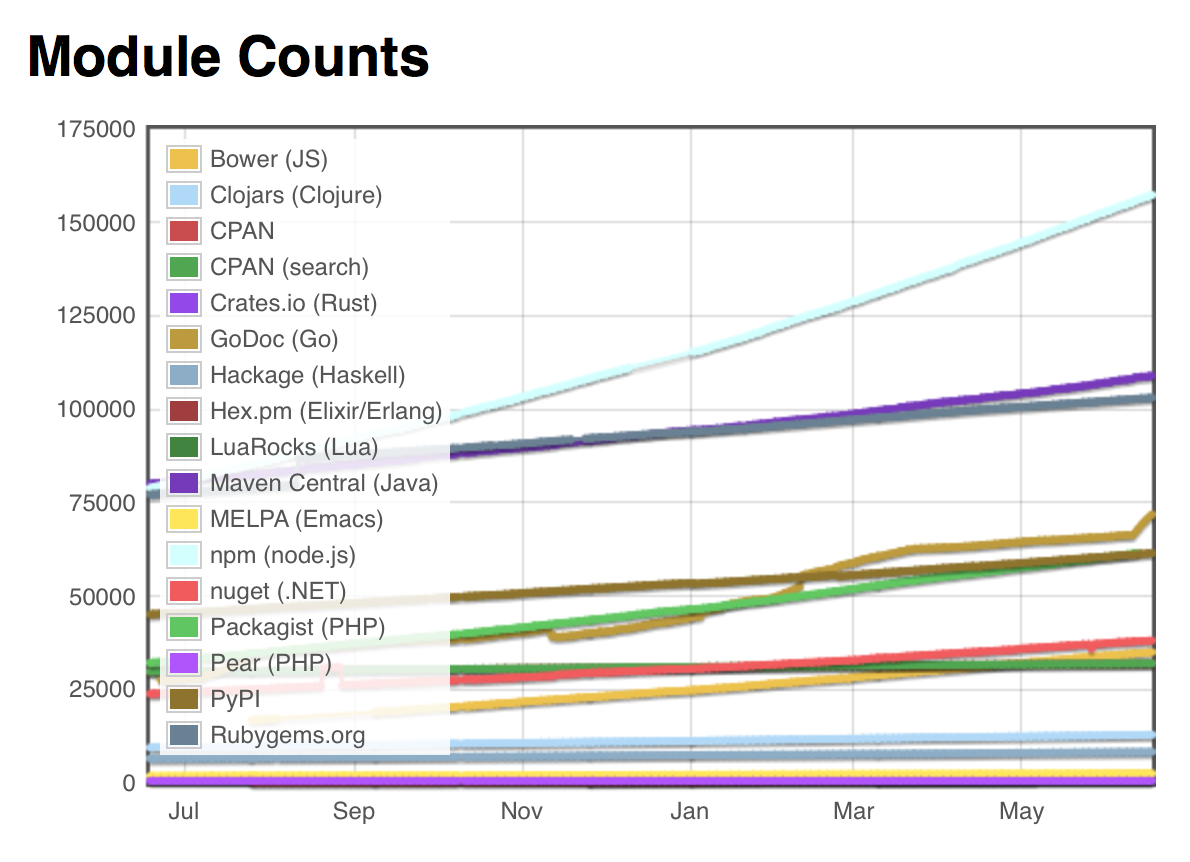
Today I want to focus on the huge ecosystem of open source projects (“suppliers”) that feed a steady stream of innovative components into our software supply chains. In the Java ecosystem alone, there are now over 108,000 suppliers of open source components. Across all component types available to developers (e.g., RubyGems, NuGet, npm, Bower, PyPI, etc.), estimates now reach over 650,000 suppliers of open source projects.
Source: ModuleCounts.com
However, like in traditional manufacturing, not all suppliers deliver parts of comparable quality and integrity. My latest research, the 2015 State of the Software Supply Chain Report, shows that some open source projects use restrictive licenses and vulnerable sub-components, while other projects are far more diligent at updating the overall quality of their components. Choosing the best and fewest suppliers can improve the quality and integrity of the applications we deliver to our customers.
While I am hosting a webinar next week to share many of the detailed report findings, I wanted to share a few of the more meaningful stats here.
Your 7,600 Suppliers
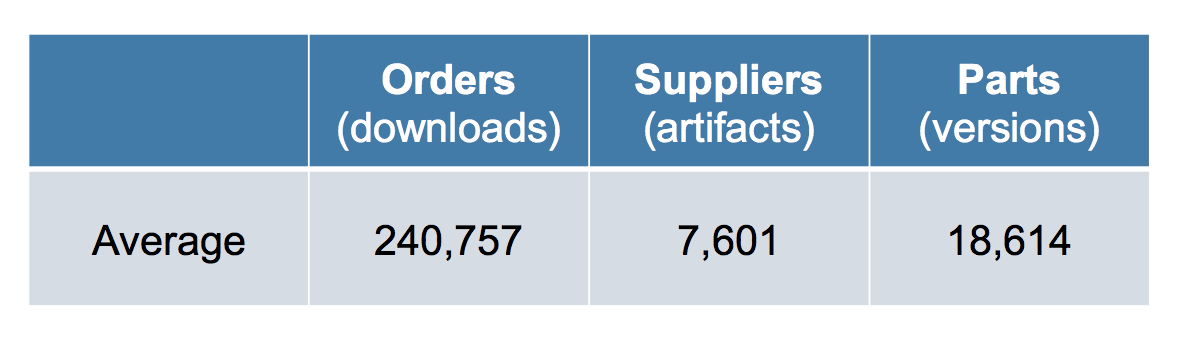
My research for the report revealed many new perspectives on “suppliers” across the software supply chains. First of all, I saw that the average large development organization consumed over 240,000 open source components last year — sourced from over 7,600 open source projects.
Average number of open source component downloads per organization in calendar 2014
On the surface, the huge reliance on open source projects is a great thing. Development teams have chosen to not write those pieces themselves, but have sourced the needed components from outside suppliers. This practice speeds development, enables more innovation, and ensures time-to-release goals are achieved. The use of open source is so prolific today, few of us could ever imagine reducing the use of those components and their suppliers in the future.
At the same time that we benefit from open source, our high paced, high volume consumption practices don’t allow us the time needed to do the due diligence on the suppliers or open source projects where we source our component parts from.
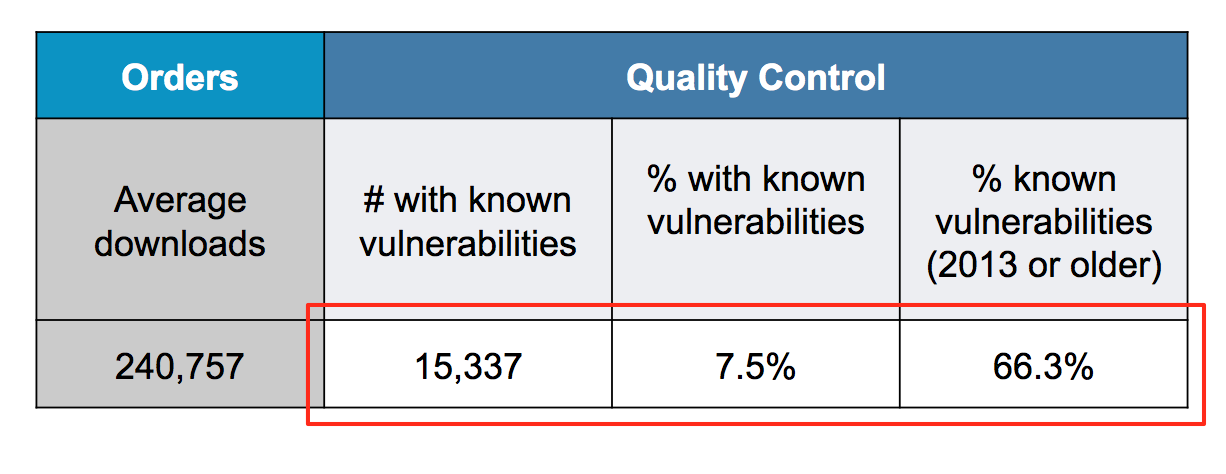
Average number of known vulnerabilities downloaded by organization in calendar 2014.
For example, of the 240,000 average component downloads in 2014, the same businesses sourced an average of 15,000 components that included known security vulnerabilities. In many cases, developers were downloading vulnerable component versions, when safer versions of those same components were available from the open source projects. While no one intends to download components with known vulnerabilities, the problem is exacerbated due to the lack the visibility into a better recommended version.
Fewer Suppliers, Less Context Switching
Choosing an open source project supplier should be considered an important strategic decision in organizations because changing a supplier (“open source project”) used is far more effort than swapping out a specific component. Like traditional suppliers, open source projects have good and bad practices impacting the overall quality of their component parts.
Traditional manufacturing supply chains intentionally select specific parts from approved suppliers. They also rely on formalized sourcing and procurement practices. This practice also focuses the organization on using the best and fewest suppliers — an effort that improves quality, reduces context switching, and also accelerates mean time to repair when defects are discovered. One industry example from the report describes how Toyota manages 125 suppliers for their Prius to help sustain competitive advantages over GM who manages over 800 suppliers for the Chevy Volt.
By contrast, development teams working with software supply chains often rely on an unchecked variety of supply, where each developer or development team can make their own sourcing and procurement decisions. The effort of managing over 7,600 suppliers introduces a drag on development and is contrary to their need to develop faster as part of agile, continuous delivery and devops practices.
Coming to Terms
When you come to terms with the volume of consumption and the massive ecosystem of suppliers you can source your components from, you quickly realize it is impossible to address this issue with a manual review process. Any organizations clutching to these outdated manual practices are will continue to be outgunned by the velocity by their software supply chains.
Just as traditional manufacturing supply chains have turned to automation, software development teams need to take the same approach by further automating their software supply chains. Information about suppliers and the quality of their projects needs to be made available to developers at the time they are selecting components. Information about the latest versions, features, licenses, known vulnerabilities, popularity of versions being used, and the cadence of new releases should be made available to developers in an automated way. Automating the availability of this information about suppliers can lead to better and fewer suppliers being used.
Be sure to read the full 2015 State of the Software Supply Chain Report for more information about open source suppliers and organizations sourcing practices. The report also highlights current and best practices being used in organizations that are managing their use of suppliers that feed their software supply chains.
To hear more about the overall report findings and industry best practices, please join me on Wednesday, June 24th (1pm ET) for our webinar.
To drive towards faster innovation, and also ensure the stability of the core business, the need arises for what is being termed as “two-speed or variable speed IT.” While innovative Systems of Engagement demand speed, agility and experimentation, legacy Systems of Record need governance and predictability. Two-speed IT enables adoption of DevOps capabilities by adapting them to the “speed” of delivery. It requires two-speed business planning and processes and even two-speed organizational structure and budgeting. Join Carmen DeArdo, Director of Application Development at Nationwide Insurance, Sanjeev Sharma, lead DevOps Technical Evangelist at IBM, and Lee Reid, executive IT specialist as they show how IBM’s solution is helping Nationwide adopt DevOps practices for variable speed IT systems.
[seoslides embed_id=”be17733a1254″ script_src=”https://staging-devopsy.kinsta.cloud/embed-script/webinar-how-nationwide-insurance-is-adopting-devops-for-variable-speed-it-systems/6643/” overview_src=”https://staging-devopsy.kinsta.cloud/slides/webinar-how-nationwide-insurance-is-adopting-devops-for-variable-speed-it-systems/” site_src=”https://staging-devopsy.kinsta.cloud” site_title=”staging-devopsy.kinsta.cloud” title=”Webinar: How Nationwide Insurance is Adopting DevOps for Variable-Speed IT Systems” /]
VIDEO
Your Host:
Alan Shimel, Editor-in-Chief staging-devopsy.kinsta.cloud, An often-cited personality in the security and technology community and a sought-after speaker at industry and government events, Alan has helped build several successful technology companies by combining a strong business background with a deep knowledge of technology.
About Panelists:
Carmen DeArdo, Nationwide – Director – Tools and Technology Leader
Carmen DeArdo, Director – Tools and Technology Leader, Nationwide Insurance, An ardent advocate of DevOps and a leading speaker in the DevOps and technology related events, Carmen is responsible for driving continuous delivery utilizing DevOps, Lean and Agile techniques across Mobile, Distributed and Mainframe and other technologies.
Sanjeev Sharma, IBM Worldwide Lead – DevOps Technical
Sales and Adoption, IBM Cloud Unit
Sanjeev Sharma, IBM Worldwide Lead – DevOps Technical Sales and Adoption, IBM Cloud Unit, is a 20-year veteran of the software industry with expertise in DevOps, Mobile Development and UX, Lean and Agile Transformation, Application Lifecycle Management and Software Supply Chains. He is a DevOps Thought Leader at IBM and speaks regularly at conferences. He has written several papers and is the author of the DevOps for Dummies book.
Lee Reid, IBM – Senior IT Specialist
Lee Reid, Senior IT Specialist, IBM, is a senior solution architect with focus on practical adoption of software engineering tools, software delivery solutions, application life cycle management, and DevOps. He has over 25 years of experience in software engineering, design, programming, testing, development, tools & methodology, team leadership, and strategic planning.
 Pallavi Poojaryis a writer with Edureka, an online learning company with more than 250,000 learners spread across the globe. She writes on hot technologies and skills that are in demand today, including DevOps, Big Data and Project Management, to name a few. She is a believer in transformation of careers through learning

 Aater Suleman, CEO & co-founder at Flux7, is an industry veteran in performance optimization on servers and distributed systems. He earned his PhD at the University of Texas at Austin, where he also currently teaches computer systems design and architecture. As a faculty member at UT-Austin, Mr. Suleman focuses on optimizing DevOps architectures involving the AWS cloud. Along with the Flux7 consultant team, he works at every step of the dev flow, from creating local developer environments using Vagrant and Docker, to continuous integration and continuous delivery using Jenkins or RunDeck, to configuration management using Chef/Puppet/Ansible, to creating efficient systems for deploying new code from Git using Capistrano/Fabric/bash. His background is as an architect, and he has experience with both hardware and software. This combination brings a unique perspective and broad view to development and operations.




 Mark Troester is the Vice President of Solutions Marketing at Progress Software. Mark has extensive experience in bringing application development and data integration products to market. Mark previously led product marketing efforts at Sonatype, SAS and Progress DataDirect. Before moving into marketing, Mark worked as a developer and developer manager for start-ups and enterprises alike.