Category: Blogs

  • My DevOps Bookshelf

    My DevOps Bookshelf

    Aside from the many technical manuals on our bookshelves, I bet everyone has a few that are more process or philosophically oriented which hold a special place in our hearts.   To me, these are the ones we continue to go back to and that have helped develop us as engineers, software, operations, quality assurance or otherwise.  In no particular order, the following are the top four, not strictly technical, books in my library.

    Web Operations by John Allspaw and Jesse Robbins

    Allspaw and Robbins cover many topics in this text ranging from monitoring and metrics to databases and operations development relations.  I appreciate this one so much it is required reading material for anyone who joins my operations teams.  In my opinion, it illustrates many best practices for an operations organization.

    Continuous Delivery by Dave Farley and Jez Humble

    This book bridges the gap between good software development practices and getting to continuous delivery.  It made me really think about testing and quality assurance, which in my opinion is one of the most difficult parts of a continuous delivery world to wrap your head around.  While there isn’t one right answer, you should really think about the role testing plays in the overall process.

    The Phoenix Project by Gene Kim, Kevin Behr and George Spafford

    “The Pheonix Project” is a relatively new addition to my library.  While it may sound strange, this book was an absolute page-turner and I really related to it.  It presents many Agile and DevOps concepts via a fictional story that doesn’t seem fictional because we have all been there.  Despite the fact that it is fictional, the concepts presented and techniques are applicable to each of our real-world situations.

    Etsy – Moving Fast at Scale

    While this isn’t actually a book, but a video, to me this is a pivotal piece of information has continued to guide my pursuit of DevOps methodologies and practices, so it holds a special place on my figurative bookshelf.  In the video, the guys at Esty discuss a number of topics including deployment processes, application toggles, metrics and more.  Most importantly, they not only discuss the why but also the how and I find myself frequently referencing this video.

    For me each one of these books or videos has played an important role in pursuit and real-world implementations of DevOps practices.  What are the texts digital or otherwise that you hold dear and/or have influenced you?

  • Deployment and Monitoring Automation with glu

    Deployment and Monitoring Automation with glu

    glu is a free/open source deployment and monitoring automation platform. glu is a project that was started at LinkedIn mid-2009 to address the exponentially growing needs of deploying the set of applications and services that make up the LinkedIn experience. Although some projects like Chef and Puppet existed at the time, they were mostly good at configuring the infrastructure (creating users, installing java, etc…). glu lives in a higher space: provisioning dynamic applications on an ensemble of machines (change often, real-time failure detection, etc…).

    glu is in the application deployment space

    First, let’s start with some definition: when I say application, I mean a piece of code that usually needs to run, and usually offers some form of api to talk to (which, at a lower level, is a socket listening on a port). Equivalent terminology is service or server. For example, a webapp server is an application. Although glu can also deal with one-off programs (run, do some computation and then stop) or infrastructure (perl, java, etc…), it is not optimized to handle these use cases and other projects are better at this task (Chef/Puppet).

    What is particular about applications in general, is that they tend to change a lot more often than infrastructure. In the age of continuous deployment, it is not uncommon sometimes to have the same application updated and deployed several times a day!

    glu has been designed to handle this use case: deploy applications to an arbitrary large set of nodes:

    • efficiently
    • with minimum/no human interaction
    • securely
    • in a reproducible manner
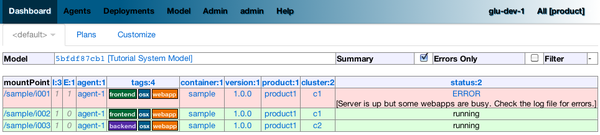
    glu executes a deployment
    simply click “OK”!

    glu is in the application monitoring space

    Once an application is up and running, many failures can happen from the low level hardware crashing to the application itself misbehaving. This is the nature of it, nothing is perfect, things will crash one way or another. So it is very important to monitor the state of the system in general in order to be able to react appropriately. glu has been designed to give a full view of the set of nodes on which you have deployed applications. When something goes wrong, you can know in a near real-time basis. You can then decide on the proper course of action like restarting the failed application on the node it crashed, or downgrading it to the previous version and redeploying the previous version to all the appropriate nodes. As a side note, you can also build a full monitoring solution on top of glu as explained in this blog post.

    glu detects failure

    glu is a platform

    It is very hard to build a one-size-fit-all solution. This is why glu has been designed to be a platform in order for you to build the solution that fits your environment and workflow on top of glu:

    • glu offers a REST api so that you can control glu yourself via a simple and documented api. For example, glu is not auto-reactive by design (which means that if something fails, glu will tell you about the failure, but it will not act on its own about it), but using the REST api, it is fairly easy to build a reactive solution on top of it.
    • the console (which is the main UI / REST api), is highly customizable (plugins to change the behavior of some features, css tweaks to let you change the look of it, etc…)
    • glu comes with its own package/distribution builder which lets you customize every component to suit your own needs (as simple as changing the port numbers or as complex as providing your own specializations).
    • glu does not dictate what a deployment mean to you, nor how to model your own system (clusters, groups, etc…), nor how to model your workflow (aka state machine in glu’s terminology). You are in control and you decide.

    glu in practice

    glu is not an academic exercise. glu has been built and successfully deployed at LinkedIn early 2010 prior to being released as open source. glu helps LinkedIn manage the complexity of releasing hundreds of applications/services on a 1000+ node environment (numbers from 2010). Other big names like Orbitz and Outbrain are using glu for their deployment needs.

    Over the years, glu has been refined and enhanced in order to support more use cases but the core and fundamental concepts on which glu was based originally and that I briefly introduced in this post are still what makes glu what it is!

    How to start with glu?

    If you want to take a look at glu, the best is to head to the main documentation page. I would also recommend to download glu and try the tutorial which gives you a feel of what glu is capable.

  • An Introduction to DevOps

    An Introduction to DevOps

    What is DevOps

    You can ask 10 people for a definition of DevOps and likely get 10 different answers.

    If you want to find a definition of your own, your research will probably begin by asking Google, “what is DevOps”. Naturally, Wikipedia is one of the first result so that is where we will begin. The first sentence on Wikipedia defines DevOps as “a software development method that stresses communication, collaboration and integration between software developers and information technology (IT) professionals.” Well, that’s a fairly dense definition, yet still pretty vague. I think DevOps can be explained simply as operations working together with engineers to get things done faster in an automated and repeatable way.

    So let’s delve into how DevOps works and can better adjoin two traditionally opposing departments.

    Growing pains

    When you are responsible for large distributed applications the operations complexity grows quickly.

    • How do you provision virtual machines?

    • How do you configure network devices and servers?

    • How do you deploy applications?

    • How do you collect and aggregate logs?

    • How do you monitor services?

    • How do you monitor network performance?

    • How do you monitor application performance?

    • How do you alert and remediate when there are problems?

    Combining the power of developers and operations

    The focus on the developer/operations collaboration enables a new approach to managing the complexity of real world operations. I believe the operations complexity breaks down into a few main categories: infrastructure automation, configuration management, deployment automation, log management, performance management, and monitoring. Below are some tools I have used to help solve these tasks.

    Infrastructure Automation

    You no longer have to build a server from scratch, buy power and connectivity in a data center, and manually plug a machine into the network. After wearing the operations hat for a few years I have learned many operations tasks are mundane, manual, and often have to be done at two in the morning once something has gone wrong. DevOps is predicated on the idea that all elements of technology infrastructure can be controlled through code. With the rise of the cloud it can all be done in real-time via a web service. Infrastructure automation solves the problem of having to be physically present in a data center to provision hardware and make network changes. The benefits of using cloud services is that costs scale linearly with demand and you can provision automatically as needed without having to pay for hardware up front.

    Configuration Management

    Configuration management solves the problem of having to manually install and configure packages once the hardware is in place. The benefit of using configuration automation solutions is that servers are deployed exactly the same way every time. If you need to make a change across ten thousand servers you only need to make the change in one place.

    There are other vendor-specific DevOps tools as well:

    In the operations environments I have worked in there were always strict controls on who could access production environments, who could make changes, when changes could be made, who could physically touch hardware, and who could access what data centers. In these highly regulated and process oriented enterprises the thought of blurring the lines between development and operations seems like a non-starter. There is so much process and tradition standing in the way of using a DevOps approach that it seems nearly impossible. From an operational perspective, my first instinct is to understand the application architecture so I can start thinking about the proper deployment model for the infrastructure components. From a development perspective, my first milestone is to make sure the ops team fully understands the application and what it takes to deploy it to a pre-production environment.

    DevOps isn’t just a set of tools, but a philosophical shift that needs that requires buy-in from all folks involved to truly succeed. It’s only through a high-level of collaboration that things will change for the better.

  • A Critical First Step in Bringing Dev and Ops Together

    A Critical First Step in Bringing Dev and Ops Together

    We all want to deliver excellent software to our customers. We now have a greater awareness than ever before of the interconnectedness of all the activities required to do so. The agile movement started this but it was not until the advent of DevOps that Ops was considered part of the full picture. In this article I will explain an effective first step that agile organizations can take to complete the picture and bring ops more completely into the product development process.

    Delivering excellent software starts with product definition and flows from those initial stories and designs, into dev, verification and testing, into production and then back again in the form of customer feedback and bugs. In reality the feedback paths represent a transitive closure of all activities just mentioned as you can see in the diagram below. Agile recognized the importance of feedback loops in good product development. Agile also realized that for the right information to flow, walls had to be broken down. The motto “Done means tested” arose and indicated that product owners were not done with a story, could not consider it closed, until it had been tested and they had verified it. This represented the integration of PM, development and QA functions. A huge step, but one step too short. Operations was still not viewed as a key part of building excellent software and there was not much insight into the fact that the feedback loop did not stop at testing. DevOps has recognized this shortfall and taken it to its logical conclusion – “Done means in production.”

    Operational Excellence Feedback Loop

    Product development is a cycle, a cycle that operations is a critical part of. In describing how all parts of the cycle can be integrated lets start at the most natural beginning; product definition. Product definition activities produce stories, designs, functional acceptance criteria (A.C.) and prioritization. In this phase we don’t produce all we need for the finished product but just enough to get us going. With popular agile methodologies like Scrum this is ideally not done solely by a product owner but instead in conjunction with dev and test at story grooming meetings, design reviews and sprint planning. In these meetings dev, QA and product communicate and negotiate stories, comment on designs, and flesh out acceptance criteria. In this way the stories, designs and acceptance criteria are improved and everyone gains an understanding of what is being built; they also become invested in it. A story may look something like this (abbreviated):

    Story: Blog administrator can change user roles SO THAT users can be managed effectively

    A.C: Given blog administrator is logged in
    And on a user profile
    When he selects a permission scheme from a permissions drop-down menu
    Then the users permissions are updated and stored in the DB

    This is a great start but it is not enough. If we are to be excellent we must modernize this just a bit and add in some DevOps spice.

    A first step towards bringing ops effectively into the cycle is to include someone responsible for actually operating the software in the story and acceptance criteria grooming sessions, design reviews, and sprint planning meetings. The critical aspect is that when the team negotiates the acceptance criteria associated with a story it will be ops responsibility to ensure we for each story or feature the team adds success and failure metrics, initial alarm values and any operational functionality such as a kill switch that will be needed in order to operate the functionality effectively. So a story will now contain things like the following in the A.C. (acceptance criteria).

    Given operation X fails
    Then the metric operation-x:failed will be sent through the metrics feed

    We will also alter our definition of done to make sure that a story will not be closed until we meet the ops driven acceptance criteria. For example: we can see the metrics we have defined in our A.C. show up on an ops dashboard. There are so many benefits to this such as folks that are unlucky enough to be on on-call will have participated in this story grooming and will know exactly what these metrics mean when they encounter an issue with them for the first time in production. Furthermore, they will know what operational levers they can pull or request to be pulled.

    This first step represents a connection from product definition to dev, to QA, to operations. This connection is perfectly natural and intuitive when you think about it. Being a true DevOps organization and developing operationally excellent products requires more but having connected product definition to operations as we have provides a nice toe hold from which to flesh things out further. Best of luck. If you have any questions leave them as comments and I will respond as best I can.

  • Enough with the DevOps already

    Enough with the DevOps already

    Ever say a word 10 times in a row and feel it start to lose its meaning? Try it, say the word “boat” ten times out loud and watch what happens – be sure you are a alone when you try this or you will get funny looks. When your done try it with the word “devops”.

    Writing and articles relating to DevOps heavily use the word DevOps, particularly in their titles.

    • What is DevOps
    • Getting started DevOps
    • DevOps culture
    • DevOps and continuous delivery

    etc…

    Take a look here at staging-devopsy.kinsta.cloud for example, the majority of articles have “DevOps” in the title. This is the case across pretty much all DevOps related sites across the web.

    This suggests an immaturity in the space. There is not yet a strong consensus on what the term DevOps means and what its domain actually is. I suspect this is going to correct itself over time but how rapidly depends on the DevOps community and how much information we can get out there. So looks like we need to hear about DevOps as a term for a little while longer.

    I suspect in 6 months to a year we will start to see articles about specific technology and practices and it will just be obvious to us that this relates to DevOps. Ironically this article has 231 words and uses the term DevOps 14 times.

  • THOUGHT LEADERS OR NAVEL GAZERS?

    THOUGHT LEADERS OR NAVEL GAZERS?

    I get tired of hearing what is DevOps? It just tells me that no one really has got it exactly right, but everyone longs to be the authority on the topic. Everyone writes their perceived answers ad nauseam. Reading all the different definitions is kinda like listening to infomercials. An individual puts themselves out there as an expert simply because they have an audience and the topic is in vogue.

    But before I go any further let’s put the “What is DevOps?” questions to bed once and for all. Of course the only real source to turn to is Wikipedia, as that is the definitive source and because it’s on the Internet you know it has to be true. Did I tell you I was a French model; bonjour.  Now to the definition you have been anxiously anticipating:

    DevOps (a portmanteau of development and operations) is a software development method that stresses communication, collaboration and integration between software developers and information technology (IT) operations professionals. DevOps is a response to the interdependence of software development and IT operations.

    There you have it; DevOps is a methodology not an industry. Now that that question has finally been answered, I hope that I never hear about it again, let’s turn back to those thought leaders. Let’s go back to time when many of today’s thought leaders were still asking what the internet is. Once again I refer to my expert source Wikipedia:

    A thought leader can refer to an individual or firm that is recognized as an authority in a specialized field and whose expertise is sought and often rewarded. The term was coined in 1994 by Joel Kurtzman, editor-in-chief of the Booz & Co magazine Strategy & Business, and used to designate interview subjects for that magazine who had business ideas which merited attention.

    Everything on the internet is about branding and the marketing of the brand. Thought leaders typically write a blog, column, book, record a podcast or webinar.  As long as the message resonates they don’t care about the delivery mechanism. So called thought leaders are simply marketing their brand whether they truly have the expertise to do so or not.  It is a simple process when you have a topic that is loosely defined in an early stage of development, as there is no objective measure of what is correct.

    Thought leaders typically are an individual or firm that profit from being recognized as such. I submit many are truly mere navel gazers, as a navel gazer is derived from the phrase “contemplating one’s navel” or “navel-gazing” if you will, typically referred to in jocular fashion, to refer to self-absorbed pursuits. Please someone explain to me the difference between thought leaders and navel gazers?

    We have so many self anointed thought leaders I am beginning to wonder is there anyone out there actually practicing DevOps or is everyone just talking about it to make a fast buck. If you are a thought leader why can’t you tell me if and when DevOps is going to cross the chasm?

    What have I learned from all this? DevOps needs an infomercial to cross the chasm, not thought leaders. Don’t even get me started on chasms.

    If you would like say something; email parker@devops.com and don’t forget to comment here.

  • Don’t Let the (April Fools Day) Joke Be on You

    Don’t Let the (April Fools Day) Joke Be on You

    As much as seasonal increases in demand for on-line resources are discussed, the one day that’s often overlooked is April Fools Day.

    It’s the day the Internet loses its mind and your best bet is take everything not just with a grain of salt, but with the entire shaker.

    The use of April Fools’ Day to promote brand awareness and bring some laughter into the world as everyone tries to outdo everyone else in a bid to be named the King of Fools is well known. This is no more a surprise today than is Black Friday, Cyber Monday or Super Bowl Sunday.

    So it behooves those participating in the tom foolery to be prepared. That means being ready to handle an increased demand for whatever it is you’re offering up for consumption. This is where devops shines; where automation and orchestration and a demand-driven scalability strategy is your best answer. Because you can’t be sure your offering is going to go viral, but you can be sure it won’t if any piece of the application delivery chain breaks under the pressure.

    In other words, this is unacceptable:

    err-db-conn

    What might have gone viral may end up languishing as just another overlooked and forgotten attempt because of a lack of database resources and a failed scaling strategy.

    One of the key aspects of devops is that it should approach scalability with a comprehensive view of how each piece of the delivery chain needs to scale – and when. Thresholds and metrics collected from each domain of an application architecture must be correlated and understood in the context of how it impacts capacity so that it can be automatically scaled – or at least addressed – on demand.

    Maybe that means devops must advise a cloud-based approach to handling demand for such days. Maybe that means a bit more preparation and integration across the entire application delivery chain to ensure the load balancing service is basing its decisions on the right variables such that resources are maximized and enable greater scale across the application. Maybe that means throwing up a cache to reduce the pressure on web and application servers, or taking advantage of a CDN.

    Regardless of the approach to how you’re going to scale, devops practitioners should be driving the process to ensure that on April Fools Day – or any well-known high demand generation day – the joke is not on them.

  • My Journey to the Land of DevOps

    My Journey to the Land of DevOps

    Welcome to my first installment in a series where I talk about my long transition as an engineer, first from a very traditional waterfall development methodology into a more Agile process, and finally into a true DevOps organization at my current gig at JumpCloud.

    Who Am I?

    First, a little background on me. I’m (almost) a lifelong coder, and by that I mean I started writing my first simple programs at 9 years old, on a HP 3000 MP/E host running MP/E BASIC. I got my first computer at home at 12, a Radio Shack TRS-80 with a whopping 16K of RAM, and a cassette drive for loading and saving programs. I’ve had computers in my house since then, and probably never in my life since have I gone more than a week without being in front of a computer.

    I love building software, but for a long time, I was resistant to changing how I did that in a professional environment. But, I try to be a guy who’s open to at least evaluating new stuff, even if I don’t dive into new things as a way of life. I tend to be one of those guys who does it (everything) the same way over and over until I see a way that is demonstrably better. I’m a creature of habit, but I’m also a creature of continuous improvement (as long as I can see the improvement).

    In college, I did a fair amount of system administration work on UNIX systems, including BSD and some System V R4 boxes. During that stint, I learned quite a bit about how not to destroy systems by running rm -rf /etc (every system admin does that on a production box at least once, don’t they? If you haven’t, I can’t really recommend the rush that comes from recognizing that you’ve just decided how you’re going to spend your night, instead of sleeping), and how to install, backup, maintain, and fix big (but by today’s standards laughably slow) mini-computers. I’ve always maintained UNIX/Linux system administration as a skill set, and it’s always come in handy.

    After that, I jumped into software development, in databases, security, and systems programming.

    You get the idea: I’ve been around awhile, and I’ve done enough to be able to gauge whether a new technology or process is valuable or not. And, because I’ve done dev, operations, and DBA work, I think I can offer a solid perspective on the transition to DevOps.

    The Waterfall Method, or, How Can We Fail Big?

    Looking back, Waterfall as we practiced it then was comparable to building a campfire, versus the subtlety and refinement of fireworks, and Agile methodologies.

    Waterfall is the place where we all started (for those of us joining the workforce in the early 90s). That was how software got built: no ifs, ands, or buts. We all “enjoyed” the many hours of building requirements with business analysts, the joint application design (JAD) sessions with clients, the weeks of first writing functional specifications, then moving to the design phase and building design specifications. In the midst of all that, iterating through many reviews with stakeholders under the watchful eye of our project manager.

    Once we got to coding (on my teams, at least) the docs were treated as an afterthought for the most part. Sure we’d open them up periodically to see if we’d missed a requirement, or if there was an argument about some previous decision we’d made. But, most of the time, most of us didn’t code with a document open in one window, and code in another. Sometimes we did, but inevitably we’d hit a section that literally or figuratively says, “magic happens here” (nerdspeak for, I have no idea how that’s going to work) and then go off the rails: the specs never to be seen again.

    When the coding was done, we’d package everything up, and throw it over the wall to QA. QA would start cranking through executing their test plans, doing ad hoc testing, rarely doing load testing, and eventually (through internal iteration – sounding a little like Agile?) would make our software look like the requirements spec, or at least what it was made to look like after the dev team spent a lot of hours and countless emails asking the client detailed questions about how a particular thing should work. QA would then pronounce that version good, and either we (the dev team) or an ops team would actually deploy our software to production.

    Oh, and by the way, I missed another step: the deployment documentation. This file goes here, reboot the system at this point, install this package, upgrade to this version of the database or OS. All that fun stuff got written into documents, and executed by humans, over and over again. And did I mention, that had to be tested, too? And maintained? And that inevitably would result in a developer getting a call in the middle of the night, or during a weekend change window to get things back on their feet?

    Oh, the joys of writing documentation that was out of date almost as soon as it was finished, the deviations from it that occurred when you were building real software to handle real world cases that you never considered during the specification phase. It was almost as if all the docs were completely useless. But, well-paid individuals spent countless hours to build them. They did look impressive, and it showed that we were doing things “professionally”, not just getting out and starting to code something, because that would be crazy.

    I should probably mention at this point that I’ve never been involved in building software for applications that could have life-threatening consequences, or that are one-chance things, where you spend years building the software, and if you don’t get it right, human lives, or millions or billions of dollars can be lost. I think the extreme levels of documentation, planning, and review cycles are still necessary for these types of applications, though I think both Agile and DevOps have benefits to offer parts of these projects, more on that later. In my view, these applications are not ones that lend themselves to lots of iteration, at least not externally: “Oh, I’m sorry, captain, the feature that lets you apply landing brakes is not part of this release. The team says that’s coming in the next sprint.”

    Microsoft Project: The Wrong Tool for the Job

    All this work took a long time, and managers were still under the illusion that project managers could predict the future. Management would say: you have 18 months to get this project done, and we’d open Microsoft Project (as though we were about to build a building or something), and start putting in development tasks. We’d estimate based on our prior experience how long a particular task was likely to take, and schedule it all out. We’d nearly always end up reducing scope at that point to make all our work fit into that short(!) 18-month schedule. I remember spending hours in Project trying to make all the dependencies work, and then seeing the schedule get changed over and over as we changed from one task to another based on what was logical at the time, not what was on the schedule.

    We’d go back to management, and say, this is what we think we can do in 18-months. The more astute project managers would give a best case, likely case, and worst case estimate, all of which would be wildly different. We’d play games like ensuring that the weakest members of the team never became part of the “critical path” (the path of tasks that was packed full from beginning to end, such that missing a deadline would delay the whole project). To try to reduce risk, we’d build risk mitigation documents that listed out all the stuff that could go wrong, and what we were going to do to fix it and get the project back on track.

    Management would take our project schedule, risk mitigation plans, and high level functional spec, look it over, ask some pointed and thoughtful questions, and send us away again to improve our plan. Nearly everyone in the process was competent, professional, and thoughtful. And, in the end, everyone in the process was horribly, brutally, wrong: repeatedly.

    Even if we met major milestones on schedule, it was very rare to actually hit a scheduled end date. Something new would pop up, something would go wrong, something would be harder than we thought, and these somethings would pop up more frequently the longer, larger, and more money we threw at a project. So, as the risk level increased, so did the likelihood of failure. It was almost a foregone conclusion that we’d have to cut scope before the end of the project to try to meet our original deadlines. Or, the team would end up in a death march for months on end to try to pull the schedule back. Or, we’d cut into the time set aside for QA. Or all of the above.

    We learned all too well the old project management axiom that you can have any two of: time, quality, or cost. That is, you can get something fast and of high quality if you want to spend a lot of money to get it. Or, you can go cheap and fast, at the cost of quality. Or, finally, you can get great quality and low cost, if you want to take more time. That was called out especially harshly when iterations were counted in years, rather than months or weeks.

    The funny thing was that we all fought with these problems daily, and we argued with management about how broken the process was, that all the specification and up front planning work (especially when building phone books or mailing lists) wasn’t useful, but in the end, we all just kind of continued down the same path, until the late 90s, when the ideas of Agile development first started taking root.

    Next time, I’ll focus on Agile, my initial reactions to it, and and how it started gaining traction.

  • Don’t Fear, Testing Team! DevOps is here!

    Don’t Fear, Testing Team! DevOps is here!

    I love Gene Kim’s analogy about how all unicorns used to be horses; its  a great visual that I use all the time when encouraging IT organizations to change from thinking “why not” to “why not us” when it comes to starting their DevOps transformation.  If culture is really one of the greatest enemies to faster adoption, then you have to start with where the horses live.

    One of the biggest herd of horses in every organization is the team of people dedicated to testing and validating applications.  Even though these teams are not being included in the conversation, they are in fact the most pivotal part in the transformation.

    A Dangerous Love Triangle

    DevOps is touted as the marriage of development and operations; a match made in heaven.  One small problem though:  in most traditional organizations there is a love triangle between operations, development, and testing, as the flow of bits roll from one team to the other until the application is delivered to production.  With the conversation shifting to how can development and operations work better together the testing teams are being alienated.  The question is where does a testing team fit into this conversation, when the focus is all about bringing development and operations closer together?  How can the testing team assert themselves to help facilitate this transformation?

    Horn Growing Engagement

    The Phoenix Project is a great narrative that introduces robust DevOps concepts.  One cannot go far on staging-devopsy.kinsta.cloud without seeing “The Three Ways” and what they mean.  The first “way” is about getting a really good understanding of the delivery chain and how it works as a whole to deliver applications to the end user.  The team that knows the most about this is the testing team as they are the glue that binds operations and development together. If you are going to start growing a horn, you need to start here.

    Engage with the testing team early and often.  This team knows more about the flow of information from development to production than any other team.  They understand the process of moving applications from development environments, testing them, and delivering them to production. They understand the infrastructure and how it should work and what operations team needs to deploy applications.  This knowledge is the perfect horn-growing fertilizer.

    Performance-Driven Feedback

    In my last post I talked about how performance and change management were two pillars to start building on.  As you start to move from simply understanding the system as a whole and increasing the rate of feedback, performance data is critical.  Remember, in science there is no right or wrong answer – only data that says the outcome is desired or not. Performance data can help take the emotion out of determining whether or not processes are going right or wrong after change is made.  Most of the performance engineering folks are embedded in the testing groups since this type of expertise is needed to drive a successful DevOps transition. However, be careful as you start to utilize these resources as they have the potential to become your biggest constraints.  Protect them and get the mechanics of performance testing and engineering out of their head and into the heads of your development and operations teams.

    Continuous Experimentation

    Once you have the testing team on board and helping in this process an interesting event should occur.  The testing teams will start to embed themselves into Development and Operations.  This is when an environment of experimentation becomes possible, just like in a factory, quality is being tested continuously. This leads to a more combined focus on the task at hand while ensuring the quality of the applications and the speed of delivery.

    So really the phrase should be: DevOps, don’t fear! The testing team is here!


  • Follow Friday, DevOps To Follow on Twitter and DevOps Podcasts

    Follow Friday, DevOps To Follow on Twitter and DevOps Podcasts

    As I wrote last week, in doing my research for this blog I have been looking around for a good list of DevOps people to follow. I have found a small list here and there, but unlike in the infosec community where we had the @securitytwits, there is no analogue to that in DevOps. So with a tip of the hat to Bill Brenner of Akamai (and formerly of cso.com) I have stareted a new tradition here on staging-devopsy.kinsta.cloud.  Our own Follow Friday: DevOps Peeps to follow on Twitter.  New for this week:

    @hullsean @champagnie @planetdevops @krishnan @tarunbhatti @wickett @nathenharvey @andimann @byron_miller

    From last week:  @patrickdebois: @realgenekim: @botchagalupe: @jezhumble; @garethr; @kartar; @krisbuytaert; @jordansissel; @agentdero;@allspaw; @monkchips: @devops_borat; @lnxchk: @damonedwards;  @lusis; @obfuscurity; @shanley: @adrianco; @scriptrock;@jumpcloud; @sd_architect; @govictorops @softlayer @docker; @chef

    You can find all of these people on a Twitter list I have started at: https://twitter.com/devopsdotcom/lists/devops-twitters-to-folow

    Also as a bonus this week a list of some of the great DevOps podcasts to listen to:

    DevOps Cafe

    Arrested DevOps Podcast

    FoodFight

    The Ship Show

    Do you have any twitter names to add to the list or DevOps podcasts to list?  Mail me at ashimmy@devops.com or leave it in the comments.  Have a great weekend!