Tag: devops

  • Digital Business Transformation Driving More API Adoption

    Digital Business Transformation Driving More API Adoption

    A global annual survey of 2,200 developers published today by RapidAPI, a provider of an application programming interface (API) hub, finds digital business transformation initiatives have led to an increase in reliance on external-facing APIs.

    According to the survey results, nearly three-quarters of developers (74%) are using APIs for internal applications. However, nearly half (49%) said they are working on third-party APIs, with 44% working on partner-facing APIs. That’s up from 35% a year ago.

    RapidAPI CEO Iddo Gino said it’s clear APIs are a key enabling technology for driving digital business transformation initiatives.

    More than three-quarters of developers (75%) indicated that participating in the API economy is a top priority for their organization now or in the near future, according to the survey results. Companies are realizing the opportunity for new revenue streams, with growth in API monetization strategies increasing to 41% from 35% in 2020.

    In addition, more than two-thirds of developers (68%) said they expect to increase API use in 2022, with 61% relying on APIs more in 2021 than in 2020.

    However, well over half (56%) noted that a shortage of developer talent is a top concern, followed by lack of internal prioritization around digital transformation efforts (34%), lack of API development resources and tools (32%) and lack of alignment with other departments (29%). A full 90% also noted that security and data privacy is a key issue to consider when employing APIs.

    The results also show the use of REST and SOAP APIs in production environments fell 3.7% and 1.4%, respectively, in 2021. That drop reflects the rise of alternative API technologies such as GraphQL and Async APIs, said Gino, However, he noted it’s unlikely any new class of APIs is likely to supplant legacy APIs anytime soon; instead, most organizations will be employing a wide range of APIs for many years to come.

    The survey results reveal that JavaScript is the most used (71.6%) and preferred (51.9%) programming language for building APIs. TypeScript is also gaining traction in terms of usage (20%) and being preferred (12%).

    The most troubling aspect of the survey, however, may be the fact that well over half of respondents (56%) said they are open to switching jobs. The top five reasons developers said they might switch jobs are higher compensation or improved benefits (60%), interest in a specific product or technology at a different company (54%), desire for a more flexible working environment (38%), interest in a specific company or market (25%) and an opportunity to work with former teammates or friends (17%).

    It’s not clear to what degree the so-called Great Resignation phenomenon might be impacting DevOps teams in general. However, it’s apparent no class of jobs is immune from a general sense of restlessness that pervades the market as the global economy continues to recover from the COVID-19 pandemic. The challenge and the opportunity for DevOps leaders is to encourage the best talent available to join and then remain with their organization versus pursuing a job somewhere else that, at least from afar, appears to have greener pastures.

  • FinConDX: Leveraging DevOps in FinTech

    FinConDX: Leveraging DevOps in FinTech

    The FinTech industry has experienced remarkable growth during the last couple of years as consumers increasingly turn to online shopping and contactless payments. Financial services organizations are adopting DevOps practices to enable faster software releases, improve quality and fulfill customer expectations. On Dec. 9, financial services and tech leaders will come together at FinConDX Virtual Event to discuss the latest and most effective DevOps, DevSecOps and digital transformation practices and tools you need to thrive in the FinTech industry.

    The agenda for FinConDX features a mix of topics, including continuous security and continuous compliance best practices, value stream management, secure development in highly-regulated industries, source code security in financial services, threat detection, incident response, software supply chain attacks, cloud security, emerging technologies and modernization tools.

    FinConDX features a stellar lineup of industry experts, including:

    • Ravi Lachhman, field CTO at Shipa
    • Simon Maple, field CTO at Snyk
    • Dan “Pop” Papandrea, director, Opensource Community and Ecosystem at Sysdig
    • Ravi Yadalam, head of product for cloud optimization at Harness
    • Eric Carter, director of product marketing at Sysdig
    • Maurice Evans, director of product management at BluBracket
    • Jeff Keyes, VP of product marketing and strategy at Plutora
    • Ronen Slavin, CTO and co-founder at Cycode
    • Andrew Fife, VP of marketing at Cycode
    • Edwin Kwan, application and software security, security advisory at Tyro Payments
    • Sanjeev Sharma, SVP, head of Platform Engineering at Trust Bank
    • Colin Wynd, head of Real Time Payments Technology at The Clearing House
    • Mitch Ashley, CTO, principal at Techstrong Group, Techstrong Research

    The virtual environment features five session tracks, live chats, raffles and prices, entertainment and an exhibit hall lined with booths showcasing the latest solutions from leading DevOps companies. In the exhibit hall, attendees will have access to downloadable resources provided by our partner sponsors.

    Registered attendees will also receive a link to access the virtual environment on-demand once the live event is over.

    To see the full agenda and to register, please visit the FinConDX website.

  • EP 21:  Leading a DevOps Transformation – Lessons Learned

    EP 21: Leading a DevOps Transformation – Lessons Learned

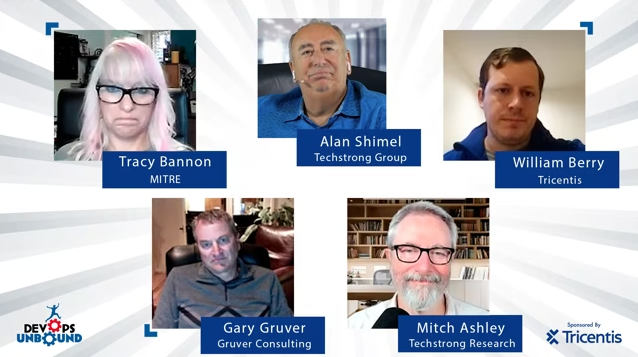
    Alan: Hey everyone. Welcome to another edition of Devops Unbound. Devops Unbound is a biweekly video series featuring relevant topics in devops. We go wherever we think develops is going and what we need to shine a light on. Devops Unbound is sponsored by our good friends at Tricentis and we thank them for their sponsorship. In addition to the biweekly Devops Unbound show of which you’re going to watch one right now hopefully every month or so we also do a devops live roundtable with an expanded panel that’s live and open to the general public for questions as well. This episode of course is a recorded one, not a live roundtable. But if you go to Devops Unbound on or staging-devopsy.kinsta.cloud you can see the schedule if you’d like to perhaps attend a live roundtable in the future.

    But with that out of the way let me jump into this episode’s topic, leading a devops transformations, lessons learned. And I couldn’t think of a better panel to have us do this. For me devops, leading a devops transformation has always been kind of synonymous with my friend Gary Groover who wrote a book leading the transformation which early on in my in staging-devopsy.kinsta.cloud when we first launched was a big staple of what we were preaching then. Gary, welcome to Devops Unbound. Maybe a little introduction about you, your company and your background.

    Gary: Great to be here. I’m Gary Groover. I led several large transformations. Probably the most one you’ve heard of most is the one at HP where we transformed and got a two to three X improvement in productivity. I’ve written four books in this space and I spend my time now trying to do everything I possibly can to help organizations transform how they do software development because it had such an impact on me and the businesses that I was part of.

    Alan: Fantastic. Ok. Next is a woman who is also no stranger to devops transformations herself, a lot of them in the government and government contractor world where she lives a lot now. It’s Tracey Banon. Hi Tracey.

    Tracy: Hey. Hi there. Thank you for the invite. My background is as a software architect and engineer so I’ve been living devops for a long time because I needed to get software into the hands of the end users and I needed to do it efficiently. Part of that required us to get that transformational thinking going. So I do spend time like Gary does in the middle of my client and my sponsor’s spaces helping them to understand, really talking straight with them about the differences that they’re going – the different thought mental model that they have to bring forward ‘cause it’s not easy. But I know we’re going to get into that today. Really excited. I work currently with the Mitre Corporation. They’re a federally funded research and development. And what that means is that I don’t compete with industry. Congress chartered us specifically to provide the expert leadership to the government to help them move in the right direction. So a little bit different perspective. Really happy to be here.

    Alan: Thank you Tracy. Last but not least is William Berry. Hey William. Welcome to Devops Unbound and maybe a little introduction.

    William: Yeah. Absolutely. Thanks Allen. It’s great to be here and great to be here with this panel. So I’m Will Berry. I lead our business engagement at Tricentis. I help our customers with aligning our initiative or their initiatives to continuous testing so that they’re able to derisk that aspect of delivery, be able to make those timeframes deliver faster and being able to achieve those goals that they have set forth.

    Alan: Great. And thank you for joining us. So guys the topic is devops transformation. When I first started staging-devopsy.kinsta.cloud I was excited to see all these companies undergoing devops transformation and I really relished talking to as many practitioners, representatives of other, of organizations as I could to see patterns, to see what was emerging as what was the best way to do this. Right? ‘Cause there was the cultural aspects and the tools and the people and the processes. Right? But what was the best way to bring it together? And also remember when I started staging-devopsy.kinsta.cloud there was this silly in retrospect silly argument of whether devops was something just for startups and Silicon Valley unicorns or as Gene Kim would say was it just for horses as well, right, the enterprise. Were large enterprises able to adopt a devops kind of mindset.

    And there were believe it or not – Gary I’m sure you remember this. There were fights raging on the Twitter sphere and the blogger sphere about was devops an enterprise thing. To me I always thought so and the consensus was yeah, of course. Stage two was ok, so all these companies started saying ok, we’re going to do a devops transformation. And you know what? A lot of them didn’t get the results they were expecting and there was this loser tech.  Devops stuff don’t work. So Gary I’m going to ask you to kick it off. I’ve given a little historical perspective. Do you think I’m crazy? Is that –

    Gary: No.

    Alan: Or your thoughts?

    Gary: No. But the debate that I’ve had with Gene over years is if you’ve got a large system of people that need to work together the things that you’re going to do are different than you do with a small team.

    Tracy: Exactly.

    Gary: And a lot of the debate that I get in with Gene is Gene saying no, no. This is how the small teams do it so now we need to make the large teams do it like the small teams do it. And that just doesn’t work and fundamentally I think that’s why a lot of devops things struggled and failed.

    Tracy: But small companies don’t necessarily succeed either because – so first of all it’s not about doing devops. Allen you’ve heard me say this before. I get so peeved when people say we need to do devops. They’ll bring me in and say help us. We need to do devops. We need to start to transform so we can do devops. And I’ll push back and I’ll say why. What exactly are you trying to accomplish? Right. Let’s get back to brass tacks. Let’s have a reason that we’re doing something and then we’ll track towards it. We’ll adopt the principles that are appropriate for you. But I’ve seen small organizations fail because it is pursuant to your context. And I think that’s where you’re going Gary.

    You’ve got to know the context of that organization. You’ve got to understand what its business objectives are, its engineering objectives are and its people. And then you figure out which pattern might apply to them because it’s not going to be – there’s no lather, rinse, repeat recipe. There’s not a singular playbook for this. And that unfortunately is what everybody is looking for. They’re looking for that playbook. I just – I need the checklist of what I need to do. Can you give me a book ‘cause I’ll just follow that?

    Mitch: Tracey I’ve seen many an organization where they will spin off a group sort of a skunk work project like back in the ‘40s and ‘50s, right with the X1 things. And those can work. They can work as a start but oftentimes they become a thing themselves and then they hit the corporate the white corpuscles, right, that come out and attack the foreign object. So I think it’s all in the context of the organization. If you’re savvy about what makes an organization tick. We’re all about data.

    We’re all about measurement. We’re all about whatever it is, finance, whatever it might be and know how they adopt change or don’t. You’ve got to sort of build in the psychology of ok, great. How do things get adopted here? How do people get on board? And it’s never easy but it can be a lot harder if you sort of walk in with the bright shiny knight and sword and we’re the new savior of the day and poof, you’re the first one to get skewered and taken out to the back.

    William: Yeah. And I think you hit it. I mean it’s an organizational mindset and you can kind of see it today. I mean you can see the responsiveness of what companies do in the market and what their competitors do. And you can see who has that mindset and who doesn’t based on whether or not I release like a new phone type strategy. Can T-Mobile respond? Can AT&T respond? And who responds the quickest to be able to address that?

    Tracy: I was having a conversation yesterday with a fellow by the name of Steven Spear. He’s a professor at MIT Sloan. He’s done a lot of –

    Mitch: Yeah. I know him well.

    Tracy: Had a lot of really good thought leadership. And we were talking about the cultural overlay and how that makes a difference because we keep looking for that recipe. We keep not understanding what the culture is. Now I don’t push for culture change. I never push for culture change because if you came into my house and said you need to change your culture the first thing I’m going to do is put my hand up and say no, I don’t. But I am into culture building and culture understanding because we build a culture together. So the cultural part means a lot. And I’ll go back to what Mitch said about context, understanding the context, the cultural context of that organization.

    When you think about government specifically that’s where I’m living a lot right now especially on the DOD side of the house. They are in a zero defect like low risk tolerance. Right? They need to make sure that it’s right the first time. Well that adds another level of complexity to the mix. So yeah, I want to go fast but how fast is appropriate? I want to adopt these principles and how many of those principles do I apply that allow me to get there in a cyber secure safe way. Right? How do I make sure the missile hits the target? How do I make sure that the plane is flying the right way? I mean Willian you brought up about the continuous testing and what Tricentis does in that realm. It’s interesting that the transformation has to include testing in a way that it hasn’t done. And it’s not just that automated unit test. Just automate the unit tests and we’ll be fine. Get some high code coverage. Hey. Hit 90 percent code coverage. It’s not that, right? There’s a bigger, broader set of this.

    And I want to bring myself back though. Something that you all said earlier is that it matters the understanding the context of the organization matters. But where do you start? So if you’re walking in the very first time to meet somebody new Gary how do you approach counseling – I’ll use that term, counseling a new organization that you’re meeting whether they’ve been in the government space, whether they are international, whether they are a small US startup. Where do you start with that exchange of knowledge to figure out how to help them?

    Gary: I tend to start by trying to understand what their problem is and trying to figure out what they’re doing. If I can get the leaders to engage not just in empowering the team and getting out of the way but really trying to take the time to understand how their current processes work and work with them to try to figure out how to make the waste in their current processes visible and then spend the time to let them pick the ideas that they think will help the most. I don’t ever go in and do devops.

    I think that’s the most – I think it’s the most disservice we’ve done to the industry. It went to – it’s kind of like trying the automobile industry trying to copy Toyota in the ‘80s. Eventually they figured out that wasn’t working and it was stupid. The software industry stuck trying to copy what worked for other people instead of trying to create a culture of continuous improvement and letting the organization pick the ideas that they will champion, the ideas that they will embrace and the ideas that they will invest in making those improvements. And if we can’t get the leaders to do that you’re never going to see the organization transform.

    Alan: So let me comment on that. You can’t change human nature. And there are certain – in the technology industry we emulate success. We emulate – if you succeed, right? How many business plans did we see seven, eight, nine years ago that said I want to be the Uber of? Right? I want to be the Uber of testing. I want to be the Uber of name a business model. Because what Uber did, I want to be the Uber of. I want to be the Twitter of. Right? In the technology industries this is what VCs whip out their checkbooks for. Right? And so you’re going to get that. I don’t know how you avoid that.

    Gary: But if you go into one of Tracey’s clients that’s developing a missile launch type system and you go let me tell you what Netflix did and how they made it work and how they had these teams they are going to check out. Never mind checking out. They’re going to dig their heels in so hard that they’re going to shoot down any idea that you ever had and you’re never going to make a bit of progress.

    Mitch: You become the new missile target I think.

    Tracy: Well hold on. It’s actually in between.

    Mitch: Ok.

    Tracy: There are. So Gary is right. Depending on the audience some of them will just, they’ll get ashen. They’ll look down and then they’ll put their hand up and they’ll say go away. But there is a growing body of folks who have come into this they’ve grown up as those developers. They’ve been hitting up against this and they are now becoming those leaders. So there is an amazing undercurrent that’s out there and I’m getting to work with them firsthand. They are looking for that air cover so to speak. Right? They are looking for those most – they want to go the whole way up to the Pentagon. They want to go to congress. They want people weighing in.

    And here’s where it tracks back to the problem that you talked about Allen. We’re not talking straight and we’re not getting the messages out that it’s not about copy catting but it’s about learning from. If we go into it and say I don’t want to use the Netflix model. I don’t want to use the Uber model. I want to look at it and I want to be informed by it. And I was to juxtapose it against my unique context. That’s where we help to get real success, incremental improvement. But we also have to come back to learning fast, failing small, failing cheap is ok. That’s a mindset shift regardless of to the industry. We always say fail fast but people react to that so say learn fast but fail small. And if you can start to fail small, surface it, allow it to be seen, allow there to be transparency into the failure, discuss it openly. That in my mind and in my observation that’s actually transformational in nature because people start to look at that and glom onto it.

    Now Mitch you mentioned something which is when you spin off this group and you say ok. You guys go be that new devops group. Can you guys go establish how devops work and you guys be a pilot project. The problem is when they succeed and come back and try to scale it. Well they’ve been partitioned off as though they’re a dot com. Right? They’re over here. They do this amazingness. And what they did isn’t necessarily scalable as is. And there’s another failure point that happens because now you’re in an organization, an enterprise that’s got a unicorn team that did great things. How do I scale that? Well I don’t just pick it up and copy it. Now I have to look at how information flows, how I go about teamification when I have lots of different folks coming from different consultancies and contractors. Not all software is written by developers and by organizational resources that are owned by one company. It’s actually getting to be kind of rare.

    William: So I mean that’s it. That’s what I see as the biggest challenge a lot of times when it comes to speed is the management layer is ready for it. The management teams they want to be able to do it but the executive layer still operates in a very project based initiative based thought process. And so you see this like this was supposed to play into this larger role of how I roll out devops across my enterprise so I went to this team and I did this. But it was still in this big initiative.

    It wasn’t allowing teams to fail fast. It wasn’t creating that environment where these managers can really dive into what they know and figure it out and drive it and then have somebody else consolidate all that at the same time, that larger level. We’re still very much when we sit in a board room we talk years and we talk plans and we execute against in that manner. We don’t always necessarily break it into these tidbits that we need to be able to empower our managers.

    Gary: And it’s a big bang transformation. And I’ve spent a lot more time recently looking at organizational change management. And they say one of the biggest barriers to people adopting new ways of doing things is risk. Any risk and when you do these big bang transformation there’s huge risk and that’s a barrier. If you do a bunch of incremental large, small changes and you create a culture of continuous improvement that’s a smaller risk. It’s reversible. It’s kind of like Tracey says. You can fail or learn quick and you can adjust and you can learn along the way. And I think what we’re missing is we’re trying to tell people what to do.

    And I’ve done this whole shift to teaching people the principles and the approaches of making their process visible, letting them pick things that they’ll champion and they’ll make work and doing it in small incremental bits that they’ll get excited and they can reverse and they can learn and adjust. And it seems to be getting a lot more success in terms of teaching people how to analyze their processes and letting them pick instead of telling them what to do and seeing them resist the changes.

    Mitch: And Gary I think we have made this repeated mistake over and over every time we introduce a change. It’s about telling people that they’re wrong and what they’ve been doing is wrong and it’s bad. And people have learned through some hard knocks of the folks that come in and do that, they come and go. Right? The last person that did that got fired, right, ‘cause they ran up against this or their project failed or whatever. And so it’s more about like let’s take the things that we do really well and let’s figure out how to do those even better. And as you were talking about let’s find the places where we’re either creating waste or there’s a bottleneck there. Give people a common problem to work on, not a common enemy, you, the change agent. You’re the person with the arrows in your back. Right? You’re running away from the last change project.

    But I think that’s – and it’s always the shiny object, right, the next great thing that’s going to solve all our problems. Well if we just went all to Cloud native. If we just all went to devops. If we just all went to agile. It’s never that simple. It’s how do we take the ideas that this has and adopt it in our way and our style and to match what our objectives are. Because as soon as you create computing objectives like the skunk works team is this to show everybody they’re wrong and this is the right way to do it. Well poof. You’ve automatically, you’ve failed already before you even get out of the gate.

    William: Yeah. And I think there’s a bit of a misnomer in the term devops because as soon as we say dev we lean towards developers and we think oh it’s a coding initiative. But really in business we’re all capable of developing something whether we’re developing a strategy or initiative or some way that we’re going to take our business to market. You’re doing something that would create a change in your organization. So then it’s about how do I make sure that that change is quality and how do I measure the impact of that change and so that I can know that I fail fast? Because that’s what I see is that we sometimes get too far into well it’s more about the initiative and not about the measures and we have to have them both together. And we have to have this be a mentality that everybody is developing something for the organization.

    Tracy: There’s so much fodder with what you just said. I was jotting down a couple of different things. I wish I loved the term devops anymore. I don’t anymore because it’s another label. It’s an overloaded term. You’re right that we are hyper focused on dev. We leave the ops out of this. Yes, I know we’re focusing on this and we’re getting smart about ops. But we put so much pressure on the developers to go fast. Right? That’s what people say. Developers have to go faster. We’ve been so hyper focused on enabling that to happen and that doesn’t help transformation. And so then we say well, what we’ll do is we’ll give you a maturity model which if you have a maturity model then you can just figure out how devops-able you are. How devopsy are you because I’ve got a maturity model? So hater on the models. I do agree that it’s great to have a metric or a measurement that matters as long as you know how to change it. Right? You know what it means and you don’t weaponize it.

    And a buddy of mine, _____. You guys know him. He’ll talk about the weaponizing of metrics. But I want to come back to something that you all said about not trying to change a culture but rather helping them to grow that culture by teaching them. One of the things that I’m running into is depending on the organization the individuals have muscle memory. And I’m talking incredible muscle memory. So I’m finding that if I have that same pod and I don’t insert some additional change agents, just mix up the group a little bit, I can’t get the change that I want.

    And there have been some interesting studies about exactly that in the organizational change management area. If you have a group of ten people and you say ok guys, suddenly we’re all going to start behaving differently because somebody has come in and they’ve given us help and they’ve given us some guidance. What’s the likelihood that that nine or ten person group suddenly manifests without amazing amount of coaching and rigor and over the shoulder help.

    But imagine or maybe you’ve been in that position where somebody joins. Somebody new joins and they have an energy and they have a different perspective and they have a diverse way of coming at it. Well then transformation starts. It’s no different than a blended family. Family unit as it is. You bring somebody new in. Somebody marries in and they have a different way of cooking and they have a different way of talking and they have a different way of doing something. Then suddenly its catching on and its becoming part of the fabric of that family. I see devops transformation as kind of putting some additional spice in. We’ve got to have the scaffolding around it. We have to have that education that’s out there.

    But we’ve got to have those catalysts, those humans that bring that energy to help propagate and to help the people around them, the developer who really gets it, that quality engineer who is really excited about things, the leader, right, who is out there, able to fail publicly about something that they’ve done and really foot stomp when their team fails about how great it was that they’re moving forward quickly to resolve that. So Gary I’d be interested in your thoughts on especially on I saw you grimace when I said maturity model. Interested to see what your thoughts are about measuring transformation. How do we start to measure transformation?

    Gary: So I’ve gotten to the point where I’m like you. I’ve quit using the word devops. It’s not that the principles don’t work and aren’t effective. But it’s just so balled up in a wrapped up image that I think in a lot of cases it’s doing almost more harm than good. Two, I’ve gotten to the point where I don’t want to measure whether a team is doing devops and I don’t want to do this ‘cause that assumes everybody is going on the same path. What I’ve tried to do is we’re trying to make organizations more productive and more effective and we’re trying to get them to improve on a continuous basis. And we can’t really measure throughput and some of the different things.

    But what I think I’ve gotten really good at doing is measuring the waste that slows down organizations. And so we make the waste visible. We teach people how to make their process visible, how to make the waste visible. And then we give them key metrics that show when I made this change I removed this waste and inefficiencies. As much as I fought the certification thing I’m finally on board. I tried to emulate what was done in the manufacturing where you’ve got a white belt where you get a basic knowledge but to get a green belt or black belt you’ve got to do an improvement project. And in that improvement project what I’m trying to do is motivate people to make a change, make an improvement. And when you do that I’m trying to quantify the waste that they’ve removed from the organizations.

    And most of the improvements that I’ve seen so far they’re removing like $50,000.00 – $60,000.00 of annual waste a year in the improvement project. And they’re able to go to the company and the organization and say look at the waste that I removed. Can I go do another one? And people are going yeah, yeah, yeah. Let’s go do another one. That made sense. Let’s go do some more of those. And we’re creating that culture of little changes one by one. And if I can get the executives to engage the magnitude of the improvements that they’re going after are just orders of magnitude higher because they’re in a position to have a higher impact on the organization just because of where they sit and how they work across teams.

    Tracy: The surfacing of waste is so important. One of the air force groups that I’m working with, massive PMO or should I say massive joint – it’s actually a JAPO, a joint PMO with six massive PMOs underneath it. And we strategically went through and we did I call it rapid value streaming. It’s not lean six sigma official value stream mapping. But it was getting together and we had to be remote but using mural and talking through their processes at a very high level just to surface it. It was about two 90 minute sessions, just enough that people were like huh, look at that and allowing their own stories to hit them in the face in a very open and engaging way. We didn’t want to indite anybody but it was having them tell that story together and it was surprising just that three hours how much that meant. And we did that with each one of these PMOs. How much they learned from that to help them directionally.

    Now there’s a lot of other massive challenges with acquisition and policy and other things that they have to deal with. But your point of identify where the waste was. Seeing something go into an inbox as an attachment, a Word doc attachment and knowing that it was sitting there for 18 to 25 days because there weren’t enough humans to even look in the inbox. Those are some of the things that you don’t even think about as impacting a value stream or the delivery of a flow. There’s so many amazing twists and turns that you get into. Gary do you – and I guess I should ask everybody. Are you, when you’re looking to identify waste what are some of the techniques that you’re using to identify waste?

    Gary: I tend to map the deployment pipeline. And some people will call it value stream mapping. But value stream mapping assumes you’re doing one thing at a time. But in software when you get into the build release process you’re doing it as a group.

    Tracy: Yeah.

    Gary: Right? And so I think there’s a lot of errors that a lot of people make when they value stream map that don’t highlight the types of things that slow software organizations down. So I do value stream mapping kind of but I map the deployment pipeline and I kind of put some metrics on the requirements process. And I use that to make it visible. If you can do what you did and get the executives to take the time to understand their processes and make it visible you’re like orders of magnitude ahead of anybody else who is going to do this type of stuff. To me it’s so important that if I’ve got a company that’s willing to do a prototype and they can get the executives to sit down and go through my training I’ll give them the white belt training in a way just so that they can get a line and see it.

    And I had an organization come in the other day that Brian Fenster sent me to them and they came up and they sort of said we’re thinking about surveying our culture and doing a cultural survey as the start of our devops. It’s like what do you want to do? I finally stopped. I said here. Take this free training and go off and do it. And they had three executives go off and do it and they came back together and said I can’t believe how well it aligned our thinking. We had this disconnect and we were all seeing it from our own personal view. And as we took this training it aligned our thinking. If you can get the executives to do that I think you’re going to be – the probability of success for seeing results is going to be orders of magnitude higher.

    And I’m at this point of the career where yeah, I do it for a living. But I’m trying to help as many people as I possibly can. And I worked with David Farley to help with the technical side. And we’re trying to figure out how do we – now that we’re in this point in our career if we can digitize our knowledge we can help a lot more people. We can help them more cheaply and they can go off and do these things. And then they can do it for themselves and if they do it for themselves they’ll embrace their ideas and make their ideas successful.

    Tracy: Right. Teach a man to fish. Teach a man to fish.

    Mitch: I’m curious. Let me throw a little wrinkle in this. This sounds like a very kind of well thought out methodical process and I think a lot of it is. What about organizations that are under great threat? We have a lot of companies who their supply chain is a total mess. Right? And they’re scrambling to get new suppliers in place, new transportation if you’re up on that part of it. There’s a lot of organizations who are dealing with either market threats, just even operational threats. And so they can’t do back and let’s look at the next piece of waste. Or maybe that is a method –

    Tracy: I was going to say I think we’re talking about exactly the same thing Mitch.

    Mitch: How do you do that when you know what’s hitting the wall and you’ve got to like make something happen right now? At least that’s what management’s going to come to you and say. We might not have jobs tomorrow. Go fix this.

    William: Yeah. I think it goes to what Gary is saying. Like look at your release pipeline. And what I see a lot of is this idea of what I call an avocado release which is you have all these people do this work and then it gets to this decision about whether we go or no go and people hold onto it like an avocado. They’re like is it ready, is it read, is it ready, oh it went bad. We’ve got to get it out there. And you don’t have this confidence in your organization and that’s where a lot of this waste comes in to make that decision, to have that go, no go to be something that’s almost automated to a sense of here’s the report. Here’s the impact. Make the decision and move. And that’s where these companies are struggling from supply chain perspective. If I’m going to hire a new vendor and I have to get 10 – 12 sign offs and it takes two months those transportation vendors are in high demand right now so by the time I get my signatures on paper they might be gone.

    Mitch: They’re gone. They’re busy.

    Tracy: But at the end of the day doesn’t it all track back to identifying what your set of whys are? You’ve got an imperative. You’ve got to solve it. It’s not going to be lather, rinse, repeat for everybody. If you have a supply chain issue, software supply chain or firm goods it doesn’t matter. If that is your issue and your challenge then you’re going to gaze at that and you’re going to turn it fast and you’re going to say what’s the waste. Right? To Gary’s point looking at that it might not be a devops pipeline. But if I’m looking at how fast it takes to get information in to me, how fast does it take for us to sign that off, we’re going to apply the same type of thinking Mitch so I don’t see that imperative as being any different than the software is failing in production or I can’t get a new user onto it. It’s another risk or challenge and it gets prioritized at the top of the list and all eyes are on that to solve it together.

    Gary something that you and William both said really resonates with me and it comes back to that education piece. I’m at that same point where my goal is to share experience stories, get the information out there so that people are educated. When the taxonomy is not shared, when we don’t have a common lexicon. I mean why do certifications matter? Well the reason the certifications matter often is so we’re speaking the same language. Why sometimes will I look for particular certifications? Not that I know that the person can actually do the particular type of task coding but at least I know they know the words.

    And in there I think that there’s merit in us thinking about getting to those lexicons, common lexicons that what is devops – oh I’m not even getting down in that path. But if we can in our own sphere of influence get to some more common terminology, augment that with the right types of education so that people can consume this and they can get on a level playing field we’re going to see continued growth and transformation. That’s at the end of the day and that’s what we’re trying to do.

    Gary: And I want to go back to a little bit what Mitch said. I think that the habit that the executives get into is I’ve got this burning fire and I’m just going to beat up the teams and I’m going to beat the teams until they work harder. I had a group of executives go through this training and the senior vice president stepped back and said I had no idea of what people were dealing with on a day to day basis was getting in their way of delivering. And if they don’t have any idea of what’s getting in the way of the organization delivering they’re going to continue to focus in on we’ve got to put this fire out. We’ve got to put this fire out. We’ve got to put this. And so a big part is getting them to step back and get visibility to the things that are slowing them down.

    And if they’re driving the dev team like crazy they continue to create more stuff and they’re doing manual testing they’re got an unsustainable process because dev writes 100 lines of code and test has to test 100 lines of code. That’s iteration one. Iteration two you’ve got 100 more lines of code and then QA has to test 200 lines. Right? It just doesn’t work. Right? You’ve got to get past that. But if they don’t see that and they don’t have appreciation for what the teams are going though and what’s slowing the organization down, they’re going to do nothing but what you said Mitch which was beat on what the business is beating on to get delivered. And the key is how do we get these executives to slow down and take the time to understand what’s getting in the way of getting what they really want.

    Mitch: There’s nothing like a crisis to get people to rally around at times. Now if it’s manufactured crisis and it’s the 52nd crisis this year of the week that’s only what you’re describing too. I think one of the things whether it’s a crisis or not when you can rally people around a set of challenges, set of problems. We’re really ok. Our objective, let me give you a real example. I’ve gone through two transformations both involving Cloud and devops and they were both because the conditions had changed and what we were targeting, what we were shooting for wasn’t the same target anymore. And one of them was we had moved to a much more cash sensitive company, changed the structure of the company. So we couldn’t invest in hardware, etcetera.

    And so we said ok, this isn’t really 100 percent true but let’s pretend for a moment we don’t have cash. I mean we don’t have money to go buy lots of hardware and we want to figure out could we leverage the Cloud. And it wasn’t a gun to our head but it was a let’s do that scenario and figure out what we do or we need to change how we’re developing software because while we have a monolith application there’s part of it that we really would like to be able to change more quickly and iterate on and do some services around. So you can use and sometimes it is a gun to your head. Everybody is going to be working from home next Monday so figure it out. But you can use those kind of rallying cries to say ok, this is the problem we want to work on. What could we do?

    Tracy: Well it’s pushed by circumstances or pulled by a drain. Right? Like carrot or stick, circumstance or drain. Tracking back to something Gary said and Mitch that you brought up the education part of this is important. There’s a group of us that go across industry, government, academia who have been meeting and talking about how do we very rapidly expose the leaders to a day in the life in their organization because it’s not going to be lather, rinse, repeat. And Gary I know you have some really incredible training and education that are coming up that you’ve been working on with Dave. And I’m excited to see if that’s something that I can leverage in this space.

    But that is becoming one of our rallying cries is exposure. Simply walk a mile in the moccasins. They don’t have to do hands on all day development but I want them to see what it’s like to get those, their priorities changed. You have a sprint but now you’re telling me that I have to change up everything that I’m doing. You’re forcing me to go faster and faster and you’re only worried about my velocity and my burn down and you’re not thinking about sustainability. You’re not thinking about the quality of – you’ve not thinking about the fact that you want me to dev sec ops and I’m a hobbyist. I haven’t been trained as a cyber expert. I don’t know secure coding standards.

    I mean there’s a lot that we’re putting onto them and we need to educate those leaders, a day in the life. I think a day in the life the other way might be helpful as well. So how do the developers, how do the design teams, how do folks who are delivering, how do they understand the stresses, the pressures and the strategies that the leaders have to undertake? Because I think that there’s both sides of it need a little bit of that cross understanding. But it is going to have to start with the leaders who have the bigger stick and making sure that they understand.

    Alan: By the way so Tracey I don’t think it’s just two sides. This was a technique I forgot who I heard it from with people who do devops consultations and consulting which is have someone from the ops side spend a week as a dev, have someone as a dev go over to the cyber team for a couple days. Right? Have a leader do the managers role or have the leader do a non-leader role. Have the single contributor do – like empathy. Right? It’s one of the cornerstones of whether you want to call it devops or not. It’s one of the cornerstones here was empathy. And can you – I don’t know if you could really empathize until you’ve walked a mile as Tracey said in those moccasins.

    And I think it goes across all of these kind of – I don’t want to use the word silos but all these kinds of roles that we’re talking about because I think you need empathy for respect and you’ve got to respect what every single person, human on that team does. I grabbed the last word ‘cause it’s my prerogative. We’re way over time guys but I didn’t want to stop you. Shocking. Anyway Tracey, Gary, William thank you so much for being our guest panel on this Devops Unbound. We probably cold have done three shows today and still not covered everything. But it was a great show. Mitchell I’ll give you the last word if you want to wrap it up and we’ll sign off.

    Mitch: Well I just am in awe of the wisdom and experience that everyone on the panel is bringing to this and there’s a lot of good lessons here. If I walked away with one nugget it’s stop for just a moment and think. Take in, let’s take in what we’re doing and make sure we’re focusing on the right things or make sure that we’re learning what we can do to work on the next set of right things. And I think that’s if I had to summarize in a just general way I think that’s a lot of what William, Gary and Tracy have said today. So thank you all for that very much.

    Alan: Ok. We’ll be back in two weeks with another Devops Unbound episode. Until then good luck. Be well. Thanks for joining us. Have a great day everyone. Bye bye.

    [Music plays]

    [End of Audio]

  • Beyond IaaS: The Benefits of Using EaaS

    Beyond IaaS: The Benefits of Using EaaS

    Beyond IaaS: The Benefits of Using EaaS

    The market for cloud infrastructure is growing at a rapid clip. Driving factors include IT’s need to cut costs, provide more services, respond faster to business needs, and enable innovation and digital transformation. For many years, Infrastructure-as-a-Service (IaaS) offerings have been both the first and most used cloud services consumed by businesses. But increasingly, more is needed. That has opened the door for Environment-as-a-Service (EaaS), what some call IaaS Plus.

    To put the demand for such services into perspective, consider cloud spending. While most organizations were already executing on their cloud migration strategies pre-COVID, the pandemic was a serious wake-up call for those lagging behind. Gartner predicts public cloud services global spending will grow to $332.3B this year, up from $270B in 2020. Gartner also anticipates that by 2024 almost half of all IT spending on software, system infrastructure, and process outsourcing will have pivoted from traditional solutions to the cloud.

    Within those numbers, the IaaS segment is predicted to have the largest growth (percentage-wise) over the next few years. The IaaS market will nearly double from roughly $60,000 in 2020 to about $107,000 in 2022. Looking beyond next year, ResearchAndMarkets.com predicts the IaaS market will reach $74.63 billion in 2025 with a compound annual growth rate (CAGR) of 13.8%.

    Why the big jump? Cloud-based service models can provide significant financial advantages for businesses, allowing them to quickly access new functionalities without requiring heavy upfront investments. Cloud services rotate some capital expenditure costs into operational costs, with infrastructure-as-a-service (IaaS) enabling organizations to move fundamental storage and networking functions to the cloud and away from on-premises hardware.

    Enter EaaS

    One of the greatest fundamental changes companies have encountered in the last few years is that business demands for new applications and services have rapidly grown, causing a need to accelerate application development.

    And most importantly, development is no longer a one-time effort, and applications must continuously be patched, updated, and enhanced. Each change or addition requires one or more development environments, plus infrastructure and applications for performance testing, quality assurance and deployment.

    That’s where EaaS helps. EaaS extends the capabilities and benefits of IaaS into the development environment. It offers the infrastructure, applications, and data that DevOps teams need to develop, deploy and maintain their applications.

    An ideal EaaS solution will offer certain features to increase the efficiency of the DevOps staff, reduce costs and help businesses maintain control over fast-paced development environments.

    For example, a well-suited EaaS would use automation to configure servers for a specific application. It would be a self-service offering that integrated with normal DevOps workflows, tools, and methodologies. For example, a business might look for an EaaS offering that gives users a choice in how they access the services. That might include access via a web portal, command-line interface, or directly through a developer’s CI/CD tools.

    That last capability is particularly important today, given the way applications are developed and maintained. An EaaS must integrate into the existing DevOps ecosystem and CI/CD pipeline to support today’s demand for complete, ready-to-run environments delivered on demand. The way to ensure this is to look for an EaaS provider that supports out-of-the-box plugins and an extensive REST API for common CI/CD and DevOps tools.

    One additional issue that businesses need to address is cost control. Costs can quickly add up with the use of cloud services being so easy and with some providers offering self-service options. In many situations, cloud service users have no insights into their cloud spending until after the monthly bill arrives. And even then, there is often no granular view into where the costs were incurred.

    What’s needed is an EaaS offering that incorporates cloud cost management capabilities that are implemented in such a way as to not slow down application development and delivery. In particular, cost visibility and control are required but cannot be implemented in a way that adds friction to the process. Many cost management approaches fail in this regard. A good EaaS solution will provide the needed visibility and control while not hindering development and deployment.

    Last word

    Modern applications development must be based on CI/CD to deliver new applications, services and updates in a timely manner to match fast-changing business opportunities and requirements.

    While IaaS platforms satisfy many of the core infrastructure requirements, EaaS complements these capabilities by offering the complete environments delivered on-demand needed for DevOps to work. EaaS also offers tight integration into DevOps workflows and CI/CD pipelines.


  • Managing Technical Debt is a Balancing Act

    Managing Technical Debt is a Balancing Act

    Technical debt is a nightmare for product managers. It can slow down teams and inhibit response time for delivering quality products to market. Yet, there are times when technical debt can be beneficial; but turning it from a headache to a positive is a balancing act. 

    Nimble project managers and developers should strive to develop an equilibrium that balances creating, reducing and accepting technical debt. The good news is: That’s attainable.

    The Shape of Technical Debt

    It’s essential for PMs to understand how technical debt can arise so they can identify its characteristics and manage the amount to carry or avoid to the team’s advantage.

    Laying too much brick and mortar will take software features too long to develop. It risks their rollout arriving well past due dates. But fixating on speed threatens to underdeliver on functionality. Circumstances like these will diminish the ability to deliver powerful results over time.

    Similarly, ignoring the power of third-party solutions to slot in and satisfy customer needs and speed-to-market is outdated thinking. For example, software like embedded analytics can arrive off-the-shelf to complete an architecture task quickly and affordably while freeing up the team to address other challenges. Remaining agile with all options available to the team is critical.

    Overall, the project manager’s goal should be to identify the indicators of technical debt and hone their skills to address each type.

    Building Architecture

    When a team is tasked with delivering new features or functionality, building upon the existing structure to support the new capability is not unusual. Lack of foresight or diligent planning about what’s necessary to enable this function can be a critical oversight that leads to a void in need resolution, i.e., incurring debt requiring payment.

    Speed versus Quality

    Delivering at the speed of modern business often means facing time constraints that can impact the quality of work. Faced with such limitations, teams may take shortcuts. Ultimately, those shortcuts can lead to an increase in technical debt.

    Quantity versus Speed

    On the opposite end of the spectrum, eagerly attacking a project that requires significant lead time can result in overbuilding. This leads to a different form of technical debt. Longer projects can be affected by technological change—an evolution that makes some previously completed structures outdated. Debt takes the form of teams forced to return upstream to make necessary changes when they should instead remain downstream.

    Near-Sightedness

    Unlike the oversight or overbuilding described above, if the team fails to consider future needs and focuses only on current tasks alone, it risks creating debt that arises by starting from scratch. If teams don’t anticipate the next feature or prepare for future functionality while in development, they will likely pay for this near-sightedness down the road.  

    To Build or Buy

    Developers want to build. It’s what they do. But it’s not always in the organization’s best interests. When a team faces complicated requirements, is extended beyond its capabilities or is simply well outside its repertoire, debt can be avoided by looking toward existing platforms that fulfill its needs. In such instances, a third-party solution saves significant time and money. For example, an embedded analytics tool built with the latest technologies and deployed turnkey frees the development team to remain focused on its expertise and apply its talents there. Think: Does the team need to invent a new wheel, or does one already exist? While choosing the former risks taking on debt, selecting the latter holds the promise of reducing it.

    Manageable Debt

    Still, technical debt can be a benefit. 

    Consider this example: You want to roll out a platform that delivers to the customer and market, but it’s a ground-breaking product. You don’t yet know everything you want or need to know about how end users will engage with it and what they’ll ask it to do. In situations like these, it’s reasonable to get the functional framework of the software into the hands of the market so that you can absorb reams of feedback, return to the platform and then build out or fine-tune its features and functionality. Actions like these are wise. PMs haven’t mortgaged the farm for a bag of magic beans—they’ve taken on a reasonable amount of debt to fertilize team knowledge into a product that will ultimately deliver the most value.

    Recognizing technical debt and its approach, avoiding or accepting it accordingly and then managing it with deliberate efforts to pay it down within acceptable limits is where PMs want to be. If you invest in paying it down or seek and accept third-party solutions to avoid it altogether, you’ll maintain team focus and velocity on the projects they excel in. 

  • Software Design Patterns – Gary Gruver, Gruver Consulting & Dave Farley, Continuous Delivery Ltd.

    Software Design Patterns – Gary Gruver, Gruver Consulting & Dave Farley, Continuous Delivery Ltd.

    Gary Gruver has partnered with Dave Farley, co-author of “Continuous Delivery,” to supply trainees with key software design patterns and an understanding of how to avoid common mistakes along the way. This curated, wiki-style content library is based on Farley’s breadth of knowledge and decades of experience; Alan, Gary and Dave discuss. The video and a transcript of the conversation are below. 

    Intro: This is Digital anarchist.

    Alan Shimel: Hey, everyone, it’s Alan Shimel. Welcome to another TechStrong TV segment, here. I’m joined by an old friend a new friend, today, that I wanna introduce you to. Both of them are actually very well known in the dev ops world and to our dev ops audience, but let me introduce them to you. First, I wanna introduce you to Mr. Dave Farley. Hey, Dave, welcome to TechStrong TV.

    Dave Farley: Thanks. Nice to be here. 

    Alan Shimel: Pleasure to have you on. Dave, for those who may not be familiar with who you are and kind of, you know, where you are in the world, why don’t you share, if you can, a little bit of your background.

    Dave Farley: Sure. My background is as a professional software developer, for many, many years. Mostly, at probably the more difficult end of the spectrum in terms of the kinds of systems I was involved in building up. I led a team that built one of the highest performance financial exchanges in the world. But I’m probably best known for as being one of the authors of the continuous delivery book, which introduced dev ops and continuous delivery to many people. And I’ve got a new book coming out, soon, on software engineering, as well. So, I think and talk about continuous delivery, software engineering, those kinds of things. These days, I run a consultancy advising big companies on how to do this kind of stuff better.

    Alan Shimel: Fantastic, and welcome, and thank you. Next up is one of my older friends, not that he’s old, but I know him for as long as I’ve been doing staging-devopsy.kinsta.cloud, and that’s going on eight years now. He’s well-known dev ops author, dev ops practitioner, leader, Gary Gruver. Hey, Gary, how are you?

    Gary Gruver: I’m doing great, Alan. It’s good to see you again.

    Alan Shimel: Yup, I did my best to embarrass you, but why don’t you give people a little bit of your background.

    Gary Gruver: [Laughs] Well, you said I’m old, and I am kinda old, and I’ve been in this space for a while, and I’m not any smarter than anybody else, I just think I’ve been making mistakes in this space longer than anybody else. So, you know, probably where you hear the most about me is the transformation that led at HP, where we got a 2x to 3x improvement productivity leading a group of 800 developers around the world. And where Dave comes into this starting at the keyboard and working his way up, I start at the leadership level and working my way down towards the keyboard, but never quite on the keyboard type of thing. And, you know, really started doing things that later became dev ops, not to do dev ops or not to do CD. We were just trying to make the organization more productive and figure out what worked. So, years of trying to figure out how to help people realize the types of benefits that we got at HP with that type of transformation.

    Alan Shimel: Sure. And then, I mean, not to be your agent here, but from HP, you also went to macys.com and helped build that out from a dev ops perspective, and you’ve written several books around your experiences at HP and Macy’s and others, on leading the transformation and, you know, making the transformation. And I should note that that was before Covid, B.C., right, it was B.C., and before digital transformation became the buzzword that it has, you know, since Covid.

    Anyway, gentlemen, welcome, both of you, here. You guys have an announcement, some news we’re gonna break. Which one of you wants to go first?

    Gary Gruver: Well, let me give it a try, since I kind of started this.

    Alan Shimel: Okay.

    Gary Gruver: You know, [crosstalk] all of my time, whether it’s books or webinars or keynotes or whatever, I’ve been trying to help as many people as I can on this journey, because of the benefits that we realized. And, you know, I came up – what I realized is people weren’t making the progress that I felt like they needed to be. And what I realized is, I started looking at other industries, whether it was the manufacturing industry or organizational change management. One of the things that was out there was I realized that, in the 1980s, the automobile companies in the US started getting attacked by Japan and really losing out on quality, and they came to the conclusion that, you know, we really needed to copy what Toyota was doing. And they spent years doing that, and it didn’t work, which feels a lot similar to what we’re doing in software. We’re going and looking at the people who are doing it well and trying to copy what they did.

    Eventually, manufacturing realized the key to success was not copying, but coming up with a systematic approach to continuous improvement. So I’ve been really focused on that, and trying to do it in a way that overcomes the resistance to change, and coming up with a systematic approach and getting people excited about it. And then once people get excited about it, we really want’em to be able to be successful implementing these changes. A lot of them are new, and I’m looking for somebody that understands more, at the technology level, how to make all this stuff happen. And I ran across Dave and started reaching out to him, and what we realized is we started in different times and different places, but we ended up in a similar place, because they were the things that worked.

    And so, we’ve come together to create a training program to help people, and we’re both at a similar point in our career where we wanna help as many people as we can, and we continued to do that through traditional engagements. But we realized if we digitized this content and made it accessible to everybody, we could help more people and it would be more affordable for them, if they could learn how to do it for themselves instead of needing the hands-on engagement.

    Alan Shimel: Very cool, very cool. Dave, you wanna kind of fill in some of the gaps, here, or a little color to this?

    Dave Farley: Yeah, sure, so as Gary said, we kind of come at this from slightly different angles, but tend to have coevolved similar approaches. I’m a technologist and I think in technical terms, and I think that some of the ideas that underpin the approaches that Gary and I talk about have some fairly deep reasons why they work. I think that continuous delivery, in particular, and the kind of engineering approach to dev ops that I talk about is genuinely, defensively an application of scientific-style rationalism to solving problems in software, which is something that I would call proper software engineering. And if that were the truth, then we’d expect to get better results by doing that, because that’s how engineering works

    the disciplines. And I think we’ve got that.

    I think that if you followed our advice, we can’t guarantee you success, but we can guarantee you that you’ll have a better chance of success if you follow our advice. Because I think that’s the kind of input that we can deliver, with the approach to software development that we describe. It’s the approach that underpins many of the organizations that we think of as exemplary at software development. This is how the best organizations in the world practice software development. And Gary and I have been doing this for a long time and advising people for a long time, and as he said, we came to the conclusion that we’d be able to help more people by trying to digitize some of our understanding and knowledge in a way that can help more people, you know, than we can just do talking to them as consultants.

    Alan Shimel: Sure. You know, interestingly, you know, we’ve recently gone through a whole rebranding here, and we’re now the TechStrong Group and part of TechStrong TV, and we have TechStrong Media, TechStrong Associations, TechStrong Education. And as part of that exercise, we’ve been talking about just the whole way people learn today, right? I grew up where you wrote a whitepaper, right? A company wanted to tell you about their product, I wrote a whitepaper, or a series of whitepapers. When was the last time any of us read a whitepaper? You know, when was the last time someone wrote a whitepaper? But anyway, forget whitepapers for a second, just education in general, right?

    We went from, you know, in-person being the only way to do education. You know, we always understood people learn, you know, via vision, via hearing, or tactile via touching. We went from that in-person education to online education, we went from formal certification to informal learning as you go, we have virtual reality, augmented reality education, anything goes, love is love. But, so, I gotta ask you guys, how are you packaging this? How does our audience consume this? And why did you choose that particular methodology or method?

    Gary Gruver: Well, it starts with the white belt training, which is computer-based. And what I realized, when I was writing books, is I was hoping people would get’em and engage and then start reading them as an organization. And what I realized is, people would buy the books, and they’d sit around and gather dust. And one of the challenges is, how do you get people to absorb the content as it’s a computer-based system that can be integrated into your learning management systems, and there are large organizations that have integrated it into their employee development. So they buy an enterprise package and they’re having everybody take the training, and that’s a process that doesn’t tell them what to do, but it teaches them how to make their processes visible, and make the waste and the opportunities for improvement visible for everybody so they can align on those improvement ideas.

    And that includes videos and texts, and more importantly, it’s scenario-based assessments: “If you are this person in this role and you saw this data, what would you prioritize doing?” And I came up with a lot of those scenarios based on things that I saw customers doing in the industry that I interacted with. So it shows how to use the views of trying to identify it, but it also shows some of the things that people are doing wrong. So it helps to highlight those types of things, and we put that together, and then, you know, we leveraged a little bit off of Lean Six Sigma and manufacturing, not in exactly what to do, but with the idea that, to get higher levels of certification, you really need to do an improvement project.

    It’s more than just understanding the concepts and repeating them back. You’ve gotta go do a four- to six-month improvement project where you identify the issues, you highlight the problems, and you go to fix something, and you have metrics that quantify it. And the initial green belts were coming out with they’re saving, you know, over $50,000.00 in annual savings a year of waste _____ from the organizations. So we’re trying to motivate as many people to do that. And then, as we get’em motivated, we pulled in Dave to help’em avoid common mistakes and struggles along the way, and I’ll let him talk to that.

    Dave Farley: Yeah, so you were talking, a little bit earlier, Alan, about the start of the pandemic, and the start of the pandemic triggered me into starting a YouTube channel. And I started recording videos, short videos on different aspects of software engineering, continuous delivery, dev ops, software development, those kinds of things. And that kind of led me to kind of thinking more seriously and taking more seriously the ideas of education and the ways in which I can help more people do more stuff. And Gary reached out and started explaining his ideas about the white belt training, and so on. And so, I started working on that material that can help with those separate improvement projects, to allow people to solve problems. So, we’ve come up with a bunch of tools that will allow people to explore different ideas.

    So, my part of the offering is a multimedia wiki that will allow you to explore ideas as a wiki normally will and kind of jump around randomly. But also a bit like, when you’re going to visit the hospital and you follow the yellow track to get to x-ray, there are paths through the information that, if you follow those paths, they will guide you and give you advice on different ways of solving different parts of the problem. And that’s gonna be growing, over time, as we add more and more stuff, but already there’s a lot of useful information that can help people do things, like do more effective approaches to automated testing beyond deployment pipelines. And adopt the approaches of dev ops and continuous delivery into their discipline, and start to think about this engineering approach that we’ve both been talking about.

    Gary Gruver: And what I really like about it is there’s specific design patterns, but there’s actually code you can look at. So you can see why Dave coded it a way, and the implications of not coding it that way. ‘Cause we don’t want people to get excited about making improvements and go forward and to get frustrated and get stopped, and we don’t want’em to create something that’s really hard to maintain and brittle. So we wanna try to – we can’t answer all the technology and we can’t tell them how to do it, but if – you know, Dave’s been doing this for a lot of years and has done it wrong a lot of times, and so, if he can help people avoid those mistakes, they’re gonna be more successful and more likely to continue along their journey.

    Alan Shimel: Fair, fair. Guys, is this available now?

    Gary Gruver: Yes, and there’s another thing that I’ve struggled with. One is, how do you get leadership engagement? Right? For leadership engagement, they’ll say, “Yeah, go do safe, or go do this, or go do that, copy what they did, and I’m gonna measure you and I’m gonna drive you on metrics,” but the leaders don’t really take the time to engage and truly understand the problems. And it’s so important to do, because, you know, because the same team does product development and improvement of the process, the process improvements always get traded off. And we call that technical debt. In manufacturing you have different groups, but you have a group very focused on the process.

    If we can’t get the leaders to understand the opportunities for doing the process improvements, we’re not gonna get’em to champion that and put it in perspective with what they’re being demanded from the product standpoint. So we wanna get the leadership engaged, and we’ve tried to prototype processes working in a few large companies where they’ve had a lot of success. Well, we let the executives take the training together as a team, and we don’t say, “Go do the training,” ’cause it’s eight to ten hours and they’ll never get it done. We’ll say, “Can we put one more meeting on our agenda and we’ll do the training together, every week, for an hour. And then, it’s not just the training. We have somebody take the training ahead of them and bring examples from their organization.

    So it’s not just training for training’s sake. It’s, like, “Okay, here’s a way of thinking about it and viewing the problem, and here’s that applied to our organization,” and then we leave’em time to debate. And it takes a little longer for’em to get through the training, but the alignment across the executives goes much quicker. And this, having done a lot of these transformations, this executive alignment is so important that I’m willing to offer a free prototype of the training to any organization that can get a group of executives committed to it, and has a change management person who’s willing to lead it and start to collect the data to facilitate those conversations.

    And that’s available now, and you could just send the e-mail at garygruver.com, and I’ll help you get set up with the prototype. And the training’s available at garygruver.com, or you can go directly to engineering the digital transformation, and get all this training and certification that is available and is being used successfully at large companies today.

    Alan Shimel: Very cool. So it’s garygruver.com for the information, here.

    Gary Gruver: Yeah.

    Alan Shimel: Cool. Guys, we’re almost out of time, but I gotta tell ya, I’m really stoked to have the both of you together on this. I think it’s a powerful testament, right, that this is gonna be something that’s worthwhile, if the both of you are the folks behind it. So best of luck with it. Guys, you gotta come back on and give us a progress report, maybe in a month or so, what do you think?

    Gary Gruver: Yeah, sounds good to me.

    Alan Shimel: All right. All right, go check out, look, if you’re interested in learning and learning right, about continuous delivery, about dev ops, about, you know, leading the transformation, engineering the transformation, check out this series of questions. I think you’ll find it worthwhile. Gary, Dave, thanks for being on TechStrong TV. We’ll talk to you soon.

    Gary Gruver: Sounds great. Thanks for having us, Alan.

    Dave Farley: Thank you. Bye.

    Alan Shimel: Bye-bye.

    [End of Audio]


  • Developer Challenges in Commercial Banking

    Developer Challenges in Commercial Banking

    Much like many other business sectors, the banking industry has had to accelerate their digital transformation efforts as a result of the COVID-19 pandemic.

    Today’s retail banking industry is a far cry from where it was even just five years ago. Consumers no longer have to physically appear in their bank to process payments or open new accounts. Mobile and web apps feature intuitive experiences and sophisticated functionality. Overall, retail banks and their software development teams have done a tremendous job in creating tools that are integral parts of personal banking today.

    However, while significant gains have been made in retail banking over the last few years, the commercial banking sector is lagging behind. For all of the innovation within the retail banking experience space, the commercial banking space is still as fragmented and “untechnical” as ever. For developers, this means they have their work cut out for them.

    If you’re a developer who wants to delve into the banking space or if you’re just beginning to work on commercial banking products, here are a few things to keep in mind.

    Be Prepared to Work with Outdated Tech

    One of the biggest challenges developers will face is that, more often than not, commercial banks are relying on decades-old legacy infrastructure. 

    As banks have evolved, their IT teams, vendors and consultants have routinely built layers on top of and beside core banking systems. The problem is in many cases, these layers were designed and implemented when authentication delegation, microservices and event-driven architecture were either too novel or nonexistent.

    Therefore, developers need to resign themselves to meeting the banks where they are in terms of technology. For example, they might see files instead of APIs, obscure XML schemas (never mind JSON), unexpected throttling and batching in addition to an overall lack of more advanced tools such as webhooks, events, streams and reporting.

    Patience is Key

    While elsewhere in the IT industry speed is king, many large organizations such as commercial banks tend to operate at a much slower pace. This goes beyond just using a “slower” methodology or having a “slower” development process with lengthier iterations. Unlike in a startup, the development process within larger organizations is a part of a bigger business process — and business processes in banks take a lot more time and effort and are subject to much greater scrutiny. Developers should expect a slower pace and must understand the need to be patient. 

    Embrace the Unknown and Experiment (Responsibly)

    Banking, finance and accounting are very complex, intricate domains. Moreover, banks are large and complex organizations whose inner workings most developers are not generally familiar with. Therefore, developers may be afraid of making mistakes and opt for safety over creativity. This simply can’t be allowed to happen.  Of course, no one likes to make mistakes. However, mistakes are often a key building block in innovation. Instead of letting the unknown stunt innovation, developers should embrace this unfamiliar terrain as an opportunity to experiment. Granted, there need to be quality control steps in place to make sure that these experiments don’t cause havoc or send critical functionality off the rails. 

    Here are a few best practices that each role can follow to strike the right balance between experimentation and objective achievement:

    • Engineering managers:
      • Build a culture that encourages writing clean code followed by refactoring.
      • Ensure developers understand the business and prioritize addressing customers’ pain points.
      • Make sure the organization allocates sufficient capacity to accommodate the cost of innovation. 
    • Developers:
      • Don’t rush putting things into the core of your platform. 
      • Move side effects to the edges of your application and decouple them from the business logic. Moreover, strive for keeping business logic as pure as possible when it comes to functionality; for example, make sure the same inputs produce the same outputs without creating side effects or depending on them.
    • Everyone:
      • Use the Theory of Jobs-to-be-Done to better understand the customers’ needs. It takes much longer to understand how the banking industry works than to understand the customers’ jobs-to-be-done and their needs.

    Having these guideposts in place will help developers become more comfortable with sparking innovation in commercial banking and allowing creativity to flourish. Understanding and accepting these challenges will enable developers to build the sophisticated tools and experiences that have been long overdue in the commercial banking space.

  • A New Era of Observability, Monitoring and Analytics for DevOps

    A New Era of Observability, Monitoring and Analytics for DevOps

    [pdf-embedder url=”https://staging-devopsy.kinsta.cloud/wp-content/uploads/2022/02/a-new-era-of-observability-monitoring-and-analytics-for-devops.pdf”]

  • THE UPSKILLING IT 2022 SURVEY IS NOW OPEN

    THE UPSKILLING IT 2022 SURVEY IS NOW OPEN

    IT SKILLS IN FOCUS

    By Eveline Oehrlich, DevOps Institute

    According to McKinsey, nine out of 10 global executives and leaders are saying that their organizations are facing a skill gap or expect to develop additional skill gaps in the next three to five years. During the past few years, IT organizations, in particular, have already been facing skill gaps. The desire to accelerate technical innovations and digital transformation only makes it harder to identify and narrow current and future skill gaps. IDC predicts 75% of organizations will have a comprehensive digital experience implementation roadmap by 2023, up from 27% today. While 2023 is still a few years away, it is essential that IT organizations prepare for what skills are necessary, how to manage their talent supply and look at the underlying skills of people that must support this digital journey.

    DevOps Institute research team and sponsors, Palo Alto Network, Cycloid, and The Linux Foundation, are excited to announce the launch of the Upskilling IT 2022 Survey. The survey takes approximately 25 minutes to complete, and we’d love to hear from you. Your answers will allow us to better understand which IT skills are essential for the future, ensuring that organizations are able to accelerate their digital journey.

    The Upskilling IT 2022 Survey, by DevOps Institute with its yearly sponsors, is the only and longest running research of its kind. The results provide an unbiased view into what skills are essential across a variety of IT and other skill domains.

    Like the past three research reports, our goal following this year’s survey is to share a detailed analysis to help various leaders and roles, in order to help them determine what skills they should hire, retrain or upskill for, following the publication of the Upskilling IT 2022 Report in the first quarter of 2022.

    Don’t let IT Skill gaps be a competitive liability for today or in the future

    The survey is open for everyone, regardless of the size of your organization, or your organization’s industry. This year we have expanded the focus beyond DevOps and are homing in on cognitive and human skills.

    Some of the key topics we look to deep dive into this year include:

    1. Exploring where the biggest skill gaps currently exist and within which roles, such as leaders, developers or operations.
    2. How skill gaps are identified across the IT industry.
    3. How upskilling is done, funded and executed.

    While each person has their own unique experience, expertise, examples of execution or outcomes and various tolerances for exploration, for the fourth year, we are setting out to explore what the must-have skills are within different skill domains. This year we are focusing on the skills needed within modern IT organizations today and in the future.

    There are a variety of roles that are involved in recruiting, hiring or working within IT organizations. We are setting out to highlight and understand which must-have, nice-to-have and optional skills are essential within key skill domains. The skill domains include Automation, Human skills, Technical skills, Functional skills and knowledge, Process skills and framework knowledge, Business skills and leadership skills. We are targeting the community of IT leaders, developers, practitioners, team leaders, consultants, human resources and other individuals who are familiar with modern IT best practices, such as DevOps. We are targeting all industry verticals and all company sizes. Our survey questions are developed with input from a variety of team members and experts, and our goal is to achieve a sample size of 4,000 individual responses across North America, Europe, Asia Pacific and Latin America.

    Help us shape the future of IT and DevOps and make your voice heard by completing the survey now.

    The survey will remain open until January 31, 2022. We look forward to hearing from you.

    Take the survey now:  https://www.surveymonkey.com/r/Upskilling2022Blog