Tag: devops

  • Learning ‘The First Way’ of DevOps – Continuous Flow

    Learning ‘The First Way’ of DevOps – Continuous Flow

    Many organizations are struggling to realize well-engineered DevOps, even ‘the first way’ of DevOps – continuous flow.

    DevOps is an evolving body of knowledge. There is no one-stop shop that covers all roles and the complete range of skills required for DevOps. A DevOps-competent workforce requires an ongoing commitment to DevOps skills development and mastery. Enterprises must approach DevOps training strategically to leverage training resources to their best advantage.

    Learning Continuous Flow

    The first way of DevOps, continuous flow, is the foundation for DevOps.

    Why Is Learning Continuous Flow Important to Engineering DevOps?

    A knowledgeable, skilled workforce is needed to meet strategic objectives. Without a solid understanding of DevOps concepts and terminology, communication between people and teams is inefficient and a source of bottlenecks and misunderstandings. Developing hands-on skills for the tools and workflows is needed to understand and implement DevOps pipelines. There is an industry-wide shortage of skilled DevOps candidates. New skills foster innovation. Knowledge workers reduce production costs and reduce mistakes. Having skilled coworkers makes for a satisfying working environment. Employee retention is better. Competitive advantages are derived from knowledge.

    How Is Learning Continuous Flow Accomplished?

    The following are recommended engineering practices for learning continuous flow.

    People are encouraged to be continuous learners with an ongoing commitment to DevOps skills development. DevOps training is approached strategically to ensure DevOps training is well aligned to business goals. DevOps skills gap assessments are conducted and used to define and refine the training strategy. Leaders and cross-functional teams are encouraged to take DevOps fundamentals training. Leaders define a training strategy that best fits the needs and priorities of the organization to meet critical skills gaps.

    The training strategy considers which skills and roles can be covered by inexpensive self-study resources. Determine which skills and roles warrant more costly training. DevOps training has a distinct budget. Compliance to DevOps training programs are tracked. DevOps leadership training is offered to management and staff that have a role relevant to DevOps. DevOps tools training includes the recommended engineering practices for using each DevOps tool in the Service Catalog. Staff are encouraged and supported to take DevOps certifications that are relevant to their assigned roles.

    A DevOps training program is defined and includes a recommended curriculum for each role including leaders, developers, QA, Ops, and infrastructure and security staff that are operating in a DevOps environment. Recommended DevOps training resources are cataloged, and the catalog is visible for all stakeholders. Merit and recognition programs encourage employees to master DevOps skills.

    All staff is allocated time for DevOps training. DevOps mentoring programs supplement formal training. Job swapping and immersive training is encouraged and planned. People are encouraged to attend external conferences and meetups and share what they learn with other team members.

    What Is Needed to Implement Learning for Continuous Flow?

    The following are recommended engineering practices for implementing a learning program for continuous flow.
    Assign roles and responsibilities for DevOps training leadership (e.g., DevOps Sensei, Training PM, evangelist). Conduct a DevOps skills gap assessment. Define a training strategy that best addresses the gaps and fits the needs and priorities of the organization. Define a training budget that includes expenses and time allocations per role and skill.

    Determine which skills and roles can be covered by inexpensive self-study resources. Determine which skills and roles warrant more costly commercial training. Identify training goals for each role. Ensure job recruiting profiles match skill requirements for DevOps skills that are most relevant to the organization strategic goals. Put in place the means to make training resources visible and available. Set training goals for teams and individuals. Put in place incentives and recognition programs for completion of training.

    Some of the best sources of DevOps training resources are listed below:

    1. The DevOps Institute
    2. Partners of The DevOps Institute, such as Learning Tree International and Xellentro
    3. Udemy
    4. Recorded talks and publications available through IT Revolution
    5. Books such as my own Engineering DevOps, by Marc Hornbeek.

    What this Means

    Organizations need a trained workforce to succeed with DevOps—even ‘The First Way’ of DevOps—continuous flow. Organizations need to approach DevOps training strategically to leverage DevOps training resources to their best advantage. To learn more about my blueprint for learning all things DevOps, refer to my book Engineering DevOps.


  • Live from JFrog Swamp Up 2021 – The Top 4 DevOps Headlines of 2025

    Live from JFrog Swamp Up 2021 – The Top 4 DevOps Headlines of 2025

    We’re reporting live from swampUP. If you want to join this great session and many others you can still grab your free pass here.


  • Live From JFrog SwampUP 2021 – End-to-End DevOps for Containerized Applications with JFrog and Docker

    Live From JFrog SwampUP 2021 – End-to-End DevOps for Containerized Applications with JFrog and Docker

    We’re reporting live from swampUP. If you want to join this great session and many others you can still grab your free pass here.

  • Live From JFrog SwampUP 2021 – CodeCraft – BMW’s Driver of ‘Digital Car’ Software Development

    Live From JFrog SwampUP 2021 – CodeCraft – BMW’s Driver of ‘Digital Car’ Software Development

    We’re reporting live from swampUP. If you want to join this great session and many others you can still grab your free pass here.

  • Live From JFrog SwampUP 2021 – Going Serverless, with Artifactory and Containers on Cloud Run

    Live From JFrog SwampUP 2021 – Going Serverless, with Artifactory and Containers on Cloud Run

    We’re reporting live from swampUP. If you want to join this great session and many others you can still grab your free pass here.

  • Live From JFrog SwampUP 2021 – An Accelerated World Requires Accelerated Delivery

    Live From JFrog SwampUP 2021 – An Accelerated World Requires Accelerated Delivery

    We’re reporting live from swampUP. If you want to join this great session and many others you can still grab your free pass here.

  • Three Ways Machine Learning Can Change Incident Management

    Three Ways Machine Learning Can Change Incident Management

    Incident management for important applications has many connotations, many of them negative. Most are well-deserved. Stress, panic, hurry, urgent, drop-everything, all-hands-on-deck, emergency, to name a few. Typically, there is a critical problem, ranging from complete failure to loss of certain functionality or performance. The problem or outage potentially means loss of revenue, loss of customers, negative social media commentary or bad reviews and more. Time is of the essence, dictating that the primary objective is fixing the incident as quickly as possible. Often, this means that symptoms or partial causes are mainly addressed rather than the underlying root cause.

    Without fully addressing the underlying issue, companies virtually guarantee that the same problem – or a similar one – will reoccur. Not identifying root cause often prevents a durable fix. In addition, companies lose the opportunity to proactively improve application code or infrastructure based on real-world experiences and issues. Postmortems may only result in reviews of monitoring and observability solutions and the inevitable updates to alert rules. Most DevOps professionals not only understand but have lived through these frustrations on an ongoing basis. Management, then, often wonders why their systems are so unstable.

    Changing the model for incident management has been limited by a combination of the overriding urgency combined with short-staffed, overworked teams. Although AI and machine learning has been positioned as the panacea for nearly every kind of technical ill, this is a clear case where “machines” could fundamentally enhance human efforts to improve a situation. The best troubleshooters exhibit a combination of instinct, experience and patience to carefully sift through reams of data, spotting unusual events and their correlation with bad outcomes. This turns out to be a perfect application for machine learning.

    By ingesting all logs and metrics to find meaningful problems or anomalies, systematized machine learning can quickly and comprehensively sift through all data to gain a thorough understanding of the real problem. Using this approach significantly speeds up the root cause analysis. Such an applied solution introduces three game-changers for incident management.

    Three Game-Changers for Incident Management

    First, incident remediation times can be reduced dramatically and with less of an all-hands-on deck, drop-everything frenzy. Rather than SREs and engineers spending hours digging through dashboards, traces and millions of log lines, an automated approach can accomplish it more quickly, more thoroughly and with less impact on human professionals, allowing them to focus on other responsibilities. This instantly relieves stress and panic and alleviates pressure because incidents can be remedied better and faster, restoring the application to its expected service level. The value is, of course, two-fold: faster time to resolution and greater efficiency or productivity of the teams who would otherwise be involved. Ending or mitigating the frustration professionals have to deal with is an additional bonus.

    Second, besides faster MTTR, an automated, machine-learning-driven approach is more comprehensive and gets to the root problem. This means that future incidents may be avoided altogether. This also means a potential end to the alert rule “hamster wheel.” The knee-jerk tendency to continually adjust alert rules and settings to enable better “early warning systems” is far less necessary. Instead of trying to gain an early indication of a similar failure in the future, the cause of such failures can be found and addressed proactively. Eliminating such problems in the first place is far better than trying to evolve alerts to catch unresolved causes. Alerts are still important, but machine learning can shift the basis for them to more root-level issues, and they can be constructed automatically by the system.

    Third, automated, machine-learning-based incident management can help proactively catch silent bugs that may not yet directly be part of an incident. It can also inform developers earlier in the cycle. Not terribly long ago, new releases were tested extensively before deploying to production, allowing for the creation of specific test plans, conducting stress tests and potentially catching bugs that might have potentially terrible consequences in the future. Now with faster, non-stop development cycles, testing mainly occurs during production. Machine learning can surface new or unusual errors, event patterns and patterns in metrics. The approach can proactively surface subtle bugs early, before they impact users or cause widespread failure.

    Changing the DevOps Life Cycle

    Each of these three results significantly changes not only the incident management life cycle, but also DevOps as a whole. Poring over logs and metrics is a perfect application for machine learning and offers the opportunity to fundamentally change incident management, transforming it from a scourge and necessary burden to a competency. An automated system of machine learning applied to incident management advances DevOps rather than encumbers it.

  • Le Morte d’Arthur— A DevOps Engineering Journey

    Le Morte d’Arthur— A DevOps Engineering Journey

    The stories of King Arthur have fascinated me from the time I was young. Now that I am old DevOps_the_Gray, I enjoy relating the story of King Arthur to my experiences with DevOps. I hope you find this blog interesting and relevant too.

    Imagine a boy raised in Britain by the wizard Merlin who becomes king because he can pull the magic sword Excalibur from a stone. Once king, he unites warring tribes, forms a brotherhood of knights and creates a round table to be sure everyone who sits around it has equal status as they pursue the quest for the Grail.

    DevOps as the Grail of Software Creation and Delivery

    To engineer DevOps, even the first way of DevOps—continuous flow (harmony)—requires faithful employment of leadership (King Arthur), collaborative team culture (the Knights of the Round Table), disciplined engineering processes (laws of Camelot), technology (Excalibur) and automation (the magic of Merlin, Archimedes and Nimue). The ultimate pursuit of the third way of DevOps—continuous improvement (quest for the lost Grail)—requires persistent commitment to engineering discipline and noble practices.

    DevOps also requires a persistent evangelist (Nimue, the Lady of Avalon) and leadership (Morte d’Arthur) to be forever vigilant and ready to lead DevOps’ evolution into the future (King Arthur is forever ready to rise again with Excalibur).

    Both King Arthur and DevOps depend on the virtuous tenets of chivalry/culture, laws/ processes and use of Excalibur/technology.

    Arthurian tales represent a masterful integration of historical events with misty, imagined magical episodes and, like DevOps, embody tenets of chivalry and respectful moral leadership. While the means can be elusive, the results can be magical. The sword Excalibur and the search for the Grail are powerful symbols that remind me to always try to engineer technology for good and noble purposes.

    The Arthurian Analogy Expresses the Importance of DevOps

    “Then there entered into the hall the Holy Grail covered with white samite, but there was none might see it, nor who bare it.” —Le Morte d’Arthur, BOOK XIII CHAPTER VII

    “…said Sir Gawaine, we have been served this day of what meats and drinks we thought on; but one thing beguiled us, we might not see the Holy Grail, it was so preciously covered. Wherefore I will make here avow, that to-morn, without longer abiding, I shall labour in the quest of the Sangreal.” —Le Morte d’Arthur, BOOK XIII CHAPTER VII

    Like the Grail, DevOps is too often regarded as an ethereal thing, earnestly sought after and pursued. To do DevOps well means treasures and miraculous benefits; satisfying, harmonious production; and competitive advantages in abundance.

    Like Arthur’s battles, hard work and skills are required for success with DevOps.

    “King Arthur rode in the battle exhorting his knights to do well, and himself did as nobly with his hands as was possible a man to do; he drew out Excalibur his sword, and awaited ever whereas the Romans were thickest and most grieved his people, and anon he addressed him on that part, and hew and slew down right, and rescued his people; and he slew a great giant named Galapas, which was a man of an huge quantity and height, he shorted him and smote off both his legs by the knees, saying, Now art thou better of a size to deal with than thou were, and after smote off his head. There Sir Gawaine fought nobly and slew three admirals in that battle. And so did all the knights of the Round Table.” —Le Morte d’Arthur, BOOK V CHAPTER XII

    DevOps, At its Best, is Engineering Greatness

    In my experience, well-engineered DevOps always starts by defining a great goal. Greatness is won by careful, inspirational leadership, measured tactics, superior technology, a culture of collaboration, courage and unwavering persistence in applying skills to the task until the goal is attained. To engineer is to do the noble work of engineering. DevOps engineering requires the skills of elite leaders and engineers that have a profound understanding of DevOps practices.

    DevOps’ Enduring Legacy and Future

    “Yet some men say in many parts of England that King Arthur is not dead, but had by the will of our Lord Jesu into another place; and men say that he shall come again, and he shall win the holy cross.” —Le Morte d’Arthur, BOOK XXI CHAPTER V-VII

    DevOps implementations – and DevOps itself – are not immortal.

    As DevOps leaders, experts, and evangelists come and go, the perceived value of DevOps may wax and wane. The fame of innovative new technologies expires ever more quickly with the acceleration of technological systems facilitated by stacking technologies higher and higher.

    Epilogue

    The stories of King Arthur teach us to lead passionately when needed to triumph against DevOps challenges and to continue the pursuit of perfection. I hope you find this Arthurian DevOps analogy as relevant and interesting as I do, and I hope that it adds a little uniqueness and fun to your DevOps understanding. If you would like to see more on this analogy, I refer you to the only DevOps book with the sword Excalibur on the cover. Now, on with the quest of engineering DevOps!

    Marc Hornbeek – DevOps_the_Gray, esq.

  • Despite Cloud Adoption, Enterprises Demand On-Premises Software

    Despite Cloud Adoption, Enterprises Demand On-Premises Software

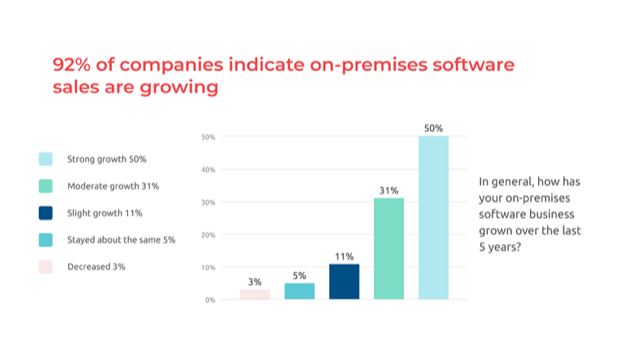
    A recent report from Dimensional Research reveals that the demand for on-premises software is equal to that of public cloud. The report, which was commissioned by Replicated, a company specializing in on-premises software modernization, queried 405 participants in software development, executive, product management, sales and services roles to determine the needs, usage and challenges of on-premises software.

    The report revealed that some 90% of companies surveyed said their on-premises sales of software solutions continue to rise, while 70% that do not currently offer on-premises solutions intend to in the near future. 

    “In the past few years we’ve experienced a steady increase in interest from leading global companies who see that modern on-prem software delivery through containers and Kubernetes can make data protection and security much easier,” said Grant Miller, co-founder and CEO of Replicated. “Coupled with growing customer demand, it’s a win-win scenario for any industry.”

    While Miller’s view may be optimistic, the survey also revealed that the majority (65%) of companies cited privacy compliance as the top reason for using on-premises software delivery; an indication that the market is being influenced by cybersecurity issues more than any other factor. However, 54% also stated uptime and reliability were a primary driver for on-premises solutions, while 45% noted the importance of integration.

    The report indicates that enterprises, which have cited digital transformation and a movement towards the cloud as critical factors over the last two years, may also be thinking more about on-premises solutions in light of cybersecurity and compliance concerns. This, in turn, means that DevOps has the potential to gain even more traction in the enterprise. 

    While the report mentions the merits of an on-premises software strategy, it does raise the question of why more enterprises have not moved in that direction already. That hesitation to re-embrace on-premises software can mostly be attributed to perceived complexity, time commitments and the cost of engineering resources to make it happen. 

    Complexity is further highlighted by 74% of survey respondents reporting that it would take more than a week to install and configure on-premises software, and 29% stated an install could take over two months. For the 16% that claim they can rapidly install and configure on-premises software in less than a week, the potential for growth in the market is notable. 

    While the future remains somewhat uncertain, the report from Dimensional Research runs counter to other reports, such as a Synergy Research Group report that revealed in 2019, spending on cloud platforms edged past the resources spent on acquiring servers and software for on-premises data centers. “60% of the servers now being sold are going into cloud providers’ data centers and not those of enterprises,” said John Dinsdale, a chief analyst at Synergy Research Group, confirming the trend. “Clearly, companies have been voting with their wallets on what makes the most sense for them.”  Dinsdale said the growth of cloud infrastructure will continue to accelerate aggressively over the next five years. 

    Although conflicting observations tend to add to the market confusion, one thing is certain – DevOps shops have market opportunities to service customers deploying both to the cloud and on-premises software.

    on-premises

  • Why DevOps Needs Mandatory Vacations

    Why DevOps Needs Mandatory Vacations

    “If a team doesn’t have time for retrospectives, you should hold them twice as often.”

    It’s 5:00 p.m. on Friday, and you’re just shutting down your computer to kick off the weekend. A message pops up in Slack:

    “Congratulations, you’ve been selected to take the next week off! We’re cutting off access to all work-related systems and revoking your credentials for the week. See you the following Monday.”

    What just happened?

    There’s an ancient security practice worth reviving in the age of DevOps: mandatory vacations. In practice today, it typically looks more like cutting off access when an employee is taking an already planned vacation, rather than forcing them to take a spontaneous one.

    But the goal remains the same: quickly assess bottlenecks, critical dependencies and security vulnerabilities. The side benefit? Your employees actually disconnect completely when they go on vacation!

    The Double-Edged Sword of DevOps

    DevOps practices increase a team’s end-to-end ownership, responsibility and autonomy. Team members modify code, deploy infrastructure and handle operational duties – sometimes all in the same day. Bringing Dev and Ops teams closer together results in reduced lead time, faster deployments and higher-quality software.

    But blurring the lines between Dev and Ops requires broad access and permissions. When everyone on the team has access to everything, there’s no forcing function to prevent relying on individual or shared accounts. This access proliferation results from a lack of clear indication on which credentials, accounts or permissions authorize each responsibility. Critical tasks may depend on a single person’s account. Credentials may be shared and never rotated.

    For example, deployment may depend on a service account, or bot, for which everyone has a copy of the API token. Admin or sudo rights may be delegated on a case-by-case basis to individuals, rather than role-based access control or group management.
    The result: a confusing quagmire of roles, permissions and dependencies.

    Reviewing and Remediating

    Explicit review of all accounts and permissions is an onerous, audit-like chore. While it might be necessary, particularly in regulated environments, it doesn’t mesh as well with agile, iterative, automated and just-in-time principles that fuel DevOps.

    Mandatory vacations provide an alternative. It’s a simple concept: cut off a team member’s access when they go on vacation.

    Depending on your setup, you might use this time to disable accounts, revoke privileges, rotate credentials, remove them from groups and even archive any home directories left over in production.

    The danger lies in leaving dependencies on personal accounts for day-to-day operations. From a security perspective, personal accounts are much more likely to be compromised or abused by a disgruntled insider. They’re an automatic back door into your deployment and production systems. From a reliability and operations perspective, a dependence on personal accounts means that changes to personal accounts (such as an employee leaving or losing access) may cause unforeseen outages. When you control the change as part of a mandatory vacation, you’re prepared for a change that could potentially cause things to break and can trace it back to the root cause quickly. Nothing like breaking the build to force a cleanup of technical debt! This technical debt could include critical nightly cron jobs left in home folders or owned by a single user, personal credentials hidden away in build secrets or operational practices that were assuming an individual’s identity or role.

    As a bonus, mandatory vacations also help ensure you keep your on-boarding practices up to date and robust. While re-provisioning your well-rested colleague upon their return, you are forced to acknowledge which privileges and permissions are truly necessary. Depending on the team’s growth and maturity, that may mean creating well-documented practices or enabling full user management automation.

    Finally, this provides an opportunity to promote key security principles. Are you enforcing least privilege where you can, giving users the minimum level of permissions needed to do their job? Are you granting access to shared folders in your password manager? If so, did you rotate the stored credentials when your colleague “left” the company, however briefly? This might provide an excellent example of why it’s time to implement multi-party authorization (MPA), just in case gaps like these persist, even after a few mandatory vacations.

    Mandatory vacations provide a ‘testing framework’ for access proliferation. Repeating difficult agile practices frequently helps streamline the process simply by doing it more often. If your team doesn’t have time for retrospectives, you should hold them twice as often. Testing your access management practices every time a colleague goes on vacation provides a natural, easy cadence to ensure your practices remain up-to-date – without having to scramble after a breach or when a team member leaves permanently.

    Take a Vacation, for Everyone’s Sake

    You might think you don’t have time to deal with the ramifications of random mandatory vacations. But imagine how much more difficult it is to discover a single chokepoint during a live incident! If you don’t have the time to test off- and onboarding accounts, that implies your access management practices are rusty, poorly defined and thus, unavailable when they’re needed in a rapid-response scenario. Laptops and accounts will be compromised. Staff may leave or join for unforeseen reasons.

    So please, take a week off … for your sake, and ours.