Tag: devops

  • Dear Vendor: Letter to Technology Vendors

    Dear Vendor: Letter to Technology Vendors

    While I was writing my “Dear Management …” post, something was going on behind the scenes that inspired me to write another. We all have things we wish to say to vendors; this open letter picks some of the big points that they seem to invariably struggle with.

    Dear Vendor,

    We want to use your products, otherwise we wouldn’t even be writing to you. But depending upon who you are, and what year it is, you are struggling to meet our needs.

    We understand that your insistence that your new product or acquisition will solve all of the problems we don’t have is probably executive-driven, but give us the benefit of the doubt. We know our environment, and just because we use you for one thing does not automatically imply we want you to constantly push this other thing at us. By all means, tell us about your entire product line, but then back off. We will let you know if anything appears to fulfill a need.

    While we’re chatting, can we discuss pricing? Not just cost, but the byzantine structures you create, time after time? If you are going to use 15 different charges and fees to jack up the price there, we’re paying the bill – we’ll see it. You’re far better served by being forthright. Do you have any idea how many stories like, “I am not funding your Ferrari with your commission,” stories (this was actually said; it was hilarious – we went with a competitor) are out there? And they keep occurring. Just this week, the phrase “Your pricing is bonkers!” was submitted to a company. We want a good product at a fair price, not a cheap price up front that will drain all of our budget over time.

    Speaking of good products, let’s talk about security. Security issues with your product are our issues more urgently than they are yours. Don’t mess around; when notified, quantify the threat and notify us immediately, with suggested remediations until you can get a patch ready. Holding off until you can patch puts us in the unenviable position of being vulnerable and, worse, not even knowing we’re vulnerable. Use good coding practices so we’re not all caught off guard, and waive those secure coding requirements for no one. Interns and C-level execs are not professional coders (interns aren’t yet, and C-levels no longer are), and any code by these two groups needs to be reviewed by someone that knows your systems before they are sent to us for deployment. Don’t force bad updates on us. Do your best not to give us bad updates at all.

    Finally, on the topic of forcing things on us – guess what? We have a need for a specific tool in a specific environment. Telling us that starting next month your services are all “moving to the cloud” does not suit all of our needs. We get it, you want that data. It’s all the rage right now. You should understand that, if you stop serving our needs in your quest for our data, we’ll go elsewhere, eventually, no matter how reluctantly. Cloud is a great platform, but most IT tools need the versatility to run where we need them, not just on one platform out of many.

    And, as a side note, your AIOps generally isn’t. We know it’s the buzzword du jour, but honestly, if it’s basically the same product with some logic or a dashboard strapped on, that’s not AIOps, it’s normal product improvement. When you have deep data collection and analysis that uses trained algorithms, then you can join the crowd screaming AIOps. Until then, hush. You sound silly, and it undermines the rest of your messaging.

    Just to reiterate: We have a need, show us how you fill it, and let us decide if that suits our requirements. Then tell us about your other offerings and back off. We’re smart enough to smell vaporware, stubborn enough to resist your desire to collect all of our data and wise enough to judge whether or not you and the product you’re pushing this week will be around in a year or two. You serve a purpose, and we’re grateful you are doing this stuff so we can focus on our business. But please, make life easier on us, not harder. And if one more of you sells a product we don’t need to the C-suite, we may explode. That Sword of Damocles that you raised over us will inevitably fall, and your company’s reputation will suffer for it. But we’ll pay the price for trying to implement something we didn’t need in the first place.

  • SecDevOps is the Solution to Cybersecurity

    SecDevOps is the Solution to Cybersecurity

    Anybody paying attention to world news will notice that the threats and risks perpetrated by cybercriminal actors, in many forms, is a serious problem on the rise, affecting individuals, organizations and nations daily. The cybersecurity threat space is indeed alarming and growing rapidly. The cybersecurity solution space is struggling to keep up. After all, there is no such thing as 100% security.

    What is the Solution to Cybersecurity’s Problem?

    In my opinion, the industry has long underestimated the problem of cybersecurity, which has resulted in solutions that do not sufficiently stand up to the cybersecurity threat space. What is clear is that solutions must come from rapid software changes that detect and plug security holes as fast as they are found, and continuously deploy innovative defensive solutions that keep bad actors off their guard. To do that requires Agile and DevOps continuous delivery practices coupled with a security-aware mindset.

    What is a Security Aware Mindset?

    To put things in perspective, it is useful to consider the mindsets of design, QA, operations and security.

    Design mindset – create a product or service that customers want, now. The Agile framework addresses this requirement.

    QA mindset – verify a product or service works the way customers expect it to, when it is released, for all production configurations available at the time of the release. The DevOps framework addresses this requirement.

    Ops mindset – ensure a product or service continues to work the way customers expect, for all production configurations, for the life of the product or service. The site reliability engineering (SRE) and ITIL frameworks address this requirement.

    Security mindset – defend valuables for organizations that create or use a product or service against unintended and malicious actions, by people and organizations, both inside and outside of the organizations, for all production and non-production configurations, for as long as there is something of value to protect. The DevSecOps framework was created to address this requirement; as we have seen, this does not yet offer sufficient safeguards for the growing cybersecurity threat problems.

    The security mindset has multiple additional vectors of thought required compared to the design, QA and ops mindset. This helps us to understand why the cybersecurity problem space is bigger and requires more comprehensive solutions.

    Not long ago I considered security assurance to be a subset of testing practices. In 2016, in my blog, “Seven Pillars of DevOps – Essential Foundations for Enterprise Success“, I did not break out security as a separate pillar. At that time, this type of thinking was typical of developers. Security was someone else’s job. Perimeter defenses were deemed sufficient.

    Soon after, I realized that way of thinking was naïve on my part. By the time that I co-authored a subsequent blog, “Nine Pillars of Continuous Security Best Practices,” I added a separate pillar for security specific practices, and also added security practices within each of the other pillars.

    In parallel, DevSecOps became a thing in the DevOps world. The idea of integrating security practices into DevOps makes a lot of sense, because DevOps is the answer to continuous delivery of software, and security needs continuous delivery of defensive solutions. However, simply adding security to DevOps is not a sufficient solution, because DevOps was conceived to address specific problems associated with design, QA and Ops – not security. Simply adding security as another metric for releases is not enough. What is needed is a re-think of how DevOps can be used to deliver continuous security, as indicated in my book, “Engineering DevOps.” This is the same idea behind what is referred to as SecDevOps.

    In my opinion, it is now time for SecDevOps to gain favor over DevSecOps when it comes to integrating security practices with DevOps practices. This represents a much more significant shift than simply putting security first in the name. With SecDevOps, security concerns within the entire development organization and at every stage in the DevOps value stream, are explicitly prioritized over other types of concerns. This makes sense, given the much wider blast radius of security events versus other quality concerns that DevOps was originally designed to address.

    With SecDevOps, security tools and resources are weighted at the highest priority level. SecDevOps and secure coding practices are required training for application developers. Threat modeling is part of the value stream. Security tasks that are required to mitigate security risks are given the highest priority in backlog planning. At each stage in the DevOps pipeline, security concerns rise to the top of the priority list. Release and deployment readiness are weighted at the highest level. In short, SecDevOps explicitly plugs some important security holes that are not covered by DevSecOps. With SecDevOps, security becomes continuous, not just an add-on to DevOps.

    What This Means

    By explicitly plugging some important security holes that are not covered by DevOps or DevSecOps practices alone, it makes sense for SecDevOps to now emerge as the preferred framework to close the gaps between the growing security problem space with the evolving security solution space. SecDevOps offers the required security-first mindset and solves the need for rapid software changes that detect and plug security holes as fast as they are found, and continuously deploys innovative defensive solutions to keep bad actors off their guard.

  • Why Businesses Need to Transform From DevOps to DevSecOps

    Why Businesses Need to Transform From DevOps to DevSecOps

    The need for modern applications to support continuous integration, delivery and deployment spawned the need for DevOps. Increasingly, as cyberthreats evolve and grow and application development methods and time frames change, security now needs to be an integral part of today’s application life cycle. As a result, businesses should move from DevOps to DevSecOps.

    DevSecOps is needed to address security implications introduced by changes in the way applications are now developed, deployed and updated. Some of the main drivers for moving to DevSecOps include:

    The speed and frequency of new apps creation and updates: It is no secret that developers are under great pressure to create new applications and features in faster time frames than ever before. Some industries such as banking and financial services are being challenged by nimbler FinTech organizations offering innovative services and better customer engagement. The same is true in retail versus online competitors. And most other businesses are in the midst of a digital transformation. All of this necessitates the development of more apps in shorter time frames.

    As the industry knows from DevOps, app development is just one part of the more extensive application lifecycle work that needs to be done. Here again, there is a change from tradition. Beyond the customary needs to update, patch and maintain applications, today’s users are accustomed to quick actions on their demands. They have an app store mentality. When they point out a flaw or suggest an enhancement, they expect these things to be addressed immediately.

    They want the same responsiveness in their business applications. It is no longer enough to put items in a Jira or some other project tracking solution for later consideration; actions must be taken immediately.

    In both the building and enhancing of the apps, the need for speed can overlook security issues.

    Cloud-native architectures: Many modern apps are built using cloud-native architectures based on loosely coupled microservices and containers. The architecture lets developers quickly build and update applications. The approach typically makes use of third-party and open source code to build a larger application. For instance, a loan processing application might include an open source decision engine, an outside financial institution’s credit rating service and a commonly used mobile app user interface.

    Another advantage of using a cloud-native architecture is that changes can be made quickly. Rather than writing a monolithic app from scratch or recoding an entire app when small changes need to be made, changes only need to be made to impacted elements. If a new feature needs to be added to a front-end mobile user interface, that’s the only element of the app that must be changed.

    These conveniences that make cloud-native so well-liked in the development community, again, can mean that security issues are overlooked.

    Low-code/no-code and composable applications: New technology such as low-code and no-code platforms abstract details about the code from developers. And they enable citizen developers, who certainly do not have an eye for security, to build their own apps. Composable techniques further simplify application development via the reuse of components.

    Bringing Security Into DevOps

    The implication of these industry changes is that security needs to be entrenched in the process throughout an application’s life cycle. It is no longer enough to test for vulnerabilities after the fact.

    Specifically, security operations must be integrated at every step of application development, modification, and deployment. It must be real-time instead of reactive. Security can no longer wait for a breach or attack; it must constantly examine the elements of an application as they operate and are modified.

    Additionally, DevSecOps is increasingly needed to find weaknesses and vulnerabilities due to hidden dependencies in today’s cobbled-together applications. The bottom line is that implementing cybercrime protection at the code-level and secure coding practices are lower cost, more efficient and more effective than trying to patch security holes in a finished application.

  • Lessons in User Engagement From Game Development

    Lessons in User Engagement From Game Development

    Quarantine measures forced most of the world to stay physically distant — a shift that has forever changed consumer behaviors, and especially how humans interact and spend their free time. A clear change over the past year was the rapid boom of gaming, which saw a massive increase in both console and mobile games — estimated to be as much as 50%. With this sudden increase in new players, how can developers keep gaming experience fresh and exciting? What can game developers do to keep players coming back after they hit ‘Close’? And are there lessons developers in other industries can learn from those game developers to make their applications more engaging?

    While this article is geared toward game developers specifically, there are multiple lessons that could apply to any application with regard to user experience and engagement. It’s especially applicable if you have a gamified corporate application or continuing education app for your enterprise users.

    Much of the answer to the engagement question comes down to users’ journey before, during and after they play a game. Effectively communicating why someone should download a mobile game is the first step, but communicating with players during and after their experience is equally important for long-term engagement and overall experience.

    A vast majority of mobile games still don’t implement basic messaging best practices for improving user engagement and retention. At the same time, COVID-19 has raised the bar for digital experiences. More than ever, game developers need to improve their communication strategies to survive and succeed.

    One difference between established gamers and the large number of new gamers from the pandemic is that they are increasingly diverse. This wave of new gamers are also more likely to play on their mobile device, or even across multiple devices like their smartphone and tablet, which will likely require a friendlier, more streamlined experience than their more experienced peers.

    Hence, creating the right communication strategy, whether through in-game events, updates on exciting new content, or relevant promotions, will all go a long way in keeping gamers coming back after they hit close.

    User Onboarding is Crucial

    There’s been over a 700% increase in game titles available on the Apple and Google app stores in the past decade, with nearly a million titles to choose from. With so much more competition, developers struggle to find and keep players; the top 25% of mobile games have an average 28 day retention rate of just 4%.

    Mobile games have minutes (or even seconds) to convey value and engage users. How a game onboards a player can mean the difference between a loyal customer and a missed opportunity. If you drop a player into a game with no support or context, they might fumble through the rules and features, and could get frustrated enough to abandon the game.

    Here are some ways to onboard players more effectively:

    Function-Oriented Onboarding – This can take the form of a deck-of-cards tutorial immediately after a user opens your game. Through full-screen in-app messages, it educates the player on game mechanics, app navigation and enables players to swipe through the information at their own pace.

    Benefit-Oriented Onboarding – This method reveals features that improve the player’s experience in addition to the game’s basic mechanics. For example, highlighting how a user can resume from a checkpoint instead of starting over.

    Progressive Onboarding – This method helps players interact with the game interface and guides them through different actions when they reach milestones in the game. It’s well-suited to games that have more complex or varied mechanics.

    Enhancing the Post-Game Messaging Experience

    Re-engaging users outside of the game through push notifications, email messages or even SMS can be incredibly powerful. At the same time, if your message’s quality does not match the quality of your in-game experience, users are much more likely to block your messages or uninstall your game entirely.

    The differences come down to personalization, timeliness and progression.

    Players want to get recognition for their achievements and milestones, plus get instantly notified about making their next move, attack or strategy. Generic messages like, “You haven’t played in a while. Come back today!” are unlikely to have much of an impact on user retention. Instead, enhancing the in-game experience with personalized messages that provide incentives tend to perform far better: “Congrats, Matilda! Your hero is nearly at level 10 – get double XP for every level you complete today!” is a much more engaging option.

    In Zynga’s popular “Words with Friends” game, the granular personalization of notifications tells users when a friend made a move, which word they played and its point value. This helps increase messaging utility and encourage reengagement by promoting friendly competition.

    Another way to enhance the experience both within and outside of the game is by leveraging achievements and recognition. These can turn a mundane milestone into a moment of celebration, or convince a player to return to the game to get another reward. Displaying the daily high score of top players can also motivate players. With set goals, players strive to achieve a higher score, push harder to win a level, and play the game more.

    Developers who only focus on building great game mechanics often overlook basic (and critical) communication features to engage and retain users. By employing these best practices for engagement, game developers can build a solid, growing community of happy players that keep coming back for more.

  • DevOps Practices Gap Assessment

    DevOps Practices Gap Assessment

    Using DevOps to continuously deliver software has proven value for organizations that are on a path towards digital transformation and continuous improvement. To get the maximum value from DevOps, it is important to use recommended best practices, inclusive of people, processes and technologies. A gap assessment is a great way to efficiently evaluate an organization’s practices for DevOps, and determine a strategy for improvement. Gap analysis provides valuable inputs for formulating a strategy and roadmap to improve a topic including DevOps.

    My SlideShare, Gap Survey, Assessment and Analysis For DevOps, explains how my Nine Pillars Gap Assessment Tool greatly speeds up the gap survey, gap assessment and gap analysis process for DevOps.

    It is important to clarify a few definitions for this blog, because I have found that different people and organizations use these terms differently. In this blog, and in my consulting work, I use the following definitions.

    • Gap survey is a discovery tool used to collect information about the current state of practices for a topic.
    • Gap assessment is a process to determine differences (gaps) between current practices and recommended practices for a topic. Gap assessment is also used to refer to the entire collection of activities in this list.
    • Gap assessment workshop is a meeting in which the gap assessment is validated prior to gap analysis.
    • Gap analysis is the process of determining priorities for reducing gaps found during a gap assessment.
    • Gap assessment tool is software that helps perform gap surveys, gap assessments and gap analysis.

    For those that want to dig deeper on this topic, additional definitions and contextual information related to the way I do gap assessments are clarified in my book Engineering DevOps.

    I define a seven-step process for gap assessments. The steps are as follows:

    1. Pick a topic to analyze. The same processes and tools can be applied equally well to almost any topic.
    2. Determine recommended practices for the topic. Something that is worth doing a gap assessment for, such as DevOps, will normally be fairly complex with dozens, if not hundreds of practices. Categorize the practices into groupings (I call the groups “pillars”) to make the list of practices more understandable and meaningful. To do this will require some research and work. For example, I have a database of practices and pillars for DevOps, continuous testing, DevSecOps and SRE and some other topics such as DevOps.
    3. Enter the practices from step two into a gap assessment tool. The tool can be a simple survey tool you create, a commercial survey tool or something custom-made.
    4. Determine who needs to be included in the gap survey.
    5. Collect data using the gap survey.
    6. Perform a gap assessment.
    7. Perform a gap analysis.

    For the remainder of this blog, I explain the above seven steps for DevOps.

    Step one: Pick a Topic to Analyze
    In this blog, the topic is DevOps.

    Step two: Determine Recommended Practices for DevOps
    For an example DevOps assessment, I used the practices under the nine practices categories described in a blog that I co-authored called Nine Pillars of DevOps Best Practices. The nine practice category pillars are:

    • Leadership
    • Collaborative culture
    • Design for DevOps
    • Continuous integration
    • Continuous testing
    • Continuous monitoring
    • Elastic infrastructure
    • Continuous delivery
    • Continuous security

    Step three: Enter the Practices from Step Two into a Gap Assessment Tool
    A gap assessment tool, pre-loaded with a sample of DevOps practices, in a file called DevOps Assessment, can be downloaded for free from one of the resource pages found on my website Engineering DevOps. You can edit the practices categories and add/delete practices from each category if you prefer to make changes.

    Step four: Determine Who Needs to be Included in the Gap Survey
    For the gap analysis to be comprehensive, people in roles that are affected by DevOps practices need to be surveyed, or at least represented, to ensure their perspectives are included. The following are example roles that typically are included.

    • Business leaders – because they influence culture and budgets for DevOps.
    • Developers – because they need to design in accordance with DevOps practices.
    • Project owners – because they influence product work priorities.
    • QA testers – because they need to test in accordance with DevOps practices.
    • Ops – because DevOps practices affect operations.
    • Security – because DevOps affects security practices.

    The survey can be conducted for an individual application, a group of applications, or all the applications in the enterprise. However, it is important that the gap assessment and gap analysis be performed on the organization segment that is being targeted for improvement.

    Step five: Collect Data Using the Gap Survey
    A gap survey should allow each surveyed person to enter an importance level score, a practice level score and comments for each practice. All this information is essential for the gap assessment and gap analysis. In the gap survey included within my gap assessment tool, survey respondents are asked to score the importance of each practice as one of 0=not relevant, 1=not important, 2=nice to Have, 3=important, 4=very important or 5=critical. Practice level choices are 0=not sure, 1=rarely, if ever, 2= sometimes, 3=most of the time, 4=always or 5=We are really good at this. Comments that are relevant to qualify or explain the scores entered for each practice should also be entered, especially if there is any doubt or ambiguity.

    Step six: Perform a Gap Assessment
    The gap assessment process requires all the practices scores collected from the surveys to be collected and assembled to calculate an aggregate set of scores. Gap scores are calculated using a formula that weights each practice level score with the corresponding importance level score. A visual representation helps to identify practices areas and individual practices that have the highest, most important gaps.

    No matter how professionally written the practices and score definitions are, it is not unusual for some people to misunderstand and to enter scores that they would not have otherwise. For this reason, it is important to ensure that the data collected is validated before conducting the gap analysis. The preferred approach is to conduct a gap assessment workshop with key representatives from each role that participated in the survey. During the workshop, the scores for each practice that have a high deviation between survey responses are discussed and, if necessary, adjusted.

    Step seven: Perform a Gap Analysis
    The gap analysis process involves extracting the high gap practices and tagging and ranking each of them against solution categories determined by a consultant or topic expert.

    The results of the gap analysis indicate where solution strategies and implementation roadmaps need to be focused to reduce the most important gaps.

    What This Means

    While it is true you can easily stand up DevOps tools quite quickly, this alone will not realize the benefits of following effective and safe DevOps practices. Those who are serious about DevOps will do well to learn from others, and be serious about using recommended DevOps practices. This blog explained a gap assessment approach, which uses my nine pillars of best practices for DevOps. My free DevOps gap assessment tool facilitates getting a gap analysis for DevOps and priorities to improve DevOps practices for an organization.

  • Survey Shows Acceleration of Centralized IT Management

    Survey Shows Acceleration of Centralized IT Management

    An OpsRamp survey published this week suggests large enterprises are looking to finally unify IT management at at time when it is becoming increasingly complex.

    OpsRamp, a provider of an IT management platform based on machine learning algorithms, polled 132 IT operations directors working for organizations in the U.S. with more than 500 employees that spend more than $5 million a year on IT.

    According to the results, the survey found nearly 73% of respondents plan to roll out a digital operations management platform in 2021. That platform will, hopefully, enable IT teams to unify hybrid cloud computing environments made up of monolithic and microservices-based applications via a single console. Another 21%of respondents expressed interest in such a platform, if budgetary constraints allowed.

    More than half (51%) also noted they expect to employ automation and AIOps (51%) in the form of machine learning algorithms and process automation to reliably cut down on the number of alerts being generated, identify the root cause of issues and eliminate repetitive manual tasks.

    The two main goals identified in the survey are to enable greater agility and resolve issues faster (46%) and reduce costs by consolidating tools (41%).

    While the rise of cloud computing has made IT more agile, each cloud service that is added to the IT firmament tends to increase the total cost of IT. Each IT platform in use today requires a dedicated team to operate, which conspires to increase both the number of tools required and the overall size of the IT staff required to master them.

    In the wake of the economic downturn during the COVID-19 pandemic, the amount of pressure being applied to reduce those costs has increased significantly. Security and compliance concerns are also starting to push organizations toward centralizing the management of IT as much as possible. The OpsRamp survey notes that platform security (59%) is the most critical attribute of a next-generation IT platform, followed by hybrid infrastructure management capabilities (52%) and flexible pricing (37%).

    Deepak Jannu, senior director for product marketing at OpsRamp, said achieving those goals across what has become an extended enterprise requires a platform that has the ability to first capture telemetry data in real-time and then aggregate that data in way that enables artificial intelligence (AI) models to learn how the IT environment actually operates.

    Armed with that data, it then becomes possible to employ AI to both troubleshoot IT issues more easily and surface recommendations that address capacity utilization, noted Jannu.

    It may be a while before AI-enabled IT management platforms are commonplace in the enterprise. However, it’s also apparent a number of factors are driving IT leaders to reevaluate their existing platforms as IT environments become increasingly more complex.

    Regardless of what platform an organization eventually opts to standardize on, the rate at which IT management tasks are being automated is only going to increase as machine learning algorithms become more familiar with the IT environment in which they are deployed. That doesn’t necessarily mean those algorithms will remove the need for IT administrators and DevOps teams, however. It does mean that the tasks the individuals on IT teams are focused on will, hopefully, provide a lot more value to the business.

  • How the DevOps Skill Journey Fosters a Learning Culture

    How the DevOps Skill Journey Fosters a Learning Culture

    Human skills, among others, have always been important; now more than ever. Empathy, diversity, creativity, personal commitment have been put to the test. The increase in remote work tends to challenge individuals in unique ways, and these human skills are becoming critical.

    Top 5 Skill Domains for 2021

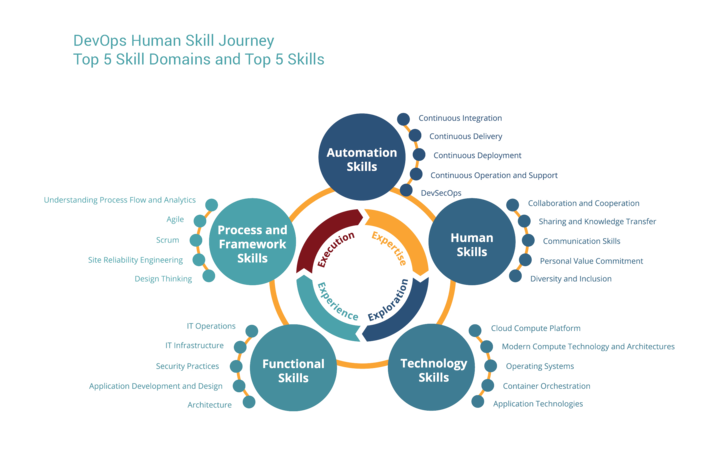
    This year, 69% of respondents to the Upskilling 2021: Enterprise DevOps Skills Report told DevOps Institute they consider human skills a “must-have or very important” skill for the DevOps human, among other priorities, around skill domains as seen below:

    It is no surprise that challenges around the DevOps journey continue around people, process and technology with all respondents giving them equal weight (33%).

    To continue thriving within DevOps or to initiate a DevOps journey, individuals, leaders and organizations should take action in developing skills across these areas. Right?

    Why, then, are only 39% of respondents reporting they have a formal upskilling program? What is the challenge for the other 61%? Recognizing the importance of these skill domains is one thing – doing something about it seems quite another. Why is so little done about upskilling?

    Can these skills be taught? Well, maybe, or maybe not.

    Research has shown that knowledge and skills can be developed by most people, while abilities, personal capabilities and characteristics are rather innate. Furthermore, existing human capabilities are constructs that facilitate individual learning, adaptability and development and maintain their value even when drastic environmental changes occur.

    When we asked how organizations are prioritizing human skills during our research, we found that the human capability or domain is among the top five must-have skill domains. We also found that organizations have adopted both the concept of the learning organization and safety culture as two important constructs for DevOps.

    3 Things to Understand about Human or “Soft” Skills

    1. The human skill or domain is fundamentally different. While technical skills – such as container orchestration, CI/CD automation technologies and cloud infrastructures – can be developed through training (and these skills can be certified), the human skill domain is somewhat different. First, some human skills are shaped through experience and practice in both our personal and work life. For example, collaboration and communication skills are shaped during projects and can be adjusted according to the culture of the organization. Other skills, such as curiosity, might have been developed during early life stages or are somewhat innate.
    2. Take inventory of your top human skills. Our survey respondents offered great insight on the top must-have human skills within DevOps. Every situation, however, is different, but take a look at these and do a self-check on your human skills.
    3. Human skill development requires coaching and continuous feedback. No matter what methodologies organizations leverage, one key aspect is that individuals and leaders alike should have a coach or mentor who provides guidance and support. And, just as important is continuous feedback around an individual’s personal development. Today’s human resources teams might be able to assist. If not, network with others which might already model the skills needed and that can provide support and guidance.

    Must-Have Human Skills According to the C-Suite

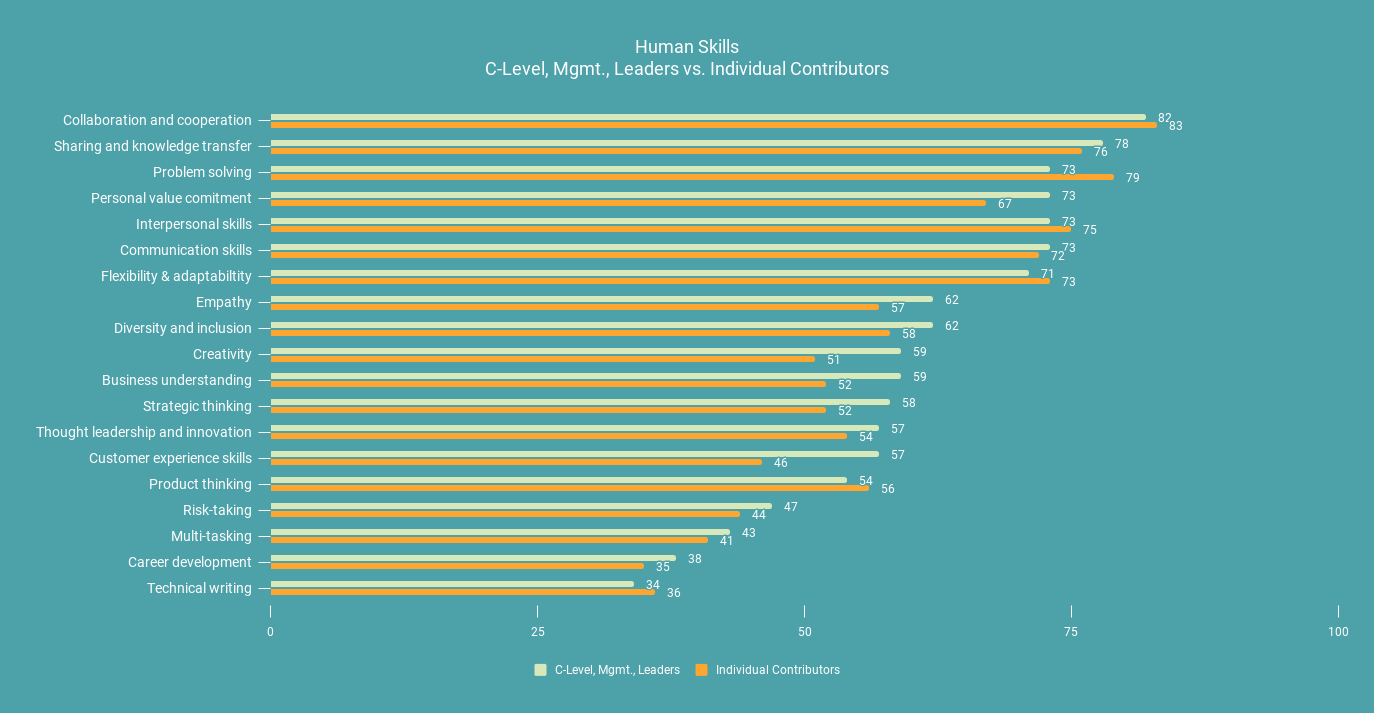
    The graph below shows executives, management and individual contributors all have similar priorities when it comes to human skills. (Blue is executives and management, and orange are individual contributors)

    C-suite Human Skills

    There are some differences in opinion when it comes to multitasking, customer skills, thought leadership, business understanding, creativity, diversity and inclusion, empathy, personal value, communication, interpersonal skills, sharing and knowledge transfer.

    How does one identify an individual’s potential for soft skills and other skill development? Unfortunately, this is not an exact science. One possibility is to understand what DevOps capabilities are needed, first, and then perform a skills inventory check. Then, the question becomes, how can you encourage individuals to develop their skills?

    The Skill Journey Toward a Learning Organization

    A learning organization is composed of individuals and leaders all interested in increasing their capabilities and improving their skills to achieve results they care about. Learning how to do something is extremely rewarding, and, at the same time, achieves specific organizational goals if the learning is aligned to the needed capabilities.

    First, assessing what DevOps capabilities are missing, paired with a skill path for the DevOps team members, is a win-win.

    DevOps human skills

    5 Tips for Your DevOps Journey

    1. Make continuous learning part of the DevOps journey. Continuous learning and education must be a fundamental best practice within your DevOps journey. A first step is always education, providing learning resources and allowing engineers and individuals to participate with and learn from others in the community.
    2. Don’t hide the experts. Another critical step is determining if subject matter experts are being sheltered or siloed away. Instead, learn how to embed those people within teams, so they can spread their subject matter expertise by osmosis to others on the team.
    3. Growth of skills requires time and budget. According to Jayne Groll, “Enterprises should take intentional steps to support the growth of their DevOps humans.” Some may assume that engineers learn organically, but in truth, engineers need time and budgeted resources to develop new skills, hone existing skills, experiment and improve their capabilities. This could be in the form of time to attend a virtual conference, go to a training class, practice in a sandbox and/or doing peer-to-peer mentoring. Just take a look at site reliability engineers, for example, which are tasked with spending half of their time “making tomorrow better than today” by reducing toil through automation. DevOps engineers should be allotted a similar amount of time to do the same.
    4. Adopt a buddy system. The adoption of a coach or buddy system to further aid individual learning and growth is an excellent idea; pair less-skilled DevOps humans and engineers with highly skilled and experienced ones, and watch growth happen. This helps growth on both sides – both for the experienced buddy and the less-experienced person, in learning and teaching.
    5. Equip your leaders. Leaders are expected to know how to do things, right? To have all the answers? Well, not really. Some research has shown that the largest group of leaders today are “accidental leaders,” and 60% of frontline leaders say they have never received any training for their new role. Leaders need to learn and upskill, as well.

    The challenges of the past year showcased the importance of human skills in transformational efforts. Without the spirit, willingness, collaboration, cooperation and competencies of IT professionals around the world, many enterprises would not have been able to adapt to rapidly changing business models in a pandemic-fueled economy. As we continue into this next decade, organizations should plan to invest in upskilling their humans as much (or even more) than their technology.

  • The Evolution of the Assessment of DevOps Capabilities (ADOC)

    The Evolution of the Assessment of DevOps Capabilities (ADOC)

    The Assessment of DevOps Capabilities (ADOC) is crowdsourced, vendor-neutral and designed for individuals, teams and organizations who want to baseline their current DevOps state, identify the next target state, gain insights into how to improve their organization and team capabilities and measure and accelerate continuous improvement during their DevOps journey.

    The assessment models five DevOps dimensions – the human aspects, process and frameworks, functional composition, intelligent automation and technology ecosystems – to help you gauge your DevOps maturity and identify areas for improvement. In this TechStrongTV interview, chief content officer Charlene O’Hanlon talks with Feisal Mohammed, Niladri Choudhuri and Don White about the evolution of the ADOC and how it can assist organizations at any stage on their DevOps journey. The video is below, followed by a complete transcript.

    Announcer: This is Digital Anarchist.

    Charlene O’Hanlon: Hey, everybody. Thanks so much for joining us today. This is Charlene O’Hanlon, I’m the Chief Content Officer at MediaOps, and I am very, very excited to be having a conversation with three very, very smart people from the DevOps Institute Ambassadors. We have Feisal Mohammed, Niladri Choudhuri, and Don White. Gentlemen, thank you so much for joining me today. I’m very, very excited to have a conversation with you all about the new assessment of DevOps capabilities.

    But first, I wonder if we can start by having you guys introduce yourselves. Please tell us your name, your title, your company, and what you think we all should know about you.

    Feisal Mohammed: I’ll start first—Charlene, is that okay?

    O’Hanlon: That’s perfect.

    Mohammed: Alright. Good morning, everyone, and good afternoon, good evening, where you are listening in. First of all, thank you for having me here, it’s a tremendous honor to speak today. My name is Feisal, I am with Sapience Consulting, I’m the Principal Consultant at Sapience Consulting, which is a consultancy and training firm that is headquartered in Singapore, but we deliver our services regionally in Southeast Asia and in Asia, per se. We’ve been in business since 2008 and our core expertise is actually in the area of service management, governance, risk, compliance, security management, and of course, in the last five or six years, the natural evolution of DevOps.

    And I’m proud and happy to be here. I’m a DevOps Institute Ambassador. I am leading the practice when it comes to DevOps for Sapience Consulting.

    O’Hanlon: Alright, great. Thank you, Feisal. Niladri, tell us a little bit about yourself.

    Niladri Choudhuri: Thanks, Charlene. I’m Niladri Choudhuri, CEO of Xellentro, India and Singapore. I’m also the Chief Organizer for the largest DevOps event that happens out of Asia, and coordinated the DevOps India Summit. And quite excited to be part of this panel because the ADOC, the Assessment DevOps Assessment Capability is going to be a great one, and we will further talk about it.

    O’Hanlon: Alright, great. Thank you, Niladri. And Don, please tell us about yourself.

    Don White: Well, I’m honored to be in the presence of some pretty brilliant folks that have been in the DevOps community for a long time. I really appreciate, Charlene, you inviting me. I come in to DevOps from a 15-year career in the software quality assurance space, and started with extreme programming and it evolved into the lean agile space, and then eventually got into DevOps.

    Worked with many small startups, got them transitioned into lean agile ways of working, extreme programming ways of working, and that led me into coaching and being a DevOps Dojo Sensei for the Fortune 1 company in the world. That catapulted me, launching my business, Agility Science, and that’s where I do consulting and coaching for people throughout the world, quite frankly, but mostly United States-based.

    O’Hanlon: Alright, great. Such an honor to have all three of you on the panel with me today. I love the breadth of experience and depth of experience that you all have and each one of you brings something different to the table, so I do appreciate all three of you being here.

    I want to dive right into the Assessment of DevOps Capabilities tool, I guess, for lack of a better word, it’s an assessment tool, that the DevOps Institute has recently released, and it is now available for organizations to use it to basically assess their DevOps capabilities. It’s one of those titles that needs no explanation, basically. [Laughter] But I think it’s a great tool, and I think it’s going to be very well received in the market.

    But I do wanna talk a little bit about the background of it. So, Feisal, maybe we can start with you. What are some of the challenges that you’ve seen in assessing DevOps capabilities in the enterprise? It seems to be, obviously, there is a need or this assessment tool, so what do you see?

    Mohammed: Well, for me, an assessment—any assessment worth its salt would need to have a good sample size. I think that’s essential. You need to have a really good sample size and not just depend on the responses of a select ________. Let me represent the—misrepresent the actual conditions, if you like, that the organization is actually at, right?

    So, what I do like about the ADOC assessment tool was that it allows for you to scale up the assessment. It allows hundreds of people to participate in this exercise. You know, if you do not have such a tool available, what happens is that this will be largely a manual, face to face process, right? And when it comes to a manual, face to face process of getting assessments, getting people to chime in on their views, chime in on their feedback—essentially, what you will get is tyranny of the loudest, right? The person with the loudest voice will be heard. And then you’ll get the messes that just shrink into the background, right, just disappear into the background.

    With this assessment tool, it allows people to, in some ways, some anonymity, and they’re braver to give their true assessment of where they are in terms of DevOps capabilities. I think that’s the really cool part about the ADOC tool.

    O’Hanlon: Alright. Niladri, what about you? What challenges have you seen with assessing DevOps capabilities in the enterprise? Beyond Feisal noted with having enough people to do a good sample, what do you see?

    Choudhuri: So, a couple of points. One point is, if you look at the assessment—who is doing what, is the point. So, there are multiple organizations or consultants who goes and does assessments. And one of the challenges which I see is that many of them thinks in terms of maturity. And like what I have discussed with John Willis and some of the people who have started the momentum of this, I mean, how can you have a majority of an outcome?

    It’s a continuous improvement process. So, we have to look at it from that point of view. Not that these 25 points have been ticked, so we are done, we don’t have to do any more.

    O’Hanlon: Right.

    Choudhuri: However good we are, we can still improve. So, that’s the first thing. And the second point, which I also see is that the senior, top people in the organization, they have, as people mentioned, they have a rosier picture of what is actually happening.

    And I have seen that, when I go to any of the conferences or even in the DevOps Enterprise ________, when you see them on the podium, the top management talking on the podium, I call it—I mean, it’s not that they are not doing good work, they are definitely doing good work, but it’s a more sanitized version of what is actually happening. When you talk to their team members during the breakfast or the lunch, you get to know a lot of the other challenges which comes up.

    So, as Feisal said, another very important aspect is to get the right information. So, one is the sample size. The other is, I would call it the psychological safety. The people should be able to come out and say what they really feel, and not always say everything is nice.

    O’Hanlon: Interesting.

    Choudhuri: Now, that, getting that right picture is very important, because ultimately, we all have to understand that we are doing it for the improvement.

    O’Hanlon: Yeah, that’s very well said—very well said. Thank you, Niladri. And what about you, Don? What are you sing? Because, obviously, you are working with so many different companies in so many different areas. I imagine you’ve seen these challenges kinda run the gamut, so what are you seeing out there?

    White: Everything that Niladri and Feisal said is spot-on. The one thing that I would like to mention is what to assess. Our assessment tool is so comprehensive and informed by all the expertise. And knowing what to assess is a huge part of it, but it’s really important to get a true, good assessment of the whole area. The psychological safety is absolutely spot-on. People need to be able to be true and honest about what’s going on, because you’re absolutely right, Ni—

    O’Hanlon: Niladri.

    White: – Niladri. The starting point, you can always improve. It’s all about that continuous improvement journey, but knowing where you’re at is critical. And most people try to think of the technical stuff—there’s so much people, the people part is the biggest part. And being able to assess the people part—because culture is my big thing. Culture is my huge thing, because if you don’t have the right culture, that mindset will not take root and it won’t grow, it won’t blossom, and you can’t grow it. you gotta get that culture right. The people part is the critical component.

    So, that’s—what I love about this assessment, it digs into that. It’s not just all the technological know-how, it’s the people pieces.

    O’Hanlon: I love that.

    Mohammed: And that’s spot on. If I just may add on a little bit and ________ on what Don said, I fully agree with you. The culture is the most important ingredient necessary for any movement to take place, right? Any maturing, any improvement—it has to be the right culture. And the thing about DevOps is, the organization is so—it’s so diverse, right, that DevOps may mean different things to different people.

    O’Hanlon: Mm-hmm.

    White: Yes.

    Mohammed: You ask a group of persons and they say, “Oh, we’ve got this set of tools, we are already DevOps.” And you ask another set of persons and they say, “Look, our processes are really lean. I think we’re DevOps.” And so, you know, people do not have a holistic, complete view of what DevOps is. And that’s fine. They’re coming from different perspectives. And when assessment comes in, it binds everything together, and it gives the true capabilities of what an organization is really capable of, right, from all aspects. And that’s really important.

    White: I mean, I learned some things just by taking the assessment of some things that I wasn’t even aware of, practices and things of that nature. And you know, quite frankly, we’ll take it next year and we’ll learn more, because DevOps is continuously evolving, right? That’s the big thing, especially from the technological perspective. But the people pieces—that’s the huge thing, the mindset and where you’re at from psychological safety, those are the huge pieces.

    O’Hanlon: That’s a really, really interesting point, because, you know, you think about an assessment, a lot of times, companies will take an assessment, and it’s kind of—in their mind, it’s kind of a one and done thing, right?

    White: Mm-hmm.

    O’Hanlon: And it’s kind of the same with DevOps, you never really—to your point, you guys, you never really achieve DevOps maturity, because the industry is changing so much.

    So, with that in mind, though, a company will take an assessment, they have the information—how do they use that information, and is it something that they treat as maybe, say, a living document that is constantly updated and improved upon? Niladri, I’d like to start with you on this question, because I think it’s very, very important that organizations understand exactly what we’re talking about when we’re talking about this assessment tool and DevOps in general.

    Choudhuri: Absolutely. Very, very important point, because that also has a lot of impact on what we get as the data. The point here is, we have to be very, very clear as a consultant when we are going with ADOC is that this is not a tool to fire your people. This is not a tool to evaluate your people, whether they are doing something good or bad. It is about how to make them more efficient, effective, and better. It is about achieving the organization’s goal, what needs to be done.

    That is definitely a very important aspect that I feel. Because if there is that fear, if there is, that psychological safety is not there and people think, “Oh, at the end of this, my management will look at it and see whether Niladri has done better or Feisal has done better and give a promotion or a hike to Feisal and not to Niladri, then Niladri is not going to deliver—I mean, give the right information.” Then the whole purpose is lost. So, we have to be very, very categorical in stating, as a consultant when we go, that this is for the improvement journey and not to punish somebody.

    White: I couldn’t agree more with that.

    O’Hanlon: Go ahead, yeah. So, Don, do you have maybe some thoughts on how organizations can use the assessment information after it’s completed? I mean, you know, we’ve made it clear that organizations really need to consider this as kind of an ongoing thing, and I think it’s super important that organizations do understand that. But, you know, maybe after the first assessment, what can they do with that information?

    White: Well, the big thing is, getting everybody having a collective understanding of what your current state is. And this is just one current state tool to get everybody collectively understood on that. Understanding your value streams and all that, those are all current state tools, but it’s a starting point to help you figure out a roadmap to move forward. It’s your starting point, and you look, and as a consultant, we can guide that, because we know kind of the sequential order in which you wanna attack these things, right? And we can help them prioritize their roadmap and their backlog of how they wanna proceed, is how I view it.

    O’Hanlon: Feisal, any thoughts on that?

    Mohammed: Yep. You know, assessments—Niladri’s right, Don’s absolutely right as well. Assessments shouldn’t be used for the wrong purposes. It should be guided by the real desire to improve, to move to the next level. That’s the first.

    The second thing is that an assessment shouldn’t be a one-time exercise. Look, I’m at an age where I’m doing health screening every few years, I really am. And every health screening, I get a snapshot of where I’m really at in terms of my health. And then I figure out, where are the areas I need to improve upon? Where are the areas I need to watch out? I need to look at just little bits of maybe change in lifestyle habits so that I get the benefits of the health assessment results, right?

    And it’s not a one-time exercise. I need to do a checkpoint assessment at some point in time in the future to determine whether what I’m doing is yielding the right results.

    O’Hanlon: Mm-hmm.

    Mohammed: So, it should be an organized, periodic set of assessments with predetermined, agreed plans to move from one state to a future desired state, and then those assessments take place over and over again, heading towards that general direction of improvement, right?

    So, one thing we need to debunk is that we do it once, then we figure out what to do, and then that’s it. No, we need to constantly evaluate. We need to constantly assess ourselves in regards to our capabilities.

    O’Hanlon: So, it’s not just about understanding or taking this assessment and understanding where you are, though, but you also have to have kind of that guidance, I you will, from folks who are experienced in the field. You know, it’s one thing for you to—Feisal, if you went to the doctor and you got the tests done and thy explained to you exactly what the results were.

    Mohammed: Yeah.

    O’Hanlon: But if you went out and did all the testing yourself, you’d look at all these numbers and say, “I have no idea what this means.”

    Mohammed: I would not only have no idea, I would probably be alarmed, you know?

    O’Hanlon: [Laughter] Right.

    Mohammed: I’d think, “I should be dead by now,” right? I’m looking at all these test results—but you do need that expertise to help break these pieces of information down for you, calm you down, and say, “Look, these are the steps that you need to take,” right?

    O’Hanlon: Yeah.

    Mohammed: There are a lot of things that you can do, there’s a lot of things that you should do, right, but these are the things that you should focus on immediately in that journey, right? There’s an order is what Don said. There’s a sequence, there’s a realistic sequence which you can undertake, right, to gradually improve and hit towards the general direction of excellence.

    O’Hanlon: Exactly, exactly.

    Choudhuri: If I may, Charlene—so, this is a tool which is helping us in moving to improve the way of working. And taking what Feisal said, that it’s not a one-time activity—so, we have to look at that evolutionary process of improvement. So, you look at an assessment, you find the weaknesses in the different, the five dimensions, then you decide, “Okay, let’s look at some of the value streams where the weakness is more,” decide on what you need to do, whether you need training, whether you need automation, whether you need whatever change in the process, you do it, you take it forward, you go for another set of assessments. And you keep improving on your journey.

    Because today, what is important to understand is, we have to be adapting to the changes that is coming and more to come.

    White: What I would like to also—

    Choudhuri: And this will help you with that.

    White: What I would also like to point out is, you also need to keep the outcomes. Why are you doing all of this in the first place? Make sure that that is what you’re driving all of this toward.

    The other thing I wanted to point out is, there’s the enterprise assessment and then you have, I think, a team assessment. And so, you use enterprise to kinda get a holistic picture of it, and then once you kinda figure out where you’re at holistically, you can figure out where within the organization you want to do it. Then you can assess those areas, and then you continue to assess those areas as you’re continuing that journey, and it’s a continuous process.

    And Feisal, I love your metaphor with the health. I think that really resonates well, because it’s really what—it’s very similar to that. We assess all the different metrics in our body—well, just look at an organization as an organism, right? An organism that has health concerns, and we need to tweak that with continuously assessing it and coming up with a roadmap and a plan and then executing on it, and then testing our hypotheses that we’re moving toward our outcomes that we’re trying to achieve.

    Mohammed: Absolutely. And it should not be a project, it should be a program.

    White: Yes, yes.

    Mohammed: Right? It should not be a one-time effort, it should be a program effort—weight management, health management is lifetime. It should be that way, and organizations should embrace that.

    White: And the wider it’s within the organization, the better, because the folks that—if you’re just dealing with a partial part of the organization, well, those people that are going through the transformation are not working in a vacuum, they’re working within an organization that needs to kind of be on the same page, because they need to interact and collaborate with one another. If they’re not on the same page and wanna keep the old ways of working and are not open to being able to collaborate and work with these people that are trying to do more DevOps stuff, they’re gonna have limited success.

    So, the broader the understanding of this journey is, the more successful it will be.

    Mohammed: Agreed.

    O’Hanlon: That’s a great point, that’s a great point. And, you know, Don, just to kind of expand a little bit on that and the need for having somebody who’s kind of an experienced person who’s been in the business for a while to kinda help them through the assessments—I would imagine that it not only helps them understand where they are, but also kinda help them build a roadmap for where they need to go, and also show them the areas where they’re in need of most improvement and, from a culture perspective, I imagine that that is super important for organizations.

    White: Absolutely, yeah. Being able to prioritize your plan of attack and know where you really need to focus your energies, but being able to assess your actions is just as important. Because you have a hypothesis that you’re doing these things that are going to move you closer to your goal, but after you do those things, you want to validate your hypothesis by assessing.

    O’Hanlon: Right, right, right. Alright, and offering up areas where maybe the organization hadn’t thought—they would not have thought on their own. So, interesting stuff. Alright.

    Hey, guys, I would love to have this conversation for hours, and I know we could, but we are running up against our time. But I do want to thank Feisal, Niladri, and Don for such a great conversation. I wish you guys the best of luck with ADOC, and I think it’s gonna be a great success. You guys are awesome, you’re so well versed in the DevOps space and you really know your stuff, so considering the fact that you guys were involved in creating it, I know the industry is definitely gonna get a lot of value out of ADOC.

    So, thank you, again, and thanks so much for getting on the Zoom with me and talking about it and about the market in general. So, thanks again—it was great to see you guys.

    White: Thank you. Pleasure meeting you, too.

    Mohammed: My pleasure. Bye, guys.

    Choudhuri: Bye.

    O’Hanlon: Alright, everybody. Please stick around. We’ve got lots more coming up, so stay tuned.

    [End of Audio]

  • Unified Enterprise DevOps Platforms Eliminate Bottlenecks

    Unified Enterprise DevOps Platforms Eliminate Bottlenecks

    Nearly all enterprise digital transformation projects include moving software to DevOps processes and platforms. The effort, cost and time it takes to be successful with these transformations depend on a lot of factors, but one thing stands out: as indicated in my white paper Unified Enterprise DevOps Platform Why? How? And What?, “An enterprise with many variations of DevOps platforms and tools is at best chaotic, and at worst, is a gross impediment to overall organization agility – undermining the very purpose that DevOps is meant to serve.”

    In my recent blog Why a Unified Enterprise DevOps Platform is Necessary, I indicated that “The aggregate set of platforms and tools is like a Frankenstein’s monster, with many incompatible parts resulting in an awkward looking product that is hard to control, replicate and evolve.”

    Success with DevOps requires frictionless interplay between the people, processes and technologies that need to cooperate for continuous deliveries to happen effectively. The existence of different DevOps solutions creates organizational barriers to unification, because different groups become dependent on their local variations.

    A Unified Enterprise DevOps Platform Accelerates Time-to-Value

    Culture barriers, process problems and DevOps platform “wars” all are factors impacting the progress of digital transformations. A unified enterprise DevOps platform would accelerate time-to-value, and realize efficient, safe operation for digitally transforming enterprises and organizations.

    The following are general requirements for a unified enterprise DevOps platform.

    ● A new, unified approach that supports end-to-end capabilities for continuous delivery of software, as a managed service, for multiple streams of pipelines.
    ● Unified metrics that show business value, costs of the value stream and timing for end-to-end continuous delivery flow across multiple pipelines.
    ● Unified capabilities including visibility, orchestration, integration, security, governance, traceability and management of flow for application value streams across multiple pipelines.
    ● Capabilities to unify continuous testing/QA, troubleshooting and debugging.
    ● A new, unified approach to simplify and accelerate toolchains that support new cloud-native and cloud-adapted applications, infrastructures, machine learning, commercial off-the-shelf and open source software.

    A DevOps Platform Blueprint

    In my SlideShare DevOps-as-a-Service Values, I described a four-layer blueprint for a unified enterprise DevOps platform that satisfies these general requirements. The main elements in the blueprint are:

    ● Stakeholders – There are three types of stakeholders: business, appdev users and DevOps admin teams.
    ● Service access layer – Consists of portals and APIs for business, appdev and DevOps administration users and access security.
    ● Service layer – consists of user services and DevOps admin services.

      • User Services include things that appdev users need to perform their application development and testing work. This includes capabilities for no-code automation and orchestration, repos for code, artifacts and data, multi-CI/CD pipelines and sandboxes, test data, configuration, continuous testing/QA, service level objectives (SLOs) for business and appdev users and troubleshooting and debugging.
      • DevOps admin services include things that a DevOps team needs to administer and manage the platform. This includes capabilities for platform administration, the ability to import pipelines into the unified platform, integration with enterprise service catalogs, integration with enterprise issues and change request systems, SLOs for DevOps administrators and capabilities to implement governance policies-as-code.

    ● Resources layer – includes resources that the services need to run including application stacks, infrastructure resources, tools, infrastructure code and topology data.

    One of the most important benefits of a unified platform is the ability to unify SLOs for each class of stakeholders. The SLOs need to be chosen to best fit the requirements of each application.

    Business value can be demonstrated by the following SLOs:

    ● Productivity metrics.
    ● ROI data tracking.
    ● Agility of services – Lead time for changes and frequency of releases.
    ● Reliability of services – Change failure rate; time to restore services.
    ● Governance compliance and security.

    Appdev user value can be demonstrated by the following SLOs:

    ● Platform availability.
    ● Service response time.
    ● User experience scores.
    ● Change request response time.

    DaaS team value can be demonstrated by the following SLOs:

    ● Scope of applications – number of apps supported, number of users per month.
    ● Number of requests served per month.

    Without a unified enterprise DevOps platform, all these SLOs would have to be implemented multiple times, once for each type of DevOps platform.

    To realize DevOps-as-a-Service for enterprises with multiple related pipelines, each pipeline needs to be configured to work within a unified model where common tools process each application and microservice continuous delivery task in parallel. Unified control and monitor points are needed – and should be exposed by the unified platform – to realize SLOs in a unified way. Without a unified platform, all of these SLOs will need to be implemented separately, for each platform, and then another system will be needed to aggregate them into a common view.

    The SLOs will indicate where the biggest bottlenecks are for a particular pipeline. In many enterprise pipelines, the biggest bottleneck is testing, troubleshooting test failures and debugging to resolve the failures. It is a myth that continuous testing is just the execution of automated tests. The whole range of “testing things” includes test planning, test resource scheduling, test design, test implementation, test environment management, test execution, test results reporting, test result analysis, troubleshooting, debugging, fix retest and test management, and all can be sources of bottlenecks. These “testing things” are all sources of bottlenecks for every stage of a DevOps pipeline, for all Three Ways of DevOps. Without a Unified enterprise DevOps platform, all these testing things must be addressed separately, in accordance with the different pipeline platforms.

    Testing, troubleshooting and debugging tasks are a major source of bottlenecks for most DevOps value streams. A unified platform improves continuous testing/QA, troubleshooting and debugging as follows:

    ● Continuous testing/QA – Orchestration of test environments, execution of tests and reporting test verdicts is unified.
    ● Troubleshooting – Failures are displayed in a consistent format, including trends correlated to pipeline and application log data, to simplify analysis of test failures.
    ● Debugging – Causes of failure can be isolated with intelligent analysis of troubleshooting results, and the platform can quickly install the fixes and orchestrate the test environment to verify the fix is working.

    These testing, troubleshooting and debugging advantages have a major impact on the ability to accelerate digital transformations.

    What This Means

    Digital transformation of many enterprises and organizations are being seriously impeded by having too many DevOps platforms and tools. A unified enterprise DevOps platform resolves the technical problems of broken, leaky, “Frankenstein” toolchains and processes. Enlightened leaders that understand the importance and the broad impacts of unified enterprise DevOps platform are wise to recognize the sense of urgency surrounding a migration to a unified platform, and take action to stop the proliferation of too many platforms.

    To realize a unified enterprise DevOps platform in an enterprise takes more than simply buying and installing a new platform and telling everyone to start using it in place of what they are used to. With multiple entrenched DevOps platforms in place, there are practical and political considerations that must be overcome. Introducing any changes across a large group of applications in an enterprise can be chaotic, and will often be more costly and take too much time if the changes are not well-coordinated in accordance with a carefully crafted strategy and implementation roadmap that leaders and team members are aligned with.

  • Continuous Testing: The Quest for Quality at Speed

    Continuous Testing: The Quest for Quality at Speed

    The DevOps goal to reduce lead times by accelerating software deliveries presents a serious challenge for assuring the quality of the software that is delivered. As I indicated In my SlideShare post, “The Quest for Quality at Speed,” testing activities span end-to-end software value streams and often account for more than 50% of bottlenecks.

    The answer to these DevOps testing challenges is referred to as continuous testing (CT), which is more than simply automating tests. My blueprint for continuous testing identifies eight pillars of practices, each with strategies to reduce bottlenecks. In this article, I enumerate the strategies for each of the eight pillars of continuous testing and explain how to approach implementation for greater adoption of CT across an organization.

    Continuous Testing Pillars

    Continuous Testing Tenets

    There are five tenets which are guiding principles that enable continuous testing:
    • Shift Left: Conduct each test as early in the pipeline as possible.
    • Fail Early: Arrange the tests so the most likely problems are found during the earliest possible stage in the DevOps pipeline.
    • Fail Often: Run tests frequently and with many different conditions.
    • Test Fast: Arrange tests to run in quick cycles.
    • Be Relevant: Focus on the most important tests and results.

    Leadership and Culture

    Leadership and culture practices have a major impact on influencing behaviors and habits of everyone involved in testing across the DevOps value stream. Bottlenecks to CT include inadequate funding of testing due to lack of quality vision and goals at the executive level, and bottlenecks caused by distrust and lack of cooperation between Dev, QA and Ops. Executive sponsors need to clarify the definition of quality for the organization, and emphasize quality’s importance. Executives can communicate the vision and goals for quality and establish incentives that foster a culture of collaborative behavior.

    Test Strategies and Plans

    Test strategies and plans are needed to guide testing approaches for each product/service pipeline. Bottlenecks to CT include confusion caused by lack of product/service test strategies, and unplanned testing activities and resources are not included sufficiently in planning process. It is important to establish test coverage standards, test case standards, gate criterion and planning process that include testing requirements. CT strategies include making sure test coverage requirements are defined, all types of tests required are identified, allocate tests that are required at input gates, indicate test results are required at output gates and enforce that test tasks are included in planning backlogs and sprints.

    Test Management

    Test management is needed to coordinate testing resources and test schedules. Bottlenecks to CT include poor utilization of test resources due to lack of visibility and schedule bottlenecks due to lack of coordination of test schedules. It is important to have a database of tests and test resources, and test scheduling tools. CT strategies include version management of tests and resources, an inventory of test resources and dynamic test scheduling.

    Test Automation

    Designing, creating, selecting and executing tests in an automated fashion to get to a verdict as fast as possible is the primary strategy to accelerate testing. Bottlenecks to CT include slow test creation, slow test execution and slow time to realize verdicts. It is important to have effective automation strategies for test design, test creation, test selection, and test execution. CT strategies include test design templates, advanced test creation tools (E.g., TDD, keyword, behavior, model-based), dynamic test selection, tests designed for fast verdicts and horizontal and vertical scaling tests.

    Test Tools

    Test tools are designed to automate specific types of tests and integrate with DevOps platforms through APIs for orchestration, execution and reporting. Bottlenecks to CT include test tools that are not designed to scale, limited test configurations and lack of complete APIs, which make integration with DevOps platforms inefficient and error-prone. It is important to have scalable test tools with good APIs. CT strategies include limiting the selection of test tools to ones that are DevOps-ready or DevOps-native and that have well-defined, stable APIs.

    Test Environment Management

    Scheduling and setting up resources into the needed topologies for running different types of tests for developers and testers can be a major bottleneck if not managed efficiently. Bottlenecks to CT include lack of test resource scheduling, which causes conflicts for resources, manual test setups, which are time consuming, causing long wait times for testing and delayed retesting. It is important to have test resources scheduling, test environment orchestration and resource utilization management. CT strategies include test environment inventory tools, test environment sharing tools, test environment orchestration tools and monitoring test environment utilization.

    Test Results Analysis

    Reporting and analyzing test results can be a major bottleneck after test execution is completed. Bottlenecks to CT include poorly written tests which can report confusing results and that take a lot of time to analyze. It is important to have design standards for test results and test results reporting standards. CT strategies include test verdict design in test cases, common test reporting tools and test analysis tools.

    Steps To Implement Continuous Testing

    Start with one or two services and a small set of critical CT practices, then expand to more services and more advanced CT practices.

    A gap assessment is a great way to determine the current state of CT practices, and will help focus the implementation plan. Given a list of practices from each of the pillars in the continuous test blueprint, a cross-functional team of developers, testers and ops people can assign scores to measure importance and current level of practice to generate a gap score. The combined set of gap scores will give guide and direct current priorities for the CT plan.

    For example, beginning CT priorities could be to establish a strategy sponsor, define quality goals, obtain an inventory of test resources and requirements, put in place version management for tests and test standards, tool selection and test refactoring to match the standards.

    An intermediate CT goal could be to complete tool integrations with DevOps platforms, automate test scheduling, orchestrate test environments and optimize test results reporting.

    With maturity, advanced CT goals could be to put in place advanced test creation strategies, accelerated test execution, automated test environment management and optimize test results analysis.

    What This Means

    Testing activities are typically a major source of bottlenecks that slow the quest for quality at speed. Continuous test strategies that accelerate all aspects of testing can have a major impact on speeding up lead time for continuous delivery of quality software. Implementation strategies that start by applying specific continuous test strategies to a targeted small number of applications, and then expand to more advanced strategies applied to more applications is an effective approach to CT adoption across the organization.