Tag: devops

  • Engineering Practices Can Overcome DevOps Challenges

    Engineering Practices Can Overcome DevOps Challenges

    When I think about the challenges of DevOps transformations, I love the viewpoint expressed by Ryan Harmon, strategic accounts manager at Trace3: “DevOps is a complex maze that has many leaders frustrated. In many large enterprises, ‘DevOps’ is simply a buzzword they are striving to achieve but struggle with what the end state looks like or even where to start. There are many layers across the organization that are instrumental to truly executing on DevOps. DevOps is not something you go get a quote for and simply buy. It’s an evolving journey.”

    In my previous article, The Time Has Come for an Engineering Approach to DevOps, I agree with Ryan.

    Too many organizations launch into a DevOps transformation initiative without considering the full scope of what it takes to engineer a successful DevOps solution. DevOps is more than “just” a CI/CD pipeline or toolchain, as complex and challenging as this alone may be to accomplish, for even one application. DevOps is more than simply a culture change, as difficult as that always is.

    There are 24 DevOps practice categories that need to be mastered to realize and evolve well-engineered, high-performance enterprise DevOps solutions. Not all 24 need to be mastered to begin the DevOps transformation, but, ultimately, all of them do need to be mastered before the solution will achieve the high performance levels to which many enterprises aspire. The good news is, successful enterprises have demonstrated that the investment in people and technologies required for the journey is worthwhile, and a strategic approach will get you there systematically if you follow a disciplined engineering implementation roadmap.

    As explained in my book, Engineering DevOps, the core of every successful DevOps practice includes nine core pillars. These are the pillars to focus on as you start on your DevOps journey. The following paragraphs illustrate requirements for each of the nine pillars.

    Leadership – Leaders set an inspiring DevOps directional vision for the organization, and proactively stimulate and sponsor team activities that help progress toward goals.
    Collaborative culture – The organization encourages cross-functional collaboration, shared responsibilities and works to reduce restrictive boundaries between organizational functions.
    Design for DevOps – Products are architected to support service-oriented, modular, independent packaging, testing and releases, in accordance with the principles of twelve-factor apps.
    Continuous integration – Changes to software code and artifacts needed for releases are frequently merged, built, tested and packaged into executable artifacts for application releases.
    Continuous testing – Software tests that are most important to verify the results of pipeline stages including pre-flight, integration, regression, performance and release acceptance tests are automated as much as possible.
    Elastic infrastructure – Infrastructure-as-a-service (IaaS) resources (i.e., software, computing machines, storage and networks) are integrated into a toolchain for automating builds and testing environments to efficiently support variable workload demands.
    Continuous monitoring – Applications, pipeline tools and infrastructure components are instrumented with metrics, and the collected data is analyzed to manage health and performance.
    Continuous security (DevSecOps) – Security practices, processes and technologies for applications, databases, pipelines and infrastructures are integrated into the culture and pipelines to assure security.
    Continuous delivery – Release artifacts are validated, prepared for deployment to production and may be automatically deployed to production once acceptable deployment measures are achieved.

    A Comprehensive Engineering Blueprint

    While the above nine practice categories are the core of every successful DevOps solution, 14 additional practice categories are essential parts of a comprehensive engineering blueprint for accomplishing high-performance DevOps.

    DevOps infrastructure practices are used continuously by the nine core practice categories as follows:

    Version management systems – Every stage in the end-to-end DevOps value stream depends on keeping track of versions of software source code, configuration data and executable images using source code management systems, artifact repositories and configuration management systems.

    Infrastructure-as-a-Service – Virtualized cloud and dedicated resources must be served up ephemerally to meet variable workload and storage demands, which requires mastering engineering practices for orchestrating dedicated and cloud, hybrid cloud and multicloud services, and deployment of applications to the infrastructure.

    DevOps pipeline practices, which constitute a layer just above the nine core practices, include two additional categories that make use of the nine core DevOps practices.

    Application release automation – Directing and monitoring software changes through the CI/CD pipeline requires process orchestration and data analysis working at a level above the CI/CD pipeline itself.

    Value stream management – A deployed service, composed of multiple application microservices and data services, requires orchestration and analysis of a federated set of services, end-to-end, across the value stream from planning through to operations.

    Management Practices

    DevOps management practices include four categories that make use of the DevOps Pipeline practices, as follows:

    Service catalogs – Organized collections of software stacks, tools and pre-configured pipelines, made available through portals, enable DevOps-as-a-Service operations and simplify access, configuration, control and evolution of DevOps resources needed by enterprise application teams.

    Disaster prevention and recovery – Proactive disaster monitoring coupled with high-availability configurations and disaster mitigation practices, such as automated processes, work together to minimize the blast radius of disastrous events, and orchestrate rapid restoration of essential DevOps services, when needed.

    Site reliability engineering (SRE) – A combination of practices which include service level objectives (SLOs), error budgets, monitoring, work-sharing policies, toil reduction, proactive anti-fragility practices and blameless post-mortems help to “shift left” production wisdom from operations into development, thus improving the efficiency, readiness, security and resiliency of applications and infrastructures in production.

    Governance – The scale and scope of enterprise DevOps solutions are controlled using governance policies-as-code implemented through service catalogs, management dashboards and error budget policies.

    Project Practices

    DevOps project practices include four categories that guide enterprise adoption and evolution of DevOps, as follows:

    Adoption – Enterprise-wide DevOps adoption strategies that engineer and build DevOps capabilities in logical phases. This begins with a small set of representative applications that serve as a model for other applications; this method has been shown to be more successful than “boil the ocean” strategies that attempt to transform all applications at the same time.

    Model applications – Applications – that can serve as a model for greater enterprise adoption – are selected and monitored according to criterion that spotlight the value of DevOps for other applications.

    Return on investment (ROI) – DevOps investments must compete with other IT projects for resources. An ROI model that demonstrates measurable cost savings is an approach that has proved to achieve greater numbers of DevOps project approvals compared to other methods.
    Continuous improvement – Competitive forces and industry trends require that DevOps solutions continue to evolve to keep up with enterprise requirements.

    The Human Element

    Human development practices include two categories, as follows:

    DevOps engineering – The development of DevOps engineer roles, skills and the structure of DevOps engineering within an organization is critical to the success of designing, building, maintaining and evolving DevOps solutions.

    Continuous learning – A DevOps continuous learning strategy is critical for the development and transfer of DevOps knowledge needed to develop and continuously improve DevOps for the enterprise.

    In summary, the importance of practice categories – and specific practices within each of the categories – will evolve as each application does, alongside the changing needs of the enterprise. DevOps is complex, but a comprehensive engineering strategy that considers the 24 DevOps practice categories described in this article can help enterprises achieve the high-performance DevOps solutions they need to justify the investment and to meet business goals.

  • Survey: The State of Database DevOps

    Survey: The State of Database DevOps

    Enterprises are undergoing rapid changes. Throughout the past year, companies have been pressed to learn a diversified set of technologies and methods to remain agile in a changing economy. In this digital-first world, data plays a heightened role; in tandem, so does the delivery of data and the persistence of the database layer itself.

    Applying DevOps principles and automation throughout the software life cycle is critical to maintaining a high level of efficiency. As with application development, databases are not immune to the DevOps takeover. Database DevOps is a discipline that considers the processes used to automate database changes and deployments — a field growing in mindshare as databases diversify.

    Seventy percent of companies now use more than one database in their stack. Many organizations now use a blend of on-premises and cloud databases. Styles are diverging, too, as non-relational databases like NoSQL gain favor, and new open-source databases emerge to fit niche circumstances. All of this means database operators may require an increased emphasis on database DevOps to handle additional complexity.

    The 2021 State of Database DevOps report, conducted by Redgate, surveyed 3,200 database professionals on the general state of their DevOps adoption. The survey also inquired about database change automation and deployment and underlying database technologies. Now, five years in, the study continues to reveal shifts in practices across industries.

    Below, we’ll review the report’s main takeaways to see how companies implement database DevOps in practice.

    DevOps Adoption Increases Across Projects

    To meet pressing digital innovation needs, DevOps has surged in importance across all industries — 74% of organizations have adopted some form of DevOps, and 26% of respondents reported applying DevOps practices across all projects — a significant uptick from previous years. The report acknowledges a slight increase in DevOps adoption among larger company sizes.

    So, which DevOps practices are companies employing the most? Well, in terms of DevOps for application development, the majority of organizations (50% or above) have adopted version control, automated builds, monitoring, automated unit tests, static code analysis and semi-automated deployments in production. Only 41% of organizations surveyed have fully automated deployments to production. These methods can be viewed as a basic benchmark for modern DevOps.

    The study demonstrated that in most organizations, DevOps is a communal undertaking. More respondents reported adopting a community of practice, rather than relying on individual decision makers, to disseminate DevOps strategies and direct planning. According to the report, a community of practice is a group of people that “makes decisions, provides recommendations, or is consulted.”

    Lack of Skills Tops DevOps Obstacles

    The pressure is on engineers to produce to meet digital transformation demands. However, organizations experiencing a developer drought may not possess the talent to introduce DevOps practices. It’s no surprise that the common obstacle hindering DevOps adoption was a “lack of appropriate skills in the team.”

    Other cultural barriers to DevOps adoption include disruption of existing workflows and a lack of alignment between teams. Interestingly, a lack of executive support was cited as the lowest hurdle to DevOps adoption, indicating universal consensus on DevOps goals. If we consider what technical barriers prevent improved software delivery and operations, 41% noted insufficient automation in release processes and 39% expressed hindrances due to legacy code.

    Continuous Delivery For Databases Increases

    Database DevOps appears to be growing in production use too. For the purpose of this study, Database DevOps is defined as “automating the delivery of database changes.” According to the report, 51% of respondents are already automating some parts of their database deployment process.

    Though growing year after year, database DevOps is nowhere near ubiquitous. Compared to DevOps in application development, database DevOps has lower overall use. For example, only 36% are implementing automated builds. And, only 22% adopt continuous delivery (CD) for all databases. Nevertheless, this could quickly change, though, as 80% of respondents are working to implement CD for database changes or have already implemented it.

    Setting up a CD process for database changes could increase overall software delivery speed. The top two drivers for adopting database automation are increasing the speed of database changes and freeing up time for other work. The third top reason, minimizing application downtime, rose in rank this year — which makes sense, as the desire to create more reliable systems is an ever-present concern.

    However, to reap these rewards, organizations must overcome some significant challenges, like synchronizing application and database changes and maintaining high speeds for database automation, among other concerns.

    Organizations Adopt Hybridized Database Approaches

    Companies increasingly use a mix of different database technologies and styles. We also see an increase in cloud and hybrid database estates.

    In terms of database styles, relational databases still make up the majority of market share — 98% of respondents have at least one relational database. However, non-relational databases, like NoSQL, are gaining popularity. Forty-seven percent of database professionals have a NoSQL database in their enterprise. Interestingly, only 2% use non-relational databases exclusively, indicating it’s a niche use case.

    Enterprises are now using more databases than ever before. Seventy percent of database professionals reported having more than one database in their stack. This figure rose nearly 10% since last year. Database types are multiplying too — 45% have more than one type of database. In terms of database management systems, Microsoft SQL Server holds the most use, at an 82% usage rate. Others like MySQL, Oracle, PostgreSQL, and MongoDB trail behind.

    Enterprises are also increasing their use of cloud and hybrid database deployment models. Eighty percent of respondents host a cloud database, and 65% report a mix of cloud and on-premises estate.

    One possible explanation for the diversified database effect is an increase in public cloud provider usage, combined with the rise of multicloud strategies. Database options are increasing as well — many free, open-source databases can cater to unique project needs.

    This “polygot persistence” could also simply be a natural occurrence within large enterprises supporting many application nuances. As Martin Fowler describes, “… any decent sized enterprise will have a variety of different data storage technologies for different kinds of data.”

    Quality Database Ops = Quality Software Performance

    In summary, non-relational databases are gaining steam, cloud and hybrid database models are becoming more common, and large organizations are increasingly using multiple database types. The landscape is forecasted to diversify further, meaning database DevOps is stepping up to manage this complexity.

    The report indicates a correlation between quality database Ops and overall software quality, noting that organizations that release more frequently typically deploy database changes in much less time. To achieve these goals, “… the next area for database DevOps is in the data engineering and analytics space,” writes Pramod Sadalage, director, data & DevOps, ThoughtWorks.

    While it’s important to take a vendor-endorsed study with a grain of salt, it’s safe to say we will likely see more interest in database DevOps, especially as DevOps themes continue to permeate through the entire spectrum of software development and delivery.

    For more information, you can download The State of Database DevOps report behind an email gate here.

  • Ambassador Insights: Cloud-Native

    Ambassador Insights: Cloud-Native

    Cloud-native is a methodology and a mindset that’s been gaining traction in the DevOps and application development space as more organizations look to leverage the benefits of cloud infrastructure, including scalability. As with many other topics in the DevOps space, however, cloud-native isn’t easily definable; rather, it is loosely described by the technologies it utilizes, including containers and Kubernetes.

    In our second episode of Ambassador Insights, featuring DevOps Institute ambassadors Leonardo Murillo, CTO of Qwinix Technologies; Tracy Bannon, senior principal and DevOps strategic advisor and software architect at MITRE; and Pawel Piwosz, lead system engineer at EPAM Systems, we delve into what it means to be cloud-native, look at some of the cloud-native technologies helping shape the landscape and address the security aspects of cloud-native applications and infrastructures.

    The video is below, followed by a transcript of our conversation. Enjoy!

    Transcript

    Charlene O’Hanlon: Welcome back to TechStrong TV. I’m Charlene O’Hanlon, and I am here with another episode of the DevOps Institute Ambassador Insights Panel Discussion. I’m so excited to have these on a monthly basis with some very, very smart people who also happen to be ambassadors with the DevOps Institute. And each month, we have a different topic of discussion to align with our monthly spotlight topics on staging-devopsy.kinsta.cloud.

    This month, we are going to be talking about cloud-native and cloud-native technologies, and so, I have some experts in the field right now. First up, we have Leonardo Murillo, who is the CTO of Qwinix Technologies. Hey, Leonardo, thank you so much for joining me today.

    Leonardo Murillo: Thank you for having me, Charlene. I really appreciate it. This is great.

    O’Hanlon: Alright, alright. Next up, we have Tracy Bannon, who is the Senior Principal and DevOps Strategic Advisor and Software Architect at MITRE. Tracy, thanks so much for joining me, we really appreciate it.

    Tracy Bannon: Thanks for the invite.

    O’Hanlon: Great. And finally, last but not least, we have Pawel Piwosz, who is the Lead System Engineer at EPAM Systems. Pawel, thank you, also, for joining me today, we really appreciate it.

    Pawel Piwosz: It’s a pleasure to be here with you.

    O’Hanlon: Great, great, great. So, let’s dive right into the discussion. I know we’ve been talking on staging-devopsy.kinsta.cloud and Container Journal a lot about cloud-native, but I’m not sure, actually, that a lot of people understand exactly what we mean when we say cloud-native, so maybe we should set the stage, if you will.

    Leonardo, maybe you can start us out since you are really focused heavily on cloud-native. Can you kinda tell us what we mean when we say cloud-native? What are we talking about?

    Murillo: Sure. So, I think when we talk about cloud-native, we’re talking about a specific mindset and patterns to apply when we’re building both systems as well as organizations, which is kinda one of the things that I wanted to discuss today, right? Because cloud-native is not just how you build technology, and you don’t really need the cloud to build cloud-natively, right? Usually, when you think in terms of cloud-nativeness, you’re thinking about loosely coupled architecture, you’re thinking about containerization, immutability, statelessness, right? All of these are components that are incorporated in a cloud-native solution, and I think the organization has also to become cloud-native, and that’s where DevOps becomes really important, right? To be able to leverage and really take advantage of all the different qualities, right, that the cloud has basically surfaced and made available, right? What do you think, Tracy?

    Bannon: To extend on that and sort of foot stomp for what you’ve said already and love that you want to talk about the organization, we can talk about, I call it a reverse Conway maneuver.

    Murillo: Right. [Laughter]

    Bannon: [Laughter] So, there’s a lot to be said—I’m actually finding that there’s not agreement on what cloud-native is. There’s an argument—it means containers. Well, yes, and let’s talk about serverless and the impact of serverless. So, it’s not a specific architecture pattern, but it does mean that we are building to take the best advantage of the infinite scalability, right, and the self-healing nature and other aspects of cloud. Love your point as well, Leonardo—while we say it needs to be on cloud proper, building for cloud, right, doesn’t mean that I’m necessarily hosting in an AWS GCP, et cetera and so on. It means that I have applied those principles, and I can do that within my data center, my private cloud, or whether I’m paying somebody else to be the host for me.

    Murillo: Yeah, great point.

    Piwosz: That’s true, and it’s not only about the application, it’s about everything what is around. For example, CI/CD, how we store our code, how we approach to the code, how we approach the security networking. Because this is something that we very often forget when we are going to the cloud, right?

    O’Hanlon: Mm-hmm.

    Piwosz: So, platform as a service, we have everything, we don’t need experts.

    Bannon: [Laughter] Don’t get me started at all!

    O’Hanlon: [Laughter]

    Bannon: But that’s an interesting point is that there are so many fantastic capabilities that are being provided as a service that I don’t think the folks actually know where to begin. I’ve had some awesome infrastructure folks who go out and they do some Googling and they do some research and they come up with a reference architecture. And heaven forbid, but God love them, they go out and spin it up and push the button, and—wow, this is a good solution for my firm or for my client or for my needs—and it isn’t, necessarily.

    So, there’s a lot of trade space that we’re unintentionally losing with the rapidity that we’re moving, trying to move towards cloud. Architecture should be more important, not less important. It shouldn’t be a stalling factor up front, but I jokingly say that, in order to push some value, provide value out into industry or to my clients, I have to be doing that from vision forward, right? I can’t take a steel girder and put it through a wood chipper, right? It’s not going to work because it wasn’t constructed and thought of that way.

    But Leonardo, to your point earlier, as much as the technology to me is the fun and sexy part, the human aspect really needs to be dealt with as well. We talk about it a lot in the DevOps piece of it, the DevOps portion or support effort on it, but you really bring up that cloud-native requires us to think about the organizational structure and building a separate culture than what we’ve had before. I’d be interested in what you think about some of the emerging software factories, or should I say continued proliferation of software factories as the way to move forward on software?

    Murillo: I think that actually talks about kind of a different subject, and I’d like to kinda step back a little and think—because you mentioned something that is very much aligned to this, and it is the whole strategy as to how you approach the cloud, right? It’s not just about click a button and going in, right?

    Bannon: Mm-hmm.

    Murillo: And, to me, that has a lot of resonance to what DevOps is all about, right? If you think into kinda the cada mindset, right, define your North Star first, right, assess your current state, think about it consciously and mindfully, right?

    I think if organizations that are looking to go into the cloud or mature into the cloud do take that step, do take time, they will be able to maneuver this gigantic ecosystem of tools that are out there and technologies that are out there. Because I think there’s also an interesting component that we should discuss. You mentioned, Tracy, how it’s not just about the technology, it’s also about the humans, right, the people that are implementing.

    Bannon: Mm-hmm.

    Murillo: But I think that also resonates with the fact that technology is not there just for the sake of picking the latest and greatest tool, right? I read this great post by somebody that I can’t recall, that basically talked about how boring is good. You know, how boring technology is good because people are used to it and they’re kinda like aware of how it works.

    And I think the closer you are in your evolution path to what is comfortable, the better. And I think that’s one of the problems that I sometimes see in cloud adoption—people try to bite too big of a chunk of change at a given time, right?

    Bannon: Yep. Mm-hmm.

    Murillo: And there’s so much to choose from to make that huge bite. An actually targeted approach that is mindfully defined that is well strategized will solve a lot of these problems, right? Because it will give you a signal amongst all this ecosystem noise that teams are gonna be exposed to, right? So, Pawel, you are kinda like engineering these solutions, right? How do you work around this ultra-diversity of available technologies, right, when you’re building something?

    Piwosz: Mm-hmm. This is … a very big problem. Because right now, together with cloud, we gained much, much more speed with everything, really. So, imagine 20 years ago you had a server room with racks and servers there, so you’d change only the server, but the logical side was still the same.

    Today, we are jumping. Let’s stay with AWS. We are jumping from instituting analysis to microservices, then to serverless microservices, then to serverless itself. Who knows what we will find next year, for example, right? You need to switch your mindset here. This is something that especially all kinds of CisOps—well, I am all kinds of CisOps—people have in mind, right? The same for networking, for security. There is a huge difference in speed here.

    So, you need to incorporate into your mind things like do fast, fail fast, learn fast—especially learn fast, because we are forgetting about this very often; too often, I would say. And also, we are forgetting very often in the trenches about the security of the cloud.

    Bannon: Oh, gosh, yes.

    Piwosz: Because—yes, because we’re saying, okay, we have a shared responsibility model, so they are responsible for everything. We’re just running our application and not caring about anything else, what is really, really wrong, I believe.

    Murillo: And I think that points to a fundamental misunderstanding, right, of what security in the context of cloud native architecture is all about, right? And I also think about, Tracy mentioned this infinite capacity, right? And you mentioned, Pawel, going fast.

    I’ve been thinking a lot recently as to how those two components need also to be very effectively managed.

    Bannon: Yes.

    Murillo: By leadership, by those that are sponsoring these initiatives, right? Because after all—and this is something that I’ve been talking about lately, right? We have optimized for speed alone already without having, really, awareness of the impact that that would have on the environment and many things, right? And I think we really need to establish a mindset where engineering teams are aware that infinite capacity doesn’t mean just free for all, grab whatever amount of resources you have, that shared response security is not infinite, overwhelming security, right?

    And I think this is also relevant in the context of the tooling that we were talking about, right? Everything now is available kinda point and click. You download a package, you have an appointment. You download another package, you have authentication and connectivity, right? And we don’t go into details necessary to understand kinda the supply chain of all these solutions.

    So, I think that’s where—the mindset of DevOps, right, reduce waste also becomes very relevant, right? Just because you have infinite capacity doesn’t mean you can’t be wasteful or you don’t have to be constantly evaluating the outcome of your ongoing efforts, right? Yeah, so, I think that’s very important.

    Bannon: There’s a treasure trove of topics that you just landed on, so it sounds like it could be a longer collaborative.

    O’Hanlon: Yeah, right. [Laughter]

    Bannon: So, in terms of reducing waste, one of the things that I’ll put out there is that I believe, in what I’ve observed with teams that I run or teams that I’m reviewing the content is that some of the cloud capabilities have made us, I think, lesser programmers, lesser developers, because we’re not concerned about the same things that we were before. We’ve delegated authority or we’ve delegated that concern.

    I’ve seen some pretty hideous, performance-wise, if I were to run it anywhere other than being able to up my compute, it used to be that we had to be concerned because it cost a lot to add additional resources, right? If it wasn’t as performant as we needed it to be, you just threw more hardware at it. That went away for a long time because it was cost-prohibitive.

    We’ve almost gone back and revisited that in some ways. From a security perspective, it’s always been my perspective that it needs to be baked in. It has to be part of the ecosystem. So, when folks started talking about DevSecOps, I was actually against that, because DevOps means that there’s a security part of it, but I do understand that it was, at times, not thought about. Our developers need to be educated, but they need to be held accountable because it becomes—there is a group effort. Now, when I say developers, I mean the athletes who are hands-on, they’re engineering with us, they’re moving the software forward.

    But there are two pieces that come to mind with this. There’s a limit to how much they can consume. Mentally, there’s a limit to how much they consume. I’m looking at Pawel’s background and I’m thinking to myself, “I love all the stickers” and yet, those are all the technologies that he’s considering that he’s looking at. So, as leaders in technology, one of the things that we need to do is to provide guidance to the folks who are on our teams to help them reduce the noise. It doesn’t mean to ignore the new things, but it does mean go ahead and get to finish, get to done on one thing, get it working, learn from it, and then improve it. And if improving it means that there’s a certain amount of acceptable refactoring or pulling in another tool—absolutely, right? That’s technology insertion, that’s a good, smart thing.

    But it does also mean that we don’t instantly glom onto everything that’s coming along. I have one organization in particular where every team is allowed to have the autonomy and latitude and I’m just there as an observer, and it’s a little bit of melee. There are lots of good pockets of interesting things, but because there’s such technical diversity even in a small space, they’re having a hard time, because they’re not able to get crisp and good and deliberate with the first set of tools. To your point earlier, Pawel, they’re not getting good enough with what they’re doing before they’re switching on to something else.

    So, cloud native mindset is pretty important, but helping to folks understand cloud native from a, what is it from a patterns perspective, what are the architectural tradeoffs for it, and then helping them to make selections and stick with it long enough to get a success, I think, are really keys to helping organizations.

    O’Hanlon: So, do you guys think that cloud-native is kind of an all-or-nothing proposition? Are organizations—have you seen organizations kind of going all-in on cloud-native and then maybe pull back?

    Murillo: I’ve seen them going all in and I’ve seen them crash and burn. [Laughter]

    Bannon: Yes! [Laughter] Alright, then!

    Murillo: Yeah, I think—I was talking the other day as to, everybody knows juggling is really good for the brain, but if you try to learn to juggle with your most precious items, you’ll never learn because you’re gonna be very afraid.

    I think it’s the same about cloud and DevOps, right? Everybody knows it’s great, everybody knows there’s gonna be a lot of value out of it, but if you try to learn it with your most precious things—for instance, your entire organization—you’re gonna have a lot of resistance to getting it right.

    So, I think the same applies for DevOps and cloud-native. I think you need to iterate. You need to start small with projects that you’re capable of experimenting with, right? Kinda like the whole concept of a culture of experimentation and iteration is important, right? But there’s gotta be awareness to the fact that you cannot just experiment with everything, right, or with everything at the same time.

    So, what I mentioned, right, bite small pieces at a time, iterate, do concepts, and use those concepts to build kinda your operating model, right? What does a cloud mean to you for your organization, right? And then expand up until you have a very solid framework that is well establish, well understood, and then you can kinda start juggling with fire, but not until then.

    Bannon: That also helps us think through greenfield versus brownfield. I deal a lot with governments and a lot with federal governments and different agencies in defense. And there’s a tremendous amount of brownfield. It doesn’t mean that there’s old brownfield, but it means that there’s something pre-existing, so there have to be decisions made about where do I add on the cloud-native? Do I do it around the edges, is it incremental, am I doing strangler fig tree patterns, et cetera and so on? That’s one piece of it. Net new sometimes is a good place to try cloud-native, right, because you do have perhaps less confines around it, so take something smaller that’s greenfield and make your first foray that way.

    I think it’s an interesting conversation about the starting and stopping points for cloud-native? I noticed—and I’d like to hear, Pawel, if you’ve seen the same thing—I saw everybody lift and shift as quickly as they could. “I wanna get rid of my data center, so I’m just gonna move my workloads, right? IAS, I’m gonna move my workloads.”

    So, they moved their workloads, and I naturally thought the progression would be to pass or would be to cloud-native and to the refactoring. What I actually observed was a pendulum swing to the analytics side. And so, there was a tremendous, I have all of this compute available to me, I have less expensive storage, I’ll move over to the analytics side, and we’re just starting to see, a real increase in the cloud-native application space. Unless you’re truly talking about upstarts and greenfielding, there has been much less of it with the brownfield and the incremental improvements.

    Piwosz: Yeah, I agree with you. So, first of all, if you just do lift and shift to cloud, whatever we call the cloud, you will cry very soon. So, this is the first thing.

    The second—yes, we have a lot of possibilities regarding analytics, we have beautiful words right now, buzzwords like observability, telemetry, et cetera, et cetera. So, we’re just expanding our monitoring, let’s say old-fashioned monitoring to the new areas and collect more and more and more, and more structured things.

    So, this is something what is very, very easily achievable, but also—and this is in relation to the previous topic here, if you start with cloud, well, you are already in the cloud. There should be still a logic behind everything. Because, today is so tempting, because you do not have to do the initial investment, right? You just click a button and start using serverless or just create a big, big cluster of something, right?

    And then, in my work, I observe this multiple times, then you create a crazy, really crazy solution for a very simple thing. Well, what can go wrong in this, right? So you are using like 10 or more technologies which are completely different, you are trying to wire them together and then you are saying—okay, I know 20 technologies, it looks perfectly well in my CV. But when you talk with people, you just realize that it doesn’t work as it should work, really. That’s why, very often, organizations which are going to cloud and do not take logic in this, how it is organized, how it is architected, how this even developed, they are paying much, much more, not just because they did lift and shift, but they started to create very, very crazy solutions, right? And this is the kind of waste that you mentioned as well.

    Bannon: I’m gonna throw out just a couple quick words that’ll make people cringe, but when I think about—so, agility 20 years ago, right, the agile manifesto, there’s a woman named Linda Northrop from the Software Engineering Institute at Carnegie Mellon who said it was one of the worst things that ever happened to software architecture, because unintentionally, there was this emergent architecture, my architectures will just emerge, I don’t have to worry about them in advance. I want to push forward that enterprise architecture needs to still exist, but in a different form, in a different format. There still needs to be, it’s okay for there to be somebody more senior, somebody who is helping to drive the architecture and helping to pick which cloud technologies and where cloud native is the most appropriate.

    Because there’s different trade space, right? Even if I talk containers, there’s different trade spaces between how I’m using the containers and how I’m moving forward with that. Does that resonate with you, Pawel and Leonardo?

    Piwosz: Yes, yes. I would even add here that if you want to be cloud-native, your developers need to be cloud-native. So, there is no more, “It works on my machine”—this is obvious, right? But also, I will be bold here, so even development should go into cloud. And this is another layer here, which we didn’t touch, but it is very important, I believe.

    O’Hanlon: Well, I feel like we could have this conversation for at least another hour, but unfortunately, we gotta wrap things up, guys. But I do appreciate Tracy and Pawel and Leonardo for your insights. You guys are great. I’m gonna have all three of you back on and we’ll talk about other things in the future. We have lots of topics to get through this year.

    The level of intelligence and insight you guys bring to these conversations is just so, so value added, so I do appreciate your time in joining me today for another one of our DevOps Institute Ambassadors Panel Discussions. So, thank you, guys, again. We really do appreciate it, and please do stay in touch with me. I’d really absolutely love to get your expertise back on the show, so.

    Bannon: Alright, fantastic. Be well. Stay safe, everybody.

    Murillo: Thank you very much.

    Piwosz: Thanks, everybody. Thank you.

  • CircleCI Adds Private Orbs to DevOps Toolchain

    CircleCI Adds Private Orbs to DevOps Toolchain

    CircleCI announced today it is enabling IT reams to configure their own private integrations around its namesake continuous integration/continuous delivery (CI/CD) platform.

    The company enables integrations with third-party services via reusable config packages, based on YAML files, known as orbs. Now, internal IT teams can create private orbs that they can securely reuse to invoke, for example, a frequently accessed microservice via the command line interface (CLI) and invoked via the CircleCI platform.

    CircleCI CEO Jim Rose said the goal is to make DevOps teams more efficient at a time when the number of microservices organizations are reusing is increasing steadily. Rather than having to manually integrate each of those services every time they are needed, a private orb will consistently automate the process using the same template, said Rose. That approach, over time, will enable DevOps teams to more easily build and maintain an ecosystem of microservices, Rose added.

    In general, Rose said, with more DevOps teams now working from home to help limit the spread of the COVID-19 pandemic, there is a greater need to automate as many tasks as possible to enhance overall DevOps productivity. Constructing an orb gives DevOps teams a relatively simple way of achieving that goal, Rose said. Today, there is often a small, elite group within DevOps teams that builds tools to automate processes in a way that the rest of the DevOps team can more easily consume. Private orbs make it easier for anyone on the DevOps team to create a reusable process, said Rose.

    Many of those DevOps teams are, of course, attempting to accelerate digital business transformation initiatives launched in response to the pandemic. Those initiatives are generally based on applications being constructed using microservices that, ideally, developers will reuse across multiple projects. The CircleCI private orbs can be remotely invoked from anywhere via the CI/CD platform the company manages on behalf of DevOps teams that employ it.

    It’s not clear to what degree IT organizations are shifting CI/CD platforms to the cloud in the wake of the pandemic. In theory, a cloud-based platform is more accessible to DevOps teams that, like most employees, are working from home. Even after the pandemic eventually subsides, many members of DevOps teams will undoubtedly be working from home more regularly.

    In the meantime, a recent analysis of data from 11 million workflows on the CircleCI platform suggests that, after an initial spike of activity in the early days of the pandemic, DevOps teams settled into a more deliberate pace of application development after quickly adjusting to what has become the new DevOps normal. That new normal is likely to change again once COVID-19 vaccines become more widely distributed, but there will certainly be no returning to the way applications were built and deployed prior to the pandemic.

  • DevSecOps May Be Key to Prevent Data Leaks

    DevSecOps May Be Key to Prevent Data Leaks

    Data leakage has become something of a norm in the digital realm, despite the fact that cybersecurity budgets are growing and more engineers are assigned to these very issues. Nowhere does this seem more true than in the realm of health care, where breaches that expose sensitive patient data are, sadly, a fairly common occurrence. 

    A recent report by Approov illustrates how severe the problem has become. According to Approov’s  All That We Let In research report, many of the mobile healthcare applications in use today are leaking sensitive patient data through APIs, potentially compromising millions of patients. 

    The study tested 30 popular mobile health (mHealth) apps, and the research estimates that some 23 million mHealth users are exposed, at a minimum. The average number of downloads for each app tested was 772,619. Analysts expect that the total number of users exposed by the 318,000 mHealth apps now available on major app stores is likely far greater. Among vulnerabilities detailed in the report:

    • 50% of the records accessed contained names, Social Security numbers, addresses, birthdates, allergies, medications and other sensitive data for patients.
    • 50% of the APIs tested allowed users (medical professionals) to access the pathology, x-rays and clinical results of other patients.
    • 50% of the APIs tested did not authenticate requests with tokens.
    • Of the 30 popular apps tested, 77% contained hardcoded API keys, some of which don’t expire, and 7% contained hardcoded usernames and passwords. Seven percent of the API keys belonged to third-party payment processors that warn against hard-coding their secret keys in plain text.

    “Look, let’s point out the pink elephant out in the room,” said Alissa Knight, researcher and author of the report. “There will always be vulnerabilities in code, so long as humans are writing it. Humans are fallible. But, I didn’t expect to find every app I tested would have hard-coded keys and tokens, and all of the APIs to be vulnerable to broken object-level authorization (BOLA) vulnerabilities allowing me to access patient reports, X-rays, pathology reports and full PHI records in their database. The problem is clearly systemic.”

    The report helps to illustrate a critical point: Sloppy code can lead to data leakage. “These findings are disappointing, but not at all surprising. The fact is, leading developers and their corporate and organizational customers consistently fail to recognize that APIs servicing remote clients, such as mobile apps, need a new and dedicated security paradigm,” said Approov founder and CEO David Stewart. “Because so few organizations deploy protections for APIs – that ensure only genuine mobile app instances can connect to backend servers – these APIs are an open door for threat actors, and present a real nightmare for vulnerable organizations and their patients.” 

    For organizations deploying apps using a DevOps methodology, it becomes very clear that much more must be done on the cybersecurity side to prevent data leakage. However, the general consensus is that data protection falls under the purview of CISOs and cybersecurity teams in the enterprise. Perhaps there is no better argument for adopting DevSecOps than the data leakage problems caused by insecure code and sloppy APIs. The report echoes that sentiment and offers several recommendations for developers creating and organizations using mobile applications. In other words, organizations should take several key steps to protect their customer data and sensitive resources, including:

    •  Address both app security and API security: Recognize that synthetic traffic to the API is an issue, and arises from bots and automated tools, not from genuine apps and legitimate data requests.
    • Shift left and shield right: Secure the development process and harden apps, but ensure that runtime protection is also in place.
    • Protect against X-in the middle attacks: Certificate pinning is critical, but often left undone because expired certificates can block apps and impact customer experience. However, when done correctly, certificate pinning does not impact either performance or availability.
    • Improve visibility into controls: Organizations and developers need to monitor the effectiveness of the controls they implement and adjust them easily – both for compliance with legislative mandates and to sustain data security and privacy.
    • Continuous testing: Penetration testing and static and dynamic code analysis should be performed regularly.

    Interestingly, those recommendations fit squarely into the role that DevSecOps should take in the DevOps process. 

  • Amid COVID-19, Developers Struggle to Keep Pace

    Amid COVID-19, Developers Struggle to Keep Pace

    It’s been a wild ride for digital innovation. It’s also been a stressful year for developers. At most organizations, the pandemic has increased reliance on digital experiences (and its programmers) exponentially. IT spending is rising, and competition is skyrocketing. More than ever before, the pressure is placed on developers to meet rigorous demands.

    A recent study by Couchbase revealed how developers are revolutionizing digital transformation efforts throughout the COVID–19 crisis. Yet, this output may not be sustainable. The 2020 Tech Lead Survey, which surveyed 450 senior IT decision-makers worldwide, exposed stressors for development teams, which, if not mitigated, could easily result in fatigue and burnout.

    So Much To Do, So Little Time

    Some digital transformation efforts that were slated to take five years have had timelines reduced to a matter of months. In this unprecedented era, flexibility is an indispensable characteristic to adapt to change. In fact, 63% of respondents said that flexibility to change direction on a whim is critical to meeting digital transformation goals.

    But, extreme flexibility comes at a price. Forty-nine percent of respondents indicated their development teams have been asked to do too much in too little time. As a result, 40% of respondents said their development teams were behind schedule with their current projects.

    “In a year when organizations have had to struggle to adapt to new decentralized ways of working and rapidly evolving markets, developers have come under severe pressure to help their organizations adapt,” said Steve Yen, co-founder of Couchbase.

    It’s apparent that developers are under escalating pressure. If the weight continues to pile on, exhaustion could bring overall production to a grinding halt. At least leaders realize who is driving digital innovation — 92% acknowledge developers are the unsung heroes of current digital transformation initiatives.

    Lacking Clear Direction From On High

    Eighty-six percent of respondents experienced challenges with their development teams. However, this does not wholly reflect poorly on developer inabilities — managers have a responsibility to set more explicit guidelines.

    Another obstacle: goal setting. Forty percent of respondents reported that setting clear, measurable goals for their team is a serious challenge. In addition, ensuring developers use the right technology, and ensuring teams understand overarching strategic goals were oft-cited pain points, as well.

    Resolving these issues will be critical to reducing developer complaints and remediating the stressors outlined above. “There needs to be investment in not just people, but also in the technology, management and communication that will help individuals succeed,” said Yen.

    Solution: DevOps

    So, where should architects direct new investments? Well, of the 450 IT leaders surveyed, 92% believe DevOps could have a revolutionary impact on their digital transformation efforts.

    The report refrains from offering specific technical advice, but makes the following general recommendations:

    • Don’t rely on legacy technology ill-suited for the tasks at hand. Current investments must be future-proofed for tomorrow’s scalability and integration requirements.
    • Don’t assume onboarding new tech will be easy. As digital innovation matures, new technology becomes more refined and specialized. As I’ve covered, whether it’s Kubernetes, service mesh or multi-cloud strategies, all require time to learn, along with some pretty specialized skillsets.
    • Take time to communicate with developers and understand obstacles. Be realistic with timelines, and do not ask for too much. Plan out project goals strategically, because haste does not equate to overall speed.

    Under pressure to perform and maintain flexibility, it makes sense that engineers are feeling the pressure of an amplified development pace. As that pace is likely not to decrease in 2021, finding methods to better support developers is key for long-term sustainability.

    At many organizations, a greater DevOps investment equates to operationalizing and automating processes for areas like microservices CI/CD, and networking and zero-trust security. It could also mean supporting developer workflows with some-code tooling. Other institutions are even introducing low-code tools to democratize the development process, intending to relieve some burden from professional engineers.

    Invest in Developers, Invest in Smooth Operations

    On average, development teams grew by 20% in 2020. As expectations for developers rise, so will investment in developers and the processes that support them. As teams move forward, it will be critical to gather feedback and understand what’s causing gridlock so that developers maintain agility and avoid burnout.

    In this competitive climate, choosing the correct people and systems to support new digital advances will be a competitive advantage. “Investing in [developers] in the right way will help them play to win,” said Yen.

    Since 2017, Couchbase has surveyed IT decision-makers on the challenges they face throughout their digital transformation efforts. Here, I highlighted the major takeaways from the 2020 report. You can view the full findings here.

  • CloudBolt Software Aims to Bridge DevOps and IT Divide

    CloudBolt Software Aims to Bridge DevOps and IT Divide

    CloudBolt Software today released a Winter update to its cloud management platform that aims to bridge the divide between DevOps teams and traditional IT administrators.

    IT administrators can now employ the CloudBolt platform to invoke the open source Ansible framework for automating IT processes and workflows using a graphical user interface (GUI) surfaced via a OneFuse Ansible Tower module.

    Additionally, the OneFuse Scripting module will now make it possible to automate script creation for anyone who creates a script using, for example, Terraform, and package that script in a way that IT administrators can invoke via a graphical tool.

    Jeff Kukowski, CEO of CloudBolt Software, said the goal is to make it easier for IT teams across the organization to reuse code created by a DevOps team. OneFuse provides IT with a codeless integration tool. In addition to the core cloud management platform, CloudBolt Software also provides access to a Kumolus service that enables IT teams to optimize cloud costs and provides additional governance capabilities such a generating an audit trail.

    Other capabilities added in the Winter release include deeper cost optimization analysis for VMware vCenter and Microsoft Azure environments, support for the latest release of VMware vRealize and additional C-level dashboards and reports.

    As the number of workloads deployed in production environments increases, there is going to be a greater need for some form of détente between DevOps teams and traditional IT administrators. Site reliability engineers (SREs) can typically manage a much wider range of workloads than an IT administrator. However, SREs are both expensive and hard to find and retain. IT organizations will need to find a way for IT administrators that, at best, have limited programming skills, to pick up some of the slack.

    Those IT administrators can play a critical role in minimizing the number of misconfigurations arising from provisioning IT infrastructure as code. Misconfigurations as a result of developer mistakes are rife across the cloud, and IT administrators are more inclined to check for these than are developers who are racing to deliver their next application.

    The truth is, there are a wide range of tasks that DevOps teams would just as soon see managed by IT administrators, especially if a script or runbook that addresses common issues has already been created. The trick is making that script or runbook easily accessible.

    In the meantime, IT organizations are racing to keep up with complexity in IT environments, often by applying automation at scale in a way that is both repeatable and well-documented. Whether IT professionals like it or not, the days of writing automation scripts and failing to document them are coming to an end. The real issue is ensuring that what does get automated actually works as expected, each and every time a script is applied.

  • CloudBees Appoints New CEO to Drive Next Level of DevOps Growth

    CloudBees Appoints New CEO to Drive Next Level of DevOps Growth

    CloudBees announced today the appointment of Stephen DeWitt as its new CEO, taking over from Sacha Labourey, who will become chief strategy officer.

    Labrourey said after leading the company for the past 10 years, and after a banner year that saw the company generate more than $100 million in revenue, the time was right to appoint a new CEO to take the company to next level. The move also allows Labourey more time to focus on product development.

    Stephen DeWitt
    Stephen DeWitt, CloudBees CEO

    DeWitt most recently served as chief strategy officer for Automation Anywhere, a provider of a robotic process automation (RPA) platform. DeWitt previously served as the CEO of WorkMarket, a labor automation platform for enterprises, Azul Systems, a provider of platform for running Java applications and Cobalt Networks, a provider of Linux servers.

    Without committing to a specific initial public offering (IPO) date, DeWitt said the ultimate goal is to put the processes in place that will enable CloudBees to grow to $200 million in revenues and beyond.

    Achieving that goal will also require tighter integration across what has become a diverse portfolio of DevOps platforms, DeWitt said. The challenge is providing IT organizations with all the benefits of that integration without locking them into any specific component, DeWitt added.

    Going forward, DeWitt said IT teams should expect to see CloudBees invest more in artificial intelligence (AI) to further automate DevOps processes. There are many low-level DevOps tasks that could be automated using machine learning algorithms to reduce the level of friction DevOps teams often encounter.

    Becoming a $200 million company, however, is more difficult than becoming a $100 million company, DeWitt said. Not only does the company have to put the processes in place to grow, but CloudBees today faces more viable competition than it did when it first pioneered the adoption of DevOps best practices.

    The number of organizations adopting DevOps best practices is not only increasing, but organizations that have implemented continuous integration/continuous delivery (CI/CD) platforms also are employing them more widely. Instead of only being employed by pockets of development teams, entire enterprises are now using DevOps best practices and standardizing on a CI/CD platform. Many of those decisions are being driven by the need to accelerate digital business transformation initiatives in the wake of the economic downturn brought on by the COVID-19 pandemic.

    As the application development stakes rise, C-level executives are also getting more involved in application development and deployment decisions, DeWitt said. Those executives not only want to accelerate the rate at which applications are built and deployed, they also want greater visibility into processes that now have a direct impact on revenue streams, DeWitt said.

    It remains to be seen just how quickly DevOps platform providers, as a whole, will grow, but with more venture capital pouring into the sector by the day, there is no shortage of fuel to throw on the proverbial DevOps fire.

  • Best Free Virtual DevOps Conferences to Attend in 2021

    Best Free Virtual DevOps Conferences to Attend in 2021

    New year, new beginnings and new conferences. It’s that time of the year again, to review and research upcoming events for 2021. Of course, given the ongoing COVID-19 pandemic, we’ll cover only virtual conferences. Here are the top five best DevOps virtual conferences you can attend for free. Just sign up, reserve your seat and attend, it’s as simple as that. 

    Why attend virtual conferences?

    Conferences provide wide visibility into market trends. As an individual, it’s impossible to know everything that is happening around the industry, especially the software industry. Conferences give us a chance to see things from different perspectives. Knowing how others are solving their engineering problems, what best practices they are using, how they deploy to production, etc., gives us the confidence to tackle our own problems. Demos, practical approaches and learning from top experts and speakers is yet another advantage for conference attendees. As the world has gone virtual, it has become easier to attend conferences via our laptops/desktops, right from the comfort of our home office. 

    So, let’s consider some of the industry’s best DevOps conferences this year.

    swampUP

    Date: May 25 – 27 (AMERICAS) | June 1-3 (EMEA)

    devops epicenter conference

    swampUP is one of the most recognized global DevOps conferences meant for DevOps practitioners around the globe. This conference puts you at the center of DevOps.

    It’s about all the stuff you ever wanted to know and understand from an engineering perspective. It empowers the attendees with actionable tips, patterns and use cases to drive DevOps initiatives with modern CI/CD, package management and security best practices. swampUP enables attendees to talk to the leading DevOps gurus live and benefit from their insight. 

    What is unique about this conference?

    The conference also includes three full days of hands-on DevOps training, keynotes, breakout sessions, real-world use cases with renowned speakers and brands and comprehensive, deep-dive tutorials. 

    DevSecOps Days

    Date: March 5, 2021

    devsecops days conference

    DevSecOps Days is a renowned conference that takes place in various cities and is organized around the latest security best practices in DevOps. Topics and talks center on adding security to DevOps. This conference aims to educate, share knowledge, evolve and explore DevOps and DevSecOps technologies and concepts, keeping security the focal point in software development. That’s what we call developing security as code. Volunteers from the local community organize the event. 

    What is unique about this conference?

    Attendees of DevSecOps Days will get a chance to talk to the industry’s leading security practitioners, and come away with insights about implementing security, automating security, overcoming challenges in DevSecOps and scaling security best practices. 

    DockerCon

    Date: May 27, 2021

    dockercon conference

    Docker is the tech that popularized container technology. If you are a DevOps enthusiast and want to know more about working with container tech, DockerCon is the conference for you. So much is happening around Docker these days, and it is worth your time to attend the event. DockerCon is an industry-recognized conference that offers:

    • Technical demos of container technology products and innovations from Docker and their partners. 
    • In-depth, real-world Docker use cases and examples of how others are using it to streamline software development. 
    • Technical sessions from Docker experts and captains and notable leaders from across the industry.
    • A chance for the community to come together and connect with collaborators around the world.

    What is unique about this conference?

    The conference is for everyone from beginners to experts. This is a great opportunity to hang out and chat with Docker experts and Docker captains. 

    DevOps World

    Date: September 22-24

    DevOps World 2021 conference

    DevOps World  is one of the premier DevOps events, bringing together DevOps thought leaders, software practitioners, developers, contributors and the entire DevOps ecosystem in one place. What else can attendees expect? 

    Aside from interacting with industry experts, it provides attendees the opportunity to learn, share, explore and help mold the future of software development and delivery best practices.

    What is unique about this conference?

    Attendees get hands-on experience with various new DevOps technologies and can make new connections in the industry.

    cdCon

    Date: June 23 – 24, 2021

    cdCon conference

    cdCon is a two-day virtual conference on delivering software with security and speed. It is a global conference featuring continuous delivery thought leaders, industry experts, practitioners, open source experts and developers delivering world-class talks. Attendees get to be part of the conversations driving the future of software delivery, enterprise leadership and open source technology.

    What is unique about this conference?

    cdCon is the best place for networking with industry thought leaders. Attendees will learn the latest trends in software delivery from experts. Meet and explore open-source technologies with other practitioners and enthusiasts. 

    DevOps India Summit

    Date: August 27-28, 2021

    DevOps India Summit conference

    One of the APAC region’s top conferences is DevOps India Summit.

    The conference theme this year is “Adapting to Industry 4.0 with DevSecOps, SRE, AI/ML/IoT and Data Science.” This conference focuses on broad topics related to SRE, data science and DevSecOps. It emphasizes Industry 4.0, which refers to the fourth industrial revolution focused on the rising trends in automation, IoT, big data, AI and cloud computing technologies.

    What is unique about this conference?

    The conference features industry leading speakers and panel discussions, and it enables attendees to interact with sponsors, attend yoga sessions, a party with a DJ, fireside chats and much more. 

    Let’s make 2021 an amazing year for DevOps by attending some great conferences, learning new technologies and adopting them into your organizations to solve engineering problems. Happy DevOpsing!

  • Sentry Updates Tool for Monitoring JavaScript Apps

    Sentry Updates Tool for Monitoring JavaScript Apps

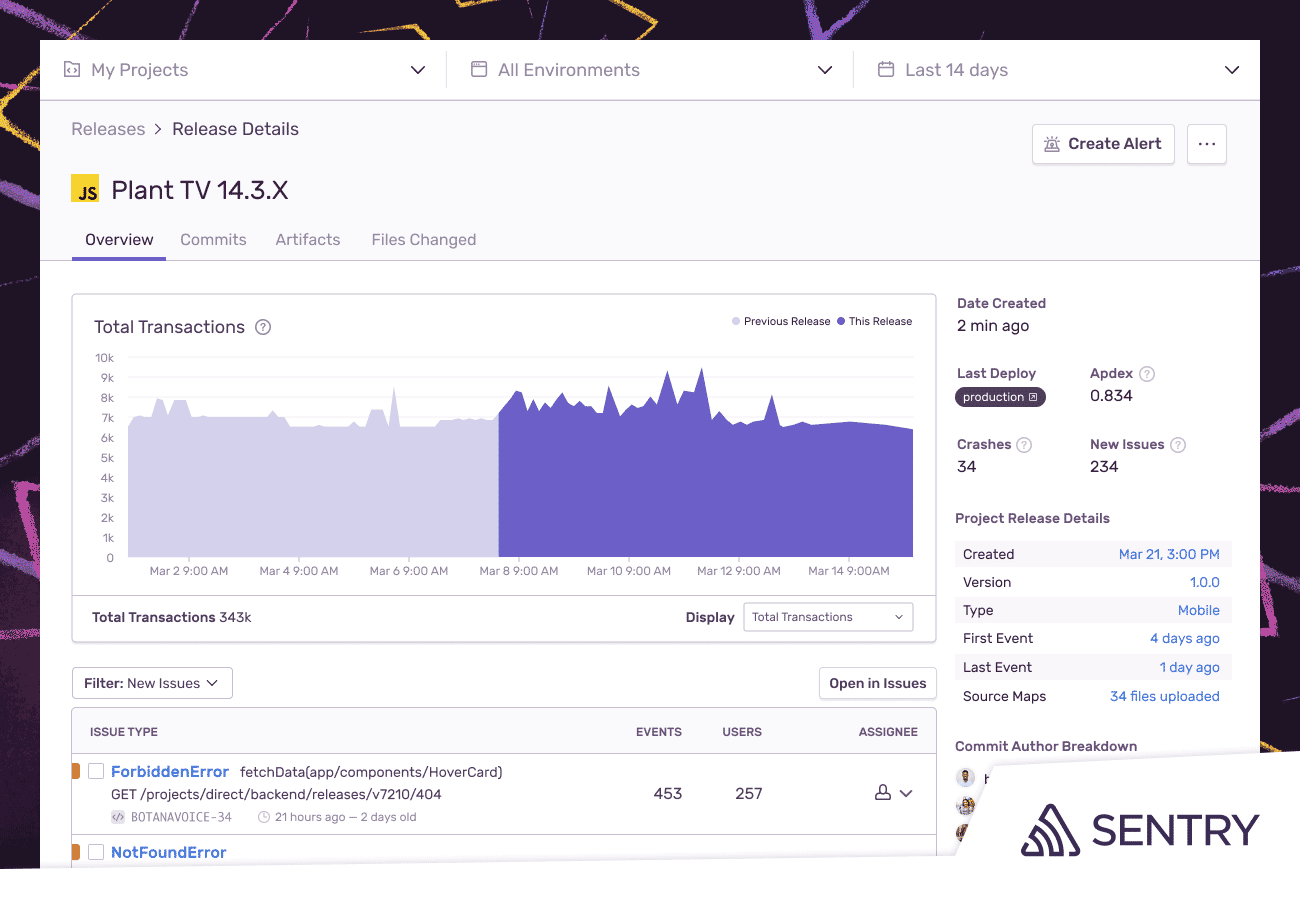
    Sentry today announced it has updated its JavaScript SDK tool for monitoring applications to provide a more comprehensive view of application health.

    Previously, Sentry’s JavaScript SDK enabled JavaScript developers to insert lines of code that would tell them, for example, how many times an application failed. A new release health capability now also identifies what percentage those fail instances represent of the total number of times that application was successfully launched.

    Developers can, in effect, better gauge adoption of a JavaScript application by tracking the percentage of crash-free sessions and crash-free users over the application’s life cycle.

    Ben Vinegar, vice president of engineering for Sentry, said the JavaScript SDK is designed to provide developers with a monitoring capability that doesn’t require an IT operations teams to stand up and manage an entire application performance management (APM) platform. That approach also eliminates the need to instrument JavaScript applications with agent software, Vinegar said.

    The JavaScript SDK consumes tens of kilobytes of memory after it is embedded directly within a JavaScript application, said Vinegar.

    In general, JavaScript is increasingly being used to build complex applications, using frameworks such as React, as an alternative to Java. Over the years, IT organizations have developed a certain amount of bias around how Java applications should be monitored and managed using APM platforms. However, as JavaScript developers assume more responsibility for their applications after deployment, they need real-time monitoring tools that can consume JavaScript application metrics and are built in to existing APM platforms, .

    Of course, APM platforms are managing more than just JavaScript applications, so they’ll remain useful for the forseeable future. However, ease of observation and monitoring is a significant factor when application developers choose a language in which to build an application, and it’s up to individuals to remediate issues that might arise in production. Developers, therefore, have a vested interest in discovering potential issues before that application is deployed.

    Historically, developers have not had access to JavaScript application monitoring tools that they could easily implement on their own. Sentry’s tools makes it possible for developers to identify performance issues, including calls to application programming interfaces (APIs) and other common errors, and address those before an application crashes.

    It’s possible, as performance and security issues shift left and developers become more accountable for user experience, that developers might one day instrument and monitor applications on their own – if for no other reason than self-preservation. Every minute a developer spends remediating a production issue in an existing application is one less minute they will have to write new code.