Tag: devops

  • Virtual Instruments Changes Name to Virtana to Drive AIOps

    Virtual Instruments Changes Name to Virtana to Drive AIOps

    With the formal launch of a software-as-a-service (SaaS) to monitor cloud platforms and optimize cloud, Virtual Instruments today renamed itself Virtana.

    The company’s CloudWisdom platform is based on technology Virtana gained via the acquisition of Metricly earlier this year. In addition to being integrated with existing on-premises offerings from Virtana, CloudWisdom has been expanded to include a self-service option. Downloadable trial versions are also available.

    Virtana CEO Philippe Vincent said the name change reflects a transformation from being simply a provider of storage I/O performance testing tools to becoming a provider of an IT operations management platform infused with artificial intelligence (AIOps). As part of that effort, the CloudWisdom offering represents the first time Virtana has extended the reach of its offerings beyond on-premises IT environments, he said.

    CloudWisdom will differentiate itself, Vincent said, because it combines cloud monitoring with built-in tools for optimizing cloud costs. Rival offerings require IT organizations to acquire two separate services, he noted. The CloudWisdom platform monitoring capabilities span databases, messaging platforms and containers, as well as cloud infrastructure services from Amazon Web Services (AWS) and Microsoft.

    In general, Vincent said IT organizations are moving away from a reactive approach to managing IT to a more proactive approach that will require increased reliance on automation. As IT environments become more complex, too many IT organizations are trying to compensate by overprovisioning IT infrastructure resources to make sure application performance doesn’t deteriorate or applications crash. That approach not only drives IT costs higher, he said, but it also makes those costs unpredictable.

    To address that issue, Virtana is combining CloudWisdom with an AIOps platform designed to be equally applicable in legacy IT service management (ITSM) and emerging DevOps environments. Organizations that have adopted DevOps will be at the forefront of the transition to AIOps because of the inherent fluidity and velocity of those environments, Vincent noted. Machine learning algorithms coupled with real-time monitoring, big data analytics, workflow engines and automation frameworks will enable IT teams to streamline ITSM and DevOps processes to become more efficient. The opportunity for Virtana is to disrupt a highly fractured monitoring category by leveraging AIOps to unify monitoring at an unprecedented level of scale and scope, he added.

    Virtana is not the only IT management platform provider that has identified the same opportunity; much larger incumbent providers of these platforms and a raft of startups are moving in the same AIOps direction. Vincent said Virtana will differentiate itself by pursuing a more application-centric approach to delivering on the promise of AIOps.

    It’s too early to say to what degree IT operations can be automated using AI. There’s general agreement that AI will play a significant role in automating IT, and the more standardized the IT environment is, the easier it is to accomplish. The challenge is, most IT environments today are still anything but standardized.

    — Mike Vizard

  • Survey Suggests DevOps Drives Digital Business Transformation

    Survey Suggests DevOps Drives Digital Business Transformation

    A survey published this week by New Relic, a provider of IT monitoring services, suggests there is a high correlation between organizations that have embarked on digital business transformation initiatives and adoption of best DevOps practices.

    Revealed at the Futurestack conference hosted by New Relic, the survey 750 global senior IT decision-makers of enterprises with 500 to 5,000-plus employees in Australia, France, Germany, UK and the U.S. conducted by the market research firm Vanson Bourne finds roughly 50% of organizations in the U.S. have completed or are close to completing their digital transformation journeys.

    The same survey finds nearly two-thirds of U.S. respondents in the region claim they’ve adopted DevOps practices.
    Buddy Brewer, group vice president and general manager for client side analytics at New Relic, said the challenge most organizations face in terms of DevOps is they lack access to real-time analytics. DevOps teams may have access a raft of metrics, but all the data they have only tells them how many times something occurs on average. Roughly half of end users may be having a satisfactory application experience, but the half that are not are the company’s most important customers, noted Brewer.

    Overall, the survey finds that that there’s nothing easy about modernizing IT environments to drive digital transformation initiatives. Nearly three-quarters (72%) expect the technology team to deliver more innovations and updates. However, more than 50% said they find their complex new software and infrastructure difficult to manage and monitor for performance issues.

    Nearly half the respondents (48%) also admitted end users or customers are likely to tell them about a problem before they know about it and 46% said they are told about these issues before they know how to fix them.

    At the same time, 79% said the rest of the business has higher expectations in how digital systems perform and 63% admitted that because of pressure to respond to business needs, they work longer hours to observe and manage software performance. Almost half (46%) said C-suite executives want daily updates about how software systems are performing and 40% said CEOs also want more answers when outages or performance problems happen.

    More than half (56%) of all respondents acknowledged that it is impossible to properly assess all the machine data being collected. Just as troubling, a third said they are challenged on business benefit metrics for their digital transformation projects.

    The survey identifies the top five digital transformation challenges:

    1. Separate parts of the organization are moving at different speeds to embrace digital transformation.
    2. Shortage of skilled employees.
    3. Restricted budgets.
    4. Understanding and measuring business benefits.
    5. Continued resistance to shutting down legacy systems.

    As always in the case of IT professionals, however, hope springs eternal. A full 89% said they believe artificial intelligence and machine learning algorithms will become important element for managing digital systems. That may indeed come about one day. However, until that day arrives, DevOps teams should count on the fact that every digital business transformation project that gets launched equates to a lot more hard work for them.

    — Mike Vizard

  • DevOps Deeper Dive: DevOps Accelerates Open Source Innovation Pace

    DevOps Deeper Dive: DevOps Accelerates Open Source Innovation Pace

    In the span of a few short years, open source software has evolved from being a means to create the free equivalent of an existing commercial platform to now becoming the primary means of driving innovation across the IT industry.

    That rate of innovation has increased dramatically in the last few years. However, much of that innovation would not have been possible if large swaths of the open source community hadn’t been able to employ best DevOps practices to collaborate, said CloudBees CEO Sacha Labourey.

    Early on, the adoption of open source software was driven by a desire to commoditize operating systems and databases by making available a free equivalent.

    “It was all about replacement software,” said Labourey.

    Open source adoption got a major boost in the enterprise during the last economic downturn. Many organizations implemented an “open source first” strategy to lower their IT acquisition costs. As part of that mandate, developers began making greater use of cloud infrastructure to build applications based on an open source stack of software using best DevOps practices.

    In some cases, that preference for open source software turned into religious fervor. In other cases, it simply became a means to bypass IT purchasing processes that developers considered obstacles to writing code. Of course, it was only a matter of time before the open source software used to build applications made its way into production environments managed by IT operations teams.

    Just as significantly, open source software was leveraged to build public clouds that today are transforming the way IT is consumed.

    None of this shift has been lost on IT vendors. As the demand for proprietary code slackened, many found it profitable to offer support services for open source software. The more there is to consume, the more the support services contracts grew. Now every vendor from IBM to small IT services providers such as Fairwinds has launched open source projects that help drive demand for IT services expertise.

    “There’s pain around integrating a lot of disparate open source projects,” said Robert Brennan, director of open source software for Fairwinds. “Organizations may be getting software for free, but there’s usually not a lot of help around.”

    Now almost every IT vendor in the world is making software engineers available to work on open source projects. All that talent focused on open source projects has led to the development of new platforms such as Jenkins, GitHub, Kubernetes and, more recently, a raft of smaller projects. With the rise of containers and cloud-native applications, open source software projects are entering another era that will see many of those same software engineers leveraging DevOps practices more broadly to drive even more innovative projects at increasingly faster rates.

    “All the innovation is now being driven by open source,” said Joe Fernandes, vice president, products for cloud platforms at Red Hat. “You no longer have to wait for a single vendor to move something forward.”

    The challenge many organizations now face is keeping pace with the rate of innovation. Most major open source projects, thanks to DevOps practices, are updated once a week. To shield themselves from having to work with raw bits of code, many IT organizations rely on curated distributions of open source code from vendors such as Canonical, SUSE and Red Hat.

    Today, the economics of software development have changed. Providers of proprietary software are at a distinct disadvantage when competing against open source projects that can marshal more developer resources. A vendor selling proprietary software needs to keep a smaller team of developers highly focused on adding compelling, innovative features faster than an open source project can replicate them. As many vendors continue to show, that goal isn’t impossible to achieve; however, it is a pace of innovation that is exceedingly difficult to maintain.

    It remains to be seen just how much of the software deployed in IT environments will be based on open source code going forward. But with each passing day, the balance on the scale continues to lean further away from proprietary code.

    — Mike Vizard

  • IoT Security Concerns

    IoT Security Concerns

    The Internet of Things (IoT) is being hailed as the next step in our technological development. It’s hard to argue with that. The abilities it provides are as captivating as they are numerous: smart cars and homes, automatized agriculture, advancements in medicine that help with after-stroke recovery and the list goes on.

    However, while the IoT is truly a huge topic nowadays, we must not let our fascination with it overcome us. It’s too easy to forget about security and privacy concerns when you hear about exoskeletons that can increase a person’s strength and dexterity–trust me, I know. But we can’t afford to forget about them.

    It does seem, though, in our pursuit of the interconnected device environment, the security of those devices was somewhat left behind. Let’s take a look at what the primary IoT cybersecurity hindrances are and what can be done to overcome them.

    When Security Struggles To Keep Pace

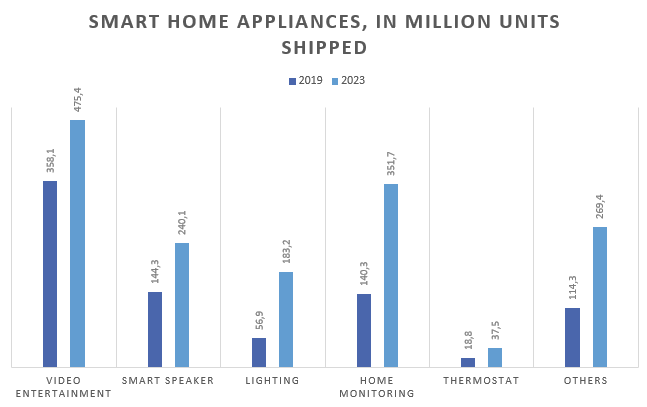
    One example of the quantity of devices outrunning their quality safety-wise is smart homes. They are very popular now, and according to the IDC forecast this trend is not going away:

    Data source: IDC Worldwide Quarterly Smart Home Device Tracker.

    While undeniably convenient, smart homes can pose a potential threat to their users. To do their job, they must collect information about those users. And the more interconnected the entire system gets, the more trouble can a single weak link cause.

    Take smart door locks, for example. Some of them come with facial recognition algorithms. That in itself is a pretty big privacy concern. Facial recognition can be used with an alarming accuracy to identify and track individuals. It can have various purposes, but very few of them (if any) are benevolent.

    To add to that, within the smart home system, a smart lock is going to be connected to other devices. Maybe it is safe from cyberattacks on its own, but is the smart thermostat safe? What about the smart water kettle? It only takes one vulnerability to get access to a lot of one’s private data.

    This risk can be somewhat mitigated by users taking certain precautions: installing AV software to protect their devices, updating the said devices regularly to prevent exploits, setting up a VPN on their routers to safeguard all of their internet traffic, etc. But how many users are actually going to go through with all this trouble?

    Physical Problems

    It should be noted that data breaches and cyberattacks are not the only threats the IoT faces. Some problems arise from poor design.

    For example, among other considerations presented in the June NIST publication, a non-descriptive appearance of an IoT device is mentioned. If it’s just a black box with no markings on it to indicate what software and hardware it runs on, updating it (as well as keeping track of its activities) becomes a very unpleasant chore. It is especially true if there are thousands of such devices located on the premises of a company.

    Alternatively, the support of a certain device may get discontinued well before the company plans to replace it. It is also possible the news of its discontinuation can be missed by the company, thus creating a possible vulnerability.

    Sheer Scale of the IoT Makes Threats Bigger, Too

    Another concern with the IoT is it’s so overwhelmingly difficult to maintain secure. If there is the need to install crucial updates on hundreds of millions of devices, the task becomes all but impossible.

    The hundreds of millions of devices example is not an exaggeration, either. Recently, several critical vulnerabilities were found in the VxWorks real-time operating system. Thankfully, this finding was not made by hackers but by a security firm. Some might think it should, therefore, be easy from now on for those vulnerabilities to be patched.

    Here comes the problem. There are 2 billion devices that run on VxWorks. Although not all of them can be affected by the vulnerabilities found, hundreds of millions still can. Moreover, there are difficulties in finding all the devices that need a patch, as it’s not obvious what devices even run on this RTOS.

    Many of the VxWorks devices are used in medicine. To update them, it is required they undergo the certification and testing processes, and that can take a long time. And before all the necessary testing is done, those devices remain vulnerable.

    Making the IoT Safer

    That’s why the approach to IoT device security must become more holistic than it is now. It is necessary for the IoT market itself to develop, as security and privacy issues were named one of the biggest problems hindering the implementation of smart devices.

    According to the recent Deloitte webcast, one of the biggest threats of the IoT today is security measures and systems are not incorporated into the core design of devices and networks. Another top risk is the lack of security awareness and training among engineers. Yet another one is the lack of proper incident response processes due to the wanting skill levels of security professionals.

    It’s obvious the IoT field can benefit immensely from the implementation of DevOps and, especially, DevSecOps. To ensure safety in the IoT, it is not enough to start worrying about it only after the fact, as an addition to other functions. On the contrary, it must become secure by design, and its safety must be a concern on all levels.

    — Dean Chester

  • GitLab Outlines Scope of DevOps Ambitions

    GitLab Outlines Scope of DevOps Ambitions

    At the GitLab Commit event in New York today, GitLab launched an ambitious effort to extend the scope of its DevOps platform to provide a view into the software development life cycle for not just developers but also designers, product managers and business leaders.

    Fresh off raising an additional $268 million in funding, GitLab now plans to create different ways to view a common pool of metadata and metrics generated by the GitLab DevOps platform.

    It may be a while before GitLab can deliver on that promise, but the core concept builds on the dashboards the company already has built for IT operations and cybersecurity teams. Rather than requiring each team participating in the software development process to acquire a separate platform, GitLab should be viewed as a DevOps platform delivered as a single application that can now be applied to everyone, said Mark Pundsack, vice president of product strategy for GitLab, in speaking with conference attendees.

    As part of that commitment, Pundsack noted GitLab is expanding its DevSecOps capabilities to include auto remediation. The scanning capabilities built into GitLab will be extended not only to detect issues based on the cybersecurity policies of an organization, but also, when allowed, automatically remediate routine issues, Pundsack said, adding GitLab also will automatically roll back applications if necessary. Once in place, GitLab will have pushed application cybersecurity much further left than anyone might have expected when DevSecOps was first broached as a concept, he said.

    At the conference, GitLab demonstrated a pipeline graph capability that will provide a foundation for many of these promised offerings. GitLab already can be employed to accomplish tasks such as code quality scanning, container scanning, dependency scanning and licensing dependencies.

    All these features are an extension of GitLab’s existing strategy that aims to rationalize the number of tools organizations need to stitch together to drive a set of best DevOps processes. However, other DevOps platform providers have similar ambitions.

    Thanks to its latest round of funding, GitLab—which also announced its plans to go public next year—is now valued at $2.75 billion. The company has not released any revenue results but does claim to support more than 100,000 organizations using its platform, including Ask Media Group, Charter Communications, Delta Air Lines, Goldman Sachs, Ticketmaster and Nvidia. GitLab also claims to have more than 4,800 active contributors to its open core platform. The company now has more than 800 employees in more than 55 countries across the globe, and there currently are 222 open GitLab jobs posted.

    It remains to be seen how much $268 million will enable GitLab to fend off rivals such as GitHub, which was acquired by Microsoft, and CloudBees, which has built a large DevOps community around the open source Jenkins continuous integration/continuous deployment (CI/CD) platform. Whatever the outcome of this arms race, the massive amount of funding pouring into the platforms soon should take DevOps platforms to places many might not have ever imagined possible.

    — Mike Vizard

  • An Inside Look at GitOps

    An Inside Look at GitOps

    At a time when variations on DevOps abound, get ready for the latest: GitOps. This new term promises to bring some order to what can be operational chaos and empower operational teams to leverage best practices learned from their developer counterparts. It’s early days yet for GitOps, but here’s what we think you need to understand about this new facet of DevOps.

    What is GitOps?

    Everyone we spoke with has a slightly different perspective on GitOps, but this is our take: In its most basic form, GitOps is infrastructure and operational procedures defined as code, and living in a source control system, such as Git. Git becomes the single source of truth for what is running in production (or staging, or development).

    Declarative systems, such as Terraform, AWS CloudFormation and Kubernetes help enable this practice; but operations is much more than Infrastructure as Code. True operations requires a way to plan, review and approve moves, adds and changes to the infrastructure. It also requires well documented procedures, or runbooks, to be successful. This is where GitOps differentiates itself. We believe GitOps is the full operations lifecycle of infrastructure management, living as code in a git repository.

    GitOps may be used for managing both application deployments and base infrastructure made up of systems needed regardless of the applications deployed (i.e. networking, security, etc.). Both will follow the same procedures to plan, review, approve and release code into production. Done right, GitOps will let engineers constantly apply updates to infrastructure meet all the needs of the applications in a continuous delivery format. The version control system ensures everything is recorded and visible and an audit trail keeps teams compliant. GitOps will make it easy to revert problematic changes, becoming a single source of truth about what is happening in the system from both the software development and infrastructure perspective.

    What Technology is Required?

    In order to kick off GitOps, you’ll use a Git-based version control system. Then you’ll need the ability to create a declarative cloud infrastructure, using something such as Terraform and Kubernetes, with the help of Helm or Flux. Because both Terraform and Kubernetes are declarative systems, they make it simpler to create and deploy infrastructure as code in a manner that is both replicable and transparent. And you’ll also want to implement a solution such as GitLab that wraps operational procedures around these tools. GitLab, being an end-to-end DevOps solution can manage the backlog of requests, assign those requests to the appropriate subject matter expert to create the change in Git, facilitate the review and approval process, and kick off the execution of the changes using its flexible CI/CD system.

    While it is possible to achieve this sort of workflow by using different solutions to merge and ship code to Kubernetes, GitLab is certainly a straightforward path to GitOps. It allows developers and operations administrators to work from the same source of truth and with a common set of procedures and tools.

    What Are the Benefits?

    In the DevOps world, GitOps is perhaps unique in that it can potentially benefit both operations team members and developers. For starters, GitOps aims to address the sometimes cave-like nature of operations (a single person working largely in isolation) by taking all of the best practices from software development and letting them loose on the deployment side.

    Full oversight, architectural review, project management and all the other pieces of the process are brought together in GitOps in an effort to end ops versus everyone else and get all the stakeholders involved in the process. The basics don’t change–an ops engineer will still create an infrastructure–but that will just be one part of a much larger process that everyone can contribute to and collaborate on. No more worrying about an engineer creating a cloud infrastructure that can’t be replicated; with GitOps everything is tracked making repeatability easy. Suddenly it will also be simple to answer the “what changed?” question because no one will have to hunt for an answer. The bottom line is a successful GitOps program will benefit the actual bottom line because operational processes will be dramatically streamlined.

    Possible Challenges

    With any collaborative effort, change can be tricky and GitOps is no exception to that. It is usually easier to create one-offs and not follow a process, so the first thing to consider about GitOps is it will require discipline from all participants. It will be vital for teams to write everything down.

    At GitLab we live and die by this thanks to our culture of collaboration, but we know it’s not necessarily something that comes naturally to any individual or organization. It will be vital for everyone on the team to record what’s going on in merge requests and issues. The temptation to edit something directly in production or change something manually is going to be difficult to suppress, but the less “cowboy engineering” the better GitOps will work.

    If GitOps sounds like something your organization might benefit from, our best advice is to start small. Pick a tiny area to begin with, get a win and then build on that. At GitLab we call that iteration and it’s worked well for us.


    This article was co-authored by Priyanka Sharma, director of technical evangelism at GitLab.

    — Brad Downey

  • Why COBOL Still Matters After 60 Years

    Why COBOL Still Matters After 60 Years

    In the world of DevOps, the Agile Manifesto and countless other application delivery frameworks, one has to wonder how an anachronism such as the programming language COBOL (common business-oriented language) has managed to remain relevant. After all, COBOL has its roots back in the 1940s, and was built upon Rear Admiral Grace Hopper’s work on the FLOW-MATIC programming language (a text-based programming language). Hopper, who worked as a technical consultant on the FLOW-MATIC project, is sometimes referred to as the grandmother of COBOL.

    Last century, COBOL quickly became one of the most used programming languages in the world and it is still quite popular, claiming more lines of code in active use today than any other programming language. It offered a huge advantage over the other programming languages of the era. One that can be summed up as portability. From the outset, COBOL was the first popular language designed to be operating system-agnostic. In other words, it could be run on numerous different systems with little change made to the source code. What’s more, as a text based language, COBOL used English words and phrases to make it easier to understand and also made it somewhat self-documenting. 

    While much of the programming world has moved onto JavaScript, Python, PHP and even C and C#, COBOL can not be ignored. It continues to evolve and remains relevant, even in the age of the cloud. Simply put, it still has some chops to it. Take for example:

    • COBOL is a Language of Business: It is still used by the majority of major banks and insurers. The language can be found in widespread use across numerous other sectors, such as retail, healthcare, government and automotive. For most of those businesses, no other programming language has displaced COBOL and it remains as the back-office business language of choice.
    • COBOL is Extremely Portable: From the outset, COBOL was designed to be operating system agnostic, meaning the same applications developed under it could run unchanged across many different platforms. That allows COBOL developers to focus on building applications, instead of worrying about the intricacies of operating systems. That fuels DevOps and agile by allowing developers to test and deploy across a wide range of supported platforms.
    • COBOL Continues to Evolve: It supports and integrates with numerous platforms and works with operating environments such as Linux, mainframes, Windows and UNIX. What’s more, COBOL also integrates with Java, C#, Docker containers, mobile, .NET and JVM as well as Azure and AWS cloud environments. It can be used today to build cloud, containerized and managed code apps. And continues to evolve to meet the challenges of the future.
    • COBOL is Easy to Learn and Understand: It was created with the objective of making it easier for programmers to work with computers and each other. That objective has translated into a language easy to learn and understand by using English phrases and commands. The readability aspects of COBOL make it self-documenting, along with an ease of use not found in other languages. What’s more, the language costs less to maintain and its readability means it is easier to maintain.
    • COBOL is Future-Proof: It has continually evolved and now works with industry-standard IDEs, meaning programs can code with COBOL using familiar tools that support teams. COBOL developers are able to use the language alongside contemporaries, without having to forgo the latest IT tooling and processes.

    While many in the DevOps world sell COBOL short, there are many reasons why the language remains popular today. It continues to meet the needs of business and embraces many of the changes the cloud and new techniques can throw at it. COBOL is even now embracing APIs, micro services, the cloud and distributed platforms, making it a worthwhile tool for business today.

    — Frank Ohlhorst

  • Virtual Instruments Aims to Meld DevOps, ITSM Worlds

    Virtual Instruments Aims to Meld DevOps, ITSM Worlds

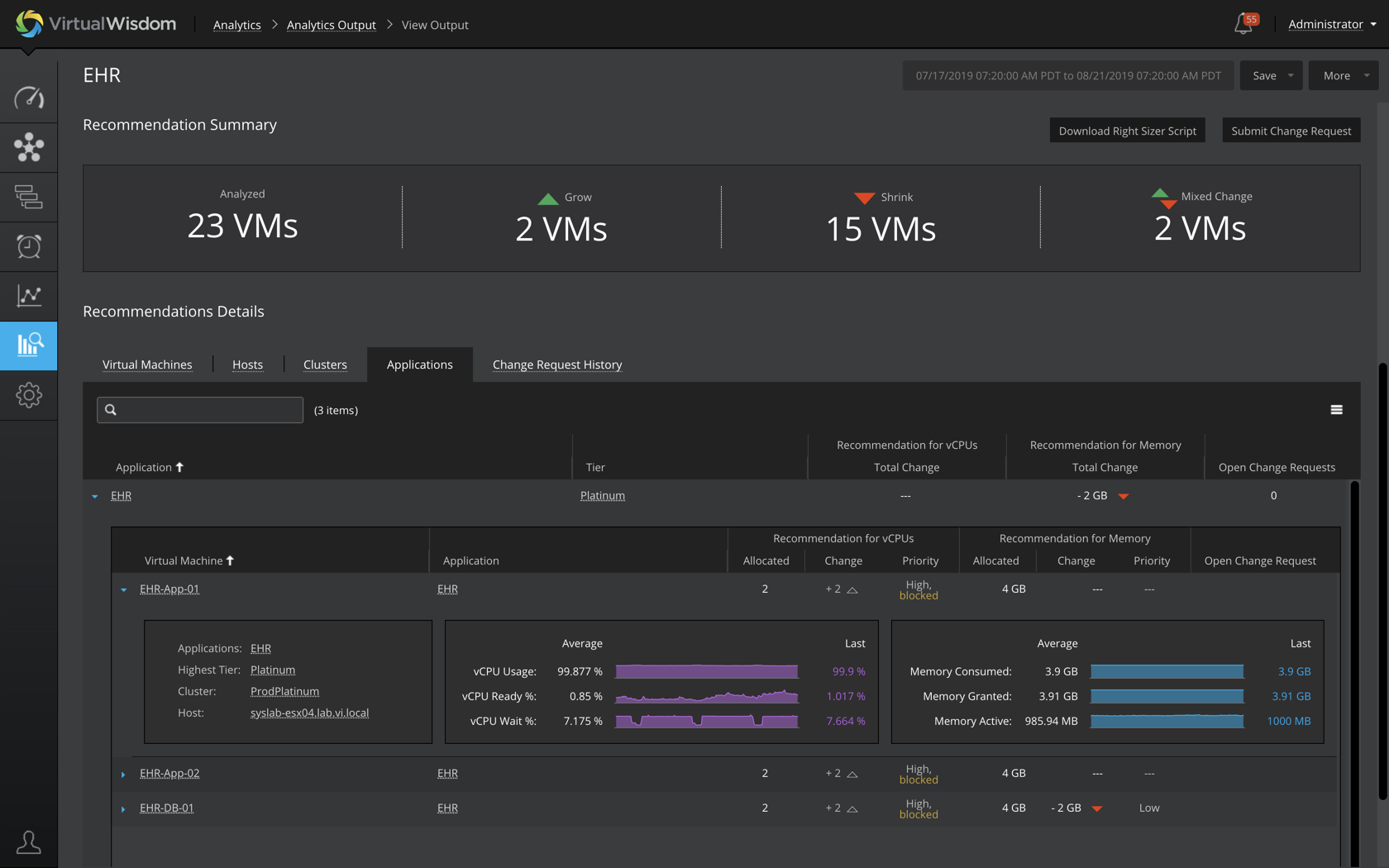
    Virtual Instruments today announced additions to an IT management platform that leverage machine learning algorithms to identify application drift and dynamically right-size virtual machines.

    Tim Van Ash, senior vice president of products for Virtual Instruments, said version 6.2 of the company’s VirtualWisdom platform is part of an ongoing campaign to meld the traditional world of IT service management with best DevOps practices using an AIOps platform. As part of that effort, Virtual Instruments last month acquired Metricly, a provider of tools for monitoring cloud costs in real-time.

    The latest update to that platform also adds tools to monitors, reports, forecasts and alarms against the capacity consumption rate of any application, while a capacity forecast alarm now allows IT teams to specify how many days, weeks or months they wish to be notified prior to potential capacity exhaustion occurring on any one node or cluster.

    Finally, Virtual Wisdom 6.2 provides access to updated VirtualWisdom Proactive Dashboards that provide access to Smart Charts, through which the AIOps platform now supports annotation, linking and smart naming in addition to topology views that are specific to a set of IT infrastructure or an application.

    Van Ash said the Virtual Instruments approach to AIOps is that it allows IT teams to respond to changing application conditions in real-time and set granular limits on how much capacity can be consumed by any particular application. For example, IT teams can ensure that specific applications are given a Platinum-level preference that prevents any other application from consuming resources allocated to that application, he said.

    In general, Van Ash said Virtual Instruments is pursuing an application-centric approach to AIOps that will make it easier for IT organizations to optimize IT infrastructure capacity dynamically. Rather being overly focused on utilization rates and tracking events, AIOps platforms need to be able to address the entire IT life cycle as it relates to the value that IT environment has to the business, he said, noting today many DevOps teams are building and deploying applications with little regard or actual control over the service levels those applications need to achieve and maintain. The goal, he said, is to provide a single platform through which DevOps and IT operational teams steeped in legacy IT service management (ITSM) models such as ServiceNow can collaboratively achieve a common set of goals.

    A day of reckoning is coming for proponents of DevOps and IT teams that have built sprawling IT environments employing ITIL-based processes. Those ITIL-based processes are not especially flexible, but they have been employed successfully to roll out applications at scale consistently. Advancements in AIOps should go a long way to bring the two schools of IT management together by making it easier to bend the available IT infrastructure resources to the will of multiple application developers trying to share a common pool of resources.

    In the meantime, no one should expect AI to solve their problems magically overnight. It takes a while for algorithms to solve all their IT headaches. However, the days when the relationship between developers and IT operations teams could be described as mostly contentious soon may be coming to a merciful end.

    — Mike Vizard

  • The State of DevOps Report 2019 Is Out

    The State of DevOps Report 2019 Is Out

    The Accelerate State of DevOps Report 2019 is out like every other year. Now, let’s talk about the key findings of this year’s survey:

    • The Industry Continues to Improve, Particularly Among the Elite Performers: Proportion of high performers have tripled, now comprising 20% of all teams. This shows the improvement is real for those who really are doing the right things.
    • Delivering Software Quickly, Reliably and Safely Is at the Heart of Technology Transformation and Organizational Performance: It is evident that speed, stability and availability leads to organizational performance in terms of profitability, productivity and customer satisfaction.
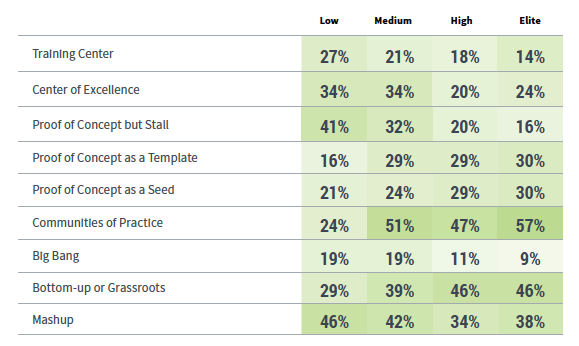
    • The Best Strategies for Scaling DevOps in Organizations Focus on Structural Solutions that Build Community: High performers favor strategies that create community structures at both high and low levels of organization. Having established community of practices, having proof of concepts, helps them become more resilient and successful. Dojos are becoming more and more important.
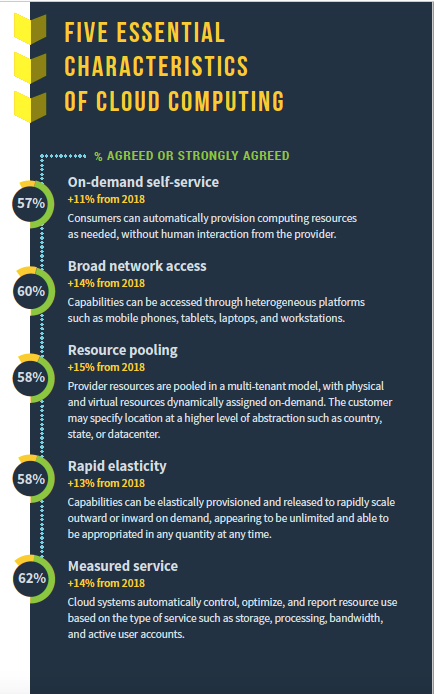
    • Cloud Continues to Be a Differentiator for Elite Performers, and Drives High Performance: The use of cloud as defined by NIST Special Publication 800–145, is predictive of software delivery performance and availability. High performers are 24 times more likely to execute all five capabilities of cloud computing:
      1. On demand self-service
      2. Broad network access
      3. Resource pooling
      4. Rapid elasticity
      5. Measured service
    • Productivity Can Drive Improvements in Work/Life Balance and Reduction in Burnout, and Organization Can Make Smart Investment to Support It: To support productivity, organizations can foster a culture of psychological safety and make smart investments in tooling, information search and reducing technical debts through flexible, extensible and viewable systems.
    • There Is a Right Way to Handle the Change Approval Process, and It Leads to Improvements in Speed and Stability and Reductions in Burnouts: Heavy weight change approval processes such as CAB, negatively impact speed and stability. In contrast, having a clearly understood process for changes drives speed and stability, as well as reduction in burnouts. It is nice to see ITIL 4 has adopted this best practice, and the CAB there is no longer mandatory.

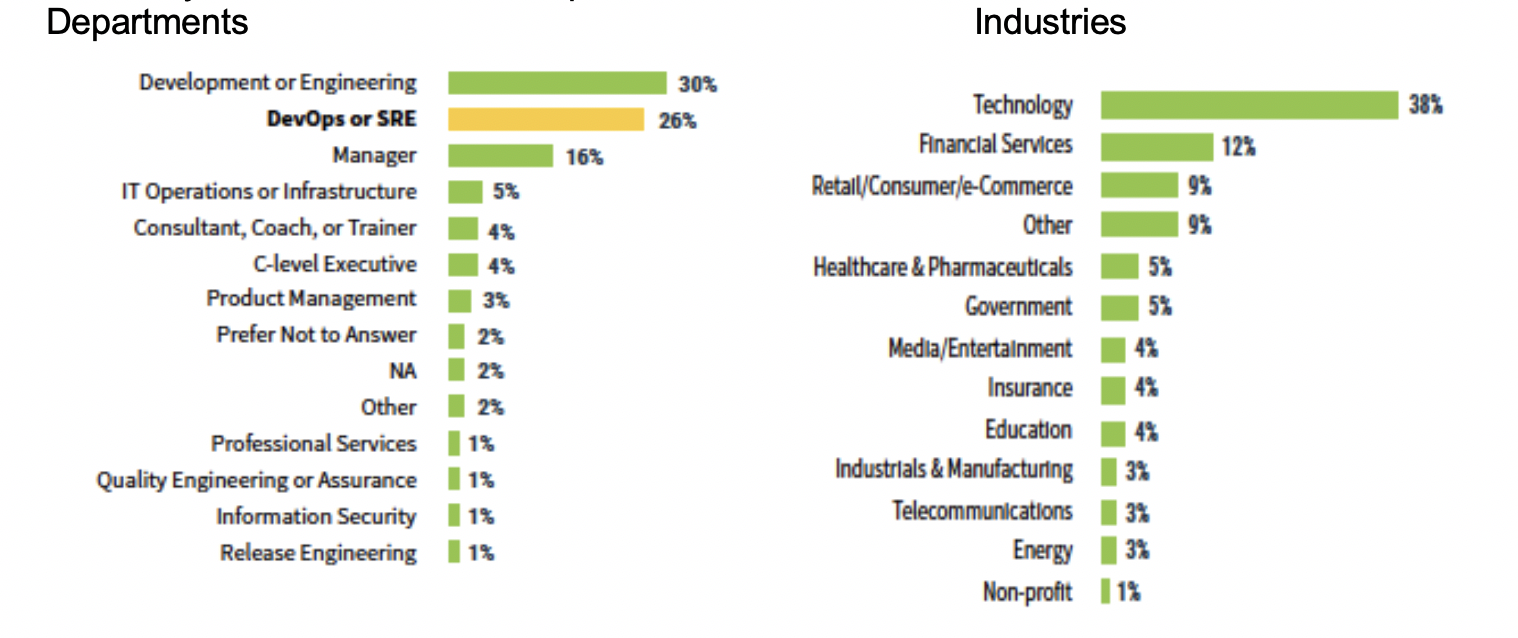
    The study was done on varied departments and industries.

    Software Delivery and Operational (SDO) Performance

    Over the last 6 years, a set of key metrics has been developed to measure SDO performance which provides a high-level system view of software delivery and performance and predict an organization’s ability to achieve goals. Last year, one operational metrics were added and found this measure helps delivering superior outcomes.

    This puts the focus and proves operational performance adds to the overall performance of the organization and helps in achieving the outcomes. Availability becomes an important component to recognize the outcome and co-create value. In ITIL 4 we also find this being brought out in the Service Value System. Importance of operations in adopting DevOps is very important.

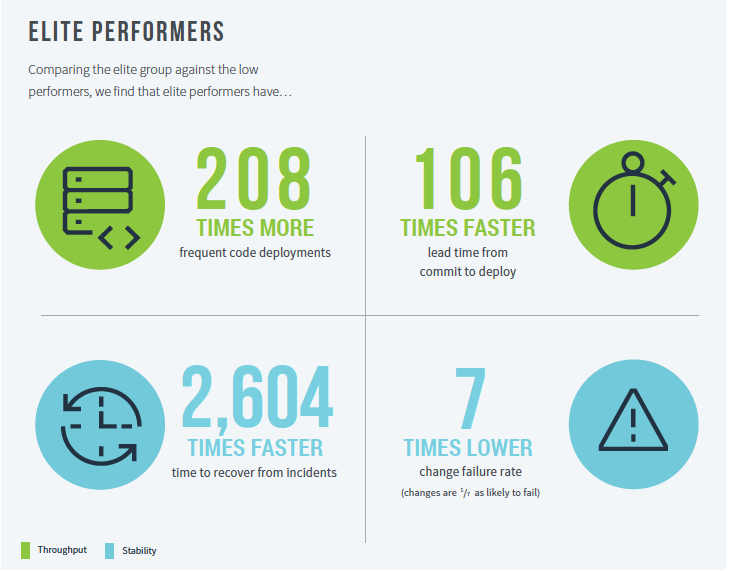
    The SDO for Elite Performers as per the Accelerate State of DevOps Report 2019

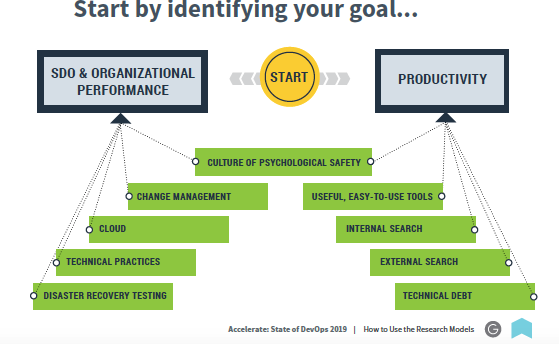
    This year the report has shown two research models to help drive improvement in both improvement in performance and productivity.

    Use of cloud has been one important factor. How it is used leads to the benefit generated out of it.

    The Five Essential Characteristics of Cloud-Related Result:

    Only 29% of the respondents who said they use cloud infrastructure agreed or strongly agreed they met all the five essential characteristics of cloud computing as defined by NIST.

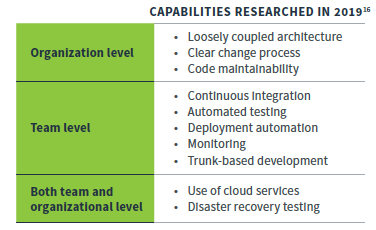
    The report talks about technical practices.

    Executing for maximum effect:

    • Concurrent efforts at team and organization levels
    • Continuous delivery using automation
    • Team-level technical capabilities
    • Organization-level technical capabilities

    Factors within are:

    Importance of architecture still remains important at organization level. Relook at the change process, it’s an important point highlighted in this year’s report. Use of cloud services is giving more improvement. DR testing is as critical as any other testing.

    Change management needs to be tuned to facilitate continuous delivery. It should not be heavyweight and on the other hand do not compromise risk. Points to be looked at in change management are:

    1. Implementing segregation of duty
    • Use Version Control
    • Use Infrastructure as Code
    1. Role of CAB becomes more strategic
    • Helping teams to implement capabilities that improve performance by providing guidance and resource
    • Weigh important business decisions that require a trade-off or sign-off at higher levels of the business
    • Shifting detailed code review to practitioners and automation and providing more time for strategic decisions to leadership
    • Transition from gatekeeper to process architect and information beacon
    1. Clear change process with proper delegation of authority

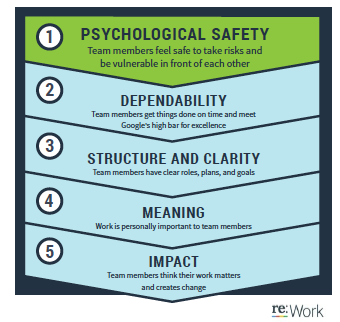
    Psychological safety helps in improvement of performance.

    This report talks about improving productivity. How do we improve productivity? The following factors can help:

    • Useful and easy-to-use tools
    • Technical professionals and tools
    • Internal and external search
    • Technical debts

    Finally, the approaches to improve–heatmap of DevOps transformation strategies by performance profile.

    Learn more about the Accelerate State of DevOps Report 2019 and attend the DevOps India Summit 2019 to hear the global experts.

    — Niladri Choudhuri

  • Aspects of Machine Learning on the Edge

    Aspects of Machine Learning on the Edge

    Machine learning (ML) is hard. Making it work within the confined environment of an embedded device can easily become a quagmire unless we consider, and frequently revisit, the design and deployment aspects crucially affected by ML requirements. A bit of upfront planning makes the difference between project success and failure.

    For this article, our focus is on building commercial-grade applications with significant, or even dominant, ML components. Edge devices, especially ML enabled ones, don’t operate in isolation; they form just one element of a complex automated pipeline.

    You have a device, or better yet, an idea for one which will perform complex analytics, usually in something close to real time and deliver results as network traffic, user data displays, machine control or all three. The earlier you are in the design process, the better positioned you’ll be to adjust your hardware and software stack to match the ML requirements. The available tools (especially at the edge) are neither mature, nor general purpose. The more flexible you are, the better your odds of building a viable product.

    Let’s start by describing a hypothetical device and we’ll work through some ML considerations of the design. As we discuss the design, we’ll visit and revisit DevOps automations that go hand in hand with these other engineering processes.

    A Smart Security Camera

    For our design, let’s look at a networked security camera. As an IoT device, it’s continually connected to the internet. We’ll assume our device will have at least 4GB of SDRAM, a 64-bit ARM CPU and run an embedded Linux that supports an Anaconda Python distribution, OpenCV, DLIB and TensorFlow.

    Our ML related goals are first, recording and labeling interesting frames, and second, alerting security personnel to suspicious activity. We are constrained by various physical, environmental and cost factors. To make the best use of the available data, we’ll need to use ML to examine and classify multiple objects from every image frame. We’ll use a cloud service to handle the second goal, so here, ML on the edge concerns image recognition. How should we proceed?

    Process the Images in the Cloud?

    We’ll need to recognize various objects in the frames, such as people, faces, vehicles, etc. Each object set requires execution (inference) of an ML model, which produces a set of bounded, labeled objects. A typical camera will record about 30 frames per second. Couldn’t our camera just send that data to a cloud provider? Ignoring other considerations, this is about 2.5 million images/day; even at a deep discount this would be billed at about $1000 a day, and that’s for each recognition model applied. Clearly, we’ll need to make other choices.

    Let’s start by examining the raw input stream. Each raw 720p (standard HD 1280x720px) frame uses about 5MB, so if we were to send 30 frames/sec over the network we would need an incredible 1.5Gbps connection (about a terabyte every two hours). For full HD and higher, multiply this by four to 10 times. We will not be sending raw, uncompressed video. Our problem is our ML models will only work against individual image frames. Where should we make our trade-offs?

    Video produces vast amounts of data, but very little information in a given frame is new; this is why various compression techniques work extremely well, and raw data reductions of 100-1000x is typical. These reduced rates of 15 down to 1.5 Mbps is fairly reasonable, so perhaps we can do our ML inference using cloud services, as long as we host our own machine instances rather than paying for ML services. Depending on our workloads, we can expect to process 24×7 video for between $50 and $200 per month.

    Having decided to host our ML models in the cloud, we now need to manage a corresponding set of DevOps considerations. Do we have enough compute power to manage the service? How will we scale the workload as the number of edge machines increases? What are the storage and data retention policies? And of course, since we’re dealing with images of people, how will we manage privacy concerns and the associated legal and political ramifications.

    What should bias us toward more cloud processing?

    • Our initial development budget is more limited.
    • Our ML models have not been proven effective in limited processing/memory environments.
    • We need the flexibility to rapidly change the models we use for processing.
    • We know the network connectivity is robust and offline operation is not required.
    • Our budget for cloud services can significantly exceed the cost of our edge hardware.

    The choice between processing in the cloud, or on the edge is not a binary one. Designs can massively benefit from even limited edge computing; in some cases, simple detections (motion/vehicle/human/face) can be implemented on the edge to reduce cloud workloads by orders of magnitude with no loss in utility.

    Can We Do Most of the Work on the Edge?

    If we’re using Python with C library acceleration on our quad core ARM, simple ML models such as face detection (not recognition) may handle 10 to 20 frames/second, but 30/fps on anything like a full sized image will not be possible. Deeper, more complex models won’t fit into our limited RAM, and if they did fit, we could see inference times exceed a second per frame. We’re now faced with the realities of life on the edge: trade-offs.

    Once we’ve committed to placing our models into the edge device, we’ll need continuous integration (CI) and deployment services to support our product. These will let us train and retrain our models in the cloud, automate the process of validating improvements and produce the embedded code that updates the models in our target devices.

    Since we initially used models well suited to GPU based servers, can we just add a GPU to our device? In a word, yes, but with some very real costs. Adopting an alternate SoM with GPU support will provide a magnitude of improvement in inference performance, but will double or treble the unit cost and power consumption will increase. Such changes may incur significant non-recurring engineering as adjustments, rewrites or retraining of the model will be required to take advantage of the new hardware. Non-recurring engineering is a one shot cost associated with a change to a part, assembly or system.

    In some cases we can plug an Intel Movidius Neural Compute Stick (NCS) into a spare USB port and see 5x to 10x boost in per image rates. These are supported by the Intel OpenVINO toolkit, but there will be some development time to get things running and not every model can be made to work.

    The next tool in the box is Field Programmable Gate Arrays (FPGA) development. It’s a chore to incorporate these into our board design, but performance can be equal or better than GPUs (on some models), and power consumption is lower. The Intel OpenVINO Toolkit supports Arria and Stratix FPGAs for DNNs. Pricing can be prohibitive.

    Finally, if our device will be produced in large quantities, it can be worth a few million dollars of NRE to build an Application Specific Integrated Circuit (ASIC). The sunk cost of ASIC design can be huge, but the lower unit costs will make up for it. We’ll go this route only once our design has been proven, locked down and we are sure the market can take the volume needed to break even on these engineering costs. I should note architectural improvements in dataflow processing of DNNs in ASICs, such as Vivienne Sze’s work, show promise for dramatic improvements in weight, power consumption and cost. If you are planning for a longer term, don’t rule out these developments.

    What would make our edge processing easier?

    • Start with low footprint models such as TinyYOLO, MobileNet or SqueezeNet.
    • Accept lower frame rates for image processing in our design.
    • Evaluate the ML models with the hardware specifics and tool sets in mind, up front.
    • Provide automated DevOps services to update models in your devices.

    Building our ML models to run on edge devices will involve significant development costs. Tool chains do not install seamlessly, and it’s common to spend days to weeks tweaking the environments. Development and testing on these platforms tend to be slower and involve more manual steps than we’re used to in our DevOps environments.

    Running models on the edge will increase our DevOps complexity. Our cloud workload will be lower, but now we’ll include cross compilation, embedded code builds, download management of larger images and various additional test and validation stages. These will be on top of the training, load balancing, data retention, privacy and security issues we need to address for a cloud-only system.

    Conclusions

    What else will affect our choices here? The nature of the inputs can really matter. If our camera visualizes traffic on a busy roadway, or people in an airport terminal, we can expect almost every frame will contain something of interest; if we’re monitoring the bottom floor of a parking garage–not so much.

    To recap:

    • Cloud services for video rate ML are cost prohibitive.
    • Integrate DevOps early to complete your product support system.
    • Understand and characterize your input data by volume, scale and importance.
    • Recognize not every model can execute on edge hardware.
    • You have more choices in edge hardware than you thought.

    Although there are still challenges to building more intelligence into devices, it’s important to realize every year these constraints are fewer, the tools get better and the devices become more powerful. A compelling argument can be made that most data processing should occur as close to its source as possible.

    — John Fogarty