Tag: devops

  • Waterfall to Agile to DevOps: The State of Stagnant Evolution

    Waterfall to Agile to DevOps: The State of Stagnant Evolution

    DevOps is all the rage. The hot IT buzzword intended to heal the expanding divide between development and IT operations is being used to sell a range of services and solutions to struggling development shops and enterprises, even though DevOps can’t be sold – it’s a cultural shift that nurtures under a strong leadership.

    Prior to DevOps, Agile methodology generated a similar hype that forced businesses to spend millions of dollars in revamping organizational hierarchy, deploying new solutions and hiring self-proclaimed expert consultants. The original values and principles of Agile development to deliver working solutions in small and iterative chunks were quickly forgotten. The methodology was only implemented during development phase and created backlogs for operation teams that failed to push product releases fast enough.

    (more…)

  • The DevOps Scorecard

    The DevOps Scorecard

    Mid-last year our team switched from doing Agile to doing DevOps. As we forayed into the journey trying to learn about DevOps and practice it at the same time,  a lot of questions arose in the team.  How was this different from agile and most importantly How were we going to be successful?

    That’s when we wrote down what would be the success criteria for our team: “Ship code frequently without causing a customer outage“.

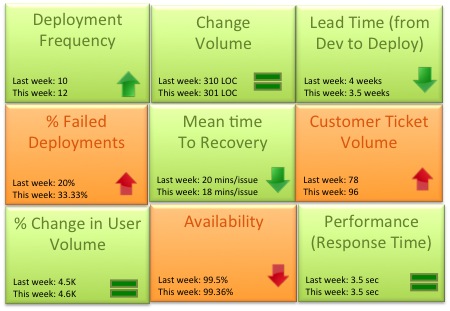
    As the team matured we started evaluating a more granular way to track success.  Could the team mantra be broken down into quantifiable success metrics that could be represented in a scorecard? Based on our experience the DevOps scorecard should contain these 9 metrics to track DevOps team success:

    DevOps Scorecrd

    1. Deployment frequency: How often were we deploying code and getting new code in the hands of our customers? This metric should trend up or remain stable from week to week. Example: Twice a week, 50 times a day
    2. Change volume: For each deployment how many user stories and new lines of code were we shipping?  Example: 3 new features per day, Average 500 lines of new code per week. Another parameter to consider in addition to volume is complexity of change.
    3. Lead Time (from Dev to Deploy): How long does it take on an average to get the code from development complete through a cycle of A/B testing to 100% deploy and upgrade on production? Lead time should reduce as the team gets a better hold of the lifecycle.
    4. Percentage of failed deployments: What percentage of deployments failed causing an outage or a negative user reaction? This metric should decrease over time. Example: 9% deployments failed this month as opposed to 15% last month. This metric should be reviewed in combination with the change volume. If the change volume is low or remained the same but the percent of failed deployments increased, then there maybe a disfunction somewhere.
    5. Mean time to recovery: When we did fail, how long did it take us to recover? This is a true indicator of how good we are getting with handling change and this should ideally reduce over time.  You can expect some spikes in this number due to complex issues not encountered before. Example: On an average it took the team 15 minutes to resolve each last week, 14 minutes this week.
    6. Customer Ticket Volume: Number of alerts generated by customers to indicate issues in the service. This is a basic indicator of customer satisfaction. Example: 54 tickets were generated this week as opposed to 38 while the user volume remained steady is not a good thing
    7. % Change in User Volume: Number of new users signing up, interacting with my service and generating traffic. As new users sign up is my infrastructure able to handle the demand? Example: This week the number of customers spiked by 30% due to an external event causing volume of requests to go up
    8. Availability: What is the overall uptime for my service and did I violate any SLAs? Example: 99.9% uptime consistently for the last 3 months even with change in user volume
    9. Performance (Response Time): Is my service performing within my predetermined thresholds? This metric should remain stable irrespective of % change in user volume or any new deployment. Example: Sub 5 second response time from all geographies and devices

    Would love to hear thoughts on what other critical metrics DevOps teams are using

  • The Dark Side of Infrastructure as Code

    The Dark Side of Infrastructure as Code

    We spend a lot of time extolling the virtues of infrastructure as code. All of it is true. Treating infrastructure as code can add great value in terms of its ability to promote consistent, predictable and repeatable results during the application deployment process. One of the ways in which infrastructure is treated as code is through the use of programmability.

    Programmability is an integral component in software defined architectures and a part of the DevOps approach is automation through integration with traditionally development lifecycle focused tools and technologies. APIs, app templates and the ability to programmatically interact with the data path are enabling rapid provisioning of services in the network. That’s important to the business. Improving service velocity in the network is critical to achieving faster time to market and enabling the operational scale necessary to meet growing pressure on networks arising from the growth of applications driven by cloud, mobile and the Internet of Things.

    Speeds and feeds of processes are now as important to gain a competitive advantage as speeds and feeds of packets.

    Those who see DevOps and SDN as having a strategic impact on their organization view programmability as having even greater importance.

    But that does not mean that treating infrastructure as code doesn’t have its dark side. Because adopting a programmatic approach to anything means you get both the benefits and the risks.

    I happened to be cogitating on this topic when I stumbled across a post reminding us of the importance of code reviews. The content was so-so, but the premise was spot on: code reviews are a must for those embracing the notion of treating their infrastructure as code.

    Why is that (or should it be) an imperative?

    Consider some stats from InitialState, “a technology startup helping engineers capture and understand product data. Our cloud-based log visualization-as-a-service platform helps engineers make sense of the exploding number of logs being produced by “smart”, complex products and applications.”

    According to their data, developers have to find and fix 100 bugs per 1000 lines of code. And it takes 30 times longer to fix one of those bugs than to write one line of code. Overall, developers end up spending 75% of their time (about 1500 hours per year) debugging code.

    Now spend a moment thinking about what that means when you start treating infrastructure as code, writing scripts to automate provisioning and integrating with other systems to orchestrate deployment processes.

    2011.09.18_code_reviews

    I won’t lie, code reviews can be tedious. But the first time someone points out an error, particularly one that could have resulted in a security breach or an undesirable service outage, the pain is more than made up for. In the long run, code reviews are beneficial to eliminating disruptive errors. A SmartBear survey in 2012 found that “70% of organizations indicated that code reviews are very important” and “Those that do code reviews clearly have a greater level of satisfaction in the overall quality of their software – they were twice as likely to indicate that they were very satisfied with their software quality.”

    In other words, code reviews are an important part of the software development lifecycle (SDLC). Which means it should be a part of the software deployment lifecycle when it leverages programmability to treat infrastructure as code.

    Therefore it is important in the early stages of DevOps (or SDN if you’re going that way) adoption that you put into place processes to check (and perhaps double check) the scripts, templates and integrations you’re using to automate application and service deployment along the entire operational chain – from the app to the network.

  • Microsoft strives to embrace open source culture

    Microsoft strives to embrace open source culture

    In many ways Microsoft is going through the corporate equivalent of a mid-life crisis—it has reached a stage where it longs to drop a few pounds, and turn back the clock a few years. After years of tremendous success, it’s now starting to show its age, and it is struggling to adapt to the new tech landscape and compete with younger, leaner, more innovative competitors.

    The shift began under ex-CEO Steve Ballmer. Ballmer’s approach, though, was misguided. Ballmer’s Microsoft suffered from hubris, and ignored the seismic shift in technology until it was too late. When Ballmer finally recognized the existential threat, and tried to turn the ship around, it was done from within the established bloated corporate culture. There was an effort to rearrange the chairs on the deck with a management reorganization, but it simply wasn’t enough.

    Then Satya Nadella took over. Nadella has a more aggressive vision. It’s still not an easy job, nor a goal that can be accomplished overnight with a behemoth the size of Microsoft, but Nadella has dramatically changed the culture, and the vision for where Microsoft is heading.

    Part of the new and improved Microsoft includes embracing communities that Microsoft has long ignored or alienated, and shifting the way things get done at Microsoft so the company can be more agile. It is evident in how Microsoft partnered with Chef and Puppet Labs to integrate popular DevOps tools into the Azure cloud platform, and it can be seen in how Microsoft is adopting open source.

    “Recent articles have shown that Microsoft is “open sourcing” code to their internal teams. The fact that that is advertised as innovation is telling,” declared Michael LaVista, CEO and Founder of Caxy. “That’s what smart organizations have always done. In fact, Microsoft has somehow found itself the underdog in this sense and probably needs to do things like this to attract talent.”

    Leveraging open source concepts internally isn’t quite the same thing, though, as actually making Microsoft code open source. Open source projects like Apache, Project Libre, or Docker share source code with the general public, and anyone can review the code, and submit changes to improve or fix the code. Open source communities collaborate to continuously enhance the code. Microsoft appears to be doing something similar, but without exposing its source code to the general public.

    LaVista suggests that Microsoft should take that next step, though, and work collaboratively with the open source community outside of Microsoft’s walls. If it does so, Microsoft will some issues to address. Will it accept code fixes from a 14-year old on the other side of the world? Will exposing source code for the Windows operating system, Microsoft Office, or other popular Microsoft applications open up a Pandora’s Box of security concerns?

    “They will have to embrace what happens to code when it is open sourced. Once the code is out there, everyone can see the flaws,” explains LaVista. “The benefit of the model is that you have so many more eyes looking at it from more perspectives. If Microsoft is used to running their own software and making their own decisions about what to work on and fix, this could pose problem.”

    Perhaps. LaVista makes good points about concerns Microsoft would face, but in and of themselves they’re not a reason not to adapt and evolve. Yes, exposing Microsoft source code to the general public would probably result in a spike in security concerns, but once the dust settles the collaborative approach of an open source community addressing those issues could result in quicker patch releases, and make the software more secure.

    LaVista recommends that Microsoft use companies like Red Hat, IBM, and HP as examples of how a larger corporation can be successful in an open source culture. Only time will tell. We’ll have to wait and see to what extent Microsoft makes the shift to open source, and we’ll have to wait and see how Nadella’s Microsoft adapts, and whether Microsoft can successfully reinvent itself to remain competitive in this new tech landscape.

  • Five Top Tips for DevOps At Scale

    Five Top Tips for DevOps At Scale

    Since I published my blog explaining the topic of ‘Big DevOps’ late last year, the concept of Enterprise DevOps has exploded, with commentary, experience, and advice (some good, some awful) popping up from many different quarters. Fortunately, many pundits have now come to agree that application delivery in a traditional enterprise is very different from in a typical web-scale/startup environment.

    As a result, a growing body of work is filling a significant and important gap with unique insight into Enterprise DevOps, from many excellent commentators and practitioners who understand how large enterprises are different, and how to address those different challenges.

    As Enterprise DevOps takes off, I seem to field questions about it on an almost daily basis, so I decided to contribute to the body of work with a webinar explaining my answers to five of the most frequent challenges I hear about DevOps at scale. It was titled ‘Big DevOps: Five Top Tips When Implementing at Scale’ and you can catch the full replay on YouTube.

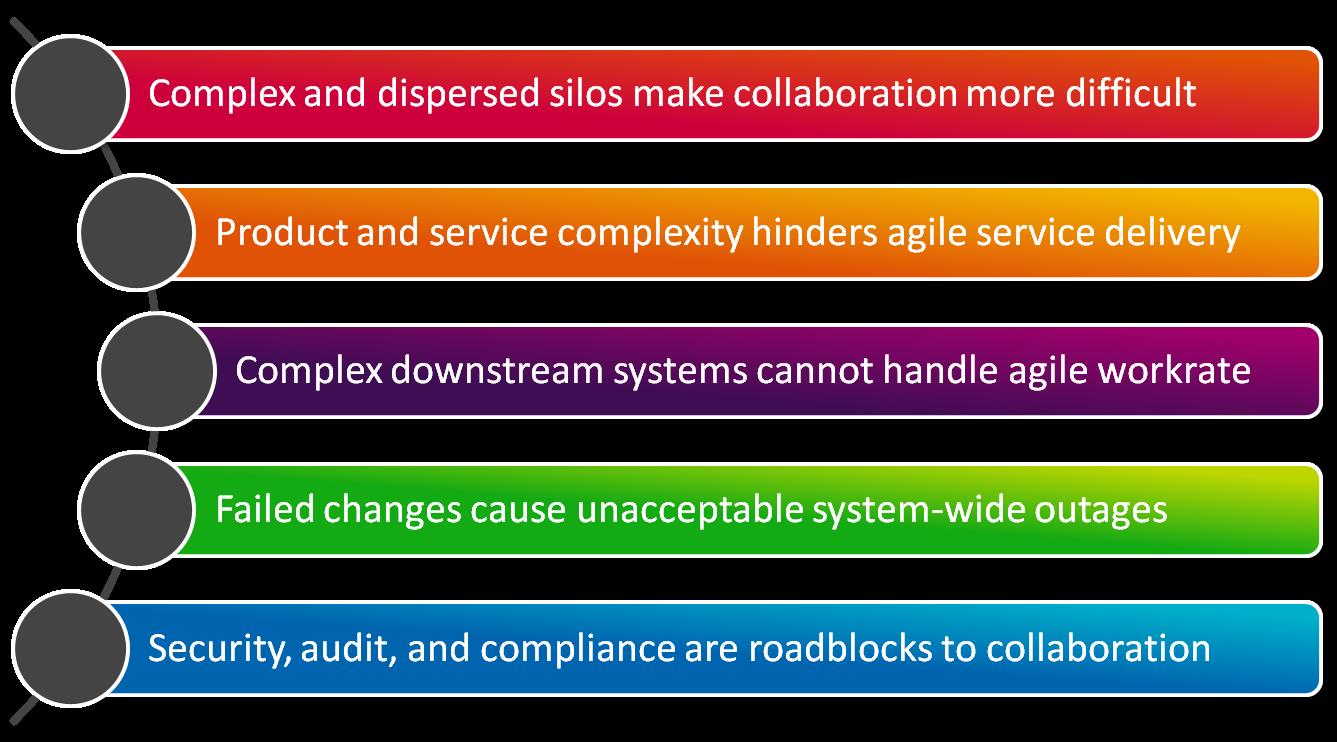
    The top five issues I chose to address are below:

    TopFiveIssuesDevops

    My five ‘Big DevOps’ tips for overcoming these issues center mainly on cultural change, because DevOps is primarily a cultural and attitudinal shift. However, it is also undoubtedly true that certain technologies can play a large part in enabling that change, especially in the more complex world of larger enterprises.

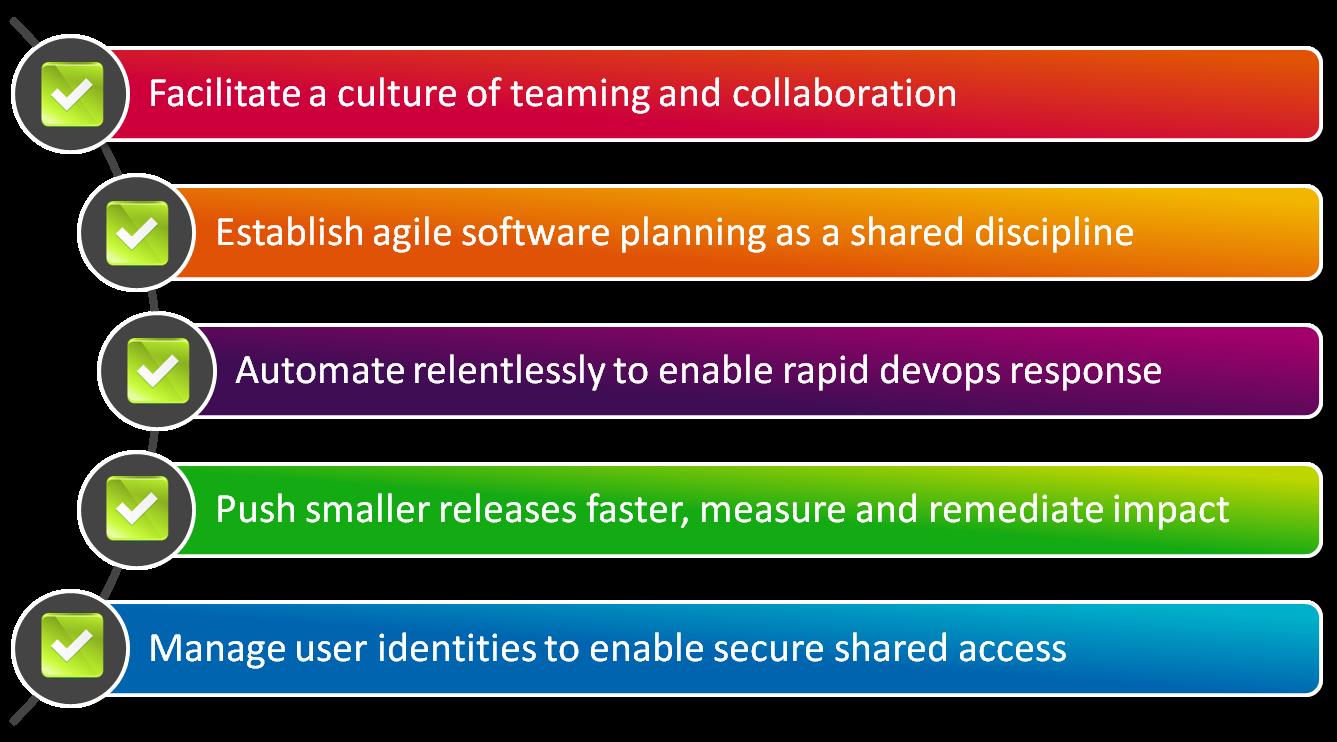
    With that in mind, my top five tips to address these challenges are as follows:

    FiveAnswersDevOps

    • Facilitate a culture of teaming and collaboration – this is at the core of devops in any environment, large or small, but especially for large organizations with bright lines between teams, this is essential to overcoming the tyranny of complex and dispersed silos
    • Establish agile development as a shared discipline – agile development is brings code to market faster, but can result in just filling the clogged pipes of PMO, HR, training, security, and other departments faster. ‘Agile’ needs to be common throughout the SDLC – in dev, ops, and beyond
    • Automate relentlessly to enable rapid devops response – automation allows faster execution throughout the system, enabling downstream processes to keep up with speed of DevOps. Automation also adds audit and governance, especially important to larger organizations
    • Push smaller releases faster, measure and remediate impact – large organizations especially are can avoid big errors by avoiding big releases. Adopt faster, smaller cycles with closer scrutiny to achieve a DevOps approach while managing the risk of faster cycles and fewer controls
    • Manage user identities to enable shared access – in smaller organizations it might be acceptable to give out root access like candy, but not for large enterprises. Identity and access management can enable a new DevOps approach that is safe, secure, auditable, and well-governed

    While these tips may not be the perfect answer for every organization, I have seen how these approaches have made the journey to DevOps easier, safer, and more effective for big enterprises. I hope they help you on your journey.

    If so, you will want to stay tuned to staging-devopsy.kinsta.cloud. Since starting work on Enterprise DevOps concepts, I have collected many questions on how large organizations can best succeed in their DevOps transformation. I will be sharing these questions along with my answers here on staging-devopsy.kinsta.cloud in a regular series, to give everyone the chance to understand how large enterprises can overcome the challenges of adopting DevOps at scale.

    So keep your eyes out for my posts over the coming days, weeks, and months in the brand new occasional series, ‘Enterprise DevOps Q&A’. I hope you will keep reading, and maybe even help me out by discussing your experiences and ideas in the comments below.

    Finally if you have any questions about Big DevOps, Enterprise DevOps, or anything to do with adopting a DevOps approach at scale, let me know in the comments below too. I would love to hear from you, and answer your questions if I can, or source guest opinions from the DevOps community.

    Meanwhile, please stay tuned for more Enterprise DevOps Q&A. I am excited to continue the discussion on what it takes to transform application delivery at scale.

  • ChatOps: Communicating at the speed of DevOps

    ChatOps: Communicating at the speed of DevOps

    DevOps is about knocking down barriers between developers and operations teams, and in doing so reducing organizational frictions wherever possible. And that’s certainly the spirit behind ChatOps – the term for the hyper-collaborative way of running DevOps, including operating aspects of systems and infrastructure, through online chat.

    Proponents of ChatOps say it streamlines communication in a centralized and powerful way. Born within Github, ChatOps evolved from its open source chat bot, Hubot, which has changed the way the web-based Git repository runs operations through the automation of deployment, graphing, monitoring, provisioning, and even mitigating security events.

    Think of Hubot, a Node.js app that is commonly run on Heroku, as a robot that helps keep everyone informed in a centralized place and in real-time, or in a near real-time, way. There are many benefits to ChatOps, says David Mortman, David Mortman, contributing analyst at Securosis, including the integration of ops activities with notifications into one place, making it easier for everyone to know what’s going on across the enterprise, as well as everyone throughout the organization having the ability to see error messages on events as they occur, he says.

    Github, as a highly distributed organization, with its several hundred employees spread across 103 cities, can use all of the communication efficiencies it can muster. As Mark Imbriaco, Ops engineer at Github, in his presentation ChatOps, Augmented Reality for Ops, uses Github, email, internal apps, other web systems that they’ve built to help teams communicate asynchronously – and yet they needed an option for the real-time or “semi”-real time communication. “I say semi-real time because, when we talk about chat, the social contract at GitHub around chat doesn’t require you to be immediately responsive to everything you see. Chat is still asynchronous, but it’s more synchronous than GitHub or email or other sorts of notification mechanisms,” said Imbriaco.

    Without enhancement, Hubot doesn’t do a whole lot right away. But when added to chat with one of the dozen or so connectors that include access to Google Talk, IRC, Skype, and Hubot monitors for events that come from within chat or from one’s systems and applications. “The magic happens when you build additional functionality into him to automate, well, everything,” Imbriaco said.

    Hubot will do certain things, such as notify people not present in a chatroom that they were mentioned, phrases can be registered so that notifications to those interested in certain events will be notified. Github has also plugged Hubot into the GitHub service itself. Today, when anyone creates an issue or pull request in GitHub, according to Imbriaco, a link and definition of the event is sent to chat. While Github already has ways to send notifications, by entering events real-time into the chat stream, others can jump in and comment, help, or otherwise advise on events and interact as they’re occurring.

    As for the adoption of ChatOps, Github isn’t the only one: but it’s not yet widespread among DevOps practicing organizations, either, based on our reaching out to numerous organizations. Nor, is the concept especially well known.

    That’s not slowing Owen Zanzal a developer at systems management provider VividCortex down from adopting ChatOps. Zanzal says in his blog post, ChatOps at VividCortex, that, despite ChatOps being off to a slow rise, “ChatOps has really revolutionized how we operate,” he wrote.

    The first Hubot mission at VividCortex was to help improve how code is deployed. The problem Zanzal highlights is that encryption keys and new developers apprehension around code deployment, was slowing down production.

    To streamline deployment, Zanzal moved the execution of Capistrano commands to a Jenkins (a continuous integration server), and created Hubot commands so that jobs could be created using a Jenkins exposed REST API. When done, developers needed only run a chatroom command, such as “hubot stage webapp” or to deploy “hubot release webapp,” Zanzal explained. “Now, no one is blocked by the gatekeeper from pushing code into staging or production, and every developer can push code when they are ready. The unfamiliar Capistrano commands were simplified into much easier to understand Hubot commands,” he wrote.

    VividCortex is also using ChatOps to fetch logs and more quickly remediate issues as they arise, Zanal wrote.

    Chat-as-Ops
    GitHub has also pushed ChatOps much further than simply as a place to stage and deploy code. It’s using ChatOps as a way to help actually run ops. For instance, Imbriaco spoke to how Hubot and ChatOps is used for efforts such as rebalancing shards across its file servers. “Honestly, it took me a little while to get used to some of these. We have some [Hubot actions] that do things like rebalance shards across our file server. And that’s horrifying to me, because the consequences of failure are so bad. But the reality is, I’m either going to run it from a chat room, or I’m going to run a shell script from a terminal. If I ran it here, at least everyone saw it. So at the end of the day, this is repeatable, it’s tested, it’s commonly used,” Imbriaco said. “And if it stopped working we would notice,” he said.

    And one time when Github was fending off a distributed denial of service attack, Imbriaco needed only enter the name of their service provider to direct traffic and the attack was successfully mitigated.

    Moving to ChatOps isn’t without risk, however, Imbriaco explained. A lessoned learned when it became a little too easy to deploy to Amazon Web Services. “We went from zero to way too much spend on Amazon in about two weeks, when I turned up the ability for us to provision EC2 hosts from Chat,” he said. But that issue was resolved by giving users information at the time of provisioning, such as including metadata into the instance that details who created it, as well as informing users how much it’s likely to cost,” Imbriaco said.

    Despite the efficiencies of ChatOps, don’t expect a widespread embracing of ChatOps, but more likely a slow adoption. “GitHub is a flying unicorn. They’re like Netflix,” says Mortman. “People will pick up some of what they are doing but it’s too advanced for most,” he says.

  • Meet Infrastructure as Code

    Meet Infrastructure as Code

    Maybe you have already heard the terms “Programmable Infrastructure” and “Infrastructure as code”.  But even if you have not, if you are interested in DevOps it’s something you need to know.   Most new lingo causes me to roll my eyes.  But in this case, it’s not just new lingo, it’s an entirely new concept. Besides making the nerdy feel cool when they say it, these terms describe a new idea of what an application consists of. (more…)

  • An open letter to Jeff Knupp

    An open letter to Jeff Knupp

    Dear Jeff,

    First off, nice recovery. I commend your gesture to return to positivity and make what to my eyes, looks like a kind and altruistic offer to an underserved class of engineers. I personally sent your offer to all the female engineers on my team and got very good feedback from several of them.

    Some people will try to tear you down and criticize your offer to make a difference in the lives of female engineers as patronizing or sly self promotion, but I take you at your word and applaud your offer as both poised and graceful.

    Given your offer to one underserved population in IT, I thought you would be OK with some constructive feedback from one dev guy concerned with the welfare of IT workers to another and hope you take this feedback as it is intended, with the same eye towards a desire to be a force for positive change to the plight of all IT workers, everywhere. Please remember that this is just my perspective. I could be wrong, and often am. So, here goes:

    DevOps does not mean everyone has to do everything

    DevOps is not just for startups.

    I work in a big shop and we have all the sorts of disciplines you call out in your posting on how DevOps is killing the developer. We are also embracing the DevOps movement not to force anyone to take on roles they aren’t optimized for, but rather to inspire them to expand the boundaries they have set for themselves and others in an effort to make things better for everyone.

    We want QA professionals to know how to script and automate tests. This is good.

    We want operations staff to know how to script and automate changes. This is good.

    We want release managers who know how to triage problems, automate configuration management and instrument the throughput of the IT machine. This is good.

    We want developers and architects who know how to go deep when required to help solve performance problems. This is good.

    You may disagree and I respect your right to do so. I just am not that interested in hiring an IT professional of any type who says “That ain’t my job”. That’s not a guy or gal who gets things done or makes things better.

    I’m not saying that everyone has to be able to do every role or even that developers must branch out. I am saying that making others wrong for increasing their value prop is not likely to do anyone any good.

    Injustice anywhere is a threat to justice everywhere

    Using narratives of which type of IT worker is more important than another type of IT worker does us all harm. All of us. All men. All women. All IT workers. All Developers. All operations staff. All employees from any department of any company no matter the size.

    Now, I realize that this is a bold statement (even from the guy who wrote “Sharepoint is Crack and Microsoft is the Pusher”), and I have no problem admitting that you probably have no desire to harm any employee anywhere (Except for the guy or girl who invented IVRs. I can understand wanting to do bodily harm to whoever did that). I would ask that you consider a few ideas before writing me off as a troll.

    1) The schism upstream is the enemy to be fought, not the people downstream from you

    You may not be aware of the schism to which I refer, but I would argue that you are probably very familiar with it’s effects. The deep and distrusting divide that exists between enterprise IT and the customers of enterprise IT across the industry is the single most destructive and demoralizing artifact in the lives of IT employees everywhere.

    Have you ever worked in a shop where IT employees are casually referred to as “technical” while marketing, product and design employees are referred to as “creative”. Have you ever been exposed to a shop where the developers were treated and talked about like they were worker insects who’s job it was to keep their mouths shut and code what they’ve been told to?

    If you have somehow managed to have an IT career and avoided exposure to this phenomena that seems to pervade so many (but not all) IT shops around the world, I would ask you to pull back and reflect for minute. Spend some time and have some gratitude for the fact that you have not been either witness to, or been the subject of the message: “we are the so and so team and you are not on our team so you have no say IT boy, go back to your nerd closet and build what I tell you to build”.

    If you are familiar with this idea that robs developers everywhere of the right to claim their creativity and basic need for self realization through recognized craft, then I ask you this: Aren’t you all sick and tired of the completely loathsome ideas that we are not “creative” because we are IT? Doesn’t that make you want to throw up? Don’t you want to go postal when you hear people push developers down the collectively agreed to illusion, referred to by you as the “totem pole”, that creates a veritable corporate caste system?

    I would run out of my word limit if I were to try and cite the publications that point out that silos are the prime roadblock to unlocking business potential, but I will point you to a few modern classics which make the case much better than I ever could:

    • The Advantage: Why Organizational Health Trumps Everything Else In Business by Patrick Lencioni, best known for The Five Dysfunctions of a Team: A Leadership Fable
    • Silos, Politics and Turf Wars: A Leadership Fable About Destroying the Barriers That Turn Colleagues Into Competitors also  by Lencioni
    • Orbiting the Giant Hairball: A Corporate Fool’s Guide to Surviving with Grace by Gordon MacKenzie

    This isn’t just about IT workers. This is about every employee everywhere who has their role demeaned and belittled by another. There are three basic roles inside of most companies in the products and services business. Sell the work, do the work, support the work. One thing in common to them all is that if any of the three roles don’t get done well, then everyone is at risk of not being paid.

    We are all necessary and none of us is sufficient at any real corporate scale. The moment we allow division (i.e. the totem pole) between ourselves, we have ceded the ground that other people upstream from us or up the hierarchy from us have the right to demean whomever they want to.

    You can’t possibly eliminate injustice via injustice

    2) The schism will always exist if we reinforce it

    Being of service to another is an honor and all who claim to want to improve the lives of workers anywhere, should hold themselves accountable to not belittle the contributions of others.

    Every single employee has the potential to be innovative and creative in their work. We constantly create and reinforce the concept of commodity items and jobs and then are paradoxically shocked and surprised by:

    • how the unmotivated and unengaged masses of people in jobs frustrate us with their lack of passion for doing a job well
    • how new people constantly create a “new and improved” version of something perceived to be commoditized forever and then dominate the market because they believed it was possible to reinvent a new level of quality

    Innovation is not a department. Creative is not a department. Aren’t you all sick and tired of narratives of ownership and control from other teams who claim to own these abstract qualities when they are delivered at you?

    When we the development community adopt the same basic ideas, we allow it to continue.

    If you want to world to be different, than you must have the courage to be willing to be one of the first ones who fully live in that new different world.

    What world are you working towards?

    3) How will you know your ideas and contributions are better if you set up barriers that make it harder for others to contribute?

    I am privileged to lead one of the best dev teams in the world. I am privileged to work in a shop that is committed to breaking down the barriers to collaboration and cross-pollinating innovation. To keep us all all at our best, we have to be brave enough to say that our dev team and our creations can more than likely withstand any criticism or contribution from any team up or down stream and if they don’t because some other idea was better, so be it.

    I won’t take the cheap and easy shot and ask “Are you afraid that the outside idea is better and that you will seem weak for having a lesser idea?”, because I doubt that this is true. I honestly think this kind of resistance has roots in the human condition itself. It probably has more to do with fear of the clock running out or the possibility of lesser ideas winning the day than of fear of being shown either as “weak” or “not as smart”. With these dreadful possibilities in mind, I would ask you consider this: The way to maximize the likelihood of these undesirable outcomes is by allowing others to say we are closed off to outside ideas. This is what leads to goat-rodeos, witch hunts and ultimately those with more authority than we have removing the little authority and control we actually have.

    Let the best ideas win, not the ones made by those with the authority backed up by a title.

    If you truly are looking for the best and most game changing ideas to help your enterprise, be aware that the richest source of these ideas will inevitably come from people who’s blinders have not been firmly affixed by the discipline they are embedded in. This is a widely accepted historical truth laid out by Thomas Kuhn in the timeless masterpiece The Structure of Scientific Revolutions and if you doubt me, remember that Albert Einstein was a patent clerk when he gave humanity the theory of relativity.

    I’m not trying to make you out to be a bad guy or anything close to one. In fact I praise you for having the guts to articulate a fairly controversial point of view that you believe in.

    When I write this letter, I’m not fighting for or against DevOps in particular (even though I am DevOps fan). I’m fighting for the end to the schism between Business and IT.

    I’m fighting for the end of narratives of control and authority.

    I’m fighting for the end of the un-empowering messages that authority gives to individuals every day.

    If you want to know why enterprise IT employees everywhere are asked questions from their business partners that display lack of trust over and over and over; This is why…because the schism exists.

    If you want to know why enterprise IT can’t complete things it starts; This is why…because the schism exists.

    If you want a world where people trust IT employees expertise and allow IT shops to complete work without questions of minutia that spawn from lack of trust, we must not embody what we oppose – narratives of authority and ownership combined with an “us vs them” mentality.

    I don’t say any of this to scold you Jeff. I say this as an attempt to call upon you to join us . Help us tear down the walls. We need more help. We need you.

    Respectfully,

    Stephen Fishman – Creative IT Professional

  • Automation versus Orchestration

    Automation versus Orchestration

    Yes, Virginia, there is a difference.

    One of the things devops practitioners are tasked with is the provisioning and configuration of all sorts of infrastructure.  Application servers, web servers, load balancers, proxies and database servers are among the lengthy (and no doubt growing) list of “boxes” devops needs to get up and running to support just about any given application today. One of the key value propositions of a devops approach to operations is that it can reduce the time it takes to get applications to market by getting them up and running in production faster. That’s increasingly important as we move into the Era of Things, driven by extreme connectivity of everything, because all those “things” need are going to need to be talking to applications on the back side.

    So speed is of the essence, but not at the cost of accuracy. We’re encouraged, then, to automate tasks and orchestrate processes to achieve that speed. The side effect of codification of tasks is higher accuracy (aka fewer mistakes).

    So far so good.

    But you may notice that I have (and will continue to) clearly delineate between “automate” and “orchestrate”, between “task” and “process”.

    The reason for that is that, simply, they are not the same thing. We should strive not to confuse these two because while the two share some benefits, there are other benefits that are achievable only by one or the other – or the combination thereof.

    Process optimization, for example, can’t be achieved by simple automation. Automation is concerned with a single task – launching a web server, configuring a web server, stopping a service. Orchestration, however, is concerned with automating, if you will, the execution of a workflow – of a process. A provisioning process may be comprised of multiple tasks and involve multiple systems. An “application” is not just a single server, after all, it’s likely several servers – web, app and database in a traditional three-tier architecture.

    The goal of orchestration is not just to automatically execute a service, which brings speed to the deployment process and gets applications into production faster. It also affords an opportunity to streamline – to optimize – those processes for even greater gains in deployment velocity.

    One of the simplest ways to optimize a process is to eliminate repetitive steps. This entry on Vagrant explains it fairly well :

    “We could just SSH in and install a webserver and be on our way, but then every person who used Vagrant would have to do the same thing. Instead, Vagrant has built-in support for automated provisioning. Using this feature, Vagrant will automatically install software when you vagrant up so that the guest machine can be repeatably created and ready-to-use.” [emphasis mine]

    — Vagrant Docs “Getting Started | Provisioning”

    Now certainly the step of installing a web server on a new box with vagrant is hardly all that time consuming, it’s just a single line of text. But every line of text must be manually typed, and that introduces the possibility of fat fingering the command, which either consumes time in fixing it or introduces an error into the system. Neither are desirable results.

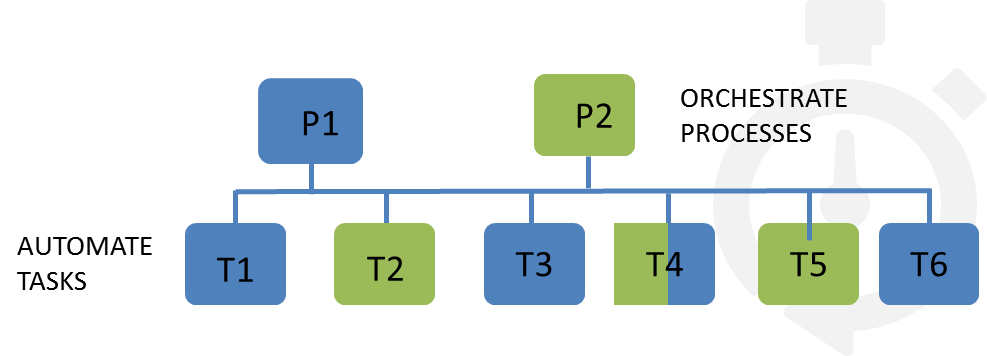
    automate-orchestrate

    Ensuring that the process is repeatable and orchestrated by automating all the tasks that comprise that process an optimize it by eliminating redundancy. That results in greater deployment velocity.

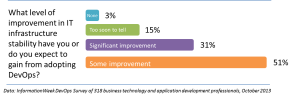
    Recognizing that processes should be comprised of composable tasks offers a higher degree of reuse across operations. The task of provisioning and configuration a web server with the appropriate base software means consistency, aka standardization, across all applications. Processes that take advantage of standardization result in greater infrastructure stability, another benefit often cited by organizations that have adopted a devops approach to operations.

    iweek-devops-stability

    The key here is to recognize the difference between automation and orchestration and how they relate to one another. Automation is about codifying tasks and orchestration is about codifying processes. Orchestration takes advantage of automation by reusing these basic building blocks.

    There is a difference, and done right, the two play off one another to result in streamlined, more accurate execution of operational processes that speed up successful application deployments.

  • DevOps Needs a Tsunami To Jump The Chasm

    DevOps Needs a Tsunami To Jump The Chasm

    All start up business endeavors must go through the phase of crossing the chasm.  Most of those business endeavors usually fall prey to the chasm. The chasm is this black hole that everyone claims to understand but no one truly does. We have all seen businesses cross the chasm or fail to cross the chasm and fall into the black hole. But no one seems to understand why and how that crossing happens. The bestselling book by Geoffrey A. Moore titled “Crossing the Chasm,” is all about the heart and soul required to get early stage technology across the chasm, from early adopters to mainstream customers.

    There is a big difference between people who are enthusiastic to try leading edge technologies and the rest of the inhabitants, who tend to be much more conservative. The reasons that people spend time trying to figure out how to cross or jump, if you will, the chasm is because that black hole is what stands between them and making their fortune. The early adopters are just a small sample of the market and there is no money in building a business or technology around them. To make real money, you need to cross over into the mainstream.

    In Geoff’s model, the innovators are all about technology.  You know those people, when a new iphone is released, they spend days standing on line to get latest and greatest new technology.  The early adopters are the visionaries that are always on the bleeding edge. The mainstream are the pragmatists, the people who practice risk avoidance. These pragmatists are the key to jumping the black hole, they move the needle.

    DevOps first order of business was getting on the curve and to that end DevOps has evangelists. But, understand that what worked in converting these early adopters probably won’t work for the pragmatists. These DevOps evangelists and visionaries want DevOps power tools, as opposed to the pragmatists who simply want to push the button and say “that was easy”.

    By all appearances DevOps has been accepted by the early adoption set. Just how does DevOps cross the chasm? Jumping the black hole after all can be quite a daunting task. To do so DevOps has to create what I refer to as the tsunami effect.

    The Tsunami effect is where DevOps gains acceptance in multiple industries or markets in what seems like a gold rush, it’s here that fortunes are made. More accurately, it’s where cult communities transform overnight into mainstream communities.  Many technologies simply create a single tornado which remains in a silo forever never gaining enough momentum to really emerge. Another common path what I call an earthquake, there is a lot of hype but it tends to fizzle out quickly, if not tended to properly. Right now DevOps has all the appearances of an earthquake, Devops evangelists have created a lot of buzz, but acceptance beyond a set of power tools is still a huge question.

    Considering DevOps is in the earthquake phase, as opposed to the tornado phase, DevOps cannot be successful converting one group at a time. The strategy in the tornado phase is convert industries and markets one at a time, via tornados forming within industries or markets. The tactical execution is to get smaller industries or markets committed and therefore the larger industries or markets will then embrace the movement. That is simply crossing the chasm. DevOps has too many cultural implications to convert believers over a long period of time; DevOps requires reorganization, not a subtle shift.

    Since I consider DevOps to be in the earthquake phase, crossing the chasm is not an option. DevOps must jump the chasm in a surge of overwhelming momentum, hence creating a tsunami. DevOps has created a very closely knit culture, DevOps needs to push hard to create a tsunami and flood the pragmatic population. But, be advised, DevOps has to be all but universally accepted, there is no almost in bringing together Dev and Ops. But if DevOps wins, it wins big, DevOps will go from being a niche culture to a truly mainstream practice.

    So what’s the strategy to create a tsunami? And more importantly, how do you move beyond the earthquake phase? Here’s how I see it according to Geoff, with my DevOps spin: First, DevOps must clearly establish that the mission-critical software development process is broken and is causing management enough pain that it would gamble on unproven methodology that is populated with a bunch of prima donnas. I am not convinced the DevOps cult has clearly established this as fact. Is the development and operations process broken or have just new power tools been created to improve speed and accuracy? Second, DevOps needs to present the total solution, not just tools. Overwhelm the community; each new DevOps tool should leverage the success and technology of the last hence creating a methodology. Even more importantly, because the DevOps tools are closely related, credibility can cross industries and markets and create the momentum required for a tsunami.  Once Devops has reached critical mass by providing the total solution in a few industries or markets simultaneously the tsunami is created and DevOps has jumped the chasm.

    The tsunami will emerge suddenly with everyone seeming to adopt DevOps all at once.  This will result in explosive growth and will pull, willingly or unwillingly, everyone into its path. It’s driven and sustained by the pragmatists.  Here, everybody has to get the latest thing all at once; the masses have been converted to DevOps. DevOps needs mass-market success, DevOps needs to become a tsunami and everyone will want to play DevOps.

    Now that you know the formula, go forward and create the perfect storm.

    If you would like to say something; email parker@devops.com and don’t forget to comment here.