Tag: devops

  • Red Hat Brings DevOps to the Network with New Ansible Capabilities

    Red Hat extends Ansible’s agentless automation framework to network infrastructure devices; At launch, Ansible supports devices from Arista, Cisco, Juniper, and more

    RALEIGH, N.C.–(BUSINESS WIRE)–Red Hat, Inc. (NYSE: RHT), the world’s leading provider of open source solutions, today announced that it is bringing DevOps to networking by extending Ansible – its powerful IT automation and DevOps platform – to include native agentless support for automating heterogeneous network infrastructure devices using the same simple human and machine readable automation language that Ansible provides to IT teams. With expanded Ansible networking capabilities, Red Hat is aiming to help customers orchestrate entire application infrastructures, including network devices, with one automation tool.

    The 2015 “SDx Cloud Management Report: OpenStack and More,” highlighted the results of a recent survey on cloud architectures and platforms, stating, “When asked what they felt was the most immature component in cloud management, the overwhelming response was the network at 76%.” By including network devices as part of the overall architecture of Ansible, Red Hat customers can benefit from increased IT agility through operational efficiency, bridging the traditional divide between IT operations and networking teams, and advancing agility and modernization efforts.

    Using Ansible’s simple, powerful, and agentless approach, organizations will have the ability to unify operational methodologies across their IT infrastructure in a new way – by orchestrating compute, applications, virtualization, and now, networking. This approach offers many customer benefits, including:

    • For network teams looking to apply more agile DevOps methodologies to network infrastructures, Ansible can enhance their ability to build and operate heterogeneous network devices, freeing them up to focus on evolving the network to meet the changing business needs instead of manually pushing network configuration.
    • For systems and applications teams that wish to include network devices in a holistic approach to application workload management, Ansible’s native network device support enables them to extend their DevOps tools and practices to heterogeneous network devices.
    • For executives and senior management concerned about their organization’s ability to automate and orchestrate solutions in an increasingly complex IT environment, Ansible provides a framework that integrates diverse network devices without introducing vertically integrated, vendor specific applications and operational methodologies.

    At launch, Red Hat’s Ansible networking framework provides support for:

    • Arista Networks – Arista EOS;
    • Cisco Systems – Cisco Application Centric Infrastructure (ACI); Cisco IOS-XE®; Cisco IOS-XR®; and Cisco NX-OS;
    • Cumulus Networks – Cumulus Linux;
    • OpenSwitch.net – OpenSwitch; and
    • Juniper Networks – Junos OS.

    Availability

    Support for automating network infrastructure devices in Ansible is available immediately.

    Supporting Quotes

    Todd Barr, general manager, Ansible, Red Hat

    “Today’s networks are complicated, and largely comprised of multi-vendor solutions, making them rather inflexible and slow to react to business changes. Bringing a DevOps mindset and approach to the network gives customers the ability to make network operations a repeatable, more predictable, and automated process. By bringing the power of Ansible, the popular open source IT automation solution, to the network, we’re giving customers the ability to solve their complicated networking automation and workflow problems in a new way.”

    Jay Lyman, research manager, Cloud Management and Containers, 451Research

    “The cloud and automation offer a significant opportunity to evolve and advance the network, bringing together once disparate technologies and teams. Through Ansible’s new networking automation capabilities, Red Hat is bringing the benefits of DevOps to a new area of IT, and aiming to help customers do a better job with their networks.”

    Joe Hielscher, director of Business Development and Alliances, Arista Networks

    “Red Hat and Arista share a goal of enabling joint customers to focus on improving their businesses, rather than learning complex proprietary tools. Arista EOS and CloudVision, combined with Ansible by Red Hat, deliver standards based tools for datacenter administrators, enabling enhanced operational efficiency and application of DevOps methodologies for cloud networking.”

    Mike Cohen, director of product management, Cisco

    “The trends of cloud, big data, and microservices demand ever increasing speed, scale, and flexibility in network infrastructure. By building on Cisco’s open software architecture and open APIs at the core of our IOS-XE, NX-OS and ACI platforms, Ansible offers our customers an extremely powerful IT automation tool to pave the way for adopting the DevOps model.”

    Brian Ortbals, vice president, Advanced Technology, World Wide Technology (WWT)

    “Ansible is an integral part of World Wide Technology’s network automation strategy. Network automation and programmability using Ansible is a key component of the training curriculum of WWT professional services Cisco ACI deployment engineers. WWT has developed a solution using Ansible to consistently and efficiently configure Nexus 9000 series switches to customer specifications in our Integration Technology Center (ITC). This announcement further solidifies the relationship between WWT and Red Hat to help realize the operational efficiency of #netdevops for our customers.”

    Additional Resources

    Connect with Red Hat

    About Red Hat, Inc.

    Red Hat is the world’s leading provider of open source software solutions, using a community-powered approach to reliable and high-performing cloud, Linux, middleware, storage and virtualization technologies. Red Hat also offers award-winning support, training, and consulting services. As the connective hub in a global network of enterprises, partners, and open source communities, Red Hat helps create relevant, innovative technologies that liberate resources for growth and prepare customers for the future of IT. Learn more athttp://www.redhat.com.

    Forward-Looking Statements

    Certain statements contained in this press release may constitute “forward-looking statements” within the meaning of the Private Securities Litigation Reform Act of 1995. Forward-looking statements provide current expectations of future events based on certain assumptions and include any statement that does not directly relate to any historical or current fact. Actual results may differ materially from those indicated by such forward-looking statements as a result of various important factors, including: risks related to the ability of the Company to compete effectively; the ability to deliver and stimulate demand for new products and technological innovations on a timely basis; delays or reductions in information technology spending; the effects of industry consolidation; the integration of acquisitions and the ability to market successfully acquired technologies and products; uncertainty and adverse results in litigation and related settlements; the inability to adequately protect Company intellectual property and the potential for infringement or breach of license claims of or relating to third party intellectual property; risks related to data and information security vulnerabilities; ineffective management of, and control over, the Company’s growth and international operations; fluctuations in exchange rates; and changes in and a dependence on key personnel, as well as other factors contained in our most recent Quarterly Report on Form 10-Q (copies of which may be accessed through the Securities and Exchange Commission’s website at http://www.sec.gov), including those found therein under the captions “Risk Factors” and “Management’s Discussion and Analysis of Financial Condition and Results of Operations”. In addition to these factors, actual future performance, outcomes, and results may differ materially because of more general factors including (without limitation) general industry and market conditions and growth rates, economic and political conditions, governmental and public policy changes and the impact of natural disasters such as earthquakes and floods. The forward-looking statements included in this press release represent the Company’s views as of the date of this press release and these views could change. However, while the Company may elect to update these forward-looking statements at some point in the future, the Company specifically disclaims any obligation to do so. These forward-looking statements should not be relied upon as representing the Company’s views as of any date subsequent to the date of this press release.

    Red Hat, Ansible and Shadowman logo are trademarks or registered trademarks of Red Hat, Inc. or its subsidiaries in the U.S. and other countries. Linux® is the registered trademark of Linus Torvalds in the U.S. and other countries.

    Contacts

    Red Hat, Inc.
    Anna Eusebio, +1-919-754-4519
    aeusebio@redhat.com

  • Designing A DevOps Strategy: A Balanced Scorecard Framework

    Designing A DevOps Strategy: A Balanced Scorecard Framework

    Despite all the hype about DevOps, little has been written on a formal DevOps strategy. Too often DevOps initiatives starts with tooling discussion and gets stalled in technology. The larger vision is rarely discussed. The goal of this article is to provide enterprises, large and small, with a framework for creating that vision and unlocking the promise of DevOps.

    Elements of a DevOps Strategy

    A holistic DevOps strategy, at the most basic level, must answer the following questions:

    • Where should we focus our efforts? Where do we begin?
    • What are we trying to solve?
    • What is our goal? How are we going to solve it? How long will it take?
    • How is this going to impact the larger enterprise? Who are our stakeholders and what do they value?
    • Is this worth doing it? What are the benefits and costs?

    If implemented correctly a good strategy provides an organization with focus, creates a common (unbiased) view of the current problems, develops the future state, unveils opportunities for growth and results in better business outputs.

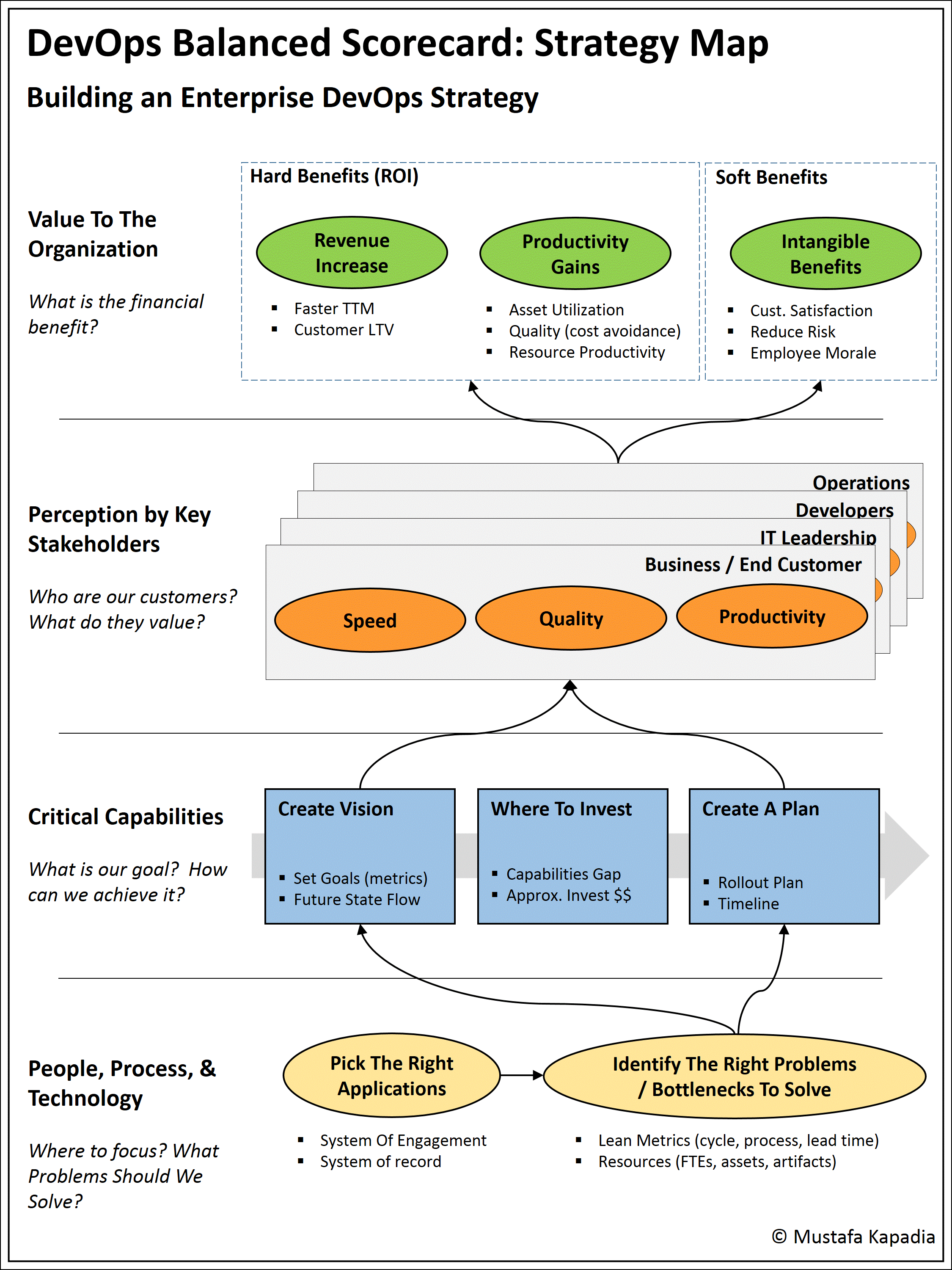
    DevOps Strategy Map: A Balanced Scorecard Framework

    A Balanced Scorecard typically consists of four high-level perspectives that highlight key practices and objectives that are needed to build a strategy. We choose this framework primarily because it does three things really well. First, it provides a disciplined approach towards creating a strategy. Second, it links the key activities together and describes the cause and effect between them. And third (and most important), its easy to use and follow.

    A scorecard is usually read from the bottom up. Enclosed below is a Balanced Scorecard modified for DevOps.

    DevOps Strategy Map
    DevOps Strategy Map

    1. People, Process & Technology

    In DevOps we have the luxury of plenty: an abundance of applications, technologies, competing initiatives, bottlenecks, nebulous problems, tools, etc. The objective of this dimension is to narrow down the application options (system of record vs. system of engagement) and target the problems that really matter (value stream mapping exercise). By doing so, we bring clarity and focus to the organization and greatly improve the chances of success.

    2. Critical Capabilities

    The next step consists of three activities – create a vision (which includes a future state value stream), determine where to invest, and build an implementation plan. Three things to keep in mind as you go about doing this exercise. First, pick hard targets for your vision. Instead of “improve speed” try to get to “improve speed by 25 percent”. Second, pay particular attention to capabilities gaps. Gaps can then be used to determine areas of investment, approximate budget, and a key input into your ROI model. Third, make sure to prioritize the bottlenecks. Putting the priority list on a timeline can be quickly translated into an implementation plan.

    3. Perception by Key Stakeholders

    Identifying your key stakeholders, determining their priorities, and aligning your strategy accordingly is the next crucial step. Some of the key stakeholders to consider are business/end customer, CIO and the IT leadership, development, operations and security. Once identified, match the value drivers from the vision to each stakeholder. This along with the output from the previous section will highlight pitfalls of your future state solution, its feasibility, and political objections.

    4. Value to the Organization

    The financial benefits section serves as the keystone for the balanced scorecard. By using output from the previous sections the business case brings the entire strategy together. As for the benefits themselves, they come in both hard and soft forms. The most common benefits we see are listed in the chart above. To get to ROI, combine the hard benefits with the investments from the previous section.

    One Last Thing

    The strategy map is meant to be iterative—the great thing about a DevOps solution is that it is not a “one size fits all” approach. Play around with all of the above steps. Move things around, change scope, update solutions and redefine vision until you come up with an objective that is both transformative and achievable for your organization.

    DevOps is a journey that’s two steps forward and one step back. Good luck!!

    Special thanks to Sunil Joshi and Emily Pence for helping create the Strategy Map. To find out more on how to use this map, joins us at IBM Interconnect.

    About The Author/Mustafa Kapadia

    Mustafa-KapadiaMustafa Kapadia is the Service Line Leader for IBM’s DevOps practice, a business advisory practice focused on helping large enterprises transform their software & application delivery. He has over 17+ years of experience in the tech. space, both as a service provider and a management consultant.

    Prior to joining IBM, Mustafa was a management consultant with Deloitte’s Strategy & Operations practice. He lives in San Francisco Bay Area, is an avid blogger (when time permitting), a speaker, and adviser to start ups.

    Connect with Mustafa LinkedIn | Twitter

  • New Context Pioneers Concept of Lean Security with Book Debut

    SAN FRANCISCO–(Business Wire)–New Context Services, Inc., the leading provider of Lean Security for software and infrastructure development, today announced the forthcoming publication of the book “Lean Security” by New Context CEO, Daniel Riedel, and New Context vice president of security services, Andrew Storms.

    Lean Security applies the “lean” management concept to the world of cybersecurity. New Context has now implemented Lean Security practices and processes with its clients in the United States and abroad, and its experiences with these implementations inform the book’s subject matter and takeaways.

    “The ‘lean’ concept has proved incredibly effective for organizations from manufacturing facilities to startups,” said Riedel. “When these principles are harnessed for security, the result is a cohesive environment that ensures continued innovation within a secure framework. Considering that cyberattacks will never cease to exist, this is the only viable model for the future.”

    Storms added: “It’s been a long-standing misconception that it is nearly impossible for a company’s software development team to meet the trifecta of being able to push code to production faster, develop more secure code and still reduce costs within the software development lifecycle. Our Lean Security practices buck that notion and are proving to be an effective model for our clients to meet their strategic goals.”

    The book is co-authored by longtime security journalist Ericka Chickowski and will be published later this year. Available via www.leansecurity.com, it will explore the five principles of Lean Security, which include:

    • Environmental Awareness: In order to adopt Lean Security principles, everyone – from engineers to architects, line-of-business managers to the C-suite – must keep IT security considerations in mind throughout the entire development lifecycle.
    • Automate or Die: Just as with DevOps, automation is the keystone to Lean Security. In order to establish a continuous delivery pipeline, organizations must develop an entire automated tool chain to push bite-sized pieces of code to production through automated integration, test and deployment. Automated security testing and approval processes must be built into this tool chain to achieve Lean Security.
    • Measure Everything: Feedback is crucial for developing quality applications and eliminating waste from the engineering process. As a result, developers, security teams and operations personnel need to be able to measure application and related infrastructure performance on a continuous basis in order to constantly improve the application accordingly.
    • Simplify Engineering: Complexity is the enemy in development. It makes code messier, more expensive and less secure. The goal of Lean Security is to simplify engineering through more savvy use of third-party components and less frequent reinvention of the wheel.
    • Lean Security Is Not Invisible Security: Security should never be opaque to the user. Users are increasingly aware of security risks today, and it is incumbent upon engineers to show them that security measures are baked into their software.

    “If we shift software engineers’ thinking to focus on building security deep into their developmental practices, then we stand a better chance of maintaining operational resiliency when we run,” said Craig Rosen, CSO of FireEye. “I’m excited about Lean Security because it is a model that creates a sustainable environment where engineers, product and finance people can cultivate innovation together amid an increasingly turbulent and dangerous threat landscape.”

    Doug Rhoades, director of information security at Sempra Energy, added: “As someone who understands how Andrew and Daniel work and build infrastructure, I’m excited to see them push Lean Security against the current status quo. Cybersecurity is one of the biggest challenges facing critical infrastructure, and it’s key that everyone involved in the development process is included and that it is automated into the business infrastructure. Lean Security does both.”

    New Context currently provides Lean Security consulting and services to financial services, energy, infrastructure protection and healthcare organizations. Its partners include thrv, Apigee and Delphix, among others.

    About New Context

    New Context delivers Lean Security™ through hands-on technical and management consulting. We are a team of experts with extensive backgrounds in information security and scalable, secure application development. Our tools and processes streamline development frameworks to ensure transparent and secure IT software development within DevOps processes. New Context is headquartered in San Francisco.

    Web | http://www.newcontext.com/
    Twitter | @newcontext
    LinkedIn | New Context

    for New Context
    Brenda Patterson, 440-623-9581
    brenda@shevrushpr.com

  • Shouldn’t DBAs Be Part of the DevOps Inner Circle?

    Shouldn’t DBAs Be Part of the DevOps Inner Circle?

    DevOps is changing the culture of IT.  This movement is bringing application development and operations teams to the same table and the same time, working to understand and overcome the challenges facing the entire application delivery process—not just their piece. Development and operations teams are forging new bonds and alliances in the spirit of accelerating software release cycles.

    However, while quickness to market is paramount to success, businesses can’t forget about the internal implications of accelerated release cycles. With that in mind, there is one conspicuously empty seat within the “DevOps Inner Circle,” and that’s the database administrator’s (DBA).

    DBAs hold the keys to one of businesses’ most important assets: the database. But database change innovation has not kept pace with agile development methodologies and DevOps tooling that enable continuous delivery of software updates and changes. The vast majority of enterprises are still updating databases the same way they have been for the better part of the last three decades: through manual script review, validation, execution and individual heroics. As a result, application release cycles ultimately slow down at the last mile—the database.

    It’s time for a better approach. It’s time databases and their stewards, DBAs, be part of the DevOps Inner Circle. Including DBAs can create better, more efficient teams; save time and money; and even help companies create better solutions for their customers’ needs or their own.

    Shattering Silos

    One of the founding principles behind DevOps is the breakdown of silos between development and operations teams. Product managers can easily translate customer needs and communicate that feedback to developers in a way they understand—using epics and themes, for example. This helps bring everyone on the same page so that application updates or changes can be quickly coded, tested and delivered. But before application updates can be released to users safely and effectively, they have to be translated into the changes that will update the database. This is where the DevOps breakdown occurs. DBAs often have to rely on manually intensive, timeworn, error-prone processes and tools to make sure the right changes are made to the database.

    By inviting DBAs into the DevOps Inner Circle, database updates that go against business policy and will ultimately lock the database or “break the build” (think inserting a new column with a default value when the row count exceeds a million) can be found faster and addressed by the development team well before that change reaches the database. Having DBAs involved in release cycles sooner can help ensure developers are coding with corporate compliance in mind, ultimately making changes to the database smoother while adhering to guidelines that DBAs have typically policed.

    There was a time when databases needed protection from changes made by creative problem-solving in development, but DBAs simply cannot stand against the deluge of changes necessitated by accelerated cycles. Inviting DBAs into the DevOps Inner Circle enables teams to consider the implications of new changes and updates across the entire technology stack. Breaking down silos and making teams more aware of catchpoints in the last mile of the release process lets them anticipate and avoid database issues—which means faster releases and fewer headaches for everyone.

    Saving Time (and Time is Money)

    Faster release cycles are good for business, and not just because they get applications in front of end users sooner. Continuous delivery cycles are designed to cut costs associated with application development considerably by saving man-hours. Still, while development timelines keep getting shorter, the workload and time to deploy database changes gets longer.

    Enterprises can have multiple database configurations, so each change needs to be checked for compatibility. As the complexity of data repositories grows, so too does the time it takes to review and approve changes. In a 2015 IOUG survey on database manageability, 41 percent of respondents said changes took a week or more to approve. With multiple change requests coming to DBAs each month, each week or maybe even daily, it’s clear that sheer manpower can’t keep up with continuous delivery forever. Relief for DBAs is nonexistent without automation.

    Remember our earlier example, where we ran the risk of locking the database by inserting a new column with a default value when the row count exceeded a million?  Database automation software protects against outcomes like this by forecasting the impact application changes will have on the database. DBAs can use forecast reports generated by automation software to pinpoint any issues without expensive hours or days of searching.

    As part of a DevOps team, the DBA equipped with automation can do more than save time and headaches for themselves. Protecting against errors that could break the build saves teams from spending time to find and fix the source of a breakdown, and also saves a business from losing revenue while the fix is made. If so much time, money and potential frustration ride on DBAs’ ability to implement changes at the speed of continuous delivery, why are they still on the outside of the DevOps Inner Circle?

    Freeing Up Time for Innovation

    Flashes of inspiration rarely come about when you’re just trying to keep your head above water, and for so many DBAs, that’s the reality of work. Today, enterprises fight a war of attrition with the database, throwing manpower at the final hurdle of the release cycle. In addition to the attractive benefit of saving money on man-hours, bringing DBAs into the DevOps inner circle and automating some of their tasks also creates time and space for innovation.

    The relational database is nearly a 50-year-old innovation, one that changed the way people and computers interface through data. After so much time, and with so much on the horizon, the next innovation seems imminent or perhaps even overdue. The advent of quantum computing may bring with it a fundamental change to the way databases interact with one another. It’s certain to bring a shift in the way data is stored and retrieved, though at this point experts expect only the most complex business processes will benefit from quantum computing. So, while future tech remains out of reach, DBAs will be vital in the effort to innovate faster, more streamlined ways for dealing with zeros and ones.

    The first step to innovation, then, is addressing the needs of DBAs alongside those of customers and developers. Breaking down walls and increasing efficiencies between existing DevOps teams and DBAs will give teams more opportunity to create novel solutions to both their users’ problems and their own. Add another seat to the Inner Circle, save time and money, get quality applications to market even faster, and create innovative solutions to the problems of today and tomorrow.

    About the Author

    Derek Hutson HeadshotDerek Hutson joined Datical as CEO in 2015, bringing more than 15 years of leadership experience in enterprise software. Before joining Datical, he led multiple companies through extended periods of rapid growth and also held several executive roles at IBM. There he served on the leadership team for IBM’s acquisition of Telelogic, and was responsible for due diligence and integration of the acquired sales functions globally. He currently serves on the board of Hart InterCivic and Charity Dynamics. Other board or advisor positions have included CoreTrace (acquired by Lumension), Innography, StreamStep (acquired by BMC) and Phurnace (acquired by BMC).

  • Jelastic Partners with Tech Equity to Deliver an Advanced DevOps Platform for Cloud Applications

    Jelastic Cloud Union expands with Tech Equity, offering a turnkey cloud platform for easy application lifecycle development and management

    Palo Alto, Calif (PRWEB) February 16, 2016

    Jelastic, Inc., a well-recognized leader in cloud orchestration and DevOps announced a strategic partnership with Tech Equity, presenting the ultimate, cost-effective cloud hosting platform for applications.

    Jelastic enables DevOps teams to develop and run their applications and gain full benefits from resource autoscaling, providing cost optimization at the same time. Users can focus on their core tasks, not caring about maintenance and management issues. Jelastic platform supports a wide choice of software stacks by default, Docker containers, plugins for NetBeans IDEs, Eclipse and other technologies, providing a turnkey cloud with a complex solution. Jelastics highly advanced user-friendly platform simplifies greatly applications development and provides truly flexible pricing due to its pay-as-you-go feature.

    “More and more companies worldwide are showing a high interest in containers and DevOps integration to their businesses. To meet these demands, we keep expanding Jelastic Cloud Union and now partner with Tech Equity.” said Ruslan Synytsky, Jelastic CEO.

    Tech Equity currently offers two cloud domains. The entry level Tech Equity DevOps cloud provides an opportunity to develop, test and integrate the applications with out-of-the-box transaction processing capabilities.Dr Linus Etube, Tech Equity’s Director of Financial Technology and former Chief Investment Officer in the City of London led the design of the Swifin transaction exchange that enables any ISV and any developer to integrate their applications with Swifin, providing the opportunity for instant access to new customers and revenue opportunities for ISVs and developers.

    “Through our partnership with Jelastic, we are able to deliver an advanced enterprise cloud platform with integrated transaction processing capabilities that enabled rapid adoption of cloud services by a wide range of users, including those without access to bank accounts and credit cards,” commented Dr Shiyghan Emmanuel Navti, Tech Equity’s founder, a technology industry veteran who previously led the IBM Europe private cloud platform technical sales team, as well as the developing key elements of the IBM’s African expansion strategy.

    Dr. Linus Etube who is also the Founder of Sedel Capital LLP, which has recently obtained regulatory approval from the UK Financial conduct authority for eMoney issuance and the provision of related payment services commented that the flexibility offered by the Jelastic cloud platform makes it possible to use cloud technology and the Swifin transaction service exchange to ensure secure delivery of Financial Services to millions of people including the unbanked in a way that makes it possible for any person or any business to access and pay for cloud technology services from anywhere using any mobile phone or network. This will open up opportunities for greater participative engagement by all in the real economy and for increased use of technology to refine and optimise key business processes for many businesses to support greater wealth creation.

    Commenting on the launch of the Tech Equity cloud, CEO of the Natural Enterprises Finance and Marketing Agency Ltd, Callistus Mubangizi stated that the flexibility and efficiency of the Swifin cloud platform create unprecedented opportunities to deliver a range of services to its network of over 900 loans and savings communities across Uganda.

    Tech Equity selected Jelastic as a partner due to its ability to address key requirements from ISVs, DevOps teams, enterprises and financial services organizations migrating to the cloud. Jelastic provides a production-ready solution with a package of benefits like advanced Docker containers support, smart distribution, automatic vertical and horizontal scaling, high availability, security and full isolation. The partnership with Jelastic enables Tech Equity to support the most popular programming languages – PHP, Java, Python, Ruby and Node.js.

    About Tech Equity

    Tech Equity is a managed cloud platform services provider focused on enabling application developers and service providers to access new revenue opportunities by serving clients who previously were unable to pay for their services. The Tech Equity cloud has been designed in partnership with Jelastic, and with the support of Microsoft and IBM. Tech Equity enables ISVs and cloud application developers to grow their customers base and generate more revenue through the use of an efficient application hosting platform, integrated with transaction processing services. Tech Equity is based at Europe’s largest FinTech accelerator in London, UK. For more information about Tech Equity, visit http://techequity.company. For information on the Swifin financial services, visit http://swifin.com.

    About Jelastic

    Jelastic delivers an advanced enterprise Public, Private, Hybrid and Multi-Cloud platforms in partnership with ISVs, hosting service providers, systems integrators, outsourcing companies. The Jelastic cloud platform provides certified containers for Java, PHP, Ruby, Node.js, Python and .NET and the ability to use custom Docker containers. Jelastic offers an agile deployment model with no proprietary APIs, flexible automatic scaling for stateless and stateful applications, collaboration, access control, monitoring, backup and disaster recovery, built-in billing and business analytics tools. Jelastic enables its partners to drive down TCO with high density, hardware utilization. Its multi-cloud functionality enables customers to achieve high-availability through geo-distribution across different data centers or clouds. For more information visit us at http://www.jelastic.com

    For the original version on PRWeb visit:http://www.prweb.com/releases/2016/02/prweb13215755.htm

  • Relus Cloud Expands East Coast Footprint with Senior Solutions Architect Hire

    Ferzan Rizvi brings strategic expertise in Continuous Delivery, DevOps, and Amazon Web Services.

    Atlanta, GA (PRWEB) February 16, 2016

    Relus Cloud, a leading cloud solutions provider in Atlanta, announced today that it will expand the organization’s footprint into the New York and Pennsylvania markets with the addition of a new Senior Solutions Architect, Ferzan Rizvi. The expansion and Rizvi’s role will assist Relus in providing robust solutions in Amazon Web Services (AWS) and Continuous Delivery (CD) to organizations of all types. Rizvi brings a wealth of experience in AWS, architecture, development, and agile methodologies.

    “This exciting expansion will allow us to better serve organizations throughout our East Coast markets,” said Michael Campbell, Vice President of Sales at Relus Technologies. “Ferzan’s vast knowledge of AWS, Continuous Delivery, and DevOps will allow Relus to provide even greater expertise to organizations making cloud transitions or optimizing existing cloud environments.”

    Ferzan brings the organization over ten years in Continuous Delivery, DevOps and software engineering. Before joining Relus, Ferzan worked at Scripps Networks Interactive, Siemens, and eBay Enterprise. In previous roles, Rizvi was responsible for managing Continuous Delivery teams, solving challenging technical problems, and ensuring compliance with Federal and industry regulatory requirements.

    As Senior Solutions Architect, Rizvi will work closely with customers to deliver innovative cloud solutions and architecture. He will also support clients in developing cloud strategies and initiatives that align with the overall goals and objectives of the organization. “My goal is to bring the highest subject matter expertise to Relus clients,” said Rizvi. “I am excited to solve complex technical challenges and deliver quality results to Relus Cloud customers.”

    About Relus Cloud

    Relus Cloud is an Amazon Web Services Advanced Consulting Partner based in Atlanta, GA. Our core competencies include Cloud Strategy & Planning, Cloud Architecture & Design, DevOps Consulting, Managed Services, and Big Data Consulting. Our expertise and capabilities in cloud technologies positions us as a true business partner to the most profitable and impactful organizations around the country. Our experienced team develops tailored solutions aimed at minimizing costs, maximizing investment, building compliance, and simplifying the cloud technology environment. For more information, visit http://www.reluscloud.com.

    For the original version on PRWeb visit:http://www.prweb.com/releases/2016/02/prweb13217141.htm

  • TechWell Announces Agile Dev, Better Software & DevOps West in Las Vegas

    Over One Hundred Learning and Networking Sessions To Be Held Over Six Days

    Jacksonville, FL (PRWEB) February 15, 2016

    Agile Dev, Better Software & DevOps West will be held June 5–10, 2016, in Las Vegas, Nevada at the iconic Caesars Palace. The conference offers access to more than one hundred learning and networking sessions over six days, details of which are now available to view online.

    “We are excited to announce the full 2016 Agile Dev, Better Software and DevOps West schedule. This year’s event offers speakers from companies including Spotify, Whole Foods, ThoughtWorks, Autodesk, DirectTV, Electronic Arts, Microsoft, Agile Institute, and others.”, said Stasi Richmond, Director of Marketing for TechWell.

    At Agile Dev West, discover the latest in agile methods, technologies, tools, and leadership principles. Better Software West explores what is needed to build better software now; and, at DevOps West, learn from industry experts how your organization can apply DevOps concepts to improve deployment frequency and time to market, reduce lead time, and more successfully deliver stable new features.

    This year’s keynotes presentation lineup will feature industry experts like Jez Humble on DevOps and the Culture of High-Performing Software Organizations and Linda Rising on The Power of an Agile Mindset—plus other internationally-known speakers. Concurrent sessions offer attendees the flexibility to customize their learning experience by following a specific track or explore various track topics throughout the week. Session Tracks include, but are not limited to:

    ● Agile Leadership

    ● Agile Techniques

    ● DevOps

    ● Going Mobile

    ● Internet of Things (IoT)

    ● Projects & Teams

    ● Software Quality

    ● Test & QA

    Finally, attendees can take part in the Agile Leadership Summit at Agile Dev West. Participants in the Agile Leadership Summit work with and learn from experienced agile leaders that have led lasting change and produced a thriving agile culture. Learn ways to challenge personal leadership growth and lead in your organizational challenges including communication interpretation, anti-fragile approaches, visual data information radiators, and more.

    For more information and to access the full conference program, visit https://bscwest.techwell.com.

    About TechWell Corporation:

    TechWell—through its conferences, training, consulting, community websites, and online resources—helps people and organizations develop and deliver great software. For more information, visithttp://www.techwell.com.

    ###

    For the original version on PRWeb visit:http://www.prweb.com/releases/2016/02/prweb13217021.htm

  • Perforce Adds Emerasoft to Its Global Channel Program

    Partnership Helps Companies in Italy Adopt DevOps Practices and Bring Products to Market Faster

    Wokingham (UK) and Rome, (Italy), February 16, 2016 – Perforce Software today announced a partnership with Emerasoft, the leading distributor of application lifecycle management (ALM) solutions and consulting services in Italy. The agreement allows Emerasoft to sell and support thePerforce Helix version control and collaboration platform as part of its extensive product portfolio.

    Based in Turin, Italy, Emerasoft has been providing products and services that enable agile development, continuous delivery and DevOps for more than 10 years.

    “The advanced capabilities of Perforce Helix are exactly what our customers have been asking for—a collaborative version control solution that also meets enterprise needs for scalability and security,” said Riccardo Bernasconi, CEO at Emerasoft. “We are particularly impressed with Helix GitSwarm and its ability to provide Git users with a much more comprehensive Git experience while making Git enterprise-ready. This makes Helix an incredibly strong addition to our product mix.”

    Emerasoft joins a growing community of Perforce sales partners across Europe, the Middle East, Asia Pacific, Africa, India and the Americas.

    “We are excited to add a partner of Emerasoft’s caliber to our expanding partner ecosystem,” said Philip O’Hara, EMEA partner manager at Perforce Software. “Emerasoft’s track record of creating solutions for complex environments and their strong understanding of the Italian application development market makes them the perfect partner to expand our footprint to new geographies.”

    ###

    About Emerasoft
    Emerasoft is an Italian company providing IT products and services. Founded in 2005 Emerasoft provides products and services in the areas of Application Lifecycle Management, Software Testing, DevOps, Security, Business Intelligence and Process Discovery. Its mission is to develop, select, and integrate the best technologies for customer satisfaction. Emerasoft has expertise in the Automotive, Telecommunication, Manufacturing, Bank and Insurance industry sectors, serving innovative customers, including Ferrero, CNH Industrial, Lombardia Informatica, Fiat Chrysler Automobiles, Finmeccanica, Ferragamo, Juventus. For more information, please visitwww.emerasoft.com.

    About Perforce Software
    Perforce Software helps companies build complex products more collaboratively and securely. Its highly scalable source code management (SCM) and collaboration platform, Perforce Helix, enables global teams to collaborate on any type or size of file. It supports both centralized and distributed (DVCS) workflows while safeguarding intellectual property with advanced behavioral analytics. Perforce is trusted by the world’s most innovative brands, including adidas, Samsung, NVIDIA, Intuit, Pixar, Salesforce, EA, Ubisoft and VMware. The company is headquartered in Alameda, California, with offices in the United Kingdom, Canada and Australia, and sales partners around the globe. For more information, please visit www.perforce.com.

    Media Contacts

    Global
    Ivana Gaspic
    Perforce Software
    Ph: +1 510-473-3186
    Mob: +1 415-955-7483
    igaspic@perforce.com

    US
    Michael Thomas
    Edelman
    Ph: +1 312-233-1361
    Mob: +1 773-822-6182
    michael.thomas@edelman.com

    UK/EMEA
    Maxine Ambrose/Nicola Males
    Ambrose Communications
    Ph: +44 1491 412944
    perforce@ambrosecomms.co.uk

  • DevOps Brings IT Out of the Shadows

    DevOps Brings IT Out of the Shadows

    One of the biggest threats to organizations today is shadow IT—unsanctioned and unknown technologies and applications being employed by maverick users. Shadow IT represents a security risk for your company—the IT department can’t defend and protect technologies and assets it doesn’t know about—and should be eliminated. One of the best defenses against shadow IT is DevOps.

    When I worked in the trenches as a one-man IT department—part network admin, part tech support—there always were one or two individuals who knew enough to be dangerous. As frustrating as it was to deal with completely clueless users who didn’t know the difference between the computer and the monitor and weren’t even really sure where the power button was, those who knew enough to go rogue and reconfigure their devices or introduce new applications and services were a more existential problem for the organization. In today’s era of BYOD and cloud services, shadow IT is a scourge significantly greater than what I faced.

    Don’t get me wrong—I’ve also been on the other side of that equation and I understand the motivation that drives shadow IT. Users just want to get their jobs done, and the people in the trenches know better than anyone what the hurdles are and how to fix them. Requesting new technologies or capabilities from IT is a cumbersome and tedious process at many organizations, so in the name of expediency users just do what they need to do on their own.

    DevOps can help solve the shadow IT problem in a better and more sustainable way, though. There are two benefits that DevOps brings to the table that minimize the potential for shadow IT: More rapid development and empowering individuals.

    First, an IT organization that has embraced DevOps will be quicker to respond to requests from users. Replacing the traditional software development life cycle with a more agile and continuous pace of development means that feature requests can be incorporated much faster.

    Second, one of the cornerstones of DevOps is the underlying culture—the breaking down of silos and removal of barriers and bureaucratic nonsense that get in the way of efficient progress. Essentially, those rogue technologies and applications that comprise shadow IT in other organizations are simply a part of the larger DevOps whole in an organization that has embraced DevOps. There is even a term ascribed to users outside of traditional IT/developer roles who develop solutions: “citizen developers.”

    The 2015 State of Citizen Development Report explains in more detail what a citizen developer is: “Citizen Developers are empowered problem-solvers from the various lines of business who have the drive and determination to engage in app development even though they lack traditional coding skills.”

    That isn’t to suggest that in a DevOps world everyone can just go set up virtual servers, or store data on personal cloud services and that it’s OK. It just means that when users are given the tools and freedom to develop solutions that have the blessing of IT and the rest of the organization, they don’t need to function in the shadows.

    Embracing DevOps and the citizen developer movement enables IT to work in harmony with users to develop solutions that work rather than fighting against each other and ending up with shadow IT servers, applications and cloud services that IT isn’t even aware of. Organizations that are concerned about the impact of shadow IT should look at ways to harness the power rather than just trying to ban shadow IT completely.