Tag: devops

  • XEBIALABS ANNOUNCES RECORD GROWTH AS ENTERPRISE DEVOPS AND CONTINUOUS DELIVERY ADOPTION ACCELERATES

    Global Market Leaders Select XebiaLabs for Enterprise-Scale DevOps & Continuous Delivery
    BOSTON, MA — (Marketwired) — 02/04/16 — XebiaLabs today announced record software subscription growth as market demand for its DevOps and Continuous Delivery solutions accelerates. Some of the largest and most successful companies in the financial services, manufacturing, retail and technology sectors have selected XebiaLabs’ deployment automation and release orchestration software to gain full visibility into their software release process, reduce application deployment failures, dramatically reduce deployment times and help them ship better software.

    To take advantage of the growing momentum and accelerate growth, in April 2015 XebiaLabs appointed Derek Langone as Chief Executive Officer. The 20-year software industry veteran has held multiple leadership roles in high-growth software companies, including President of SmartBear Software, where he helped the software quality tools provider grow 1,500% in five years while executing four acquisitions. Since Derek has taken the helm at XebiaLabs, the company accelerated its revenue growth and completed the last quarter of the year with 148% growth in subscription bookings.

    “XebiaLabs is uniquely positioned to capitalize on the massive shift to DevOps in the enterprise. Our agentless technology allows for automated deployment to mainframes right through to automation of the newest container technologies and on to connected devices. Our focus on data collection and reporting brings insight and actionable intelligence to the software release orchestration process for the first time,” said Langone. “However, the greatest asset XebiaLabs brings to the market is our six years of singular focus guiding the largest companies with the most complex environments across the globe to realize the benefit of DevOps at scale.”

    “Rapid software delivery is becoming increasingly business-critical as evidenced by growth and interest well beyond the ‘unicorn’ phase to a broader, more mainstream enterprise DevOps market,” said Jay Lyman, Research Manager, 451 Research. “DevOps and Continuous Delivery increasingly represent standard practices in the enterprise, but organizations still struggle with complexity, culture and gaining visibility into their process to ensure releases are safe and reliable, as well as fast. Providers such as XebiaLabs sit in between large enterprise users and the expansive array of tools, systems and other software critical to effective DevOps implementations.”

    Other XebiaLabs highlights from 2015 include:

    • Major customer wins and multi-year contracts from leading brands such as ING Bank, Priceline, Hyundai and many other global financial services, retail, manufacturing, and technology organizations.
    • 2015 was marked by product innovation and multiple new product releases. These releases included new features for advanced release orchestration, satellite deployment, and dependency management as well as new dashboards for software quality, which allow teams to significantly simplify the management of large and complex software releases.
    • XebiaLabs pioneered release automation with industry-first capabilities to manage the complex dependencies between microservices throughout the application release and deployment process. This capability is becoming crucial with the proliferation of microservices in enterprise application architectures.
    • As companies begin to implement Docker and other container technologies at scale, they discover that release management and deployment problems present new challenges. XebiaLabs continued to innovate to help companies manage hybrid deployments and multiple interdependent release pipelines with ease. The company’s tools provide enterprises with much-needed visibility, compliance, security, reporting, auditability, and process enforcement for their container releases.
    • To support the growing enterprise demand for cloud solutions, XebiaLabs announced partnerships with Amazon and Microsoft. XebiaLabs was selected to the Amazon AWS DevOps Competency Network and enables Amazon’s CodePipeline users to deploy applications to on-premises and hybrid IT infrastructures. In addition, XL Deploy was accepted into the Microsoft Azure Marketplace.
    • XebiaLabs received recognition as a key vendor in all major industry reports from Gartner, 451 Research and Forrester Research. The most recent report from 451 research is available for download: https://xebialabs.com/resources/analyst-reports/speed-in-growing-devops-deployment-of-applications/.
    • In 2015 XebiaLabs was also selected as the DevOps and Continuous delivery partner for several recognized systems integrators who are dedicating considerable resources to their expanding Enterprise DevOps practices.
    • The XebiaLabs team was tapped to share its domain expertise and market vision at scores of DevOps and Continuous Delivery conferences, webinars and other events. It also launched The Periodic Table of DevOps Tools online. Since its launch, the table garnered more than 250,000 unique views and has been used to illustrate the DevOps market landscape at industry conferences worldwide.

    About XebiaLabs
    XebiaLabs develops enterprise-scale Continuous Delivery and DevOps software, providing companies with the visibility, automation and control they need to deliver software faster and with less risk. Global market leaders rely on XebiaLabs to meet the increasing demand for accelerated and more reliable software releases. For more information, please visit http://www.xebialabs.com.

    Press Contacts:
    Heather Moses
    VP Marketing
    Email Contact

  • OpsClarity Introduces Monitoring for Data-First Applications

    SUNNYVALE, Calif.–(Business Wire)–OpsClarity, the intelligent web-scale applications monitoring company, today announced that its Intelligent Monitoring solution now provides monitoring for the growing and popular suite of open source data processing frameworks. OpsClarity understands the extremely complex and distributed runtime characteristics of modern data processing frameworks like Apache Kafka, Apache Storm, Apache Spark as well as datastores such as Elasticsearch, Cassandra, MongoDB and others that act as sinks to these data processing frameworks. The solution enables DevOps teams to gain visibility into how these technologies are dependent on each other and troubleshoot performance issues.

    “Open source data processing frameworks have rapidly matured and gained enterprise adoption to provide immediate business value, whether it be to identify customer preferences on the fly, detect online fraud or IOT-enable the next electronic device in our homes,” said Amit Sasturkar, Co-Founder and CTO of OpsClarity. “OpsClarity has deep domain understanding of these distributed and complex data processing frameworks and how they work together and has built an intelligent assistant that visualizes the entire environment, detects and correlates failures, and provides guided troubleshooting.”

    Enterprises use big-data frameworks to process and understand large-scale data. Technologies like Apache Kafka, Apache Spark and Apache Storm are constantly expanding the scope of what is possible. However, most of these data processing frameworks are themselves a complex collection of several distributed and dynamic components such as producers/consumers and masters/slaves. Monitoring and managing these data processing frameworks and how they are dependent on each other is a non-trivial undertaking and usually requires an extremely experienced operations expert to manually identify the individual metrics, chart and plot them, and then correlate events across them.

    “Unresponsive applications, system failures and operational issues adversely impact customer satisfaction, revenue and brand loyalty for virtually any enterprise today,” said Holger Mueller, VP & Principal Analyst at Constellation Research. “The distributed and complex characteristics of modern data-first applications can add to these issues and make it harder than ever to troubleshoot problems. It is good to see vendors addressing this critical area with approaches that include analytics, data science, and proactive automation of key processes to keep up with the changes being driven by DevOps and web-scale architectures.”

    OpsClarity leverages an advanced data-science and real-time streaming analytics-based approach to ingest huge amount of metrics and events data from a disparate set of the open source frameworks and intelligently correlate metrics and events across them. OpsClarity synthesizes the various metrics, alerts and signals into an intuitive visual service topology along with overlaid health status. This radically simplifies the effort required by DevOps to set up and troubleshoot these modern data frameworks.

    The OpsClarity Intelligent Monitoring solution provides the following for data processing frameworks:

    • Auto-Discover: Automatically discover all the components of various data processing frameworks and automatically configure a deep and specific collection of metrics, events, alerts, process and network data. For example, Kafka brokers, Spark masters/slaves, Storm supervisors/workers are auto-discovered and auto-configured.
    • Visual Topology: Automatically discover the service connections and dependencies to generate a logical visual topology for these data processing frameworks.
    • Health Analysis: Enables immediate understanding of data processing framework component health, prioritized anomalies, and service-level metrics – all within the context of the topology.
    • Troubleshooting: a highly-specific and actionable anomaly detection and event correlation capability that allows for rapid root cause analysis.

    To learn more about OpsClarity and its Intelligent Monitoring solution, please click here.

    About OpsClarity

    OpsClarity is transforming modern software operations with data-science-driven monitoring solutions that help today’s DevOps teams continuously visualize, understand and troubleshoot performance of their rapidly changing web-scale application environments. Built by alumni from Yahoo, eBay, Facebook, Twitter and Google, the OpsClarity Intelligent Operations Platform is the only solution that can dynamically adapt to and learn every component of a company’s applications and infrastructure and extract key insights needed to maximize operational speed and agility. OpsClarity is privately held and headquartered in Sunnyvale, Calif. For more information about OpsClarity, visithttp://www.opsclarity.com.

    OpsClarity
    Sachin Agarwal, 408-462-9538
    Press@OpsClarity.com

  • Cloud Security: Software Defined. Event Driven. Awesome.

    Cloud Security: Software Defined. Event Driven. Awesome.

    I get it. Cloud and DevOps are disruptive and create new risks. I’m a security pro; one with decades of hard-earned experience telling me that with great chaos comes great opportunity… for the bad as much as the good. And once again it’s time to circle the wagons, make sure policies are enforced, and our organization’s are protected. Or maybe that’s just all the subliminal vendor FUD leaking past my mental firewalls.

    But maybe it’s time to tell that part of my brain to shut the blank up and start looking for all the ways cloud and DevOps make things better for security. Because they do. And not merely on the surface, but in deeply fundamental changes that upend a lot of our previous conceptions. The best part is that, for once, all of this is real, practical, and achievable today.

    Major cloud providers provide solid security foundations (otherwise no one can use them), typically better than most self-managed data centers. Great baseline security is all well and good, but I’m far more interesting in ways cloud enables us to do security better. Not a little better, but fundamentally improve our existing practices, processes, and capabilities. This isn’t a theoretical concept, but a practical one that some of us are using today in the real world, and I’m going to show you a concrete example.

    These capabilities are thanks to Software Defined Security and Event Driven Security.

    Software Defined Security is the ability to programmatically manage our security technologies, including the security capabilities of non-security technologies. For the most part it’s been an abysmal failure since security companies don’t exactly have the best track record when it comes to APIs and automation (well, outside of marketing materials). Even today the burgeoning on-premise automation tools often find themselves having to remotely log into consoles and issue command lines to manage activity. Security automation has usually been a good way to automate your rapid departure from your current employer.

    Cloud computing changes that in two ways. First, the broad accessibility of robust REST-based APIs to manage security features of cloud services and, on occasion, security tools or services themselves. SOAP APIs are usually too difficult to work with for anyone short of dedicated developers, while REST is often consumable for strong scripters and admins. Second, the non-security APIs allow security professionals to integrate with the infrastructure and platforms directly. We now use the same interfaces as operations and development, except we can use them to achieve security objectives.

    For example, at various conferences I demonstrate an automated incident response workflow that quarantines and instance, locks down the AWS management, images the storage, launches a forensics analysis server and connects the images, and performs a deep analysis of it’s state, connected resources, and potential exposure. An old version is up on GitHub and I have a vastly updated version I’ll be releasing soon. All of this happens in a few seconds.

    Another example, in that same project, nearly instantly identifies any instance in your account not managed by Chef. Identifying unmanaged servers in a traditional network is a common audit function that takes weeks or months. In cloud computing it’s two API calls and a three line comparison function. Last year at the RSA Conference I demonstrated automatically inserting a cloud WAF in front of detected web servers in less than a minute.

    The second piece of the puzzle is newer. With Event Driven Security we leverage the core instrumentation of infrastructure and platforms to detect events and initiate security automation. Until now nearly all security tools relied on polling/scanning or custom agents that have a pesky tendency to kill performance or otherwise break things. For example, instead of scanning the network to detect a change, the network tells us when it changes, and that event triggers actions. It’s a subset of Software Defined Security, yet still distinct.

    In this example I posted earlier this week I leverage Amazon’s new CloudWatch events and Lambda to automatically revert any security group changes, or only changes that fail to meet certain criteria, within 10 seconds. You could use the some template to reverse nearly any change in your environment, or kick off more complex workflows like the automated incident response.

    Software Defined Security allows us to build security operations that are as elastic and agile as the cloud itself. Event Driven Security further reduces the changes of manual error, bringing even greater automation and speed, especially when paired with frameworks and concepts like DevOps and immutable infrastructure. These aren’t new concepts, but unlike in the past they are viable and actively used by real organizations in real production environments.

    The combination fundamentally changes how we can build our security programs. Yes, we can still do all the old things we’ve always done, but with a little creative thinking we gain entirely new, and practical, capabilities. It’s a ridiculously exciting time for our community and profession.

  • Force Multiplication

    Force Multiplication

    Recently, I have found myself reflecting on the statement, “Be a force multiplier.” This usually comes to mind when faced with some sort of burnout: hearing it indirectly from a colleague or friend, or experiencing it firsthand. The intent is good and aligns well with some core tenants of DevOps. Force multiplication fits into the DevOps ethos by encouraging the need to cross-train and collaborate. By working together and sharing knowledge about respective domains (development or operations), team members gain empathy for each other. This in turn has a downstream effect of now enabling better collaboration around the repair/growth/operation/expansion of the delivery pipeline.

    The only challenge I have seen over and over again is that one or more major bottlenecks exist by the time this idea of “force multiplication” is needed in a team. These bottlenecks are often real and result from an imbalance of resources: servers arriving faster than there are resources to rack/stack/configure/turn up. Database administrators cannot handle the number of schema changes needed to be reviewed/tested/deployed. Developers must wait on a certain person or people who have access to publish a package before it can “go live.” You probably have your own bottleneck that you see very clearly in your own mind.

    The next question: Have you (or someone you know) attempted to be a “force multiplier”? The answer always is complex, but a there is always a common theme in noble attempts at team cleanup: lack of training. Think about it: Have you been taught how to be a force multiplier? How to build well-formed teams? How to effectively pass on knowledge? To compound issues even further, our current incentive structure actually celebrates the “heroes” and “unicorns” of the world, calling out these as examples of success. Our economy rewards those first to market, and team-building and normalization often are not high priorities for budding startups today. Unless improvement efforts have a direct impact on the bottom line, often it isn’t a priority. The folks that are brave enough to still even take on the challenge of being a “force multiplier” in these conditions often find little success because knowledge transfer must happen in synchronous fashions: code-pairing, over-the-shoulder demonstrations, etc. These are expensive activities in both time and energy. Opportunity cost is now lost because one resource is cross-training another. Eventually the benefits will be realized, but not today …

    The amount of work is too large. As a result, the can is kicked down the road until such a time that the pain is unbearable and something must be done. At this point, everyone wants to burn down the offending code and start again. But next time, we’ll learn. We won’t make the same mistakes we did last time.

    Bite-sized changes

    The problem is that when looking at the road in front of you, you’re constantly optimizing for the next day or week as opposed to months and years ahead. In the world of quarterly returns, this is the incentive that drives us. Thus, by the time problems are real problems, it is easy to immediately begin the bikeshed conversation and begin designing v2. The next step is to re-adjust the optimization factor. Growing the meat-cloud and getting additional resources often takes too long (three-to-six month onboard time, at least), the time cost of cross-training can be too much, and overworking resources can only go so far. What is the answer?

    Level the playing field

    One of the ideas that I share around ChatOps and Event Driven Automation is to expose small tasks to users. By doing this, you allow team members and others in your company to “consume” actions that you curate. As the curator, you can expose safe actions to users and allow them to do things once relegated to a single individual or team. I’d like to share a real-world story with you and show you how we solved it.

    Bottlenecks at StackStorm

    Recently, our team was bottlenecked in releasing updates to our Puppet module for StackStorm. The team could make changes all day long in the test environment, but getting changes out to the world depended on a single person releasing code to the Puppet Forge. Obviously, this was not ideal.

    Let’s break it down. To release a module to the forge, a user must know:

    • Know how to make a change to the puppet module
    • Update module itself
    • Update metadata
    • Update git repository (tags)
    • Know how properly package up the module for release to the forge
    • Know the credentials for the Puppet Forge

    At face value, this seems minor—just throw these commands into a README, and let others just copy/paste commands. But, my team is not full of Puppet experts. They are developers, eager to help solve interesting problems. But because of this barrier to release, the natural reaction was to shy away from making changes—not because of capability or willingness, but to avoid the pain of friction involved with releasing the code. This meant that any change to the codebase usually required at least two people (change and release). Likewise, any changes that were small or simple naturally got relegated to Puppet people because they knew how to manage the debt and navigate the waters.

    Instead, let’s sprinkle some magic ChatOps dust.

    The Setup

    First, let’s set up our user interface: ChatOps. User experience is a topic that will come up over and over again with ChatOps, so the best place to begin is to decide how to expose commands to colleagues and users. The first thing to set up is the ChatOps Alias.

    Screen Shot 2016-01-27 at 10.56.23 AM

    Source: https://github.com/stackstorm-packs/st2-publish_puppet_forge/blob/master/aliases/publish-puppet-st2.yaml

    I want an all-encompasing command that a user should have to input a minimal amount of information toward. The goal is to have a big red button that can be mashed, and magically a Puppet module is released. This should now happen anytime a user types in !puppet publish puppet-st2 … StackStorm will run the stackstorm.publish-puppet-st2 action with the branch attribute set to whatever the user types in. We choose to reuse the puppet namespace since it is already populated with similar actions.

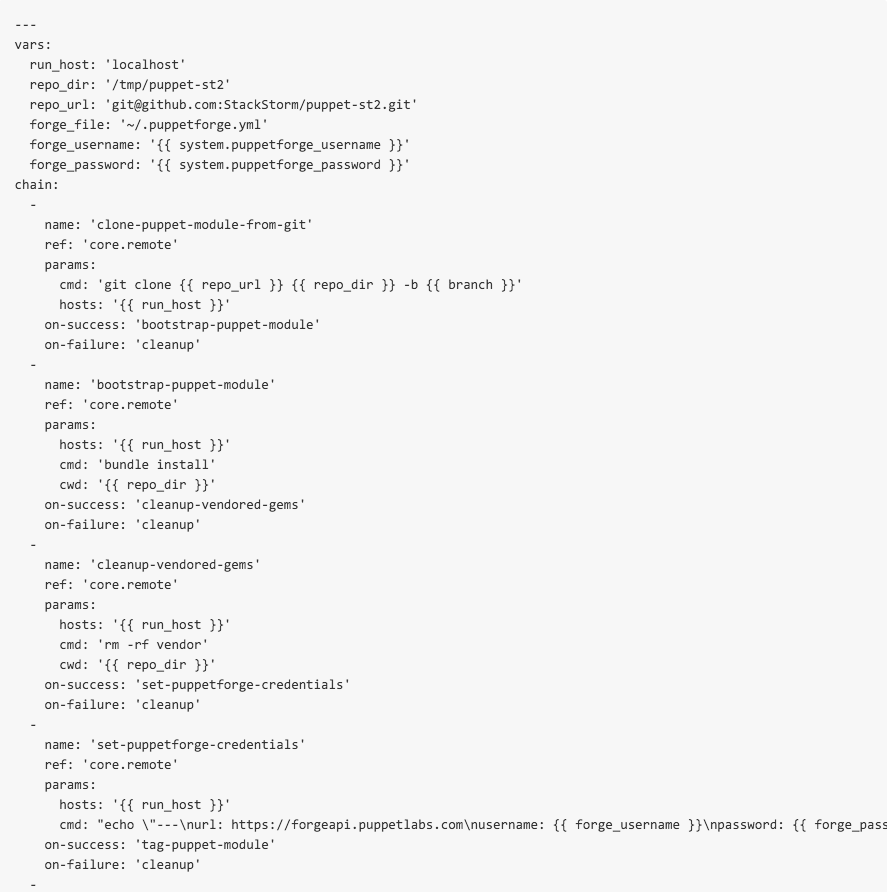
    The next step is to set up some accompanying Action Metadata for the new stackstorm.publish-puppet-st2 action. We’ll want this to run a new workflow that will take care of all the actions we discussed above. The only variable that I need to get from the user is the branch parameter, so writing the metadata should be a snap. We’ll only take a look at the workflow today.
    Screen Shot 2016-01-27 at 10.59.04 AM
    Screen Shot 2016-01-27 at 11.00.26 AM
    Screen Shot 2016-01-27 at 11.01.04 AM
    Source: https://github.com/stackstorm-packs/st2-publish_puppet_forge/blob/master/actions/workflows/publish-puppet-st2.yaml

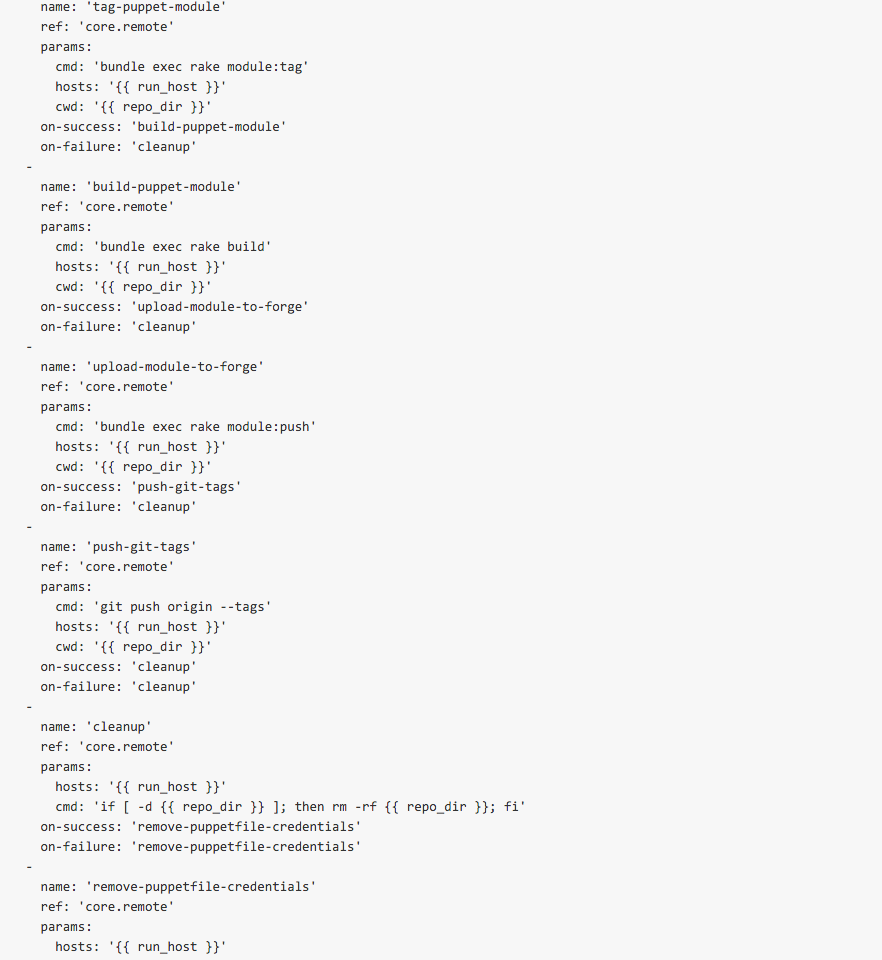
    At the top of the file includes our vars section. The puppet-blacksmith application was not built to be run with multiple users, so our workflow needs to be able to adapt. As such, we need to know that the gem will expect a credential file (forge_file) with a username (forge_username) and password (forge_password). We also need to know where our staging directory is (repo_dir), where the upstream target is (repo_url). Simple enough. The next few steps, clone-puppet-module-from-git, bootstrap-puppet-module, cleanup-vendored-gems and set-puppetforge-credentials ensure the build host is setup properly. These actions serially download the repository from Upstream, runs all bootstrap commands, attempts to ensure a pristine directory, and then sets up the puppet-blacksmith forge file. At this point, nothing has actually been done, just some preparation.

    It’s important to note the third step here (cleanup-vendored-gems): This was a small step that often was forgotten and ended up creating archives in the size of megabytes as opposed to kilobytes, which is more reasonable and expected.

    The final steps—tag-puppet-module, build-puppet-module, upload-module-to-forge and push-git-tags—are where the bulk of work occurs. The next steps are focused on running several rake tasks, as well as then tagging the git repository and republishing the package upstream. Most of these actions were enabled by the puppet-blacksmith gem, but now are encapsulated in a nice workflow that is easily consumable.

    And sure enough, if you build it, they will come …

    slack slack_1

    Techniques like this directly enable force multiplication within your team. Essentially, your role shifts from a person “responsible” for delivering to the person for “enabling” delivery. This is a very small example, but powerful. Enabling others on your team to be a force multiplier enables them to keep working, enables you to focus on more important things and also creates a new degree of transparency that may not have existed before. Everyone knows when software is released; anyone has the ability to do this. Add up enough of these small building blocks, and suddenly team members are more apt to take risk and help drive change knowing there is a safety net behind them.

    Worth consideration

    Two very interesting points were presented to me that are worth discussion here:

    Agile Manifesto, rule #1: Individuals and interactions over processes and tools. Tools that try to enforce a workflow of a human? GTFO!

    How far does this paradigm extend? For sure, “process” is the worst. When invoked, it usually means a large amount of paperwork or rules that must be strictly adhered to. The downside is that many of said process are manual in nature and, as a result, error-prone. Likewise, in companies that implement a tool before understanding what they want to achieve or, at the very least, defining a set of principles, the tools end up shaping how the company works rather than the other way around. The point here is that humans are in charge.

    Agreed. What is unreasonable here is the underlying expectation that exists here and across the IT industry: technologists must know an immense amount about an immense number of things. Even in my own domains of expertise, I can think of nothing more demotivating than trying to remember how to deploy code that I haven’t touched in three-plus months. Eventually I’ll remember, but it’s a drag and introduces unnecessary friction. Now, play that out in a larger team and multiply.

    ‘I will become redundant’: I have yet to see this happen. What instead happens is collaboration. Developers can focus on shipping and keeping their code up to date without bugging operations, and operations can care about aggregate problems (capacity, power, storage) as opposed to transactional tasks such as “push this code” or “reset this password.” Most devs I know are not afraid to get dirty, but it’s not where they would rather spend time. Devs want to develop. If you can enable them with better tools to do exactly that, everyone wins. The glucose you were once burning on smaller tasks can and often do become self-service, and you get to go and create even more cool interfaces for users to consume.

    Wrap Up

    Bottlenecks exist. They can and will continue to pop up as companies grow and expand. Sometimes you may find yourself in a situation where bottlenecks accumulate over time as a result of technical debt, while other times you join a new team and that debt may already be gaining interest on amounts owed. Either way, the situation exists where something needs to be done. Instead of going directly for the RPG, burning down the house and starting over, consider smaller approaches to enable others to do the things you do.

    Some thoughts to take with you today:

    • Tend your technology garden: curate, don’t operate
    • Make small, transparent changes for lasting effect
    • Grow it together: don’t control the change

    Until next time!

    About the Author/James Fryman

    jamesNow a senior DevOps engineer at StackStorm, James most recently worked at GitHub assisting in the development and curation of systems scaling within the Operations group. James is also a frequent speaker on the topic of automation at conferences throughout the world.

    Twitter: @jfryman
    email: james@fryman.io / james@stackstorm.com

  • Polatis and Quali Deliver Dynamic Fiber Layer Management Solution for Automating Network Equipment and System Lab Testing

    New solution enables dynamic provisioning of Layer 1 resources to create flexible “production-like” environments for network equipment and system-wide testing.

    Bedford, MA and Santa Clara, CA – February 4, 2016 – Polatis, the performance leader in all-optical switching, and Quali, the leading provider of cloud sandbox software for DevOps automation, have developed and delivered an integrated fiber layer management solution.  Quali’s CloudShell cloud sandboxing platform integrated with Polatis’ family of fiber layer switching products provides an easy-to-use and extremely flexible solution for configuring fiber layer connectivity on-demand.  The joint solution enables infrastructure vendors, data center operators and network service providers to quickly, and simply, execute complex equipment, system and service testing on high-speed (10/40/100+ Gbps) optical backbones.

    The integration allows Quali’s CloudShell software to control Polatis’ all-optical switching products, providing the ability to reconfigure Layer 1 resources dynamically from anywhere in the world. Further, it enables the orchestration needed to seamlessly manage higher layer network elements, and other connected equipment, from a single control point. Quali’s visual modelling tool dramatically simplifies the process of modelling and provisioning complex connectivity. The low loss and superior optical performance of Polatis switches enable the most accurate and reliable testing, in a wide range of network applications, with virtually no latency and minimal system impairments.

    CloudShell’s cloud sandboxing and DevOps automation platform manages the entire lab and data center infrastructure: inventory, modelling, provisioning, lab-wide connectivity, resource planning and reporting.  Together with Polatis, the result is a highly efficient, multi-tenant system that enables fiber and equipment resources to be easily shared across multiple test topologies simultaneously without concern for conflict.

    “By abstracting complex system environments, CloudShell enables Polatis customers to greatly simplify testing on high speed networks, and greatly increase productivity by enabling our switches to be used independently and simultaneously for multiple test beds,” said Gerald Wesel, president and CEO of Polatis. “Quali truly understands the need for the highest standards in testing, which is evident in the CloudShell platform when coupled with Polatis switches.  Driven by our common customers, we are extremely pleased to partner with Quali to bring them the best possible solution for their testing needs.”

    With CloudShell’s architecture based on abstracting connectivity and Polatis’ rich software interfaces, including NETCONF and OpenFlow, the integration enables testing of SDN (Software Defined Network) and NFV (Network Functions Virtualization) applications.  This includes stressing network topologies with intense packet generation, and simulating fiber cuts and degrading optical signals, among other tests.

    “Our customers want to increase the productivity and efficiency of their labs and data centers while at the same time maintaining the highest standard of accuracy and reliability,” said Lior Koriat, CEO of Quali.  “The ability to support existing and emerging environments, along with the flexibility to deploy Polatis’ wide range of fiber layer switches in their environments, makes this an extremely compelling solution.”

    “WWT has been working with both Quali and Polatis for a number of years, and both provide the best solution in their respective market segments of Lab Automation and Optical Switching,” according to Kathi Bomar, WWT Technical Solutions Architect.  “Not only will this partnership provide WWT with a tool for our internal Labs and technical showcases, but we look forward to helping our Networking and Data Center clients implement the combined solutions utilizing Cisco, Polatis and Quali.  We believe our customers will benefit from the automation of these solutions orchestrated by Quali’s CloudShell, as can be seen in WWT’s Advanced Technology Center.”

    Polatis is the only all-optical switch vendor to release a NETCONF interface and associated YANG models required for integration with transport SDN and network functions                           virtualization (NFV) management platforms. Polatis’ range of embedded SDN and network management interfaces include NETCONF, OpenFlow, REST, TL1 and SNMP.
    About Quali Quali is the leading software provider of Cloud Sandboxes.  Their innovative CloudShell software automates the DevOps lifecycle, by providing dev, test, QA, and compliance teams personal replicas of their production environments enabling total control over the development, test, and release of products and applications.  The Global 100 depend on Quali to ensure speed to market while enhancing the quality of the products they deliver to customers. For more information visit www.qualisystems.com.

    About Polatis
    Polatis delivers the world’s lowest loss all-optical switching solutions for remote fiber-layer provisioning, protection, monitoring, reconfiguration and test, with over 3 billion port-hours accumulated in service to date.   Dependable, field-proven DirectLight™  optical matrix switch technology scales from 4×4 to 192×192 ports, applying class-leading performance to provide dynamic optical networking for telecommunications, data center, government, test and video markets.  For more information, please visit www.polatis.com.

    Matt Burke
    matthew.burke@polatis.com
    +1 603.315.0618

  • DBmaestro Unveils TeamWork Version 5.0

    New version includes first of its kind Pipeline Builder for a significantly easier automated database deployment pipeline

    Houston, Texas, February 3, 2016 – DBmaestro (www.DBmaestro.com), the pioneer and leading provider of DevOps for Database solutions, announced the release of TeamWork version 5.0 which includes a first of its kind Pipeline Builder, enabling users to visually describe the database environment and the deployment flow. The new version brings maturity and stability to DevOps for database by making it significantly easier to set up an automated database deployment pipeline for Continuous Delivery processes.

    DBmaestro also unleashed new and enhanced compliance and audit capabilities for the database. DBmaestro prevents unauthorized changes to both database structure and the data it contains. Organizations now have the ability to define access levels down to database objects or content, and review compliance reports showing all database modifications or attempts of unauthorized or out-of-process modifications.

    “With the entire market moving to Continuous Delivery, automation, and compliance, organizations are seeking any possible edge,” said Yaniv Yehuda, CTO DBmaestro. “DBmaestro constantly strive to deliver the best of breed DevOps for database solutions to the market. The new version enhances database development and deployment automation, compliance and audit capabilities for the database as well as collaboration between application development and database development teams. These added capabilities means quicker, safer, easier, and cheaper deployment.”

    Some of the value added benefits of the new version include:

    • Quicker, easier and safer onboarding of database Continuous Delivery processes and automation
    • Documenting and reporting of security breaches
    • Eliminating errors which can occur while manually setting up the Continuous Delivery pipeline
    • Clear visualization of the database delivery pipeline, environments and flows
    • An added deployment safety net for the release process. Pipeline Builder verifies that upgrade packages are up-to-date and can be safely executed without potentially breaking the target environment

    Right now, you can download a free trial of DBmaestro TeamWork’s version 5.0 with the first-of-its-kind pipeline builder. Click here for a free 14 day trial.

    About DBmaestro

    DBmaestro is a pioneer and leading DevOps for database solution provider. Its flagship product, DBmaestro TeamWork, enables agile development, Continuous Integration and Delivery for the Database.

    TeamWork supports streamlining of development process management and enforcing change policy practices. The solution empowers Agile team collaboration while fostering regulatory compliance and governance. With DBmaestro, organizations can facilitate DevOps for database by executing deployment automation, enhancing and reinforcing security as well as mitigating risk.

    DBmaestro’s solutions are deployed at many major international companies, including Visa, Isracard (MasterCard), Frost Bank, Thomson Holidays, Bank Leumi, and others.

  • DevOps in 2016: Mainstream Momentum Ahead

    DevOps in 2016: Mainstream Momentum Ahead

    I believe that 2016 will be the year that DevOps takes mainstream foothold in the enterprise. And I base this assertion on seven sweeping changes that — from my vantage point — are taking hold and dramatically changing the digital world.

    1. The Job of IT Will Change From Infrastructure to Innovation. In the past, IT has been about providing compute infrastructure and applications to run the internal workings of a company. But this has been radically shifting as digital transformation penetrates nearly every company of significance across the globe. As a result, IT is increasingly about driving innovation and customer value through software. We see this every day from our work with large enterprises; indeed, almost half of the global 500 use Chef in some manner. And, in our interactions with enterprise customers, over 75 percent cite innovation, velocity and agility as top priorities for IT — and the company. The common ingredients behind this are almost always automation, cloud and DevOps. In fact, while these three elements are, in many ways, distinct, they form a magic IT trinity in service of innovation-led organizations. If you need further proof that IT is on its way to becoming the pointy end of the innovation-creation spear inside large-cap companies and organizations, just look at the auto industry, where CES may actually be more important than the Detroit Auto Show, where GM is investing in Lyft, and where Google is doing state-of-the-art R&D on a self-driving car.
    1. Continuous Delivery (CD) Will Become Ubiquitous. CD is the practice of rapid software development and iteration through fast, small-batch releases. In its purest form, developers can drive small, incremental software releases quickly, sometimes as often as every few minutes for some very well known Web sites. Not long ago, CD was exclusively the domain of big Web innovators such as Facebook, Amazon, Google and Yahoo! Not long ago, making even several releases a day sounded insane. And not long ago, a CIO told me that it was ridiculous to contemplate bringing CD into the enterprise. All this has changed, and today it makes absolutely no business sense to shy away from CD because it’s one of the keys for unleashing an organization’s software development innovation engine. The point is that the whole stack — infrastructure, compliance, security, microservices and applications — is being expressed as code now, and  it’s the same as you deliver with work-flow. In the end, whether your company needs to release frequently all the time, or not, every aspect of IT is charged with a business requirement to do something quickly some of the time. CD is a very important piece of the puzzle.
    1. The Public Cloud Will Triumph in the Enterprise. You may think the cloud is old news, but it’s not. In 2016, the enterprise is going to move beyond public cloud experimentation and project-based work and start migrating entire data centers to the public cloud. We’re also going to see more hybrid cloud initiatives (whatever the composition) because dual adoption helps companies avoid vendor lock-in. As for private cloud projects, there are definitely some good teams and technologies out there. But, having said this, I believe that the public cloud will win out. Many of the lingering public cloud issues, like security and governance, have begun to evaporate. And the ease of use, affordability and effectiveness of the public cloud will simply triumph in the enterprise over the next 12 months at the expense of the private cloud.
    1.  We Will Enter a New Era of System Administration. The world of systems administration has changed forever. In the IT world that I grew up in, a human being logged onto a system to manage, update or fix it manually. Since then, compute scale has grown exponentially for most organizations, thanks, in part, to both server virtualization as well as the cloud. Most of our enterprise customers have, excluding desktops, tens of thousands of compute nodes. Some have over 100,000. A few have over 1,000,000. Administering systems manually by having humans act on systems is no longer viable or tenable. In the new era, humans act on code and code acts on machines. In fact, code is the system. In other words, humans act on compute resources through code. And this reality creates a whole new universe for the world of system administration. The bottom line? The job and role of the system administrator will change significantly. Watch this trend play out in 2016.
    1.  Peace Will Break Out Between Developers and Security / Compliance Officers. This has been a long-running battle inside the enterprise, and there are several theories behind the conflict. One is miscommunication — the  security team doesn’t think the dev team gets it, and the dev team doesn’t think the security team gets it. Another hypothesis is that developers just want to be left alone to write code for the business, but the business is increasingly worried about security — not just IT security. And, lastly, there’s this explanation for the hostility — developers want to go fast, and security teams want to slow everything down to a safe speed. Whatever the reasons, I believe that developers and security / compliance officers will find much more common ground in 2016 because we’re learning that compliance and velocity aren’t necessarily in conflict with each other.  In fact, high-velocity IT organizations can deal with security threats more quickly by assessing vulnerability, creating a fix, testing it and then deploying it rapidly before the damage is done. We’re also seeing the early beginnings of what I believe will be a very important trend in our industry: compliance defined as code. Today, compliance is all too often defined in binders or text documents; what’s a developer going to do with this? But we’re seeing a new idea emerge: define compliance — either to your own security standards or external, regulatory standards in code. If you can define compliance as code, you can then use that code to create a test that can simply be moved into the software release process and managed like any other automated test. Forward-leaning compliance officers will shift their gaze and embrace their developers because it’s through their software developers that they’ll be able to take their craft to a new level.  Keep an eye on this in 2016.
    1.  Executives Will Move Into the DevOps Tent. The DevOps tent will expand to include the executive suite in 2016, and executives are excited to join the practitioner-born DevOps movement. “DevOps” makes one think of only “development” and “operations,” but it’s really a movement focused on how we build and operate high-velocity organizations. Frankly, DevOps is meant for the entire enterprise. The results are both clear and definitive. Mature DevOps organizations see increases in both innovation and quality that flow through to business results, including profit and shareholder value — and, quite possibly, security and safety as well. Executives have seen what code can do, and they’re fervently embracing the far-reaching organizational changes that have accompanied this technology revolution. The good news for DevOps practitioners is that they’re going to find strong support in the executive suite and many will see good things happen to their careers in 2016
    1.  Container Technology Will Be Improved and Grow Even More. Containers — which bundle entire run-time environments into packages that make it much easier to move applications from a developer’s laptop to the test, production and end-user stages — are becoming invaluable, especially in homogeneous green-fields, because they abstract so many problems away. But most enterprises aren’t homogeneous green-fields, so the challenge is how to deal with a variety of legacy technologies without re-writing all the applications that run. I believe that this problem will be addressed in 2016, and container usage will expand by leaps and bounds as a result.

    There will be other big changes in IT during 2016, but, when combined, I believe these seven represent a truly significant tipping point that will catapult enterprises toward the future with a velocity and vigor that can only enhance and enrich growth.

    Abouth the Author/Barry Crist, CEO, Chef

    Barry-Crist-620x930Barry Crist is CEO of IT automation company Chef. Barry has more than 20 years of experience in driving enterprise customer success and adoption with both open source and DevOps software solutions. Prior to joining Chef, he was CEO of Likewise, a company with a strong open source to enterprise go-to-market model that had wide industry reach including OEM agreements with VMware, Dell, HP, Riverbed, and EMC. Likewise was acquired by EMC Isilon in September 2012. Prior to Likewise, Crist served as Vice President of the Application Management group at Mercury, now a division of HP, where he grew North American sales from less than $1 million to more than $75 million. Crist led enterprise sales organizations at Network Associates (now McAfee) and was in various sales, technical, and international roles at Apple.
  • DevOps Twitter Fun and a Free T-shirt

    DevOps Twitter Fun and a Free T-shirt

    After the holidays and New Year, the team here at staging-devopsy.kinsta.cloud decided to shake things up a bit and  have fun some fun with on social media. Starting today we are going to run what we think are three pretty cool contests to post some DevOps fun through Twitter. We will select the best to win a staging-devopsy.kinsta.cloud t-shirt and other cool swag.

    These opportunities will be pushed out via Twitter; to win you must follow us @DevOpsDotCom, follow instructions, tweet out your submission using applicable hashtags (#) and answer emails asking for required information (such as address to send materials).

    The promotions are:

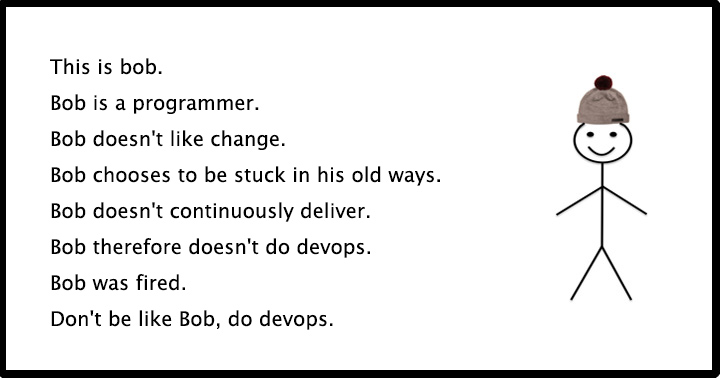
    Meme Monday: Today we introduce #DevOpsMemeMonday. Below is an example of our meme for the week, the infamous “Be Like Bob,” or in this instance, don’t be like Bob. We will supply a meme with no text writing on it, with a description of any rules that could be applied to the contest. It is then up to you, our followers to create a meme that best follows the rules. Up to five winners will be selected based on humor, cleverness and the best incorporation of DevOps. Submissions will be accepted through Twitter by tweeting @DevOpsDotcom and using the hashtag #DevOpsMM.

    Example:

    belikebob

    We have also courteously provided a blank canvas for you to create your meme here, which you can download by right-clicking and selecting “save as.”  You can then use https://imgflip.com/memegenerator to create your meme, or simply do it in photoshop.  Once you create your meme, don’t forget to submit it to us by tweeting @DevOpsDotCom with the hashtag #DevOpsMM.

    Throwback Thursday: This will be an open contest with no picture or text provided; however, these can be done through picture, text or whatever means you choose to express your creativity. The only instructions are to represent how DevOps has changed over the years, as well as how DevOps has changed IT over the years—hence, “Throwback Thursday.” Submissions will be accepted through Twitter by tweeting @DevOpsDotcom and using the hashtag #DevOpsTBT.

    Example: Remember when a computer was the size of a house #DevOpsTBT

    Freestyle Friday: This also will be an open contest with no picture or text provided; however, these can be done through picture, text or whatever means you choose too express your creativity. The only instructions are to create a short rhyme or rap about DevOps—hence, “Freestyle Friday.” Submissions will be accepted through Twitter by tweeting @DevOpsDotcom and using the hashtag #DevOpsFreestyleFriday.

    Example: Bob is stuck in his old ways, he doesn’t like to continuously deliver. He’ll be rethinking his outdated behavior when he’s sent downriver. #DevOpsFF

  • Save the Date for Sirius Madness!

    Sirius to host sixth-annual technology conference in Charlotte, North Carolina

    Charlotte, NC (PRWEB) January 29, 2016

    Charlotte, NC – 29 January, 2016 – Registration is open and the agenda finalized for the sixth-annual Sirius Madness event, the Carolinas’ premier technology conference. Hosted by Sirius Computer Solutions, Inc. (Sirius), the conference combines the excitement of college basketball, St. Patrick’s Day, and all-star partners showcasing their innovative technologies. This year, Sirius Madness will be held on March 17, 2016 at the Westin Charlotte in North Carolina.

    The 2016 Sirius Madness is expected to be the biggest yet, with an estimated 50 breakout sessions ranging from solutions-focused presentations and panel discussions to technical deep dives and much more. Sirius Madness was designed to provide rich technical content in a casual and fun atmosphere. After reviewing a record number of submissions, the Madness panel of industry experts selected what they view as the best content for 2016. “We’re very happy to keep Madness going!” said Jason Nash, ‎Sirius director of Next Generation Architectures. “This year we’ll have over 50 sessions from the kind of industry leaders that attendees have come to expect.”

    The Madness technical sessions will cover today’s most relevant IT topics, including DevOps; private, hybrid and public cloud; end-user computing; security; and more. “We are also very happy to have Gene Kim, co-author of The Phoenix Project, as the keynote speaker,” Nash said. “Many in our industry have read this book, and found similarities in their own challenges as IT departments undergo transformation.”

    Visit the 2016 Sirius Madness microsite to check out the full agenda, register, and take advantage of discounted hotel blocks. The first 500 to register will get a free Madness T-shirt. Hotel rooms at various hotels are blocked for discounts until February 23, 2016.

    Special thanks to our sponsors! Among them are: EMC, VMware, Cisco, Citrix and IBM, Bit9 + Carbon Black, Blue Coat Systems, Dell, F5 Systems, Intel, Lenovo, Nutanix, Palo Alto, PernixData, Recovery Pointe Systems, RES Software, Splunk, VCE, Alert Logic, CA Technologies, Catalogic Software, Commscope, CyberArk, Liquidware Labs, Red Hat, RSA, Solutionary, Super Micro Computer, Inc., Trend Micro, Varonis Systems, Veeam Software, Winthrop Resources and Zerto Ltd.

    About Sirius Computer Solutions: Sirius is a national integrator of technology-based business solutions that span the data center and lines of business. Built on products and services from the world’s top technology companies, Sirius solutions are installed, configured and supported by our dedicated teams of highly certified experts. Sirius is focused on helping organizations of all sizes reduce cost and complexity, improve service levels, and minimize risk through the implementation of strategic solutions that include cloud, analytics, mobility, security, IT infrastructure optimization and more.

    For more information about Sirius, visit http://www.siriuscom.com.

    Contact Information: Jessica Carter, Marketing Manager, Sirius Computer Solutions

    Phone: 919-475-3200; E-mail: jessica(dot)carter(at)siriuscom(dot)com

    Vin Tugade, Corporate Communications Manager, Sirius Computer Solutions

    Phone: 801-964-4906; E-mail: vinia(dot)tugade(at)siriuscom(dot)com

    All brand, service and product names are trademarks or registered trademarks of their respective companies.

    For the original version on PRWeb visit:http://www.prweb.com/releases/2016/01/prweb13189619.htm

  • CloudBees Signs 13 New Reselling and Services Partners in Q4 2015

    New Partners Reflect Growing Demand for Jenkins-Powered Continuous Delivery Around the World;

    New Portal Designed to Drive Partner Profitability and Customer Success

    SAN JOSE, Calif.–(BUSINESS WIRE)–CloudBees, Inc., the enterprise Jenkins company and continuous delivery (CD) leader, today announced rapid growth in its partner community in Q4 of 2015. The growth of the reselling and services partner ecosystem in Q4 alone was nearly 50 percent and facilitates ready-access to more Jenkins-related services and CloudBees products in all global regions. To support the growing partner community, the company launched a new partner portal to provide greater access to CloudBees resources.

    New CloudBees partners reflect growing demand for #Jenkins powered CD around the world!

    New reseller, services and training partners were brought on-board during the final three months of 2015. New additions included two global services partners, two partners in the U.S. federal government sector, four partners for expanded coverage in the Asia/Pacific region and five new partners in Canada and the U.S.

    The new CloudBees partner portal, launched this month, provides the CloudBees partner community with a single destination to uncover and manage new opportunities and expand DevOps and enterprise-scale Jenkins business. Exclusively for CloudBees partners, the portal delivers marketing, sales and technical content and tools to help partners architect the best enterprise Jenkins solution for customers, help partners manage opportunities and facilitate the closing of sales.

    “The expansion of our partner ecosystem is a direct result of the global and growing demands for enterprise Jenkins solutions,” said Durga Sammeta, CloudBees senior director, global alliance and channels. “Customers are seeking enterprise Jenkins solutions and trusted advisors who can help them identify and implement continuous delivery in their transformation to a DevOps culture. These partners join CloudBees’ already extensive set of global reseller, services and training partners that enable enterprise software delivery teams to more easily embrace continuous delivery with Jenkins-based solutions.”

    The latest moves follow a series of innovations over the past year in the CloudBees partner program. The company revamped the program in July 2015 to include new tracks for reseller and training partners. By expanding these categories of partners, CloudBees ensured that customers seeking enterprise Jenkins solutions had expanded buying choices from trusted partners in the application development and DevOps sectors.

    New partners recently signed include:

    Global Services Partners:

    • InfoStretch – Global, Platinum Services and Reseller Partner
    • Unisys – Global, Services and Reseller Partner

    Reselling and Services Partners focused on the US Federal Government:

    • KP SOFT – U.S. Federal, Gold Services and Reseller Partner

    Reselling and Services Partners in APAC:

    Reselling and Services Partners in U.S. and Canada:

    Partner Comments:

    “With organizations under pressure to constantly deliver fully-featured, quality software that’s a step above the competition, the need for automation is a critical success factor. We are excited to partner with CloudBees to support customers through their continuous delivery and DevOps transformations.”
    – Adam Edwards, CTO, Middleware360 Solutions

    “U.S. Federal Government Agencies seeking to increase standardization and use of best practices, are turning to DevOps and IT automation solutions. Aurotech is excited to partner with CloudBees to help our government customers re-engineer IT practices.”
    – Imneetpal Brar, DevOps Program Manager, Aurotech

    “For InfoStretch’s enterprise customers, Jenkins is crucial for continuous integration and continuous delivery initiatives. By using the CloudBees Jenkins Platform, our customers’ will evolve their mobile strategy toward quality engineering and greater agility.”
    – Guy Vachtel, Senior Director of Global Partners & Business Development, InfoStretch

    “Alten is thrilled to resell CloudBees’ innovative solutions across the APAC region. Alten’s presence in China, Hong Kong and Korea, in particular, provides our mutual customers with leading edge technology, guidance and expertise in implementing CI and CD initiatives.”
    – Lawrence Kole, Managing Director, ALTEN China

    “It’s fantastic to work with an organization as committed to partnerships as CloudBees. What’s really compelling is to see the resources and investment CloudBees has made in its channel strategy. That aligns well with how we approach partnerships.”
    – Tyler Davey, VP Sales, Architech

    “Jenkins plays a key and essential role and is a recommended best practice to our clients for continuous delivery practices. The advanced enterprise features offered by CloudBees makes Jenkins a natural fit for our customers looking to implement scalable continuous integration and continuous delivery processes across DevOps teams.”
    – Joe Dickman, SVP, Vizuri

    Resources

    About CloudBees
    CloudBees (www.cloudbees.com), the Enterprise Jenkins Company, is the continuous delivery (CD) leader. CloudBees provides solutions that enable DevOps teams to respond rapidly to the software delivery needs of the business. Building on the strength of Jenkins, the world’s most popular open source continuous delivery hub and ecosystem, the CloudBees Jenkins Platform provides a wide range of CD solutions that meet the unique security, scalability and manageability needs of enterprises. The CloudBees Jenkins Platform supports many of the world’s largest and most business-critical deployments.

    Backed by Matrix Partners, Lightspeed Venture Partners and Verizon Ventures, CloudBees was founded in 2010 by former JBoss CTO Sacha Labourey and an elite team of continuous integration, continuous delivery and DevOps professionals. Follow CloudBees onTwitter, Facebook, LinkedIn and Google+.

    Contacts

    PAN Communications
    Katelyn Campbell / Gaby Berkman, +1-617-502-4300
    cloudbees@pancomm.com