Tag: devsecops

  • DevSecOps Survey Finds Failure to Communicate

    DevSecOps Survey Finds Failure to Communicate

    While it’s generally agreed that shifting more cybersecurity responsibility onto the shoulders of developers is a good idea, a failure to communicate across application development and cybersecurity teams has contributed to little progress in achieving DevSecOps.

    A survey of 1,310 IT decision-makers conducted by the market research firm Vanson Bourne on behalf of Trend Micro finds that while nearly three-quarters of respondents (74%) said integrating developer, IT operations and cybersecurity processes has become more important over the past year, more than one-third (34%) said these silos are making it more difficult to create a DevOps culture in the organization. A full 89% said software development and IT security teams needed to be in closer contact, while 77% said the same for developers, security and operations.

    Greg Young, vice president of cybersecurity for Trend Micro, said the two biggest challenges in achieving DevSecOps historically are the lack of trust between developers and cybersecurity professionals and a lack of tooling to foster collaboration and communication across teams.

    The rift between developers and cybersecurity is well-known: Application developers have been known to give short shrift to cybersecurity guidelines to make a deadline, only to have that application breached in a production environment. However, developers can counter that cybersecurity professionals can slow things down too much, in the name of being overly cautious.

    Young said organizations need to find tools that make it easier for those two teams to establish trust within the context of an integrated DevSecOps process. Rather than just relegating cybersecurity teams to defining policies, cybersecurity professionals need to find a way to provide input during all stages of the application development process without compromising the overall agility of the development team, he said.

    In fact, survey respondents identified fostering greater integration between teams (61%), setting common goals (58%) and sharing learning experiences across teams (50%) as the best ways to achieve DevSecOps. The trouble is, 78% of respondents said their organization needs to improve in all these areas.

    Unfortunately, nearly half of respondents (46%) said they have only partially developed their DevOps strategy, with only a third of respondents (33%) saying DevOps today is a shared responsibility between software development and IT operations.

    Regardless of how organizations achieve DevSecOps, the one certain thing is most organizations have no alternative. The rate at which applications are being developed today generally exceeds the ability of short-handed cybersecurity teams to keep pace. The only way to make sure applications are more secure than they have been historically is to make implementing security controls part of the application quality assurance process. That said, cybersecurity teams most likely will take a “trust, but verify” attitude toward developers to ensure the right controls have been put in place.

    Of course, none of this is going to happen of its own accord. Senior leaders need to make DevSecOps best practices a requirement. Otherwise, DevSecOps will always remain one of those many aspirational IT goals that go unfulfilled.

    — Mike Vizard

  • 6 Traits That Define DevSecOps

    6 Traits That Define DevSecOps

    How do we define DevSecOps? A combination of DevOps and security is readily apparent, but the philosophy goes much deeper. In a recent eBook, The State of DevSecOps, we asked industry experts to define what DevSecOps meant to them. Below, we’ve condensed their answers into five core attributes.

    Following these principles, CIOs or CTOs now have a DevSecOps doctrine applicable to nearly any software development and release environment.

    Security Automation

    DevSecOps emphasizes security objectives within the automation processes. Ben Newton, director of product marketing and evangelism at Sumo Logic, defines DevSecOps as first making security requirements and objectives a clear part of the continuous integration (CI) and continuous deployment (CD) cycle.

    Culture of Security

    DevSecOps establishes a team culture that embraces security concerns. As stated by Ben, a security team must provide “clear guardrails for developers as to what is fair game and what is not appropriate from a security perspective.” Building security expertise to integrate security into the entire DevOps lifecycle is critical.

    De-Siloing IT

    DevSecOps is about eroding boundaries. Just as DevOps has eroded the traditional separation between software engineering and IT operations teams, “DevSecOps further erases the walls between the DevOps team and IT Security,” said Tim Jarrett, senior director of product management at Veracode. “DevSecOps is about building a bridge between the security and DevOps teams,” echoed Dan Hubbard, chief product officer at Lacework.

    Security Shifts Left

    DevSecOps places security earlier on in the development process. IT security is traditionally viewed from a risk avoidance and compliance standpoint. Rather than viewing security as a gate, Tim noted that within DevSecOps, “security is better positioned to integrate earlier in the development cycle where they can actually make a difference.”

    Security Enables, Not Stalls

    DevSecOps supports, not stalls, agile development. DevSecOps doesn’t have to be sluggish. As Dan described, DevSecOps must “support the need for DevOps to move fast, but in a way where security is not ignored.” By embracing a security-as-code mindset and involving practices such as automated threat detection, agility is not sacrificed.

    — Bill Doerrfeld

  • VMware Adds Cloud Automation for DevOps

    VMware Adds Cloud Automation for DevOps

    Those who follow my blog will recall that I covered (and did some work for) CloudCoreo, a cloud security and compliance start-up. What the company was working on was intriguing to me because it pulled many things into the realm of DevOps through automation at a time when cloud security was a big issue.

    It’s still a big issue, and the former CloudCoreo product has been enhanced and integrated into VMware’s growing DevOps infrastructure as VMware Secure State. I hopped on a call with Jason Needham, senior director of product management, multicloud security at VMware, to get an idea of what was new and how the product was integrated with VMware’s other offerings.

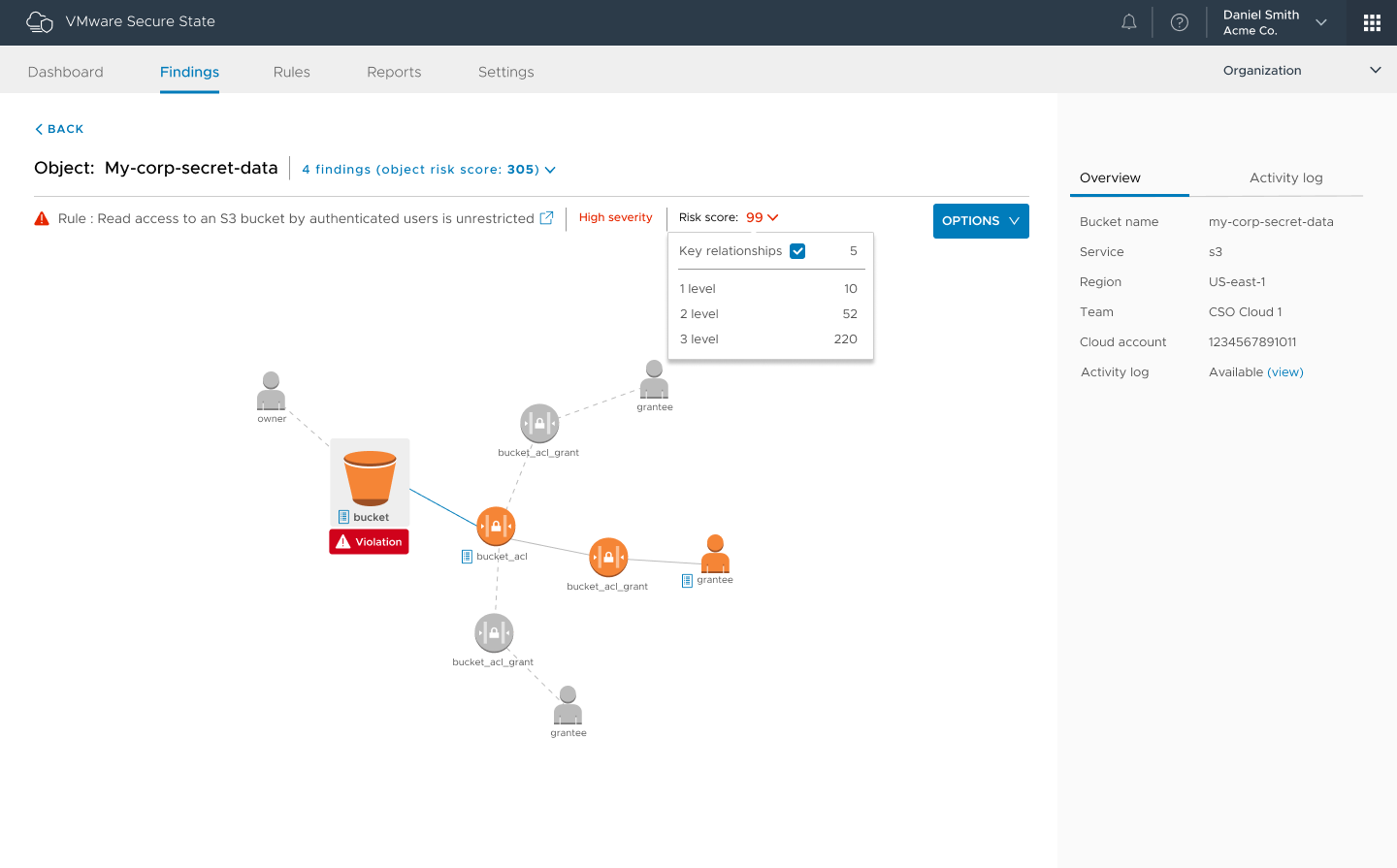
    We’ll get the thing that will interest every risk manager out of the way first. Secure State can tell you about buckets and their current security settings. It can tell you how to fix them. Considering the number of high-profile leaks caused by insecure buckets, I figured I’d mention that even before I talked about how Secure State fits with other VMware offerings. You’re welcome.

    Figure 1: Of the many violation chains available in the product, “authenticated user” buckets are one of the coolest, IMO.

    Secure State is part of VMware’s Cloud offering (grouped with CloudHealth and WaveFront), bringing security and compliance to multicloud. The cool bit is the level of automation, which allows teams to include cloud infrastructure security and compliance with DevOps efforts. That is where the world is headed, and VMware Cloud sees a greater level of DevOps automation than most alternatives just because it was conceived with APIs aimed at automation in the first place. Adding checks for rights and security settings, even compliance, into the DevOps cycle is breaking down one last wall (now we’re basically waiting for someone to do something astounding for cloud storage).

    Part of Secure State is near real-time reporting on status/state. This is big in environments that have real-time reporting for everything else, adding in the one missing piece. It is far better to be told, “There is a problem right now with instance X,” than to be fighting attackers. One of the examples Needham offered was of a project that was used via a small subset of tools: One day a report came in that it was being accessed via JVM instead of the normal methods. In this case, it turned out to be a new developer trying to get work done, but you can imagine such a warning being a heads up that you had an attack going on.

    The other interesting bit is risk scoring, officially known as Smart Risk Scoring. The ability to get a prioritized risk list allows DevOps teams to focus on what is most important. When there is so much for security to get done, this is a huge benefit.

    Disclaimer: I haven’t used this version of the product. That means I can’t say “This rocks!” but if Secure State delivers, it certainly will.

    Anything that adds automation and visibility is a welcome addition to the DevOps stack, making life easier and helping you to rock it.

    — Don Macvittie

  • GitLab Expands Scope of DevOps Ambitions

    GitLab Expands Scope of DevOps Ambitions

    GitLab, with the release of its 12.0 update, is extending the reach of its namesake continuous integration/continuous delivery (CI/CD) platform to include both cybersecurity professionals and traditional IT operations staff.

    John Jeremiah, senior product marketing manager at GitLab, said the goal is to provide organizations with a single CI/CD platform that unifies the management of everything from source code to best DevSecOps processes.

    To address that latter requirement, GitLab 12.0 adds a dashboard designed specifically for security personnel along with the ability for cybersecurity teams to approve merge requests and automatically apply patches for vulnerabilities detected. Those capabilities complement existing support for scanning and secrets detection.

    New capabilities embedded in the platform for IT Operations professionals include an operations dashboard and an embedded incident management capability that makes it easier to create a coordinated response to a specific event.

    GitLab 12.0 also adds support for feature flags to better manage the application delivery process, along with a platform-as-a-service (PaaS) environment to provision and maintain the infrastructure needed for developing and launching an application.

    Jeremiah said the new and existing capabilities in GitLab will make it possible for organizations to unify their DevOps tool chains in a way that also enables IT operations teams and cybersecurity professionals to be included in the process.
    At the same time, GitLab is making DevOps more accessible by eliminating many of the silos between various tools that have emerged over the years, including, for example, built-in support for feature flagging versus requiring organizations to acquire and maintain a separate tool, he noted.

    Because those capabilities are embedded in the platform, organizations will be able to make the cultural shift required to adopt DevOps more easily, he added. IT teams don’t always know what other tools they will need as their DevOps skills mature. With all the tools embedded in GitLab readily available, it becomes easier for organizations to expand their DevOps processes as the organization starts to implement more sophisticated processes, Jeremiah said.

    That approach is starting to resonate with the 100,000-plus developers actively using the GitLab platform and more than 2,000 contributors actively contributing code to the underlying open source platform, he added. GitLab in March saw its millionth merge request.

    It’s too early to tell how broadly any CI/CD platform might be able to consolidate the DevOps toolchain. Developers are notorious for adopting new tools as they see fit. Internal IT teams, of course, are not always excited to be asked to support yet another tool. The right level of balance between ultimate flexibility and the need for a standard set of processes that can be implemented across multiple application development teams must be determined by each organization.

    In the meantime, DevOps processes are starting to expand beyond traditional development team to now include IT operations staff and cybersecurity personnel. The challenge now that they’ve been invited to the proverbial DevOps party is making them feel welcome and appreciated.

    — Mike Vizard

  • Building a Security Feedback Process for DevOps

    Building a Security Feedback Process for DevOps

    The last few years have seen some major slip-ups in the security space among all major cloud providers, resulting in uncertainty and speculation. That’s understanding; cloud security is an extremely complicated subject as enterprises build and deploy applications faster than ever before to keep up with business requirements. Most of the security issues that occur in the cloud today are around compromised accounts, identity theft, malware apps and, of course, data breaches, which are business-critical and showstoppers, in many cases.

    Given the dynamic environment of DevOps and the nature of the cloud, it’s a complex problem to address and fix. The most effective way is to embed security, or what is usually talked about as the shift-left of security, in the IT pipeline. If DevOps is the culture of collaboration to reduce risk by the size of change, DevSecOps is the automated security control built into each point to build a sort of self-defense mechanism.

    DevOps is not about tools; it’s about philosophy and process. One of the most important processes to include to succeed at DevOps is a feedback loop that reinforces constant collaboration.

    This is certainly true when it comes to security-related information. In a healthy DevOps organization, security problems that are detected at any point in the delivery pipeline are communicated quickly to all stakeholders, who can, in turn, respond accordingly.

    In this post, we will look at the steps involved in building a security process that will ensure the right information reaches the right people quickly and that teams collaborate without duplicating efforts.

    Automate Your Way to Better Feedback

    Automation is the first step, and a no-brainer when it comes to DevOps. Without automated security tools for code analysis, configuration management, access control, vulnerability management and secrets management, it is very difficult to scale security in a dynamic DevOps environment. Manual efforts in the cloud are doomed to fail in many cases, as environments change rapidly. Hence, automate. The recommendation is to automate every security control and the entire feedback process as much as possible.

    Manage Roles Right and Control Their Accesses

    Identity and access management has become the linchpin in cloud security. Since it’s very easy to give people the wrong access, it becomes important to figure out who can access what resources. Access to information and resources must be secure, yet easy to obtain. All access should be given to a group rather than an individual. Mapping security access to the organization’s hierarchy is an effective way of establishing a communication loop. The right information reaches the right group of people. It is important to be able to answer questions such as the following to ensure the communication loop is efficient:

    • Who can delete this VM?
    • What are the resources a certain user has access to?
    • Who has service accounts access?

    Tools that show a relationship between users, groups, roles, permissions and resources help answer these questions.

    Encrypt Secrets, Manage Their Keys

    Another important step to building an effective communication cycle is controlling access to application-level secrets. Security can be improved by tightening information flow between relevant groups, which can be accomplished through creating and controlling access to secrets using principles of least privilege. Access keys to those secrets can be kept in a centralized secrets management tool or a key management tool. The rotation of these keys can be automated as often as required.

    Designing for Failure and Proactively Managing Vulnerabilities

    Though security personnel may cringe at the mention of the word “failure,” designing for failure means thinking ahead and having a plan B. The cloud is dynamic by design and things happen at an incredible pace, often resulting in issues of elasticity, configuration and cloud power.

    Context becomes an important parameter for managing vulnerabilities because there are multiple vulnerabilities at any given time. Automated vulnerability management and configuration management solutions are available to take the complexity out of protecting cloud environments. Automation capabilities and continuous monitoring provide deep insight, intelligent recommendations and continuous protection of the cloud, thus ensuring effective management of information in the feedback cycle.

    Log Everything — Everything

    Just embedding security to shift left is not enough to ensure security. It is important for all relevant collaborating groups to know the status when some code is deployed. The primary source of visibility and feedback comes from logs. Effective logging strategy is the paramount attribute of security design. Logging should be enabled everywhere possible: data access logs, identity logs, admin activity logs, logs within the cloud environment, OS, network platforms, etc. Logs, though cumbersome and volume-heavy, are non-intrusive and a critical visibility tool. You need to know what’s going on before deciding to do something with the event itself, which brings us to the next step: monitoring.

    Monitor Those Events

    Testing departments often seem paralyzed with too many flags, which prevent them from prioritizing critical issues. Having log and event data is an important first step, but the absolutely necessary next step is to relay them into an automation strategy that will separate the unimportant, voluminous issues from business-critical priorities. Automated monitoring for events triggered makes the feedback cycle more effective. Otherwise, logs can become noise—a copious amount of noise.

    Alerts and Notifications

    We embed security in the code. We manage access and roles. We turn on the logs and monitor them. An event occurs. Now, who do we alert? An effective alert notification policy will ensure that notifications are sent to the right group of individuals, depending on the notification filters—the level of criticality and relevance of the issue type. Notification policies specify the conditions that trigger a notification that will be sent to the recipient. Notifications can be sent by email, SMS, voice, push messages, etc. A recipient can then acknowledge the alert, which indicates to other users that someone is working on the issue, thus avoiding duplication of efforts.

    Conclusion

    To conclude, automating security controls and feedback cycles enables a productive DevOps ecosystem by exposing vulnerabilities early in the product life cycle. Automation, streamlined communication and appropriate response to priorities ensure availability, network connectivity and resilience. At the same time, they reduce the possibility of a data breach and duplication of efforts. At the heart of everything is the ability to deliver code in a secure and reliable way to meet ever-evolving business needs with agility.

    To see how Symantec can help maximize security in a DevOps environment, check out a free trial of Symantec Cloud Workload Assurance.

    This sponsored article was written on behalf of Symantec.

    — Twain Taylor

  • 4 Things Developers Should Know About Security in the Age of DevSecOps

    4 Things Developers Should Know About Security in the Age of DevSecOps

    If you’re a developer, most of your experience when it comes to security probably centers on designing and writing secure code. You know how to prevent buffer overflows, architect your microservices in a way that helps mitigate the impact of a breach and otherwise churn out secure application code.

    But the fact is that today, knowing how to keep the application itself secure is not enough—even if you are a developer. We’re living in the age of DevSecOps, and developers everywhere are being asked to play broader roles in security at all stages of the application delivery pipeline, from code implementation through to production release and management.

    With that reality in mind, here’s a look at four things developers should know about security today.

    What is DevSecOps, and What Does It Mean for Developers?

    Before diving into four critical things for developers to know in the age of DevSecOps, let’s take a look at what DevSecOps means.

    You’ve probably heard of DevOps, an approach to software delivery that emphasizes constant collaboration between developers and IT teams.

    DevSecOps extends that concept by adding security to the equation. For organizations that have embraced DevSecOps, the entire software delivery team becomes responsible for helping to secure the application. Security is no longer the exclusive domain of security engineers.

    In practice, DevSecOps includes work such as integrating vulnerability scanning into the build process using tools such as Packer and ensuring that images used for deployments meet GSO guidelines. Applying OWASP’s “Security by Design” principles is also a good best practice.

    What that means for developers (to put it simply) is that being a security-minded developer means more than just writing secure code. Developers must now understand security challenges and best practices at all stages of the software delivery pipeline, starting with the design and implementation of code—developers’ traditional domain—and continuing through with testing, staging, deployment and post-release management—all of which traditionally were not areas in which developers played much of a role.

    This isn’t to say that developers now have to bear primary responsibility for all of the things that happen after code is written. They don’t. Their main job is still to write code. But developers should have a solid understanding of the security implications of everything that happens once they hand off code to other members of the software delivery team, to ensure they are doing their best to write code that will stay secure as it travels down the pipeline.

    DevSecOps Security Lessons for Developers

    If you’re a developer, the DevSecOps trend means you should now have some expertise in the following:

    Microservices Security is Difficult (and Developers Can Make it a Little Easier)

    Microservices architectures, which have become very common because of the agility they provide to applications, create extra security challenges that were not present in monolithic architectures. The main reason why is that microservices add many more moving pieces to an application. As a result, there are more potential security vulnerabilities within the application, and detecting those vulnerabilities can be more difficult because there is more activity to monitor.

    Developers can help to address this challenge, and one way is to think about security monitoring complexity when they are deciding how many microservices to create. If developers can reduce the total number of microservices in an application without sacrificing agility, they can simplify security monitoring and enable a more secure application overall.

    Developers also can make sure the microservices they write log security-related information sufficiently and clearly. You don’t want to make it more difficult for your colleagues who are monitoring an application to keep track of security events because the application doesn’t log authentication information in sufficient detail, for example.

    You Can No Longer Count on Firewalls

    In the days when most software ran on-premises, firewalls were a handy way of isolating applications from most security threats.

    Today, organizations face a string of cloud security challenges that didn’t exist when firewalls were designed. Firewalls can still be helpful in some circumstances, but in many cases, you can no longer neatly segment applications or services off from the public internet, because you need the internet for services that are spread across a hybrid infrastructure to communicate with each other.

    For developers, the lesson here is that it’s especially critical to design and write code that can resist threats that originate from the internet. Even if you don’t expect a particular part of the application to be exposed to the public internet, assume it might be, either because deployment patterns change in the future or the component is exposed without anyone realizing it.

    To put this another way: Developers can’t and shouldn’t expect the IT team to be able to erect firewalls that will keep applications secure. More of the burden has shifted to developers to write applications that can resist network-based security threats because the IT team can no longer deploy firewalls like it used to.

    Shift Security Testing Left

    DevSecOps goes hand in hand with the mantra of shift-left testing. The latter term refers to the practice of performing tests earlier in the software delivery pipeline, rather than waiting until just before deployment to do the tests.

    Shift-left testing can apply to any type of software testing, including security tests. For developers, taking advantage of shift-left security testing is a useful way of identifying security flaws within newly written code early, when they can be fixed with less effort because they have not yet been integrated into the broader application code base.

    Security testing at later stages of the delivery pipeline is important, too, especially because you won’t be able to detect all security flaws until you can monitor all of your microservices as they interact with each other. But the time developers have to spend rewriting code to address security issues will be reduced greatly if their organization takes advantage of shift-left security testing.

    Don’t Be Afraid to Ask for Compliance Help

    A final point worth mentioning relates to compliance. Compliance is becoming ever-more challenging. And so is creating applications that meet the security requirements of compliance frameworks.

    In the past, developers were often left on their own to figure out how to address compliance needs. Given the spirit of collaboration that DevOps and DevSecOps champion, however, developers should no longer feel like they have to go at it alone when it comes to interpreting and addressing compliance requirements. And indeed, they shouldn’t. If you are a coding expert, you’re probably not an expert in figuring out what complex compliance frameworks require.

    The point here is that developers should not be afraid to ask for help—from legal experts, management or the IT team (which is more likely to have some experience with the compliance issues that arise once the software is in production) to make sure that the applications they design and write meet compliance requirements.

    Conclusion

    The developers’ main job is still writing code. But by having a greater awareness of the types of security risks that can arise within the code as it is pushed down the delivery chain, developers can do much to improve the security of the applications they write. They might even save themselves some time and headaches by reducing the number of complicated security issues they end up having to address by rewriting code.

    This sponsored article was written on behalf of Symantec.

    — Chris Tozzi

  • Portable Security Policies: A DevSecOps Primer

    Portable Security Policies: A DevSecOps Primer

    Protecting critical data and applications is a challenge under any circumstances, but it’s especially daunting when resources reside in the cloud. Most organizations today operate a significant portion of their workloads in the cloud, which adds to the complexity of the security problem—a security team can’t fully control cloud environments but is responsible for securing workloads and applications running there.

    Cybercriminals are exploiting the situation. They’re becoming more aggressive and ingenious in their efforts, taking advantage of the fact that there is confusion about who is responsible for which aspects of security under the Shared Responsibility Model. Adding to the chaos is the differentiation between cloud providers’ security offerings and capabilities. Quite simply, in most cases, cloud providers are responsible for the security of the cloud and consumers are responsible for security in the cloud, meaning that security and networking teams still need to ensure their organizations’ workloads and applications are free from malware or other tampering.

    To accomplish this, security and networking teams can’t rely solely on firewalls, threat detection and vulnerability patching to secure vital digital assets. Security tools developed for traditional data centers are not effective at securing workloads in the cloud due to the cloud’s dynamic nature. Security and networking teams must rethink their approach.

    Unfortunately, many organizations are still relying on old and ineffective strategies—further hardening the perimeter, investing in additional threat detection and adding new tools and controls that focus on identification rather than prevention. This security approach has its place, but it does nothing to prevent malicious actors from moving laterally across the network once they achieve a foothold, which leaves cloud-hosted apps and workloads extremely vulnerable.

    Instead, security teams need to enable zero trust in cloud environments, which treats all internal communications as untrusted by default. With zero trust, only authorized applications and services are allowed to send and receive communications, and only in specific ways governed by the principle of least privilege.

    The Second Layer

    Traditional tools aren’t effective in enabling zero trust in the cloud because security and ops teams have a very limited ability to manage all layers of the cloud’s open systems interconnection (OSI) model. Specifically, the lack of Layer 2 controls in infrastructure-as-a-service (IaaS) environments makes tools developed for discrete networks all but useless for locking down ports and controlling or scrutinizing IP addresses.

    Even if an organization manages to implement these tools in the cloud, it cannot provide the level of granularity required to stop malicious lateral movement. For example, when on-premises tools are repurposed for cloud environments, they usually rely on subnets to define the boundaries of communication. Because cloud subnets are designed to handle elastic workloads, they need to be far larger than those in on-premises environments. As a result, cloud workloads are more exposed than is necessary.

    Securely migrating workloads and applications to a cloud environment is a huge and cumbersome job when relying on traditional tooling. The best way to make workloads portable and secure is to decouple workload protection from the underlying infrastructure. In this way, organizations can be certain that any policies applied on-premises can migrate to the untrusted environment of the cloud, without the complexity of mapping changing network addresses, writing policy exceptions or losing fine-grained control during the process.

    Decoupling workload protection from the network requires abandoning a network address-based approach in favor of one based on identity. By using the immutable properties of workloads, security teams can create cryptographic identities for applications and services, which then can be used to determine what is allowed to send and receive communications. Not only does this model provide stronger security, but it also works regardless of where applications are located, because these identities are unaffected when network elements change. What’s more, they can be constructed to tolerate upgrades. By building identity-based policies, security teams can create microperimeters around applications that follow workloads wherever they go, and the policies verify communication across boundaries every time an application attempts to communicate.

    Implementing network-agnostic policies doesn’t just harden security. Software developers benefit as well. Without the roadblock of translating application-speak to network-speak, developers can build software and applications in any environment favorable to their workflow while defining policies to protect their work. Once the software is built, they can securely deploy the finished product to the production environment—even if it is hosted by a third party.

    No organization should have to compromise security to benefit from the efficiencies offered by the cloud and ephemeral auto-scaling containers. Building identity-based policies that enable zero trust and are independent of the underlying network ensures that companies never have to consider making that trade-off.

    — Tom Hickman

  • The DevOps Security Stack

    The DevOps Security Stack

    The whole idea behind DevOps is automation. DevOps automates the development process by eliminating or minimizing human error. If an error occurs, the applications fail quickly so the errors can be resolved promptly on a smaller scale. DevOps and cloud-native applications complement each other perfectly.

    Even though DevOps offers a more efficient and faster way to develop and deploy applications, security remains an issue. On paper, DevOps and cloud-native applications might be more secure than their traditional counterparts, but the reality is not that simple. With the newer, more complex, highly distributed infrastructures common to DevOps come new challenges that need to be identified and addressed.

    This article walks through those challenges to highlight what it takes to secure a DevOps workflow. I won’t focus on specific tools because DevOps is not about specific tools; rather, I’ll focus on the components of DevOps workflows that present special security challenges and explain how to address them.

    The Vulnerabilities You Just Can’t Ignore

    1. Careless use of recycled code

    One way DevOps improves developer productivity is by letting developers recycle code from previous projects or open source repositories such as GitHub. But without proper screening and sanitization, these pieces of code can pose threats to an application.

    1. Multiple platforms make the attack surface larger

    When deploying code in the cloud, you can’t use traditional security services. You need to rethink your security strategy. DevOps teams leverage various platforms, from serverless computing to microservices to multi-cloud in their applications. There’s no single solution to secure cloud-native applications. These applications are highly distributed and have various components, so organizations need a multifaceted approach to better secure these applications.

    1. The dynamic nature of cloud-native applications doesn’t help

    Cloud-native applications are continuously integrated and deployed, which makes it difficult for security teams to identify and mitigate risks. Traditional security tools can’t match the sheer velocity, scale and dynamics of cloud-native applications, leaving them useless.

    1. Secrets need to be secured

    When following the DevOps approach, security professionals need to create privileged accounts and login details and share them over business networks automatically. With serverless applications and the cloud, security teams don’t have a traditional location such as the operating system to execute security policies. A host of useful data, such as keys, storage account credentials, secrets, database passwords and embedded passwords, are stored in repositories. It’s crucial this data is kept extremely secure, as attackers can use this information to cause some serious damage.

    1. Containers can leave your applications more vulnerable

    Since the microservice approach involves a distributed infrastructure, it exposes your system to the network, which makes it easy for attackers to sneak into the system. Containers can be spread across different systems, which makes the threat landscape even larger. Containers are highly replicable, so if there is a vulnerability in one microservice, it can get replicated every time the source code is used.

    Using open source software in containers can make way for an increase in vulnerabilities. DevOps teams should make sure unauthorized containers are not used in production. These containers can be used by attackers to launch an attack on the entire application.

    1. Hosts aren’t automatically safe

    Even if containers are properly secured, the hosts they run on are vulnerable to new threats and day-zero attacks. Container runtime should be up-to-date to avoid risks that can lead to container escape. This can help attackers to take control not only of a container but also the host operating system. So, it is important that hosts are given appropriate protection.

    1. Kubernetes clusters need additional security

    Kubernetes is a widely accepted container orchestration platform. However, it’s difficult for security to be enabled at multiple layers. Kubernetes uses APIs to manage containers, and recently, it was discovered that K8’s API server is quite susceptible to attacks—attackers can make use of the API server to perform malicious activities or install malware in the application.

    Running multiple workloads on one cluster is not a good idea. Sensitive workloads should be run on a dedicated set of machines to avoid attacks through less secure neighboring applications. There’s also a need to secure sensitive metadata, which can be stolen and used to change privileges in a cluster, thereby paving the way for unauthorized changes in an application.

    DevSecOps: The Future of DevOps Security

    In traditional applications, security holds less priority, and security policies are always employed after development is completed. But with DevOps, security can’t be an afterthought. Companies depending on the DevOps approach need to make security their top priority. One of the ways to make sure security is in the foundation of a DevOps implementation is a DevOps security stack. To employ the DevOps security stack, IT teams no longer should be walled off from the DevOps team.

    Security experts’ involvement can help them gain insights into what the application is and how it’s supposed to function so they can identify risks and take steps to mitigate them. This DevSecOps approach has become popular. DevSecOps is a collaboration between the development, security and operations teams who work together to ensure security is at the root of an application, not just on the surface.

    Symantec Cloud Workload Protection: A Modern Solution for Modern Problems

    Most organizations use hybrid cloud storage comprised of workloads distributed among public clouds, private clouds and on-premises, which can lead to an increased attack surface and vulnerabilities.

    Symantec Cloud Workload Protection (CWP) helps organizations monitor and protect their workloads, no matter where they reside. With CWP, organizations don’t have to look for multiple products to meet their many security needs. CWP offers a single console to monitor and manage security across various platforms. It offers automatic discovery of workloads across AWS, Azure and Google Cloud, and visibility into security postures and software, which enables automatic workload monitoring and protection. With continuous delivery workflows and malware prevention, CWP is essential for modern software development.

    Sign up for a free trial of CWP.

    — Twain Taylor

  • Shift Left Without Fear: The Role of Security in Enabling DevOps

    Shift Left Without Fear: The Role of Security in Enabling DevOps

    It’s the age of DevOps, and we all want to shift left, which refers to the idea of performing processes earlier in the CI/CD cycle. That includes security checks and audits. By starting security operations earlier in the delivery pipeline, it becomes easier to find problems, and teams have more time to address them before pushing code into production.

    The challenge, of course, is building a shift-left security operation that allows you to perform security operations early without slowing down delivery speed. Let’s take a look at how to square that circle.

    Defining Shift-Left Security

    A popular term in DevOps culture is “shift left.” But what does shift left mean? Shifting left refers to the effort by a DevOps team to implement measures to ensure application quality at an early point in the software development life cycle. In the case of application security, this means implementing measures to ensure security concerns are taken into consideration while the application is being developed, rather than at the end of the process.

    The overall goal of shift-left security is to identify and resolve potential vulnerabilities earlier in the development life cycle, when these issues are less expensive to fix. Doing so will help to mitigate the risk potential security concerns pose to both the delivery schedule and your end -users.

    DevSecOps: Integrating Security Into the Development Process

    Let’s be honest: Faster and more frequent development cycles aren’t going away. Slowing delivery speed to analyze and bulletproof the application at the end of the development process is no longer a viable format for implementing security. DevOps and CI/CD need to be embraced and enabled by the security staff.

    For security teams to enable the DevOps process, collaboration is key. Through this collaboration, the process of DevOps transforms into something known as DevSecOps. In DevSecOps, security personnel work closely with the rest of the DevOps organization to help those who create and deliver the application to gain a better understanding of what is needed to address security concerns as early in the development life cycle as possible.

    The following tips serve as a jumping-off point for implementing this collaboration:

    • Make security the responsibility of the entire DevOps team: Impress upon the development and operations staff that security is now the responsibility of the entire organization. Simply addressing potential vulnerabilities post-development will eat up too much time and increase the risk that something will be missed. Buying into this process is an essential part of implementing successful collaboration between the security team and the rest of the organization. An example of this would be impressing upon developers to code with security in mind.
    • Facilitate regular discussions about application security throughout the development process: It is the responsibility of the security folks to keep security considerations at the forefront of a developer’s mind while they develop new features. Use the agile process to your advantage. Backlog meetings can involve security folks to ensure the creation of user stories includes consideration for security concerns. Your daily standup meetings are another place to include security personnel. This will provide security staff with an opportunity to speak up when the work described by the developer requires—or might require—considerations related to security that have yet to be addressed. Doing so will help to ensure the ball is not dropped, allowing for potential issues to be rectified before they even exist.
    • Use test automation and continuous integration to your advantage: When it comes to addressing security concerns throughout the development process, continuous testing is your best friend. And, in cases where it makes sense, the DevOps team should integrate automated test scripts for the detection of security and into their continuous integration process. Such tests can include developer-written scripts to test for vulnerabilities in the code base and tools for static code analysis. Another part of your continuous testing strategy could involve the use of tools for infrastructure monitoring.

    The data produced by these strategies can then be analyzed by security folks. And from this analysis, recommendations can be made to the DevOps team regarding the path forward to close potential gaps in security before they ever reach production and can be exploited.

    Understanding the Role of Security Personnel in the Development Process

    Security folks are often not coders, and development personnel are often not security experts. And while it may be frustrating at times, the solution to managing this disconnect is in the collaboration described above. Situations will arise where developers need to develop with various technologies to build a quality product. It’s possible that these technologies will lend themselves to security concerns that require security expertise. The job of security personnel shouldn’t always be to fight back against the use of these technologies. The security team should act as facilitators—take what development and operations staff intend to do and foresee the potential impacts that innovation will have on security—then take these potential impacts and provide insight into what needs to be done to reduce the risks.

    Conclusion

    In the past, security often was considered as an afterthought in the development of an application and its infrastructure. The movement toward faster development cycles and more frequent application releases has forced development organizations to think about security differently. Nowadays, so much can change in an application in a short time. This has forced DevOps organizations to integrate security into the development pipeline to make security a continuous consideration in the development life cycle. With this integration, the responsibilities of security personnel have shifted. Security teams now need to be enablers of the DevOps culture, empowering DevOps processes with security in mind.

    To see how Symantec CWA can help you shift left without fear, sign up for a free trial to see how it can help secure your cloud.

    — Scott Fitzpatrick

  • Open Innovation Labs: How Lockheed Brought Better Security to Fighter Jets

    Open Innovation Labs: How Lockheed Brought Better Security to Fighter Jets

    How Red Hat’s Open Innovation Labs have helped accelerate Lockheed’s software development for the F-22 Raptor

    As the key government contractor charged with helping the U.S. Air Force keep its F-22 Raptor jets in fighting trim, Lockheed Martin Aeronautics increasingly values software delivery speed as much as engine speed. So much of the continued evolution of these fighter jets depends upon continual upgrades of the software code powering all of the physical systems built into them, from tip to tail.

    Until a year ago, these jets, which first rolled out of the manufacturing plant in the 1990s, were supported by the waterfall development methods of that same era. Lockheed executives and Air Force brass recognized that the F-22 needed a DevSecOps transformation, and fast.

    “When you have a world-renowned platform like the F-22 Raptor, adversaries are constantly looking for ways to counter it,” said Michael Cawood, vice president of F-16/F-22 product development at Lockheed Martin. “This means we must constantly add capabilities and improve the F-22. And we must do it faster than ever before. We needed to transform our own organization and how we did things.”

    To accelerate that process, Lockheed last year sent a small contingent of engineers through a residency program at the Red Hat Open Innovation Labs to fast-track the process of implementing an open source architecture onboard the F-22 while adopting agile development methodologies and DevSecOps practices. Since bringing back their learning to the organization, these engineers helped to catalyze a faster development process that has helped Lockheed introduce software features for the F-22 years ahead of schedule.

    How Open Innovation Labs Works

    Now in their third year of operations, the Open Innovation Labs were developed by Red Hat as immersive training grounds to help its enterprise customers figure out how to deliver better software, faster. A standard engagement has companies such as Lockheed pay for residency for anywhere between three to six developers and operations staff to get paired one to one with Red Hat employees—engineers, consultants and others—with deep knowledge in DevOps and agile development. They work with them in a time-boxed four- to 12-week engagement to build out application prototypes using DevSecOps practices along the way. The residents are also teamed with a designer and an engagement lead who doubles as an agile coach, typically working with the customer’s product owner for the prototype.

    Obviously, Red Hat has a vested interest in training these people in technology such as its OpenShift Container Platform, getting them up to speed on how to orchestrate and manage containers and microservices. But the labs approach is in a different league than the standard vendor training program. It more closely follows the DevOps dojo model that enterprises like Target and Capital One are running internally to scale up cultural and process transformations across their IT organizations. Like those dojos, the working model is to build real software through a guided learning process that helps participants get hands-on experience in how to change the way they deliver software.

    Red Hat runs the labs either out of a handful of dedicated spaces it runs around the world or within pop-up labs of the customer’s choosing. Besides Lockheed, other notable alumni include the likes of Volkswagen, UNICEF and Heritage Bank. According to a recent analysis by Forrester Consulting, participants in the Open Innovation Labs program are accelerating application development by more than 60%.

    Lockheed’s Accelerated DevSecOps Transformation

    In Lockheed’s engagement with the Open Innovation Labs, the organization sent out a cross-functional team of five developers, two operators and a product owner. They were tasked with building out a new application for the F-22 on OpenShift, using that process as a model for future development workflows. As a part of the process, Lockheed also worked with the labs to help it build out an internal dojo that could facilitate the scale-out of the knowledge gained by its small team across the entire F-22 development team. Six months after the initial residency, Lockheed managed to scale its OpenShift deployment and DevSecOps transformation across its entire 100-person team.

    “By working with the Red Hat Open Innovation Labs team, we changed everything—our toolchain, our process and, most importantly, our culture,” explained Cawood.

    As a result, the F-22 development organization has been able improve its ability to forecast for future sprints by 40%. More importantly, it has cut what was once an onerous five- to seven-year process of rolling out new software capabilities for the aircraft. Lockheed is on track to deliver new communications capabilities for the F-22 this summer a full three years ahead of schedule.

    — Ericka Chickowski