DevOps used to be a manageable rhythm: several core tools, a handful of respected blogs, and a few incident write-ups that made everyone slightly uncomfortable in a useful way. Now […]
GitHub and PyPI Bet On Time to Slow Down Software Supply Chain Attacks

GitHub and PyPI are using time as a security control, delaying dependency updates and locking older releases against new file uploads.
The Trust Graph: Why Infrastructure Diagrams No Longer Describe Modern Systems

Traditional architecture diagrams miss the identity relationships that now drive breaches and outages. Platform teams need trust graphs that map who and what can act across modern systems.
HashiCorp Introduces tfpolicy, a Native Policy Framework for Terraform

HashiCorp’s new tfpolicy framework brings native policy-as-code governance to Terraform using HCL and lifecycle-aware infrastructure checks.
When AI Agents Get Production Access: The Next Big DevOps Risk
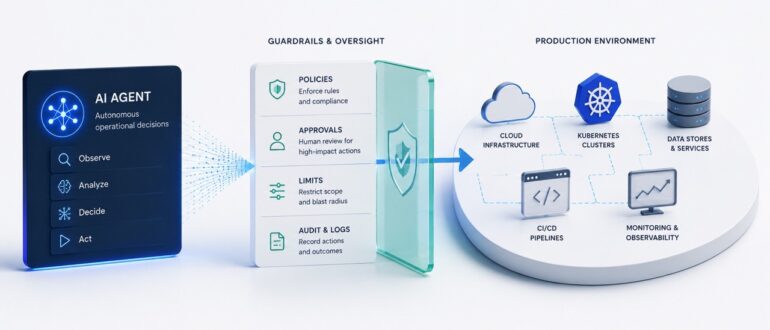
It wasn’t that long ago that AI assistants just watched from the sidelines. They could answer your questions, explain how things worked, sum up logs, and write deployment scripts. Handy, […]
Platform Engineering vs. DevOps: Why This Is the Wrong Question

DevOps has done what it was supposed to do. It broke down the wall between development and operations, it made continuous delivery a normal expectation, it made shared ownership of […]
Risk-Based Review for Infrastructure as Code Pull Requests

Not every infrastructure pull request deserves the same review path. A tag change in a development account and a network-policy change in production should not create identical reviewer load. When […]
The Death of the Four Golden Signals: Designing Telemetry for Non-Deterministic Infrastructure

In complex software systems, our traditional definition of operational health has always been comfortably binary. For over a decade, site reliability engineering (SRE) teams have relied on the industry-standard ‘Four […]
Why Enterprise AI Infrastructure Is Becoming a DevOps Problem

Most enterprise AI projects start with retrieval. You connect Jira, Confluence, SharePoint, and Slack. Maybe a few internal databases nobody has touched in five years. You tune embeddings, optimize chunking, […]
The Automation Layer Wants to Own Enterprise AI

Organizations want AI systems capable of prioritizing alerts, routing workflows, coordinating across applications, initiating remediation steps, summarizing operational data and adapting dynamically based on changing context. The system is no longer following a rigid set of instructions. It is participating in operational decision-making. That changes the operational risk profile dramatically. When deterministic automation fails, the blast radius is usually constrained. Probabilistic systems introduce a completely different level of complexity because behavior can evolve dynamically during runtime.
- « Previous Page
- 1
- 2
- 3
- 4
- …
- 13
- Next Page »