Tag: security

  • Shifting Left With DevSecOps: ESG Report Exposes Difficulties

    Shifting Left With DevSecOps: ESG Report Exposes Difficulties

    A recent report asks the tough questions about DevSecOps adoption, and the results are surprising

    In a world of increasing development velocity, companies are placing more responsibility on developers to enact quick deployments. Naturally, security is “shifting left” as well.

    Theoretically, DevSecOps sounds great, but it opens up many questions. Who exactly is responsible for security knowledge? Are cybersecurity training measures effective? Which tools excel at decreasing risk while maintaining release fluidity? Are AppSec tools aiding or adding unneeded friction?

    A report conducted by Enterprise Strategy Group (ESG) sought to answer these pressing questions and expose trends around application development security. The study surveyed 378 IT, cybersecurity and application development professionals at organizations in North America.

    I recently met with Chris Eng, chief research officer at Veracode, and Dave Gruber, senior cybersecurity analyst at ESG, to dig deeper into the report’s findings.

    Security vs. Development

    There is still friction when attempting DevSecOps in practice. Eng recognizes a disconnect between security and development teams.

    “Most security teams lack an understanding of modern application development practices,” said Eng. Security may not realize how regularly code is pushed or understand the intricacies of tooling within a CI/CD pipeline. On the flip side, developers may not be well-versed in common container exploits and vulnerabilities.

    Organizations are pretty split when it comes to application security testing ownership. Thirty-one percent of organizations dedicate security analysts to manage application security. The development manager and security team jointly own responsibility at 29% of companies. Developer managers follow at 26%, and individual developers at 13%.

    To Eng, these figures reflect an evolution from traditional security testing to the way things are changing with faster development cycles. “Go back 10-plus years, and we had a centralized, dedicated security team responsible for managing AppSec,” described Eng.

    In modern times, security is shared or even furthered where developers themselves run tools by hand or automate security within CI/CD processes. Large companies, Eng noted, now often utilize a mix of those practices.

    Paradox: Secure Yet Vulnerable

    Seemingly, the most eye-opening part of the report was a paradox. The report found that most teams give their application security a high rating (36% gave their application security programs a 9 or 10, with a 7.92 mean). Yet, the majority say they regularly push vulnerable code (48% of respondents knowingly push vulnerable code regularly).

    Though it’s counterintuitive, organizations may knowingly push out vulnerable code for many reasons. “You’ve promised a release, customers are waiting, ” said Eng. “Revenue is waiting. What are the implications of pushing that release?” Teams may not have time to fix vulnerable code, or it may simply not be worth it.

    Publishing vulnerable code may also be a symptom of placing testing too late in the release process. “That’s why there is this trend to shift left,” added Gruber.

    Gauging DevSecOps Success

    The above findings underscore a reality of IT security: To keep pace, software providers must accept a level of risk. In fact, business success may depend on it.

    “The effectiveness of the programs isn’t necessarily measured with how many times you’ve shipped your code with no vulnerabilities,” said Gruber. “Success is that we understand the risk, we have mitigated the risk at the level we believe is right for the organization, and have the right level of control over the process.”

    Companies must weigh the cost of improper DevSecOps and mitigate imminent risk to maintain release agility.

    Application Security Tools: Finding Balance

    At modern companies with quick-release cadences, “CI integrative security tools are way more prevalent and baked into the process,” noted Eng. Yet, 26% of respondents indicate security tooling friction and ineffective tooling usage.

    Whereas InfoSec teams are usually the ones dictating policies, developers have much influence in the tooling selection. Thus, tools must appeal to the developer experience, fitting into their established workflows.

    “We have to build a habit around it,” said Eng. Frictionless tools that continually scan within an IDE, for example, can enable developers to fix an issue on the spot and foster future behaviors.

    At the same time, you must set standards and avoid governance issues. This requires control and observability. “The balance here is that you want developers to be able to integrate something tightly into their toolchain,” said Eng. “But InfoSec needs a bird’s eye view on the organization.”

    Developers Lack Knowledge to Mitigate Issues

    Though security tools may reveal vulnerabilities, they don’t always correlate with remediation. The ESG report found 29% of developers lack the knowledge to mitigate issues identified by security tools.

    There is a clear gap in the market when it comes to developer education around security. This could stem from computer science schooling, in which cybersecurity is rarely taught alongside programming languages.

    On the job, hands-on developer security training is also spotty. Thirty-five percent say that less than half of their development teams are participating in formal training. Only 15% of organizations have developers actively involved in security training.

    Just giving developers a laundry list of vulnerabilities doesn’t help mitigation. For Eng, what organizations require is habitual, recurring training with hands-on tools. “Try to simulate or provide a real-world environment for learning, identifying and patching these issues,” recommended Eng. Integrating tooling within the daily developer workflow can help with knowledge retention, because “if you don’t use it, you lose it.”

    Other best practices will only arise with a security habit. For example, most development environments ship with open defaults. “You need security training and tools to understand to restrict that appropriately,” noted Eng.

    That said, a wide variety of security tooling is already advancing this process. For example, 56% of organizations use API security vulnerability (ASV) scanning to identify and mitigate risk associated with API usage, helping secure applications as developers code dependencies.

    Final DevSecOps Thoughts

    The ESG study found 43% of participants believe DevOps integration is most important to improving AppSec programs. Yet, siloed roles and a lack of security education mean DevSecOps must still mature quite a bit to meet the security-shift-left vision.

    Other eye-opening findings included:

    • More than half of respondents (54%) use automated controls to identify and quarantine vulnerable images in their image repository.
    • The proliferation of AppSec tools on the market is a significant problem for 30% of companies.
    • AppSec spending is increasing, yet only 30% will protect more than three-quarters of their codebase 12 months from now.

    For more findings, check out the ESG Survey Report: Modern Application Development Security.

  • Can NetOps and SecOps Finally Get Along?

    Can NetOps and SecOps Finally Get Along?

    For years, the very definition of NetOps and SecOps has involved friction and even contentious relationships that make their respective jobs more difficult and lessen their efficiency and effectiveness. Much of this conflict originates from having charters that are seemingly in opposition to each other. At the surface, NetOps stands for connectivity, openness, speed and capacity. In contrast, SecOps comes across as binary opponents, posting for far too many regulations with segmented connectivity and a more or less closed or impaired environment.

    The truth is, however, both groups have the same goals:

    • Ensuring business operations and agility.
    • Protecting resources.

    The network is only important in its ability to connect users, systems, applications, information or data and other resources, ensuring effective business operations and agility. The network is means to an end, and not necessarily an end to itself. In a somewhat similar way, security is also not an end, but, rather, the means to an end. Security exists to protect these same users and resources. It’s all about the users and resources being able to run business operations effectively and with the agility and flexibility necessary to give it strategic advantages. Reflecting on this perspective may help NetOps and SecOps realize that they are not so far apart from each other.

    Both NetOps and SecOps struggle with many of the same issues. Both are usually overworked and understaffed, responsible for critical components or aspects of business, face constantly changing environments and challenges and slowed by cumbersome processes and a lack of agility. Because of these things, NetOps and SecOps are largely in the same boat, sharing the same storm.

    netops secopsThe lack of agility is a particularly important issue, as new technologies and techniques are constantly being developed that enable security teams to stay ahead of—or at least keep pace with—attackers. Motivated attackers tend to be far more innovative that defenders and can use anything at their disposal to accomplish their goals. Entire cybercriminal supply chains exist to provide attackers with applications, utilities, routines and even services to conduct their campaigns. These things can and will be used against defenders.


    On the other hand, deploying a new security solution on the network is generally a long, involved, cumbersome process. Even changing solutions involves considerable effort. Sometimes the rules or process gets invented along the way, compounding the difficulties. Additions or changes to the network involve tedious review processes mostly dictated by NetOps. The NetOps team also faces some of these same difficulties in adding or changing network management or monitoring solutions.

    While a careful review is warranted, current processes are too time-consuming and involved. One significant improvement can come from NetOps and SecOps coming together with an established and codified approach for network changes or additions. Getting issues out on the table for discussion is a great start. This means more collaboration and a joint learning cycle on short- and long-term organizational objectives. Both groups need to understand and appreciate the concerns of the other and realize their common ground. Prioritizing issues and agreeing on a fundamental set will ease the overall process, reduce unwarranted fear and antagonism, and eliminate much of the inventing the process on the fly.

    An emerging approach seeks to establish a centralized deployment point for both networking and security solutions with pre-established rules agreed upon by both teams. Ideally, many of the concerns can be addressed or mitigated by hardware and software designed to enforce policies or rules, provide failover as necessary, prevent performance degradation or add to the attack surface. These can allow solutions to drop into the network while offering guarantees of performance or availability.

    Streamlining deployment of shared management will result in much-needed agility and also boost efficiency and overall effectiveness. It will also lessen the typical tensions or outright opposition.

    NetOps and SecOps are much closer to each other than either realizes. Their shared guardianship of users and resources can benefit from joint discussions, plans, tools and policies. Not only can they better accomplish their own charters of connecting and protecting while providing agility and flexibility, but they also can become far more efficient with their operations. They need each other, and their organizations need the vital contributions from both. As typically said in security jargon, “A chain is only as strong as its weakest link.” The new paradigm of security-driven networking is about preventing weak links through the collaboration and synergy between NetOps and SecOps.

  • Survey Surfaces Root Causes of DevSecOps Tension

    Survey Surfaces Root Causes of DevSecOps Tension

    Results of a survey published by SaltStack, a provider of IT automation tools, suggests tensions between cybersecurity and IT professionals on the one side and DevOps teams on the other are running high. According to the survey of 130 cybersecurity and IT leaders, 70% of respondents said their organization is sacrificing data security for faster innovation, with most cybersecurity and IT managers making a case for prioritizing data protection over innovation, speed to market and cost.

    Alex Peay, senior vice president for product at SaltStack, said that while it’s unlikely cybersecurity and IT leaders will be able to slow down the pace of innovation within their organizations, the survey results make it clear IT organizations are struggling to keep pace.

    On the plus side, the results also show that cybersecurity and IT operations teams are working more closely together. More than half—54%—of cybersecurity leaders said they communicate effectively with IT professionals, while 45% of IT professionals concurred.

    Best DevSecOps processes are, of course, meant to bridge the divide between DevOps teams and the rest of the IT organization. The expectation is that by pushing more responsibility for cybersecurity to the left, the pressure on cybersecurity and IT teams would be reduced. However, DevSecOps adoption remains nascent at best—many DevOps teams still don’t have the tools required to implement security controls programmatically within their applications.

    Even when they do have the tools needed to add security controls, organizations need to set up workflows that will enable cybersecurity teams to verify that those controls have been properly implemented. Given the chronic shortage of cybersecurity expertise, the rate at which applications are being deployed and updated easily overwhelms the amount of time cybersecurity teams have available to analyze modules of code that are now often updated several times a week. Most cybersecurity teams are already struggling to keep pace with patches for existing applications, let alone any new application modules.

    Of course, there’s not a lot of love lost between developers and cybersecurity teams. DevOps teams generally blame cybersecurity teams for slowing down the rate at which applications are deployed. In fact, one of the primary reasons DevSecOps is gaining traction among developers is that it represents a way to remove cybersecurity professionals from the application development process.

    Cybersecurity professionals, conversely, often view application developers as the root cause of the cybersecurity problem. Too many developers are reusing modules of code without first making sure those modules have been updated to address a known vulnerability. To add insult to injury, whenever a new vulnerability is discovered days, weeks or even months may go by before developers address it. To be fair, however, cybersecurity professionals are not especially adept at prioritizing vulnerabilities; as far as developers are concerned, the list of vulnerabilities presented is just one in a series of bugs that need to be addressed. Unless otherwise directed, developers will focus on bugs that impact features and performance before a potential security issue that has yet to manifest itself as an issue impacting end users.

    In general, advances in DevSecOps are being made that should provide some much-needed relief to IT and cybersecurity professionals. It’s just slowing down the rate at which applications are deployed and updated might not be one of them.

  • ClickShare Vulnerabilities May Have Been Patched, But They Mask a Much Bigger Problem

    ClickShare Vulnerabilities May Have Been Patched, But They Mask a Much Bigger Problem

    I think we can all recall a time in recent memory where, in a meeting or at a conference, someone has had issues with presentation technology. It happens so often that there is almost an expectation of a clunky experience, at least initially. It stands as no surprise, then, that ClickShare’s seamless app was immediately popular with end-users. For them, there is nothing easier than using a ClickShare application to push a presentation from their laptop, tablet or smartphone over to a big screen or conference room projector.

    Belgian-based digital projection and imaging technology supplier Barco designed their automation platform to work that way, and big business embraced the concept. FutureSource Consulting puts Barco’s market share in conference technology at 29%, with integration into 40% of all Fortune 1,000 companies.

    When researchers from F-Secure revealed in December that the seemingly innocuous automation platform was riddled with security vulnerabilities, it sent shockwaves through the business community. The uncovered security flaws are critical in nature, and could potentially enable any number of malicious activities. 

    Researchers demonstrated how the vulnerabilities could allow remote users to snoop active presentations, create backdoors into secure networks or even configure a spyware distribution server that would infect every user connecting to a Barco device. Suddenly, companies were faced with the prospect of having serious security problems installed directly inside conference rooms and offices throughout their organization. And because of the nature of the vulnerabilities, a single compromised device could support a network-wide breach.

    “An attacker who successfully compromised one unit gains the ability to decrypt as well as produce valid encrypted images for any unit, whether within one family or across families,” wrote F-Secure officials in their report. “Further, such an attacker may gain access to sensitive data at rest such as the configured WiFi PSK and certificates.”

    To its credit, Barco has been extremely proactive in issuing patches and fixes to the vulnerabilities found within its products. Security vendor Tenable recently released a report showing 15 vulnerabilities across eight presentation tools, including Barco. As of February, only Barco has been active in deploying fixes.

    Although some of the Barco vulnerabilities require hardware changes (and these will be a nightmare to deploy, if a firm acts to this degree to secure them at all), many of them can be corrected with software patches. This gives most enterprise users a seemingly good plan to fix their immediate problems, but they are hardly in the clear now. The problems with Barco are just the tip of the iceberg when it comes to dealing with vulnerabilities in well-known hardware and software products.

    The Root of the Problem

    Now that the immediate issues have been resolved, we need to ask how devices with serious security flaws ended up sitting in thousands of conference rooms worldwide, or why they were so poorly designed and programmed in the first place. It’s not like the F-Secure team was uncovering zero-day or previously unknown vulnerabilities. Ten of the flaws discovered in the Barco products were associated with well-known, common vulnerabilities such as code injection attacks. Most already had Common Vulnerabilities and Exposures (CVE) identifications.

    So how did decades-old CVEs get coded, or even hardwired, into modern presentation tools? The only possible answer is that developers either didn’t know about them, or that security was not made a priority as the Barco devices were being designed. Sadly, this is a common situation, and certainly not exclusive to the Barco teams.

    The best time to fix a vulnerability is while an application is being developed, long before it gets sent out to users. The worst (and most expensive) time is after a product has been deployed, or after it’s been exploited by hackers. This can be a hard lesson, and one that Barco will surely learn as its once-impenetrable market share takes a hit following this security fiasco.

    Shifting security fixes back toward the development process isn’t easy, but is necessary in today’s world where even seemingly simple devices like presentation tools are both surprisingly complex, and also networked into everything else. In this environment, security must become an organizational best practice. It doesn’t matter if a company is programming apps for social media or manufacturing smart toasters, security must be considered in every facet of an organization.

    Prioritizing security best practice and making it a shared responsibility is the goal of the DevSecOps movement, where development, security and operations teams work together to code and deploy secure software and products. It requires as much of a change in culture as anything else. The new mindset needs to be that deploying a working product with security vulnerabilities is just as much a failure as creating one that can’t perform its primary function.

    In a healthy DevSecOps environment, anyone touching software should be security-aware, with developers receiving relevant and frequent training to avoid introducing disastrous bugs into their work. If the teams working for Barco had looked at security as a shared responsibility, there is no way that such a large collection of vulnerabilities, including decades-old CVEs, would have made it into their presentation tools.

    The Safe Path Forward

    Nobody wants to be the next Barco, having to explain why well-known security flaws were deployed through their devices to thousands of enterprise networks around the world. To avoid that fate, companies developing software or smart hardware should immediately prioritize security as both a shared responsibility and an organizational best practice. Creating a healthy DevSecOps program will take time and likely also require a shift in culture, but the results will be more than worth the effort. Robust DevSecOps can crush vulnerabilities long before they cause trouble.

    For companies buying products and software, it’s in their best interest to support firms that have embraced DevSecOps. Doing so will go a long way to making sure that the devices and software obtained from them aren’t ticking time bombs waiting to be exploited by increasingly skilled attackers.

  • Free Remote Endpoint Protection Solution From Qualys

    Free Remote Endpoint Protection Solution From Qualys

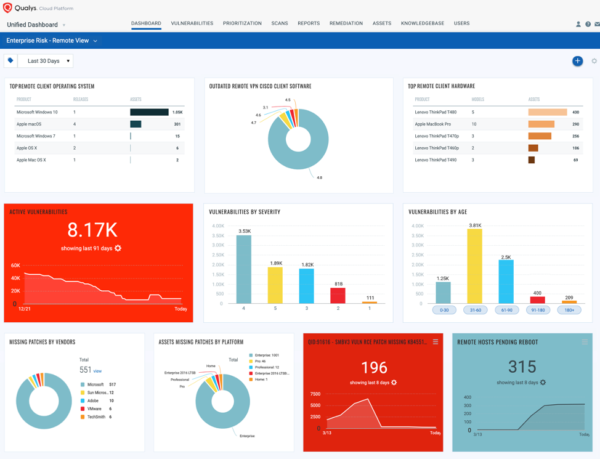
    Qualys today announced it is offering a completely free, 60-day version of its cloud-based remote endpoint protection solution. The product is fully featured, with nothing turned off in the free version. It’s also cloud-based, so there are no worries about hosting the solution. This comes at a perfect time, with so many workers working remotely.

    You can download the free solution at:

    www.qualys.com/forms/remote-endpoint

    According to the Qualys release:

    “The Qualys remote endpoint security solution allows security teams to leverage the lightweight Qualys Cloud Agent to:

    • Complete an up-to-date inventory of all their remote endpoint hardware and the applications they are running
    • Gain a real-time view of all critical vulnerabilities impacting the operating system and applications posing a risk to these devices
    • Remotely patch these systems within hours from the cloud with one click of a mouse without using the limited bandwidth available on VPN gateways
    • Realize visibility in device hygiene by tracking common misconfigurations that leave the endpoints exposed to exploits.”

    staging-devopsy.kinsta.cloud spoke with Qualys President Sumedh Thakar for more information on this new free solution. That conversation can be heard below:

    Here’s a screenshot of the web-based interface of the solution:

    Qualys endpoint screen shot

    What happens after the 60 days you ask?  Qualys did not say definitively what the plan is for that, but I suspect that will depend on what happens with our economy and the work-from-home trends. In the meantime, if you are looking for a remote endpoint solution for the enterprise, this is a great chance to try one free for 60 days.

    — Alan Shimel

  • Catch Emerging Security Risks Earlier by Leveraging Kubernetes Audit Logs

    Catch Emerging Security Risks Earlier by Leveraging Kubernetes Audit Logs

    When a Kubernetes deployment suffers a security breach, it can be difficult for security teams to diagnose and identify the source of the intrusion and its impact. Each Kubernetes cluster may host multiple applications, and each application may be composed of dozens or even hundreds of interacting microservices deployed as pods.

    The complex and dynamic communication between the applications’ components, as well as the automated Kubernetes orchestration activities, makes it difficult to understand the structure of each application and differentiate between normal behavior and malicious behavior from the observed network activity. The ephemeral nature of pods, which may exist only for moments to perform an activity before they are disposed of, makes this task even more difficult. A pod that was vulnerable may be gone by the time security teams are investigating a breach, or resume normal operation as the attacker pauses its abuse or pivots or escalates the attack to another Kubernetes resource.

    K8s is by nature dynamic, flexible and scalable, and it is this same advantage for cloud native application developers that becomes a challenge for security professionals. How can one understand the source of a breach, let alone how it propagated through the system, without deep understanding of the architecture of the application?

    One solution to the problem of tracing breaches is to examine the Kubernetes audit logs since they record all cluster-administration activity, even for pods that may have existed for seconds and are now gone. But K8s audit logs are complex and often convoluted, requiring deep expertise to understand. Therefore, security teams need to not only increase their proficiency with K8s audit logs, but also to apply automation and software tools to the K8s logs to detect suspicious behavior after the fact and even during their occurrence.

    In fact, there are many potential threats that can be discovered when observing audit logs for suspicious behavior. They include:

    • Stolen or misused credentials, enabling hackers to gain access to K8s-based clusters or pods.
    • Misconfigured Rules Based Access Control (RBAC), enabling lateral attack propagation, privilege escalation and unauthorized data access or manipulation.
    • Exploitation of vulnerabilities in the Kubernetes API Server, enabling bypassing of authentication, authorization, admission control or validation of cluster administration requests. This lets users gain access to privileged and sensitive resources.
    • Violations of security policies diverge from compliance requirements and best practices.

    Detect Breaches in Near Real Time by Watching K8s Audit Logs

    There may be a vast time span between an initial breach and the detection of the compromised application or the unauthorized access of secure data and private information. Security teams must seek to close the gap between a breach attempt and its detection as much as possible, while still being able to diagnose the causes of a breach after it has been detected and assess its scope and impact.

    Since K8s deployments can be vast and intricate, machine learning and artificial intelligence are preferred tools to monitor audit logs and flag suspicious behavior. An automated tool could continuously scan logs to learn what normal behavior looks like in the company’s clusters, and then flag network behavior that is unusual or suspicious for security teams to qualify, prioritize and investigate. This methodology would enable security teams to investigate possible security violations in near real time to protect and secure the applications.

    In addition to detecting security risks, security tools that leverage K8s audit logs should provide reporting that is easy to understand and consume by security teams. By providing the correct user experience, companies can make their K8s logs accessible to more than the hard-core experts, effectively opening a new vista of security possibilities for more security professionals. The difficult learning curve of Kubernetes will no longer be a wall between K8s pros and newcomers with less experience, relieving pressure from understaffed security teams.

    Step Up to Security and Compliance Needs

    As Kubernetes moves toward the mainstream, with roughly 71% of Fortune 100 companies using Kubernetes as their main container orchestration tool, companies must also look toward compliance with standards and government regulations designed to protect financial transactions and private or personal information such as PCI, GDPR and HIPPA. The penalties for violating these standards and regulations can be severe, so companies should proactively adopt K8s audit log monitoring as a way to identify breaches earlier, to limit their impact on customers and data, and to document the behavior of the application and would-be hackers for possible legal inquiries. An effective audit log strategy will be vital in determining what happened in the case of a breach.

    Leverage Audit Logs for Real-Time Security Observability in K8s

    Many tools exist to secure the perimeter of the data center and to identify possible security risks during application development. The benefits of analyzing and leveraging Kubernetes audit logs at runtime have been relatively overlooked. K8s audit logs are a prime way to comprehend the behavior of any cloud-native application orchestrated by Kubernetes, as well as the best way to comprehend how the Kubernetes infrastructure itself can be abused by an attacker to compromise the applications it is hosting. As such, security teams have a responsibility to deploy tools and gain a proactive, real-time view into K8s audit logs in order to minimize the time between breach and remediation and to validate compliance conformance at runtime. Such a thoughtful approach to Kubernetes security will go a long way to protect your deployments from harm.

    To learn more about containerized infrastructure and cloud native technologies, consider coming to KubeCon + CloudNativeCon EU, in Amsterdam. The CNCF has made the decision to postpone the event (originally set for March 30 to April 2, 2020) to instead be held in July or Aug. 2020.

    — Nitzan Niv

  • Better Apps and Better Security When You Shift Left

    Better Apps and Better Security When You Shift Left

    Tens of thousands of people and hundreds of cybersecurity vendors descended on San Francisco at the end of April. While the RSA Conference was the primary draw, there are a number of peripheral events that go on throughout the week as well, such as the Cloud Security Alliance Summit, the CIO/CISO Interchange, BSides San Francisco and the Qualys Security Conference.

    I was able to attend some of the Qualys Security Conference and I had the opportunity to see Alex Mandernack, security solution architect for product management at Qualys, presenting on the need to shift left when it comes to cybersecurity.

    Mandernack outlined some of the issues organizations face today when it comes to security. Migrating to the cloud and embracing DevOps culture means more ephemeral, elastic environments and compressed development time frames. He pointed out that these trends make security more challenging, but also described the opportunity they present to change our approach to streamline and improve security.

    The Traditional Pipeline is Broken

    The traditional model of application development is much more linear. Each app team builds their own image—often in a silo or vacuum disconnected from other teams. Penetration testing is conducted on a sporadic or infrequent basis, and eventually the app is deployed. Vulnerability scans are run on the app in production, and issues or deficiencies are reported back to the developers to address or incorporate into the next build.

    The process is slow and cumbersome. It also has the potential to introduce redundancies that waste resources and make the organization less efficient. As companies embrace DevOps and move to the cloud, the traditional development pipeline simply doesn’t work—especially not for security.

    DevOps, and Cloud, and Containers — Oh My!

    The cloud and DevOps fundamentally change the development lifecycle. Development time frames are compressed, and the process is a self-feeding, iterative circle rather than a repeating linear approach. The traditional approach of identifying and resolving security issues after an application is deployed won’t work in a DevOps environment because by the time issues are identified and fixed, the app itself may have already moved on to the next version.

    Cybersecurity and the development pipeline have enough challenges with the cloud and DevOps, but there is also a newer technology trend that exacerbates the problem—containers. Containers are designed to get code quickly and to operate fast. They are also built for scalability—spawning and spinning down hundreds or thousands of containers constantly to keep pace with demand.

    There is a diverse array of tools and platforms associated with cloud, DevOps and containers. Organizations often employ a complex collection comprised of some combination of AWS, Azure, Docker, Kubernetes, OpenShift and others. The result can quickly become a black hole when it comes to security—which is why it’s important to push security left into the CI/CD pipeline.

    Shift Left to Help Security Teams Do Better

    In a DevOps culture, developers and security teams need to think about security sooner. It’s important to get the security tools into the process earlier. Thankfully, with the DevOps lifecycle and the tools commonly used within a DevOps environment, it can be done.

    For starters, companies should build a golden image. Developers shouldn’t have to patch and update the base operating system before they even start developing. The golden image takes a baseline operating system such as Ubuntu or CentOS, and completely patches and configures it so everyone has a standard, consistent image to develop on.

    With the golden image in place, the next step in shifting security left is to implement testing and scanning in the CI/CD pipeline. Put vulnerability information at the fingertips of developers as they’re developing and implement vulnerability gates in the pipeline to ensure that applications that don’t comply with policies and meet minimum requirements are not allowed to be deployed.

    New Role of the Security Team

    Part of shifting security left includes providing tools that make security self-service for the DevOps team. Automating actions with scripting, APIs and CI plugins ensures that security is simplified and streamlined to provide value for developers.

    In this shift left scenario, the security team has to redefine its role in the process. The security team is still vital, but rather than being the police or a roadblock in the development process, the role of security focuses on verifying and auditing the process. The security framework should have dashboards and live data that enable the security team to monitor activity and identify trends that may need further attention.

    Better Security, Faster

    There is often conflict between developers and security teams, but there doesn’t need to be. Mandernack stressed that developers don’t want to create insecure apps either.

    Shifting security to the left into the CI/CD pipeline streamlines the whole process. Ultimately, the result is higher quality, more secure applications that are developed faster.

    — Tony Bradley

  • The Risks and Potential Impacts Associated with Open Source

    The Risks and Potential Impacts Associated with Open Source

    Open source software (OSS) is built by communities of developers who contribute their knowledge and time to OSS projects they find appealing. That code can then be used by individuals, communities and organizations in their software products—the only obligation they have is to play under the rules of the license with which the OSS project was published. 

    This type of knowledge sharing brings many benefits to OSS users as it speeds up software development time and can help companies become more competitive in the market. Unfortunately, there is also a catch. Those benefits also come with certain risks which every OSS user needs to be aware of and take necessary actions to mitigate.

    The OSS License

    One specific risk to consider involves the OSS license. Not knowing what your obligations are under the license (or not abiding by those obligations) can cause an OSS user to, for example, lose intellectual property or experience a monetary loss.

    Operational Impact on the Product

    Another risk is the operational impact that the OSS in use will have on the product. It’s important to understand whether the community is consistently managing the OSS project and its issues in a timely manner, and that your organization has implemented the latest version and deployed patches have been applied. Using out-of-date, unpatched or unmaintained OSS could impact your release capabilities, product quality and customer trust.

    Security Vulnerabilities

    The third risk to consider when using OSS is that of security risk. As open source is software—and in many cases very complex software—it brings with it the possibility of introducing software security vulnerabilities into your source code. Some vulnerabilities can be introduced into your projects through dependencies that the OSS your organization is using has on other OSS projects. Additionally, vulnerabilities could be unintentionally introduced by developers as they code a functionality using open source. The reason for this is that software developers, whether professionals or hobbyists, oftentimes do not consider security while coding. This has a substantial impact on their work and their contributions to open source projects. 

    It’s not necessarily that developers intentionally skip the implementation of security procedures. Secure coding is a specific discipline in software development that guards against the accidental introduction of vulnerabilities—a discipline that must be learned. 

    Understand that many developers are self-taught or have been trained in schools and universities (where we are only recently seeing courses in software and application security emerging). Many use their software development skills as a hobby, to contribute to OSS projects or to pursue their own personal projects. Unfortunately, training programs, programming courses in schools and online tutorials often neglect to convey this knowledge or to stress the importance of building secure software. 

    It’s also important to note that many organizations find it difficult to introduce a secure coding discipline into their software development process. In other words, this struggle persists beyond open source projects. If you’re with an organization experiencing this pain point and unsure where to begin, you’ve come to the right place. There are several strategies that can be used to begin your secure coding journey. 

    Training

    By giving developers the education required for them to become security aware, you’re setting them up for consistent, secure development success. There are a variety of in-person and computer-based training options on the market.

    Software Composition Analysis (SCA) Tooling

    Implementing an SCA tool will uncover incorrectly coded strings or vulnerabilities that have been introduced in code or OSS components. Not only can SCA tools assist developers in identifying potential software risks, some SCA solutions can help to train developers by offering remediation guidance or short training videos on how to avoid such vulnerabilities in the future.

    It’s essential for software issues to be discovered early because the deeper into the process they’re identified, the more time-consuming and costly they are to remediate. As such, in recent years there has been a push to shift left, introducing security into the product development life cycle from the very beginning. 

    Companies and individuals need to also understand that this security mindset doesn’t start and end in the coding phase of the development process. A security mindset needs to be a part of every phase: from design to deployment to maintenance, all the way through to the product’s end of life. 

    Emphasizing a security mindset also has a long-term, broad reaching positive effects on the whole software development ecosystem, including the OSS world. As developers are trained to code securely (through university courses and other training institutions, coding portals or professional development through their employer) they pass this knowledge on to the projects with which they’re involved. This then leads to the production of higher quality proprietary and open source software, which in turn minimizes risk across the board.

    — Boris Cipot

  • DevSecOps: 10 Best Practices to Embed Security into DevOps

    DevSecOps: 10 Best Practices to Embed Security into DevOps

    For companies that employ the agile approach, DevOps seems like a natural extension. Traditionally, enterprises started with integration, development and test automation early in the product lifecycle. Gradually, the agile delivery team took care of iterative development and monitoring practices that increase code quality.

    Today, organizations work in unison to bridge the gap between development and operations (DevOps). They want to offer a faster market delivery with the least human interaction. 

    But what about security integrations? Is there a way to mitigate vulnerabilities early in the development lifecycle?

    The answer is DevSecOps.

    Exploring the Concept of DevSecOps

    DevSecOps is short for development, security and operations. It brings together people, processes and technology to pursue a shared objective. 

    The objective of DevSecOps is to implement security decisions on the same scale as development and operations and make everyone in the product lifecycle accountable for security. 

    Why Should You Adopt DevSecOps?

    People adopt DevSecOps because they are seeking:

    •  Modern alternative to traditional security engagement.
    • Transparent collaboration and workflows during development.
    • Security that’s built into the product, not applied at the final stage. 
    • Reduced expenses and faster delivery rate. 
    • Faster recovery speed in case a threat is detected.

    Steps to a Typical DevSecOps Workflow

    1. A developer starts by writing code within a version control system.
    2. Any required change is committed to the version control system.
    3. Another developer analyzes the code to identify any security defect that may weaken code quality. 
    4. An environment is created to deploy and apply security configurations to the system.
    5. Next, a test automation suite is executed to evaluate the newly deployed application.
    6. After it passes the automation test, the application is deployed to a production environment.
    7. This new production environment is actively monitored for security threats. 

    While there is no right way to transform organizational culture, below are a few components necessary to sustain a DevSecOps environment: 

    Let Developers Get Security Right: Developers are responsible for security. Therefore, you must keep them on top of cybersecurity best practices through continuous training and learning activities. 

    Promote an Open Culture: Openness in communication within the enterprise environment can drastically improve development and security. One way to keep information transparent is by using metrics and dashboards wherever possible. 

    Get Experts on Board: It is extremely difficult to transition from DevOps to DevSecOps without the supervision of expert security professionals. Hire people who understand security within the development and operations environment and let them train your DevSecOps team for the big transition. 

    Tempted to embed security into DevOps? How do you ensure that the best practices are followed? We have answers.

    The Best Way to Implement the DevSecOps Process

    Gather a single group of professionals (admins, developers, security engineers and testers) that are aware of your product from start to end. They should know your requirements and should be experts in deploying, monitoring and implementing new changes. 

    Once you have your team ready, here’s what you need to do next.

    Plan

    Planning is crucial. Do not just stick to feature descriptions. Instead, go for detailed user stories that include:

    • Functional and nonfunctional requirements (e.g., security and performance).
    • UI and UX designs.
    • Acceptance test criteria.
    • Threat models.

    Develop

    Start by evaluating your existing practices. Choose the best resources to build a development model in coherence with security guidelines. 

    Build

    Automated build tools can do a lot more than compile codes. Use them to conduct test-driven development, enforce quality standards and ensure that the best security practices are implemented through static code analysis. 

    Test

    When it comes to a DevSecOps environment, test automation is not limited to UI-focused Selenium tests. Optimally, your security practice should include the following:

    • Unit testing.
    • Front-end testing.
    • Back-end testing.
    • API testing.
    • Database testing.
    • Passive security testing.

    Secure

    Because development, operations and security go hand in hand, only a few issues are left unattended toward the end of the development process. 

    When vulnerabilities are identified, there is a better chance of determining if they are potential exploitations or false positives. 

    Deploy

    Automated provisioning and deployments can be utilized to accelerate product delivery and add consistency in the development process. Using an infrastructure-as-code tool, one can audit properties across the IT infrastructure and enforce secure configurations in a system. 

    Operate

    Routine maintenance and upgrades should be an indispensable component of your operations team. Leverage infrastructure-as-code tools to patch zero-day vulnerabilities and apply updates to the entire organization’s infrastructure. 

    Monitor

    A continuous monitoring plan should be in action to generate real-time stats of how your system is performing. In case any exploitation is recorded, it can be addressed immediately. 

    Scale

    Traditional data-center operations cannot entirely replace a compromised environment. Today’s ability to scale infrastructure through virtualization and the cloud, while addressing the demands of modern-day IT user base, should go a long way. 

    Adapt

    When it is about sustaining an agile practice, continuous improvement is key. This is also true for DevSecOps practices, as you improve and adapt throughout the software development lifecycle.

    Conclusion

    DevOps isn’t going anywhere, anytime soon. It is the new phase of developing, releasing and updating products in a software lifecycle. 

    That’s why high time security professionals let go of the traditional security stack and embrace security solutions at the speed of DevOps.

    — Deepak Gupta

  • The Road Ahead for Security, DevOps Transformation

    The Road Ahead for Security, DevOps Transformation

    Qualys hosted its Qualys Security Conference 19 this week in Las Vegas. Hundreds of attendees from around the world have gathered at the Bellagio hotel to learn more about the current state of cybersecurity and what the future has in store. As you might expect, given the technology landscape today, many of the sessions and discussions have revolved around DevOps and how cybersecurity can adapt to DevOps culture.

    Scott Crawford Qualys Security Conference
    Scott Crawford, Research Vice President at 451 Research presents “The Road Ahead for Security, IT, and DevOps” at the Qualys Security Conference

    The Shifting Technology Ecosystem

    Scott Crawford, research vice president at 451 Research, opened day two of the Qualys Security Conference with his keynote, “The Road Ahead for Security, IT, and DevOps.” Crawford talked about the dramatic changes over the last decade or so—from monolithic to microservices, from standalone applications to integrated software, from Waterfall to Agile, enterprise networks to IoT / OT, from standard networks to 5G wireless, and from traditional IT to DevOps. He discussed the challenges organizations face and the dilemma of doubling down on past success and missing out on innovation.

    With all of the changes from this shifting technology ecosystem, there are consequences. Organizations no longer have a single point of control and IT teams are faced with managing and protecting an increasingly complex web of interconnected platforms, applications and services.

    Security and DevOps

    Crawford also talked about the rise of zero trust. He described it as a sort of mashup of the concept of least privileged access, combined with behavioral analytics and an on-demand, just-in-time approach to managing access. The zero trust paradigm is based on the premise of never trust, always verify—and that means determining who is requesting access, under what conditions they’re requesting access and what actions they intend to perform with that access on a case0-by-case basis.

    He shared the Xebia Labs Periodic Table of DevOps tools to illustrate the overwhelming number of options available and stressed the importance of automation. CI/CD (continuous integration/continuous deployment), RPA (robotic process automation), and SOAR (security orchestration, automation and response) solutions have been developed to help address and manage some of the complexity of both DevOps deployments and cybersecurity.

    Xebia Labs Periodic Table of DevOps Tools
    Xebia Labs Periodic Table of DevOps Tools

    DevOps and Digital Transformation

    Crawford’s keynote was followed by a presentation titled, “The DevOps Transformation of the Qualys Platform: Lessons Learned.” Dilip Bachwani, senior vice president of engineering and cloud operations for Qualys, talked about how the company has addressed the “innovator’s dilemma” and steps it has taken to deal with growing pains as it goes through its own digital transformation.

    Bachwani explained that the engineering team at Qualys has expanded exponentially in a relatively short period. That comes with several benefits in terms of how quickly they can develop and implement new solutions, but the team also faced challenges with balancing that growth and trying to maintain velocity at the same time without sacrificing stability or reliability.

    Just like every other organization going through a DevOps transformation, Qualys has had to break down silos with people, processes and tools. Bachwani explained that they needed to do things differently to automate as many functions as possible. They decided to view infrastructure and operations as software problems and find ways to fully automate deployment and configuration.

    He also emphasized that security must be built in throughout the DevOps life cycle. Qualys adopted a hub-and-spoke DevOps model and developed a robust DevOps toolchain designed to combine and orchestrate an effective set of tools for developing, delivering and maintaining software. Having a standardized toolchain ensures that there is a common platform available to everyone.

    Accelerating Transformation With Citizen Developers

    At the end of Crawford’s keynote, he talked about the lack of people with the right knowledge and skills. Cyber Security Ventures predicts that there will be 3.5 million unfilled cybersecurity jobs by 2021. That’s just cybersecurity. What about developers and other key personnel? Crawford posed the question, “Where will we find the people to do it all?”

    The answer, he said, is citizen developers. What is a citizen developer? It’s a movement to empower employees who are not developers by trade with the tools and support to implement ideas. They are the ones closest to the problem and, arguably, best equipped to understand how to solve it. They don’t need to be professional developers or need experience with coding environments. Low-code and no-code platforms give them the power to turn ideas into solutions.

    A few years ago, George Hulme wrote an article on the growing citizen developer movement. Hulme noted, “The organizations that succeed with citizen development will be those that wholeheartedly embrace the movement and cultivate it, with IT’s help and guidance.”

    The DevOps revolution isn’t going away. Companies that don’t embrace digital transformation will likely fade into oblivion as they are left in the dust by more innovative competitors, and organizations that don’t figure out how to integrate security into the fabric of their culture will struggle against a rapidly expanding and evolving threat landscape.

    At this point, these things are like the ocean tide. It is coming whether you like it or not, and it will destroy those who are not prepared. Crawford wrapped up by asking the audience to consider what their role is going to be in building and maintaining the future of DevOps and cybersecurity.

    — Tony Bradley