Tag: software development

  • Rookout Tool now Debugs Third-Party Code

    Rookout Tool now Debugs Third-Party Code

    Rookout revealed today it has extended its eponymous debugging tools to include third-party applications.

    Shahar Fogel, Rookout’s CEO, says most organizations today are building applications that rely heavily on code or modules developed by a third party. Rookout now makes it possible to analyze and debug that code before it is incorporated within a larger application environment, Fogel said.

    That’s crucial, because many of the operational issues a DevOps team is likely to encounter can be traced to flawed code written by someone outside of the IT organization, Fogel said. This new capability will reduce the amount of time DevOps teams spend trying to deduce the root cause of an issue, he said.

    Many IT organizations erroneously assume that all the code running in their environments has passed through a continuous integration/continuous deployment (CI/CD) environment, Fogel said. In reality, it’s not uncommon for developers to deploy code directly into a production environment in the name of expediency. Not all of that code, however, may have been written by the developer. Many developers wrongly assume the code they download from a repository was properly vetted and debugged.

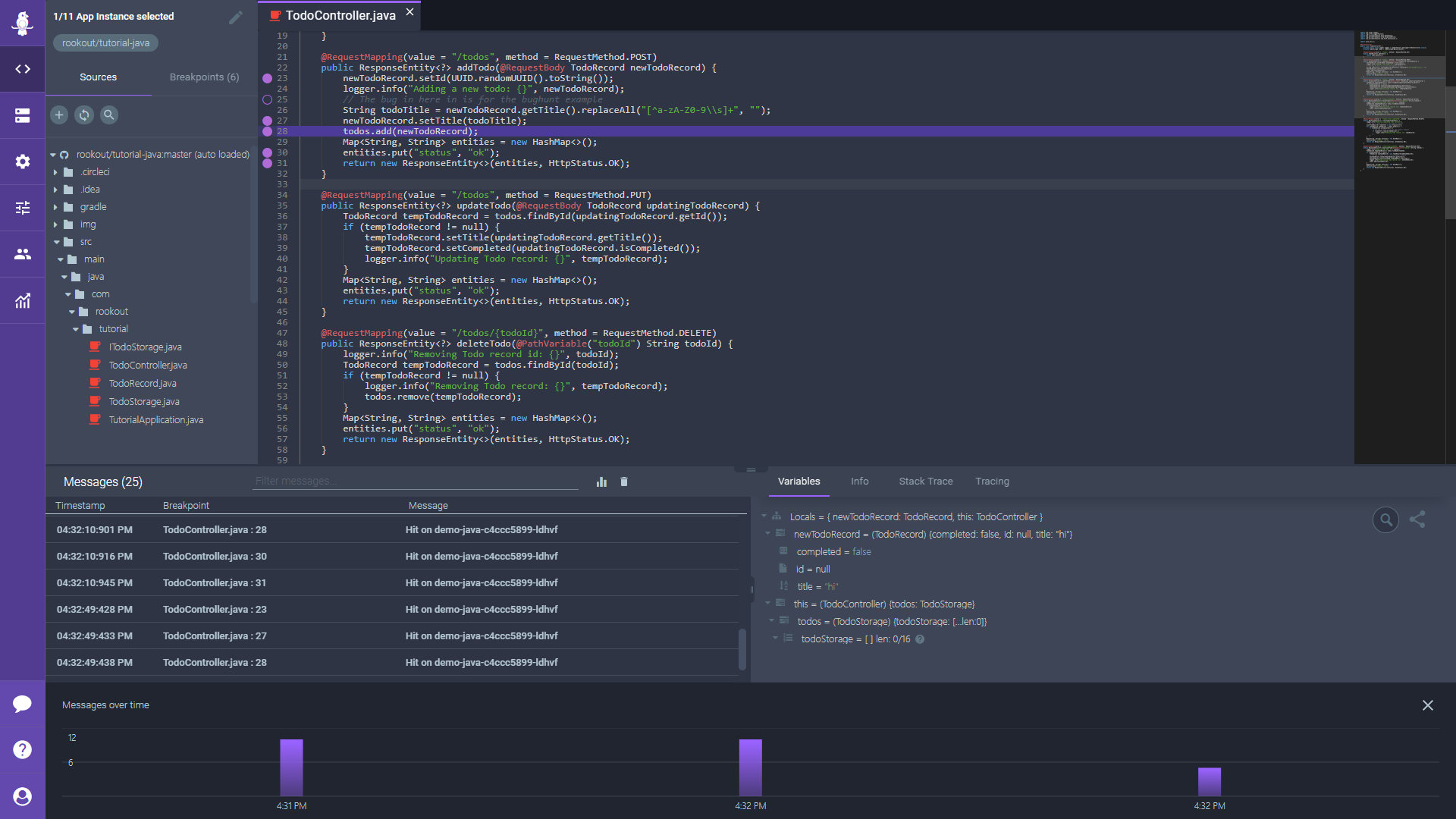
    Rookout now makes it possible to debug both open source code and proprietary code written by a third party or present on an application deployment platform, said Fogel. Rookout collects the local variables, function arguments, tracing data, call stack and other relevant data, and can identify issues down to specific lines of code. Support for third-party code has been extended to the call stack level to enable developers to see how code execution flows across their own and third-party code.

    As more responsibility for applications shifts left toward developers, organizations need to provide them with tools to analyze applications and the platforms they run on. Beside building applications faster, one of the primary theoretical benefits of DevOps is the notion that developers can build more resilient applications, because it’s ultimately their responsibility to remediate any issues that arise after an application is deployed in production. In practice, that’s difficult to achieve when developers have no visibility into code that they didn’t write themselves.

    Going forward, there’s going to be a lot more third-party code running in production, as developers reuse application code encapsulated in containers downloaded directly from registries, Fogel said.

    The degree of accountability developers have for their appliations’ code currently varies widely by organization. However, given the right tools, and enough time, most developers would prefer to debug both the code they write and any they have incorporated, even if it were written by someone else. That desire, however, requires more time to build and test applications. Of course, it’s worth the tradeoff if developers encounter fewer incidents that require developers to debug applications after they are deployed in a production environment.

  • Guide for Software Development & Software Security

    Guide for Software Development & Software Security

    In order to ensure an efficient, secure and successful software development project, there are many factors that you and your team must consider when starting a new project. The most common and pertinent considerations for many include defining the requirements of the project, selecting the correct processes for each stage of the software development project, selecting the right software development tools and ensuring the proper practices are implemented for software security.

    As meeting each of those considerations for an effective software development project can be a daunting and time-consuming challenge, we recommend you follow this step-by-step guide that will help walk you through how to organize a secure and successful project.

    Understand Your Software Development Project Requirements

    As you begin your software development project, there are several details that you must complete to help you better understand your software development project requirements.

    • Outline the project
    • Define the project vision
    • Identify compliance requirements
    • Select a flexible programming language
    • Develop a code design
    • Establish code architecture

    By completing the above tasks, you are able to create a reliable and secure framework for your software development project.

    How to Define Your Software Development Process

    As your development process will be unique to the needs and requirements of your software development project, we recommend that you consider including the following details into your process:

    • Identify what software security best practices will need to be enforced
    • Align on a development methodology
    • Organize your environment setup
    • Use repository tools
    • Enforce software security with secure coding practices
    • Incorporate checks into your development pipeline
    • Have a definition of “done” for your software development project tasks and features
    • Encourage feedback and communication

    Including the above details into your software development process helps to ensure software security as well as increase the success of your software development project.

    How to Choose the Right Software Security Tools for your Software Development Project

    One of the most important parts of your software development project is to choose the right tools. With the right tools, you are able to standardize your project and enable your entire team to work together more efficiently and effectively. Regardless of what the specifics of your software development may be, we recommend that your toolset includes:

    • Version control system
    • Static code analyzer
    • Application lifecycle management tool

    These tools help to ensure that your project is well-organized; your software reliable, compliant and high quality; and that software security is enforced.

    How to Set Up DevSecOps for Your Software Development Project

    DevSecOps is essential for efficient and secure software development, as it can help your team:

    To read more, please visit: https://www.perforce.com/blog/kw/software-development-and-software-security

  • 5 Ways Traceability Is Changing to Bolster the Remote Workforce

    5 Ways Traceability Is Changing to Bolster the Remote Workforce

    Traceability has always been a useful tool in the development process, but it has become especially important since the COVID-19 outbreak and the increased remote workforce. 

    Where developers and engineers were once working side-by-side, with the ability to discuss their process and keep their team informed, they are now navigating a remote collaboration landscape. According to a 2017 study done by Stack Overflow, there is a correlation for developers between remote work and job satisfaction, and the highest job satisfaction ratings are seen from developers who work remote full time. As technology has grown to make this process easier, remote working is expected to become a norm. 

    Advanced traceability has the potential to hold teams together by allowing increased visibility into each move throughout an entire project. Without traceability, it would be nearly impossible to keep remote teams aligned and on schedule.

    Product development tools have continuously been forced to evolve to keep up with the multi-dimensional nature of requirement, test and risk management. For these processes to be successful, all related variables must work together continuously, at scale, and across teams. 

    We’ve only just started to see how traceability tools can use updated capabilities to streamline the product development process, but we know enough to discuss two things: what’s happening now and what the future may hold.

    Traditionally, traceability could be compared to a map. While not limited to a single view, maps exist to help you navigate your way to a destination. Similarly, traceability leads product developers through every step of their processes, eventually helping them reach their goal. If your map was constantly changing you’d never be able to figure out where you were going, but what if people ahead of you could update it as they went along? This would keep you in the loop of the upcoming twists and turns, and no one would feel blindsided. Traceability makes it easy to share similar production changes with your entire team, all at once.

    In the traceability process, links are built automatically which lets major decision points, reviews and approvals be captured in final documents and reports. This allows for faster and more informed decision making and these live references can exist across versions. 

    With the switch to remote work across the globe, and no immediate end in sight, developers don’t have the option of working side-by-side with their colleagues. Because of this, it is pertinent that they are able to streamline their work in every way possible, and increased traceability is expected to be a pillar of that transition. 

    At the end of the day, connecting the dots is all about making sense of everyone’s decisions. Why did they follow that process, and what factors led them to make the choices they made? 

    In the early days of traceability there wasn’t always room to include every piece of information that you might find relevant down the line. Legacy tools such as the act of manual reporting through Word documents left much to be desired. Today, that’s becoming less of an issue, as developers are allowed more meaningful accountability and insight into interconnections as they happen.

    As we look ahead, we can expect to see these capabilities grow in five different ways.

    Less Manual Effort

    Updating your traceability reports with as little manual effort as possible will be essential to a streamlined, remote workforce. As traceability becomes more advanced, the work to create and maintain it should not become more difficult. 

    More Nuance Captured, Related and Parsed for Meaning

    Improvements in software will make data gathering more precise, and increase the number of items a team can consider relevant, traceable information. This will take additional workloads off of the developers as more items are automatically traced and easily accessible.

    More Attributes Can Define and Predict a Project’s Success 

    If you have a more data-rich, detailed record of activities, it is possible to understand the past with more context and less reliance on costly manual documentation or memory. 

    Dispersed Systems Holding Relevant Information Will Start to Feel Closer and More Interconnected

    Through more dense integration and aligned processes, systems feel more controlled and connected, giving users a more seamless experience.

    Expansion of Communication and Review Capabilities for Stakeholders Who May Be Impacted by Changes

    The availability of a full audit trail of participation will make a big difference in the ease of the review process. The ability to easily see who is impacted by changes will allow teams to proactively manage the effects of said changes.

    In response to the COVID-19 pandemic, and the number of companies who are maintaining their remote work policies, we can expect to see more innovations related to product development workflows. These innovations will enable easier remote collaboration between colleagues and across teams, overall streamlining the product development process.

  • The Secure Software Development Life Cycle: Syncing Development and Security

    The Secure Software Development Life Cycle: Syncing Development and Security

    Over the last five to 10 years, the nature of software development has shifted dramatically. Whereas large software releases occurred every six to 18 months in the past, current release schedules have become much more frequent. The waterfall model of software development has morphed into what we now know as the DevOps model.

    As a consequence, DevOps has instigated changes in the traditional waterfall security touchpoints. In essence, DevOps has changed the very nature of how application security needs to be implemented. To avoid friction in the development process, application security activities must be adapted to the new world of DevOps practices. It has to go beyond the basics of threat modeling, design review and two weeks of pen testing.

    Under DevOps, some development organizations now do software releases on a daily, weekly or bi-weekly cadence. But they’re still grappling with older application security models. As a result, development and security testing can be out of sync—you cannot conduct a two-week pen test on software that’s released weekly. These organizations need effective security assurance in their SDLC that’s good, quick, early and—above all else—automated.

    The Changing Nature of Software Development

    The way software is developed keeps changing. And it keeps accelerating. Application security needs to change to catch up. Automation will play a key role in enabling application security to maintain the pace of DevOps. DevOps needs automation to effectively deal with software release cadences that occur on a daily, weekly and bi-weekly basis as well as to increase agility generally within the SDLC.

    For example, DevOps accelerates when the automated pipeline embeds application security scanning into pre-commit checks. In this way, consistent levels of application security testing apply every time developers check in code, resulting in a fully automated check-in process. But automation doesn’t lock developers into the same level of security for every code change. For example, if the change only involves altering the color of a logo, heavy security scanning and manual won’t be necessary. At least not the way it would be if the application is accessing sensitive data.

    So, instead of giving developers quarterly SAST results, automation puts the code analysis right there in front of developers as they’re checking in code (via certain IDE plugins). Presenting the code analysis findings to developers, while they are still in the code, has several advantages:

    • The code is still fresh in the developers’ minds.
    • Coding problems can be caught earlier and more easily while developers are still thinking about the code.
    • It mitigates the risk of developers not remembering the code context at a later date.

    Overall, the more automation there is in application security the better it is for open source validation, container scanning containers, QA testing, API security and more.

    Automated Security Assurance and Out-of-Band Activities

    When it comes to implementing testing in DevOps, you must balance automated security assurance with out-of-band activities. That means it’s sometimes appropriate to slow down the automated security process. Even in a completely automated DevOps process you may need to slow down to make necessary changes. It’s true a code change, such as just changing the background color on a web app, may not be too risky. There’s no problem with automating that DevOps step and pushing out the change. But, if your web app interacts with customer data, you’d be prudent to slow down and take the next application security test out of band, and make sure you’ve got the procedure right because it’s much riskier.

    There are different levels of risk and severity within each release of an application. Development organizations need to accept this and adapt to each release’s potential risk and severity level. Then, they need to provide the appropriate level of security assurance and security coverage, whether that is automated within the DevOps workflow, performed out of band or some combination of the two.

    Life in the Fast Lane

    For DevOps organizations, one of two avenues beckons to them: the security express lane or the security slow lane. You could create an automated DevSecOps process across the development organization—the security fast lane. But, there’s no one-size-fits-all DevSecOps process for enterprises. That’s because there could be up to hundreds of development teams within an enterprise. And there’s not always a standardized process that all dev teams can follow. It’s a challenge to adapt automated security to each development team. Those in the security fast lane should use a security champion to work with the development team and be the point person to assist them with understanding application security needs and remediation guidance.

    In the security slow lane, individual development teams may still be enabled to go fast. The difference is that they will pick the SDLC tools that make the most sense for that team. Then, they should also pick the application security tools that make the most sense for them. The bottom line for organizations is that application security needs to involve an acceptable level of friction for developers to make DevSecOps work. If there is too much friction, developers will bypass application security in favor of expediting coding activities.

  • Open Source Vulnerabilities Were Up 50% in 2019 — How Will It Impact Software Development in 2020?

    Open Source Vulnerabilities Were Up 50% in 2019 — How Will It Impact Software Development in 2020?

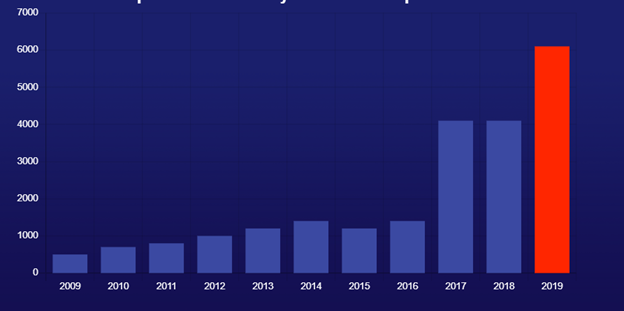
    Open source vulnerabilities have been on the rise in recent years, but 2019 was truly one for the record books with a spike of nearly 50% over the previous year.

    According to the recently released State of Open Source Security Vulnerabilities report by the WhiteSource research team, the number of vulnerabilities jumped from 4,100 in 2018 to 6,100 in 2019.

    Open Source Vulnerabilities
    Figure 1: Number of reported open source vulnerabilities per year.

    In hopes of better understanding what is behind this rise in the number of open source vulnerabilities, what it tells us about the state of open source usage in modern software development, and even where we are likely headed in the years ahead, let’s take a look at the report’s findings for insights on the current state of open source security.

    More Code, More Vulnerabilities

    According to the research report, the primary driver behind the rise in open source vulnerabilities is a function of the growth of open source. There are now more open source projects, code and members of the community than ever before.

    All of these good folks are working hard to not only write more code, often with the backing of large tech giants, but also to seek out vulnerabilities in the code that can put the users of their components at risk. The combination of more code being written and the number of eyeballs reviewing the code for those inevitable human mistakes, comes together to produce a larger number of vulnerabilities being reported.

    The increase in the number of vulnerabilities in open source components will have a considerable impact on software development. In recent years, we have seen open source components playing a bigger role in how developers build their applications. Most estimates believe that open source components comprise between 60-80% of the codebase in most modern applications. When a vulnerability is reported in a popular project such as Apache Struts or the Linux kernel, then huge swaths of developers can quickly find their software in need of patching.

    The Good, the Bad and the Bazaar

    WhiteSource’s research revealed the reassuring news that over 85% of reported open source security vulnerabilities have a fix available.

    One of the reasons for this improvement is the fact that more enterprises are dependent on open source components for their own software, so they are investing in making it more secure, via bug bounty programs, backing foundations that support open source security or backing the projects themselves.

    However, even as the situation in the field appears to be improving, there is still a way to go.

    The fact that many published open source vulnerabilities are not indexed in one central location adds complexity to this challenge for development teams attempting to stay on top of published open source security vulnerabilities. If proprietary software is still considered to be the classical Cathedral, well-organized information and support under one roof, then open source is very much the Bazaar.

    The WhiteSource report found that only 84% of known open source vulnerabilities appear in the National Vulnerability Database (NVD). This means that information about another 16% of the known vulnerabilities is out there, spread out among a wide range of resources. These might be security advisories, bug trackers and a laundry list of other locations. While 45% of reported open source vulnerabilities that were not initially published on the NVD eventually end up there, that could take months since their publication on other resources.

    The challenge for organizations is that they run the risk of using a vulnerable component unaware of the security updates, while hackers are scouring all resources, looking for vulnerabilities that could be their next meal ticket.

    Given the evolving security challenges facing organizations, what does the future hold for open source security in the year ahead?

    Our Predictions for 2020

    The easiest prediction that we can provide is that 2020 will have even more reported open source vulnerabilities than were published in 2019. The only question is: How big it will be? Chances are that the count will be more significant due to recent advances making it easier than ever to report and an open source vulnerability.

    This past year saw the launch of GitHub Security Lab which aims to help researchers, maintainers and users easily report an open source vulnerability and publish a verified fix in one centralized location. By simplifying the reporting and documentation process, GitHub has gone a long way in helping their users to protect their software with better quality reporting.

    Key Takeaways

    For many, the rise in the number of reported open source vulnerabilities might be concerning, making us confront the fact that we probably have plenty of them in our software right now. However, the situation is actually improving, and even heading in the right direction. When vulnerable open source components are reported, we get to track them and move quickly to remediate. Only once you know you have a problem can you begin to fix it.

    Hopefully, the increase in security awareness will keep pushing for a stronger, more organized and better supported open source community that will be resilient in the face of even more vulnerabilities that are likely to show up in next year’s research report.

  • A Developer’s Task: Minimizing Challenges Created by Fragmentation

    A Developer’s Task: Minimizing Challenges Created by Fragmentation

    Over the past decade, there has been a wellspring of apps, services and platforms to help developers build custom solutions for businesses. Some are great, some not so much. Regardless of quality, the quantity of options and each one’s varying level of sophistication has made it difficult for developers to separate the wheat from the chaff.

    A recent survey from IDC supports this notion. It contends that the current landscape of software development languages and frameworks is highly fragmented. Having too many options—as opposed to a single, unified environment—leads to holes and disconnects in the development process, not to mention the potential for significant complications in the long-term support of today’s apps.

    Here are some ways developers can navigate the challenges created by this high level of fragmentation. 

    Don’t Be Afraid of Low-Code (or No-Code) Solutions

    The IDC survey found that less than half of developers—44%—have used low-code development tools professionally at one point or another. As one would surmise, low-code programming brings with it a host of advantages, such as easy-to-use and intuitive interfaces, and the ability to deliver applications faster. 

    Some low-code platforms also enable developers to build applications that can be used on any device while also reducing dependency on outsourced IT. A built-in script builder can allow even relatively inexperienced developers to turn complex business logic into functional workflows—such as automating a repetitive task—within a matter of minutes. Even after apps are launched, workflows can be updated and customized to fit specific business needs nearly instantly.

    Achieve Scale with Serverless Applications

    When building on a serverless platform, developers prevent infrastructure maintenance from inhibiting applications from scaling globally. This also allows developers to build mobile apps without managing the backend infrastructure. Cloud computing using public clouds typically involves renting virtualized servers across the technology stack. But when looking to scale, the onus is on developers to deal with the operating system and database while also managing necessary updates. This can lead to a work-intensive process on the app infrastructure level.

    A serverless infrastructure, on the other hand, abstracts databases and file servers, shifting focus to the app logic level. This allows developers to build and manage microservice-based apps that integrate with other services, making it easy to scale applications.

    Make Things Easy on Your Team

    According to the IDC survey, just 20% of developers claim they are “extremely familiar” with containers and microservices. With such expertise hard to find, using flexible tools that allow teams to quickly deploy code in scalable, compartmentalized components is vital.

    Organizations should aim to help their developers focus more on designing top-class user experiences of serverless applications, rather than spending (or wasting) time and resources on setting up and maintaining components on the server side. This gives developers the ability to focus on doing what they love—developing—as opposed to other tedious and mundane activities such as manually managing servers and storage solutions, or tweaking the underlying infrastructure of their microservices.

    Of course, making things easier for developers means deploying a powerful tool built on a stable foundation that can offer SDKs and APIs for both mobile and web apps, the ability to test early and often in a sandbox environment and analytics that monitor and report performance in real-time.

    Developers know just how challenging their jobs can be, and the fragmentation that can occur due to the vast number of options on the market can make it even worse. There is nothing wrong with using multiple solutions, of course, but having a sturdy and unified underlying infrastructure goes a long way toward avoiding unnecessary headaches.

    Finally, organizations should look to those who know best when deciding which company-wide tools to implement: the developers themselves. As the IDC study states, developers should be viewed as key stakeholders in IT purchasing within any organization moving to the cloud accompanied by an internal digital transformation.

    — Raju Vegesna

  • Shift Left Without Fear: The Role of Security in Enabling DevOps

    Shift Left Without Fear: The Role of Security in Enabling DevOps

    It’s the age of DevOps, and we all want to shift left, which refers to the idea of performing processes earlier in the CI/CD cycle. That includes security checks and audits. By starting security operations earlier in the delivery pipeline, it becomes easier to find problems, and teams have more time to address them before pushing code into production.

    The challenge, of course, is building a shift-left security operation that allows you to perform security operations early without slowing down delivery speed. Let’s take a look at how to square that circle.

    Defining Shift-Left Security

    A popular term in DevOps culture is “shift left.” But what does shift left mean? Shifting left refers to the effort by a DevOps team to implement measures to ensure application quality at an early point in the software development life cycle. In the case of application security, this means implementing measures to ensure security concerns are taken into consideration while the application is being developed, rather than at the end of the process.

    The overall goal of shift-left security is to identify and resolve potential vulnerabilities earlier in the development life cycle, when these issues are less expensive to fix. Doing so will help to mitigate the risk potential security concerns pose to both the delivery schedule and your end -users.

    DevSecOps: Integrating Security Into the Development Process

    Let’s be honest: Faster and more frequent development cycles aren’t going away. Slowing delivery speed to analyze and bulletproof the application at the end of the development process is no longer a viable format for implementing security. DevOps and CI/CD need to be embraced and enabled by the security staff.

    For security teams to enable the DevOps process, collaboration is key. Through this collaboration, the process of DevOps transforms into something known as DevSecOps. In DevSecOps, security personnel work closely with the rest of the DevOps organization to help those who create and deliver the application to gain a better understanding of what is needed to address security concerns as early in the development life cycle as possible.

    The following tips serve as a jumping-off point for implementing this collaboration:

    • Make security the responsibility of the entire DevOps team: Impress upon the development and operations staff that security is now the responsibility of the entire organization. Simply addressing potential vulnerabilities post-development will eat up too much time and increase the risk that something will be missed. Buying into this process is an essential part of implementing successful collaboration between the security team and the rest of the organization. An example of this would be impressing upon developers to code with security in mind.
    • Facilitate regular discussions about application security throughout the development process: It is the responsibility of the security folks to keep security considerations at the forefront of a developer’s mind while they develop new features. Use the agile process to your advantage. Backlog meetings can involve security folks to ensure the creation of user stories includes consideration for security concerns. Your daily standup meetings are another place to include security personnel. This will provide security staff with an opportunity to speak up when the work described by the developer requires—or might require—considerations related to security that have yet to be addressed. Doing so will help to ensure the ball is not dropped, allowing for potential issues to be rectified before they even exist.
    • Use test automation and continuous integration to your advantage: When it comes to addressing security concerns throughout the development process, continuous testing is your best friend. And, in cases where it makes sense, the DevOps team should integrate automated test scripts for the detection of security and into their continuous integration process. Such tests can include developer-written scripts to test for vulnerabilities in the code base and tools for static code analysis. Another part of your continuous testing strategy could involve the use of tools for infrastructure monitoring.

    The data produced by these strategies can then be analyzed by security folks. And from this analysis, recommendations can be made to the DevOps team regarding the path forward to close potential gaps in security before they ever reach production and can be exploited.

    Understanding the Role of Security Personnel in the Development Process

    Security folks are often not coders, and development personnel are often not security experts. And while it may be frustrating at times, the solution to managing this disconnect is in the collaboration described above. Situations will arise where developers need to develop with various technologies to build a quality product. It’s possible that these technologies will lend themselves to security concerns that require security expertise. The job of security personnel shouldn’t always be to fight back against the use of these technologies. The security team should act as facilitators—take what development and operations staff intend to do and foresee the potential impacts that innovation will have on security—then take these potential impacts and provide insight into what needs to be done to reduce the risks.

    Conclusion

    In the past, security often was considered as an afterthought in the development of an application and its infrastructure. The movement toward faster development cycles and more frequent application releases has forced development organizations to think about security differently. Nowadays, so much can change in an application in a short time. This has forced DevOps organizations to integrate security into the development pipeline to make security a continuous consideration in the development life cycle. With this integration, the responsibilities of security personnel have shifted. Security teams now need to be enablers of the DevOps culture, empowering DevOps processes with security in mind.

    To see how Symantec CWA can help you shift left without fear, sign up for a free trial to see how it can help secure your cloud.

    — Scott Fitzpatrick

  • The State of Low-Code Development

    The State of Low-Code Development

    As enterprises continue to play catch-up when it comes to meeting their internal demand for new software services and applications, more enterprises—but still, only a minority—are turning to low-code development platforms to try to fill the gap.

    Low-code development platform provider OutSystems released its sixth annual “State of Application Development Report.” The report is based on surveys conducted in March of 3,300 IT professionals.

    The report found that a sizable minority (41%) of respondents are already using low-code platforms, while another 10% stated they were about to start using a low-code development platform. For comparison, in the 2018 report, 34% of respondents said they were using low-code development platforms and 9% said they were about to start using these platforms. Clearly, interest in these platforms is rising, if not modestly.

    Low-code development platforms strive to make software development more accessible. They do so by removing traditional coding interfaces with graphical user interfaces. And they typically target development toward a specific functionality, whether that be web applications, business process automation, IoT and, quite often, databases. The low-code development platform market is expected to grow to $27.2 billion by 2022 from $4.3 billion in 2017, an annual growth rate of 44%.

    The demand for software has never been higher. According to the OutSystems report, 64% of IT professionals said they have an application development backlog. For 19% of respondents, that backlog is deeper than 10 apps. While 50% said their backlogs have remained the same, 39% report that their app backlogs have improved over the past year.

    The time to deliver web apps and mobile apps is mixed. The 2018 OutSystems report found that 54% of respondents took four months or less to deliver a web application. This year, 61% said it takes them four months or less to deliver a web application. Mobile app development has changed a little: 55% on average said they deliver apps in four months or less.

    According to OutSystems, enterprises using low-code development platforms are 12% more likely to report that their backlogs have improved year over year.

    Those findings echo similar surveys. For instance, a survey released earlier this month from low-code provider Appian found that nearly 80% of its respondents believe that using low-code can free developer time to work on higher-level projects. That survey also found 86% of IT developers agree that emerging technology is increasing the pressure on the IT organization.

    One thing is certain, the demand for software isn’t going to let up anytime soon. According to the OutSystems report, the number of applications respondents plan to deliver this year is 60% higher than last year. For those with more than 500 employees, 65% said they had plans to deliver 10 or more apps, 38% plan to build 25 or more apps and 15% said they plan to develop 100 or more apps this year.

    Despite the high demand for enterprise software, only 36% of organizations have larger development teams than they did a year ago. However, that’s likely not due for lack of trying to hire and retain development talent. The OutSystems survey found only 15% of respondents described developer recruitment as easy. “For many organizations, retention of developer talent appears to be an equally grave challenge,” according to the report.

    With conditions like that, it’s only reasonable to expect low-code development platform popularity to continue to rise.

    — George V. Hulme

  • The Terrain of DevOps is Strewn with Pitfalls

    The Terrain of DevOps is Strewn with Pitfalls

    As Gene Kim, one of the leading thinkers in DevOps, once said, “DevOps is not about what you do, but what your outcomes are.” What he’s telling us is that DevOps is about enabling a rapid flow of work that transitions from development to testing to operations, but the bottom line is that it’s about achieving results. Unfortunately, this too often gets lost in modern-day DevOps practices.

    In this article, I will discuss five common pitfalls that occur in DevOps if you don’t pay attention to the endgame and how your organization can avoid falling victim to them.

    DevOps and Automation: Measuring the Wrong Outcomes

    Some people believe that, at its core, DevOps is about trying to automate everything. But ask yourself this: Once you automate, are you really delivering a better outcome?

    The answer is not always yes. While metrics such as deployment frequency or mean time to repair (MTTR) are interesting DevOps indicators, they are no more interesting to determining if your team is delivering actual value than measuring the number of lines of code submitted or counting the number of keystrokes by the development team. You measure outcomes by determining a baseline from where you start and compare that with where you end.

    We need to understand that DevOps is about much more than automation; it’s about the entire pipeline and how your team moves from ideation to delivery to production. Even large companies with world-class DevOps teams don’t always clearly see the problem and can struggle managing the value stream and putting together multiple pipelines. An anonymous but real-life example of this is an organization I know that had been doing DevOps for 18 months, yet hadn’t delivered anything into production in that span. Are they really doing DevOps? DevOps is a process, but if it produces zero value, it’s not delivering on its promise.

    The key is focusing on delivering value and measuring value delivery into production. However, before you can begin measuring value, you have to define what it means to each individual deliverable. Common metrics include the number of story points, actual revenue from product comparison and customer satisfaction. With your clearly defined metrics in place, you can measure value as it gets delivered to the customer.

    DevOps and Fragile Environments

    One Achilles’ heel in the DevOps process is the pre-production environments where code gets deployed and tested. Automating a delivery pipeline relies completely on code being built and deployed to various environments. Fragile environments mean that the developers and testers are wasting time dealing with problems originating from the environment and not the code itself.

    While we wish all environments could be on-demand; the fact is, most are not. Another DevOps expert, Randy Bias, has an analogy about pets versus cattle in describing servers, and the same analogy can be used for environments. If environments are not standardized and repeatable, you have to be willing to move on from it like a farmer moves on from livestock; you can’t hold onto sentimental attachments like we have with our pets. What’s most important is that in no case can an environment be singular in nature.

    One element of the solution is to create code and automate, but the key is building up environments that are complete. Every environment needs proper builds, proper data and proper tests validating the environment. Additionally, the automation must have the stability to perform successfully every time. If you have piece of automation that fails even just 5% of the time, that’s unacceptable.

    The only way automation works in an environment is if you can trust the environment. When the environment is unstable, it’s like playing Russian roulette: No one knows exactly where the danger lies. It could be in the environment, the code, the data, the middleware … a number of places. When a problem arises, developers are often the last line of defense, but dealing with an issue such as this pulls them away from getting real work done.

    Disconnected Teams

    On this point, I’d like to share a warning: Disconnected toolchains lead to disconnected teams. The planning, development and testing teams can lack cohesion, and the release and operations teams often struggle to be on the same page. Each of these groups have their own tools and management, but they need to be able to communicate with each other effectively to make things work smoothly. In an ideal world, planning initiatives would flow into features for the development and testing team, which would flow into release pipelines and operational changes. Every team still can speak its own language, but the tools need to be interconnected and unified across the teams.

    Mismanaging Hybrid

    The term “hybrid” has many different uses in the software development space. Hybrid methodology refers to combining waterfall, agile and DevOps practices. Hybrid environments means your environment is housed in multiple locations such as the cloud, on-premises, virtual or code. There’s also hybrid geography, hybrid architecture, hybrid style—the list goes on.

    The key to transitioning to DevOps is properly managing the different types of hybrid. If you can’t manage hybrid delivery, you can’t manage your entire delivery and you can’t improve your delivery holistically. Organizations must learn to manage in a world of hybrid delivery and be able to handle cloud and on-prem, as well as teams all over the planet.

    Fixing Non-Constraints

    The Theory of Constraints is about pinpointing the bottlenecks in your process and fixing them. Any work that’s not focused on eliminating the constraint will not result in improvement and could be considered a waste of time.

    It’s important to remember that if you haven’t fixed the bottleneck, you haven’t improved anything. At the same time, if you’re automating the non-constraints, you’re wasting efforts by trying to improve what doesn’t need improving.

    As we’ve pointed out, DevOps does not equal automation. If an organization has messy processes and tries to automate them, they’ll be left with an automated mess. Therefore, organizations will see the best results from automating their constraints and just as important, not automating the non-constraints.

    — Jeffrey Keyes