Tag: testing

  • Survey Sees AI Playing Larger Role in Test Automation

    Survey Sees AI Playing Larger Role in Test Automation

    A survey of 1,028 senior IT professionals and application developers in the United Kingdom, U.S., Germany and Singapore finds nearly half (47%) still use manual testing for mobile applications. More than a third (38%) noted that their organization could save between half and three-quarters (51-75%) of funding allocated to testing per year by fully automating mobile application testing.

    Conducted by the market research firm Censuswide on behalf of Tricentis, a provider of a test automation platform, the survey also found that just under half of respondents (49%) reported their organization is already applying artificial intelligence (AI) to application testing. Another 21% plan to apply AI in the next six months. Almost three-quarters (74%) said their organization’s general sentiment toward AI in mobile software development testing is positive.

    Respondents also expected AI to improve mobile application quality (37%), increase productivity (36%) enhance end-user experience (34%) and to reduce the number of vulnerabilities and/or bugs (32%) in their applications.

    Mav Turner, chief product and strategy officer at Tricentis, said that rather than continuing to rely on expensive testing services, more organizations are looking to reduce costs by automating a wider range of testing workflows within the context of a DevOps workflow. In fact, the survey finds just under a third of respondents (32%) expect their organizations will invest more than $1 million to further automate testing.

    As modernization of testing processes continues, the return on investment in mobile application development will only continue to improve, noted Turner.

    The survey identifies the primary benefits of investing in test automation, which are increased productivity (32%), increased revenue (31%), increased user retention (28%) and increased compatibility across devices (28%).

    The primary obstacles organizations encounter as they strive to achieve that goal are competing priorities (28%), lack of technology and talent (25%), time (25%) and cost (24%), the survey finds.

    A full 87% said the quality of mobile applications is critical to their business, with 90% noting that poor mobile application quality costs their business as much as $2.49 million in lost revenue per year. However, just over a quarter (27%) said they believe their organization’s current mobile application development and testing strategy exceeds expectations.

    As part of efforts to automate testing, it’s not clear just how far responsibility for testing is shifting left toward developers, but there is no doubt many more are being exposed to the results earlier in the software development life cycle. The goal is to provide continuous testing capabilities without overly disrupting code writing. It’s also becoming simpler for developers to leverage generative AI tools to provide summaries of tests along with recommendations to improve code. The end result should be higher-quality applications that require less troubleshooting once deployed in a production environment.

    In the meantime, as organizations continue to become more dependent on mobile applications to drive a wide range of digital transformation initiatives, the cost of testing will continue to pale in comparison to the potential amount of lost revenue that might occur when end users either don’t invoke a specific feature or capability or, more commonly, simply abandon the application altogether.

  • How Generative AI Enables Unified Continuous Testing Platforms

    How Generative AI Enables Unified Continuous Testing Platforms

    It is time for a unified continuous testing platform.

    Existing software testing platforms and tools specialize in testing activities for a subset of the different stages of value streams. The landscape of software testing tools includes a wide range of solutions, each with its strengths, focusing on specific aspects of software development, delivery and operations.

    For instance:
    • Unit Testing Tools focus on the earliest stages of development, allowing developers to test individual units of code for correctness.
    • Integration Testing Tools aim to test the interactions between different modules or services within an application.
    • System Testing Tools are designed for end-to-end testing of the complete system before it goes live.
    • Performance Testing Tools assess the application’s behavior under load and stress conditions.
    • Security Testing Tools focus on identifying vulnerabilities within the application.
    • User Acceptance Testing (UAT) Tools facilitate the final testing phase, where end-users validate the solution against their requirements.

    The challenge with unifying these diverse testing needs into a single continuous testing platform is multifaceted. Such a platform needs to seamlessly integrate with a wide variety of development tools and environments, support different testing methodologies, and be flexible enough to adapt to different organizational processes and quality standards.

    While there are Continuous Integration/Continuous Deployment (CI/CD) tools that incorporate multiple testing stages, they often do so by integrating with specialized testing tools rather than offering a unified testing solution themselves. These CI/CD tools are closer to orchestrating the various testing activities rather than unifying them under a single platform’s capabilities.

    However, the concept of a fully unified continuous testing platform, covering every stage from requirements through to deployment and in-production testing, represents a significant opportunity for innovation in the software development tools space. Achieving this would likely require leveraging advancements in areas like generative AI, as discussed in my prior blog Applying AI/ML to Continuous Testing to create adaptable, intelligent testing processes that can cover the full spectrum of testing needs in a cohesive manner.

    Benefits of a Unified Continuous Testing Platform

    Improved Efficiency and Speed: A unified CT platform integrates testing across all stages of the software development lifecycle (SDLC), significantly streamlining the testing process. This integration facilitates automated, continuous feedback loops that promptly identify and address defects, allowing development teams to quickly iterate and improve. As a result, teams can release new features and fixes more rapidly, accelerating the product’s time to market and enhancing responsiveness to customer needs and market changes.

    Enhanced Quality and Reliability: By ensuring comprehensive and consistent testing across the entire application, a unified CT platform plays a crucial role in identifying and mitigating issues early in the development cycle. This early detection helps maintain a high level of software quality and reliability, leading to increased user satisfaction and trust in the product. The consistent application of quality standards across all testing phases contributes to a robust and dependable software product.

    Cost Savings and Reduced Maintenance: Automating the testing process through a unified CT platform not only optimizes resource utilization but also significantly reduces the costs associated with manual testing and late-stage defect remediation. Early defect detection translates to lower fix costs, and the streamlined process decreases the overall time-to-market. Additionally, high-quality, reliable software requires less maintenance, further reducing long-term costs and freeing up resources for innovation and development efforts.

    Improved Collaboration Across Teams: A unified CT platform fosters a culture of collaboration and transparency among development, testing, and operations teams. By providing a common framework and tools for all testing activities, it breaks down silos and enables seamless communication and collaboration across the SDLC. This improved collaboration ensures that teams are aligned with the project goals, can share insights more effectively, and work together to identify and solve problems more efficiently, leading to better outcomes.

    Together, these benefits highlight how a unified Continuous Testing platform can transform the software development process, making it more efficient, cost-effective, and collaborative while ensuring the delivery of high-quality and reliable software products.

    While many tools address specific parts of the testing lifecycle, the vision of a single platform that seamlessly unifies all stages of testing from requirements to in-production remains an ambitious goal. It’s a gap in the current technology landscape that presents both a challenge and an opportunity for future development.

    Challenges for Unified Continuous Testing Platforms

    Creating a continuous testing platform that unifies test activities for all stages of the end-to-end value stream is a complex challenge due to several factors:
    1. Diversity of Technologies and Tools: Modern software development environments are highly diverse, incorporating various programming languages, frameworks, and technologies. Creating a platform that seamlessly integrates with all these technologies is challenging.
    2. Complex Integration Points: Continuous testing needs to integrate with multiple stages of the development pipeline, including development, deployment, and operations. Each of these stages might use different tools and processes, making it hard to create a one-size-fits-all solution.
    3. Varying Quality Metrics: Different teams and projects may have different definitions of quality, success criteria, and performance metrics. A unified testing platform needs to be highly customizable to cater to these varying needs.
    4. Change Management: Adopting a new platform requires changes in the organization’s processes and workflows. Resistance to change is common in organizations, and transitioning to a new way of testing can be met with skepticism and inertia.
    5. Scalability and Performance: Ensuring the platform can scale to handle the testing needs of large organizations with thousands of tests running concurrently is a technical challenge. Performance issues can become a bottleneck, affecting the overall efficiency of the development process.
    6. Security and Compliance: Integrating testing across all stages of development also introduces security and compliance challenges. The platform must ensure that sensitive data is protected and that testing practices comply with regulatory requirements.
    7. Cost and Resource Constraints: Developing, maintaining, and supporting a unified continuous testing platform requires significant investment. Organizations might be hesitant to commit the necessary resources without clear evidence of return on investment.
    8. Evolution of Practices: Software development practices and tools are constantly evolving. Keeping the platform up-to-date with the latest practices and technologies requires ongoing effort and innovation.

    Despite these challenges, there is a growing recognition of the value of continuous testing throughout the software development lifecycle. Some companies and open-source communities are making strides in this direction, creating more integrated and flexible testing solutions. However, achieving a fully unified platform that addresses all these challenges is an ongoing effort and represents a significant opportunity for innovation in the software development and testing industry.

    Generative AI Can Facilitate a Unified Continuous Testing Platform

    Generative AI can play a significant role in overcoming the challenges associated with creating a continuous testing platform that unifies test activities for all stages of the end-to-end value stream. Here’s how generative AI might address each of the challenges:
    1. Diversity of Technologies and Tools: Generative AI can be trained on a wide range of programming languages, frameworks, and technologies to understand and generate code or testing scripts. This capability allows it to adapt to different environments and create testing materials that are compatible with various tools and technologies.
    2. Complex Integration Points: AI can analyze the workflow of development pipelines and suggest optimal integration points for testing. By learning from different CI/CD (Continuous Integration/Continuous Deployment) configurations, AI can recommend best practices for integrating testing seamlessly into existing workflows.
    3. Varying Quality Metrics: Generative AI models can be customized to understand and apply different quality metrics and success criteria based on project-specific requirements. By training on diverse datasets, these models can adapt to various definitions of quality and generate relevant tests or analysis.
    4. Change Management: AI can assist in the change management process by simulating the outcomes of adopting new testing platforms, thereby providing evidence-based benefits and mitigating resistance to change. Furthermore, AI-driven analytics can highlight the efficiency gains and quality improvements to support the transition.
    5. Scalability and Performance: Generative AI can optimize testing processes by identifying redundancies and suggesting improvements, thus enhancing performance. Additionally, AI can dynamically allocate resources based on testing needs, ensuring scalability without compromising efficiency.
    6. Security and Compliance: AI models can be trained to identify and flag potential security and compliance issues in the testing process. By continuously learning from the latest security standards and compliance regulations, AI can help ensure that testing practices meet the necessary requirements.
    7. Cost and Resource Constraints: By automating the generation and optimization of test cases, generative AI can significantly reduce the manual effort required, lowering costs and resource demands. AI can also help prioritize testing efforts based on risk assessment, ensuring that resources are focused where they are most needed.
    8. Evolution of Practices: Generative AI models are inherently adaptable and can continuously learn from new development practices, tools, and technologies. This ensures that the testing platform remains up-to-date with the latest advancements in software development.

    Generative AI has the potential to transform continuous testing by providing adaptive, efficient, and intelligent solutions to the complex challenges of unifying test activities across the end-to-end value stream. However, realizing this potential requires careful design, extensive training of AI models, and ongoing management to ensure that the AI systems remain effective and aligned with evolving testing needs.

    Summary: Call to Action

    The need for a unified Continuous Testing (CT) Platform has never been more urgent. Current testing platforms, each adept in their niche, cover only fragments of the software development lifecycle (SDLC), leading to a disjointed and inefficient testing process. This fragmentation not only slows down development and deliveries but also compromises the quality and security of the final product. The dream of a single platform that seamlessly integrates all stages of testing, from requirements through to deployment and in-production testing, represents a monumental leap toward efficiency, security, and quality in software development.

    The challenges in creating such a platform are manifold, ranging from the diversity of technologies and tools to the evolving nature of software development practices. Each challenge, from integrating diverse technologies and managing change within organizations to ensuring scalability and compliance, adds complexity to the development of a unified CT platform. Yet, the potential benefits of overcoming these hurdles are immense, promising a significant boost in the speed and quality of software delivery. The industry’s recognition of these benefits is growing, evidenced by the efforts of some companies and open-source communities moving towards more integrated and flexible testing solutions.

    Generative AI emerges as a beacon of hope in this quest, offering innovative solutions to the multifaceted challenges of unifying test activities. By harnessing the power of generative AI, the industry can address the diversity of tools, integrate complex testing stages, adapt to varying quality metrics, manage organizational change, scale efficiently, ensure security and compliance, and evolve with the practices of software development. The path forward requires a concerted effort, but investments in AI-driven testing innovations can realize the vision of a comprehensive, unified, continuous testing platform. This is not just an opportunity for enhancement but a call to action for the industry to redefine the future of engineering platforms.

  • Applying AI/ML to Continuous Testing

    Applying AI/ML to Continuous Testing

    Artificial intelligence (AI) and machine learning (ML) can play a transformative role across the software development lifecycle, with a special focus on enhancing continuous testing (CT). CT is especially critical in the context of continuous integration/continuous deployment (CI/CD) pipelines, where the need for speed and efficiency must be balanced with the demands for quality and security. AI/ML contributes by automating complex tasks, predicting potential issues before they occur and providing actionable insights, thereby reducing manual efforts and enabling more strategic use of human resources.
    Moreover, the application of AI/ML extends beyond mere automation of tests. It encompasses the capability to learn from data, adapt to new information, and improve over time. This ability is invaluable for identifying patterns, anticipating vulnerabilities and optimizing testing strategies. In quality assurance, AI-driven tools can predict areas most likely to fail and tailor testing efforts accordingly. In security, ML algorithms can detect anomalies that signify potential threats, while in operations, AI can enhance feedback mechanisms, leading to more resilient and responsive systems.

    AI/ML for Continuous Testing

    Here’s how AI technologies can be applied to reduce bottlenecks associated with testing activities across various testing activities:

    1. Requirements Analysis
    • Explanation: Ensures test scenarios align with business requirements and user needs.
    • Bottleneck: Misinterpretation or incomplete analysis can lead to inadequate test coverage.
    • AI/ML Solution: NLP can automate the extraction and interpretation of requirements, ensuring comprehensive and accurate test coverage.

    2. Test Strategy
    • Explanation: Outlines the testing approach, objectives, and resources.
    • Bottleneck: An unclear strategy may lead to inefficient testing efforts and resource allocation.
    • AI/ML Solution: AI can analyze historical data to suggest the most effective test strategies and predict resource needs.

    3. Test Plans
    • Explanation: Detailed documents guiding the testing process, timelines, and responsibilities.
    • Bottleneck: Inflexible plans can struggle to adapt to project changes, causing delays.
    • AI/ML Solution: Machine learning algorithms can suggest adjustments to test plans based on ongoing project developments and past outcomes.

    4. Test Cases
    • Explanation: Specific conditions under which a test is executed.
    • Bottleneck: Time-consuming development and significant effort to maintain.
    • AI/ML Solution: AI can automate the generation of test cases from requirements documents, improving efficiency and coverage.

    5. Test Scripts
    • Explanation: Automated scripts that execute test cases.
    • Bottleneck: Script development and maintenance can be resource-intensive.
    • AI/ML Solution: AI can generate and update test scripts based on changes in the application or test cases, reducing maintenance effort.

    6. Test Data
    • Explanation: Data sets used during testing to simulate real-world scenarios.
    • Bottleneck: Creating, managing, and maintaining accurate test data is challenging.
    • AI/ML Solution: AI can automate the generation and management of test data, ensuring relevance and variety.

    7. Test Environment
    • Explanation: The setup where testing is conducted mirrors production environments as closely as possible.
    • Bottleneck: Configuration and maintenance of test environments are complex.
    • AI/ML Solution: AI can predict and configure optimal test environments based on test requirements, reducing setup time.

    8. Coordination with Dependent Systems
    • Explanation: Ensuring the system under test interacts correctly with databases and other applications.
    • Bottleneck: Dependency management can cause delays.
    • AI/ML Solution: AI can automate the detection and resolution of integration issues, enhancing coordination efficiency.

    9. Test Environment Setup
    • Explanation: Configuring infrastructure and tools necessary for testing.
    • Bottleneck: Setup complexity and resource contention lead to delays.
    • AI/ML Solution: AI algorithms can optimize environment setup, automatically adjusting resources as needed.

    10. Test Campaign Setup
    • Explanation: Organizing and scheduling a series of test executions.
    • Bottleneck: Requires careful planning and can be hindered by resource limitations.
    • AI/ML Solution: AI can assist in scheduling and prioritizing test campaigns based on risk and impact analysis.

    11. Test Execution
    • Explanation: The process of running test cases and scripts, both automated and manual.
    • Bottleneck: Time-consuming, particularly for manual tests.
    • AI/ML Solution: AI can prioritize test execution and identify flaky tests, streamlining the process.

    12. Test Verdict Reporting
    • Explanation: Determining and reporting the outcome of test executions.
    • Bottleneck: Manual verdict determination can be slow.
    • AI/ML Solution: AI can automatically interpret test outcomes, speeding up reporting.

    13. Logging of Data
    • Explanation: Recording data relevant to the test for further analysis.
    • Bottleneck: Extensive data collection can overwhelm resources.
    • AI/ML Solution: AI can intelligently filter and log pertinent data, reducing noise.

    14. Test Result Analysis
    • Explanation: Analyzing test outcomes to identify defects and issues.
    • Bottleneck: Requires significant time and expertise.
    • AI/ML Solution: ML algorithms can quickly identify patterns and anomalies in test results, highlighting potential issues.

    15. Test Result Reporting
    • Explanation: Communicating findings to stakeholders.
    • Bottleneck: Compiling reports is time-intensive.
    • AI/ML Solution: Automated reporting tools powered by AI can generate insightful and comprehensive reports quickly.

    16. Waiting for Resource to Fix Failed Tests
    • Explanation: Downtime while awaiting fixes for identified issues.
    • Bottleneck: Halts testing progress.
    • AI/ML Solution: AI can predict which areas might fail and propose potential fixes

    Challenges

    Applying AI/ML to software testing activities offers numerous advantages but also introduces several challenges. Addressing these problems requires a combination of technical solutions, process adjustments, and cultural changes.

    1. Lack of Intuitive Understanding of the Application Being Tested
    • Problem: AI/ML models may not fully grasp the application’s context or the nuances of its functionalities, leading to less effective test scenarios.
    • Solution: Enhance AI models with richer contextual data and incorporate feedback loops where testers can refine and adjust AI-generated test cases. Employing techniques like reinforcement learning can also help AI models better understand application contexts over time.

    2. Repeatability and Consistency Between Test Sessions
    • Problem: AI-driven tests may generate different outputs for the same input over different sessions, complicating test consistency and traceability.
    • Solution: Implement versioning for AI models and their training data, ensuring consistency across test sessions. Use deterministic approaches in conjunction with AI to maintain a core of stable, repeatable tests.

    3. Lack of Understanding of the Tests Generated
    • Problem: Testers may find it challenging to understand or trust the rationale behind AI-generated test cases, impacting their ability to evaluate test outcomes effectively.
    • Solution: Incorporate explanations into AI/ML models to provide insights into their decision-making processes. Foster a culture of trust and understanding through education and transparency regarding how AI models operate.

    4. Test Coverage
    • Problem: There’s a risk that AI/ML might not adequately cover all testing scenarios, potentially missing critical defects.
    • Solution: Combine AI/ML with traditional testing methods to ensure comprehensive coverage. Regularly review and adjust the criteria used by AI/ML models to generate test cases, ensuring they align with evolving application features and risks.

    5. Compatibility with Different Test Tools
    • Problem: AI/ML models might not seamlessly integrate with existing testing tools and frameworks, limiting their utility.
    • Solution: Develop or use AI/ML solutions with extensive API support and integration capabilities. Work with tool vendors or contribute to open source projects to enhance compatibility.

    6. Acceptance by Teams
    • Problem: Testers and developers may be skeptical or resistant to AI-driven testing due to concerns about job displacement or mistrust in AI’s effectiveness.
    • Solution: Educate and involve teams in the development and implementation of AI/ML testing strategies. Demonstrate the value of AI/ML in augmenting their roles rather than replacing them, focusing on AI as a tool to tackle mundane tasks and allowing them to focus on more complex and rewarding work.

    7. Data Quality and Availability
    • Problem: AI/ML models require large amounts of high-quality data for training. Inadequate or poor-quality data can lead to ineffective testing.
    • Solution: Invest in data curation and generation strategies such as synthetic data creation to ensure models are well-trained.

    8. Continuous Learning and Adaptation
    • Problem: AI/ML models may become outdated as applications evolve.
    • Solution: Establish continuous learning mechanisms where models are regularly updated with new data and feedback, ensuring they remain relevant and effective.

    9. Ethical and Bias Considerations
    • Problem: AI/ML testing models might inherit or amplify biases present in their training data, leading to unfair or discriminatory outcomes.
    • Solution: Implement ethical guidelines and bias detection methodologies for AI/ML model development and use. Regularly audit models for biases and correct them as needed.

    By addressing these challenges with thoughtful strategies, organizations can maximize the benefits of AI/ML in testing activities while mitigating potential drawbacks, leading to more efficient, effective and trustworthy processes.

    Summary

    This blog explained use cases of artificial intelligence (AI) and machine learning (ML) within the realm of continuous testing of the software development life cycle. By harnessing the power of AI/ML, we’ve seen how organizations can significantly enhance their development processes, making them more efficient, secure and responsive to user needs. The exploration of specific AI/ML applications across various activities has provided a blueprint for automating and optimizing tasks that traditionally required significant manual effort.


  • Copado Streamlines Custom Salesforce App Testing

    Copado Streamlines Custom Salesforce App Testing

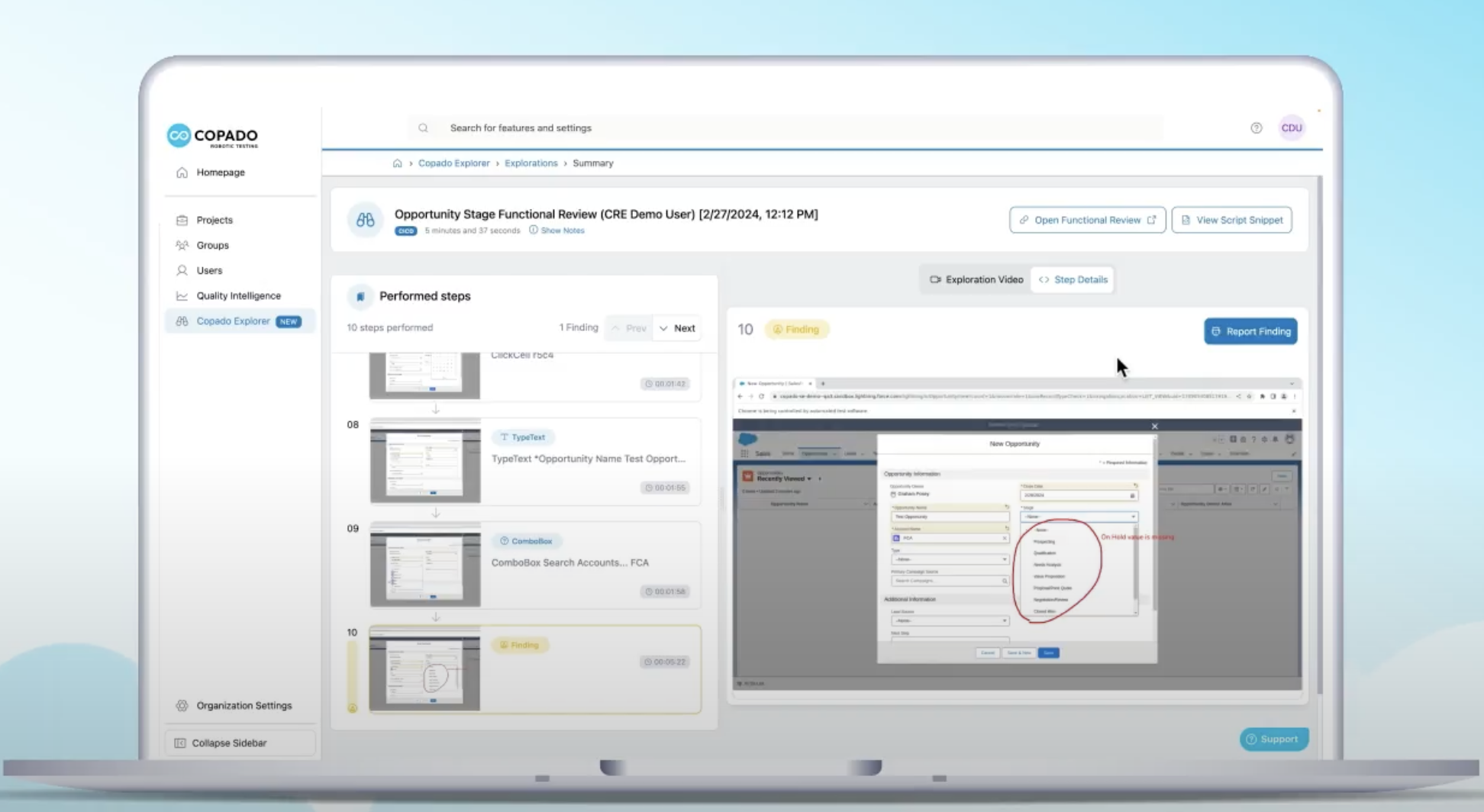
    Copado today added a testing tool to its platform for managing DevOps workflows in Salesforce application environments that automatically creates scripts based on manual tests being conducted.

    Announced at the TrailblazerDX conference hosted by Salesforce, Copado Explorer enables DevOps teams to integrate those scripts into testing processes that can be repeated as required.

    David Brooks, senior vice president and lead evangelist for Copado, said the goal is to make it simpler for DevOps teams to add those tests to the regression tests that are incorporated into pipelines created using the Copado continuous integration/continuous delivery (CI/CD) platform.

    In addition, markup and annotation tools enhance collaboration by allowing non-technical subject matter experts to provide detailed feedback and insights to quality assurance and development teams as part of an effort to streamline communications between product owners, testers and developers. Testers without a technical background can use that capability to contribute to the creation and deployment of effective automated tests. That capability makes it possible to shift testing further left to incorporate the business teams that better understand how an application should function, said Brooks.

    The challenge is far too many organizations still overlook the importance of testing, noted Brooks. There is a tendency when using low-code tools to assume that not as much testing is required because the tools that generate code create a false sense of instant quality despite flaws that might not manifest themselves until an application is deployed, noted Brooks.

    Rather than constantly updating applications, more testing should improve the quality of the applications being built sooner. That’s critical because most organizations don’t have the time and resources needed to continuously iterate applications until they eventually arrive at what the business requires, said Brooks.

    It’s still early days so far as the level of DevOps maturity that organizations using the Salesforce platform to build and deploy custom applications have thus far attained, noted Brooks. However, just about every organization that licenses the software-as-a-service (SaaS) platform from Salesforce customizes those applications to better align them with their internal business processes, he added.

    Each organization will naturally need to determine to what degree they are prepared to deploy customer applications, but it’s clear it’s becoming simpler to build them. Late last year, Copado, for example, added generative artificial intelligence (AI) tools to make it easier to manage the DevOps workflows used to build these applications, which means the speed at which these apps are built and deployed is about to exponentially increase.

    Salesforce, of course, is only one of many SaaS platforms that organizations rely on to build and deploy custom applications. However, as one of the most dominant platforms, the pace at which custom applications are being built continues to increase, with a larger percentage of these applications being built by professional developers familiar with DevOps best practices.

    Eventually, those DevOps workflows will be extended to every kind of developer, but for now, most organizations building applications are looking for more consistent outcomes regardless of what type of tool is used to build them.