Category: Application Performance Management/Monitoring

  • 3 Performance Challenges as Chatbot Adoption Grows

    3 Performance Challenges as Chatbot Adoption Grows

    Today, many organizations are starting to use voice or text-enabled chatbots for the first time or already have chatbot systems in place. In fact, Gartner said 25% of organizations are predicted to make chatbots their primary customer communication channel by 2027. This is because consumer behavior has shifted to primarily digital interactions and away from traditional customer support channels.

    As a result of today’s digital landscape, consumers are now accustomed to immediate gratification and expect instant responses and resolution from customer support, which makes chatbots an ideal solution for brands to rapidly serve customers. Due to this rising demand for instant customer service, chatbot systems have become more sophisticated and consumers’ reliance on them is increasing. This increase in adoption has led to higher performance expectations for bots and if those expectations are not met, customer satisfaction and brand loyalty will suffer.

    Below, we’ll look at three major challenges tied to the growing popularity of chatbots as they handle larger and more diverse groups of customers, and how business leaders developers and DevOps and customer experience (CX) teams can tackle these common challenges with a continuous testing approach.

    The Pain Points of Adoption: 3 Key Challenges as Chatbot Usage Grows

    As the popularity of chatbots explodes for customers around the world, the underlying systems that handle natural language processing (NLP), latency, data security and other functions need to be stronger. This is due to a growing and increasingly diverse demographic of users, many of whom are sharing more of their personal information to address a wider range of customer needs. Common chatbot pain points can be summarized by three overarching challenges.

    Challenge #1: Chatbots must contend with a larger and more diverse base of customers

    Chatbots that are voice or text-enabled must be smart enough to operate securely while navigating countless variations in spelling, a wide range of spoken accents and vernacular, background noise, static from bad connections and more. Even in a single language, there may typically be only four or five “intents” from most customers in engaging a chatbot, but those intents may be phrased in hundreds of different ways. Now, the global growth in adoption raises the chance of poor connections and exponentially increases the number of languages and variations in phrasing that a chatbot must understand and interpret.

    Challenge #2: Customers are trusting chatbots with more personal and sensitive data

    As chatbots become smarter and more trusted by customers to meet their needs, people are getting more comfortable giving their personal data to chatbots. That increases the number of situations where chatbots are working with personally identifiable information (PII) or other highly sensitive data. Especially given GDPR and other data privacy regulations being enacted worldwide, there’s added pressure to ensure a chatbot system’s handling of this data remains secure and compliant across all use cases and geographic regions.

    Challenge #3: Modern chatbots require 24/7 availability and reliability

    In an era of flexible work and millennial and Gen Z audiences interacting with bots after business hours and on weekends, chatbots can’t afford to work in shifts. Users may be spread across many time zones or around the world, meaning there’s always a sizable portion of customers awake, online and looking for fast and efficient service. Because of this, chatbots must be able to handle spikes and heavy traffic 24/7.

    The executive takeaway from these challenges is that modern chatbot investments must be built around dynamic systems capable of adjusting to shifting customer usage and performance requirements.

    A Continuous Testing Mindset is Required for Top Chatbot Performance

    Fortunately, by honoring a few best practices and making the right strategic technology investments in automated artificial intelligence (AI) and machine learning (ML)-driven systems, C-suite leaders responsible for CX and the teams they manage can deploy chatbots capable of keeping up with the above challenges. Perhaps the most central element for success is to embrace a continuous testing approach.

    For example, when a company is undergoing digital transformation and shifting its contact centers and supporting systems to the cloud, they are moving a significant amount of data, reimagining complex integrations and rearchitecting processes. In order to maintain application stability and existing integrations in the contact center, continuous testing is critical to ensure that an organization’s systems still operate effectively throughout the cloud migration process. With continuous testing, development and testing aren’t separate processes. The testing is automated and quality assurance is involved as developers submit code.

    The most effective approach to continuous testing includes end-to-end analysis across all channels. Testing chatbot behaviors should mimic real-time customer interactions. This should include challenging scenarios such as unexpected user inputs and usage spikes at random times of the day and night. Automation is critical, especially in peak demand scenarios such as Black Friday, Cyber Monday, open enrollment, etc. Load testing up to 1,000-100,000 bot requests per second, or more, can help ensure companies will be able to handle the increased traffic. Ideally, the testing approach should be comprehensive to include automated NLP score testing, conversational flow testing and security testing and performance testing and monitoring.

    By promoting the continuous testing approach across contact center operations, executives can empower their teams to build and maintain chatbots that remain optimized on an ongoing basis and that form an essential part of providing exceptional CX. This will make a huge difference in performance and reliability as systems scale and adapt to the evolving demands of a growing customer base.

    Continuous Testing Elevates Chatbot Reliability and Value

    High-performing chatbots and the continuous testing that keeps them optimized at those performance levels can benefit any company by lowering risks and enhancing revenue. Organizations that become adept at applying continuous testing avoid 90% of the downtime from high-severity (SEV 1) errors, which can result in saving $2.2 million in costs over a three-year period. When continuous testing touches every stage of the development process, it identifies issues earlier and helps strengthen an organization’s ability to innovate faster and service its customers effectively and profitably.


  • How To Build Anti-Fragile Software Ecosystems

    How To Build Anti-Fragile Software Ecosystems

    Just as organisms are susceptible to diseases and viruses, software systems are susceptible to hacks and errors. And within many complex interconnected systems, a minor bug could have a cascading effect across an entire organism, causing it to break. As such, increasing the resiliency of a software ecosystem is something engineers continually strive for. But how do we get there?

    One concept to consider is anti-fragile. Being anti-fragile refers to the ability of a system to thrive in adversity and adapt to change. Specifically, with regard to software, anti-fragile can equate to responsive coding practices, such as auto-scaling or default backups, to mitigate unforeseen events. Chaos engineering, for example, is one method to expose edge cases and build with adaptability in mind. And with the introduction of intelligent automation, often fueled by machine learning (ML) and artificial intelligence (AI), it’s becoming more and more feasible to build anti-fragile software systems.

    I recently met with Asim Razzaq, co-founder and CEO of Yotascale and former head of platform engineering at PayPal, to discover what it takes to build anti-fragile software. According to Razzaq, anti-fragile represents the next evolution of reactive, resilient software systems. And introducing anti-fragile concepts into your application networks can be done with just a few (relatively) simple steps. Below, we’ll define what anti-fragile is and see how this concept can be applied to software development and DevOps.

    Understanding Anti-Fragile

    As the adage goes, “What doesn’t kill you makes you stronger.” And it’s true—many natural systems tend to thrive under inhospitable conditions. As described by Nassim Nicholas Taleb in the book ‘Antifragile: Things That Gain from Disorder,’ anti-fragile systems thrive in adversity. For example, consider how human muscle grows under stress and load. Immune systems similarly adapt and respond to new viruses and improve the body’s resilience over time. So, how does this relate to software development?

    Well, organizations need to develop highly-tolerant software systems to meet rising digital consumer expectations. Especially when under extreme loads, systems must be elastic to adapt and survive. To meet high user demands, as well as specific service-level objectives (SLOs) and agreements (SLAs), most software companies are already investing in cloud-native tools that improve reliability. For example, a hallmark of site reliability engineering (SRE) is introducing automation to enhance the stability of applications.

    One example of gauging anti-fragile in software environments is chaos engineering, says Razzaq. Chaos engineering is the act of throwing a wrench into the machine. You randomly introduce bugs and malformed requests and attempt to create as much havoc as possible to see what happens. This could mean pulling out cables and restarting servers to gauge how software systems respond.

    “Software that can respond the best adapts the best,” said Razzaq. For example, if you manually remove a few nodes from the cluster but the system knows it needs seven to function, it could automatically spin up additional nodes. Or if the whole cluster goes down, ideally, the system would automatically restart and scale to the necessary requirements. In essence, anti-fragile software systems can understand and adapt to new environments without much, or any, human input.

    Tips to Construct Anti-Fragile Software Systems

    So, how can we construct anti-fragile software systems — especially when real-world challenges are often unpredictable? Razzaq shared helpful advice to consider when crafting anti-fragile software architecture.

    1. Start With Your Most Critical Systems First

    First, introduce chaos engineering to your most absolute critical systems. Define these vital components at the heart of your product which must remain functional. For a payments processor SaaS, for example, this would be the infrastructure supporting its transactional engine, such as the login and payment microservices.

    2. Determine How to Test Fragility

    Once you’ve identified this critical infrastructure, figure out how to test for fragility in your environment. Introduce chaos engineering to the component to see how it behaves. For example, returning to our payment platform example, this may include switching off a payment transaction type to see how the system functions in an extreme scenario.

    3. Decouple Components

    If systems are too closely coupled, errors and outages can ripple across multiple software services. To avoid that, it’s a good practice to prevent tight coupling between components—especially between critical systems and non-critical ones.

    4. Introduce Alternate Paths

    One method to decouple is by introducing alternate paths. For example, if a credit card verification component goes offline, the system should naturally accept other forms of payment and automatically suggest another form, such as a bank transfer. If all systems are down, the system could still accept unverified payments in a queue and let this continue until the threshold reaches a certain risk level.

    5. Learn From Past Events

    The next frontier of designing anti-fragile architecture is developing self-learning, autonomous systems. Of course, there is a limit to how automation can respond to unforeseen issues. But by feeding a machine learning model with more and more experiences, it could deal with untested new scenarios more gracefully. Of course, AI has the potential to make harmful decisions and even introduce unintentional bias, so organizations should have accountability for the algorithms they oversee, cautioned Razzaq.

    Benefits of Building With Anti-Fragile in Mind

    The goal is to able to thrive and function even under duress. By identifying the elements of core infrastructure to keep alive and putting it through the wringer, you can discover frailties before they cause significant consequences. And by decoupling components and introducing alternate paths, software systems can be better equipped for whatever may come. Uplevelling system operations with increased automation and AI is likely the future of constructing more fault-tolerant applications.

    “Software is everything in this day and age,” said Razzaq. “It increasingly plays a critical role in life-enhancing capabilities.” As such, the end benefits of developing an anti-fragile style could have hugely positive effects. In health care situations, it could make a difference in saving lives. For other less dire scenarios, increased fault tolerance leads to less lost revenue during peak traffic times and more consistent end-user experiences.

  • New Relic Bolsters Observability Platform

    New Relic Bolsters Observability Platform

    New Relic has updated its observability platform to include the ability to better detect and track errors in addition to monitoring vulnerabilities.

    At the same time, an instance of the New Relic observability platform that runs natively on the Microsoft Azure cloud platform is now also generally available.

    Manav Khurana, general manager for observability product and chief growth office for New Relic, said the alliance will enable Microsoft Azure customers to consume New Relic as part of their existing Microsoft Azure services contract.

    New Relic already provides an errors inbox to track issues, but is now adding a tool to track the impact an error might have by correlating data across traces and logs. The company has also integrated its platform with Slack to make it simpler for IT teams to generate alerts when vulnerabilities are introduced into codebases and manage errors more collaboratively.

    Similarly, New Relic is also looking to foster greater collaboration between software engineering and cybersecurity teams. A New Relic Vulnerability Management tool with no additional configuration required captures security signals generated via the company’s Telemetry Data Platform in a way that can be analyzed using an interactive application security testing (IAST) tool that New Relic gained with its acquisition of K2 Cyber Security. Additional IAST capabilities available in preview include the ability to leverage a patented deterministic technique to identify and provide automated vulnerability validation that highlights a proof-of-exploit.

    The overall goal is to provide more visibility and context for organizations that are implementing best DevSecOps practices, said Khurana.

    It’s still relatively early days as far as the integration of observability platforms into DevOps workflows is concerned. A recent survey conducted by New Relic found most organizations don’t expect to have robust observability practices in place by 2025. While most organizations have tools to monitor predefined metrics today, there is a significant gap between observability platforms that enable IT teams to determine the root cause of an IT issue and monitoring platforms that generate an alert whenever a threshold is exceeded.

    In fact, many organizations have too many monitoring tools that often surface conflicting or redundant alerts, noted Khurana.

    One way or another, more codebases are being instrumented. As that process continues to evolve, the agents embedded in that code make it simpler to collect the logs and traces needed to advance observability. The challenge, as always, is that it takes time for the number of fully instrumented applications to exceed the number of legacy applications that are either partially instrumented or not instrumented at all.

    As IT environments become more complex, the need for observability is becoming much more pressing at a time when most IT teams are more short-handed than ever, noted Khurana.

    Regardless of approach, there’s no doubt that observability, with patience, will impact the management of IT for the better.

  • Let the Machines Do It: AI-Directed Mobile App Testing

    Let the Machines Do It: AI-Directed Mobile App Testing

    AI has been in the news a lot lately. We’ve all heard a lot about ChatGPT and you’ve no doubt encountered the end result of a variety of other advances in AI technology of late, such as Lensa. But there’s also a much quieter and less visible shift happening behind the scenes during the development of your favorite apps—AI-directed mobile app testing. Let’s take a look.

    Behind the Scenes

    It’s no secret that every product, no matter the industry, goes through a gauntlet of tests before it’s unleashed on the general public. This goes for everything from a simple object like a cardboard box, for example, to a far more complex product, such as the latest electric vehicle.

    The same goes for the mobile apps on your phone. And if you haven’t given that much thought, then good! It means that the QA team behind the app’s functionality did its job, producing a seamless experience that functioned without a hitch, exactly as you wanted and expected.

    But that’s not always the way it goes, and mobile app testing is only growing more complex. That’s a growing problem that AI will eventually resolve.

    If your app didn’t perform as expected, you—and many other users like you—may delete it and move on to the next app that promises to do the same thing. While this may not seem like a big deal to you as the user, it’s a total disaster for the tireless teams working behind the scenes to ensure a successful app launch or update.

    The adage ‘You only get one chance to make a first impression’ is very true in the mobile app market. It’s a big, crowded and cutthroat mobile app world out there, and users simply have no incentive to put up with an app that doesn’t do exactly what it’s supposed to do. After all, for every single app, there are often several others standing by to scoop up your unhappy (former) users.

    This issue is by no means restricted to small development teams strapped for resources. I’m sure you can think of some high-profile software releases from major companies that have launched in a disastrous state over the past few years (particularly in the tremendously profitable arena of video games).

    So why is it that some teams cut corners when it’s time for testing, only to dearly wish they hadn’t?

    Well, the answer is pretty simple: Up until very recently, mobile app testing has traditionally been time-consuming, complex and bewildering, all too frequently delaying releases and flabbergasting QA teams.

    To understand this ongoing problem, let’s take a look at what this kind of mobile app testing entails and how this landscape has recently started to shift, as well as what’s on the horizon to make it all more efficient.

    Cutting Corners = Consequences

    Once upon a time—in an era that seems like it was really just yesterday—software testing was performed manually, entirely by hand. This was possible because quality assurance personnel only needed to consider a very limited set of variables: There were only so many use cases and form factors to consider, and programs were only expected to do so much.

    It’s hard to imagine testing a modern app manually and having the result be effective. The approach is only reasonable under very limited circumstances. Nowadays, teams use automated tests, which save them a tremendous amount of time, effort and resources.

    Yet these automated tests come with their own problems. Most of these automated tests are hand-coded, meaning that they must be set up and adjusted by specialists with a background in computer programming. Such specialists are not only costly and in demand, but they’re also needed for later aspects of the software development cycle, such as developing new product features and overseeing other aspects of production.

    And this is where companies start to cut corners and miss problems and issues, both large and small. Instead of what is known as shifting left (that is, testing as early in the cycle as possible), many teams, unfortunately, view testing as a burden or afterthought. Only when things go haywire and they have a full-blown crisis on their hands does the need for rigorous app testing become apparent.

    Testing, Machine-Made

    This is where machine learning and artificial intelligence enter the picture. For several years, we’ve known that testing performed by machines will be more and more necessary to handle increasingly complex apps, and it won’t be long before the cost associated with the complex testing scenarios will simply become too much for many developers.

    Fortunately, advances continue to appear on the horizon. These include the much-discussed no-code revolution, which abstracts away much of the noise associated with software development and opens the door to a much wider testing base.

    AI- and machine-learning-based testing is also on the horizon, yet there’s a significant challenge that must be overcome before this can happen at speed and scale. To develop mobile app tests with true intelligence and maximum efficiency, machines must be capable of autonomously completing the following steps:

    1. Comprehension: Draw from the ability to understand what’s changing in an app. For example, the machine must be able to detect differences and issues in a signup sequence or a checkout screen change.
    2. Impact analysis: The machine must know what test cases can cover that change. This sort of identification can be quite tricky.
    3. Test case generation: Next, the machine must possess the ability to generate test cases related to steps one and two. To do this, the machine must draw from several data sets. These include:
      1. Extent test collateral/test cases with product code
      2. Data from actual customer usage so that numbers one and two above may be identified
      3. What user environments look like, including information like how many users are active in the United States and in Europe
      4. Automatic execution: Perhaps the most crucial need is that the machine can perform testing entirely by itself. With the ability to self-execute tests, we’ll have reached a new era in testing.
      5. Reports: Before the testing cycle can begin again, the machine must be able to produce detailed reports that make sense to its human handlers. When it comes to test results, the more detail the machine can provide in as approachable a manner as possible, the better.

    Problems and Solutions

    Some testing platforms are now capable of many of the tasks I highlight above, and quality assurance teams that move away from self-coding tests and toward the future of testing stand to benefit from these solutions (particularly when their competitors do not).

    Partially enabled by AI and ML, no-code solutions provide a stopgap solution until machines can really get a handle on the above five steps. At this point, it’s really just a matter of time: We can already see glimpses of a wholly automated testing cycle where human input is limited and machines do the heavy lifting.

    It’s easier than ever to imagine a world where there’s no need for testing to be an afterthought and software disasters have become a thing of the past.

  • Atlassian Extends Automation Framework’s Reach

    Atlassian Extends Automation Framework’s Reach

    Atlassian this week extended its namesake automation framework to include its Confluence collaboration software. In addition, it’s now possible to automatically create bi-directional branches in Bitbucket, GitHub or GitLab platforms from within the company’s Jira project management application.

    At the same time, it’s now possible to automatically generate feature flags from within Jira through integration with the feature management platform created by LaunchDarkly and automate alert and incident responses stemming from the Amazon Web Services (AWS) cloud.

    Dilani Kahawala, head of product for the automation platform at Atlassian, said these extensions to the Atlassian Automation framework are part of a larger ongoing effort to remove the silos within software engineering teams and the rest of the business.

    DevOps teams, for example, will now be able to expand the number of those automated actions being taken because change requests can be automatically created. Atlassian estimated that IT teams will spend 25% less time managing change requests and save 115 hours per month.

    To save more time, templates that automatically create Wiki pages in Confluence can be spun up at the completion of every sprint.

    Since it first launched for Jira in 2020, Atlassian claims more than 10 billion automated actions have been executed across the Atlassian platform.

    Kahawala said as more organizations realize how dependent they are on software to drive revenue, the need to close the divide between software engineering teams becomes much more pressing. She noted that changes to the timetable for one project can have a cascading effect across the entire business. At a time when organizations are counting on digital business transformation initiatives to remain competitive, the speed at which organizations share updates across silos is critical, said Kahawala.

    At the same time, organizations are also striving to become more productive in an uncertain global economy. Automating rote tasks makes it possible for development teams to spend more time writing code, added Kahawala.

    Less clear right now is whether businesses can absorb the pace of change that is enabled by modern software development. Historically, business leaders complained that their dependency on IT was holding the business back because it took too long for IT teams to implement changes. Today, however, many organizations routinely deliver code updates to mission-critical applications daily. While not every delivery may involve a major new update, it’s apparent that the pace of innovation is now occurring at speeds many organizations find challenging to absorb.

    As organizations continue to adopt best DevOps practices, the pace of innovation is only going to accelerate further. The challenge—and the opportunity—is to ruthlessly eliminate as many manual tasks as possible to accelerate the pace of innovation. After all, software engineering pros have better ways to spend their time than manually creating yet another branch in a continuous integration/continuous delivery (CI/CD) platform or, worse yet, reenter data into a project management application.


    Join the makers of Jira for a brand-new (free) Agile & DevOps event. Atlassian Presents: Unleash is designed to help your team collaborate from discovery to delivery to running great software. Get first access and “cheat codes” to the newest Jira Software features and products from Atlassian; network with peers, industry experts, and Atlassian product leaders; and solve real-life challenges around your Jira and toolchain configuration and workflow. Live in Berlin or digitally on February 9. Register for free.

  • GitLab Strengthens Remote DevOps Management

    GitLab Strengthens Remote DevOps Management

    GitLab this week moved to provide remote developers with access to a more secure continuous integration/continuous delivery (CI/CD) platform while at the same time adding a dashboard that makes it simpler to track the overall status of application development projects.

    David DeSanto, chief product officer for GitLab, said GitLab Remote Development takes advantage of an instance of the GitLab CI/CD platform running on a Kubernetes cluster. That cluster is accessed via a Web-based integrated development environment (IDE) to eliminate the need for developers to create development environments on their local desktops.

    That capability reduces developers’ time and effort on tasks other than code and gives organizations more centralized control over the intellectual property being created, noted DeSanto. Organizations will no longer have to worry, for example, about theft of a developer’s laptop that has sensitive data on it, he added. In addition, organizations will be able to more easily create “golden” images that can be consistently accessed by developers residing in multiple locations.

    In addition to making it easier to centrally manage a distributed team of developers, GitLab is also adding a GitLab Value Streams Dashboard that provides senior executives with access to metrics that assess the overall health of an application development project. While GitLab has always provided metrics to DevOps teams, DeSanto said this dashboard, available as a private beta, makes it possible to identify, for example, bottlenecks that might result in delayed delivery of an application.

    Value stream management (VSM) is, of course, not a new idea. The issue that DevOps teams are trying to come to terms with is whether they need to adopt a dedicated VSM platform. The other option is to simply provide a set of dashboards that enable senior IT and business executives to track projects’ progress without deciphering a set of much lower key performance indicators (KPIs). Previously, the GitLab platform surfaced a lot of nitty-gritty details that don’t provide the context senior executives required, noted DeSanto. The Value Streams Dashboard metric surfaces KPIs based on DevOps Readiness Assessments (DORA) metrics from Google alongside other flow metrics.

    These latest offerings are part of a larger case being made for an integrated DevOps platform that reduces the total cost of application development by eliminating the need for organizations to integrate various tools themselves. Each DevOps team can employ as many of the modules GitLab makes available as they need. Once invoked, they take advantage of the same data store as every other element of the GitLab platform. That capability is becoming more critical as organizations embrace platform engineering to reduce the cost of application development using DevOps best practices, said DeSanto.

    It’s not clear how much interest there is in replacing legacy CI/CD platforms that, in some instances, have been in place for nearly a decade. However, as the pace at which applications are being built and deployed continues to accelerate, there is no doubt that organizations of all sizes will need to modernize application development processes.

  • Microsoft Outage Outrage: Was it BGP or DNS?

    Microsoft Outage Outrage: Was it BGP or DNS?

    Welcome to The Long View—where we peruse the news of the week and strip it to the essentials. Let’s work out what really matters.

    This week: All of Microsoft’s cloud services go down, everywhere except China. Redmond’s IaaS, PaaS and SaaS—including GitHub—were dead for several hours, and are still running unreliably—despite Microsoft saying it’s fixed the problem. (more…)

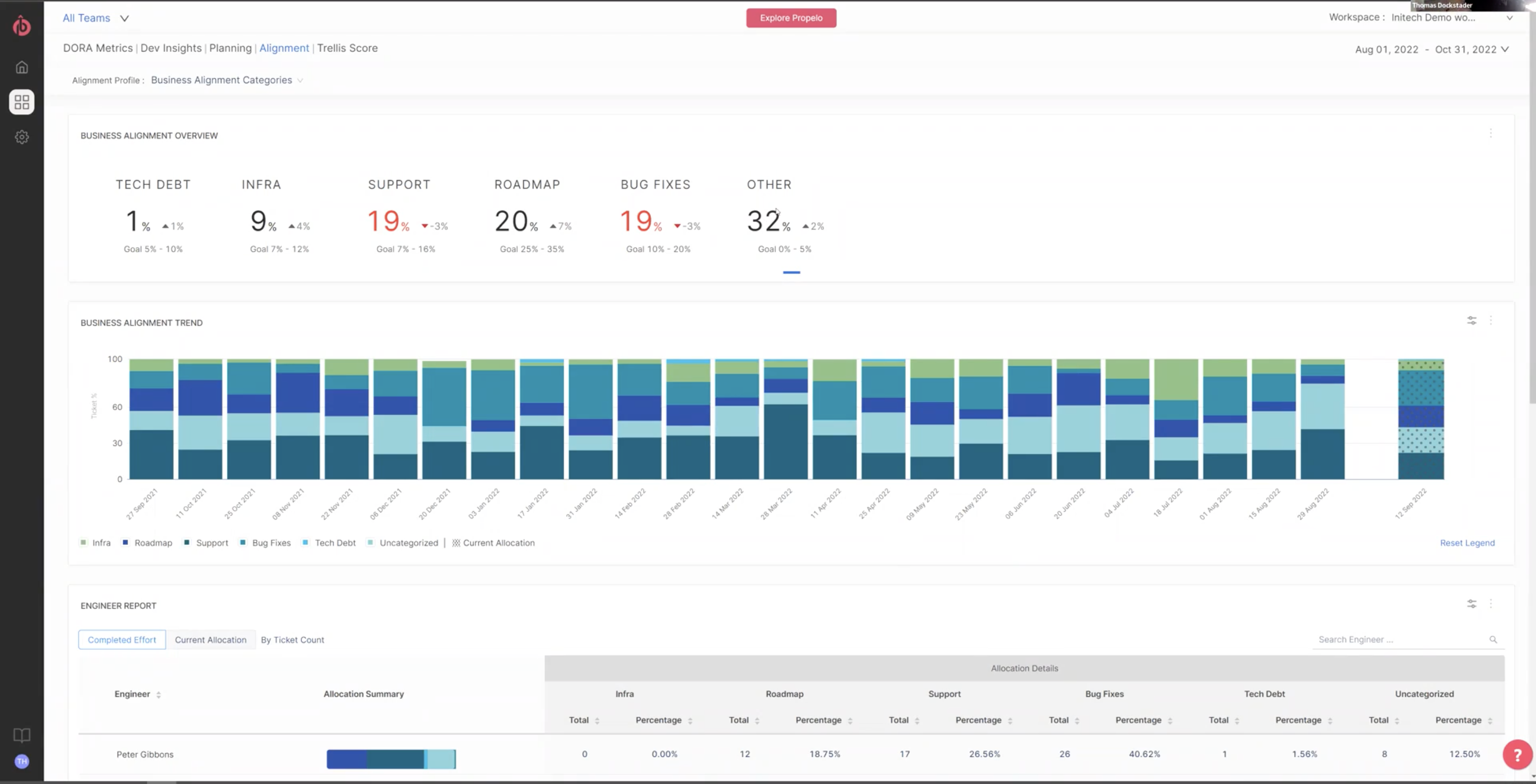
  • Harness Acquires Propelo to Surface Software Engineering Bottlenecks

    Harness Acquires Propelo to Surface Software Engineering Bottlenecks

    Harness this week announced it has acquired Propelo, a provider of an analytics tool that identifies bottlenecks in software engineering processes. Terms of the acquisition were not disclosed.

    The Propelo offering will be made available as a module, dubbed Harness Software Engineering Insights, that organizations can choose within the company’s overall continuous integration/continuous delivery (CI/CD) platform.

    Scott Sanchez, chief marketing officer for Harness, said Propelo is unique in that all the integration required to collect data from a wide range of DevOps platforms is already baked into the tool. As a result, DevOps teams can instantly collect telemetry data from not just the Harness platform but also CI/CD platforms such as Jenkins, GitLab and Azure. In addition, there are integrations with more than 40 third-party tools, such as the Jira project management software from Atlassian.

    Those integrations enable the Harness Software Engineering Insights module to surface insights aligned with the DevOps Readiness Assessment (DORA) metrics from Google and the satisfaction, performance, activity, communication and efficiency (SPACE) frameworks.

    In an uncertain global economy, there is more focus than ever on increasing the productivity of DevOps teams, noted Sanchez. More organizations are going to be reluctant to hire as many full-time employees as they once did, so more attention is being paid to getting the most out of existing investments, he added.

    That focus on productivity will naturally lead to a re-examination of workflows to identify bottlenecks in DevOps workflows that, if eliminated, would help increase the pace at which software is being developed, said Sanchez. In some instances, the software development life cycle (SDLC) processes companies are using are as much as 20 years old, he noted.

    The acquisition of Propelo is the latest addition to a portfolio of DevOps tools designed to be deployed alongside existing platforms, noted Sanchez. Organizations that have been using platforms such as Jenkins are not going to rip and replace overnight, he added. The Harness portfolio is designed to be deployed alongside existing platforms to enable organizations to modernize their DevOps workflows in a much less disruptive way than rival DevOps platforms, said Sanchez.

    Harness initially developed a CD platform before acquiring Drone to add a complementary CI capability. It then acquired ChaosNative to add a chaos engineering tool, based on the LitmusChaos open source tool, that is now being advanced under the auspices of the Cloud Native Computing Foundation (CNCF).

    It’s not clear how quickly organizations will modernize legacy DevOps platforms. Still, in many cases, workflows and pipelines that were designed for a different era of application development are not able to support the pace at which modern cloud-native applications are being developed. It will, of course, be up to each DevOps team to determine whether adding additional DevOps tools and platforms makes economic sense; application developers tend to naturally gravitate toward organizations that reduce as much development friction as possible.

    In an era where organizations are counting on developers to drive digital transformation initiatives, the underlying DevOps tools and platforms employed to build applications can easily make the difference between success and failure.

  • The API Economy: Increasing Potential to Monetize Public APIs

    The API Economy: Increasing Potential to Monetize Public APIs

    API-first strategies are becoming more commonplace throughout today’s digital strata. APIs connect microservices architectures, power new digital transformations and help development teams avoid reinventing the wheel for common functions. And although most are built to connect internal components, studies indicate a movement toward more externalization and monetization of public APIs.

    Over three-fourths of developers now view participating in the API economy as a priority for their organization or plan to prioritize it soon, found Rapid’s newly released 2022 State of APIs report. The survey, which surveyed hundreds of professional developers, also uncovered a modest increase in companies seeking to generate direct revenue from APIs.

    Below, we’ll review some intriguing statistics from the Rapid report and consider the major takeaways technology professionals should consider in the year ahead.

    API Reliance Increases

    Reliance on APIs is rising across the board. Over 62.6% of developers reported relying on them more in 2022 than in 2021. Internal APIs help avoid development duplication and third-party APIs can quickly integrate standard functionality related to payments, messaging, geolocation, data sharing and many more areas. For example, ChatGPT has demonstrated the power of standard APIs to deliver advanced AI/ML to the masses in a programmatic way.

    As a result of this interest, the majority of organizations now consider participating in the API economy as a top priority. And as an organization grows larger, its reliance on APIs is likely to increase. A full 40% of the largest companies surveyed reported having more than 250 internal APIs. Nowhere is this more prevalent than in financial services. This finding makes sense, given how APIs can automate payments and underpin the open banking movement.

    In terms of who is using APIs, it’s most commonly full-stack or backend developers, the report found. One intriguing factoid is just how much of this work is now dominating developers’ time. Impressively, 65.5% of developers reported spending ten hours or more working with APIs in their job; 14.5% of them said that work takes up all of their time.

    In terms of design styles, various standards are used throughout the web development sphere. Yet REST is still king—69.3% of engineers used REST in production. REST is followed by webhooks, WebSockets, AsyncAPI, serverless and FaaS, SOAP, GraphQL, Kafka and gRPC, in descending order of popularity. Across the board, these statistics showed a steady increase from last year.

    Of note is that most APIs are built for internal purposes. These often wrap a database or provide open access to an internal microservice. Private use cases are by far the most common approach; according to the report, 75.1% of respondents worked on internal APIs. These findings aligned with other industry reports, such as the Postman State of the API Report, which found that, in 2022, 58% of API initiatives were private.

    Third-party APIs (53.9%) and partner-facing services (48.9%) trailed behind internal APIs in popularity. Interestingly, while internal use cases have remained steady, both partner and public-facing strategies have increased since last year. While the growth was a modest 5% for most sectors, partner-facing APIs in some industries grew by nearly 10%.

    Spotlight on Monetization

    Many still view APIs as operational glue for internal data or connecting partner services. Yet, the possibility of monetization through self-service developer portals shouldn’t be overlooked—countless API-first startups are actively gaining traction and funding. And monetizing this power is seen as a holy grail to some unicorn-chasing VC funds.

    Most APIs are purely for in-house internal integrations and are typically not externalized to the outside world for profit. However, this is slowly changing. In fact, 42.6% of organizations are now monetizing APIs, representing an increase of about 5% from 2021.

    As one may have guessed, financial services are leaders in monetizing their external APIs. The telecommunications industry is also noticeably active in monetization, too. Furthermore, with size comes increased monetization potential—about half of the companies with a large footprint of ten or more internal or external APIs also monetized them.

    API Economy in 2023

    Looking to the future, most anticipate more reliance on APIs across sectors — 69.2% expect to rely on APIs even more in 2023. Yet, organizations will have to grapple with particular hurdles in this newfound landscape. For example, a cloud skills gap might bar some groups from realizing the benefits of an API strategy. Other concerns include ungoverned sprawl, authorization concerns, shadow APIs and escalating attacks on public-facing endpoints. Also, some organizations are still determining how to best secure and scale their use of new styles, like GraphQL.

    A standards-based approach that applies platform-wide governance will likely be necessary to maintain an efficient yet stable API footprint. To meet these high quality standards, testing is nearly universally applied—92.7% of those surveyed test their APIs or plan to do so. The most common tests ranged from functional testing to integration testing, acceptance testing and performance testing.

    The Rapid 2022 State of APIs report received 850 responses from over 100 countries. For more insights, readers can view the complete results here.

  • FAA Ground Stop due to Technical Debt? | Don’t Do DIY Crypto!

    FAA Ground Stop due to Technical Debt? | Don’t Do DIY Crypto!

    Welcome to The Long View—where we peruse the news of the week and strip it to the essentials. Let’s work out what really matters.

    This week: The FAA’s NOTAM database gets corrupted, and Threema shows why DIY cryptography is bad. (more…)