Tag: developers

  • Mendix Injects More AI to Accelerate Low-Code Development

    Mendix Injects More AI to Accelerate Low-Code Development

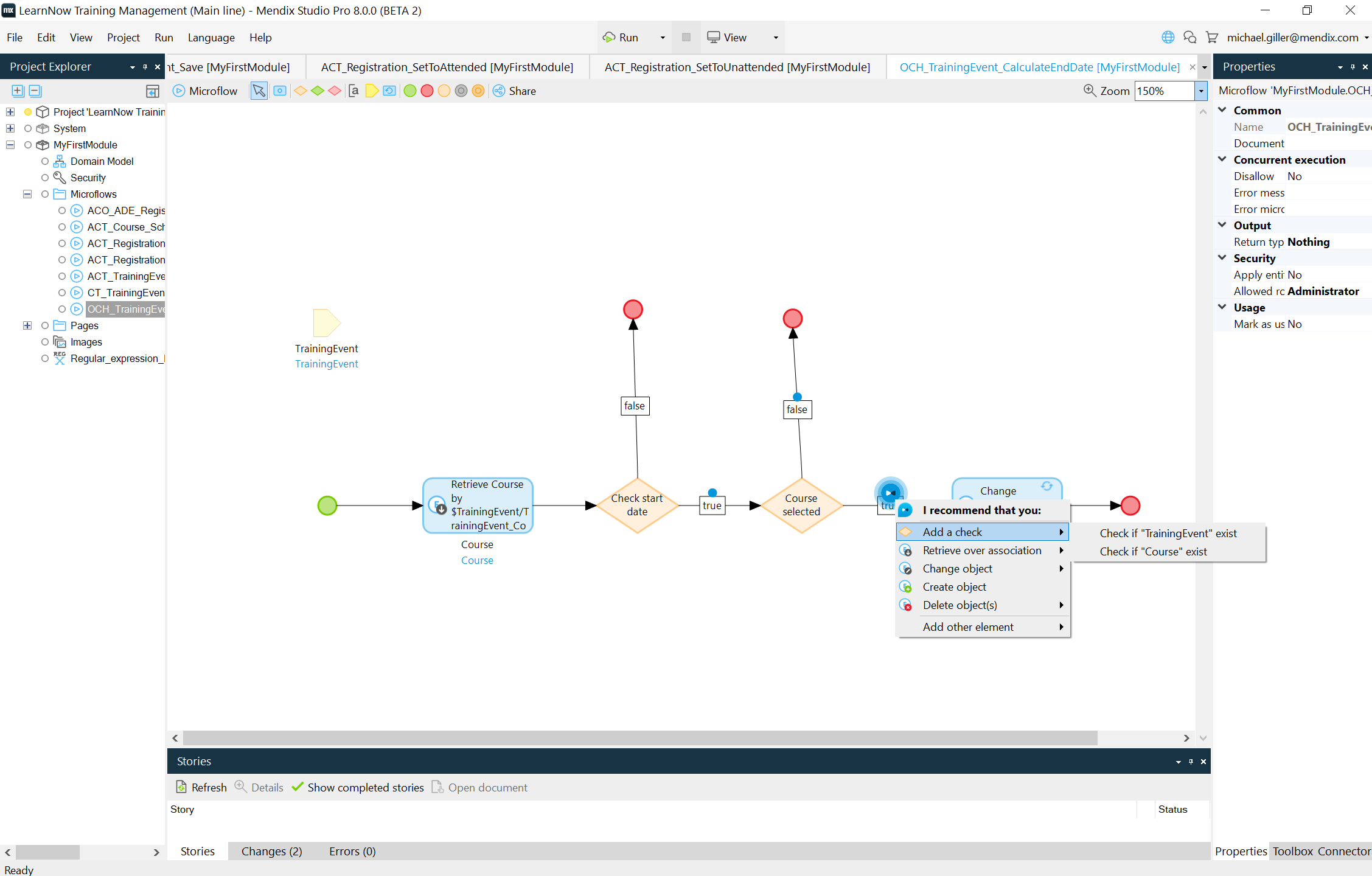
    The rate at which low-code applications are built and deployed will accelerate as developers begin to rely more on artificial intelligence (AI) to write code. The summer 2019 release of the Mendix low-code platform includes a revamped instance of Mendix Assist, which employs machine learning algorithms to make coding recommendations. Those algorithms have been trained using data drawn from 5 million application models employed across 15 industries over the last 10 years, and Mendix claims this version of Mendix Assist improves the accuracy rate of the recommendations being made to 95%.

    Sheryl Koenigsberg, director of product and solutions marketing for Mendix, said Mendix Assist will enable new developers to write better code faster, while experienced developers will be able to employ Mendix Assist to address routine issues that often get overlooked faster. Mendix Assist not only advises developers on what to do next but also generates recommended actions in previous logical steps based on whatever new code is introduced in the application.

    Mendix

    To make these capabilities more accessible, the summer release of Mendix adds Mendix Studio and Studio Pro, a set of integrated development environments designed to be accessible to both citizen and professional developers, to the low-code platform.

    In addition, Mendix is adding support for native mobile application development by adding support for React, a set of JavaScript libraries for building user interfaces for mobile applications, and including a native JavaScript editor. Those capabilities eliminate the need to rely on emulation software when building mobile computing applications, said Koenigsberg. Because the Mendix IDEs integrate low-code abstraction across iOS, Android, Java and Objective-C programming models, it also becomes easier for mobile developers to build reusable components. Mendix has also included more than 50 pre-built connectors to mobile device capabilities, such as camera, geolocation, biometric authentication and Bluetooth enablement, along with support for conversational chatbots and voice interfaces such as Alexa and Siri.

    Longer-term, Koenigsberg observed that it’s conceivable the AI capabilities being included in application development tools eventually will share insights with AI models being incorporated into continuous integration/continuous deployment (CI/CD) platforms. Proposed changes to an application could, for example, might be assessed from a performance perspective before any lines of code are written.

    In the meantime, the rate at which low-code applications will be moving through CI/CD platforms is about to increase substantially as developers augment their own skills by relying more on recommendations surfaced by AI engines. The quality of those applications should also improve as AI engines check, for example, to make sure all the appropriate compliance and cybersecurity controls are in place.

    It’s not likely AI engines will replace the need for developers anytime soon. However, it is apparent all the little things that routinely conspire to slow application development and delivery processes increasingly will be automated. That should make it easier for a larger number of organizations to embrace best DevOps processes. After all, the primary issue with DevOps adoption these days is not necessarily appreciating the value of the concept, but rather managing pipelines that still tend to get clogged every time an application fails to pass a gate because a developer forgot to do one thing or another.

    — Mike Vizard

  • Blockchains Done Right Are the Next Evolution in Open Source

    Blockchains Done Right Are the Next Evolution in Open Source

    Open source code is more than just a way to create new technology. It’s a disruptive force that changed the way software is built, from taking individual developers and turning them into thriving communities to changing how enterprises do business–building open ecosystems versus restricted walled-gardens.

    The next evolution of this movement is blockchain technology. Decentralized groups of developers across the globe are contributing to greater data integrity for businesses, better guarantees to ecosystem partners and can work together on live instances including their data. And that was the missing piece–live instances. Up until now, we could only collaborate on writing the code for a system together. Today, with blockchain technology, we can also collaborate on running this system together.

    Open Source is Decentralized

    From its ideological beginnings in the 1980s, open source code changed how we do business around the world, all stemming from developers’ work in software creation. Developers have seen open source disrupting almost every field of infrastructure, from operating systems (Linux in the cloud) to databases (MySQL, MongoDB, Redis) to programming languages (JavaScript, Python, Java, C, PHP).

    Over time, open source connected thousands of developers and established a corporate precedent. In parallel, the largest corporations in the world are also the biggest contributors to open source. It is with these two transformations open source is now over 50% of all code relied upon in the average proprietary system in enterprise.

    Now, blockchain is disrupting existing business models by extending the implementations and possibilities of open software. It does so by providing a transparent and immutable record keeping method, auditability of algorithms, forking of live instances with the data and possibility facilitate governance participation, all derived from an open source, decentralized community.

    Amazon recently added support for open source blockchain frameworks such as Hyperledger and Ethereum on AWS. This is a great first step toward making this technology widely available. As more AWS blockchain customers build on the open source frameworks to build for enterprise business, the powerful capabilities of open source will become a part of the blockchain movement. Transparency, auditability and forkability in code, all present enormous opportunities for developers while also demonstrating a precedent.

    It should be noted where these instances run, whether on private permissioned networks or public permissionless ones, is material to their ability to provide external guarantees to their users. The highest standard of trust is permissionless–where any member of the public can participate in their operation and audit.

    Decentralization Rewards Both Developers and Enterprise Business

    Businesses have gained major advantages through the use of open source software. In the same way, decentralized blockchain infrastructure offers businesses increased security, robustness and most importantly, guaranteed transparency with its customers.

    Prior to the open source software movement, traditional methods of programming were expensive, slow to develop and lacked insight into user experience until long after each new release came to market. Today, developer communities download, interact and actively contribute to blockchain projects in the same way as open source. Decentralized developers give businesses rapid ability to replace arbitrary features with intentional decision-making by a large, merit-based community. Decentralized blockchains are Open Source 2.0.

    Today, most standard apps run with centralized back ends. The server hosts the back end and dictates how the database evolves, given users’ requests and transactions. End users interact through the front end and never see what’s going on behind their static experience. What if we gave users a way to shift the power structure inherent in this state? Apps could become better for their users and much more competitive.

    Not All Blockchains Fit the Open Source Credo

    There’s a wide spectrum in the industry with blockchain technologies ranging from fully public to completely private. There’s a lively debate whether the value given by these fundamentally different solutions is comparable. I argue that distributed ledger technologies or private blockchains have little technological innovation. Their validators are permissioned, which means they cannot provide unbiased external guarantees to their partners and users.

    That said, there are some benefits to using private blockchains in certain use-cases such as coordination between a small number of competitors or WalMart onboarding all its external supply-chain services onto one coordinated platform, but they are limited in giving any guarantees to anyone not participating in the consensus (i.e. not running a node).

    Public blockchains offer a business greater transparency, because there are neutral and external parties operating the blockchain outside of the company and its customers with an independent incentive system. This removes anyone’s opportunity inside the company to falsify records, as they could potentially do on a private blockchain, or have data integrity relying on business relationships and dependency. Public blockchains also live up to the ultimate test of trust–from the comfort of your home you can verify by yourself every guarantee provided by the network.

    Where Hybrid Blockchain Comes In

    Most public blockchains were designed for absolute decentralization, which makes them impractical for mainstream businesses. Private blockchains are highly practical but don’t offer the transparency and trust possible with public blockchains.

    Hybrid blockchains, such as the one developed by Orbs, offer the best of both worlds. They’re perfectly designed to address fundamental issues with performance and interoperability while allowing for applications in highly distributed environments. They provide strong guarantees, verifiable by anyone, yet leave businesses in control of their business models, governance and security.

    — Tal Kol

  • Low-Code Has Taken Development by Storm. Why Not the Web?

    Low-Code Has Taken Development by Storm. Why Not the Web?

    For more than a decade, development tools increasingly have made their way into the hands of less-technical people. On the web in particular, we’ve eliminated the webmaster as the middleman with content management systems and moved progressively toward a model where non-technical users could assemble their own sites with little to no coding experience of their own.

    Fast forward and today, the terms “no-code” and “low-code” are used to describe this idea. Furthermore, no-code and low-code tools have been on a decade-long rise, with an increasing impact on the web. Examples include:

    While this has been a strong, decade-long market trend, we’re only at the beginning. This trend won’t stop until new website experiences are automatically generated and optimized by machine learning.

    Trends Driving the Low-Code and No-Code Movements

    According to Wave, “In our survey of global developers, 23% reported using low-code platforms in 2018, and another 22% planned to do so within a year.”

    Major market forces driving this trend include a talent shortage among developers, with an estimated 1 million computer programming jobs expected to remain unfilled by 2020 in the U.S. alone. What’s more, the developers who are employed are often overloaded with work and struggle with how to prioritize it all. Some of this burden could be removed by low-code and no-code tools, allowing marketers and other non-technical professionals to do some of the development work themselves. In addition, the fact that technology has permeated every aspect of our lives, from our smartphones to our smart homes, has driven the need for more people to become creators.

    “As creating things on the internet becomes more accessible, more people will become makers. It’s no longer limited to the <1% of engineers that can code, resulting in an explosion of ideas from all kinds of people,” said Ryan Hoover, founder of Product Hunt, in a blog post.

    In other words, the supply of web creators must keep up with the demand for more digital experiences across more channels.

    But this does not only apply to individuals. Consider this: The typical large organization has to build and maintain hundreds of sites. These organizations need to build, launch and customize sites in days or weeks, not months. Today and in the future, marketers and other non-technical stakeholders can embrace no-code and low-code tools to develop websites rapidly.

    Abstraction Drives Innovation

    As predicted in my middleman blog post, developers won’t go away. Just as the role of the original webmaster has evolved with the advent of the CMS, the role of web developers is changing with the rise of low-code and no-code tools.

    Today, developers tend to focus on creating next-generation digital experiences that require new and emerging technologies not yet available in no-code solutions. In the process, they help invent and build new technologies such as React, Vue.js, etc.

    Successful no-code approaches abstract away complexity for web development. This enables less-technical people to do things that previously only could be done by developers. When those abstractions happen, developers can move on to the next area of innovation.

    Such abstractions are a good thing for both developers and non-technical website creators. When everyone is a builder, more good things will happen on the web. I was excited about this trend more than 12 years ago and remain excited today. I’m eager to see the progress no-code and low-code solutions will bring to the digital world in the next decade.

    — Dries Buytaret

  • GitLab Survey Surfaces Major DevSecOps Challenges Ahead

    GitLab Survey Surfaces Major DevSecOps Challenges Ahead

    A report based on a survey of 4,071 software professionals published this week by GitLab, a provider of a continuous integration and continuous deployment (CI/CD) platform, found that while appreciation of the potential value of DevSecOps best practices is high, the ability to implement those practices is uneven at best.

    According to the survey, half of the respondents reported that security vulnerabilities are discovered mostly by the security team rather than developers after code is merged and in a test environment. And, when cybersecurity professionals participate in a DevSecOps process, the survey found those organizations are three times more likely to discover bugs before code is merged. In addition, a full 90% of those organizations are more likely to have tested between 91% and 100% of their code early in the development process.

    Obviously, that’s better than discovering them after they’ve been deployed in a production environment. On the downside, however, nearly half of security professionals participating in the GitLab survey (49%) said they struggle to get developers to make remediation of vulnerabilities a priority. That challenge may reflect the overall maturity of the DevSecOps practices in place. For example, only 25% of developers participating in the survey rated their security practices as being good. That compares to only 20% of security professionals who rated their processes as good. Only 14% of respondents said they are relying on application security tools to test more than 91% of their code. A full 44% are using these types of tools to test less than a third of their code.

    Priyanka Sharma, director of technology evangelism for GitLab, said the survey makes it clear that DevSecOps is now officially a thing in the enterprise. However, only 44% of the survey respondents said that security vulnerabilities are a performance metric for developers in their organizations. As such, it’s clear there is still a long way to go before anything approaching DevSecOps nirvana is likely to be achieved. In fact, Sharma noted building and deploying more secure applications may require organizations to slow down the rate at which applications are being built, at least initially.

    The GitLab survey makes it clear most organizations are still struggling with mastering DevOps. Only 28% of developers said they feel good about their organization’s level of DevOps sophistication, while less than half (45%) said they have been able to implement continuous code deployment at least somewhere in their organization. That level of adoption suggests there still is plenty of opportunity to refine DevOps processes that are not fully ingrained. In fact, it appears most organizations are still trying to master agile development methodologies—more than half of the respondents said they employ Scrum (54%) as their application development methodology, followed by Kanban at 37% and DevOps at 36%.

    Ultimately, most organizations will have no choice when it comes to embracing DevSecOps. There simply are not enough cybersecurity professionals available to secure every application on their own. That means developers will need to assume more responsibility for cybersecurity, regardless of whether they like it. DevSecOps processes will be required to validate whether developers have implemented all the security patches and controls required. Anything less than that going forward will be deemed as nothing short of reckless—which, as any lawyer will gladly share, means much higher penalties for everyone involved.

    — Mike Vizard

  • Pulumi Advances DevOps on AWS

    Pulumi Advances DevOps on AWS

    Pulumi announced the availability of Pulumi Crosswalk for Amazon Web Services (AWS), an open source framework for deploying applications on Amazon Web Services (AWS).

    Company CEO Joe Duffy said Pulumi Crosswalk for AWS provides a software-as-a-service (SaaS) application through which DevOps teams can automate the deployment of applications on AWS infrastructure using software development kits (SDKs) from Pulumi. The SDKs are based on programming tools such as JavaScript, Python, TypeScript and Go, which most developers already know how to use. That approach eliminates the need for DevOps teams to learn how to employ YAML files or to acquire tools such as CloudFormation or Terraform to deploy applications on AWS, he said.

    Pulumi Crosswalk for AWS also embeds the best DevOps processes recommended by AWS directly within its SaaS tools, including patterns for containers and serverless computing frameworks, Duffy noted.

    Pulumi Crosswalk for AWS is available on GitHub. It is designed to be integrated with existing Team and Enterprise Editions of Crosswalk that come with support and training provided by Pulumi.

    In addition to AWS, Pulumi Crosswalk supports other cloud platforms, including Microsoft Azure and Google Cloud Platform (GCP). The company also plans to provide support for private clouds and leverage Kubernetes clusters to automate deployments across hybrid cloud computing environments.

    Duffy noted that despite all the enthusiasm for DevOps, many IT operations teams have been left behind. While much time and effort has been put into unifying backend cloud services, the operational experience in the cloud still revolves around low-level application programming interfaces (APIs) or specialized tools that are challenging for IT operations teams to employ. That situation often creates a backlog of applications for IT operations to deploy. Crosswalk enables IT operations teams to leverage the skills developers have to deploy applications they approve on AWS, he said.

    As cloud computing evolves in the age of DevOps, the relationship between developers and the IT operations team is becoming more nuanced. IT operations teams still need to put guardrails in place, but they can’t afford to be perceived as a bottleneck slowing down the rate at which applications can be deployed in the cloud. The challenge IT operations teams must overcome is finding a way to enable developers to self-service their application deployment requirements as much as possible within a set of policy guidelines defined by the internal IT team. That approach will enable developers and IT operations teams to get out of each other’s way.

    It may be a while before IT operations and developers find the right DevOps balance that best suits their organizations. Individual teams within enterprises tend to define their own best practices based on the expertise available within the team. Ideally, those best practices are then shared and implemented as appropriate across the rest of the enterprise.

    In the meantime, it will be interesting to see how aggressively cloud service providers embrace tools such as those from Pulumi. Cloud service providers have a vested interest in getting as many workloads deployed in their clouds as quickly as possible. They tend to be a little less enthusiastic about anything that makes it easier to move those workloads anytime a DevOps team sees fit.

    — Mike Vizard

  • The State of Low-Code Development

    The State of Low-Code Development

    As enterprises continue to play catch-up when it comes to meeting their internal demand for new software services and applications, more enterprises—but still, only a minority—are turning to low-code development platforms to try to fill the gap.

    Low-code development platform provider OutSystems released its sixth annual “State of Application Development Report.” The report is based on surveys conducted in March of 3,300 IT professionals.

    The report found that a sizable minority (41%) of respondents are already using low-code platforms, while another 10% stated they were about to start using a low-code development platform. For comparison, in the 2018 report, 34% of respondents said they were using low-code development platforms and 9% said they were about to start using these platforms. Clearly, interest in these platforms is rising, if not modestly.

    Low-code development platforms strive to make software development more accessible. They do so by removing traditional coding interfaces with graphical user interfaces. And they typically target development toward a specific functionality, whether that be web applications, business process automation, IoT and, quite often, databases. The low-code development platform market is expected to grow to $27.2 billion by 2022 from $4.3 billion in 2017, an annual growth rate of 44%.

    The demand for software has never been higher. According to the OutSystems report, 64% of IT professionals said they have an application development backlog. For 19% of respondents, that backlog is deeper than 10 apps. While 50% said their backlogs have remained the same, 39% report that their app backlogs have improved over the past year.

    The time to deliver web apps and mobile apps is mixed. The 2018 OutSystems report found that 54% of respondents took four months or less to deliver a web application. This year, 61% said it takes them four months or less to deliver a web application. Mobile app development has changed a little: 55% on average said they deliver apps in four months or less.

    According to OutSystems, enterprises using low-code development platforms are 12% more likely to report that their backlogs have improved year over year.

    Those findings echo similar surveys. For instance, a survey released earlier this month from low-code provider Appian found that nearly 80% of its respondents believe that using low-code can free developer time to work on higher-level projects. That survey also found 86% of IT developers agree that emerging technology is increasing the pressure on the IT organization.

    One thing is certain, the demand for software isn’t going to let up anytime soon. According to the OutSystems report, the number of applications respondents plan to deliver this year is 60% higher than last year. For those with more than 500 employees, 65% said they had plans to deliver 10 or more apps, 38% plan to build 25 or more apps and 15% said they plan to develop 100 or more apps this year.

    Despite the high demand for enterprise software, only 36% of organizations have larger development teams than they did a year ago. However, that’s likely not due for lack of trying to hire and retain development talent. The OutSystems survey found only 15% of respondents described developer recruitment as easy. “For many organizations, retention of developer talent appears to be an equally grave challenge,” according to the report.

    With conditions like that, it’s only reasonable to expect low-code development platform popularity to continue to rise.

    — George V. Hulme

  • The Terrain of DevOps is Strewn with Pitfalls

    The Terrain of DevOps is Strewn with Pitfalls

    As Gene Kim, one of the leading thinkers in DevOps, once said, “DevOps is not about what you do, but what your outcomes are.” What he’s telling us is that DevOps is about enabling a rapid flow of work that transitions from development to testing to operations, but the bottom line is that it’s about achieving results. Unfortunately, this too often gets lost in modern-day DevOps practices.

    In this article, I will discuss five common pitfalls that occur in DevOps if you don’t pay attention to the endgame and how your organization can avoid falling victim to them.

    DevOps and Automation: Measuring the Wrong Outcomes

    Some people believe that, at its core, DevOps is about trying to automate everything. But ask yourself this: Once you automate, are you really delivering a better outcome?

    The answer is not always yes. While metrics such as deployment frequency or mean time to repair (MTTR) are interesting DevOps indicators, they are no more interesting to determining if your team is delivering actual value than measuring the number of lines of code submitted or counting the number of keystrokes by the development team. You measure outcomes by determining a baseline from where you start and compare that with where you end.

    We need to understand that DevOps is about much more than automation; it’s about the entire pipeline and how your team moves from ideation to delivery to production. Even large companies with world-class DevOps teams don’t always clearly see the problem and can struggle managing the value stream and putting together multiple pipelines. An anonymous but real-life example of this is an organization I know that had been doing DevOps for 18 months, yet hadn’t delivered anything into production in that span. Are they really doing DevOps? DevOps is a process, but if it produces zero value, it’s not delivering on its promise.

    The key is focusing on delivering value and measuring value delivery into production. However, before you can begin measuring value, you have to define what it means to each individual deliverable. Common metrics include the number of story points, actual revenue from product comparison and customer satisfaction. With your clearly defined metrics in place, you can measure value as it gets delivered to the customer.

    DevOps and Fragile Environments

    One Achilles’ heel in the DevOps process is the pre-production environments where code gets deployed and tested. Automating a delivery pipeline relies completely on code being built and deployed to various environments. Fragile environments mean that the developers and testers are wasting time dealing with problems originating from the environment and not the code itself.

    While we wish all environments could be on-demand; the fact is, most are not. Another DevOps expert, Randy Bias, has an analogy about pets versus cattle in describing servers, and the same analogy can be used for environments. If environments are not standardized and repeatable, you have to be willing to move on from it like a farmer moves on from livestock; you can’t hold onto sentimental attachments like we have with our pets. What’s most important is that in no case can an environment be singular in nature.

    One element of the solution is to create code and automate, but the key is building up environments that are complete. Every environment needs proper builds, proper data and proper tests validating the environment. Additionally, the automation must have the stability to perform successfully every time. If you have piece of automation that fails even just 5% of the time, that’s unacceptable.

    The only way automation works in an environment is if you can trust the environment. When the environment is unstable, it’s like playing Russian roulette: No one knows exactly where the danger lies. It could be in the environment, the code, the data, the middleware … a number of places. When a problem arises, developers are often the last line of defense, but dealing with an issue such as this pulls them away from getting real work done.

    Disconnected Teams

    On this point, I’d like to share a warning: Disconnected toolchains lead to disconnected teams. The planning, development and testing teams can lack cohesion, and the release and operations teams often struggle to be on the same page. Each of these groups have their own tools and management, but they need to be able to communicate with each other effectively to make things work smoothly. In an ideal world, planning initiatives would flow into features for the development and testing team, which would flow into release pipelines and operational changes. Every team still can speak its own language, but the tools need to be interconnected and unified across the teams.

    Mismanaging Hybrid

    The term “hybrid” has many different uses in the software development space. Hybrid methodology refers to combining waterfall, agile and DevOps practices. Hybrid environments means your environment is housed in multiple locations such as the cloud, on-premises, virtual or code. There’s also hybrid geography, hybrid architecture, hybrid style—the list goes on.

    The key to transitioning to DevOps is properly managing the different types of hybrid. If you can’t manage hybrid delivery, you can’t manage your entire delivery and you can’t improve your delivery holistically. Organizations must learn to manage in a world of hybrid delivery and be able to handle cloud and on-prem, as well as teams all over the planet.

    Fixing Non-Constraints

    The Theory of Constraints is about pinpointing the bottlenecks in your process and fixing them. Any work that’s not focused on eliminating the constraint will not result in improvement and could be considered a waste of time.

    It’s important to remember that if you haven’t fixed the bottleneck, you haven’t improved anything. At the same time, if you’re automating the non-constraints, you’re wasting efforts by trying to improve what doesn’t need improving.

    As we’ve pointed out, DevOps does not equal automation. If an organization has messy processes and tries to automate them, they’ll be left with an automated mess. Therefore, organizations will see the best results from automating their constraints and just as important, not automating the non-constraints.

    — Jeffrey Keyes

  • SREs: The Happiest – and Highest Paid – in the Industry

    SREs: The Happiest – and Highest Paid – in the Industry

    According to the 2019 StackOverflow survey completed by 90,000 developers around the world, whether you are already a Site Reliability Engineer (SRE) or thinking about becoming one, looks like you are onto something.

    SREs, also called DevOps specialists, are a pretty unique type of talent; one that has knowledge in both software development and system infrastructure. And because the world of infrastructure is so vast, these professionals also need to juggle networking, security, system administration, hardware and anything else that could make an infrastructure unstable or down (yes, I am looking at you, A/C). That makes any day at work unique.

    SREs, for the most part, are in charge of making sure that your favorite website apps are loading, and fast. Their work is not customer-facing but highly critical. According to Gartner, the average cost of IT downtime is going anywhere from $5,600 per minute to—when you work for Amazon—$2 million for every minute down.

    That’s one of the reasons why SREs are among the highest paid in the industry, well, right behind their fellow managers! They also rank among the ones with the most coding experience—it takes time and hard work to get there.

    And all of this leads to happiness! With an interesting job and high pay, SREs satisfaction is among the highest in the industry, and they rank in the top three of the ones not actively looking for a job. SRE for a day, SRE forever!

    But here’s the problem: There aren’t a lot of SREs out there and hardly any computer science programs cover the topic. A recent tweet from Target software engineer Jessica Schalz illustrates the point very well:

    As TechRepublic reported, these professionals are among the most wanted in the tech industry and 33% of IT leaders report having a hard time hiring profiles with these skills. A potential reason for this lack of talent might come from the fact that the profession is failing at attracting about half of our population: women. SREs are 30 times more likely to be men than women. Training non-bearded SRE talent is possible. The Holberton School, a coding school I co-founded where 40% of the students are women, is leading a lot of students to be hired as SREs.

    And the good news is that we are not alone: CloudFoundry and Infrastructure Masons are also taking action to move the needle. And industry leaders such as Tammy Bütow and Abby Kearns are showing the way.

    As former software architect Eduards Sizovs pegged it: Great developers are raised, not hired. The industry is spending tons of money and energy and trying to attract the best talent when it would often be more efficient to take juniors that can grow to their need.

    “There is a new generation of developers of all races, genders, backgrounds coming up who can do these jobs,” said Max Johnson, DevOps engineer at Pypestream. “Businesses should widen their hiring scope and consider non-traditional sources that train as good, if not better, talent and coach them further for these highly skilled jobs.”

    LinkedIn is among the first to understand the value of investing in people—so it’s probably not a coincidence that it’s among the best places to work in the U.S. From an internal, employee-led perspective, the company has developed a number of in-house programs for both career and technical development. For example, its Women in Tech (WIT) organization leads a number of programs to connect, inspire and grow women technologists. From an external standpoint, with its REACH engineering apprenticeship program, LinkedIn is redefining the way it identifies, recruits and trains talent. REACH is an apprenticeship program that creates opportunity for every individual with the passion and potential to either develop or restart their career in engineering. The program guides participants through various levels of technical roles at the company, with the end goal being that each individual builds their skill set and gains the experience needed to become an engineer.

    “Reinventing our approach to recruiting and developing junior talent has been a great way to expand our funnel and has brought forward more diverse perspectives, forming a more robust team,” said Casey Brown, senior manager, SRE at LinkedIn and core team member of the REACH program.

    As you have probably understood, SREs are a niche talent (43% of them even picked Vim as their favorite editor). But as I recently tweeted, they are ruling the world, and more of them are needed. Let’s get creative to train and hire more of these amazing professionals!

    — Sylvain Kalache

  • Different Organizations, Different DevOps Outcomes

    Different Organizations, Different DevOps Outcomes

    The main motivation behind inventing DevOps platform was to help close collaboration between developers and IT operations. Basically, DevOps emerged as a great platform to bring closer together developers and beneficiaries of the app development process. DevOps initiates a cross-disciplinary practice spanning across development and operations.

    The ultimate benefit of the DevOps approach is removing the barrier between development and deployment of software applications in specific business processes. Regardless, not all businesses reap the benefits of DevOps platform.

    Does DevOps really suit all businesses of different sizes and niches? What are the key considerations for utilizing DevOps platform? These are the questions we will try to answer through this article.

    Do All Businesses Require DevOps?

    The common and widespread consensus is that any software development company geared for innovation must embrace a DevOps environment. Any business that considers innovation and smooth deployment in the software development process—a key factor in their long-term growth strategy—should take advantage of the benefits of a DevOps platform. Whenever any service provider needs to adopt new strategies to keep pace with the evolution in the software space, DevOps will come as an irreplaceable platform choice.

    Despite this consensus and widely accepted perception, there are different opinions in the market. Many industry experts believe that to reap the benefit of the platform you need to have a dedicated DevOps team in place. If you have a DevOps culture and in-house DevOps team in your company, you can gain a competitive advantage.

    The Key Benefits of DevOps

    The main benefit of DevOps is faster delivery of software with much-improved quality. There can be several other benefits depending on the industry.

    While some companies refer to the huge reduction in downtime since they adopted DevOps culture, there are still many others who simply give credit to the platform because of its integrated approach that makes the process more agile and fast-paced.

    For most companies, the domino effect of getting better software at a faster speed ends up delivering sustainable growth and revenue opportunities.

    Here’s a look at the role of DevOps platform across three types of businesses: small companies and startups, midsize companies and large business houses.

    Small Companies and Startups

    In smaller companies and startups where resources and human capital remain under-supplied, the responsibilities ascribed to developers, engineers and deployment professionals often tend to get blurred or overlap. Because of the scarcity of human resource, developers and engineers are often assigned multiple responsibilities. Naturally, in such companies, it is common to see cross-functional teams ready to engage into various development projects with ease. This makes them ideal business organizations to embrace and grow with DevOps culture.

    Midsize Companies

    As the companies tend to grow bigger in size and resources, they have a bigger (and often unbreachable) divide between verticals such as operations and development. In such organizations, staff are less likely to be open to cross-functional responsibilities, as many have been in the same job doing the same tasks and feel settled. This brings in a stagnant organizational process, where strong departmental divide rules the business process outcome.

    This stagnant work culture makes such companies less appropriate candidates to implement DevOps environment. For these companies to reap the benefits of a DevOps platform, mass organizational changes should be brought in the team structure. Building a separate cross-functional DevOps team to handle some focus projects can also be good practice for them.

    Large Companies

    Large companies enjoy the luxury and abundance of resources, and this makes them much better-placed compared to other organizations. Companies such as Amazon, Facebook, Google and Microsoft have the diversity, huge experience and robust abilities to bring together cross-functional specialists from development and operations to work on ambitious projects. These organizations are known for having product-oriented units, comprising specialists from both development and operations.

    Apart from their cross-functional expertise, product-focused approach and abundance of resources to roll on new projects, large companies also can make a big difference to the teamwork and motivation through a highly unified vision and strategic long-term objectives shared by every member of each team. This is why large companies always stand as suitable candidates to embrace DevOps approach and environment for their projects.

    Fixing the Right DevOps Strategy: 3 Things to Consider

    Beyond the organizational differences and core strengths and weakness for embracing a cross-functional DevOps approach, we must look into the key aspects that make a right strategy for any organization to incorporate DevOps into their scheme of things. Question is, despite the shortcomings and lacking, how can you embrace DevOps environment and reap the benefits? Here we provide some clues:

    • Making Change a Habit. Some strategists believe that any organizational change will face a lot of friction, causing substantial harm to the immediate business outcome. But there should be no reluctance to change for this. Rather, by bringing constant changes, people get used to the friction and pain and it becomes normal. This is one way to replace traditional IT mindset with DevOps.
    • Starting Small with a Neat Team. Obviously, finding the appropriate and credible skilled employee for your DevOps projects is not always easy. This is why it is advisable to create small startups or units, in which sharing the common vision and embracing a cross-functional approach becomes the order of the day. On top of that, do your best to bring out the best from your team and hire some experienced ones with knowledge of DevOps.
    • Continuous Development Mindset. We all know how the DevOps platform always focuses on continuous development approach. It is easier for the software developers to embrace such approach, but for operations staff, you have to slowly make them think of infrastructure as evolving and slowly building components. That’s something challenging but not impossible.

    Conclusion

    DevOps has emerged as the most promising development approach for modern software developers. Though for many development companies the friction emanating from strict role divides is becoming an obstacle, the positive push by DevOps for cross-functional approach looks indomitable.

    — Atman Rathod

  • DevOps and Collaboration: Fraternizing with the Enemy?

    DevOps and Collaboration: Fraternizing with the Enemy?

    DevOps is all about collaboration, we hear.
    “You must collaborate,” say managers initiating DevOps adoption programs.
    HR make new posters declaring the corporate values “We value Collaboration & Teamwork.”
    Can’t fail!
    Then when it appears not to be as effective as we had hoped we tell teams they are “Empowered” to collaborate.
    Blank stares!
    When things still don’t appear to be working we tell teams they are “self-steering,” “self-organizing, collaborative teams”….
    Still, we don’t get what we were hoping for.
    Luckily the tool vendors come to the rescue and tell us why it is failing. We need “collaboration tools and software” – Throw some “Slack” at it.
    Can’t fail!

    This is when we usually get frustrated managers knocking on our door asking about the Phoenix Project DevOps simulation. They are moaning about communication and collaboration! When we talk to the teams they are frustrated and moaning about “empowerment” and managers not “walking the talk.”

    In my mind these lack of collaboration skills is not really surprising. Why?

    Impression: Well, it doesn’t help when the word has also historically been connected to global conflict situations. “He faces charges of collaboration,” “fraternizing with the enemy.” Dev & Ops. Traditional adversaries?

    Interpretation: The interpretation of the word itself is also part of the problem. I googled an English Language Help Desk:

    Collaboration: “To work together with somebody in order to achieve a single shared goal.”
    Cooperation: “Work with other people by achieving one”s own goals as part of a common goal.”

    In an HBR article titled, “There’s a difference between cooperation and collaboration,” it was argued  “… Managers mistake cooperativeness for being collaborative,” adding, “… most managers are cooperative, friendly, willing to share information – but lack the ability and flexibility to align their goals and resources with others in real time.” If managers don’t get it then what chance do the teams have when told – “You must collaborate”!

    Induction: Part of our failure to be able to effectively collaborate could come from our schooling. We are chastised at school for asking others for help, for looking to see how somebody else is doing it—”That is cheating”—things are changing with more “collaborative assignments.” Yet, my children (now in their early 20s) were not taught what effective collaboration is, other than discovering for themselves. As my daughter explained about her school assignment, “You have to do it yourself if you want it done because others will slink off and not do it, then my individual grade may suffer.” They are told they need to collaborate but individual performance grades are scored. My daughter once came home stressed and almost in tears, declaring “Oh no! I have been given another collaborative assignment for my most important subject!” Children leave schools distrustful of collaborating.

    Indoctrination and Imperative: There is also the historical perspective. When we, the current workforce entered our chosen profession we had decades of functional silos that created a “them” and “us” attitude. This stimulates a sort of “territorial imperative” or “tribalism,” not helped by our own “technology” languages and tribal cultures. We have learned over time that other teams “dump things on us” or other teams “stop us from getting stuff done.” In other words, Other teams frustrate work.  (Territorial imperative—”the drive in animals and man to take, hold and defend a particular area, zone, turf,” —e.g. defending their best practice framework! And attacking others that come near!).

    Inconsistency: We then built walls between these teams and if they wanted something from each other they needed to escalate it to their manager. Managers would collaborate or not, especially when they were given conflicting, inconsistent goals and KPIs. Development teams are given goals to release as fast and as often as possible. Operations are given goals to make sure everything is as reliable as possible and available at all times.

    I had an example of this “them and us attitude,” once with a board of directors. I split them into two teams and gave each team a pack of ABC cards (Attitude, Behavior and Culture) and within 10 seconds heard, “Oh good, our team will win this!” automatically creating an atmosphere of competition and winning and losing, I hadn’t even explained the task yet! Teams compete.

    ‘It’ factor: A study by Google (2012) called Project Aristotle, named in tribute to Aristotle’s quote, “The whole is greater than the sum of its parts,” looked into why some teams work and others don’t. One of the key conclusions was that “psychological safety” was the “it” factor, “… a sense of confidence that the team will not embarrass, reject or punish someone for speaking up.” Because we have not learned to collaborate and because we have a “them and us” history often accompanied by blame, there is fear, uncertainty and doubt (FUD) about speaking up, sharing ideas or giving feedback.

    In the dark: However, there is another significant reason for poor collaboration, as I have discovered from running hundreds of Phoenix Project simulations with teams globally. It is the fact that nobody has defined the “behaviors” that demonstrate effective collaboration. We assume everybody knows what we mean when we say, “You must collaborate.” Fact: We don’t!

    Below are the results of a series of recent Phoenix Project simulations. One of the goals was to learn DevOps practices such as CALMS and the Three Ways, while another goal was to learn effective team-working and collaboration.

    I asked the teams at the start of the sessions, “What is effective collaboration? What behaviors will I see today that demonstrate this”?  The teams came up with a list of behaviors (each team came up with a top five or six behaviors; this is the consolidated list from seven teams).

    • Transparent communication – “open and honest” and “frequent.”
    • Calm and constructive dialogue (no blame, accusations and shouting).
    • Feedback “asking for and giving feedback.” Constructive feedback.
    • Shared team goals (and cross team). What are we aiming for? Impact on others and their goals. Maybe conflicts that need managing.
    • Listen – is it clear and understood? Show that you listen.
    • Being open for dialogue, being approachable –not closing the door or hiding behind.
    • Giving and taking responsibility.
    • Sticking to agreements.
    • Central moment to get together (e-2-e).
    • Knowing the roles and responsibilities, sticking to responsibilities.
    • Mistakes are OK.
    • Be proactive to get information needed.
    • Equal treatment: “Respect” ideas from ALL
    • Don’t HOPE, confirm.
    • “Willingness.” Confirm and agree.
    • Ownership of responsibilities.
    • Clear agenda and purpose of meetings.
    • Pleasure – celebrating success.

    “Are these behaviors you want to see more of in your daily work?” I asked.

    Yes! Was the answer.

    “Do we now all commit to sticking to these behaviors today, in this simulation?

    Yes! Was the answer. Easy! See there’s nothing to this collaboration stuff.

    However …

    During the simulation it soon became evident that roles and responsibilities were not clear or not being carried out; it was not agreed which information was needed by the business nor when; goals were unclear, meaning that priorities were arbitrary; people did not understand procedures and did not ask for help; assumptions were made (“I told you …,” “I thought you meant …”); people taking responsibility were not respected (“Let’s stop and try and sort this out …”)— everybody just carried on running around! “Headless chickens,” said one delegate; people were not listening to each other; there was a lot of “assumicide”; mistakes were made and people blamed—there was no exploration as to why and what can be done to stop these  mistakes. Mistakes were often corrected by somebody else but without giving any feedback to correct future mistakes; agreements were unclear across the team; there was no end-to-end flow—work and information was ping-ponging back and forward.

    “All in all, just like reality!” declared the teams.

    See how easy collaboration is. Within one hour of making a list of desirable behaviors, they were totally, utterly and universally ignored. Nobody appeared to own these behaviors or to confront each other on them.

    After the Experiences in Simulation

    At the end of the simulation round we looked at the team scores (number of releases, number of successful releases, business value realized). It wasn’t a pretty sight. The CEO wasn’t happy. The team felt stressed, unhappy, frustrated and powerless.

    We explored what this had to do with “effective collaboration.” Had anybody used the list of behaviors? No.
    Had anybody consciously practiced these behaviors?
    No.
    Did anybody give feedback on these behaviors when they were clearly not done?
    No.
    “Giving feedback feels strange, it feels like we are criticizing and blaming,” said one delegate. Another assumption!

    “It’s hard,” said one delegate. “The manager needs to manage this,” said another.
    “It was YOUR list and YOU all agreed this, why is this a manager’s job to get you to do what you said you wanted to do?”
    There was silence. “It’s not easy, we fall back into old ways of doing things, we need help!”

    Is it a Bird, Is it a Plane, Is it a Bus? No, it’s a coach!

    As the simulation progressed, the team refined their list of desirable behaviors based upon their experiences. They were coached for two rounds and consciously practiced and experimented with the behaviors. The coach role became a critical catalyst.

    In the final round the team owned, and were executing on these behaviors without coaching.
    Why were they suddenly executing?
    They felt less stressed; they were trusting each other; they felt the positive impact on their work; they saw, felt and shared the value gained by these behaviors. They felt immediate positive consequences from these behaviors.
    Why no more coaching?
    The team were taking it in turns to lead their own stand-ups; they were giving feedback and correcting their own behaviors. These were the additions the teams made to the behaviors as they practiced them.

    • Transparent communication – “open and honest” and “frequent” (Relevant, and timely as agreed with the various stakeholders).
    • Feedback “asking for and giving feedback.” Constructive feedback. (Related to agreed behaviors and responsibilities, calling stop, then swarming to solve an impediment, constraint, or remove waste; immediate fact based feedback).
    • Shared team goals (and cross team). What are we aiming for? Impact on others and their goals. Maybe conflicts that need managing. Understanding strategic portfolio and how we contribute to strategy, show you understand and agree common goals and prioritize accordingly. Goals for both value creation (features and benefits) and value leakage (risks, debt).
    • Leadership within team – team members took turns in facilitating the stand-up and retrospective. This role was respected.
    • Listen – is it clear and understood? Show that you listen, sender: Ask for clarification, ask to confirm understanding, listener: summarize what was understood and agreed. Avoid assumptions.
    • Being open for dialogue, being approachable—not closing the door or hiding behind. All were engaged and equal in the stand-up and retrospective. All were asked for feedback, ideas, suggestions.
    • Giving and taking responsibility. Respecting team behaviors; e.g if somebody calls “stop,” or “respect somebody taking responsibility for an improvement stand-up.”
    • Sticking to agreements. Confront people to understand why agreement not met and what can be done about it in the future (e.g conflicting priorities, lack of understanding).
    • Central moment to get together (e-2-e). Scheduled stand-ups, retrospectives, and improvement prioritization.
    • Knowing the roles and responsibilities, sticking to responsibilities, confirming your responsibilities, confronting people on responsibilities (feedback). Showing that you take ownership.
    • Mistakes are OK – no blame, so long as it is used as an opportunity to learn and improve.
    • Be proactive to get information needed (or ensure information is available, e.g. visible management board, avoid unnecessary “disruptions).
    • Equal treatment: “Respect” ideas from ALL. Ask people for input, engage ALL in ideas generation and decision-making.
    • Don’t HOPE, confirm.
    • “Willingness.” Confirm and agree – “Willingness” and “ability,” empower to be able. Share knowledge, cross train, coach, help.
    • Ownership of responsibilities. Confronting people on responsibilities.
    • Clear agenda and purpose of meetings. My role, what is expected from me? What is in it for me? avoid “wasting” time in meetings.
    • Team coaching to give feedback on behaviors.
    • Create trust by demonstrating team behaviors.
    • Check understanding and commitment to “agreements” and confront people (feedback) on agreements.
    • Improving own work as a team.
    • Asking for and offering help.
    • Having insight, overview, visibility.
    • Limit WIP (reserve WIP for learning, improving, technical debt).
    • Pleasure – celebrating success. Product owner shared results including customer feedback. Team complemented each other.

    The teams were then asked to make a list of behaviors and actions they wanted to take away and apply. Their line managers and assigned team coaches were there when the list was made and gave commitment to help guide, coach and empower teams to experiment and practice these new behaviors in their daily work.

    The team would prioritize one or two behaviors to start with and consistently practice in the coming weeks. When the new behavior becomes the accepted norm and a “habit” they would focus on more behaviors.  This fits in with the Third Way of DevOps: Continuous experimentation and learning. “Understanding that repetition and practice is the prerequisite to mastery.” And to tie this back to Aristotle the philosopher (not the Google project): “Excellence is an art won by training and habituation … We are what we repeatedly do. Excellence, then, is not an act but a habit.”

    Meetings, Including Training Sessions!

    And finally, one of our industry’s most popular, and wasteful, examples of collaboration are poorly run meetings, which are the biggest time-sink in organizations and a source of frustration. I include some training classes as forms of meetings.

    In more than 100 training sessions in the last year, less than 10 percent have started on time.
    Nine minutes late is the average. Delegates say this is normal in their organizations. When I ask people what their own personal learning goals are for sitting eight hours in this “training meeting,” more than 25 percent had not defined this and more than 70 percent had not agreed this with the “sponsor” of the training.

    We need to manage our overload of wasted meeting effort. How? One way is the ask for goal and agenda in advance, asking what value you need to bring in and what value you need to get from the meeting; also to limit your time to the agenda items relevant for you or your team.

    Efficient collaborators decide when they do, or don’t, have unique value to add—“maintaining focus on what matters.”

    The same applies to training, asking, “Why am I going on the training?” “What am I expected to learn?” “What problem is this training expected to help solve?”  “What will I be expected to do differently after the training?” “How will the learning be transferred back to the workplace?” “Will I be mentored and coached?” “Will I be given opportunities to experiment?” “Will I get constructive feedback?” “How can we demonstrate that the new knowledge delivers expected benefits?” This is better than the most common answer, “I don’t know I was told to come to this training!”

    A training is also a form of collaboration between you, the trainer and the person sponsoring the training.

    There is an “I” in Team, after all. “I” am responsible for my effective contribution to team performance.

    — Paul Wilkinson