Tag: IoT

  • IoT Security Concerns

    IoT Security Concerns

    The Internet of Things (IoT) is being hailed as the next step in our technological development. It’s hard to argue with that. The abilities it provides are as captivating as they are numerous: smart cars and homes, automatized agriculture, advancements in medicine that help with after-stroke recovery and the list goes on.

    However, while the IoT is truly a huge topic nowadays, we must not let our fascination with it overcome us. It’s too easy to forget about security and privacy concerns when you hear about exoskeletons that can increase a person’s strength and dexterity–trust me, I know. But we can’t afford to forget about them.

    It does seem, though, in our pursuit of the interconnected device environment, the security of those devices was somewhat left behind. Let’s take a look at what the primary IoT cybersecurity hindrances are and what can be done to overcome them.

    When Security Struggles To Keep Pace

    One example of the quantity of devices outrunning their quality safety-wise is smart homes. They are very popular now, and according to the IDC forecast this trend is not going away:
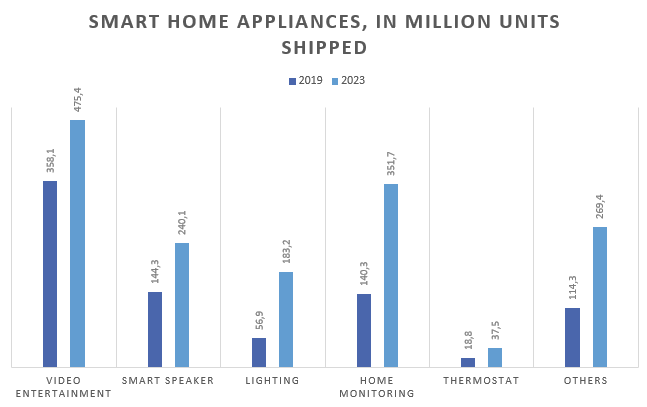
    Data source: IDC Worldwide Quarterly Smart Home Device Tracker.

    While undeniably convenient, smart homes can pose a potential threat to their users. To do their job, they must collect information about those users. And the more interconnected the entire system gets, the more trouble can a single weak link cause.

    Take smart door locks, for example. Some of them come with facial recognition algorithms. That in itself is a pretty big privacy concern. Facial recognition can be used with an alarming accuracy to identify and track individuals. It can have various purposes, but very few of them (if any) are benevolent.

    To add to that, within the smart home system, a smart lock is going to be connected to other devices. Maybe it is safe from cyberattacks on its own, but is the smart thermostat safe? What about the smart water kettle? It only takes one vulnerability to get access to a lot of one’s private data.

    This risk can be somewhat mitigated by users taking certain precautions: installing AV software to protect their devices, updating the said devices regularly to prevent exploits, setting up a VPN on their routers to safeguard all of their internet traffic, etc. But how many users are actually going to go through with all this trouble?

    Physical Problems

    It should be noted that data breaches and cyberattacks are not the only threats the IoT faces. Some problems arise from poor design.

    For example, among other considerations presented in the June NIST publication, a non-descriptive appearance of an IoT device is mentioned. If it’s just a black box with no markings on it to indicate what software and hardware it runs on, updating it (as well as keeping track of its activities) becomes a very unpleasant chore. It is especially true if there are thousands of such devices located on the premises of a company.

    Alternatively, the support of a certain device may get discontinued well before the company plans to replace it. It is also possible the news of its discontinuation can be missed by the company, thus creating a possible vulnerability.

    Sheer Scale of the IoT Makes Threats Bigger, Too

    Another concern with the IoT is it’s so overwhelmingly difficult to maintain secure. If there is the need to install crucial updates on hundreds of millions of devices, the task becomes all but impossible.

    The hundreds of millions of devices example is not an exaggeration, either. Recently, several critical vulnerabilities were found in the VxWorks real-time operating system. Thankfully, this finding was not made by hackers but by a security firm. Some might think it should, therefore, be easy from now on for those vulnerabilities to be patched.

    Here comes the problem. There are 2 billion devices that run on VxWorks. Although not all of them can be affected by the vulnerabilities found, hundreds of millions still can. Moreover, there are difficulties in finding all the devices that need a patch, as it’s not obvious what devices even run on this RTOS.

    Many of the VxWorks devices are used in medicine. To update them, it is required they undergo the certification and testing processes, and that can take a long time. And before all the necessary testing is done, those devices remain vulnerable.

    Making the IoT Safer

    That’s why the approach to IoT device security must become more holistic than it is now. It is necessary for the IoT market itself to develop, as security and privacy issues were named one of the biggest problems hindering the implementation of smart devices.

    According to the recent Deloitte webcast, one of the biggest threats of the IoT today is security measures and systems are not incorporated into the core design of devices and networks. Another top risk is the lack of security awareness and training among engineers. Yet another one is the lack of proper incident response processes due to the wanting skill levels of security professionals.

    It’s obvious the IoT field can benefit immensely from the implementation of DevOps and, especially, DevSecOps. To ensure safety in the IoT, it is not enough to start worrying about it only after the fact, as an addition to other functions. On the contrary, it must become secure by design, and its safety must be a concern on all levels.

    — Dean Chester

  • Cisco Opens IoT Development Center

    Cisco Opens IoT Development Center

    Cisco Systems this week launched an IoT Dev Center as part of an effort to foster development of a new generation of applications that will be deployed at the network edge.

    Announced at the Cisco Live EMEA event, the IoT Dev Center provides access to sandboxes and tutorials for building highly distributed IoT applications that Cisco envisions will be deployed directly on top of Cisco routers and switches. To facilitate that effort, Cisco also launched a series of ruggedized switches and routers, which, in addition to usingCisco ASICs for processing network traffic, can be configured to include x86 processors that enable low-latency applications to be deployed at the edge.

    The Cisco IoT Dev Center also provides access to a DevNet Ecosystem Exchange, through which organizations will be able to discover IoT applications optimized for Cisco infrastructure.

    Susie Wee, senior vice president for the DevNet community at Cisco, said the IoT Dev Center is an extension of the company’s ongoing efforts to build a DevOps community around Cisco infrastructure. From Cisco’s perspective, IoT represents an instance of edge computing.

    Cisco is attempting to extend its current dominance over networking infrastructure to include both networking gear for IoT environments and two-node hyperconverged infrastructure (HCI) platforms intended to be deployed at the network edge. Each of those systems will be connected via the Cisco Application-Centric Infrastructure (ACI) software-defined network (SDN), which Cisco says enables intent-based networking when infused with advanced analytics.

    Cisco claims it already has 40,000 customers using some element of its portfolio to drive an IoT application. As that ecosystem continues to evolve, Wee said it’s apparent that both operational technology (OT) teams, which historically have been responsible for embedded systems, and enterprise IT teams will need to embrace best DevOps practices to deploy, manage and update IoT applications. While embedded systems deployed by OT teams were not frequently updated, IoT applications will take advantage of containers and other microservices-based technologies to add new functionality more frequently and, when required, update systems to remediate potential vulnerabilities. By the end of the decade, many of those applications will be connected via 5G wireless networks that will provide enough bandwidth to make continuously updating edge applications much more practical than it is today.

    Less clear going forward is the degree to which networking teams will become part of a larger DevOps teams. As more applications get deployed on switches and routers at the edge, it’s obvious networking teams will play a critical role. The issue is to what degree. In many cases, networking teams will attempt to provide developers with access to a defined set of resources they can access via a self-service portal. But there are also likely to be instances when developers will want programmatic control over network resources that can be invoked via application programming interfaces (APIs).

    Naturally, Cisco is not the only networking vendor with similar edge computing ambitions. But while most IoT initiatives remain relative nascent, the next major battle for control over the network edge is more likely be determined by the sophistication of the processes enabled as it is the core underlying infrastructure.

    — Mike Vizard

  • Cybersecurity Improvement Act of 2017:  The Ghost of Congress Past

    Cybersecurity Improvement Act of 2017: The Ghost of Congress Past

    It seems like yesterday when when Representative Ed Royce proposed legislation titled the “Cyber Supply Chain Management and Transparency Act.” Almost three years have passed since Congressman Royce introduced his bill in November 2014 and helped educate the world about serious security vulnerabilities (such as Apache Struts and Heartbleed) lurking inside open-source components that are commonly used by anyone and everyone building modern software applications.

    Broadly speaking, Royce’s bill would have required technology vendors selling software to the U.S. government to do the following:

    1. Provide customers with a bill of materials documenting all open-source components utilized in the software application;
    2. Demonstrate that the component versions utilized in the application have no known vulnerabilities (CVEs from NVD) for which less-vulnerable alternatives are available;
    3. Provide a mechanism to promptly remediate new vulnerabilities when they are discovered.

    Despite dying a quiet death, the Royce bill helped to pioneer an important conversation between government and industry leaders with respect to the age-old question of software liability.

    This conversation continues to evolve—and just recently Sen. Mark Warner, a Democrat in Virginia, and Sen. Cory Gardner, a Republican from Colorado, introduced the “Internet of Things Cybersecurity Improvement Act of 2017“—an attempt to force companies selling IoT devices to federal agencies to adhere to new security standards.

    Just like the Royce bill before it, the newly proposed legislation from Sen. Warner would require vendors selling IoT-connected devices to government customers to do three simple things:

    1. Provide written certification that IoT devices do not contain hardware, software or firmware components with any known security vulnerabilities or defects listed in the NVD or similar databases.
    2. Notify government customers of any new security vulnerabilities or defects subsequently discovered.
    3. Provide a mechanism that allows for any future security vulnerability or defect in any part of the software or firmware to be patched or fixed in a timely and secure manner.

    As Bruce Schneier observed more than a decade ago, there are no real consequences for having bad security or having low-quality software of any kind. Even worse, the market often rewards low quality. More precisely, it rewards additional features and timely release dates, even if they come at the expense of quality.

    Although the Royce bill failed and the future of the Warner bill is yet to be determined, there is an increasingly steady breeze blowing from Washington, D.C., that is gently nudging the entire software industry toward a future in which vendors will no longer be immune to liability for damages due to known security vulnerabilities or defects.

    About the Author / Matt Howard

    A proven executive and entrepreneur with over 20 years experience developing high-growth software companies, Mr. Howard leads Sonatype‘s corporate marketing, strategic partnering, and demand-generation initiatives. Prior to Sonatype, he co-founded, developed and successfully sold two software companies. Earlier in his career, Howard led sales and marketing at USinternetworking (acquired by AT&T) and Groove Networks (acquired by Microsoft), where his teams distributed workgroup collaboration products to enterprise customers. Howard holds a Bachelor of Arts degree from The George Washington University and a Master of Arts from George Mason University.

  • Functional Testing for IoT

    Functional Testing for IoT

    The Internet of Things (IoT) is becoming a bit more than a fun three letter acronym. And while internet connected devices have been around for a while, turning it into a practice is an important evolution. It allows the establishment of best practices, better integration into standard software development, and thus more robust applications, sometimes too robust. And because software drives everything, and software quality is key. How can you ensure quality in all those connected devices?

    (more…)

  • DevOps + IoT

    DevOps + IoT

    The Internet of Things (IoT) is part marketing hype and partly a real movement. After low power WiFi chips have allowed small devices to connect to the web for a long time. Remember Eye-Fi founded in 2005?

    But there is no denying it is BIG. Service revenues rooted in micro-controller-based IoT are expected to reach a whopping $7.3 trillion by the year 2017 according to a recent IDC report, with the radical new paradigm shift of DevOps leading to the perfect storm of IoT adoption.

    IoT is set to be a disruption those building and connecting things. It forces a transformation that is largely driven by the integration of development, IT operations and quality assurance practices delivered for IoT under a single automated umbrella in the DevOps-oriented world.

    (more…)