Author: Mike Vizard

  • Digital Business Transformation Driving More API Adoption

    Digital Business Transformation Driving More API Adoption

    A global annual survey of 2,200 developers published today by RapidAPI, a provider of an application programming interface (API) hub, finds digital business transformation initiatives have led to an increase in reliance on external-facing APIs.

    According to the survey results, nearly three-quarters of developers (74%) are using APIs for internal applications. However, nearly half (49%) said they are working on third-party APIs, with 44% working on partner-facing APIs. That’s up from 35% a year ago.

    RapidAPI CEO Iddo Gino said it’s clear APIs are a key enabling technology for driving digital business transformation initiatives.

    More than three-quarters of developers (75%) indicated that participating in the API economy is a top priority for their organization now or in the near future, according to the survey results. Companies are realizing the opportunity for new revenue streams, with growth in API monetization strategies increasing to 41% from 35% in 2020.

    In addition, more than two-thirds of developers (68%) said they expect to increase API use in 2022, with 61% relying on APIs more in 2021 than in 2020.

    However, well over half (56%) noted that a shortage of developer talent is a top concern, followed by lack of internal prioritization around digital transformation efforts (34%), lack of API development resources and tools (32%) and lack of alignment with other departments (29%). A full 90% also noted that security and data privacy is a key issue to consider when employing APIs.

    The results also show the use of REST and SOAP APIs in production environments fell 3.7% and 1.4%, respectively, in 2021. That drop reflects the rise of alternative API technologies such as GraphQL and Async APIs, said Gino, However, he noted it’s unlikely any new class of APIs is likely to supplant legacy APIs anytime soon; instead, most organizations will be employing a wide range of APIs for many years to come.

    The survey results reveal that JavaScript is the most used (71.6%) and preferred (51.9%) programming language for building APIs. TypeScript is also gaining traction in terms of usage (20%) and being preferred (12%).

    The most troubling aspect of the survey, however, may be the fact that well over half of respondents (56%) said they are open to switching jobs. The top five reasons developers said they might switch jobs are higher compensation or improved benefits (60%), interest in a specific product or technology at a different company (54%), desire for a more flexible working environment (38%), interest in a specific company or market (25%) and an opportunity to work with former teammates or friends (17%).

    It’s not clear to what degree the so-called Great Resignation phenomenon might be impacting DevOps teams in general. However, it’s apparent no class of jobs is immune from a general sense of restlessness that pervades the market as the global economy continues to recover from the COVID-19 pandemic. The challenge and the opportunity for DevOps leaders is to encourage the best talent available to join and then remain with their organization versus pursuing a job somewhere else that, at least from afar, appears to have greener pastures.

  • Iterative Adds Experiment Versioning to MLOps Platform

    Iterative Adds Experiment Versioning to MLOps Platform

    Iterative today added an experiment versioning capability to an open source platform for managing machine learning operations (MLOps) using GitOps workflows.

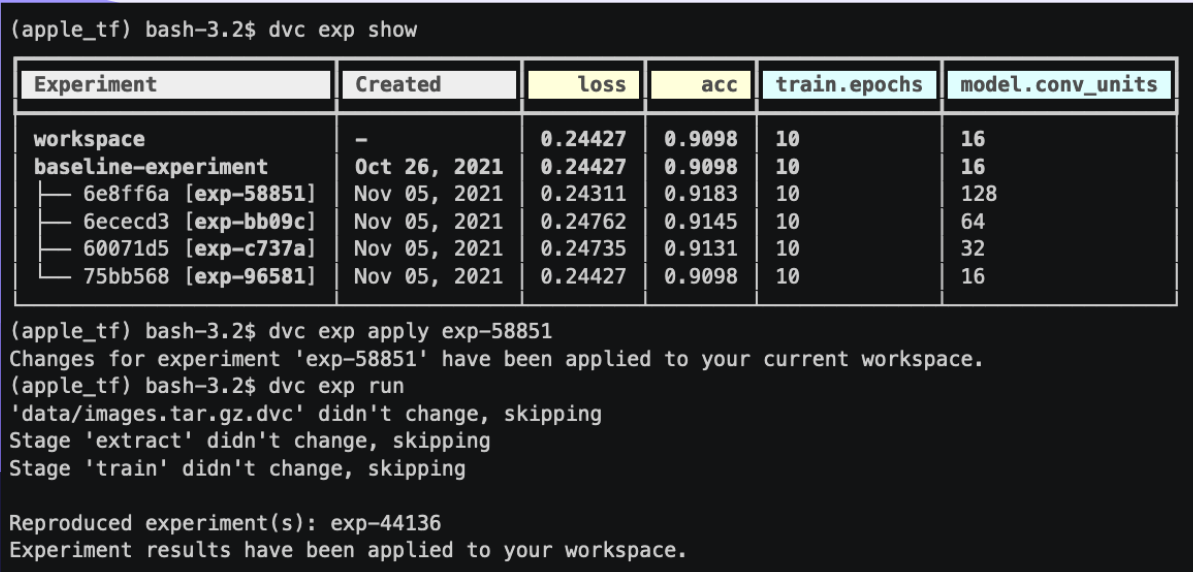
    Dmitry Petrov, Iterative CEO, said the latest version of the Data Versioning Control (DVC) platform makes it simpler to save, compare and reproduce machine learning (ML) experiments at scale without requiring organizations to set up an additional repository to track them. Instead, organizations can store those experiments alongside other software artifacts in a Git repository, he said.

    As a result, IT teams will no longer need to try to keep track of experiments using spreadsheets or notebook tools such as Jupyter, he noted. Organizations that are building AI models for applications constructed using DevOps workflows will also find it easier to comply with a wide range of existing and forthcoming compliance mandates, added Petrov.

    The DVC platform makes use of a Git-like interface to enable organizations to track multiple versions of data sets, models and pipelines across an MLOps workflow. That capability is being extended to make it easier to manage the experiments data science teams create during the construction of an AI model.

    Iterative is at the forefront of an emerging debate over how best to infuse AI models into applications. Providers of platforms used by data science teams are making a case for separate repositories for tracking the artifacts used to construct an AI model. Iterative, on the other hand, is arguing for the use of an AI model build framework that uses the same Git repositories where any other type of software artifact is stored and shared. Iterative’s argument is that, in effect, AI models are just another type of software artifact, noted Petrov.

    In addition to reducing the total cost of building AI models by reducing the number of platforms required, a Git-based approach also makes it simpler for DevOps and data science teams to collaborate because the DevOps team will have more visibility into what AI models will eventually need to be incorporated into an application.

    It may be a while before the development of AI models and applications fully converges. Data science teams today typically have defined their own workflow processes using a wide range of graphical tools. However, as it becomes obvious that almost every application is going to be infused with machine learning and deep learning algorithms to some degree, the need to bridge the current divide between DevOps and data science teams will become more acute.

    In the meantime, DevOps teams should assume that many more AI models are not only on the way but that those models will need to be continuously updated. Each AI model is constructed based on a set of assumptions; however, as more data becomes available, AI models are subject to drift that results in less accuracy over time. Organizations may even determine that an entire AI model needs to be replaced because the business conditions on which assumptions were made are no longer valid. One way or another, the updating and tuning of AI models is likely to soon become just another continuous process being managed via a DevOps workflow.

  • Sumo Logic Extends Observability Reach to AWS Lambda

    Sumo Logic Extends Observability Reach to AWS Lambda

    At the AWS re:Invent conference this week, Sumo Logic announced that in addition to collecting log data, metrics and traces, it now can collect telemetry data from the Lambda serverless computing service provided by Amazon Web Services (AWS).

    In addition to collecting telemetry data, Sumo Logic also revealed that the Sumo Logic Continuous Intelligence Platform hosted on the AWS cloud can now analyze how functions used on the AWS Lambda service perform during transactions.

    That data can then also be correlated against the performance of other AWS services that Sumo Logic tracks via integrations with the AWS CloudWatch and AWS CloudTrail monitoring services.

    George Gerchow, chief security officer for Sumo Logic, said the company is making extensive use of the OpenTelemetry agent software created under the auspices of the Cloud Native Computing Foundation (CNCF) to make it simpler to instrument IT environments. That data is not only being used to improve application performance but also to surface anomalies indicative of a security breach, he added.

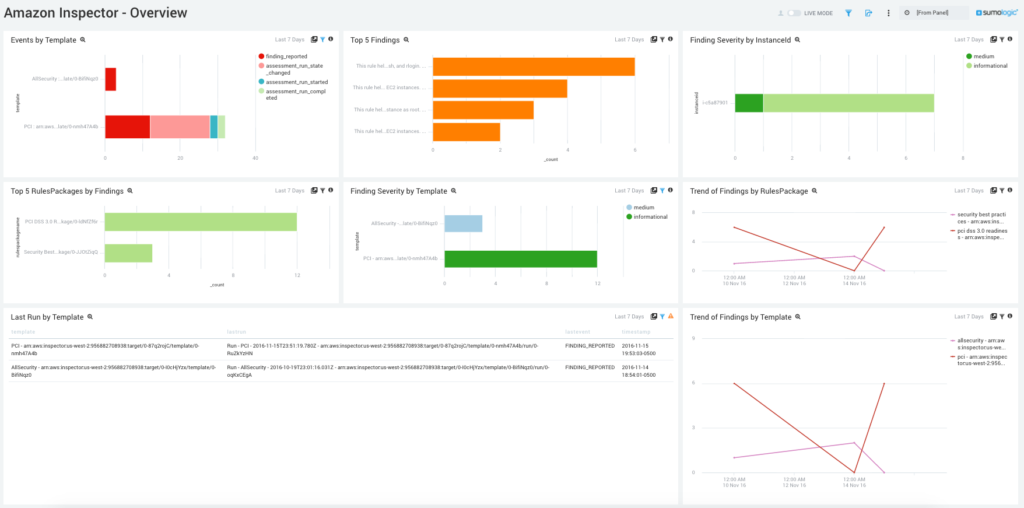
    As part of this ongoing security effort, Sumo Logic this week also added Sumo Logic AWS Quick Start integrations for rapid access to security and compliance insights along with support for Amazon Inspector, a vulnerability management service provided by AWS.

    AWS this week named Sumo Logic as its independent software vendor (ISV) partner of the year. The two companies have a longstanding relationship that began with Sumo Logic’s decision more than 10 years ago to build a monitoring platform hosted on the AWS cloud.

    As IT monitoring tools continue to evolve into observability platforms, Gerchow said it’s becoming much easier to leverage machine learning algorithms and open source agent software to identify the root cause of an issue before it results in a major disruption.

    Most IT teams today are still relying on legacy monitoring tools that only tack a set of predefined metrics to identify when a specific platform or application is performing within expectations. The metrics tracked generally focus on, for example, resource utilization. In contrast, observability combines metrics, logs and traces—a specialized form of logging—to instrument applications in a way that makes it simpler to troubleshoot issues.

    Observability, of course, in one form or another, has always been a core tenet of DevOps best practices. Initially, DevOps teams focused on continuous monitoring as the most effective way to proactively manage application environments. However, it can still take days (and sometimes weeks) to discover the root cause of an issue. Observability platforms promise to make it easier to manage IT environments even as the overall complexity of those environments continues to increase.

    It’s not clear at what rate IT organizations will be transitioning to observability platforms. However, it generally takes only one major outage before IT organizations start looking for better tools to manage their IT environment. As those IT environments become more complex, the probability that there will be a significant disruption is now higher than it’s ever been. The challenge and the opportunity is to find a way to instrument applications more widely; the expectation being that an observability platform will be able to analyze telemetry data to reduce the number of issues that lead to service disruptions.

  • AWS Unfurls Bevy of Automation Tools to Streamline DevOps

    AWS Unfurls Bevy of Automation Tools to Streamline DevOps

    At the AWS re:Invent conference, Amazon Web Services (AWS) added a bevy of tools to its portfolio intended to accelerate the pace of application development while simultaneously simplifying DevOps processes.

    AWS development tools unveiled this week include AWS Amplify Studio, a visual development environment that allows developers to create web application user interfaces (UIs) with minimal coding.

    Ken Exner, head of product for developer tools at AWS, said as an extension of an existing AWS Amplify Studio tool, this latest addition allows developers to customize application UIs at a higher level of abstraction using a library of components while enabling them to drop down to a lower level of coding to customize their application further whenever required. After the UI is designed, AWS Amplify Studio automatically generates the associated JavaScript or TypeScript code for the developer.

    In general, AWS is committed to improving developer productivity by providing, for example, automated reasoning tools that automate processes without locking devs into a layer of abstraction that, ultimately, may create a wall that blocks them from meeting customization requirements, he said.

    Other developer tools launched by AWS this week include updates to Amazon CodeGuru Reviewer that adds a secrets detector that uses machine learning algorithms to identify hardcoded secrets that can be secured using AWS Secrets Manager; a revamped Amazon Inspector vulnerability management tool that provides automated assessment scans, automated resource discovery, support for container-based workloads, improved risk scoring, integration with Amazon EventBridge and AWS Security Hub and the removal of the stand-alone Amazon Inspector scanning agent.

    AWS also revealed it has eliminated the need to manually pull images from the Amazon Elastic Container Registry (ECR) repositories by adding automated synchronization capabilities that keep private and public registries consistent with each other.

    In terms of IT operations tools, AWS added a managed database service to its Amazon Relational Database Service portfolio that allows IT teams to customize the underlying database and operating system using an RDS Custom option, a new table class for Amazon DynamoDB designed to reduce storage costs for infrequently accessed data and a service for RDS, dubbed Amazon DevOps Guru, that extends existing machine learning capabilities to automatically detect and diagnose performance bottlenecks and operational database issues.

    Jeff Carter, vice president for relational databases at AWS, said that as databases are increasingly managed by DevOps teams rather than traditional database administrators (DBAs), the cloud service provider is moving to reduce friction by automating as many manual tasks as possible. That’s critical at a time when IT teams are deploying a much wider range of purpose-built databases that are optimized for different classes of applications, he added. The overall goal is to rely more on automation to reduce friction across the IT environment, said Carter.

    Overall, there are two classes of AWS customers: The first are development teams that are increasingly relying on managed services provided by AWS to automate a wide range of DevOps processes. The second tend to be enterprise IT organizations that prefer to manage cloud services themselves.

    Mitch Ashley, a principal for Techstrong Research, an arm of the parent company of staging-devopsy.kinsta.cloud, noted that, in many cases, enterprise IT teams are managing DevOps workflows that span multiple clouds. As such, they tend to prefer tools and platforms that can be applied to both multiple clouds and on-premises IT environments. The more those organizations rely on managed services provided by a cloud service provider the more difficult it becomes to consistently manage DevOps workflows across multiple IT environments.

    It’s too early to say just how much IT organizations will rely on managed services going forward. However, at a time when more organizations are using more IT platforms than ever, it’s clear the DevOps management challenge increases with each new platform introduced into the IT environment.

  • Fugue Marries Compliance-as-Code Tool to AWS Well-Architected Framework

    Fugue Marries Compliance-as-Code Tool to AWS Well-Architected Framework

    Fugue has infused the best practices defined by Amazon Web Services (AWS) within its software-as-a-service (SaaS) offering for provisioning infrastructure using its infrastructure-as-code (IaC) platform.

    Fugue CEO Josh Stella said that IT teams can now evaluate templates for provisioning AWS infrastructure that were created using AWS CloudFormation or Terraform tools to ensure they comply with the AWS Well-Architected Framework.

    The AWS Well-Architected Framework spans five pillars that AWS has defined for designing and operating reliable, secure, efficient and cost-effective systems in the cloud. AWS has defined a set of best practices for each pillar and rewards organizations for following those by making available additional cloud credits. The goal is to improve overall cloud security by providing guidance that ultimately reduces the number of misconfigurations so that cybercriminals can’t discover and exploit them.

    The Fugue platform complements that effort because it is based on Open Policy Agent (OPA), a general-purpose engine for managing compliance-as-code that is being advanced under the auspices of the Cloud Native Computing Foundation (CNCF). Fugue extended OPA by creating Regula, an open source tool that evaluates IaC files for potential security and compliance violations. Fugue then created a SaaS platform that makes extensive use of the AWS Lambda serverless computing platform to make it easier to enforce compliance policies.

    Those policies include turnkey coverage for specifications such as SOC 2, NIST 800-53, GDPR, PCI, HIPAA, ISO 27001, CSA CCM, CIS Controls, CIS Docker and CIS Foundations Benchmarks for AWS, Microsoft Azure, Google Cloud and Kubernetes.

    Stella said Fugue has now incorporated the technical aspects of the AWS Well-Architected Framework. However, it’s still up to each IT team to navigate the cultural aspects of the shared responsibility model of compliance and security that cloud service providers like AWS follow.

    Unfortunately, developers that employ IaC tools to provision cloud infrastructure often make some faulty assumptions about the level of security maintained by the cloud service provider. The result is often a raft of security and compliance issues that arise mainly because most developers don’t have a lot of domain knowledge expertise in either area.

    It’s not clear how many organizations have adopted the AWS Well-Architected Framework, but as various tools make it easier to implement these best practices defined by AWS the more secure and efficient cloud computing environments should become. In fact, in many cases, those tools are being embedded within a larger set of DevSecOps best practices that are being implemented across multiple clouds.

    Stella said he doubted there will ever be any standardization when it comes to security and compliance frameworks that could be applied to multiple clouds; however, it’s clear that cloud service providers are at least making available frameworks that borrow concepts from one another.

    Regardless of the approach, the overall state of cloud security and compliance will continue to improve as more guardrails are automatically implemented. The issue then becomes not only finding a way to ensure that cloud infrastructure is secure when deployed and also determining how much of the infrastructure being relied on today is less secure than it should be.

  • WhiteSource Report Finds NPM Vulnerabilities Fixed Fast

    WhiteSource Report Finds NPM Vulnerabilities Fixed Fast

    WhiteSource today published a report that found most of the vulnerabilities that affect node package managers (NPMs), widely employed to deploy JavaScript applications, are addressed long before they are assigned a Common Vulnerabilities and Exposure (CVE) in the National Vulnerability Database (NVD).

    The report, based on an analysis of the vulnerabilities that WhiteSource tracks in its own vulnerability database and revealed at the AWS re:Invent conference, found more than 90% of vulnerabilities in NPM packages are fixed before the vulnerability is published in the NVD.

    Susan St. Clair, director of product management for WhiteSource, said that fact suggests that, overall, the open source community is staying on top of vulnerabilities as they are disclosed rather than waiting for them to be assigned a CVE number.

    The WhiteSource report comes on the heels of a breach of UA-parser.js, a widely employed NPM based on a JavaScript library that detects browser, engine, OS, CPU and device type/model from User-Agent data. Unknown malicious actors found a way to inject malware into the NPM that modified the library. That vulnerability has since been remediated.

    In fact, the WhiteSource report noted 83% of the CVEs assigned to the most widely used versions of vulnerable NPMs could be remediated before the publication of the CVE.

    In the wake of a series of high-profile breaches of software supply chains, there is a lot more focus on how open source software is actually secured. Commercial software products have a distribution list that they typically notify of a security patch. Open source updates, on the other hand, need to be tracked by developers that use that software. The level of attention individual developers might pay to any number of open source updates can vary widely.

    Many developers are also hesitant to immediately update their applications because they are not sure what impact that additional code may have on their application, said St. Clair. For example, their application may have dependencies that are no longer backward compatible with the updated code, she noted.

    Developers also need to determine the degree to which that vulnerability may affect their applications because they often don’t use every component of an open source library, so the fix being offered may not be required.

    Open source project maintainers often depend on their community to help uncover vulnerabilities and create the fixes as quickly as possible. When a vulnerability is detected in an open source library, the more common practice is to report it to the NVD even after the fix for that issue has been made available.

    In general, St. Clair noted the most important thing for the open source community to remember is to remain proactive when it comes to tracking vulnerabilities and then implementing DevSecOps best practices. The one thing that is certain is that a wide range of malicious actors also are tracking those vulnerabilities closely. It’s not uncommon to see a wave of exploits being created once a vulnerability is disclosed via the NVD.

    The challenge, of course, is that the more open source software that is employed, the more difficult it becomes for individual developers to stay on top of every vulnerability in an application portfolio that only continues to grow. On the plus side, vendors have pledged more than $10 million to help better secure open source software. Hopefully, the return on that investment will become apparent sooner than later.

  • Digital Transformation Driving VSM Adoption

    Digital Transformation Driving VSM Adoption

    The number of organizations using value stream management (VSM) to bridge the divide between DevOps and the rest of the business is expected to dramatically increase over the next two years. The shift is due, in part, to investments in digital business transformation initiatives.

    A survey of more than 500 executives, IT and business leaders conducted by Dimensional Research on behalf of Broadcom, a VSM platform provider, finds the percentage of organizations employing VSM will rise from 42% today to 70% in the next two years. Nearly three-quarters of organizations (72%) that are not currently using VSM plan to do so in the next 18 months or more.

    The survey also finds that 85% of organizations are collecting some subset of value stream metrics today as part of an effort to deliver solutions faster (56%), improve decision making (55%) and increase transparency (54%).

    Laureen Knudsen, chief transformation officer at Broadcom, said that as organizations embrace DevOps best practices more broadly to drive digital business transformation initiatives, they need more visibility into the application development process. VSM surfaces the insights required to not only identify bottlenecks but also track how changes in application delivery timetables will impact key performance indicators (KPIs).

    VSM traces its lineage back to lean manufacturing methods, which called for each step of a manufacturing process to be continuously measured. As software development has evolved from being a craft to an automated process using DevOps best practices—and as organizations realize just how dependent they are on software—an appreciation for the value of monitoring the impact of missed software development deadlines on the business is growing steadily. VSM platforms automatically collect technical metrics from DevOps tools that are then correlated against the KPIs the organization decides to track.

    The Broadcom survey found more than 96% of respondents’ companies are already in the process of adopting digital transformation. Strategic objectives include increasing efficiencies (70%), improving product quality (67%) and improving customer value (63%).

    Most respondents (92%), however, are anticipating product development challenges for 2022. The biggest product development challenge cited is a lack of visibility throughout the product life cycle (45%) followed by inefficient processes (44%), lack of resources (42%) and enterprise-wide lack of understanding of how products deliver customer value (42%). A full 89% of the business leaders surveyed also noted they continue to struggle with organizational silos between strategic development and operations; 93% noted that better alignment between teams would improve their organization’s overall return on investment (ROI) in software development. A total of 95% said they believed VSM would optimize their product life cycle processes.

    Knudsen said that, in time, artificial intelligence (AI) technologies will increasingly be infused into VSM platforms to enable automated feedback loops between the business and DevOps teams. In the meantime, DevOps teams should be prepared to adjust project priorities based on the needs of the business and to endure a higher level of scrutiny as business stakeholders become more involved in setting the software development agenda.

  • WhiteSource Adds SBOM Tool That Lists Vulnerabilities

    WhiteSource Adds SBOM Tool That Lists Vulnerabilities

    WhiteSource has added a software bill of materials (SBOM) tool to its portfolio that, in addition to capturing the components of an application, also surfaces vulnerabilities that should be addressed.

    Many organizations are becoming more rigorous about making sure SBOM are attached to every software development initiative in the wake of an executive order issued by the Biden administration that requires federal agencies to employ them. While not every organization builds applications for federal agencies, the fact that the federal government is requiring them in the wake of a series of high-profile breaches has led other organizations to review their software supply chain processes.

    An SBOM facilitates those reviews by making available a formal, machine-readable inventory of software components and dependencies that can be used to track their supply chain relationships and identify dependencies and hierarchical relationships.

    Ori Bach, executive vice president for product at WhiteSource, said WhiteSource SBOM takes the concept a step further by also identifying open source libraries. It will also automatically update the SBOM when changes are made to make it easier to identify unintentional or malicious content being installed during application builds.

    Finally, WhiteSource SBOM also provides remediation guidance that ensures updates won’t break the build.

    Bach said it’s already apparent cybercriminals have significantly increased their effort to compromise supply chains as part of an effort to compromise as many downstream applications as possible. In many cases, cybercriminals are now specifically targeting open source projects that create software that tends to be employed across a wide range of use cases.

    An SBOM in and of itself doesn’t make applications more secure. However, it can provide visibility into the components of an application that can then be used to inform DevSecOps best practices, which organizations are implementing more broadly as responsibility for application security continues to shift left toward developers.

    There are two primary specifications that organizations can use to create an SBOM. The Software Package Data Exchange (SPDX) specification is an open standard for communicating SBOM information including components, licenses, copyrights, and security references. Defined by the Linux Foundation, SPDX is now recognized as the ISO/IEC 5962:2021 international standard. The second is the Software Identification (SWID) format that is today widely used by publishers of commercial software.

    Regardless of the format used to construct the SBOM, Bach said there’s an opportunity to more closely align the increased visibility it enables with the application security goals of the organization building the application.

    The primary reason SBOMs are not as widely used as they might be by now has as much to do with inertia as it does with technology. However, as organizations start to expect an SBOM to be made available, it’s clear application developers and builders will need to find a way to automate the SBOM process as applications are continuously updated. The challenge, of course, is that applications are now being updated with greater frequency—thanks mainly to widespread adoption of DevOps best practices—that now need to be integrated with any tool for creating and maintaining an SBOM.

  • ServiceNow Acquires DotWalk to Gain AI for App Testing

    ServiceNow Acquires DotWalk to Gain AI for App Testing

    ServiceNow today revealed it has acquired DotWalk to gain an artificial intelligence (AI)-infused application testing capability that runs natively on its software-as-a-service (SaaS) platform.

    Joe Davis, senior vice president for platform engineering at ServiceNow, said that testing capability will be made available free of charge to all organizations that build custom applications on the company’s platform.

    The number of custom applications being built on the ServiceNow platform has risen sharply since the start of the pandemic. Many organizations have taken advantage of the low-code tools provided by ServiceNow to build a range of applications that use the company’s SaaS applications as a foundation. That approach enables them to more quickly build applications that drive a wide range of digital business transformation initiatives.

    Davis said ServiceNow is committed to enabling organizations to improve the quality of those applications using a DotWalk testing capability that eliminates the need for developers to build and run tests themselves or for organizations to hire dedicated application testing teams.

    ServiceNow

    ServiceNow decided to acquire DotWalk because the company built a testing platform using machine learning algorithms specifically for the ServiceNow platform, noted Davis. The DotWalk tools also analyze logs in the background to identify and validate error sources that can arise during any application upgrade process.

    While there are a large number of professional developers that build applications on the ServiceNow platform, the company is also trying to encourage more so-called citizen developers to build applications. The challenge is many of the end users building applications lack an appreciation for design, security and what it takes to make sure an application scales as more users employ it. Testing tools infused with AI should make it easier for developers, regardless of experience, to build enterprise-class applications.

    Of course, professional developers will also benefit from AI-infused testing tools. Many developers have a tendency to cut short the application development process as they rush to meet application delivery deadlines. The end result, however, is that an application must be updated almost immediately after it has been deployed in a production environment. Testing tools that make use of AI will enable professional developers to more easily run tests they don’t have to build and then maintain, said Davis.

    One way or another, the number of custom applications built on SaaS platforms will increase as organizations digitize more processes. In the last year, more organizations have become adept at extending these platforms using a wide range of low-code tools that automate many aspects of application development. A significant percentage of those organizations are now also adopting DevOps best practices to better manage the pace at which those applications are developed and deployed.

    In the meantime, it’s too early to say precisely how AI will transform application testing. However, one thing that is certain is that even as the number of custom apps grows, applications will be more thoroughly tested before being deployed in a production environment.

  • Logz.io Extends Open Source Observability Platform

    Logz.io Extends Open Source Observability Platform

    Logz.io has enhanced its observability platform to include both unified dashboards and support for distributed tracing to monitor service performance enabled by the open source Jaeger agent software being advanced under the auspices of the Cloud Native Computing Foundation (CNCF).

    At the same time, Logz.io is making available a preview of an anomaly detection capability that leverages machine learning algorithms to build an artificial intelligence (AI) model to monitor data.

    The company has also added support for OpenSearch, a fork of the open source ElasticSearch software project that is no longer available via an Apache license. OpenSearch was created by Amazon Web Services (AWS) and Logz.io as an alternative search engine.

    Finally, Logz.io has added a security event management capability that makes it easier to classify, prioritize and collaborate on mitigation of cyberattacks as they are discovered.

    The Logz.io observability platform is entirely based on open source software. In addition, the company has made contributions to enhance both Jaeger and the OpenTelemetry project, including contributing an OTEL Span Metrics Processor that makes it easier to aggregate metrics.

    Logz.io CEO Tomer Levy said that, in general, it’s still early days as far as observability is concerned. As a concept, observability traces its lineage to linear dynamic systems. Observability at its most basic level measures how well internal states of a system can be inferred from knowledge of its external outputs. The overall goal is to make it easier to query machine data in a way that enables DevOps teams to proactively discover the root cause of issues before they cause further disruption. That’s a major advance over monitoring platforms that typically only provide predefined metrics to identify when a specific platform or application is performing within expectations. The issue, however, is most IT teams really don’t know what questions to ask to take full advantage of an observability platform, said Levy.

    However, as more organizations are exposed to observability platforms, it will become easier to advance both DevOps and DevSecOps as more platforms continue to leverage AI to provide remediation capabilities and automate processes based on the massive amounts of data collected via these platforms, said Levy. There is simply no way the average IT team will be able to manage all the microservices being strewn across a distributed computing environment without the aid of an AI model trained using observability data, he added.

    As DevOps continues to evolve, it’s more than likely that the best DevOps engineers are not going to want to work for organizations that have not invested in some form of observability. The odds of being consistently successful as a DevOps engineer decline sharply as IT environments become more complex.

    On the plus side, it should soon become a lot easier as the overall level of application instrumentation increases to manage those complex environments and to do so at a level of scale that doesn’t require a small army of DevOps engineers.