Tag: devops

  • BlazeMeter Uses the Force of Performance Testing to Prepare MovieTickets.com for the Release of “Star Wars: The Force Awakens”

    SAN FRANCISCO–(BUSINESS WIRE)–Movie releases are major traffic events for online ticket providers. So when the most storied movie franchise in history comes out with a new chapter, it creates a unique performance challenge. That’s whyMovieTickets.com, a worldwide leader in advance movie ticketing, turned to BlazeMeter to ensure that its new Amazon Web Services infrastructure could manage the volume of online ticket orders around opening weekend for “Star Wars: The Force Awakens.”

    The majority of online advance ticket buying occurs 1-2 weeks prior to a release date, but the release of “Star Wars: The Force Awakens” marked a historically unique buying trend, as MovieTickets.com was inundated with pre-orders months prior to the film’s December 2015 release date.

    “The demand for advance ticketing during the first buying opportunity was unprecedented,” said Craig Lefkowitz, Director of Infrastructure Systems at MovieTickets.com. “We had not seen that type of volume two months before a movie release, so we needed to make sure we were well prepared for opening weekend.”

    To prepare its site to meet demand, MovieTickets.com wanted to upgrade its infrastructure to manage spikes in volume, migrating to an Amazon Web Services (AWS) cloud environment that could scale alongside demand. However, in order to make sure the new cloud-based infrastructure could perform optimally, the company enlisted the help of BlazeMeter’s continuous performance testing technology.

    “We chose BlazeMeter because it’s the leader in performance testing,” said Lefkowitz. “BlazeMeter is a standout and very well-respected in the industry. We needed to utilize a proven solution to get us ready for such an important event.”

    MovieTickets.com used BlazeMeter’s performance testing solution to examine various load volumes and times across the AWS infrastructure. A member of the AWS CodePipeline partner network, inaugural DevOps Competency Program member and trusted partner, BlazeMeter’s testing solution can integrate directly into an AWS DevOps or continuous delivery framework, identifying trouble spots in real-time and readying the site for major traffic events.

    With BlazeMeter’s help, MovieTickets.com tested their infrastructure to manage more than 30,000 simultaneous users per second. As they continued to extend their infrastructure, that number expanded to more than 300,000 concurrent visitors.

    “The higher the performance expectation from an event, the greater the need to ensure an infrastructure can support the required service level,” said Alon Girmonsky, CEO and Founder of BlazeMeter. “The trust that large companies have in our technology around critical events speaks to the importance of performance overall. The inability to manage the volume directly equates to lost sales, making performance testing a critical investment for any company that needs to maintain peak performance at all times.”

    “Performance is our top priority,” said Lefkowitz. “Our customers have high expectations and we need to meet those expectations.”

    For more information on how MovieTickets.com works with BlazeMeter, visit https://www.blazemeter.com/case-study/movietickets?utm_source=BM&utm_medium=newswire&utm_campaign=MovieTickets. And for more information on how to improve site performance through continuous performance testing, visit https://blazemeter.com/.

    About BlazeMeter
    BlazeMeter ensures delivery of high-performance software by enabling DevOps teams to quickly and easily run open-source based performance tests against any mobile app, website or API at massive scale to validate performance at every stage of software delivery. The rapidly growing BlazeMeter community has over 100,000 developers and includes prominent global brands such as Adobe, Atlassian, Gap, NBC Universal, Pfizer and Walmart as customers. Founded in 2011, the company is headquartered in Mountain View, California with Research & Development in Tel Aviv, Israel.

    For more information, sign up for a free 14-day trial at www.blazemeter.com, visit our blog or find us on Twitter @BlazeMeter and on LinkedIn.

    About MovieTickets.com
    MovieTickets.com is the leader in advance movie ticketing with nearly 250 theater chains, representing over 28,000 screens in its group, offering moviegoers a quick and convenient way to purchase tickets online, via mobile devices and at 877-789-MOVIE. The company currently enables remote ticketing for consumers across 21 countries/territories including the United States, Canada, United Kingdom, Ireland, Argentina, Puerto Rico, the Dominican Republic and the Caribbean. Fans can stay connected with MovieTickets.com through Facebook (facebook.com/MovieTicketscom), Twitter (twitter.com/movietickets) and YouTube (youtube.com/c/movietickets).

    Contacts

    Press Contact:
    PAN Communications
    Adam Novak, +1-617-502-4300
    blazemeter@pancomm.com
  • DevOps Debates: Monoliths or Microservices

    DevOps Debates: Monoliths or Microservices

    From the time software came into existence, application software has been booming to leverage the benefit of the computing paradigm. During this cycle, it has transformed decades of design and architectural thinking, and has crossed all aspects of application development and management needs, be it configurability, reusability, maintainability, scalability or security (a good list is of these “ilities” is here).

    While many have been addressed, one “ility” that has turned a lot of eyes and attention in the last few years is deployability. More than that, it is the ability to do so continuously. This requirement has changed the thinking of building software for two main reasons: (a) Businesses have started asking to release software faster than ever, even in verticals unheard of before; and (b) Cloud and infrastructure as code has made faster deployment a easier possibility. When you look at application design with deployability in mind, given the need to be agile, what you end up getting is a microservice.

    Most applications of old style addressed most “ilities” in an architecture but did not consider “continuous deployability” as a core need as well. I call these monolith from a deployment perspective. They are tightly coupled, and for any small change a complete build of the application was necessary.

    Now the question is, Should you really look at microservice as a silver bullet to deploy all software? Should you consider that as the de facto standard to deliver any application functionality? Will applications cease to exist the way we know? Here are my thoughts. As usual, feel free to add yours or write to me personally, as some of you do as well.

    Applications as monoliths will stay as they are

    1. Monoliths have evolved over generations of design and architecture tests and stood the test of time. The focus on modular development is, in fact, a way of creating modules, which are built with separation of concerns in mind.
    2. Monoliths were built to run for a long time. It had addressed some of the “ilities” well before they became considerations.
    3. Applications will remain easier to debug, as most of the debuggable areas are in developer’s hand, instead of having to work with a team.
    4. Applications will perform better, as they can share data in memory; they don’t have to do out-of-process calls to get one task executed.
    5. Applications will be more secure, as they will be a black box from an end user perspective or even a hacker perspective, with little coming out from the system.

    Microservices will be a monolith-killer all the way

    1. Deploy, deploy and deploy to correct your problems away. Fail fast and fix faster is the mantra that you can practice.
    2. It helps bundle two-pizza teams owning microservices and hence embrace better ownership and faster response.
    3. The overall architecture to deliver an end-to-end use-case may become complex, but each piece of the jigsaw puzzle can be handled faster.
    4. In the faster-moving world, business wants to try a concept rather thinking through all the “ilities” ahead of time, and progressively make everything better. Microservices helps abstract all complexities much better.
    5. Microservices will help developers think out of box from day one, while helping business deliver smaller chunks, without having to make the system a “big ball of mud.”

    At the end of the day, irrespective of the approaches, the key is to ensure the applications are managed well, changes are refactored well, the code that is written is readable and maintainable, and significant test assets are created to regress the entire system quickly. So whether it is a large system or microservices, you are able to make any necessary changes quickly and can deploy fast.

    While microservices surely will help this new faster-deployment thinking, I—and I am sure you all—have also seen large monolithic systems that are making delivery at an astounding pace.

    Thoughts?

  • 5 Things DevOps is Not

    5 Things DevOps is Not

    For those who have been embracing and championing DevOps for years, the growing popularity of DevOps is as exciting as landing your first job out of college! Okay, maybe not that exciting, but still really cool. More and more companies of all sizes are embracing DevOps by including the adoption of DevOps practices directly into their fundamental strategies.

    On one side, this is giving teams the leverage they have needed all along to either begin their DevOps journey or to increase the maturity of existing DevOps adoptions. On the other side, when DevOps becomes a mandate, some of that grassroots passion can become watered down, as the use of the word becomes increasingly overused or incorrectly used.

    DevOps incorporates a new collaborative culture that embraces numerous practices combined together for a continuous software development methodology that places significant emphasis on feedback loops, collaboration and continuous improvement. DevOps requires fundamental cultural changes and includes so many practices that can be overwhelming to those just starting their journey.

    Instead of highlighting everything that DevOps is, I thought it would be good to take a step back and highlight what DevOps is not instead.

    1. DevOps is not simply combining Development & Operations teams

    We’ve all seen this one when the term DevOps comes up. “Let’s combine the Development & Operations team and, voilà!, we now have DevOps.” DevOps combines a set of processes and practices to be adopted throughout the entire delivery pipeline and spans multiple stakeholders. A couple of the key practices within DevOps adoptions include continuous integration (CI) and continuous delivery (CD). Simply combining two teams and calling it DevOps cannot accomplish those practices.

    2. DevOps is not a separate team

    Setting up a separate DevOps team is another trap many organizations fall into when beginning their DevOps journey. In general, I’m not a fan of the DevOps team as I believe it leads to more silos in the end. I’ve also found the creation of these teams can lead to further confusion when the mission is not clearly defined.

    There are some cases where a temporary DevOps team may make sense to help enable the processes and potential tooling that may be needed for adoption, but the key is making it temporary—which is often better in theory than in practice. There are several great blogs out there discussing DevOps teams such as Matthew Skelton’s blog, “What Team Structure is Right for DevOps to Flourish?”

    3. DevOps is not a tool

    Let me be the first to say I actually love the growing number of tools that enable us to continue maturing our DevOps adoptions, but I’ve noticed the use of one or two tools starts to lead to the perception that DevOps is a tool. How many times have you heard?

    “We’re already doing DevOps. We have Chef.”

    “We do DevOps. We automatically deploy through Jenkins.”

    Keep in mind, I’m a big fan of both Chef and Jenkins, but I think the power of DevOps is drastically underutilized if you’re equating the utilization of a single automation tool to DevOps success. Adopting automation and tooling is, of course, a part of DevOps, but only when combined with end-to-end practices of increased collaboration with continuous integration/continuous delivery, amplified feedback loops and continuous improvement (to name a few)! DevOps is a journey and that journey may start with a tool, but the goal should be to first identify your DevOps strategy and then find a tool or tool chain that meets those goals.

    4. DevOps is not a one-size-fits-all strategy

    Because there are so many different business drivers and technologies to consider when setting up an overall DevOps adoption strategy as well as identifying your DevOps tool chain, it’s important to apply the same tenets of DevOps to your DevOps strategy. Embrace change, gather metrics, understand feedback, fail fast and correct your course quickly. As an example, if you initially identify a tool that no longer works for your technology or environment, abandon it and move on. Just because you used it on the last project doesn’t make it a silver-bullet fix for the next one. We need to first understand our current strategy and environment, then react accordingly.

    5. DevOps is not automation

    That one may have caught the eye of a few people, so I’ll clarify: DevOps is not solely automation. Automation is absolutely a huge part of DevOps; however, it is not the only part, and deploying some degree of automation is often used interchangeably with DevOps. I think understanding the key DevOps practices is a great precursor to ensuring DevOps is viewed as more than just automation. Understanding the core DevOps principles is key to understanding the true benefits of DevOps adoption.

    There are a lot of things that DevOps is and I think I share a widely spread passion for DevOps. There are also a few things that DevOps isn’t—or isn’t solely. If you’re just starting your DevOps journey or still maturing your existing model, making sure everyone on your team has some basic DevOps education and is aware of the DevOps strategy for your project is key. It will go a long way in helping everyone understand that DevOps is about a lot of things. It’s also not about a lot of things.

    The list above isn’t exhaustive and I’m sure you all have a few you’d like to see on the list. I’d love to hear you thoughts and suggestions at @Shelbee_SE.

    You also can download and browse through the DevOps for dummies e-book.

    About the author/Shelbee Smith-Eigenbrode

    Shelbee

    Shelbee Smith-Eigenbrode is a Senior Software Engineer/IT Architect at IBM Cloud Infrastructure Center of Competency. She has worked across varying roles spanning the software development life cycle. Her experience across functional roles as well as performing that work deeply inside traditional silos has contributed to her passion for embracing the DevOps culture and transforming the way teams are delivering technologies by adopting DevOps practices. She is a member of the IBM Academy of Technology committed to driving innovation and technical advancement.

  • PagerDuty Selects Threat Stack to Enable High-Velocity Security and Compliance in the Cloud

    Threat Stack’s Continuous Security Monitoring Helps Assure Security and Scalability

    BOSTON– March 16, 2016 – Threat Stack, a leader in cloud security management and compliance, today announced that PagerDuty, the pioneer in agile incident management, selected Threat Stack Cloud Security PlatformTM to protect and secure its rapidly growing infrastructure within its Amazon Web Services (AWS) environment. PagerDuty’s decision to adopt Threat Stack was driven by its need for continuous security monitoring and complete visibility into its users, data, and expanding AWS and Microsoft Azure infrastructure.


    “As a rapidly growing organization committed to delivering reliability and uptime, it’s critical that we leverage the scalability and flexibility of the cloud, while keeping our resources safe and secure,” said Arup Chakrabarti, Director of Infrastructure Engineering at PagerDuty. “Not only is Threat Stack easy to deploy, it’s also easy to integrate with both new and existing tools. We now have complete visibility into our processes and activities for continuous monitoring and security management across our environment.”


    The PagerDuty platform allows IT Ops and DevOps teams to manage and respond to incidents quickly and efficiently, reducing the chance of outages or setbacks of any kind. Threat Stack’s continuous, real-time security monitoring helps the PagerDuty team to quickly identify top-level threats, streamline processes within the operation’s workflow and increase security across the organization.


    “We are longtime fans of PagerDuty, and are excited to partner with them to deliver granular, integrated visibility into user activity, processes, files and network connections,” said Venkat Pothamsetty, Vice President, Products and Customer Advocacy at Threat Stack. “We are proud to deepen this relationship by helping PagerDuty scale their cloud-based business while keeping them secure and compliant.”


    PagerDuty is using Threat Stack Cloud Security Platform’s full suite of features and special integrations across its AWS environment to provide host-level visibility and other key capabilities including:

    • Autoscaling: Threat Stack’s cloud-native architecture automatically scales up or down with the capacity of PagerDuty’s AWS and Microsoft Azure infrastructure to ensure continuous visibility across its dynamic environment.


    • Insider Threat Identification: Continuous monitoring for unauthorized actions, such as escalation of user privileges, unauthorized installs, new users added/deleted, suspicious commands, anomalous behavior, changes to security groups, user session information and process stops.


    • External Attacks Early Warning: Automatic detection of abnormal login attempts/failures, wide open security groups, launches of new processes or kernel modules, user session information, process stops, external connections for command and control.


    • Data Security Verification: Automated access, editing or copying of customer or personal data intellectual property, as well as internal configuration, passwords, certificates and keys.


    • Compliance Reporting: Real-time visibility, detailed audit trails and built-in compliance reporting provide the historical record needed to meet compliance regulations and ensure data and infrastructure are protected.


    To learn more about how PagerDuty uses Threat Stack, please visit the Threat Stack blog.

    About Threat Stack

    Threat Stack enables growth-driven companies to scale with confidence by identifying and verifying insider threats, external attacks and data loss in real-time. The only fully integrated, cloud-native continuous monitoring solution that gives customers instant visibility and automatically responds to changes in their environment, Threat Stack provides the coverage needed to run secure and compliant, in all environments, without sacrificing speed and efficiency. For more information, or to start a free trial, visit threatstack.com.

    About PagerDuty

    PagerDuty is an agile incident management solution that integrates with IT Ops and DevOps monitoring stacks to improve operational reliability and agility. From enriching and aggregating events to correlating them into actionable alerts, PagerDuty streamlines the incident management lifecycle by reducing noise and resolution times. With hundreds of native integrations with operations tools, automated scheduling, advance reporting and guaranteed availability, PagerDuty is trusted by over 7,000 organizations globally to increase business and employee efficiency. The company is headquartered in San Francisco and backed by leading venture capital firms Andreessen Horowitz, Bessemer Venture Partners, Baseline Ventures, Ignition Partners and others. To try PagerDuty for free, or to get more information, visit www.pagerduty.com

    Media Contact

    Ashley Crutchfield

    fama PR for Threat Stack

    (617) 986-5025

    threatstack@famapr.com

  • Git: One Giant Leap Toward DevOps

    Git: One Giant Leap Toward DevOps

    If you work in an organization that has not yet embraced DevOps, then you might be wondering where to begin. Fortunately, there are many good answers. But I want to introduce one simple starting point that you probably haven’t heard: introducing Git to operations. By itself, Git might not seem like a meaningful way to overcome the barriers between dev and ops. Yet, Git provides some capabilities that mark the difference between the lowest performing IT organizations and the highest. And the difference in IT performance can translate into substantial business benefits. The highest performing IT organizations have noticed the following benefits:

    • They are about twice as likely to exceed profitability, market share and productivity goals.
    • Their employees reported far higher levels of job satisfaction.
    • They realize 50 percent higher market capitalization growth over a three-year period.

    To be clear, no amount of data will ever prove that use of Git leads directly to growth, profit, productivity and job satisfaction. What the Puppet Labs’ “State of DevOps Survey” does show is the incredible range between low and high performance in IT organizations. The rate of deployment has hovered at 30 times faster for high-performing organizations over the lowest. The 2014 survey showed 50 percent fewer deployment failures, while 2015 showed 60 percent fewer deployment failures, when comparing highest to lowest. The survey also indicates which practices separate the highest performers from the lowest. According to the State of DevOps Survey, the top two indicators of high performance are:

    • Version control of all production artifacts (surprisingly, a far greater predictor of performance than version control of source code); and
    • Peer review of production changes (in contrast to external change approval).

    It’s not that these two practices magically yield business benefits. Indeed, ITIL has long recognized management of production artifacts and review of production changes as best practices. But too many organizations still believe faster deployment and higher reliability are trade-offs. What is “magical” in high-performing organizations is they realize they can have both faster deployment and higher reliability by collaborating across organizational boundaries and automating intelligently. That means dev and ops sharing goals, measurements and tools. So one way in which these practices differ from typical ITIL practices is how dev and ops perform them collaboratively. More specifically, when dev and ops use the same tool for version control, they can better share techniques and workflows. For example, the peer review of changes can include both dev and ops. Thus, Git is a gateway to DevOps.

    Git has long provided those two capabilities for software developers: Developers use Git to version source code and developers use pull requests to perform peer review of source code. With a few tips about how to apply Git to configuration files, operations can use pull requests to perform peer review of configuration changes. Now with git-lfs, operations can also version production artifacts, which often are large, binary files that historically have not worked well with Git. More advanced concepts such as infrastructure as code and dedicated binary repositories, for example, build on version control, so even if the role of Git changes over time, the skills and collaborations remain valuable.

    In summary, the business case of Git for Ops is simple. The Puppet Labs survey shows meaningful upside for low performing IT organizations to become high performing. The survey shows high performing organizations are characterized by both rapid deployment and high reliability, not picking one over the other. Two practices that characterize high performing IT organizations are version control of production artifacts and peer review of changes. Git is now well-positioned to provide both capabilities. If you’re ready to start introducing operations to Git, don’t forget that Bitbucket has no limits to the number of private repositories.


    About the Author/Ian Buchanan

    ianWhile Ian Buchanan has broad and deep experience with both Java and .NET, he is best known as a champion of agile methods in large enterprises. He is currently the Developer Partisan for Developer Tools at Atlassian, where he focuses on the emerging DevOps culture and the application of Bitbucket and Bamboo for better continuous integration and continuous delivery. During his career, he has successfully managed enterprise software development tools in all phases of their life cycle, from cradle to grave. He has driven organization-wide process improvement with results of greater productivity, higher quality and improved customer satisfaction. He has built multinational agile teams that value self-direction and self-organization. When not speaking or coding, you are likely to find Ian indulging his passions in parsers, meta-programming and domain-specific languages.

  • Jelastic Cooper 4.6 Unlocks Reselling of PaaS and CaaS for Hosting Service Providers

    Jelastic Cloud launched its new reselling program for hosting providers and MSPs to offer DevOps platform with support of Docker containers without upfront investments

    Palo Alto, Calif (PRWEB) March 15, 2016

    Jelastic, Inc., the cloud software company for automation of DevOps processes with the help of containers, today has announced the launch of their latest release – Jelastic Cooper 4.6. The main focus of this version is a new reselling option that makes PaaS and CaaS business accessible for a wide range of hosting companies and MSPs.

    The inspiration for this release name lies in the words of Joseph Cooper, the main character from Interstellar: “We’ve always defined ourselves by the ability to overcome the impossible. And we count these moments. These moments when we dare to aim higher, to break barriers, to reach for the stars, to make the unknown known.” In these words it is explained the main aim of Jelastic 4.6 release – to make such fast growing trends like DevOps and microservices available for hosting business, to provide hosting companies of different sizes with ability to reach new market, to let them try something unknown (but perspective) without upfront investments, and in this way to break the barriers.

    ”Cooperation is a key point to unlock new opportunities and reach new horizons. Working together hosting providers are able to conquer DevOps space faster and easily adapt to quickly transforming cloud market. The new Jelastic release allows service providers to cooperate across countries and continents, regardless of their size and without risky investments,” told Ruslan Synytsky, Jelastic CEO and co-founder.

    Many hosting companies face a set of problems while fighting for their place at the current cloud hosting market: lack of expertise and knowledge to handle new business opportunities, new markets exploration risks, not enough sales and marketing force, low hardware utilization, budget limitations to speed up growth and many more.

    To overcome these difficulties Jelastic offers a smart franchising system between existing Jelastic hosting partners and resellers. A reseller can use the infrastructure and billing system of a parent hoster. As a result, the parent hosting provider will obtain a wider area of influence, a better local presence and higher selling, while the reselling partners can easily start their new hosting business out-of-the-box with zero investments:

    • no installation fee or investments in hardware
    • no minimal commitment
    • production ready PaaS and CaaS with Docker containers support
    • built-in billing system
    • support and marketing tools
    • marketplace with pre-packaged applications

    “Adding a partner portal to the main panel is truly innovative and logical step. This capability now gives small and medium sized hosting companies an opportunity to expand their service portfolio literally with a single click and open up a cloud playing field which was historically available only for big players. All this is achieved without any investments or commitments! I talk to hosting companies quite often and I am constantly hearing about new investment risks and diminishing margins. MIRhosting pioneered this initiative and now we want to open new business opportunities for all and we are happy that Jelastic supported us and unlocked new functionality within their platform. Now our partners can enjoy true cloud features and will add highest flexibility to their business to become more successful!” told Andrey Nesterenko, CEO, Innovation IT Solutions Corporation.

    Starting from this release, our hosting partners can easily create a special reseller account with a dedicated dashboard for users and a cluster admin panel for management and customization. User dashboard and all the settings can be fully customized and white labeled, so the reselling partner can sell the product under own brand, with own prices, quotas and permissions.

    Besides reselling opportunity, Jelastic 4.6 release included a set of improvements like advanced containers hibernation control, automatic horizontal scaling of Docker containers and wider range of load alerts for their monitoring, pricing tutorial within the dashboard and many other enhancements. A full list of new features and improvements can be seen in the Release Notes 4.6.

    About Jelastic

    Jelastic is an enterprise DevOps PaaS for containers deployed on bare metal hardware or any IaaS. Jelastic customers and partners, such as ISVs, hosting service providers, systems integrators, outsourcing companies, DevOps teams and enterprises, can choose between Public, Private, Hybrid and Multi-Cloud options. The platform provides certified containers for Java, PHP, Ruby, Node.js, Python and .NET and the ability to use custom Docker containers. Jelastic offers agile deployment models without coding to proprietary APIs, flexible automatic scaling for stateless and stateful applications, collaboration, access control, monitoring, backup and disaster recovery, built-in billing and business analytics tools, while driving down TCO with high density and hardware utilization. Jelastic multi-cloud functionality enables customers to achieve high-availability through geo-distribution across different data centers or clouds, easily relocate the projects to the superior hardware with the help of live environment migration, choose between higher quality or more cost affordable hardware and host applications with the trusted cloud vendors. For more information, visit us at http://www.jelastic.com


  • DBmaestro Mitigates DevOps Security Risk with CyberArk

    DBmaestro Customers Gain Solution to Better Secure and Manage Privileged Credentials in Oracle Database Environments

    Houston, Texas, March 15, 2016 – DBmaestro (http://www.dbmaestro.com), the pioneer and leading provider of DevOps for database solutions, today announced a technology integration with the market leading CyberArk Privileged Account Security Solution. This integration helps improve security and compliance in DevOps environments by allowing DBmaestro to secure the powerful privileged access needed across the range of DevOps actions.

    Successful application development is dependent on the efficient management of multiple Oracle database environments including development, integration, internal testing, user acceptance testing, production and disaster recovery. To mitigate security risk, powerful access associated with the privileged credentials used by in-house/custom applications in DevOps environments needs to be effectively managed and secured.

    Privileged credentials are frequently targeted in cyber attacks due to their broad, often unfettered access to an organization’s most sensitive assets and information – including databases and applications. Without this security in place, privileged credentials can be hijacked by attackers, leaving the organization susceptible to significant theft or destruction of data, or even complete network takeover.

    DBmaestro integrates with CyberArk Application Identity Manager, part of the CyberArk Privileged Account Security Solution. This enables DBmaestro TeamWork to automatically retrieve and securely use the target database credentials that are stored in and managed by CyberArk Enterprise Password Vault. Enforcing multi-factor authentication to the CyberArk Vault to retrieve a credential indicates that it is a valid, trusted application requesting and gaining access to their key applications and targets.

    As part of a proactive cyber security program and to address evolving compliance requirements, passwords can be automatically rotated based on the organization’s security policy for both in-house/custom applications running on Oracle, and the DBmaestro TeamWork Oracle solution. CyberArk Application Identity Manager enables automated synchronization of credentials in the background without requiring any code or file changes while reducing downtime and maintenance windows caused by manual credential rotation.

    DBmaestro TeamWork is a secured DevOps for database solution that brings continuous delivery best practices to the database. Offering features and functionality far beyond what’s achievable using manual work or simple compare-and-sync tools, DBmaestro TeamWork will transform development operations, while dramatically increasing productivity and reducing development costs.

    “This integration helps companies successfully manage and secure multiple database environments in order to create applications and drive business results,” said Yariv Tabac, co-founder and CEO of DBmaestro. “By combining security and database change management capabilities, customers can better address critical database security vulnerabilities and their ability to meet audit and compliance requirements.”

    To achieve secure DevOps for Oracle databases, CyberArk Application Identity Manager enables organizations to protect critical business systems by eliminating embedded credentials from application scripts, configuration files and database tables. In addition, implementing both these solutions leads to combining individual accountability with detailed, centralized tracking and reporting on all application privileged account activity, thus enabling organizations to meet diverse sets of compliance requirements.

    “Privileged accounts and credentials, including those that allow applications to access sensitive databases and systems, are targeted by attackers in virtually every cyber attack,” said Adam Bosnian, executive vice president, global business development, CyberArk. “CyberArk reduces the risk of unsecured privileged accounts and credentials use across the enterprise. For developers utilizing solutions like DBmaestro, CyberArk complements existing agile workflows to empower developers to balance security and productivity, while enabling organizations to automate compliance based on their security policies.”


    About DBmaestro

    DBmaestro is a pioneer and leading DevOps for database solution provider. Its flagship product, DBmaestro TeamWork, enables Agile development, Continuous Integration and Delivery for the Database.

    TeamWork supports streamlining of development process management and enforcing change policy practices. The solution empowers Agile team collaboration while fostering regulatory compliance and governance. With DBmaestro, organizations can facilitate DevOps for database by executing deployment automation, enhancing and reinforcing security as well as mitigating risk.

    DBmaestro’s solutions are deployed at many major international companies, including Visa, MasterCard, Frost Bank, Bank of the West, Knight Capital, Thomson Holidays, Bank Leumi, Barclays, and others.

  • CLOUDBEES ANNOUNCES INDUSTRY’S FIRST CERTIFICATION PROGRAM FOR JENKINS ENGINEERS

    New Technical Certification for Jenkins and the CloudBees Jenkins Platform adds value for engineers, teams and employers

    SAN JOSE, Calif. – March 15, 2016 – CloudBees, Inc., the enterprise Jenkins company and continuous delivery (CD) leader, today announced the rollout of a professional certification program for both Jenkins and CloudBees Jenkins Platform engineers. Though Jenkins and the CloudBees Jenkins Platform are utilized in over 128,000 projects globally by countless engineers, no formal certification existed until now. CloudBees developed the certification program in collaboration with a Certification Advisory Board comprised of Jenkins subject-matter experts, as well as CloudBees customers and partners. Registration opens on March 15 and engineers can take the exam in Prometric test centers around the world as of May 12.

    The program offers two options for certifications:

    • Certified Jenkins Engineer, for demonstrated knowledge and hands-on experience in the use of the open-source Jenkins server and plugin ecosystem
    • Certified CloudBees Jenkins Platform Engineer, for certification of additional, specific knowledge and hands-on experience in the use of the CloudBees Jenkins Platform, which adds enterprise functionality on top of the open source Jenkins server

    Achieving certification can benefit engineers in several important ways. Along with recognizing them for their Jenkins skills, certification helps engineers build credibility with colleagues, differentiate themselves from their peers and gain additional knowledge through the certification preparation process.

    The certification program offers benefits to employers and organizations, as well. Hiring managers can more easily identify qualified candidates and have confidence that they are acquiring an employee with a documented level of expertise. Alternatively, if an IT manager contracts a services organization employing certified staff, the IT manager will feel more confident that they will receive competent, skilled Jenkins experts for their project. Finally, services organizations who employ certified staff will be confident that their teams have the right skills, showcasing the organization’s qualifications and differentiating their services from competitors.

    “I volunteered to be part of the Certification Advisory Board created by CloudBees,” said Senior Director of DevOps at Ellucian, Jason Shawn. “I see the certification program as very strategic – for both the community of practitioners who are using Jenkins or the CloudBees Jenkins Platform and for hiring managers, such as myself, who want to be sure they are getting someone with a documented level of skills.”

    Attaining Certified Jenkins Engineer status will mean the engineer possesses the technical skills and knowledge necessary to effectively implement and use Jenkins with a proven level of proficiency. The exam questions are designed to test an engineer’s knowledge and hands-on experience with Jenkins throughout all stages of the software delivery process – from development to build, test, stage and deployment. Achieving Certified CloudBees Jenkins Platform Engineer status means the candidate has answered additional exam questions related to functionality specific to the CloudBees Jenkins Platform.

    “As the popularity of Jenkins for continuous delivery grows, the market demand for advanced skill levels in Jenkins as a discipline is tracking right alongside that growth,” said VP of Customer Success at CloudBees, Francois Dechery. “We’re proud to offer Jenkins and CloudBees Jenkins Platform certification opportunities. We’re looking forward not only to helping engineers build knowledge and improve their career prospects as domain experts, but also to making a contribution to the overall improvement of DevOps and CD practitioner skills available in the marketplace.”


    The customary certification exam fee is $200. However, for the first year of the Jenkins Certification Program, the exam fee is based on registration date, as follows:

    • Early bird: $50 for registrations between March 15 – March 31, 2016
    • Extended early bird: $150 for registrations between April 1, 2016 – March 31, 2017
    • Ongoing: $200 for registrations as of April 1, 2017

    Additional Resources

    About CloudBees

    CloudBees (www.cloudbees.com), the Enterprise Jenkins Company, is the continuous delivery (CD) leader. CloudBees provides solutions that enable DevOps teams to respond rapidly to the software delivery needs of the business. Building on the strength of Jenkins, the world’s most popular open source continuous delivery hub and ecosystem, the CloudBees Jenkins Platform provides a wide range of CD solutions that meet the unique security, scalability and manageability needs of enterprises. The CloudBees Jenkins Platform supports many of the world’s largest and most business-critical deployments.

    Backed by Matrix Partners, Lightspeed Venture Partners and Verizon Ventures, CloudBees was founded in 2010 by former JBoss CTO Sacha Labourey and an elite team of continuous integration, continuous delivery and DevOps professionals. Follow CloudBees on Twitter, Facebook, LinkedIn and Google+.

    Media Contacts:

    Katelyn Campbell / Gaby Berkman

    PAN Communications

    +1.617.502.4300

    cloudbees@pancomm.com


  • InterConnect 2016: Culture Matters

    InterConnect 2016: Culture Matters

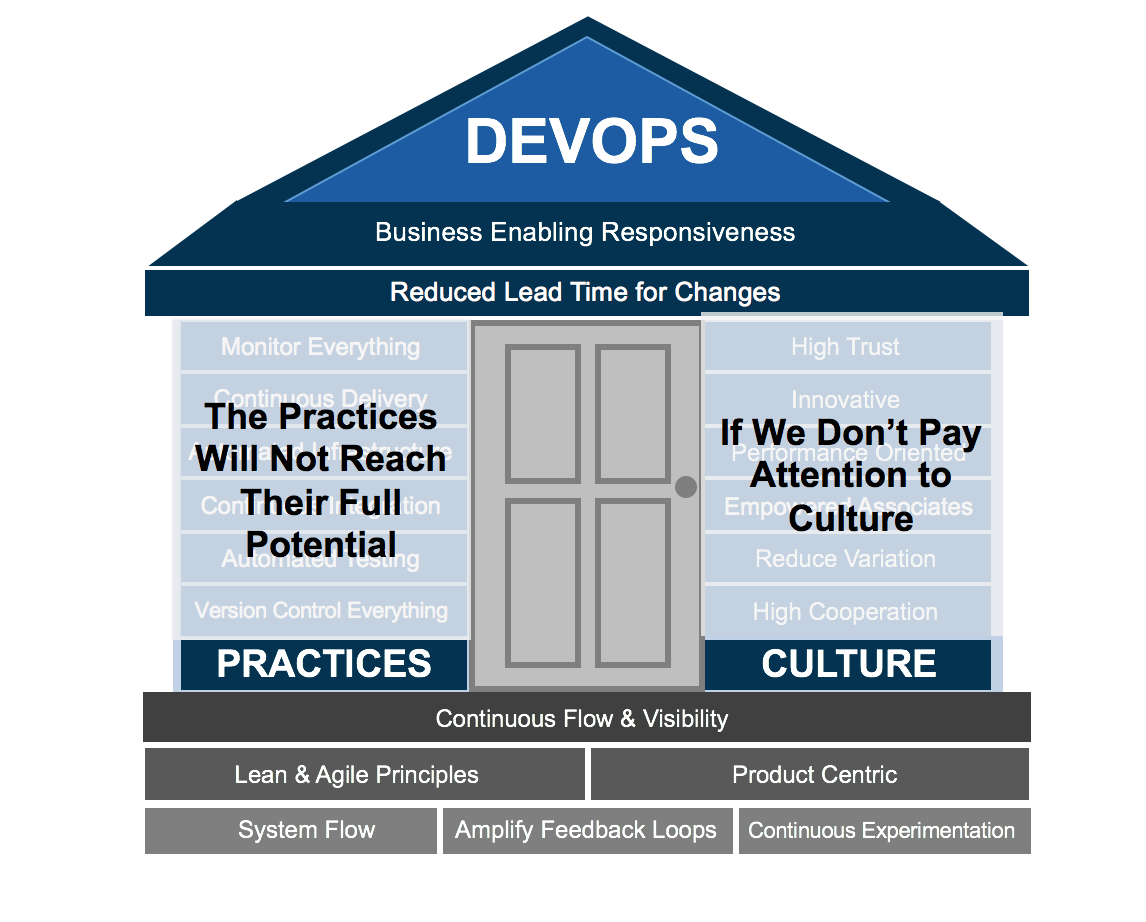
    The recent IBM InterConnect 2016 focused on plenty of tools and technologies, from cloud/SaaS solutions to containers and automation, but there was another popular topic of conversation heard in the halls—the culture of organizations. The basic premise of these conversations was that unless you get the culture right, all the technology in the world won’t get an organization to where it needs to be to compete in the ongoing digital transformation.

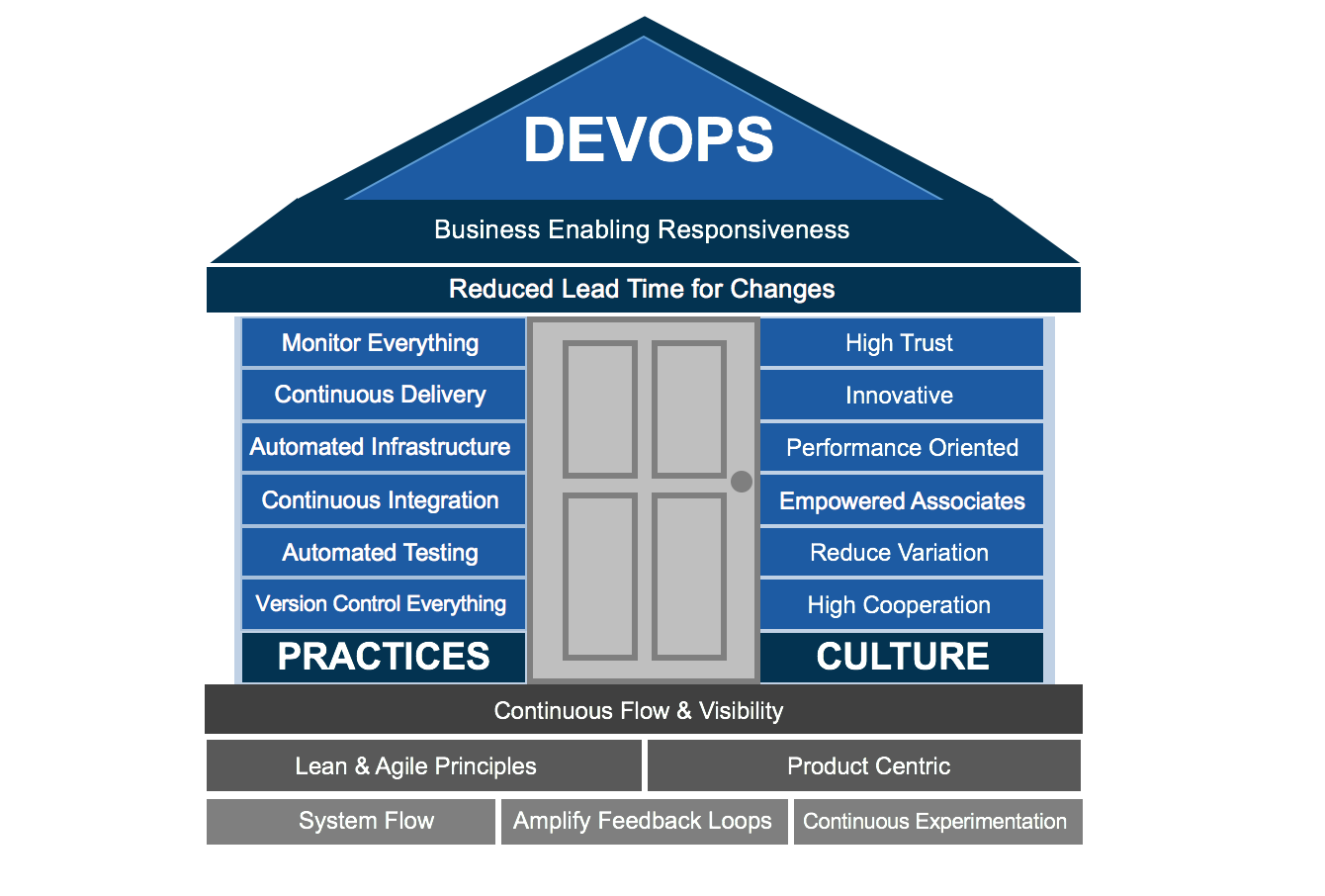
    At Nationwide, we have developed a foundational DevOps model that has two main pillars built on top of Gene Kim’s “The Three Ways” and lean and agile principles.

    While there are initiatives to implement the DevOps-related practices such as continuous integration using Jenkins, continuous delivery using TaskTop and UrbanCode and version control everything using GIT, how does one influence culture? Because clearly if the culture is not correct, technology solutions will not be enough to reach the goals of DevOps in terms of reducing lead time and enabling the business areas to be more responsive to market needs.

    Dev Cul 22

    Trust: The Foundation of Culture

    A key component of what underpins culture is trust. This was emphasized in a blog written by Lee Reid last year titled, “The Simple Math of DevOps.”

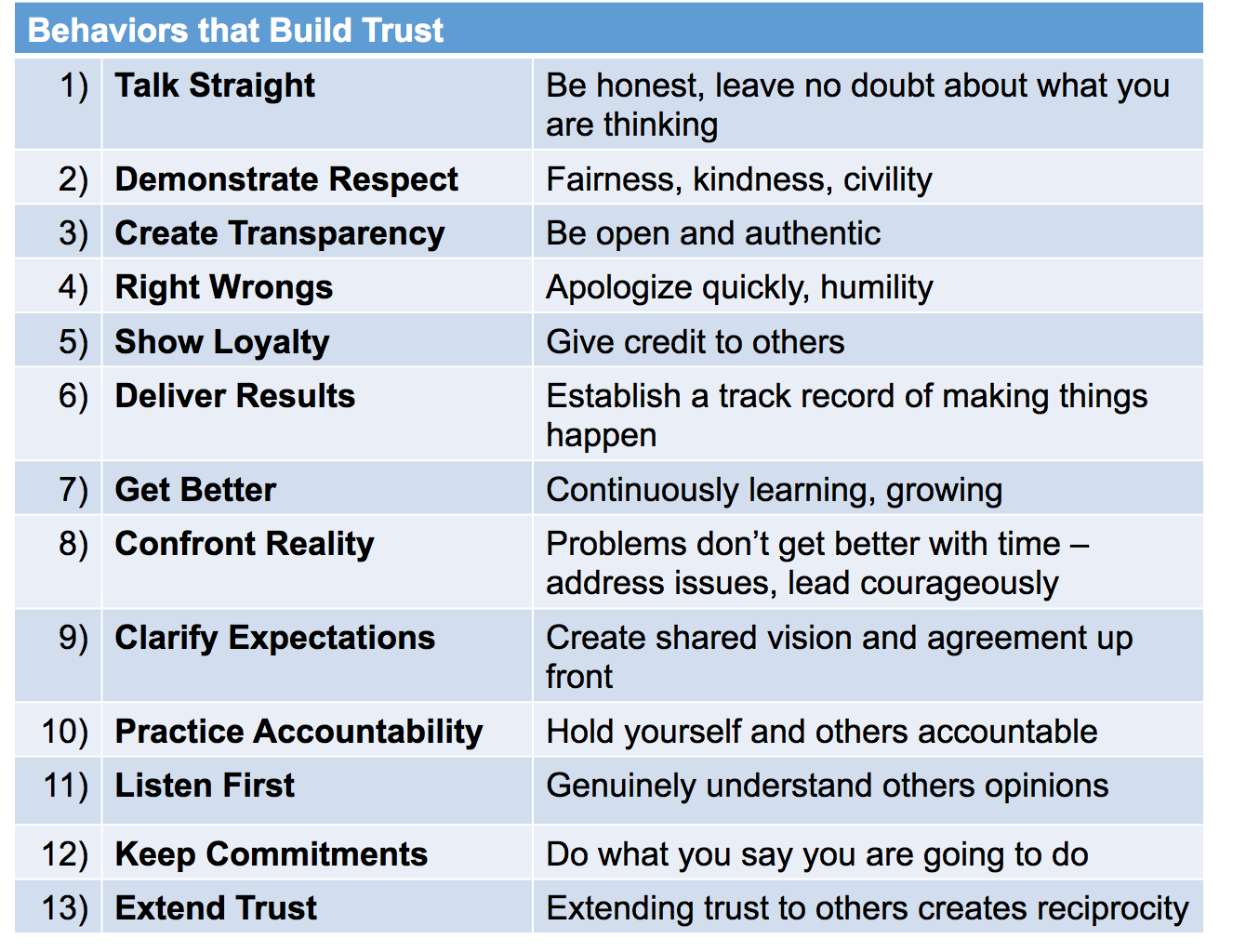
    So how does one build trust? Here are 13 behaviors that build trust from Steven Covey:

    Dev Cul 33

    Colin Powell, in a video on the Essence of Leadership, talks in a powerful way about this, saying that one way to build trust is to “Do what you say and say what you do.” He also stresses that successful leaders are those who provide selfless service to their teams.

    I don’t claim to have any magical formula to build trust, but clearly an organization’s transformational success must include a focus on culture and trust. Without this, the true promise of DevOps won’t be realized.

    You can read more about my session, “Achieving continuous visibility across the DevOps Lifecycle” at InterConnect 2016.

    About the Author| Carmen DeArdo

    Carmen-DeArdo-sq
    Carmen DeArdo is technology director at Nationwide Insurance. An ardent advocate of DevOps and a leading speaker in the DevOps and technology related events, Carmen is responsible for driving continuous delivery utilizing DevOps, lean and agile techniques across mobile, distributed and mainframe and other technologies.

  • Black Duck Announces Open Source “Rookies of the Year”

    BURLINGTON, Mass.–(Business Wire)–Black Duck, a global leader in automated solutions for securing and managing open source software, today announced the eighth annual Open Source Rookies of the Year, recognizing the top new open source projects initiated in 2015.

    The selected projects show how diverse and ambitious open source software development has become. From communications to healthcare and beyond, they offer innovative solutions to a range of consumer- and enterprise-grade problems.

    The 2015 Rookies class reflects three industry trends shaping the future of open source software:

    • Docker Containers: Docker, a 2013 Rookies of the Year selection, established containers and DevOps as the heirs apparent to server virtualization. In 2014, a number of Docker ecosystem players emerged, and the trend continues this year with several, including projects sponsored by Red Hat and Capital One.
    • Open Collaboration: Email isn’t dead, but it’s not as important as it used to be. The success of Facebook messaging and Skype for personal use fuels demand for similar solutions in the office, with real-time tools like Slack and GoToMeeting becoming standards. However, proprietary solutions face competition from open source alternatives which promise all the same features of the originals, but without the lock-in downside of proprietary solutions.
    • Artificial Intelligence: We may be a long way yet from truly “sentient” machines, but development teams are helping computers get smarter at getting smarter. Deep learning techniques aim to teach computers to teach themselves by using a system of multiple processing layers to model the neural network of a human brain. This year we recognize two new projects in the field of deep learning.

    The 2015 Black Duck Open Source Rookies of the Year are:

    • Rocket.Chat – an open source web chat platform built for communities and companies wanting to privately host their own chat service.
    • Mattermost – an open source, on-premise Slack alternative, written in Golang and React.
    • Hubl.in – a free and open source video conferencing solution.
    • MXNet – a lightweight deep learning library created by DMLC, the people behind CXXNet, Minerva and Purine2.
    • Bazel – a subset of Google’s internal software development tools, building software quickly and reliably through a shared code repository in which all software is built from source.
    • React Native – a Facebook-sponsored framework for building native mobile applications using the React JavaScript library.
    • Kontena – an open source container management solution “built to maximize developer happiness.”
    • Nulecule – a specification for packaging complex multi-container applications while ensuring smooth deployment across all instances.
    • InSpec – an open source compliance testing framework for specifying compliance, security and policy requirements.
    • Hygieia – Capital One’s enterprise DevOps dashboard, released last year as an open source project on GitHub.
    • Glucosio – the world’s first open source diabetes monitoring application.
    • Honorable Mention: Vault – a tool for securely accessing API keys, passwords, certificates, employee credentials and other sensitive resources.
    • Honorable Mention: RancherOS – a miniscule Linux distribution specially designed to be the easiest way to manage Docker containers.
    • Honorable Mention: OWASP Security Knowledge Framework (SKF) – a free, open source web app security system based on OWASP security standards.

    “This year’s Rookies are impressive examples of how far open source has come, with start-ups like Mattermost and Glucosio as well as big players like Google, Facebook and Red Hat leveraging the open source community to help drive innovation in everything from DevOps and Docker container solutions to diabetes monitoring and real-time communication,” said Patrick Carey, Director of Product Management, who headed the Rookies selection process.

    “These are sophisticated initiatives where the open source approach is a core part of the business strategy for speeding development, promoting adoption and providing the most value to their customers,” Carey said.

    For more information about the Black Duck Open Source Rookies of the Year, please visit www.blackducksoftware.com/open-source-rookies.

    About Black Duck Software

    Organizations worldwide use Black Duck Software’s industry-leading products to secure and manage open source software, eliminating the pain related to security vulnerabilities, open source license compliance and operational risk. Black Duck is headquartered in Burlington, MA, and has offices in San Jose, CA, London, Frankfurt, Hong Kong, Tokyo, Seoul and Beijing. For more information, visit www.blackducksoftware.com.

    Black Duck
    Brian Carter, 508-277-7570
    Director of Strategic Communications
    bcarter@blackducksoftware.com
    or
    PAN Communications
    Michael O’Connell, 617-502-4300
    blackduck@pancomm.com