Tag: devops

  • Databricks Offers APIs to Enable Agile Application Development With Apache Spark for the Enterprise

    Fusion of API and Visualization Meets Application Deployment and Data Science Needs

    SAN FRANCISCO, CA–(Marketwired – Mar 30, 2016) – Databricks, the company behind Apache Spark, today launched a new set of APIs that will enable enterprises to automate their Spark infrastructure to accelerate the deployment of production data-driven applications.

    Today’s enterprise data platform must satisfy the disparate needs of multiple constituents as they work together to deploy production data-driven applications. While developers and DevOps teams operate in command line and APIs to automate infrastructure, data scientists demand a visual environment to create algorithms. Without a unified platform, enterprises suffer from a sprawl of tools, leading to long application development cycles and high IT infrastructure complexity. With the addition of secure APIs to an integrated workspace, Databricks natively supports this full spectrum of enterprise needs in one platform — a capability not yet available anywhere else.

    Databricks users will now have the ability to implement Agile Development best practices, such as continuous integration, in tandem with performing real-time data analysis and visualization. Added benefits to enterprises include:

    • Faster release cycles of Spark applications;
    • Higher reliability in Spark infrastructure deployments;
    • Improved oversight and management of Apache Spark infrastructure expense in the cloud.

    “Agile data-driven application development requires data scientists to work in perfect sync with DevOps, but these teams lack a unified platform to connect their separate workflows,” said Ali Ghodsi, CEO of Databricks. “The addition of Databricks APIs will enable these constituents to work seamlessly in one platform, allowing them to act on hidden insights from their data and create unique competitive advantages for the business.”

    “The APIs provided by Databricks combined with its integrated workspace and security framework has allowed us to release our applications twice as often as before,” said Doug Stein, chief technology officer at Metacog. “Instead of waiting for multiple weeks to incorporate improvements into our product, we are now able to do so every week.”

    The new APIs are available today to all Databricks customers. To sign up for Databricks, visit www.databricks.com or contactsales@databricks.com.

    About Databricks:
    Databricks’ vision is to make big data simple for the enterprise. The company was founded by the team that created and continues to drive Apache Spark, a powerful open source data processing engine built for sophisticated analytics, ease of use, and speed. Databricks is the largest contributor to the open source Spark project providing 10x more code than any other company. The company has also trained over 20,000 users on Apache Spark, and has the largest number of customers deploying Spark to date. Databricks is venture-backed by Andreessen Horowitz and NEA. For more information, contact info@databricks.com.

    CONTACT INFORMATION

  • IT Organization: Blend, Don’t Divide

    IT Organization: Blend, Don’t Divide

    Bi-modal is the new normal, but the best way to approach this is to blend operations, not create separate groups.

    There’s been much ado lately about the transition of enterprise IT from traditional, steady operations to a highly agile and services-based operation. Companies of all sizes are moving to the cloud and adopting DevOps, yet many must maintain legacy systems for years to come. Pundits and analysts such as Gartner suggest that CIOs need to split their organizations into two: the Mode 1 group (traditional, “lights on” operations) and Mode 2 (the business-innovating group). In fact, Gartner is so bullish on this idea that the research firm is predicting that 72 percent of enterprises will be operating in a bimodal structure by 2017.

    Yet dividing and conquering won’t work. By creating two separate groups, with likely two different leaders, there’s bound to be tension and turf wars. Overlap of duties will happen, and higher costs may result. Regardless, the two groups will still need to work together—but may have little incentive to do so.

    Let’s take a step back. Bimodal is just another name for transitions that IT organizations have been through many times in the past: analog vs. digital, mainframe vs. client/server, batch vs. interactive, native vs. web-based, on-premises vs. cloud and so on. Creating walls between existing and emerging processes and technologies doesn’t make much sense. It’s possible to manage “old” and the “new” requirements and projects in tangent.

    Instead of creating walls, Mode 1 and Mode 2 processes can coexist and employees with different perspectives can help each other as the company transitions to its next phase of innovation. Over time, the entire organization will shift to the most progressive, efficient and business-aligned way of delivering IT.

    IT organizations should think more holistically about building cross-functional teams made up of the best members to serve that team’s particular purpose. Those teams may have mobile app developers and DevOps managers sitting side by side with network engineers and system architects who have developed deep specialties in enterprise databases and data center infrastructure over many years. There may be Waterfall teams and DevOps teams, and individuals managing cloud providers working closely with data center managers implementing converged infrastructure. It all begins with the business requirements and designing a strategy that is inclusive of both required legacy systems and future, cloud-based initiatives.

    But wait, aren’t the most progressive companies Mode 2 from top to bottom? The answer is no. Companies such as Amazon, Google, Netflix, Facebook, Apple and LinkedIn are IT innovators that also manage solid and stable internal environments.

    It was only in mid-2015 that Apple announced its migration of the Siri application platform to the Apache Mesos platform. This didn’t happen overnight. The team responsible for Siri realized that it could cut costs and increase flexibility for ongoing support and development. It was an evolutionary move focused on front-end scalability and allowing a clustered approach for scale and management—arguably a very Mode 2 approach. That said, it’s also widely known that the data sources for Siri are a mix of traditional RDBMS and No-SQL—massive data repositories handling millions of transactions 24/7. These platforms require Mode 1, utility-grade availability constructs.

    LinkedIn is another innovator running a distributed architecture that blends Mode 1 technologies (data layer and business engines) with Mode 2 clusters focused on presentation of new and existing initiatives.

    Ways to Blend Effectively

    Here are some ways to approach a blended IT organization that incorporate both Mode 1 and 2 technologies and processes without building walls:

    1. Create a best-of-breed environment. Evaluate your applications and create an architecture plan. Identify existing applications that require modernization. Create a clear picture of the gap between current and desired state. Build an architecture for your applications that leverages one or more platforms that can adapt to your application architecture goals, both present and future.
    2. Balance out your weakness. Most large companies in traditional industries will be heavier on the Mode 1 orientation regarding skill sets, tools and processes. To jump-start a transition toward Mode 2 operations, consider hiring people from software startups with ample experience developing, scaling and maintaining cloud-based systems under rapid time frames. These are the people whose failures bring the perspective necessary to empathize with your Mode 1 teams. They might even appreciate the Mode 1 team’s experience.

      Conversely, if your organization is already a strong Mode 2 operation, know that scaling your business will require you to embrace Mode 1 skills to maintain reliability and consistent user experience as demand grows unpredictably. Ideally, find someone with a large enterprise background that has experience delivering reliability for new, web-scale applications.

    1. Don’t force new methods. DevOps, a technique for infrastructure management in support of rapid delivery of applications services that is generally considered to be well-suited for Mode 2 applications, may not retrofit to every situation. For example, one can write code to manage infrastructure systems that expand and contract with the proliferation of application containers. While well-suited for the container-based application model, many of the coding concepts associated can be too complex for scripting the deployment of a multi-tier Mode 1 application. The layers and complexities of the scripting don’t provide enough return on the time invested to justify the upfront efforts. Leveraging a purpose-built automation engine or simply deploying manually likely makes more sense today. Choose the technique that best serves the initiative, not the one that seems the newest and coolest.

    Rather than getting hung up on how to reorganize IT departments, a better use of time is to determine how to blend the best of the old and the new. IT organizations today are frequently in a state of transition, given the pace of new technological developments. By merging tried-and-true tools and practices that deliver stability with the latest innovations for web-scale business models, companies can move quickly in their respective markets without sacrificing business longevity.

    About the Author/Steve McDonald

    Steve McDonald StrataCloudSteve McDonald is Vice President of Product at StrataCloud, developer of a platform for software-defining enterprise data centers. Over the past 15-plus years, McDonald has led cross-functional teams in the delivery of innovative business initiatives, most recently at Softchoice, where he a managed a team of business development and pre-sales professionals in the United States and Canada focused on the profitable growth of the entire Cisco portfolio as well the networking category overall.

  • VictorOps Unveils Significant Mobile Application Enhancements to Cut Response Times and Reduce Burnout for On-Call Professionals

    Users can prepare, react to, and recover quicker from incidents using iOS and Android devices

    BOULDER, Colo. – March 30, 2016 – VictorOps, the real-time, agile incident management company for DevOps teams, today announced significant updates to the VictorOps mobile application. Since 2012, VictorOps’ immersive mobile applications alerts on-call teams to incidents and allows users to solve them quickly and seamlessly. VictorOps native, fully-functional mobile applications allow teams to remediate problems regardless of time of day or physical location. This increased mobility means that on-call teams are no longer tied to their desks, which keeps employee burnout to a minimum.

    Features of the upgraded version of VictorOps’ mobile application include:

    • Bi-directional chat integrations with Slack or HipChat which allows users to see system information and chat remediation data all in one application eliminating the need to toggle between applications
    • New in-app organization by team allowing users to quickly search through large organizations to coordinate with specific users to assist in incident remediation
    • New ‘quick filters’ that allow application users to differentiate between people currently online or using the application and those who are simply on-call
    • Ability to view alert annotations such as graphs or runbooks, to help the on-call professional determine the severity of the alarm
    • Highly customizable timeline that allows DevOps engineers to have full visibility into all of their systems or quickly zero in on recent conversations or alarms that pertain to them
    • Ability to launch a conference bridge within the mobile application and invite as many team members as are needed
    • Improved personal summary view that allows users to see when they are next on-call, any missed messages and other items that are pertinent to them

    “Each day thousands of our customers pull their mobile devices out of their pockets in order to respond and solve problems in real-time,” said Joni Klippert, Vice President, Product, VictorOps. “This latest version release will give hours of time back to on-call teams by providing everything they need to investigate, triage and communicate with other team members right from their mobile devices.”

    The latest version of the VictorOps mobile application for enterprises and SMBs is now available for download on the iTunes App Store or Google Play. For more information about the mobile application, click here.

    About VictorOps

    VictorOps is the real-time, agile incident management platform focusing on incident lifecycle management and collaboration for IT and DevOps teams. The solution combines the power of people and data to solve IT problems in real-time. The VictorOps platform seamlessly orchestrates team situational awareness, incident creation, escalation, notification, and remediation with team members regardless of physical location or time of day. Privately held, VictorOps is backed by Costanoa Venture Capital and Foundry Group. For more information, visit www.victorops.com and follow the company on Twitter @VictorOps.

  • Threat Stack Announces Most Comprehensive Cloud Security Vulnerability Verification

    Cloud Security Platform™ Provides Automated CVE Check Against Every Package Installed

    BOSTON– March 30, 2016 – Threat Stack, a leader in cloud security management and compliance, today announced advanced capabilities in the Threat Stack Cloud Security PlatformTM that provide customers with the most comprehensive vulnerability verification of any cloud security offering currently on the market. Threat Stack’s Cloud Security Platform automatically analyzes all customer packages against the more than 2 million Common Vulnerabilities and Exposures (CVE) listed in the National Vulnerability Database (NVD) run by the National Institute of Standards and Technology (NIST).

    “Threat Stack wants to keep customers as current as possible on critical CVEs,” said Venkat Pothamsetty, vice president of products and customer advocacy, Threat Stack. “The Threat Stack Cloud Security Platform compares every single CVE published to every package installed, cross-checks against all corresponding vendor advisories on those packages and pin points to the image ID that the servers are instantiated from. The extensive and platform approach we take is resulting in the least false positive rate of CVEs in the industry, but also directly helping with workflows by pointing out what AMI needs to be updated.”


    Security and operations teams operating in the cloud are challenged with assuring security, eliminating vulnerabilities and running as fast as possible. Operations teams, in particular, need to quickly identify packages with vulnerabilities before they’re rolled out into the infrastructure.

    Understanding the growing importance of vulnerability management to cloud users, Threat Stack has assured that the cloud-native platform automatically examines package information on the workload, checking against the NVD. The cloud service also provides manual, custom updates; cross references with operating systems vendors; and proactively directs customers to which AMI needs to be updated.


    The cloud native, fully-integrated Threat Stack Cloud Security Platform supports data across all environments, cloud security providers and containers, eliminating the need for fragmented solutions and reducing the complexity of security concerns facing IT leaders and CIOs. By providing vulnerability management at the workload layer, Threat Stack gives customers the confidence they’re managing CVEs efficiently, enabling them to focus on more high-priority security threats.

    To learn more about Threat Stack’s vulnerability management capabilities, please visit the Threat Stack blog.

    About Threat Stack

    Threat Stack enables growth-driven companies to scale with confidence by identifying and verifying insider threats, external attacks and data loss in real-time. The only fully integrated, cloud-native continuous monitoring solution that gives customers instant visibility and automatically responds to changes in their environment, Threat Stack provides the coverage needed to run secure and compliant, in all environments, without sacrificing speed and efficiency. For more information, or to start a free trial, visit threatstack.com.

  • Culture Change: Metrics, Tools Make a Difference

    Culture Change: Metrics, Tools Make a Difference

    Change is in the wind.

    This time of the year, as winter weather gives way to springtime renewal, this concept isn’t a cliché but rather a concrete, visceral experience. You go outside, smell the earth defrosting and know for certain that change is happening all around you. You can feel it.

    Such is the case on the current DevOps landscape. Seemingly every conversation, with everyone from end users to industry analysts, reaffirms that people are making significant progress toward greater adoption. For an increasing number of organizations, DevOps is maturing from a set of budding goals into a tangible reality.

    At the center of this massive shift within the software factory is the issue of cultural change; as we know in all things DevOps, culture trumps all else. So how are organizations affecting, empowering and measuring all this seismic transition, in particular the human elements?

    During the recent DevOps Virtual Summit, leading practitioners representing industries ranging from banking to travel and technology shared their views on the progress of cultural reinvention.

    From management tips, to tools and even metrics useful for driving transformation, here are some of their observations:

    1. What’s the most critical cultural aspect of planning?
      Kazi Whitfield, director, Quality Engineering, MUFG Union Bank, N.A.: Scalability on this is the key; if you’re doing this at a new organization, you need to understand how to scale it, and starting at some smaller level helps you get there. It also helps each individual and those components that are changing to truly understand what’s changing, and why it’s changing; I think that’s a huge part of the conversation that has to happen.
    1. What’s the biggest obstacle to cultural change?
      Eric Warheit, senior manager, Environment Management, Southwest Airlines: The challenges that we’re working through are organizational in nature. It goes back to the question of localization, and people maintaining a mindset that they’ve previously had, and what we do to create the conversation around what’s possible and the key impacts that we want to have. Ultimately, it’s about being productive with quality, and creating those common values.
    1. How can tools enable cultural change?
      Eugene “Bear” Lehenbauer, group manager, Information Technology, Citrix: If I have to pick one that links them all, a ring to rule them all, that’s when you have an orchestration platform that can take what individual teams are already using and plug right in, or you can take what needs to be automated and automate it; that orchestration harness can now become that common thing that links them.
    1. How can you ensure cross-culture collaboration?
      Warheit: Creating that concrete example, that proof case tying analytics to it, so that we have real measurable ways to make good business decisions, and being able to foster that perspective so that we can look across the organization, as opposed to in a localized way, is really critical to be able to foment that collaboration that’s needed.
    1. How do you measure cultural change?
      Daniele Romano, product owner, Continuous Delivery Pipeline, ING Bank: The most important thing as an organization is to able to apply an analytical approach, meaning that for each team or department you should look at the current situation and have in mind the target situation, and then have different means to guide everyone toward that target.
    1. What’s a key cultural change metric?
      Lehenbauer: We’ve a developed an agility rating scale that allows people to earn scores for something as basic as change management. Based on how those key metrics behave, and there are several of them, but they are fact-based and they’re user impact driven for the most part, they reward the right behaviors. Those types of things can draw out some of DevOps principles results, but also have hard data behind them.
    1. How do you recognize advocates of cultural change?
      Whitfield: Being able to phase reward and recognition into the process is key. Organizations are doing a lot of great things and making millions of dollars, and as the individuals that are coding or testing are driving it, you have to understand how you get to those people’s hearts, to make them passionate about what they’re doing. That’s something that becomes key and it’s something that’s different per organization.
    1. What’s the best way to gauge successful cultural transformation?
      Romano: There is a really only one critical human metric, which is happiness. So, if engineers are happy and they can deliver fast, at a high quality and with intense focus—that’s a very unique but important metric.

    So there you have it, some of today’s most critical elements in driving the cultural transformation necessary to succeed in the DevOps world.

    If you missed the DevOps Virtual Summit you can still view recordings of all the sessions including this customer panel, and stay tuned to this space for more excerpts and highlights.

  • JFrog Announces swampUP 2016 Agenda and Keynote Speakers

    SANTA CLARA, CA — (Marketwired) — 03/29/16 — JFrog today announced the agenda for its second annual swampUP user conference, featuring keynote speakers Sully Sullenberger, former airline captain and aviation safety expert, and Adrian Cockcroft, DevOps visionary at Battery Ventures. Taking place May 23-24 in Napa, Calif., the two-day event will also include sessions led by several DevOps industry experts and Fortune 500 customers of JFrog.

    swampUP 2016 will gather leading developers and DevOps engineers from around the world to exchange knowledge, new ideas and best practices around continuous integration and continuous delivery (CI/CD), and provide a unique opportunity for attendees to meet and build relationships with fellow users and community leaders, with a glass of Napa Valley wine in hand.

    Captain Sullenberger will share his experience managing a real disaster, when he successfully executed an emergency water landing of a commercial flight in the Hudson River, at the swampUP community gala on the evening of May 23. With the data center as their cockpit, developers and DevOps pros will learn how to avoid and recover from their own disasters. Watch the trailer: “Will You be Ready When Your Server Crashes?”

    swampUP 2016 sessions include:

    • “Will You Be Ready When Your Server Crashes?” – Capt. Sully Sullenberger
    • “The Future of DevOps” – Adrian Cockcroft, Battery Ventures
    • “Managing Huge Files on the Right Storage with Git LFS” – Tim Pettersen, Atlassian
    • “Best Practices in Docker Continuous Delivery” – Carl Quinn, Riot Games
    • “Astrid: Artifactory-Sourced Dependency Insight at Netflix” – Jon Schneider and Nadav Cohen, Netflix
    • “Automated Distribution of Open Source and Private Components with JFrog Bintray” – Allen Reese and Jack Weaver, Yahoo!
    • “Docker at Scale” – Viraj Purang, Oracle and Jagan Subramanian, JFrog
    • “Immutable Infrastructure with Docker and Artifactory at Cars.com” – Keith Kreissl, Mac Heller-Ogden, Zlatko Sisic and Deep Mistry, Cars.com
    • “DevOps Journey at IBM Research” – Christian Vecchiola, IBM
    • “GitHub + Artifactory – A Match Made in Heaven (Or at Least in the Cloud)” – Cynthia Rich, GitHub and Baruch Sadogursky, JFrog
    • “How Bintray Saved My Marriage: Scaling WebJars with Bintray” – James Ward, Salesforce.com
    • “Bringing Android Content to the Big Screen with Google Cast” – Kevin Nilson, Google
    • “Bot-driven Development with Artifactory” – Jim Clark, Atomist
    • “Are Open Source Vulnerabilities Hiding Out in Your Repository?” – Bill Ledingham, Black Duck
    • “JFrog Artifactory as the Automated Backbone for a Global CD Tool Chain” – Craig Vosburgh, CA Technologies
    • “Building the System of Systems – Creating a Universal CI/CD Pipeline for Legacy Applications” – Mark Maxey, Raytheon
    • “Make Artifactory Dance: Automate Data Center Management Using Artifactory’s REST API and Groovy Plugins” – Bryan Belanger, Autostructure
    • “Continuous Delivery for the Cloud Native Java Developer” – Josh Long, Pivotal and Baruch Sadogursky, JFrog
    • “Leveraging JFrog Artifactory to Empower Developing Ideas in a Restricted Environment” – Alex Coto, University of Havana
    • “Does Size Matter? CI/CD in a Large Scale Infrastructure” – Loreli Cadapan and Rohit Kumar, Oracle
    • “Continuous Deployment into the Unknown with Artifactory, Bintray, Docker and Mesosphere” – Gilad Garon and Kiril Nesenko, VMware
    • “Writing Performance User Plugins for an HA Environment” – Daryl Spartz, Yahoo!
    • “Pragmatic Scalability: Under the Hood of Artifactory HA” – Viktor Gamov, Hazelcast

    To learn more about what swampUP 2016 will offer and what’s new to this year’s event, watch this video: https://youtu.be/57Zy7tu58sA.

    For additional information and to register for the event, visit:https://swampup.jfrog.com.

    Resources

    About JFrog
    More than 1,500 paying customers, 50,000 installations and millions of developers globally rely on JFrog’s world-class infrastructure for software management and distribution. Customers include some of the world’s top brands, such as Amazon, Google, LinkedIn, MasterCard, Netflix, Tesla, Barclays, Cisco, Oracle, Adobe and VMware. JFrog tools, comprising open-source, on-premise and SaaS cloud solutions, are revolutionizing the way companies and individuals develop, release and distribute software. JFrog Artifactory, the Universal Artifact Repository, and JFrog Bintray, the Universal Distribution Hub, are used by millions of developers and DevOps engineers around the world. The company is privately held and operated from California, France and Israel. More information can be found atwww.jfrog.com.

    Embedded Video Available

    Embedded Video Available: http://www2.marketwire.com/mw/frame_mw?attachid=2984534

    Media Contact
    Danielle Salvato-Earl
    Kulesa Faul for JFrog
    (650) 922-7287
    Email Contact

  • Electric Cloud Announces Four Events To Advance DevOps Release Automation In The Enterprise

    SAN JOSE, Calif., March 29, 2016 /PRNewswire/ — Electric Cloud (http://electric-cloud.com), the leader in DevOps Release Automation, today announced four upcoming industry events taking place in April and early May. These events focus on advancing DevOps and Continuous Delivery in the enterprise by discussing tips and learnings for implementing modern IT practices across a wide range of industries and organizations.

    Electric Cloud logo (PRNewsFoto/Electric Cloud)


    Event #1:

    Live Video Podcasts: Continuous Discussions (#c9d9) Episode 38: CI Acceleration

    Continuous Discussions is a live video podcast for discussing Agile, DevOps and Continuous Delivery. Each episode focuses on a different topic relating to modern software delivery, and features different speakers from the DevOps community.

    Join us on Tuesday, April 5, to discuss tips for accelerating your CI efforts.

    • 

    Tuesday, April 5, 2016 at 10 a.m. PT

    https://plus.google.com/events/cp4f4ch4f7iijfo5nskm1bgr2n4

    Event #2:

    Avantika Mathur to speak about strategies for managing Microservices at scale at MERGE 2016

    At MERGE 2016, the Perforce Conference, over 400 developers, executives and thought leaders will come together in San Francisco to discuss the future of DevOps. During three days of breakout sessions, speakers and lively discussions, attendees will learn about the current state of the industry and discuss where DevOps is headed.

    Join Electric Cloud’s Avantika Mathur as she discusses strategies and best practices for managing Microservices at scale. Using a real use case example and a live demonstration of Perforce Helix, Docker and Selenium, Avantika will share patterns and tips for enabling a robust, scalable and extensible pipeline to support today’s modern app delivery with microservices.

    •

    Thursday, April 14, 2016 at 3:40 p.m. PT

    •

    Ballroom III – Level 4

    Parc 55 – A Hilton Hotel

    San Francisco, Calif.

    Event #3:

    Live Video Podcast: Continuous Discussions (#c9d9) Episode 39: CD Automation

    On Tuesday, April 19, join DevOps experts to discuss tips for automating your CD pipelines.

    •

    Tuesday, April 19, 2016 at 10 a.m. PT

    https://plus.google.com/events/cuj348ss8l75d4u572e7h9l9qec

    Event #4:

    Anders Wallgren to speak about patterns and processes for Continuous Delivery of Microservices at Continuous Lifecycle London

    Continuous Lifecycle London brings together experts and decision-makers in Continuous Delivery and DevOps to help reveal the potential and scope out the obstacles ahead of time. The conference’s holistic approach addresses concepts, processes and tools that are essential to Continuous Delivery and DevOps, as real world experts share their practical experience with attendees.

    Join Electric Cloud CTO Anders Wallgren as he outlines modern requirements for creating, deploying and managing multiple microservices both independently and as a collection in order to satisfy end user requirements and allow for Continuous Delivery.

    •

    Continuous Delivery of Microservices: Patterns and Processes:http://continuouslifecycle.london/sessions/continuous-delivery-of-microservices-patterns-and-processes/

    •

    Tuesday, May 3, 2016 at 11:40 a.m. BST

    •

    30 Euston Square

    London, U.K.

    Share:

    Tune in for new #c9d9 episodes at 10 am PT on 4/5 & 4/19 @electriccloud http://electric-cloud.com/c9d9 #DevOps #CD #automation

    OR

    Attending #MERGE2016? Be sure to catch @avantika_ec‘s talk on managing#microservices at scale on 4/14: http://bit.ly/1VL08kt @perforce

    OR

    Join @anders_wallgren at @ConLifecycleLon as he discusses#ContinuousDelivery of #microservices on 5/3: http://bit.ly/1RnsJJ6

    More Info:

    For more information, contact Hilary Livingston at 303-581-7760 ext. 19 or via email at hlivingston@catapultpr-ir.com


    About Electric Cloud
    Electric Cloud is the leader in DevOps Release Automation. We help organizations developing enterprise web/IT, mobile and embedded systems applications deliver better software faster by automating and accelerating build, deployment and release processes at scale. Leading organizations like Cisco, E*TRADE, Gap, GE, HP, Intel, Lockheed Martin, Sony and Qualcomm use Electric Cloud solutions and services to boost DevOps productivity and Agile throughput, while providing a scalable, auditable, predictable and high-performance pathway to production.

    Media Contact:
    Hilary Livingston
    Catapult PR-IR
    303.581.7760 x19
    hlivingston@catapultpr-ir.com

  • Cloud on the customers’ terms: iland offers maximum flexibility with new ReST API and software development kits

     iland cloud API empowers developers to tap the advanced security, disaster recovery, compliance, management and big data functionality of iland’s enterprise-class cloud 

    HOUSTON – March 29, 2016 – iland, an award-winning enterprise cloud hosting provider, today announced its new iland cloud API, enabling customers to easily access cloud data, deploy workloads, and integrate the iland cloud into their own management tools. By releasing the API along with Python, Java and Golang software development kits (SDKs), iland gives DevOps, IT Operations and managed service providers yet another vector of customizability and flexibility to interface with cloud on their own terms.

    “From day one, we designed the iland cloud to give companies the fastest possible path to the scalability, cost efficiency and agility benefits of cloud while also ensuring customers never sacrifice transparency or security,” said Justin Giardina, CTO at iland. “By leveraging ReSTful endpoints, we’ve been able to rapidly integrate advanced security, disaster recovery and other features that set us apart from the competition. With the new API, we’re now giving customers the ability to directly access and build on top of that integration so they can focus on designing and delivering new capabilities for their business.”

    Unlike most cloud infrastructure offerings, iland Enterprise Cloud Services-Advanced Security (ECS-AS) platform integrates advanced security, compliance, disaster recovery, backup, monitoring and resource management functionality to ease cloud adoption and ensure rapid success. Further, iland ECS is built on the open source Apache Cassandra global data warehouse, giving iland and its customers a powerful Big Data back-end that fuels intelligent control, automation and reporting capabilities. iland’s cloud console allows companies to manage all of this functionality from a single web-based interface, which is ideal for many cloud infrastructure customers.

    Now with the new iland cloud API, customers also have the option of programmatically interfacing with the iland cloud and all of its advanced features – from security information to disaster recovery to the vast resources in the Big Data back-end. This straightforward gateway to comprehensive data and services enables customers to further benefit from the unmatched transparency, granular resource control of vApps, clear pricing and nuanced alerting of the iland cloud. The API and SDKs provide seamless access to the complete functionality integrated into the iland cloud, assembled into a single stack of accessible services. The iland API is built using the ReST architecture, which, due to its usability, is the industry-leading approach to exposing functionality.

    iland’s global customers will deploy this API towards a host of innovative uses, but some initial approaches include:

    • DevOps and Operations automation:Developers and systems engineers can rapidly spin up virtual machines or configure systems using their existing deployment tools. There is no need for extended training or a deep understanding of the data structure and workflow to add a connector. The straightforward SDKs mean creating the lightweight cloud interfaces can be simple.
    • Operations integration: Operations teams can access and visually integrate cloud data alongside their other monitoring tools in a single display or network operations center.
    • Reporting Flexibility: Whether delivering billing reports or assembling executive updates, the API can ensure IT can easily and accurately demonstrate cloud success.
    • Data to fuel innovation: With access to the iland Big Data back-end, customers can leverage performance, capacity, usage, security and compliance information about their systems to drive decision-making, prioritization, and IT innovation.

    For more information on iland Enterprise Cloud Hosting or to access the iland cloud API and SDKs, go to:

    About iland

    With data centers in the U.S., U.K. and Singapore, iland delivers the only enterprise cloud solutions in the market today with true innovation, transparency, intelligent management and advanced security built in. iland’s technology and consultative approach mean anyone– regardless of expertise, location or business objective–can benefit from a hassle-free cloud. From scaling production workloads, to supporting testing and development, to disaster recovery, iland’s secure cloud and decades of experience translate into unmatched service. iland has been recognized as Veeam’s Service Provider of the Year as well as VMware’s Service Provider Partner of the Year, Global and Americas. iland is also part of the Cisco Cloud Managed Service Provider Program for IaaS and DRaaS and partners with other industry leaders including Zerto, Trend Micro, Hytrust and Nimble Storage. Visit www.iland.com.

    Trademarks

    All registered trademarks and other trademarks belong to their respective owners.

  • Our Sprint to Agile Success

    Our Sprint to Agile Success

    Adoption of the agile methodology is essential to the success of a DevOps culture. This is not revolutionary, but is an important foundation.

    We view agile as the tool for developers to achieve DevOps. Our team, which is developer-centric, is focusing on the agile piece of the equation moving forward.

    But what happens when you think you have a grasp on the agile methodology but it turns out you were completely wrong?

    A change is needed.

    Getting back to the Agile Manifesto is a great starting point. This is our story of DevOps failure to success by implementing the correct agile methodology.

    Our Perception Was Wrong

    When thinking about the agile methodology, and, to a greater extent, DevOps, open communication is at the core. However, it is not the only thing agile and DevOps is.

    At the beginning, we thought as long as there was open communication we were agile. Seeing as we sat in the same room, this was pretty simple. But we quickly learned that this was not agile, and the revelation was painful.

    As we experienced development bottlenecks and difficulty in defining responsibilities, we knew there needed to be an adjustment in how we viewed the agile process. Also, we had begun adopting projects in areas where we did not have a high level of expertise.

    This is what brought us back to the drawing board.

    Getting back to the basics meant looking at the reason for implementing agile in the first place. For us, it was releasing better software, more often, with fewer updates. In detail, it was looking at how long it took the team to identify and define the need. Then, it was looking at how long it took from problem definition to software release. We consider this one software cycle.

    The reason for implementing agile is to decrease the time it takes to move through one of these cycles, as well as to decrease the number of cycles on any one project. Defining this process to the team is how we brought our software development back to the basics.

    Renewed Focus

    Once there was a renewed focus, it was time to implement a set of tools and processes. The concepts we focused on incorporating are the following:

    • Adoption of sprints
    • Open communication
    • Version tracking
    • Environment of continuous testing
    • Responsibility definition

    None of these are particularly revolutionary, but when implemented effectively, it made a world of difference. Once we defined these five areas of focus, we adopted the daily sprint meeting. This implementation was the core of our transformation into a truly agile environment.

    The Daily Sprint Meeting

    In the developer environment, meetings can be against the team culture, especially in a startup. This is why a meeting needs to be strategic. The daily sprint meeting should have both a question constraint and a time constraint. The result is no dragging meetings.

    The two metrics for the daily sprint meeting are: 1) each team member gets two minutes to speak, and 2) four questions need to be answered. Those are:

    1. What did I accomplish yesterday?
    2. What will I achieve today?
    3. What obstacles do I face to accomplish my projects?
    4. How am I feeling today?

    With a team of five people, this meeting should take 10 minutes at the beginning of each day. The adoption of the daily sprint has helped us achieve a level of focus not possible without it. This focus has produced increased productivity, as well as adopting an effective agile environment.

    The daily sprint meeting is how we successfully implemented a DevOps culture. This has made all the difference within our team.

    About the Author/Logan Rivenes

    LRivenes PictureLogan Rivenes is a Marketing Manager with Datapath.io, specializing in decreasing latency through network traffic optimization for DevOps.
    Twitter: @loganrivenes

    LinkedIn: https://www.linkedin.com/in/logan-rivenes-01a8964a

  • Evolving to Continuous Testing

    Evolving to Continuous Testing

    As agile development practices mature and DevOps principles infiltrate our corporate cultures, organizations are realizing the distinct opportunity to accelerate software delivery. However, when you speed up any process, immature practice areas such as testing and roadblocks become much more pronounced. It’s the difference between driving over a speed bump at 5 mph vs. 50 mph … at 50 mph, that speed bump is going to be quite jarring.

    Accelerating any business process will expose systemic constraints that shackle the entire organization to its slowest moving component. In the case of the accelerated software development life cycle (SDLC), testing has become the most significant barrier to taking full advantage of more iterative approaches to software development. For organizations to leverage these transformative development strategies, they must shift from test automation to continuous testing.

    Drawing a distinction between test automation and continuous testing may seem like an exercise in semantics, but the gap between automating functional tests and executing a continuous testing process is substantial. This gap will be bridged over time as the process of delivering software matures. Both internal and external influences will drive the evolution of continuous testing. Internally, agile, DevOps and lean process initiatives will be the main drivers that generate the demand for change. Externally, the expense and overhead of auditing government and industry-based compliance programs will be the primary impetus for change.

    A Roadmap for Testing

    Any true change initiative requires the alignment of people, process and technology—with technology being an enabler and not the silver bullet. Yet there are some basic technology themes we must explore as we migrate to a true quality assurance process. In general, we must shift from a sole focus on test automation to automating the process of measuring risk. To begin this journey, we must consider the following:

    Driven by business objectives, organizations must shift to more automated methods of quality assurance and away from the tactical task of testing software from the bottom up.
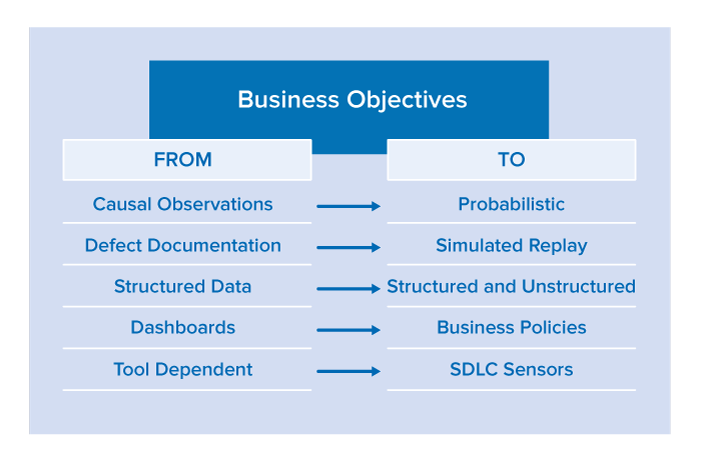
    graphic

    From Causal Observations to Probabilistic Risk Assessment

    With quality assurance (QA) traditionally executing manual or automated tests, the feedback from the testing effort is focused on the event of a test passing or failing—this is not enough. Tests are causal, meaning that tests are constructed to validate a very specific scope of functionality and are evaluated as isolated data points. Although these standalone data points are critical, we must also use them as inputs to an expanded equation for statistically identifying application hot spots.

    The SDLC produces a significant amount of data that is rather simple to correlate. Monitoring process patterns can produce very actionable results. For example, a code review should be triggered if an application component experiences all of the following issues in a given continuous integration build:

    • Regression failures greater than the average
    • Static analysis defect density greater than the average
    • Cyclomatic complexity greater than a prescribed threshold

    From Defect Documentation to Simulated Replay

    The ping-pong between testers and developers over the reproducibility of a reported defect has become legendary. It’s harder to return a defect to development than it is to send back an entrée from a world-renowned chef. Given the aggressive goal to accelerate software release cycles, most organizations will save a significant amount of time by just eliminating this back and forth.

    By leveraging Service Virtualization for simulating a test environment and/or virtual machine record and playback technologies for observing how a program executed, testers should be able to ship development a very specific test and environment instance in a simple containerized package. This package should isolate a defect by encapsulating it with a test, as well as give developers the framework required to verify the fix.

    From Structured Data to Structured and Unstructured

    The current tools and infrastructure systems used to manage the SDLC have made significant improvements in the generation and integration of structured data (e.g., how CI engines import and present test results). This data is valuable and must be leveraged much more effectively (as we stated above in the “From Causal Observations to Probabilistic” section.

    The wealth of unstructured quality data scattered across both internal and publicly-accessible applications often holds the secrets that make the difference between happy end users and unhappy prospects using a competitor’s product. For example, developers of a mobile application would want constant feedback on trends from end user comments on:

    • iTunes app store
    • Android app store
    • Stackoverflow
    • Twitter
    • Facebook
    • The company’s release announcements
    • Competitors’ release announcements

    This data is considered unstructured since the critical findings are not presented in a canonical format: parsing and secondary analysis are required to extract the valuable information. Although these inputs might be monitored by product marketers or managers, providing these data points directly to development and testing teams—in terms that practitioners can take action on—is imperative.

    From Dashboards to Business Policies

    In a Continuous Everything world, quality gates will enable a release candidate to be promoted through the delivery pipeline. Anything that requires human validation clogs the pipeline. Dashboards require human interpretation—delaying the process.

    Dashboards are very convenient for aggregating data, providing historical perspectives on repetitive data, and visualizing information. However, they are too cumbersome for real-time decision making because they do not offer actionable intelligence.

    Business policies help organizations evolve from dashboards to automated decision making. By defining and automatically monitoring policies that determine whether the release candidate is satisfying business expectations, quality gates will stop high-risk candidates from reaching the end user. This is key for mitigating the risks inherent in rapid and fully-automated delivery processes such as Continuous Delivery.

    From Tool Dependent to SDLC Sensors

    Let’s face it—it’s cheap to run tools. And with the availability of process intelligence engines, the more data observations we can collect across the SDLC, the more opportunities will emerge to discover defect prevention patterns.

    Given the benefit of a large and diverse tool set, we need to shift focus from depending on a single “suite” of tools from a specific vendor (with a specific set of strengths and weaknesses) to having a broad array of SDLC sensors scattered across the software development life cycle. And to optimize both the accuracy and value of these sensors, it’s critical to stop allowing tools to be applied in the ad hoc manner that is still extremely common today. Rather, we need to ensure they are applied consistently and that their observations are funneled into a process intelligence engine, where they can be correlated with other observations across tools, across test runs and over time. This will not only increase the likelihood of identifying application hot spots, but will also decrease the risk of false negatives.

    About the Author/Wayne Ariola

    Wayne Ariola (1)Wayne Ariola, Chief Strategy Officer, leads the development and execution of Parasoft’s long-term strategy. He leverages customer input and fosters partnerships with industry leaders to ensure that Parasoft solutions continuously evolve to support the ever-changing complexities of real-world business processes and systems. Ariola has contributed to the design of core Parasoft technologies and has been awarded several patents for his inventions. A recognized leader on topics such as service virtualization, SOA and API quality, quality policy governance, and application security, Ariola is a frequent contributor to publications including software test & performance, SOA World, and ebizQ—as well as a sought-after speaker at key industry events. Ariola brings more than 20 years strategic consulting experience within the technology and software development industries.