Tag: devops

  • Serena Software Releases Latest OEM Versions of Tasktop Sync and Tasktop Dev Integrations for DevOps Tools

    Enable Organizations to Standardize on SBM in the Enterprise, Gain Automated Visibility, Reporting, Traceability Across Development Tools

    SAN MATEO, CA and VANCOUVER, BC (PRWEB) March 28, 2016

    Serena Software, the leading independent provider of application development and delivery solutions throughout the SDLC for the most highly regulated large enterprises (HRLEs), and Tasktop, the leader in Software Lifecycle Integration (SLI) and creator of the Eclipse Mylyn open source tool, today announced a new OEM version of Tasktop Dev and the Tasktop Sync DevOps integration platform for Serena Business Manager (SBM).

    SBM is the leading process management platform for IT development and operations to orchestrate processes across an organization, including software development, delivery and operations.

    Tasktop Sync Pro for SBM

    Tasktop Sync Pro for SBM is based upon Tasktop Sync Version 4.5, and provides fully automated enterprise-grade synchronization between SBM and third-party tools used by practitioners in various specialized roles. This integration enables organizations to standardize on SBM in the enterprise while gaining the automated visibility, reporting and traceability across multiple development tools that is essential for HRLEs. Key third-party integrations for SBM include Atlassian JIRA, HPE ALM & Quality Center, Microsoft Team Foundation Server and Zendesk.

    This release includes Tasktop’s market-leading Artifact Relationship Management (ARM) capability that mirrors not only artifacts in other systems but also manages the complex relationships between them for sophisticated traceability across systems. Other enhancements include new support for complex status workflow configuration, the ability to support massive scale deployments with one instance, and numerous usability and performance improvements.

    “Many of our customers assemble a best-of-breed development tool stack with SBM as the central system of record where one or more third-party tools are also required by specialized practitioners,” said David Easter, director, Product Management at Serena Software. “Tasktop enables Serena customers with these mixed environments to create an integrated tool chain and automate the necessary information flow for collaboration, reporting and visibility throughout the lifecycle. By deploying premium DevOps integration technology from Tasktop, these customers can still move fast without breaking things.”

    Tasktop Dev for SBM

    The latest version of Tasktop Dev for SBM is based upon Tasktop Dev Version 4.5, and provides integrated access to SBM from within the Microsoft Visual Studio, Eclipse and Eclipse-based Integrated Development Environments (IDEs) for software developers. This integration makes it easy for developers to view, update and create SBM artifacts without leaving their development environments so that project status information in SBM is timely and accurate for better decision making.

    “Serena has long been a leader in highly regulated industries, and is also well positioned to help customers excel as the new wave of IOT takes hold,” said Wesley Coelho, senior director, Business Development at Tasktop. “Software traceability across development tools is essential in these areas, and we’re excited to work with Serena to provide the powerful combination of SBM and Tasktop.”

    The latest OEM versions of Tasktop Sync for SBM and Tasktop Dev for SBM are available from Serena Software immediately. Interested parties should contact their Serena Software representative for more information.

    About Tasktop

    Over one million users employ Tasktop’s DevOps integration technology to transform software development and delivery. Tasktop not only unifies the software development and delivery team, but also provides unprecedented visibility into the business critical processes of software delivery. Tasktop customers are the global leaders in financial services, insurance, government and manufacturing, and include 34 of the Fortune 100, 11 of the top banks in the world and five of the top ten US insurance companies. Partners, including Serena, CA, HP and IBM, rely on our independent, vendor-neutral role to connect their customers’ software delivery disciplines via OEM distributions of our products. For more information about Tasktop, please visit: http://tasktop.com

    Twitter: @tasktop

    Blog: http://blog.tasktop.com/

    About Serena Software

    Serena Software provides orchestrated application development and release management solutions to the Global 2000. The company is the largest independent ALM vendor and the only one that orchestrates DevOps, the processes that bring together application development and operations. Headquartered in Silicon Valley, Serena serves enterprise customers across the globe. Learn more at serena.com.

    Twitter: @SerenaSoftware

    Blog: http://www.serena.com/blog/

    Serena Media Contact:

    Kevin Parker

    +1 650-481-3494

    kparker(at)serena(dot)com

    Tasktop Media Contact:

    Joyce Bartlett

    +1 781-771-3112

    Joyce(dot)bartlett(at)tasktop(dot)com

    For the original version on PRWeb visit:http://www.prweb.com/releases/2016/03/prweb13289201.htm

  • Twistlock Announces Accelerated Business Momentum, Expands Executive Team Amidst Multiple Industry Accolades

    Company Appoints Dr. Gene Kim to Advisory Board and Taps Jacinta Tobin for Chief Revenue Officer Role

    SAN FRANCISCO, CA–(Marketwired – Mar 28, 2016) – Twistlock, the leading provider of virtual container security solutions, today announced that its business momentum heading into 2016 has surpassed the company’s revenue goal for the first half of the year, delivering sales far above planned expectations. The company also announced the appointment of Gene Kim as a strategic advisor and Jacinta Tobin as Chief Revenue Officer.

    Twistlock’s Container Security Suite has experienced strong adoption since the company announced its general availability in November 2015. The product is now deployed at leading financial services, insurance, healthcare centers, as well as in highly secured military and defense environments.

    This momentum has resulted in numerous prestigious industry acknowledgements; Twistlock has been named a “CyberSecurity company to watch in 2016” by both Dark Reading and Momentum Partners. SC Magazine selected Twistlock as a finalist for the prestigious “Best Emergent Technology” Award. The company received Virtualization Review’s Editor’s Choice Award, and was named as one of CRN’s Top 10 Coolest Security Startups of 2015.

    Today, the company announced the appointment of Gene Kim, an award-winning CTO, researcher, and author, and a prominent authority in DevOps and security, as a strategic advisor. Kim was the co-founder and CTO of Tripwire, and co-authored “The Phoenix Project: A Novel About IT, DevOps, and Helping Your Business Win” and the upcoming “DevOps Handbook.” Kim will advise the company on its product direction, as well as serve as a sounding board for the company’s overall strategies.

    “Driven by the need for increased agility, containers and DevOps are increasingly being used by large, complex organizations, across all industry verticals. There is the potential to not only increase productivity, but to also increase security and reliability,” said Kim. “Container security is a powerful enabler to build quality and security into how we develop and deploy software.”

    In addition, Twistlock announced the appointment of Jacinta Tobin as Chief Revenue Officer. Tobin comes to Twistlock with many years of experiences driving hyper-growth businesses. She is known for her customer-focused execution strategies, which have consistently delivered results to help Fortune 500 customers and large operators achieve technology visions and goals. Tobin will oversee sales, market expansion, and channel practices for the company.

    “Gene brings a unique blend of experiences in entrepreneurship, security innovations and DevOps thought leadership,” said Ben Bernstein, CEO of Twistlock, “Jacinta is one of the most successful high tech sales executives in the field. The addition of Gene and Jacinta comes at an important moment as we expand our market presence and the breadth of our offerings to customers. We look forward to working with them both and leverage their vast expertise to enable innovations and business success for our customers.”

    Bolstering the general availability of its Container Security Suite, Twistlock also announced strategic integrations with two of the largest cloud platforms — Google Cloud Platform’s Container Engine and the Amazon EC2 Container Registry Service. As part of these integrations, Twistlock’s technologies are now easily available to help identify vulnerabilities, detect anomalies and enforce run-time policies for containers in and across both AWS and Google Cloud Platform.

    Twistlock’s Container Security Suite is the only dev-to-production security product on the market today. It has been adopted by more than 30 organizations, spanning financial services, health care, media, hospitality, consumer technology services and government agencies. Many of these customers have deployed Twistlock in both development and mission-critical production environments, protecting live services and valuable customer data in containers.

    Accolades and Awards:

    Additional Resources:

    About Twistlock
    Twistlock is the industry’s first enterprise security suite for container security. Twistlock’s technologies addresses risks on the host and within containers, enabling enterprises to consistently enforce security policies, monitor and audit activity, and identify and isolate threats in the container environment. Twistlock’s mission is to provide an enterprise-grade security stack for containers, enabling organizations to maximize the benefits of adopting containers. For more information, please visit www.twistlock.com

    CONTACT INFORMATION

    • Media Contact:
      10Fold
      Travis Anderson
      Email Contact
      925.271.8227
  • Resurrecting the CMDB Through a Singular Path to Production

    Resurrecting the CMDB Through a Singular Path to Production

    Change consistency (or the predictability of how change is deployed) followed by change transparency (or the visibility into the state of change at any stage in the software development life cycle [SDLC]) are two key benefits of embracing a highly functioning enterprise-class DevOps set of services. Most organizations are attempting to transform themselves from a widely varied manual delivery system to an automated, template-based delivery model that DevOps relies upon.

    Along this journey a key fact soon emerges: We cannot allow “manual” tweaks to our environments and maintain the predictability, visibility or the stability we want. To be truly consistent, process must be fully automated. A process that relies upon human interaction (whether planned or unplanned), is subject to human variability that can impact its success. In short, we do not want a deployment process that has humans coming along after it, to “clean it up.”

    Thus a key principle of DevOps, is that it becomes “the singular path to production.” We want all changes going in to production to have gone through our DevOps systems and processes. Our goal becomes to reduce and eliminate human reliance in every interaction. As an example, we automate test execution, then test evaluation, then test gated change progression. We use “smart” deployment technologies to overwrite what is different in the destination environment, forcing it into compliance with our stated version of changes that “should” be there.

    In effect, we “step on” variations, overwriting them every time we initiate a deployment. This quickly teaches our freestyle engineers who make changes on the fly that their work will get “stepped on” with each new deployment (perhaps daily or hourly). Most engineers quickly get the hint that to preserve their work, they need to include it in the deployment process itself (updating the proper configuration file, or adding the right series of steps in the deployment execution automation itself). Otherwise, they will face a daily onslaught of repetitive tasks that inevitably will overwhelm them.

    In this sense, a properly implemented DevOps system is “self-cleaning.” Paired with an executive mandate to have all change go into production through DevOps, another benefit emerges that may bring the CIO glee. Just a few years ago, IT organizations were bent on the idea of documenting change (therefore understanding it better) through the means of a configuration management database (CMDB). Those projects tended to be large, costly, and doomed to minimal success. Typically, the CMDB effort was great for 90 days after its first instantiation, then over six months its data became “suspect,” then after a year or two its data became prehistoric and close to useless.

    The simple truth is, engineers (of nearly every variety) are toxically allergic to documentation. Asking engineers to have the human discipline of keeping up with documentation is like asking the sun not to shine. No matter what set of inducements is offered, or punishments threatened, the engineer simply remains toxically allergic to documentation and its maintenance (probably a DNA thing).

    Industry tried to solve this problem by producing “discovery tools,” or tools that could determine automatically what our state of change was environment by environment. The idea being that if we ran discovery tools on regular intervals we could at least renew our CMDB baseline from time to time. It was an improvement, but discovery still lacks context for change and often is not thorough enough to generate real value beyond asset location and basic configuration.

    Enter DevOps, which inherently has an artifact database capability to track versions of builds, deployments and releases over time. DevOps understands the need for artifact identification, articulation, compilation and history. Most early DevOps tooling has some form of it built into the products. But this is where a perfect storm becomes possible.

    If our DevOps systems have achieved transparency; that is, if we are able to connect the context of change outlined from ideation (in the business requirements) through production release (including the history of testing, etc.) by version, we now have a great deal of wealth we could plug into a resurrected CMDB. And we could maintain the CMDB automatically (requiring no engineers to have to do manual things to keep it up to date). Our CMDB becomes a repository, or master repository of the artifacts of change we implement through DevOps.

    This is more than just baseline or the ability to establish a “golden copy” of what change should look like. It is the ability to establish “relative” golden copies by development version while it progresses through environments of even highly complex SDLC systems. We have thus increased the value of a CMDB exponentially beyond its use in just production, but can integrate it, into the SDLC process and watch change become documented in real time no matter how fast or how often we move change.

    This should be groundbreaking. Even if the CIO has burned all his funding and political capital on a former CMDB project that has had less-than-desirable results, he or she can salvage what is left of it and quietly use DevOps to resurrect the CMDB, making it an integrated step of moving change. Once the CIO has demonstrated success doing this, he or she can offer this reclamation project to the business and begin exploring ways of creating CMDB valuation to the business (beyond asset location and valuation).

    What emerges is a DevOps-centric CMDB. DevOps, having become the singular path to production, has both insight and context into all change progression and simply updates the CMDB (master artifact repository) as needed automatically. In this way, an integrated CMDB becomes part of the DevOps continuum. And perhaps the greatest benefit or win is the simultaneous recognition of engineer’s allergy to documentation already baked into this sustainable solution. I would call that win-win—or, at least, a recognition of reality.

    To continue the conversation, feel free to contact me.


  • Trusting Continuous Delivery

    Trusting Continuous Delivery

    DevOps, continuous delivery and the pipeline for faster software development are fundamentally different from traditional software development. It’s such a different approach and a different culture that it can take some time before Dev and Ops teams embrace and trust it—a necessary step for DevOps to make progress in any organization. By mixing containers and their value proposition into DevOps, this new software creation and deployment paradigm can readily foster that trust.

    What Continuous Delivery Brings

    DevOps and continuous delivery offer application development using containers, providing the required level of trust to get over that hump and move things forward. According to David N. Blank-Edelman, a DevOps veteran and currently technical evangelist at Apcera, the following container features lead to trust because they answer Dev and Ops concerns:

    • Containers are resource-friendly replacements for virtual machines, built to encase the coder’s development environment
    • Containers are the complete package format replacement, possessing everything you need to run an app
    • Containers create an abstraction that enables development and its results to sit in a host in any of a number of infrastructures including on-premise and inside any of several public cloud providers
    • Containers are the fastest means to launch short-lived, purpose-built testing sandboxes as part of a continuous integration process
    • Containers are the end result of a build pipeline (artifact-to-workload)
    • Containers form the boundary for loosely coupled components as part of a larger app or service. Such is the case, for example, when each part of a microservice-based app lives in its own container

    According to Blank-Edelman, the aforementioned features imbue trust because they satisfy the following Dev and Ops queries:

    • Is the container allocated to use only the resources it should?
    • What resides in that container / workload?
    • Where did that container come from? Is it OK from a security, coding and business requirements perspective?
    • Where is the container permitted to live and run such as in what cloud, environment, country, and in proximity to other containers technically?
    • Can the container communicate with only the things it should such as other containers and any hypervisor or other management resource? “If I move the container to another location, do the answers to these same questions still apply?” asks Blank-Edelman.

    Though these questions express concerns in direct and simple language, experienced DevOps engineers who have felt the frustration of building development processes and attendant infrastructure understands these are difficult questions to satisfy. Without modern containerization efforts to sustain DevOps, development and production goals grow further out of reach.

    The Importance of Policies

    As containers undergird DevOps and continuous delivery, policies support containers. Developers input changes and innovations in code to the continuous delivery pipeline. Developers then respond to the needs of the growing code in a nurturing fashion, fixing errors and enabling new features. This pipeline works when automation, together with each progressive step in the development process, lays a foundation for the next step in a predictable and reliable manner.

    “Here’s where it gets tricky: First, not only do you have to be able to answer the trust-related questions for each step, but it is entirely possible (and entirely likely in an enterprise environment) that different people/teams will share control of and input to each step on that path,” says Blank-Edelman. With so much collaborative effort in play juggling all these pieces, policies are necessary to configure these steps, address networking and other elements, and control the component parts of the process ahead of time and everywhere along the way.

    Policies that make particularly good container watchdogs include those that set steps in the DevOps/continuous delivery pipeline apart, hemming them in on all sides. “Just like having your papers in order makes for an easier border crossing when you travel abroad, so, too, does having your policies reflect the trust required to move from one step to another,” says Blank-Edelman.

  • NetEnrich Teams with Microsoft to Drive Azure Adoption

    IT infrastructure & operations management services provider will offer and deliver Azure deployment services to Microsoft partners in exclusive pilot project. San Jose, CA—March 22, 2016—NetEnrich announces it has been selected as a Microsoft® Technology Partner to deliver services for setup, migration and management of Azure Backup, Azure Site Recovery and applications to Microsoft partners and Cloud Solution Providers around the globe. NetEnrich has created a set of white-label services that a partner can incorporate as part of its Azure cloud offerings. The two companies expect to accelerate deployment and management of Azure services while also saving partners significant time and cost.

    NetEnrich Teams with Microsoft to Drive Azure Adoption Microsoft Azure revenue and compute usage more than doubled year-over-year, with Microsoft Office 365™ revenue growing nearly 70%, according to the company’s latest quarterly earnings release. As businesses migrate rapidly to Office 365, many also need help moving to Azure, giving Microsoft partners a huge opportunity for new revenue streams. Yet many partners are still not up to speed on the Azure platform and don’t have enough in-house staff, expertise or automation technology to respond to customer demand. NetEnrich, however, has nearly 500 engineers, high competency in Microsoft technologies, deep expertise in automation and all components of Azure, and several years of experience in private and public cloud deployments.

    Microsoft partners globally will benefit from a proven, high-caliber service offering, including the ability to begin migration for a customer within 24 hours, round-the-clock support, and management services. Additionally, partners will benefit from NetEnrich’s highly scalable automation platform that enables services for backup, migration and management, speeds time-to-market for partners, and minimizes costly errors during deployment.

    “Microsoft is focused on empowering customers to capitalize on the benefits of cloud, and our partners are key to providing the expertise and support they need to plan their strategy and maximize their Azure investments,” says Hyder Ali, CTO for Worldwide SMB, Microsoft. “NetEnrich will provide a valuable service in a predictable and scalable way to those partners seeking best practices and standard approaches to an Azure migration and deployment, which will mean faster time to value for our customers.”

    “Most service providers want to ramp up quickly on Azure as it offers many advantages on price, flexibility and features,” says Raju Chekuri, CEO of NetEnrich. “Our 11-plus years of experience delivering highly scalable, infrastructure & operations management services to hundreds of partners – both onpremise and cloud, along with our super-efficient automation tools for migrations, monitoring & management, makes this a reality for partners. We’re excited to help grow industry awareness and adoption of Azure.”

    About NetEnrich

    NetEnrich combines industrialized services and a proprietary automation platform to deliver next-gen IT infrastructure & operations management services from on-premise to cloud. This new world approach to IT operations reduces costs while mitigating risk, providing control, and driving innovation. NetEnrich has over 150 channel partners and over 1,400 clients spanning SMBs, mid-markets, and enterprises. NetEnrich is headquartered in Silicon Valley, California. To learn more about NetEnrich, visit www.netenrich.com.

    ###

    Media contact:

    Kevin Wolf TGPR

    (650) 327-1641

    kevin@tgprllc.com

  • First We Fixed Dev, But Let’s Not Forget About Ops

    First We Fixed Dev, But Let’s Not Forget About Ops

    Since its beginning in 2008, DevOps has gone from an underground rebellion by developers to a mainstream movement with representatives in every industry and at every scale. You can see the change just by looking at how people attending DevOps events dress: the black T-shirts are still there, but these days there are lots of suits and ties as well. Another hallmark of this success is companies trying to fit DevOps into their existing conceptual frameworks—hence, the plethora of “ITIL and DevOps” papers out there.

    Despite all this success, though, the DevOps movement is still young. Of course, things move fast in IT, but we aren’t talking about a technology or a technique that can be adopted rapidly and spread very widely. Committing to DevOps is a major cultural shift for organizations, and that takes time. Some organizations have been doing DevOps for five years and have fully re-engineered their processes around this new approach, but most are still only at the beginning of their DevOps journey. As William Gibson said, “The future is here; it’s just not evenly distributed.”

    First Things First: Speed Up Releases

    The early phase of DevOps adoption focuses on activities around releasing code to production, because that was the bottleneck that the DevOps movement was originally created to break. While it still may be too soon to declare victory, it’s safe to say the improvement in the release process is enormous. Today, any new project that does not propose to implement DevOps principles would have to have a very good reason and explanation.

    Notice that qualification about new projects. It’s easy to adopt DevOps methodologies and expectations in a greenfield situation; however, it is much harder in a brownfield project, where previous cultural norms have been expressed in tooling and processes that are hard to change in-flight. The good thing is that over time, the old way of doing things will die off naturally, as code bases get re-engineered, ported and replaced. Eventually, every project will be a DevOps project.

    DevOps image

    Are We Running So Fast That Others Can’t Keep Up?

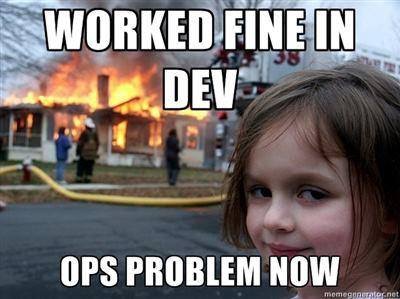
    DevOps, however, is not just about release and deployment. It also covers operation of what has been deployed. It’s right there in the name, after all! Coming from an operations background, though, there can be a feeling that DevOps is not for “people like me.” Some simplistic interpretations of DevOps focus on the sometimes adversarial relationship between Dev and Ops, forgetting that good Ops people are just as incentivized as Devs to get Devs more involved in Ops.

    One of the difficulties that arise when engineers try to “do the DevOps” without involving Ops is that Ops are not ready to join in. When Dev are doing non-agile releases on an 18-month cycle, Ops have a certain set of assumptions about what a release represents for them. Doing these sorts of monolithic releases is a major pain for Ops for a while, but there will be plenty of time to get ready for it, and other required activities can be scheduled around that release.

    One of those important dependencies is preparing the monitoring and management of the code that is being deployed. What needs to be instrumented, where do those feeds need to go, what needs to be in place to make sense of those feeds when they arrive, who needs to jump when one of the feeds goes red, and so on. There is a lot going on in the NOC that Devs are not always aware of.

    If Devs suddenly show up with a more Agile cadence of a release every couple of weeks, Ops are simply not going to be able to adapt their existing tools and process on the fly to that new cadence. When you have months of lead time, it’s feasible to write and modify extensive sets of rules and filters to make sense of monitoring data, filter out the cruft, and route the remainder correctly. When your lead time on a release is measured in days or hours—not so much.

    Devs should remember that “infrastructure as code” also includes debugging that code. Adopting release automation, containerization or whatever will be the next cool tool will not solve the problem on its own. Bridget Kromhout has a wonderful articulation of this mechanism:

    Containers will not fix your broken culture. Microservices won’t prevent your two-pizza teams from needing to have conversations with one another over that pizza. No amount of industrial-strength job scheduling makes your organization immune to Conway’s Law, which states that “organizations which design systems … are constrained to produce designs which are copies of the communication structures of these organizations.

    Leaving aside the communications barriers that all too often still exist between Dev and Ops, one of the constraints that Ops teams have to deal with is that Ops is segmented into many different teams, each of which deals only with one area or one technology. These days, though, problems tend to have symptoms that cross these domain boundaries, and so operations teams have to communicate with each other.

    The historical ways of doing this are not very efficient, relying on ticket ping-pong, escalations, war-rooms and good old blame-storming. What do you think happens if you suddenly accelerate a system like that? The answer is that it just torques itself into scrap.

    Completing the DevOps Culture Shift

    The good news is that others have been where you are now, and there are both tools and techniques that can help you operate what you have developed. In common with the rest of the DevOps movement, it’s as much a cultural shift as a technological one. Ops teams need to start thinking of operations in a new way.

    One aspect of that change is the ongoing shift to immutable architecture, also known as puppies vs. cattle. Another is to enable efficient communication across support domains. Today, like in the parable of the blind men and the elephant, support teams often get hold of different bits of the problem, misidentifying them because they only have partial information, and therefore cannot truly resolve the problem. Nobody really has a complete view of the whole elephant, except perhaps for some savant who can be reached only after many escalations—and really has better things he or she should be doing.

    If Ops teams can work side by side with Dev, on the other hand, there is a virtuous cycle that becomes possible, with efficient operations removing even more friction from the development process. Communications are the key, whether that means machine-to-machine feeds, human-to-human conversation or machine-to-human interaction. Organizations that get this right reap enormous rewards in both Dev and Ops.


    Dominic Wellington serves as Moogsoft’s Chief Evangelist

  • Puppet Labs Launches Fifth Annual State of DevOps Survey

    PORTLAND, OR–(Marketwired – Mar 22, 2016) –  Puppet Labs, the leading provider of IT automation software, today announced that it has opened the survey for the fifth annual State of DevOps Survey and Report (http://bit.ly/2016DevOpsSurvey). This one-of-kind, comprehensive industry study provides enterprises with insights into how DevOps, automation, IT and organizational performance impact the world’s leading organizations. The 2015 report revealed the critical role that IT leaders play in a company’s DevOps transformation, affirmed that through the power of DevOps and automation, high-performing organizations have 60 percent fewer failures and recover 168 times faster, and demonstrated that DevOps provides a powerful competitive advantage.

    This year’s report is being conducted in partnership with DevOps Research and Assessment (DORA), founded by IT and development experts Gene Kim, Jez Humble, and Nicole Forsgren. The survey will examine a number of new research areas, including:

    • ROI of IT performance. Exploring the ROI of IT performance and technical practices to better understand how throughput, stability and quality measures affect the bottom line.
    • Security and compliance. Security and compliance are top of mind in the DevOps space. This year’s survey investigates the role security plays in a DevOps environment.
    • Quality. Past reports have revealed the impact of DevOps practices on key IT performance metrics for throughput and stability. This year’s survey will help to better understand how quality is affected by DevOps practices.
    • Containers. Containers are no doubt changing the IT landscape. The survey will make clear how much containers are truly affecting IT performance.
    • Lean. Last year’s report found that lean management practices such as limiting work in process and creating and maintaining visual displays showing key quality and productivity metrics predict IT performance. This year’s survey will continue diving into lean practices to boost productivity and performance.

    “As DevOps practices have been increasingly adopted in all industries, we hope to have even more people in IT share their experiences through this year’s DevOps survey,” said Nigel Kersten, CIO of Puppet Labs. “We’re looking to get more information on how well DevOps practices actually pay off for organizations that make this investment, and which practices lead to more effective IT and more successful organizations.”

    “DORA is honored to participate in this year’s survey,” said Gene Kim, one of the co-founders of DORA and co-author of The Phoenix Project. “Organizations in all industries increasingly adopt DevOps because the business value is so high. More than ever, this research helps us understand what organizational and technical practices are required to make DevOps work, as well as how to measure its value.”

    In addition, for the first time in the survey’s history, Puppet Labs and DORA have opened sponsorship to a consortium of companies that are both leaders and innovators within the DevOps space. Current sponsors of the report include Atlassian, Automic, CA Technologies, Hewlett-Packard Enterprise, IT Revolution, Splunk, and ThoughtWorks.

    To participate in the 2016 DevOps Survey and Report, visit (http://bit.ly/2016DevOpsSurvey)

    Additional Resources

    About Puppet Labs
    Puppet Labs, Inc. is the leader in IT automation. Puppet Labs software provides system administrators the operational agility, efficiency and insight they need to proactively manage dynamic infrastructure, scaling from tens of servers to thousands, both on premise and in the cloud. Thousands of the world’s leading organizations use Puppet Labs software to configure and manage their IT infrastructure, including Bank of America, Cisco, NYSE, Salesforce.com and WebEx. Based in Portland, Oregon, Puppet Labs employs more than 360 people. The company is backed by investors Kleiner Perkins Caufield & Byers, Google Ventures, VMware, Cisco, True Ventures, Radar Partners, and Emerson Street Partners. To learn more, please visit PuppetLabs.com.

    About DevOps Research and Assessment, LLC
    DevOps Research and Assessments (DORA) brings together the leading DevOps experts and researchers to help technology and business leaders create world-class technology organizations, leveraging insights from Gene Kim and Jez Humble, renowned experts in the space of IT operations and development, and Nicole Forsgren, PhD, an expert in metrics and psychometrics in software delivery and IT impact.

    In the last three years, DORA has compiled tens of thousands of respondents from technology organizations around the world. By doing this, DORA can benchmark organizations against their industry peers, and provide guidance to leaders on how they can address any gaps to achieve their technology and organizational goals.

    Media Contact
    Justin Dorff
    PR Manager
    (510) 875-9608
    justin.dorff@puppetlabs.com

  • Micro Focus Announces Intent to Acquire Serena Software, Inc.

    Leading Infrastructure Software Vendor Further Strengthens Solution Set to Help Customers Build and Deploy Business Applications and Services Faster, with Greater Reliability and Less Risk

    ROCKVILLE, Md., March 22, 2016 /PRNewswire/ — Micro Focus announced today its intent to acquire Serena Software, Inc., a leading provider of Application Lifecycle Management (ALM) software, in a transaction valued at $540 million. The acquisition is expected to close in early May 2016, subject to receipt of competition clearances in the US and Germany.

    “Today’s announcement marks another significant milestone for Micro Focus, bringing together two highly complementary solution sets that enable customers to build better applications, adapt to changing business conditions more rapidly and maximize the value of existing investments to drive further innovation within their business,” said Stephen Murdoch, CEO, Micro Focus. “With Serena, we are further positioned to deliver richer solutions for the complex business demands customers are solving today – with greater reliability, predictability and less risk of failure.”

    Enterprises globally have increasing demands to build and deploy high-quality business applications to support employees, customers, partners and other third-parties. They require solutions that help them increase the quality of their applications and speed the delivery of change. The combination of Micro Focus and Serena allows companies to better:

    • Design and build business applications and services with greater accuracy, reliability and predictability;
    • Continuously deploy existing core business applications on a wider variety of platforms to meet changing business needs; and
    • Improve the speed and efficiency of new business services through automated release and deployment solutions.

    Serena has extensive expertise in software application development; software configuration and change management; and business process management. Additionally, Serena is a pioneer in processes and solutions that bridge application development and operations to create true DevOps, an increasingly critical area of focus for enterprise customers looking to develop applications and services faster, with greater accuracy and agility that fully meet business demands.

    “This is an exciting announcement that promises to offer substantial value to Serena customers and partners,” said Greg Hughes, president and CEO of Serena. “Our complementary strengths in software development and IT Operations will only serve to provide a stronger foundation for the next-generation of applications and services they require to meet ongoing business demands.”

    About Serena

    Serena is the largest independent Application Lifecycle Management vendor with more than 2,500 enterprise customers. Serena helps the highly regulated large enterprise move fast without breaking things – increasing velocity of the software development lifecycle while enhancing security, compliance, and performance. More information is available at www.serena.com.

    About Micro Focus

    Micro Focus (LSE: MCRO.L) is a global enterprise software company helping customers innovate faster with lower risk. Our software helps customers build, operate and secure IT systems that bring together existing business logic and applications with emerging technologies to meet increasingly complex business demands. For more information, visit: www.microfocus.com.

  • VictorOps Announces DevOps Roadtrip to Impart Industry Best Practices Across the Country

    New event series provides practical tips for implementing and enhancing DevOps strategies

    BOULDER, Colo.–(BUSINESS WIRE)–VictorOps, the real-time, agile incident management company for DevOps teams, today announced its DevOps Roadtrip, a series of events designed to help software development and IT professionals across the country to better implement DevOps practices. The half-day events will focus on tactics and strategies to streamline processes specific to incident management and resolution.

    The first stop in Denver on March 29 will be held at Sports Authority Field at Mile High Stadium and will feature guest speakers from Forrester,Craftsy, and SendGrid. The half day event includes fast-paced TED style talks, topical breakout sessions, and a keynote presentation all aimed at helping others progress in their DevOps journeys.

    “DevOps can be an intimidating topic to many in IT. VictorOps wanted to create a welcoming forum where technology professionals can engage with DevOps experts in the industry,” said Jason Hand, DevOps Roadtrip MC and DevOps Evangelist, VictorOps. “Throughout the country, we’ll spotlight notable speakers in an effort to share DevOps wisdom amongst those tasked with the hard job of maintaining uptime. Our hope is that attendees can head back to their teams with actionable tactics to not only improve their organizations, but also simplify their own lives.”

    In addition to benefiting from a wide range of DevOps expertise and know-how, attendees will:

    • Hear real-life DevOps implementation stories from local companies
    • Learn about industry trends from renowned analysts
    • Network with others searching to implement real-time, agile incident management best practices
    • Have the opportunity to ask questions during an interactive Q&A session
    • And receive practical suggestions to take back to their teams

    By putting these teachings into practice, attendees can help their own companies become more efficient and ultimately more effective.

    “Organizations face an existential threat: deliver more value to customers faster than their competitors, or die. In the past, faster delivery usually meant lower quality and higher risk,” wrote Diego Lo Giudice and Kurt Bittner, Forrester Principal Analyst and DevOps Roadtrip Denver speaker in the December 2015 Forrester report entitled Agile and DevOps Adoption Drives Digital Business Success. “Leading organizations have shown how applying Agile and DevOps practices enables faster delivery with higher quality and lower risk.”

    Other stops on the 2016 DevOps Roadtrip include Seattle, San Francisco, Minneapolis, and New York.

    For more information about the DevOps Roadtrip, visit VictorOps.com/DevOps-Roadtrip, and to sign up for the Denver event, visitVictorOps.com/DevOps-Roadtrip-Denver.

    About VictorOps
    VictorOps is the real-time, agile incident management platform focusing on incident lifecycle management and collaboration for IT and DevOps teams. The solution combines the power of people and data to solve IT problems in real-time. The VictorOps platform seamlessly orchestrates team situational awareness, incident creation, escalation, notification, and remediation with team members regardless of physical location or time of day. Privately held, VictorOps is backed by Costanoa Venture Capital and Foundry Group. For more information, visit www.victorops.com and follow the company on Twitter @VictorOps.

    Contacts

    For VictorOps
    Mackenzie Kreitler, 978-518-4536
    victorops@matternow.com

  • goPaddle goes Google Cloud and Kubernetes v1.2 friendly

    SEATTLE, March 18, 2016 /PRNewswire/ — Bluemeric Inc, a Cloud & DevOps company, today announced the release of the next version of goPaddle v2.0, a DevOps platform for micro-services.

    goPaddle optimised for Google Cloud and Kubernetes v1.2

    2016 being the year of DevOps, IT organizations are already looking at scale-out and economies of scale, while e-commerce companies have understood the impact of agile delivery and zero downtime of their applications. As Gartner predicted, it is becoming a mainstream strategy employed by 25 per cent of Global 2000 organisations. While the need for DevOps is building up, micro-services based architecture is becoming the key enabler for rapid application delivery. Micro-services are sizable units of execution that are independent, polyglot and reusable. Independent teams / developers can make versions of these micro-services, package them as container such as Docker and deploy them on an infrastructure of their choice. Container Clusters like Kubernetes provide a distributed and portable platform that can manage the lifecycle of these containers and provide consistent environments so that applications can be moved painlessly across datacenter and clouds.

    While a spectrum of DevOps ready solutions are emerging in the market, a platform that is focused on continuous build, integration and deployment for micro-services will be a huge cost & time saving solution for businesses.

    Customers have been using goPaddle, for continuous build and deployments since last year. With the new release, goPaddle is optimized for Google Cloud, thus making authentication, on-boarding micro-services and cluster provisioning simple and seamless for Google Cloud Developers. goPaddle provides a powerful yet simple designer interface, that developers can use to drag drop components to create micro-service designs and generate container/cluster specifications on the fly. These designs can then be deployed on to Google Container Engine (GKE) or to a cluster of their choice. Developers can leverage Google Container Registry (GCR) or use Docker Hub for storing/retrieving the container images. As these features signify, goPaddle has moved the infrastructure management hassles away from the developers, while the developers can focus on building their applications.

    While adding simplicity, goPaddle also gives the traceability and control to audit and monitor the applications. In general, log aggregation platforms like fluentd have greatly been in use by the developers and system administrators to monitor the system, application and access logs. goPaddle v2.0 brings in the support for fluentd leveraging the newest features in Kubernetes v1.2. With goPaddle, fluentd can be deployed on selective cluster infrastructure to aggregate logs from micro-services running within those infrastructure.

    goPaddle is available as a hosted version at https://gopaddle.io and as enterprise ready on-premise version with extended support. For more information, get in touch with the Bluemeric team at info@bluemeric.com.

    Photo – http://photos.prnewswire.com/prnh/20160317/345548