Tag: secdevops

  • Automated Security Testing in a Continuous Delivery Pipeline

    Automated Security Testing in a Continuous Delivery Pipeline

    Automated unit, integration and acceptance tests are essential quality controls in running a reliable continuous integration or continuous delivery pipeline. Too often, security tests are left out of this process because of the erroneous belief that security testing is solely the domain of leather-jacket-wearing security experts.

    Security testing does not need special treatment

    We’ve made great strides automating many repetitive quality testing tasks and we can use the same approach to automating security tests. There will always be a need for intelligent human testing both for security and quality, but that doesn’t mean that all security testing must be manually driven. A large proportion of security tests are essentially checks that known weaknesses have not been introduced and these lend themselves superbly to automation. In fact, using a human to perform these types of checks is a terrible waste of resources.

    From an automation point of view, security tests can be categorised as follows:

    1. Functional Security Tests.
      These are essentially the same as automated acceptance tests, but targeted at verifying that security features such as
      authentication and logout, work as expected. They can mostly be automated using existing acceptance testing browser automation tools like Selenium/WebDriver.
    2. Specific non-functional tests against known weaknesses.
      Includes testing known weaknesses and mis-configurations such as lack of the HttpOnly flag on session cookies, or use of known weak SSL suites and ciphers. These are particularly well suited for automation because the weaknesses are known up front (if not by the development team, then by the security team). What’s more is that these tests lend themselves to a TDD approach in that they can serve as the security specification before building the application and environment.
      Some work has already been done in extracting these types of tests into security test automation frameworks, see: BDD-Security (I’m the author), Mittn by F-Secure and Gauntlt.
      Because these test non-functional aspects of the application, they need access to the HTTP layer which browser automation tools do not provide. So testing these requires a hybrid approach: Browser automation together with a proxy server to inspect and inject requests. My preferred combination here is WebDriver with OWASP ZAP.
    3. Security scanning of the application and infrastructure.
      Even manually driven penetration tests usually kick off with an automated scan using vulnerability scanning tools like Nessus, Burp and OWASP ZAP. It’s worthwhile understanding the difference between these tools and how they’re used. Nessus if primarily an infrastructure scanner in that it’ll test an IP address and all exposed ports for known weaknesses. It also includes a “web” scanning component that will test HTTP services for similar known weaknesses, but the scanning at the web tier is extremely superficial. For example, Nessus would not be able to scan any content or functionality behind the login form, nor navigate through a web wizard.
      Burp Intruder (Commercial) and OWASP ZAP (Open Source) are focussed on the web tier and are true application scanners in that they inspect and test at the HTTP layer by injecting attack data into parameters and evaluating the application’s response. They can provide in-depth security scanning if they’re used correctly. But if they’re simply used to spider the application and run an automated test then there’s a good chance that they won’t find or test all the available content.
      To successfully automate application scanning, one should ensure that all of the content to be scanned is navigated and populated in the scanning tool, before starting to spider and scan the application. If you already have acceptance tests that drive a browser, then these can be re-used to populate the Burp or ZAP content before kicking off a scan.
    4. Security testing application logic.
      Automated tools can only go so far in detecting security flaws. Toidentify flaws in the logic of the application requires a human brain (at time of writing). From an automated scanner’s point of view an online auction site and an online bank are the same type of application, i.e. a series of HTTP requests. But from a human attacker’s point of view, they are vastly different beasts offering very different functions. A human security tester might try tests such as:

      • Can I manipulate the HTTP Request to bid on an item that has already ended?
      • Can I manipulate the HTTP Request to bid with a high amount, and then modify that amount to a lower amount just before the auction ends?
      • Can I transfer funds to someone else’s account using a negative number as the value?

      These require ingenuity and experience to find, but once the attack is defined they too can be recorded as automated tests and become a part of the security regression tests.
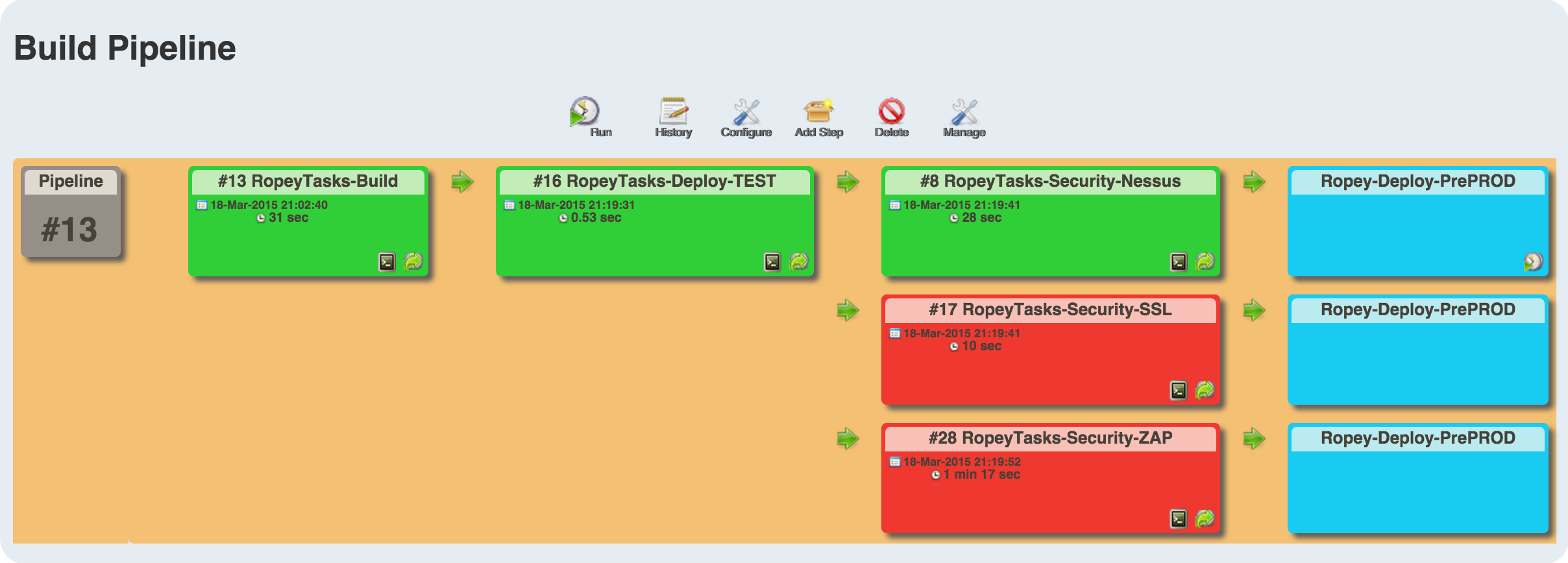
    Screen-Shot-2015-03-18-at-21.21.253

    Walk before running

    If you’re just embarking on the journey to automate security tests, the above steps may seem daunting. But it’s not necessary to implement all of them to reap the benefits of automated security testing. Points 2 and 3 probably represent the greatest value in terms of time invested vs. security value extracted since they help identify a lot of common security flaws that slip through the cracks in a normal development process.

    Any testing framework can be used to orchestrate and run these tests but in the true spirit of SecDevOps, it would be good to choose one that the development, operational and security teams are comfortable using- and that easily integrates with your CI/CD server. I’m partial to the BDD frameworks because their use of a natural language to define the testing steps means that they’re instantly understandable by a wide audience and makes them very attractive for use as security-tests-as-specifications. But some teams that are well versed in programming language X may find this additional, natural language layer, superfluous.

    Point 3 above requires an additional step if we want to integrate those tests into a CI/CD environment. The other tests all have clearly defined passing and failing criteria, but running an automated scanning tool typically results in a number of false positive results: security issues reported by the tool which aren’t actually risks. Manual security tests that use automated tools include a process of investigating and removing these false positives. Automated tests would have to do the same thing and also specify a success criteria. This can be done by wrapping the scanning operation in a test and specifying the known false positives given a particular scanning tool and target.

    For example, the BDD-Security framework performs an automated scan for SQL injection vulnerabilities using the following test:
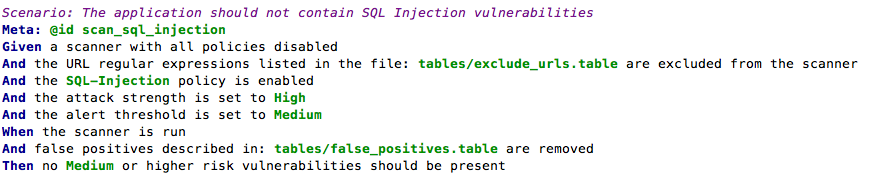
    SQL injection scanning example

    and the additional text file: tables/false_positives.table to define the known false positives to ignore:

    false positives example

    The final step in the test defines the success criteria and would need to be selected based on the security requirements of the application and the scanning tool used.

    When to run the tests

    Since they’re automated, the cost of running the tests is very low, so naturally we’d want to fail fast and run them as early as possible. But security issues are typically found at the component level and are difficult to test at the unit/class level. So testing at the application tier should be done on a running application. In other words, at the same time as automated acceptance tests.

    Testing the security of the infrastructure should be performed on an as-near-to-live as possible environment. This will typically be a pre-production environment. And of course, since running the tests doesn’t cost anything, there’s a good argument for performing the same tests in production as well- continuously.

    Blocking tests or in parallel?

    As a security practitioner, I would love to see security tests as part of the CD process and blocking delivery if tests fail. But in reality this may not be practical for all teams; and it’s ultimately a cultural question of how deeply security is integrated into the dev and ops teams.

    For those who’ve not achieved SecDevOps Nirvana, the tests can be run in parallel to the build with supervision by the security team. It’s then the security team’s responsibility to manually block delivery if test failures indicate the presence of unacceptable risk.

    CI Server Integration

    How well the security tests integrate with the CI server depends on the testing framework and CI choice. Java, Python and Ruby testing frameworks are likely to be supported by all the major CI servers. Using Jenkins and JBehave, which produces both JUnit and HTML reports, the tests output would be:
    xunit-test-results

    bdd-report-ssl-snippet

  • Containers: Secure or Not, Here They Are

    Containers: Secure or Not, Here They Are

    Containers are here. And it doesn’t mater whether or not containers are a transitional technology (they are, as our JP Morgenthal covered in Containers are designed for an antiquate application architecture) until all applications are designed for cloud and web-scale, containers will be part of the cloud and virtualization scene. Right now, containers are white hot. And as you’ve seen here in the past month, containerization was an editorial focus for us throughout March.

    To give you an idea of how popular containers are right now, consider…


    –THIS STORY HAS BEEN MOVED TO CONTAINER JOURNAL–


  • Rugged DevOps Breakfast @RSAC

    Rugged DevOps Breakfast @RSAC

    In April staging-devopsy.kinsta.cloud will highlight the intersection of DevOps and Security. We will be hosting DevOps Connect: SecDevOps @ RSA Conference on Monday, April 20 with Gene Kim, Josh Corman, Jez Humble and others scheduled to speak.

    We are also releasing the staging-devopsy.kinsta.cloud authored EBook, Rugged DevOps. The EBook will look at what role security can play in DevOps. It features interviews with several leaders of the community.  Copies of the EBook will be given to all attendees of the DevOps Connect: SecDevOps event and be available for download on our site.

    Rugged DevOps Breakfast @RSAC

    Today we are announcing an additional RSAC week event in conjunction with the release of our Rugged DevOps EBook.  The first Rugged DevOps Breakfast. The breakfast is free to anyone who pre-registers here. All attendees will receive a copy of the Rugged DevOps EBook as well.

    A great way to kick off the first day of RSA Conference and to celebrate the release of our EBook.  Hope to see you in San Francisco!

    The Rugged DevOps Ebook and breakfast is sponsored by:

    evident.io

    incapsula

    Details:

    Date and Time: Tuesday August 21, 8am- 10am

    Place: Jillians  @the Metreon, 175 4th St, San Francisco, CA

    Menu: Full breakfast buffet

    Eventbrite - staging-devopsy.kinsta.cloud Presents Rugged DevOps Breakfast @ RSA Conference

    or register right here:

    (if the button doesn’t work, here is the link: Registration link: https://www.eventbrite.com/e/devopscom-presents-rugged-devops-breakfast-rsa-conference-registration-16228701483)

  • DevOps Connect: SecDevOps, how to register if you already registered for RSA Conference

    DevOps Connect: SecDevOps, how to register if you already registered for RSA Conference

    Several people have written asking us how to pre-register for the DevOps Connect: SecDevOps conference on the Monday of RSA Week at the Moscone Center.  All registrations are handled by RSA.  The event is free to anyone who has any RSA badge.  So you can go register for an RSA expo pass and still attend Monday’s event.  If you are already registered for RSA, here is how to add DevOps Connect: SecDevOps to your registration.


    Steps to register for additional course:


    1. Log into your registration record
    2. You’ll be on a landing page with several options.  In the Purchased Items section near the bottom, click “Purchase Registration Items” rsa 1
    3. On the next page, scroll to the bottom and click Continue: rsa2
    4. The next page will have the Monday activities.  The Seminars are at the bottom, check off selection and click continue again.rsa3Obviously pick DevOps Connect: SecDevOps as your activity.  Hope that helps. Any more questions about DevOps Connect: SecDevOps or other RSA activities please email us at rsac@devops.com.


  • DevOps & Continuous Change

    DevOps & Continuous Change

    A remark by a colleague while waiting for the coffee machine to complete its cycle started my train of thought. “Should we have multiple minor releases or just do a few major ones in a year?”

    In large organizations, due to many factors, the turnaround time for a single successful release is quite extensive; but if the conceptual change which we are talking about bringing whilst using the #DEVOPS methodology would not only reduce these long cycles but deliver quicker and quality software.

    I have already discussed in my earlier article “DEVOPS: Getting our organizations aligned” on the traditional approach and how the combination of this two (DEV & OPS) has been proven beneficial in various organizations and how many are still hesitant in embarking on that path.

    Continuous Change which encompasses both Continuous Integration and Delivery is paramount to achieving this objective. To attain the objective of delivering rapid and consistent value to the stakeholders regularly, we have to have Continuous Change happening.

    I am sure we have already moved out from the Mainframe era to a more Distributed systems state. But unfortunately we have yet to let go of that culture where we pile up components on a single quasi Distributed Application, instead of creating smaller independent, yet interdependent systems.

    So, back to the same question; shall we go with a few Dinosaur sized, labored releases or make multiple short and swifter runs? In my opinion, we should strive towards the leaner model. Easier said than done you say! Agree. If I have to, then I would go about it this way:

    In an environment having a suite of Distributed Applications, start with Analyzing the components which make up the Major release, List out the changes (fixes and new features) which are planned, asses functional and technological impact, Identify dependencies, upstream/downstream connectivity’s, architectural deficiencies, list out the identified subset of components or group of components by functionality, which can go as an independent release.

    I am resisting the urge to say ‘standalone’ as with the current set of complex intervened collection of applications, it would be an incorrect statement. It would rather be a subset of components which can be independently upgraded. Now the big task is to review and decide if this subset or group would add functional value to the overall suite of applications without the rest of components going in.

    Once identified, the success of this release working as expected would be in the extensive testing (Unit/ Regression/Performance) of these components, and as we gain confidence in this split and deploy procedure, we can start with, prioritizing and scheduling critical must have features or bug fixes which also should be backward compatible with other components lagging behind. We can even come up with scenarios where these components are not just getting updated frequently, but would also have multiple independent tracks. Of course it goes without saying the testing and signoff process is strictly followed albeit in a shorter window.

    Deployments to production have always been a source of heartburn to the OPS teams, we have often seen finger pointing and firefights to contain change fails. In order to maintain stability and maximize availability, stricter controls and reduced deployment windows are put in place. In promoting frequent and smaller component level changes, OPS will also be in control of what’s going in, and smaller component level releases can be rolled back quickly within the Green-Zone window if the change is not working as expected. Though I would categorize this rollback, as a process fail than a deployment fail, and should be reviewed very seriously with right mitigation plan and lessons learnt retrospection, Continuous learning after every successful or failed sprint ensures competent and confident releases.

    Another major factor impacting multiple runs of Production releases is the long Green-Zone windows, by moving to the quicker and leaner deployments cycles, these requests can be substantially reduced, and can eventually aim to reach a stage where changes are deployed online without extensive downtime.

    Similarly, frequent maintenance activities when there are no planned deployments, effectively has the same risk on environment unavailability. Analyzing and moving to a state where these activities are conducted online without a Green-Zone would alleviate the maintenance downtimes and ensure seamless availability, adding stakeholder value.

    I have not touched on the Continuous Integration or the Automation of the deployment process for obvious reasons, we can’t achieve the objective of Continuous Change without having the Integration process in place where incremental changes to code are build into a package swiftly and seamlessly, even a sanity or basic testing might be integrated to ensure the quality of the builds. Same goes for automating the deployments, develop & integrate tools required for rapid deployments. We have seen instances where automating a single activity or revisiting a process has created substantial time savings.

    While it’s easy to propose changes to the Release Process or advocate rapid deployment cycles, we have to ensure adequate checks and balances are in place, compliance adherence and audit trails are created.

    Now to the most important measure of this article, Cost Savings!

    Proponents of the Dinosaur Releases would argue that the common activities which entail a single release like the builds, Testing, Release Management, OPS availability or reduced GZ would cut costs and multiple runs to PROD would logically increase costs.

    But it’s definitely the other way around, we wouldn’t need to feed the Dino anymore, it will be a cost worthy rapid delivery with optimized resources, a leaner process where DEV and OPS are working together to ensure quality value added deliverables are made available to business faster.. This cultural change and collaborative effort also creates new vistas of growth and provides a perfect platform to excel. The cost benefit analysis would eventually be in favor of Continuous Delivery.

    Opportunity cost is another variable which has not been considered; an innovation or a new feature available to customers quickly with reduced time to market cycle will provide the much needed edge in these competitive times. I recall some conversations where a few must have’s were pushed out due to various reasons, frustrating the business.

    DEVOPS was never meant to replace the traditional approach to software development; rather it is an efficient use of the existing resources within a collaborative model to rapidly deliver quality software products. A major cultural shift in our approach is required and to reach that goal we need to embrace the shades of grays, many a times over 50 (sorry, couldn’t resist) when it’s not truly black or white.

    Thank you for the time.

    Visit my blog http://askhurram.com/

    Read On, Live On.


  • Security Should Be the Top Driver for DevOps

    Security Should Be the Top Driver for DevOps

    I’ve often said that the driving factor for many companies in adopting a comprehensive information security program are the dreaded “F” and “A” words – FUD and Audit. Technically FUD is an acronym for fear, uncertainty and doubt. And it might be better said that audit is the action used to hopefully demonstrate compliance and trust.

    Just a few years ago, the predominant drivers for security spending were regulatory and compliance requirements. While compliance remains a driver today, the primary moving force for many is the concern of cybercrime. Fear of being the next Sony, Target, Chase or countless other victims is driving information security budgets to be readdressed.

    In a recent CA survey the top obstacle (28%) to DevOps in their organization were security or compliance concerns. Yet, in the same study, a huge percentage (88%) already have or plan to adopt DevOps in the next 5 years. The dichotomy of the situation has not escaped me. Organizations are in a situation where they are actively spending money on DevOps and information security, but at the same time view these two initiatives as counter.

    The answer is simple, information security teams need to adopt DevOps principles.

    While a widely agreed upon definition of DevOps is still up for grabs, its safe to say that DevOps is generally inclusive of a few core tools and principles. First, DevOps promotes a culture of cooperation and sharing among different groups in an organization. Second, DevOps promotes the use of heavy automation, decreasing time to market and agile development.

    Information security’s goals are the CIA triad – confidentiality, integrity and availability. Security teams argue that DevOps is the antithesis of good security. Constant change, open culture and automation smack directly in the face of security’s tactics of compartmentalization and tight process control.

    Here is a little secret – DevOps is winning, information security is losing.

    DevOps teams are deploying code faster and faster. They are reducing time to market and increasing revenue. Information security teams, well, lets just say that they continue to be in the news for the wrong reasons.

    The second little secret – the companies which are really winning are using DevOps tools and principles everywhere in their organization. Even in information security. Imagine overseeing infrastructure configurations with code that ensures compliance 24×7 across an entire organization. Or picture being able to instrument thousands of data points to benchmark security performance over time. Conceptualize being in charge of an automatic closed-loop security system which automatically takes action to mitigate attacks based on shared threat intelligence. These are possible with DevOps.

    For all that DevOps provides, security should not be a hinderance to DevOps adoption. Instead, security should be a top driver for adopting DevOps. Using DevOps to create the next generation information security program might just be your only hope in combating the next cyber threat.

  • Moving Security To the Left In a DevOps World

    Moving Security To the Left In a DevOps World

    Moving security to the left has become a coined phrase meant to describe the process of getting the security team involved earlier in a process.  Most typically, the phrase is used in conjunction with IT or software development projects. One of the top suggestions for ensuring security in a DevOps world is to move security to the left in the process tool chain. But what exactly or how exactly can you move security to the left?

    Grab that Open Seat

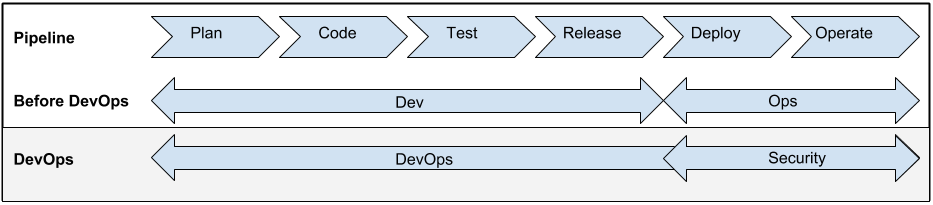
    The new DevOps process pipeline created an opening for a seat at the table for security. Prior to DevOps, the development team owned the entire pipeline from plan to release.  The Ops team would historically receive the release from over the wall and then be responsible for the deployment and operating the software inside the production environment.  With the Ops team joining forces with Development in the process pipeline, that has opened a proverbial seat at the table. What I’ve started to witness are security teams taking advantage of the musical chairs to quickly grab the open spot.

    DevOpsProcessPipeline


    Taking a seat at the end of the development pipeline is not enough.  Too many security teams are still being relegated to positions too late in the process.  While running pen tests and security code reviews after a release is better then nothing, its still not ideal.  Security needs to find ways to add value to the process so they can act as a force for positive change instead of the after thought.

    Threat Vector Analysis

    Threat vector analysis is part science and part art and part trying to guess uncertainty. What is certain, however, is that most developers would rather be spending their time writing new functionality instead of trying to understand how an attacker could be break their code. The security team could offer a tremendous service to an organization by offering their expertise in this area.

    Continuous Integration Security Testing

    Continuous integration is a key component of DevOps. The security team can leverage the development chain to insert early yet important risk control tests. Those tests could be for example static or dynamic code analysis. Other tests could be simple yet known vulnerability checks in included libraries. The OWASP introduction to testing guide lists a plethora of application security tests that should be checked often and early.

    Author Micro Security Services

    Think about how great it would be if there was a group who specialized in authoring and delivering security related services into your application?  Proponents of services models generally promote splitting the development team up into groups that are organized around business capabilities.  For example, there are separate development groups for UI, middleware and DB.  What’s missing in most of those models is who is responsible for security services such as authentication, authorization and audit. Security has an opportunity just waiting for them to add incredible value while also ensuring the security services used pass muster.

    Summary

    Where we once had Ops fighting their way to be part of the entire development process, we now have security trying to do the same. Ops managed to garner their way into the club by coming to the table with invaluable skills and resources. Now its up to security to present their creative sweet spot in order to secure their own seat at the table.

    Further Reading

    Andi Mann on Ensuring security and managing risk in enterprise DevOps

  • Q&A with Gene Kim: Bringing the auditors to DevOps

    Q&A with Gene Kim: Bringing the auditors to DevOps

    As more enterprises embrace DevOps, organizational disconnects often are created between what controls DevOps teams have in place and what IT controls auditors believe need to be in place. And if the right controls are, in fact, in place they absolutely need to be communicated to the auditing teams. Bridging these gaps is often painful for both IT teams and the auditors.

    Helping enterprises to better understand what auditors need from them to do their work is the top-line goal of the DevOps Audit Defense Toolkit, the aim of which is to “define the authoritative guidance of how management and auditors should conduct audits where DevOps practices are in place,” according to the homepage for the effort. “By doing this, the DevOps Audit Defense Toolkit will elevate the state of the management practice, defining how to understand risks to business objectives, correctly scope and substantiate the of effectiveness of controls, which reduces the costs of audits and increases effectiveness of audits.”

    The review draft of the DevOps Audit Defense Toolkit was release earlier this month for review and comment. The authors, James DeLuccia, Jeff Gallimore, Gene Kim, and Byron Miller, expect the final version to be available in coming months.

    To get a deeper understanding of the Toolkit, we grabbed a few minutes of time with Gene Kim, author of The Phoenix Project.

    Why do you think something like the DevOps Audit Defense Toolkit is necessary?
    I think at its heart DevOps is transformative. It’s the way to increase the flow of work through the DevOps value stream. DevOps increases reliability, stability, and security. And it also helps the organization win in the marketplace.

    Yet, when organizations actually embark upon this journey, probably the number one obstacle they encounter is that their “compliance guys will never let us do this.”

    I think there’s some truth to this. Because of so much that’s being proposed when you embark upon the DevOps journey, you actually take away some of the key controls that traditional IT organizations have used – like separation of duty, like change approval processes.

    So when they hear, “Hey, I’m going to be letting our developers deploys whenever they want, without necessarily getting a change approval order from the change advisory board,” auditors, compliance managers, and security people often freak out.

    And you have first-hand experience of seeing this in action, right?
    It’s why I think it’s a very important effort. The more I talk to people, the more I hear about the friction between the audit teams and audit groups in organizations trying to move this way.

    How do you see the DevOps Audit Defense Toolkit achieving this?

    The DevOps Audit Defense Toolkit was designed to train. Since we can’t bring DevOps to the auditors, we must bring auditors to DevOps. What I mean is the goal is to train practitioners in DevOps how to think like an auditor and actually walk through what an auditor will do when examining a process and systems. That’s starting from the very highest level of the top-down risk assessment into the details, just as an auditor would go through the list asking what can go wrong.

    The DevOps Audit Defense Toolkit shows how an enterprise has the environment that can prevent bad things from happening, and if we can’t prevent it, we can detect and correct for it. Then, it shows how we evidenced it. I think by doing all of that, one is doing exactly what the best auditors who examine DevOps organizations do themselves.

    By training people in in the DevOps organization to think like auditors, we can actually bring the auditors along, show our work, connect the dots, and hopefully have the auditor become DevOps’ best friend along the way.

    So, this is training IT how to think like an auditor and view the systems and processes the way that auditor would?

    In many ways, yes. This is kind of a structured thinking process that any world-class auditor would do to actually create an audit plan and then audit fieldwork.

    The toolkit asks questions like: Why is this being audited? Describe the environment Walk through the process of how code moves to production, and where the development environment comes from. It also asks: How do you prevent developers from introducing backdoor code into production; how do we ensure that untended code doesn’t make it into production?

    I’ve learned a lot just working with the other team members, in terms of showing how we have a basis to say that we know what we’re doing, and that we’re really thinking through how to have an effective control environment.

    That takes it from sort of the high-level platitudes and claims down to well, no, really, this is how we enforce peer reviews of code. We ensure that all deploys are put into the build systems. We run all the automated tests. Every time someone commits code, we run all the security tests before it can ever get into the staging environment. We can confirm that what’s deployed actually passed all the tests.

    We communicate most effectively when we write down and show our work. And we’re exposing all that is required for an auditor to be able to look at it and say, “You know what? This is actually better than my best auditors would’ve done in the field, and you know what you’re doing.”

    I would imagine that simply learning the language of auditors and how they speak is very valuable itself.

    Yes, we’re now using a language that auditors use among themselves. Even just exposing what that language looks like, I think, is helpful to connect our own dots to be able to say, “Oh, I know why it’s being phrased this way. Tons of value, just by providing that.

    Did you learn anything along the way as you created the DevOps Audit Defense Toolkit that surprised you?
    It’s funny how much I learned by working on this. You would think the person who co-wrote the Phoenix Project would know what this would look like? But I learned quite a bit when I was looking at what were the actual business flows, and where that regulated data could reside, and what specifically are the applications in-scope for the compliance domains.

    The second thing was going through the management risk analysis – to walk through the structured thinking process and look at how a company is really doing the diligence that is required, deciding what are its top business risks and if it really has a control environment that can prevent, detect, and correct.

    Of course, we all know that DevOps makes everything better, but we need to know why and how to prove it, By what standards are you holding developers accountable? You talk about peer reviewing, but where is that documented? What is the standard? How is it enforced?

    You want to be in compliance, and that’s important. But you also don’t want people to insert backdoors. You don’t want systems to crash when changes are deployed. So you really need to name all the dots, connect them, and then have that processed challenged. I have learned so much in this project.

  • SecDevOps: the new black of IT

    SecDevOps: the new black of IT

    Much has been written about the role of Security in a DevOps culture. Almost universally the thought is that DevOps can help improve security.

    Why?

    How?

    Really?

    An old friend of mine from the security world Andrew Storms and I will discuss this and other issues around DevOps and security on June 11th at 1pm eastern time, 10am pacific time on a webinar entitled “SecDevOps: the new black of IT“.

    Andrew is the Sr. Director of DevOps at CloudPassage. Prior to that Andrew headed up the security research team at nCircle. He is oft cited in the security press and highly respected.  Andrew and I ill discuss how just when DevOps is catching on, adding to security to the mix can make it even more powerful. How can security help DevOps to succeed? How can DevOps help us with better security?

    We will discuss what this means in terms of different kinds of security tools and services, the cloud and more.

    If you are interested in security and DevOps register now and  tune in to the webinar next Tuesday

  • Deputizing Everyone for Security – Building Agile Assurance

    Deputizing Everyone for Security – Building Agile Assurance

    Those of us highly focused on the delivery pipeline of DevOps will wonder why we should include the security guy to the party.  After all, aren’t they just going to slow down the process and make it harder to deliver good features to end customers?

    My prior post about introducing SecDevOps by example was not about defining a new role, but introducing how security can and should be part of the automation delivery suite.  Whether you are talking about traditional infrastructure change process or automated instantiation of new nodes to handle customer demand, the tools and processes of DevOps merged with security requirements are available to provide security accountability and assurance.  Those of you coming from the traditional security space, which might fear security automation, should consider just how exciting SecDevOps delivers on agile assurance.

    Rich Mogull provided an excellent example and code to show how firewall changes in a real life situation can be fully automated.  There is no need to be squirrely about what is emerging. Everyone needs to be involved with development and operations to take more opportunities to minimize risk.

    Dwaye Melancon also recently wrote about the issues of security and risk when the baton is handed off from one owner to another.  This too is another great example of where process and monitoring automation aids in delivering continuous security assurance.

    I believe everyone craves for a future when security events are automated with full transparency from beginning to end.  If security had a real closed-loop transparent agile process, then just imagine how easy it could be to deliver on both compliance and real risk reduction. As Richard Stiennon recently stated in a CloudPassage webcast “Compliance standards are woefully behind with the reality of operations”. Haven’t we all had an experience with an auditor and a clipboard asking for specifics that are clearly aligned with another age of computing?

    Wouldn’t it be better to give auditors the same tools, to get a picture of accountability and risk decisions made in the DevOps cloud environments?   Take for example the recent HeartBleed events that many security teams are still struggling with.  As a DevOps professional, I would have rather just showed the security team and the auditors the truth – that none of my team did anything at all to mitigate this risk.  Truth be told, our orchestration tools had already installed the new version of OpenSSL and generated audit logs before many people had their first cup of coffee.

    Security can be improved with more integrated automation and by deputizing everyone to do more with DevOps tools. A SecDevOps approach will improve the compliance and audit process with tactical security tools for all. Burn the clipboards and provide an enlightened way to prove best security practices from the collective group of Dev and Ops. Maybe give the Security guy a break and invite him to the after audit beer bash too.