Author: Mike Vizard

  • Eclipse Foundation Looks to Create Cloud-Based IDE Standards

    Eclipse Foundation Looks to Create Cloud-Based IDE Standards

    The Eclipse Foundation today announced the formation of a working group to create standards for cloud-based integrated development environments (IDEs) led by Broadcom, EclipseSource, Ericsson, IBM, Intel, Red Hat, SAP, Software AG and Typefox.

    Mike Milinkovich, executive director of the Eclipse Foundation, said the Eclipse Cloud Development Tools Working Group (ECD WG) will work to replicate the success the Eclipse Foundation had in establishing standards for desktop IDEs based on an Eclipse standard among a new generation of cloud-based IDEs.

    There already are several cloud-based IDEs available. However, because each of those IDEs is based on a codebase that differs from the codebase used to create the Eclipse desktop IDE, there is no interoperability across cloud-based IDEs. Milinkovich said that makes collaboration between developers using different cloud-based IDEs all but impossible as currently there is simply too much differentiation among providers of cloud-based IDEs.

    As standards for cloud-based IDEs emerge, the Eclipse Foundation also expects best DevOps practices revolving around the integration of cloud-based IDEs and continuous integration/continuous development tools to advance as well, Milinkovich added.

    Collectively, the ECD WG will drive adoption and standards for cloud-based developer tools, including language support, extensions and developer workspace definition. To achieve that goal, the ECG WD will pull together oversight of several existing open source projects being spearheaded by the Eclipse Foundation, including Eclipse Theia, an IDE framework for building TypeScript applications; Eclipse CodeWind, a project that adds support for containers to IDEs based on Eclipse; Eclipse Dirigible, a cloud-based development platform developed by SAP; Eclipse Sprotty, a diagramming framework; and Eclipse Orion, a browser-based integration platform.

    Milinkovich said via those efforts, the ECD WG hopes to accelerate the adoption of cloud integrated development environment (IDE) and container-based workspace management, including the recently launched Che 7 project that makes available a native instance of Eclipse to build Java applications for Kubernetes environments.

    It may be a while before the ECD WG can create a set of standards for cloud-based IDEs that will have a material impact on application development. The Eclipse Foundation still has to bring numerous application development powerhouses on board for this project, including Microsoft and, once the acquisition of Pivotal Software is completed, VMware. However, organizations that are shifting development to the cloud at the very least can take comfort in the fact that there is now some level of commitment to creating interoperability standards that one day could increase overall developer productivity as more applications are built in the cloud.

    In the meantime, it’s apparent the Eclipse Foundation is committed to remaining relevant in the age of the cloud by both fostering IDE interoperability and acting as the steward for Jakarta Enterprise Edition, the open source follow-on to Java. Of course, not every IDE may be employed to build applications using Java. But at the very least, many of the familiar interfaces and constructs developers know today on their desktops will be moving forward into the cloud.

    — Mike Vizard

  • Trend Micro Partners With Snyk to Advance DevSecOps

    Trend Micro Partners With Snyk to Advance DevSecOps

    Trend Micro today announced an alliance with Snyk through which alerts about vulnerabilities in open source code will be passed on to the tools Trend Micro makes available to apply virtual patches to both monolithic and microservices-based applications.

    Snyk provides a tool that identifies and fixes vulnerabilities and license violations in open source dependencies and container images. Trend Micro COO Kevin Simzer said his company leverages the alerts generated by Snyk to inform developers and cybersecurity professionals where virtual patches need to be applied.

    Virtual patches are a capability Trend Micro developed to enable IT organizations to address a vulnerability by applying a security policy that limits access to a specific piece of code until a developer can update a monolithic application or replace the containers housing vulnerable code within a set of microservices.

    By working more closely with Snyk, Trend Micro is trying to increase the appeal of its approach to virtual patching among DevSecOps teams, said Simzer. It’s not possible for most developers to address every vulnerability that manifests itself in a timely manner. Virtual patching allows DevSecOps teams to establish which vulnerabilities need to be addressed immediately while making use of virtual patches to protect applications from less severe vulnerabilities until they can be addressed during a DevOps cycle. To advance those capabilities, Simzer noted Trend Micro has already integrated its security offerings with continuous integration/continuous deployment (CI/CD) platforms such as Jenkins.

    Simzer said it will take a while for most cybersecurity professionals to trust developers to address cybersecurity issues during the application development process. However, virtual patches provide a mechanism through which both cultures can collaborate more closely without compromising the rate applications are being built and deployed. The primary reason developers tend not to pay as much attention to cybersecurity issues as everyone would like is because of the deadline pressure most of them are operating under. However, as responsibility for application cybersecurity continues to shift left, more developers are trying to address these issues earlier in the application development process.

    More than 16,000 enterprise IT organizations are already using Trend Micro security offerings to secure both monolithic applications and cloud-native applications based on containers, said Simzer, adding that footprint puts Trend Micro in a position to help organizations embrace best DevSecOps practices.

    Of course, Trend Micro is not the only cybersecurity vendor with similar ambitions. The challenge many organizations will face is defining what processes are best handled by developers invoking application programming interfaces (APIs) versus cybersecurity professionals who are more comfortable employing graphical user interfaces (GUI). There may come a day when more cybersecurity professionals are able to write code, but for now the two camps could not be further apart in terms of the tools they prefer to use. For IT security vendors such as Trend Micro, that means for the foreseeable future, they will continue to need to build GUIs alongside APIs.

    — Mike Vizard

  • Kong Employs Machine Learning to Extend Services Control

    Kong Employs Machine Learning to Extend Services Control

    At the Kong Summit 2019 conference, Kong today announced it has acquired Insomnia, an open source testing tool for application programming interfaces (APIs). In addition, it has added support for REST, Kafka Streams, gRPC, GraphQL and plugins written in Go to its service control platform.

    Kong also added more capabilities based on machine learning algorithms in the form of a visual service map a Kong Immunity module that detects anomalies across services spanning multiple platforms.

    Additionally, the company is delivering Kong Studio, a suite of tools to design, build and maintain APIs for REST and GraphQL endpoints based on the API testing and debugging tool Insomnia, which then can be published to Kong Gateway, proxy software for deploying and managing distributed APIs. The 2.0 release of Kong Gateway separates the data and control plane for the platform and provides the ability to write plugins in Go via Kong’s Plugin Development Kit.

    Kong CTO Marco Palladino said collectively, this approach makes it easier to address a raft of potential API issues at design time rather than after an API has been pushed into a production environment.

    Finally, Kong also updated Kuma, an open source control plane for a service mesh based on Envoy proxy software developed under the auspices of the Cloud Native Computing Foundation (CNCF).

    Kong has been making the case for a service control plane dubbed Kong Brain, which spans both cloud-native and legacy monolithic environments and makes extensive use of machine learning algorithms. Palladino said as more services proliferate across existing monolithic and cloud-native application environments, there is no way IT organizations will be able to keep pace without relying more on machine learning algorithms to manage events and processes occurring within milliseconds of one another across the much more complex IT environment.

    In fact, Palladino noted that rather than expecting one environment to supplant the other, IT organizations should expect to see services proliferate across both monolithic and cloud-native application environments. Managing all those different classes of services will require a service control platform capable of spanning multiple environments, he said.

    Over time, machine learning algorithms will enable service control platforms to become smarter as IT environments transition to managing services end to end versus continuing to focus on individual applications. Naturally, there’s a high correlation between organizations that have made that transition and those that have embraced DevOps to build, deploy and manage those services, said Palladino, noting the most successful organizations employ DevOps to deploy and update APIs as if they were a standalone application rather than a set of add-on capabilities that tend to be forgotten over time.

    It remains to be seen how the confluence of APIs and DevOps ultimately will change how IT is managed. The only thing that is for certain is the days when applications were managed in isolation are finally coming to a much-needed close.

    — Mike Vizard

  • DevOps Deeper Dive: DevOps Arms Race Heats Up

    DevOps Deeper Dive: DevOps Arms Race Heats Up

    A massive amount of capital is pouring into DevOps companies as organizations finally begin to realize the extent to which they depend on software. While Marc Andreesen may have penned his famous “Software Is Eating the World” opinion piece way back in 2011, it’s only now that many organizations are starting to realize they are software companies that also manufacture something or specialize in the delivery of some type of digital service.

    The most recent example of a massive injection of capital into the DevOps space came in the form of a $268 million investment in GitLab earlier this month. That move followed the acquisition of SignalFx, provider of an application performance management (APM) platform, by Splunk in a deal valued at just over $1 billion.

    Arguably, DevOps vendors have been gearing up for this fight for the better part of the last decade. Way back in 2014, New Relic picked up $115 million after going public. Three years later, Cisco Systems acquired AppDynamics for $3.7 billion.

    Now all these companies are racing to build the platform through which organizations of all sizes will transform themselves into true software companies by embracing best DevOps practices infused with large amounts of artificial intelligence (AI).

    DevOps as a concept has been around now for the better part of a decade. However, it’s only now that organizations are embracing DevOps across the entire application development life cycle. Previously, organizations embraced DevOps within isolated areas of the IT organization. Today, there is a much more concerted effort underway to apply DevOps practices to build and deploy software on an industrial scale.

    Achieving that goal, however, will require a lot more than simply adding higher levels of automation to a continuous integration/continuous deployment (CI/CD) platform. As business leaders realize how dependent the organization is on new applications to drive additional revenue, they are demanding more visibility into the software delivery process. Every delay to a software project now has revenue implications for the business.

    As more organizations come to that realization, it becomes apparent that monitoring software continuously as it is being built and after its deployed is now crucial to the business, said New Relic CEO Lew Cirne.

    “If mission-critical software not working, then the business is not working,” he said. “You must watch it all; you can’t pick and choose.”

    To become the de facto standard within an organization for monitoring those processes, DevOps vendors are racing to build DevOps platforms capable of operating at unprecedented levels of both scale and speed, said SignalFx CTO Arijit Mukherji.

    “The scale of the data has increased,” Mukherji noted. “Everything needs to happen in real-time.”

    DevOps platforms need to be extended to include support for everything from distributed tracing to machine learning algorithms, which organizations will rely on to identify the patterns employed to build AI models, he added.

    That level of investment requires a lot of additional capital that DevOps vendors either need to raise or, in the case of SignalFx and AppDynamics, tap into as a subsidiary of a larger company.

    The rise of microservices is further exacerbating those challenges as the number of dependencies within and between smaller segments of code increases. That fundamental shift in application architecture will require organizations to re-engineer DevOps processes across both the application and infrastructure levels of the entire IT environment, said Matt Cleve, director and global lead for Business iQ at AppDynamics.

    “Real-time visibility into the entire application stack is going to be a lot more important,” Cleve said.

    AppDynamics and parent company Cisco together will be in a unique position to deliver on that promise, he added.

    A recent survey conducted by the Harvard Business Review (HBR) on behalf of AppDynamics finds only 22% of IT organizations have access to any kind of real-time IT metrics.

    Widespread adoption of best DevOps practices has been a long time in coming. What is clear now, however, is that the organizations that take full advantage of DevOps by the end of this decade will thrive the most through the next.

    — Mike Vizard

  • Red Hat Unveils Ansible Platform

    Red Hat Unveils Ansible Platform

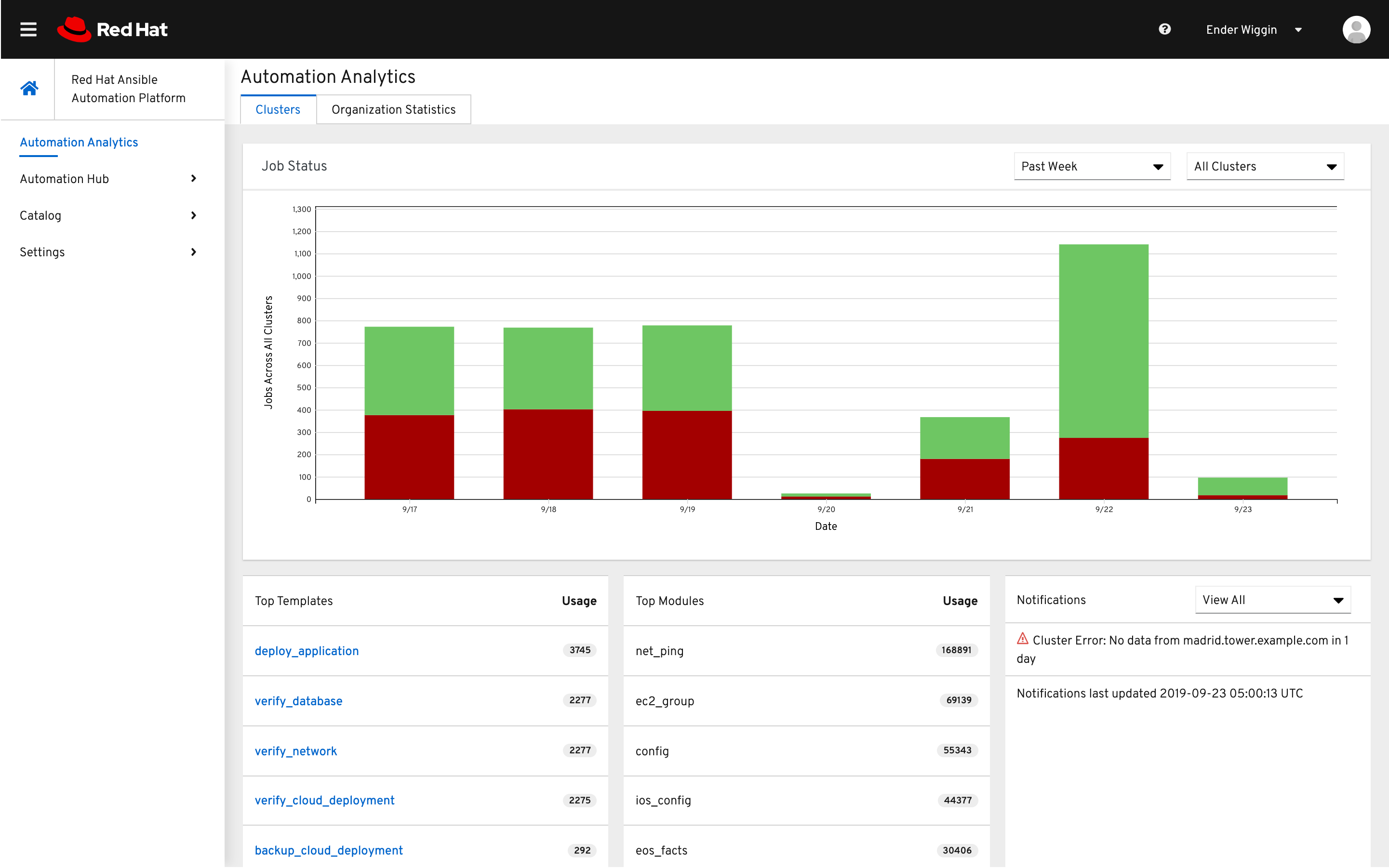
    At the AnsibleFest 2019 conference, Red Hat this week announced the general availability of the Red Hat Ansible Automation Platform that combines several IT automation technologies into a single subscription.

    Built on top of Red Hat Ansible Engine, the platform also includes Red Hat Ansible Tower, a management console, and Red Hat Network Automation, an instance of Ansible designed to automate the management of network resources.

    Red Hat is also providing access to a software-as-a-service (SaaS) analytics application that enables IT teams to monitor how deeply Ansible has been adopted within any IT environment. That application also provides access to Ansible Content Collections, a packaging format that streamlines the management, distribution and consumption of Ansible content, and Automation Hub, a repository for certified content packaged using Ansible Content Collections.

    Richard Henshall, product manager for Red Hat Ansible Automation, said with this offering Red Hat is trying to make it easier for enterprise IT organizations to implement Ansible at scale. Most of the time the Ansible framework is adopted from the bottom up within an IT organization. Red Hat Ansible Automation is intended to make it easier for enterprise IT organizations to centrally deploy and manage all their instances of Ansible, he said.

    Although it’s not possible to know how many instances of the open source IT automation framework have been installed, Henshall noted there are already more than 4 million Ansible nodes that are tied to a paid support subscription from Red Hat. Most of those instances involve organizations that have adopted a declarative IT automation framework as part of their overall DevOps strategy, he said. While IT organizations don’t necessarily have embrace DevOps to employ Ansible, Henshall said there is a strong correlation.

    Much of that success can be tied to the fact that as a declarative framework Ansible doesn’t require IT operations teams to learn how to program to manage IT operations at scale. That approach has allowed IT teams to adopt the open source framework to meet the demands for more agile approaches to managing IT infrastructure stemming from developers who have embraced best DevOps practices.

    In addition, IT infrastructure vendors such as Cisco Systems, NetApp and F5 Networks have begun to embed Ansible within their server, storage and networking platforms. As those vendors sell the latest edition of their offerings, the number of IT organizations exposed to Ansible should begin to substantially increase.

    Henshall said the biggest issue now is expanding the scope of Ansible deployments. Most organizations initially wind up using Ansible to automate disaster recovery before moving on automate additional existing processes. Red Hat is now trying to encourage those teams to create new processes that previously would not have been possible without an IT automation framework, he said.

    Ansible may not be a de facto standard in the enterprise just yet, but it’s well on its way. Of course, there are still many IT professionals for one reason or another still tend to resist relying on IT automation frameworks. There are also several rival IT automation frameworks that have been embraced by DevOps teams. But when it comes IT automation, it’s clear Ansible is starting to emerge as the path of least resistance.

    — Mike Vizard

  • DevSecOps Becomes a Higher Cloud-Native Priority

    DevSecOps Becomes a Higher Cloud-Native Priority

    At the Cloud Native Security Summit, Enterprise Strategy Group (ESG) today revealed the results of a survey of 600 senior IT leaders that finds organizations are looking at DevSecOps as a way to address the complexities of managing and securing cloud-native applications.

    According to the survey results, 43% of respondents said their biggest challenge with cloud-native applications is maintaining consistency across disparate infrastructures. As a result, the same number of respondents said DevSecOps automation as their highest cloud security priority.

    Commissioned by Capsule8, Obsidian and Signal Sciences, the survey also finds 90% of respondents are concerned about not having visibility into misconfigured cloud services, server workloads, network security or privileged accounts. Another 83% are worried about the misuse of privileged accounts by insiders.

    Two-thirds (66%) say IT is more complex than it was two years ago, with more than a third (35%) citing the need to manage multiple cybersecurity controls as a major source of that complexity.

    Doug Cahill, a senior analyst and group director at ESG, said it’s clear that as organizations embrace best DevOps practices to build and deploy cloud-native applications, those processes now are being extended to include security controls as part of the quality assurance process. Rather than bolting on security, Cahill said, more organizations are building cybersecurity controls into their software from the ground up.

    Capsule8 CEO John Viega noted much of that shift is being driven by necessity. When applications were deployed mainly in on-premises IT environments, it was easier to secure the environment by deploying appliances. Now organizations need to secure applications on infrastructure they don’t control as part of a shared responsibility model that often spans multiple cloud service providers. The cloud may be more agile and less expensive, but Viega noted it’s not uncommon for hundreds of cloud accounts to have been set up by individuals in the same organization, each with very different levels of cybersecurity expertise.

    Obsidian Security CTO Ben Johnson added the rate at which cloud-native applications are being deployed and updated is overwhelming the ability of cybersecurity teams to keep pace. In fact, many organizations are still underestimating the scope of the cloud-native cybersecurity challenge they face.

    Finally, Hala Al-Adwan, vice president of technology for Signal Sciences, observed as organizations embrace DevSecOps, cybersecurity professionals still will play a key role in terms of their consulting expertise. However, responsibility for implementing cybersecurity will continue to shift left toward DevOps teams. The challenge those teams will face is the need to replace legacy cybersecurity infrastructure designed for cybersecurity administrators with programmable tools that fit neatly within a continuous integration/continuous deployment environment, said Al-Adwan.

    It’s not clear precisely when a desire to embrace DevSecOps will result in more secure applications. In theory, cloud-native applications should be a lot more secure than legacy monolithic applications. However, the degree to which higher levels of security will motivate organizations to replace monolithic applications remains to be seen.

    In the meantime, cultural issues associated with embracing DevSecOps will abound. There are simply not enough cybersecurity professionals available to participate in every application development scrum session. The real issue now is finding a way to embed that knowledge into an application development process operating at industrial scale.

    — Mike Vizard

  • GitLab Outlines Scope of DevOps Ambitions

    GitLab Outlines Scope of DevOps Ambitions

    At the GitLab Commit event in New York today, GitLab launched an ambitious effort to extend the scope of its DevOps platform to provide a view into the software development life cycle for not just developers but also designers, product managers and business leaders.

    Fresh off raising an additional $268 million in funding, GitLab now plans to create different ways to view a common pool of metadata and metrics generated by the GitLab DevOps platform.

    It may be a while before GitLab can deliver on that promise, but the core concept builds on the dashboards the company already has built for IT operations and cybersecurity teams. Rather than requiring each team participating in the software development process to acquire a separate platform, GitLab should be viewed as a DevOps platform delivered as a single application that can now be applied to everyone, said Mark Pundsack, vice president of product strategy for GitLab, in speaking with conference attendees.

    As part of that commitment, Pundsack noted GitLab is expanding its DevSecOps capabilities to include auto remediation. The scanning capabilities built into GitLab will be extended not only to detect issues based on the cybersecurity policies of an organization, but also, when allowed, automatically remediate routine issues, Pundsack said, adding GitLab also will automatically roll back applications if necessary. Once in place, GitLab will have pushed application cybersecurity much further left than anyone might have expected when DevSecOps was first broached as a concept, he said.

    At the conference, GitLab demonstrated a pipeline graph capability that will provide a foundation for many of these promised offerings. GitLab already can be employed to accomplish tasks such as code quality scanning, container scanning, dependency scanning and licensing dependencies.

    All these features are an extension of GitLab’s existing strategy that aims to rationalize the number of tools organizations need to stitch together to drive a set of best DevOps processes. However, other DevOps platform providers have similar ambitions.

    Thanks to its latest round of funding, GitLab—which also announced its plans to go public next year—is now valued at $2.75 billion. The company has not released any revenue results but does claim to support more than 100,000 organizations using its platform, including Ask Media Group, Charter Communications, Delta Air Lines, Goldman Sachs, Ticketmaster and Nvidia. GitLab also claims to have more than 4,800 active contributors to its open core platform. The company now has more than 800 employees in more than 55 countries across the globe, and there currently are 222 open GitLab jobs posted.

    It remains to be seen how much $268 million will enable GitLab to fend off rivals such as GitHub, which was acquired by Microsoft, and CloudBees, which has built a large DevOps community around the open source Jenkins continuous integration/continuous deployment (CI/CD) platform. Whatever the outcome of this arms race, the massive amount of funding pouring into the platforms soon should take DevOps platforms to places many might not have ever imagined possible.

    — Mike Vizard

  • Eclipse Foundation Delivers on Jakarta EE Promise

    Eclipse Foundation Delivers on Jakarta EE Promise

    The Eclipse Foundation today announced the general availability of Jakarta Enterprise Edition (EE) 8 Full Platform and Web Profile specifications and associated technology compatibility kits (TCKs).

    Announced during the JakartaOne Livestream virtual conference, Jakarta EE 8 is the follow-on open source platform to JavaEE that provides a foundation for building cloud-native applications using a familiar Java construct.

    Mike Milinkovich, executive director of the Eclipse Foundation, said the availability of Jakarta EE 8 represents a milestone in that it is the first official release of a full Jakarta platform since Oracle agreed to give up control of Java EE to the Eclipse Foundation.

    Its specifications are fully compatible with Java EE 8 specifications and include the same application programming interfaces (APIs) and an instance of Javadoc using the same javax namespace. Its TCKs are based on, and fully compatible with, all Java EE 8 TCKs. Jakarta EE 8 will not require any changes to Java EE 8 applications or their use of javax APIs. The specifications were developed under the Jakarta EE Specification Process, which replaces the Java Community Process (JCP) for Java EE.

    The Eclipse Foundation is announcing the certification of Eclipse GlassFish 5.1, an open source compatible implementation of the Jakarta EE 8 Platform. Eclipse GlassFish 5.1 is fully tested under the open source-licensed Jakarta EE 8 TCKs for the Full Platform and Web Profiles.

    IBM today also announced that Open Liberty, an open source implementation of the WebSphere Liberty application server, has been fully certified as being compatible with Jakarta EE 8 profiles. All vendors in the Jakarta EE Working Group, including Fujitsu, IBM, Oracle, Payara, Red Hat and Tomitribe, have committed to certifying their Java EE 8-compatible implementations.

    Milinkovich said Jakarta EE 8 should drive a wave of innovation as more than 10 million developers who already know Java employ the platform to build cloud-native microservices that can be deployed using containers on Kubernetes platforms. In fact, he said, the number of cloud-native applications based on microservices that will be built and deployed in the enterprise will soon accelerate. As that transition occurs, the number of organizations embracing best DevOps processes to manage those applications also should significantly increase because the rate at which Jakarta applications will be built will be faster than Java applications historically have been built.

    Collectively, Milinkovic also noted that despite the rise of rival programming languages, these and other forthcoming efforts will drive a resurgence in interest in Java programming languages that will ensure Java’s continued dominance of enterprise IT environments for many years to come.

    Of course, the primary reason IT vendors are excited is they no longer need to pay royalties to Oracle. It’s not clear how much of those savings might be passed on to IT organizations. What is apparent is that organizations that are required to employ open source technologies whenever possible are going to be a lot happier now that Jakarta EE 8 has finally arrived.

    — Mike Vizard

  • Virtual Instruments Aims to Meld DevOps, ITSM Worlds

    Virtual Instruments Aims to Meld DevOps, ITSM Worlds

    Virtual Instruments today announced additions to an IT management platform that leverage machine learning algorithms to identify application drift and dynamically right-size virtual machines.

    Tim Van Ash, senior vice president of products for Virtual Instruments, said version 6.2 of the company’s VirtualWisdom platform is part of an ongoing campaign to meld the traditional world of IT service management with best DevOps practices using an AIOps platform. As part of that effort, Virtual Instruments last month acquired Metricly, a provider of tools for monitoring cloud costs in real-time.

    The latest update to that platform also adds tools to monitors, reports, forecasts and alarms against the capacity consumption rate of any application, while a capacity forecast alarm now allows IT teams to specify how many days, weeks or months they wish to be notified prior to potential capacity exhaustion occurring on any one node or cluster.

    Finally, Virtual Wisdom 6.2 provides access to updated VirtualWisdom Proactive Dashboards that provide access to Smart Charts, through which the AIOps platform now supports annotation, linking and smart naming in addition to topology views that are specific to a set of IT infrastructure or an application.

    Van Ash said the Virtual Instruments approach to AIOps is that it allows IT teams to respond to changing application conditions in real-time and set granular limits on how much capacity can be consumed by any particular application. For example, IT teams can ensure that specific applications are given a Platinum-level preference that prevents any other application from consuming resources allocated to that application, he said.

    In general, Van Ash said Virtual Instruments is pursuing an application-centric approach to AIOps that will make it easier for IT organizations to optimize IT infrastructure capacity dynamically. Rather being overly focused on utilization rates and tracking events, AIOps platforms need to be able to address the entire IT life cycle as it relates to the value that IT environment has to the business, he said, noting today many DevOps teams are building and deploying applications with little regard or actual control over the service levels those applications need to achieve and maintain. The goal, he said, is to provide a single platform through which DevOps and IT operational teams steeped in legacy IT service management (ITSM) models such as ServiceNow can collaboratively achieve a common set of goals.

    A day of reckoning is coming for proponents of DevOps and IT teams that have built sprawling IT environments employing ITIL-based processes. Those ITIL-based processes are not especially flexible, but they have been employed successfully to roll out applications at scale consistently. Advancements in AIOps should go a long way to bring the two schools of IT management together by making it easier to bend the available IT infrastructure resources to the will of multiple application developers trying to share a common pool of resources.

    In the meantime, no one should expect AI to solve their problems magically overnight. It takes a while for algorithms to solve all their IT headaches. However, the days when the relationship between developers and IT operations teams could be described as mostly contentious soon may be coming to a merciful end.

    — Mike Vizard

  • DORA Report: DevOps Maturity Levels Rise

    DORA Report: DevOps Maturity Levels Rise

    The annual DORA report on DevOps shows a marked increase among Elite performers compared to last year

    The DevOps Research and Assessment (DORA) arm of Google Cloud today published the results of an annual survey that suggests there have been marked gains in the level of DevOps maturity.

    The “2019 Accelerate State of DevOps Report,” an annual global survey of 31,000 IT professionals, finds 20% of the respondents now consider their organizations to be “Elite” DevOps performers, up from a comparatively paltry 7% a year ago.

    The Elite group reported their organizations routinely make multiple code deployments per day. By comparison, low performers reported deploying code somewhere between once per month and once per six months. The normalized annual deployment numbers range from 1,460 deploys per 365 days for the highest performers to seven deploys per year for low performers. Effectively, Elite performers deploy code 208 times more frequently than low performers, according to the DORA report.

    The report also finds Elite performers need less than a day of lead time to make a change to an application, compared to 2,555 hours for low performers, and Elite performers reported a change failure rate of 0% to 15%, compared to 46% to 60% for low performers. Finally, elite performers are able to recover from an incident 2,604 times faster than low performers.

    Nicole Forsgren, DORA Lead, Research and Strategy at Google Cloud, said the study makes it clear DevOps best practices are now crossing the proverbial chasm in IT. Organizations that are furthest along in making that transition tend to set up “communities of practice” within their organizations through which DevOps best practices are shared across teams, she noted. The DORA report also makes it clear elite performers automate and integrate tools more frequently into their toolchains on almost all dimensions.

    Forsgren said the study also makes it clear that the practice of slowing down the rate at which code is developed to achieve higher-quality application deployments is not nearly as effective as employing lighter-weight change processes to lower the amount of code getting deployed at any one time. Slowing down the rate at which code is developed and deployed is not a good strategy, she said, because as the amount of code that needs to get deployed at any time increases, reliance on heavyweight processes to deploy that code usually results in more errors being made. A lighter-weight approach provides the added benefit of reducing the amount of technical debt any organization is likely to incur at any stage of the DevOps process.

    The increased rate at which organizations are embracing best DevOps practices naturally coincides with the rise of more complex cloud-native applications. Most of those applications are being built using microservices that create a lot of dependencies within that application environment, with different development teams often working in isolation on specific microservices. The only way to manage that level of complexityeffectively is to embrace DevOps processes, noted Forsgren.

    In fact, the DORA report finds Elite performers are 24 times more likely to have met all cloud characteristics as defined by the National Institute for Standards and Technology (NIST) than low performers. Organizations that meet all essential cloud characteristics are 2.6 times more likely to be able to estimate the cost to operate software accurately. They also are twice as likely to be able to identify their most operationally expensive applications easily, and 1.65 times as likely to stay under their software operation budget, the study finds.

    Clearly, best DevOps practices is one of those rare IT gifts that simply keeps on giving.

    — Mike Vizard