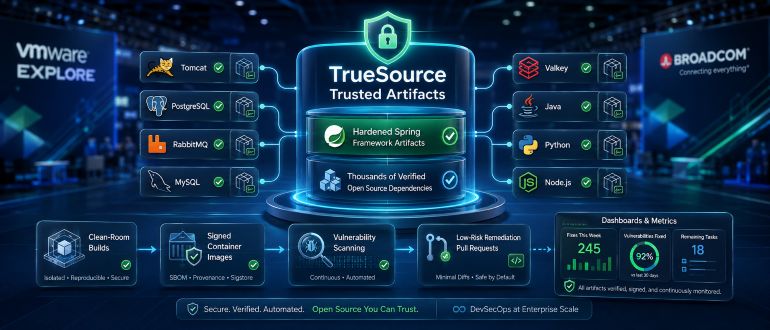
Broadcom launches TrueSource Trusted Artifacts to provide hardened Spring dependencies, secure open source packages and automated vulnerability remediation.
How Open Source Dependency and Repo Attacks Compromise DevOps Pipelines and How to Stay Safe

Modern applications rely on open source components for up to 90% of their code, creating a vast attack surface dominated by inhemalicious supply chain injections. High-profile incidents like Log4j and the sabotage of colors.js highlight that traditional scanning often fails to detect sophisticated “protestware” or dependency confusion, necessitating 19 practical controls focused on strict intake governance, dependency pinning, and behavioral monitoring to secure the development lifecycle.
The Risk Profile of AI-Driven Development

Analysis arguing that AI-driven code generation accelerates dependency decisions and expands supply-chain risk, requiring shift-left governance, prompt-level controls, automated SBOM/AIBOM visibility, threat-modeling as engineering, and autonomous security to match autonomous development.
Software Supply Chain Threats Are on the OWASP Top Ten—Yet Nothing Will Change Unless We Do

Software supply chain security is steadily moving to the forefront of cybersecurity conversations. In the past, it has been overshadowed by a focus on malware outbreaks, ransomware, endpoint protection, and […]
Codenotary’s Free SBOM Service Tackles the AI Software Supply Chain

Just because AI is writing your code doesn’t mean you can stop worrying about software bills of materials. While the quality of AI coding remains open to debate, there’s no […]
Surprise! Everybody Uses AI Tools for Software Development, Few Do So Securely
AI is generating code faster than teams can secure it, widening software supply chain risk and exposing major gaps in AppSec and governance.
What I’m Thankful for in DevOps This Year: Living Through Interesting Times

Alan reflects on a chaotic yet inspiring year in DevOps, highlighting the rise of AI in engineering, the maturation of DevSecOps, the evolution of hybrid work culture, the surge of platform engineering and IDPs, and the continued strength and inclusivity of the DevOps community — while acknowledging the talent crunch, tool sprawl and security theater that still challenge the industry.
What Fuels AI Code Risks and How DevSecOps Can Secure Pipelines

Modern development teams are under constant pressure to deliver fast, innovate continuously, and stay clear of security threats; all at the same time. Every new feature, every accelerated release, carries […]
Cybersecurity Laws Will Shape the Future of DevOps

From the EU’s NIS2 Directive to U.S. SEC breach disclosure rules, cybersecurity regulation is accelerating faster than code releases. DevOps teams must evolve into RegOps—embedding compliance, traceability, and trust directly into their CI/CD pipelines. The future of DevOps isn’t just agile—it’s accountable.
AppOmni Open Sources Heisenberg Tool to Scan Pull Requests for Dependencies
AppOmni has made available an open source tool that automatically scans pull requests (PRs) to flag risky or newly published dependencies before they are merged. Dubbed Heisenberg, the tool can […]
- 1
- 2
- 3
- …
- 6
- Next Page »